



Expandable Microspheres Market
Expandable Microspheres Market Size, Share, Insights, Competitive Landscape, and Forecast 2026 to 2033
Expandable Microspheres Market Size and Trend Analysis
What Is Driving Expandable Microspheres Market Growth?
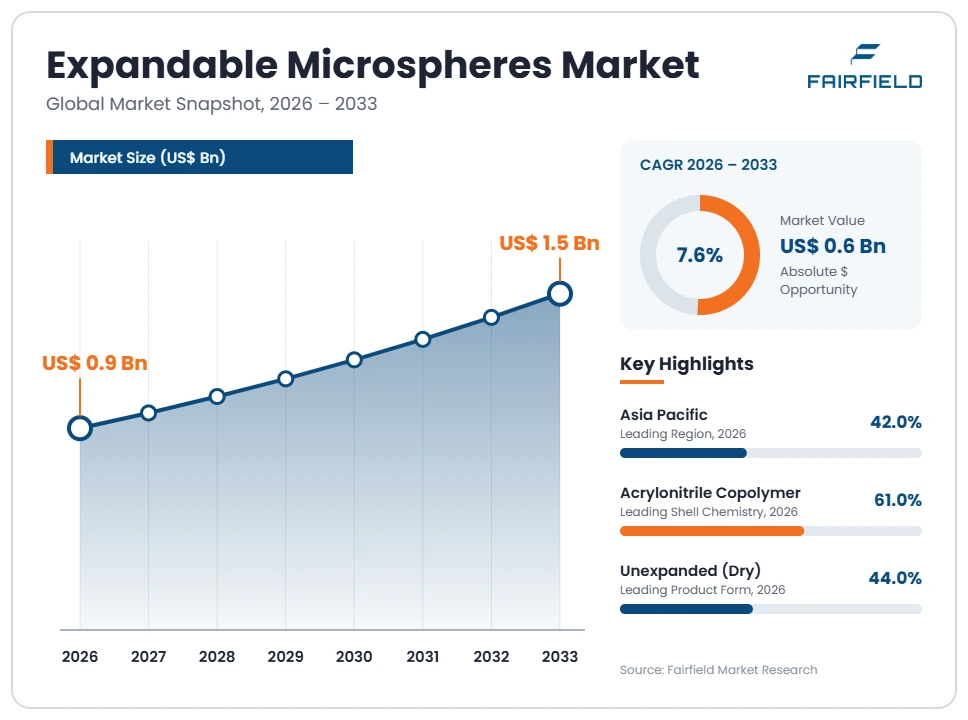
The global Expandable Microspheres market size is expected to be valued at US$ 0.9 billion in 2026 and projected to reach US$ 1.5 billion by 2033, growing at a CAGR of 7.6% between 2026 and 2033.
Stated precisely, the market is worth about US$ 912 million in 2026 and around US$ 1,521 million by 2033. This is a concentrated specialty niche, small in absolute terms but strategically important to the products it lightens. Between 2020 and 2025 volumes grew at roughly 6.3% a year, held back by soft footwear output and weak European coatings demand in the middle of that period. Three factors carry the forecast: weight reduction targets in automotive and footwear, substitution of chemical blowing agents in foamed compounds, and wider use of expanded grades in paper, board and printing inks. Direction of travel favours higher-temperature grades and lower residual monomer content.
Key Report Takeaways
- By Product Form: Unexpanded (Dry) grades held 44% share in 2026, while Masterbatch is projected to expand at an 8.9% CAGR through 2033, driven by compounders seeking dust-free handling and consistent dispersion in thermoplastics.
- By Shell Chemistry: Acrylonitrile Copolymer held 61% share in 2026, while Bio-based & Alternative Chemistries are projected to expand at an 11.4% CAGR through 2033, driven by occupational exposure scrutiny of residual monomer content.
- By Application: Footwear & Shoe Soles held 26% share in 2026, while Automotive Components & Underbody Coatings are projected to expand at a 9.3% CAGR through 2033, driven by sound-deadening and mass-reduction specifications on electric platforms.
- By End-Use Industry: Consumer Goods held 29% share in 2026, while Building & Construction is projected to expand at an 8.7% CAGR through 2033, driven by lightweight sealants, putties and crack-resistant filler formulations.
- By Geography: Asia Pacific held 42% share in 2026, while Latin America is projected to expand at an 8.9% CAGR through 2033, supported by the Brazilian footwear cluster and local adhesive formulation.
Global Expandable Microspheres Market Trends and Insights
Drivers Impact Analysis
Two demand mechanisms account for most incremental consumption of thermally expandable thermoplastic microspheres.
| Driver | Impact on CAGR Forecast | Geographic Relevance | Impact Timeline |
| Weight reduction mandates and targets in automotive bodies, underbody coatings and footwear soles | High | Asia Pacific, Europe, North America | Medium term (2–4 years) |
| Substitution of chemical blowing agents in foamed polymer and sealant compounds | Medium | Global | Short term (≤2 years) |
Vehicle and Footwear Lightweighting Pulls Expandable Microspheres Into Mass-Critical Parts
Weight reduction is the clearest commercial reason designers specify expandable microspheres. A small addition rate displaces dense filler or resin volume, cutting part mass by a meaningful percentage without new tooling. In underbody coatings and sealants the same expansion delivers sound damping and stone-chip resistance at lower applied weight, which is why automotive formulators treat the additive as a performance ingredient rather than a cost extender.
The causal mechanism is regulatory and architectural. Battery electric platforms carry heavy packs, so every kilogram removed from trim, sealant and coating layers extends range within a fixed energy budget. Footwear brands face a parallel pressure: midsole mass directly affects perceived comfort and shipping cost. Because microspheres expand during the existing cure or moulding step, converters capture the benefit without adding process stages. That compatibility with installed equipment is what turns a laboratory advantage into specified volume.
Chemical Blowing Agent Substitution Shifts Foaming Volume Toward Microsphere Technology
Formulators are replacing chemical blowing agents with expandable microspheres where decomposition by-products or odour are unacceptable. Chemical agents release gas through thermal decomposition and leave residues that can discolour parts, affect adhesion or produce off-gassing complaints. Microspheres expand as an encapsulated hydrocarbon softens the polymer shell, so the gas stays contained and the cell structure is closed and uniform.
The technical driver is process control. A microsphere grade has a defined start-expansion and maximum-expansion temperature, which lets converters tune density within a narrow window rather than chase a decomposition curve. That predictability matters in printing inks for puff effects, artificial leather, cable compounds and thin extruded profiles, where a few microns of variation is visible. Tightening indoor air quality and emissions specifications for automotive interiors and building products reinforce the shift, because encapsulated expansion generates no decomposition volatiles.
Restraints Impact Analysis
Two restraints limit both pricing power and addressable volume for microsphere producers.
| Restraint | Impact on CAGR Forecast | Geographic Relevance | Impact Timeline |
| Acrylonitrile classification and occupational exposure limits governing shell chemistry | High | Europe, North America | Medium term (2–4 years) |
| Substitution by glass bubbles, hollow glass microspheres and conventional blowing agents | Medium | Global | Long term (≥4 years) |
Acrylonitrile Exposure Controls Raise Compliance Costs Across Microsphere Production
Shell chemistry is the main regulatory pressure point on this product. Most commercial grades use an acrylonitrile copolymer shell, and acrylonitrile is classified as a carcinogen, so producers must control residual monomer in the finished powder and manage worker exposure throughout polymerisation and drying. Downstream converters inherit part of that obligation when they handle dry unexpanded powder at scale.
The specific cost sources are measurable. Registration and dossier maintenance under REACH carry recurring expense, closed-transfer handling systems and local exhaust ventilation require capital, and monomer stripping steps consume energy and extend cycle time. Directive (EU) 2022/431 introduced the first binding occupational exposure limit for acrylonitrile in the bloc, which forces exposure monitoring programmes and, in some plants, equipment retrofits. Smaller producers without existing regulatory infrastructure face the heaviest relative burden, which reinforces the market’s already high concentration.
Glass Bubbles and Conventional Foaming Routes Cap Expandable Microsphere Pricing
Substitution risk limits how much value producers can extract per kilogram. Hollow glass microspheres and glass bubbles deliver permanent density reduction with far higher compressive strength and temperature tolerance, so they win wherever the part sees high pressure or sustained heat. Chemical blowing agents remain cheaper per unit of gas generated and are entrenched in commodity foam applications where surface quality tolerances are loose.
The underlying cause is cost per unit of volume created. Expandable microspheres are priced well above commodity fillers, and the economic case depends on a low addition rate delivering a disproportionate density drop. When resin prices fall or part specifications relax, that arithmetic weakens quickly. Thermal limits add a second constraint: typical grades expand and then collapse above their maximum-expansion temperature, which excludes many high-temperature engineering thermoplastic processes and leaves those volumes to glass and mineral alternatives.
Market Opportunities
Bio-Based and Low-Monomer Shell Chemistries Open a Premium Grade Segment
Alternative shell chemistries represent the clearest new revenue pool in this niche. Grades built on bio-attributed or non-acrylonitrile monomers address the single biggest regulatory objection to the technology, and buyers in consumer-facing categories will pay a premium for a documented reduction in hazardous monomer content. Because the product is sold on performance specification rather than commodity price, a differentiated grade can defend margin instead of competing on cost per kilogram.
Established producers with polymerisation know-how are best placed to capture this, since shell design governs expansion temperature and strength simultaneously. Demand originates with footwear brands, automotive interior suppliers and paper converters who publish chemical restriction lists for their supply chains. Mass-balance certification schemes for bio-attributed feedstock give those customers an auditable claim, which is what converts a technical improvement into a procurement decision.
Paper, Board and Food-Contact Packaging Create a New Volume Outlet for Expanded Grades
Lightweight paper and board is an underexploited volume pool for expanded microspheres. Adding expanded grades to coatings and plies raises bulk and stiffness at lower basis weight, letting mills cut fibre use while meeting the same caliper and rigidity specification. Fibre is the dominant cost in board production, so even a modest grammage reduction translates into a strong payback for the mill.
Paper producers, coating formulators and packaging converters are the buyers, and the pull comes from brand owners facing packaging reduction targets. The European Union Packaging and Packaging Waste Regulation pushes minimisation of packaging weight and volume, which gives mills a compliance reason to adopt bulking technology. Food-contact compliance under Regulation (EC) No 1935/2004 is the gating requirement, so suppliers able to supply documented food-contact grades can address converting lines that competitors cannot serve.
Segment Analysis
- By Product Form: Unexpanded Dry Grades Lead While Masterbatch Gains Momentum
Unexpanded (Dry) microspheres hold 44% share in 2026, the largest product-form position, because most converters want expansion to happen inside their own process where it generates foaming, texture or volume in the finished part. Shipping unexpanded powder is also far more efficient, since a fully expanded sphere occupies many times the volume of its unexpanded form. Wet Slurry grades serve waterborne coatings and paper coating lines that cannot tolerate dust. Masterbatch is the fastest-growing form at an 8.9% CAGR through 2033, as thermoplastic compounders adopt pre-dispersed pellets to avoid powder handling, eliminate exposure controls on the shop floor and achieve consistent dispersion in cable and profile extrusion. Expanded (Dry) grades remain a smaller category used where the customer wants immediate bulk. The implication is that value is migrating toward delivery formats that solve handling problems rather than toward the raw chemistry alone.
- By Shell Chemistry: Acrylonitrile Copolymer Dominates as Bio-Based Alternatives Accelerate
Acrylonitrile Copolymer shells account for 61% of consumption in 2026, the leading chemistry, because the copolymer combines gas barrier performance with the softening behaviour needed for controlled expansion. Methacrylonitrile and Vinylidene Chloride copolymer blends serve grades tuned to lower or higher expansion temperatures. Bio-based & Alternative Chemistries form the fastest-growing group at an 11.4% CAGR through 2033, from a small base, as producers respond to the carcinogen classification of acrylonitrile and to customer restricted-substance lists. Occupational exposure rules in Europe are the practical trigger, since they make monomer management a plant-level cost rather than a labelling question. Development work focuses on maintaining expansion ratio and shell strength without the incumbent monomer. For buyers, the business implication is that chemistry choice is becoming a supply-security question as much as a performance one.
- By Application: Footwear and Shoe Soles Lead While Automotive Coatings Expand Quickest
Footwear & Shoe Soles form the largest application at 26% share in 2026, reflecting the scale of global athletic and casual footwear production and the direct link between midsole density and perceived comfort. Paper & Board and Sealants, Adhesives & Putties follow as substantial volume outlets. Automotive Components & Underbody Coatings is the fastest-growing application at a 9.3% CAGR through 2033, because electric vehicle platforms need sound deadening and mass reduction simultaneously, and microsphere-filled sealers deliver both in one applied layer. Printing Inks use the technology for puff and tactile effects, while Artificial Leather and Cable & Thermoplastic Compounds rely on it for softness and density control. Supply-chain concentration of footwear manufacturing shapes regional demand strongly. The commercial conclusion is that automotive specification work, though slow, produces the most durable volume once a grade is approved.
- By End-Use Industry: Consumer Goods Hold Scale While Building and Construction Grows Fastest
Consumer Goods lead end-use demand with 29% share in 2026, driven mainly by footwear, sporting goods and household products where lightweighting and tactile feel are selling points. Automotive & Transportation and Paper & Packaging follow, each supported by distinct technical requirements. Building & Construction is the fastest-growing end-use industry at an 8.7% CAGR through 2033, as formulators build microspheres into lightweight sealants, joint putties, crack-resistant fillers and low-density coatings that reduce applied weight and improve sandability. Printing & Publishing remains a smaller but stable outlet for puff ink effects. Construction demand is less exposed to the consumer cycle than footwear, which gives producers useful diversification. The practical implication is that producers with construction-chemical distribution reach can smooth the volatility that footwear and automotive capital cycles impose on this niche.
Geography Analysis
Regional demand follows manufacturing location rather than consumption of the finished goods, so production clusters determine where microsphere volume is sold.
- North America: Automotive Sealers and Specialty Coatings Anchor Regional Consumption
North America holds 21% share in 2026, the third-largest regional position, with the United States accounting for the bulk and Mexico contributing through vehicle assembly and component supply. Demand concentrates in automotive underbody coatings, body sealers, architectural and industrial coatings, and oilfield cement additives where low density is valuable. The region has a strong specialty formulation base, so technical service and grade customisation matter more than price. Occupational safety rules on acrylonitrile handling shape plant practice at converter level. Footwear consumption is high but manufacturing is largely offshore, so that demand is booked in exporting countries rather than here. The main regional change is the build-out of electric vehicle assembly, which brings fresh sealer and acoustic specifications into play and creates openings for grades qualified on new platforms.
- Europe: Regulatory Pressure on Shell Chemistry Shapes Grade Development
Europe accounts for 27% of global value in 2026 and exerts influence well beyond its volume share because it sets the regulatory agenda for this chemistry. Germany, Sweden, France and Italy host the key production and formulation activity, and the region has long-standing technical depth in microsphere manufacture. REACH registration obligations and the binding occupational exposure limit for acrylonitrile introduced by Directive (EU) 2022/431 push producers toward lower residual monomer and alternative shell designs. Demand comes from automotive coatings, construction chemicals, paper and board, and printing inks. Packaging minimisation rules add a further pull for bulking technology in board. Growth here is value-led: customers pay for documented compliance, food-contact clearance and consistent expansion performance rather than for the lowest price per kilogram.
- Which Region Is Leading the Expandable Microspheres Market?
Asia Pacific leads the market with 42% share in 2026, because the region hosts the manufacturing base that physically consumes these additives. China, Japan, Vietnam, Indonesia, South Korea and India are the principal demand centres. Footwear assembly is the single largest pull, with Vietnamese and Indonesian sole production drawing substantial volume, while China adds artificial leather, cable compounds, thermoplastic parts and paper coating demand. Japan is the technology anchor, home to established producers with deep polymerisation expertise and the grades used in high-specification applications. Local supply has broadened as domestic Chinese producers scaled up, which has compressed prices in commodity grades while leaving high-temperature and food-contact grades to incumbents. The regional opportunity sits in automotive electrification, where domestic vehicle makers are specifying lightweight sealers at volume.
- Which Region Is Growing Fastest in the Expandable Microspheres Market?
Latin America is the fastest-growing geography at an 8.9% CAGR between 2026 and 2033, albeit from 6% share in 2026. Brazil drives most of that growth through one of the world’s larger footwear manufacturing clusters, supported by Mexico in automotive sealers and coatings and Argentina in adhesives and putties. Local formulators are substituting microspheres for mineral filler to cut sole density and shipping weight on export orders. The barriers are genuine: almost all material is imported, so currency movement and freight cost swing landed prices sharply, and technical service presence is thin outside major industrial centres. Customs classification and chemical registration procedures also slow new grade introductions. The opportunity lies in regional distribution partnerships that hold local inventory and provide application trials close to the converter.
- Middle East & Africa: Construction Chemicals and Oilfield Additives Define a Small Base
Middle East & Africa represents 4% of global value in 2026, the smallest regional position. Saudi Arabia, the United Arab Emirates, Turkey and South Africa account for most identifiable consumption. Demand concentrates in construction chemicals, lightweight cementitious and sealant formulations, and low-density additives used in oilfield service applications. Turkey adds a meaningful footwear and artificial leather manufacturing base that consumes expandable grades directly. The constraints are structural: there is no significant local production, technical service is handled from Europe or Asia Pacific, and import logistics add cost and lead time to a material already priced at a premium. Large-scale construction programmes in the Gulf states are the main upside, since lightweight sealants and renders are specified more often on high-rise and prefabricated work.
Competitive Landscape
The expandable microspheres market is highly concentrated. A small number of established producers account for most global capacity, because the technology requires suspension polymerisation know-how, encapsulation control and careful handling of volatile hydrocarbons inside a monomer-sensitive process. Nouryon, Matsumoto Yushi-Seiyaku Co., Ltd., Kureha Corporation and Sekisui Chemical Co., Ltd. hold the strongest technical positions, with Chase Corporation and a group of Chinese producers supplying additional capacity. Entry barriers are intellectual rather than purely financial: shell composition and blowing agent selection determine expansion temperature, expansion ratio and shelf life, and that knowledge is hard to reverse-engineer.
Competition runs on grade portfolio breadth, expansion temperature range, residual monomer content, batch consistency and application support. Customers qualify a grade into a formulation and then stay with it, so switching is slow and technical service during qualification is decisive. Food-contact documentation, restricted substance compliance and supply continuity are increasingly weighted alongside performance. New entrants come mainly from China, competing first on price in commodity footwear and sealant grades before attempting higher-temperature products.
Strategic activity in the sector follows consistent patterns rather than one-off events. Producers extend grade families into higher expansion temperatures, add masterbatch and slurry formats to remove powder handling from the customer’s plant, and build regional compounding or distribution points close to footwear and automotive clusters. Each of these moves protects margin by making the supplier harder to displace once qualified.
Strategic direction centres on lowering residual monomer, developing alternative shell chemistries, and converting the product from a powder sale into a delivered-format solution. Producers that combine regulatory documentation with local technical service are best positioned as scrutiny of acrylonitrile intensifies.
Recent Industry Developments
- October 2004: Regulation (EC) No 1935/2004 on materials and articles intended to come into contact with food was adopted in the European Union – it set the framework compliance requirement that gates microsphere use in paper, board and packaging coatings.
- June 2007: REACH, Regulation (EC) No 1907/2006, entered into force – registration and dossier obligations became a recurring fixed cost that favours established producers over small entrants in this niche.
- March 2022: Directive (EU) 2022/431 amending the Carcinogens and Mutagens Directive was adopted, introducing the first binding occupational exposure limit for acrylonitrile in the European Union – it made residual monomer and plant exposure control a direct cost item for shell producers and converters.
- January 2025: Regulation (EU) 2025/40 on packaging and packaging waste was published – its minimisation requirements strengthen the commercial case for bulking additives that cut board grammage without losing stiffness.
Companies Covered in the Report
- Nouryon
- Matsumoto Yushi-Seiyaku Co., Ltd.
- Kureha Corporation
- Sekisui Chemical Co., Ltd.
- Chase Corporation
- Dongjin Semichem Co., Ltd.
- Lehmann&Voss&Co. KG
- Henan Yuanyang Powder Technology Co., Ltd.
- Zhejiang Rui’an Xinli Plastic Chemical Co., Ltd.
- Nanjing Baokai New Material Technology Co., Ltd.
Expandable Microspheres Market Report Scope
| Metric | Value |
| Study Period | 2020–2033 |
| Market Size 2026 | US$ 0.9 Billion |
| Market Size 2033 | US$ 1.5 Billion |
| CAGR 2026–2033 | 7.6% |
| Absolute Dollar Opportunity | US$ 0.6 Billion |
| Largest Market | Asia Pacific (42% share in 2026) |
| Fastest-Growing Market | Latin America (8.9% CAGR) |
| Market Concentration | High |
| Major Players | Nouryon, Matsumoto Yushi-Seiyaku Co., Ltd., Kureha Corporation, Sekisui Chemical Co., Ltd., Chase Corporation |
Expandable Microspheres Market Segmentation
Product Form
- Unexpanded (Dry)
- Expanded (Dry)
- Wet Slurry
- Masterbatch
Shell Chemistry
- Acrylonitrile Copolymer
- Methacrylonitrile Copolymer
- Vinylidene Chloride Copolymer
- Bio-based & Alternative Chemistries
Application
- Footwear & Shoe Soles
- Automotive Components & Underbody Coatings
- Paper & Board
- Printing Inks
- Sealants, Adhesives & Putties
- Artificial Leather
- Cable & Thermoplastic Compounds
End-Use Industry
- Consumer Goods
- Automotive & Transportation
- Paper & Packaging
- Building & Construction
- Printing & Publishing
Regions
- North America
- Europe
- Asia Pacific
- Latin America
- Middle East & Africa
- Executive Summary
- Global Expandable Microspheres Market Snapshot
- Future Projections
- Key Report Takeaways
- Regional Snapshot
- Market Overview
- Market Definition and Report Scope
- Historical Trends 2020–2025
- Market Dynamics
- Drivers
- Vehicle and Footwear Lightweighting Pulls Expandable Microspheres Into Mass-Critical Parts
- Chemical Blowing Agent Substitution Shifts Foaming Volume Toward Microsphere Technology
- Restraints
- Acrylonitrile Exposure Controls Raise Compliance Costs Across Microsphere Production
- Glass Bubbles and Conventional Foaming Routes Cap Expandable Microsphere Pricing
- Market Opportunities
- Bio-Based and Low-Monomer Shell Chemistries Open a Premium Grade Segment
- Paper, Board and Food-Contact Packaging Create a New Volume Outlet for Expanded Grades
- Drivers
- Global Expandable Microspheres Market Outlook, 2020–2033
- Global Expandable Microspheres Market Outlook, by Product Form, Value (US$ Billion), 2020–2033
- Unexpanded (Dry)
- Expanded (Dry)
- Wet Slurry
- Masterbatch
- Global Expandable Microspheres Market Outlook, by Shell Chemistry, Value (US$ Billion), 2020–2033
- Acrylonitrile Copolymer
- Methacrylonitrile Copolymer
- Vinylidene Chloride Copolymer
- Bio-based & Alternative Chemistries
- Global Expandable Microspheres Market Outlook, by Application, Value (US$ Billion), 2020–2033
- Footwear & Shoe Soles
- Automotive Components & Underbody Coatings
- Paper & Board
- Printing Inks
- Sealants, Adhesives & Putties
- Artificial Leather
- Cable & Thermoplastic Compounds
- Global Expandable Microspheres Market Outlook, by End-Use Industry, Value (US$ Billion), 2020–2033
- Consumer Goods
- Automotive & Transportation
- Paper & Packaging
- Building & Construction
- Printing & Publishing
- Global Expandable Microspheres Market Outlook, by Region, Value (US$ Billion), 2020–2033
- North America
- Europe
- Asia Pacific
- Latin America
- Middle East & Africa
- Global Expandable Microspheres Market Outlook, by Product Form, Value (US$ Billion), 2020–2033
- North America Expandable Microspheres Market Outlook, 2020–2033
- North America Expandable Microspheres Market Outlook, by Product Form, Value (US$ Billion), 2020–2033
- Unexpanded (Dry)
- Expanded (Dry)
- Wet Slurry
- Masterbatch
- North America Expandable Microspheres Market Outlook, by Shell Chemistry, Value (US$ Billion), 2020–2033
- Acrylonitrile Copolymer
- Methacrylonitrile Copolymer
- Vinylidene Chloride Copolymer
- Bio-based & Alternative Chemistries
- North America Expandable Microspheres Market Outlook, by Application, Value (US$ Billion), 2020–2033
- Footwear & Shoe Soles
- Automotive Components & Underbody Coatings
- Paper & Board
- Printing Inks
- Sealants, Adhesives & Putties
- Artificial Leather
- Cable & Thermoplastic Compounds
- North America Expandable Microspheres Market Outlook, by End-Use Industry, Value (US$ Billion), 2020–2033
- Consumer Goods
- Automotive & Transportation
- Paper & Packaging
- Building & Construction
- Printing & Publishing
- North America Expandable Microspheres Market Outlook, by Country, Value (US$ Billion), 2020–2033
- United States Expandable Microspheres Market Outlook, by Product Form, 2020–2033
- United States Expandable Microspheres Market Outlook, by Shell Chemistry, 2020–2033
- United States Expandable Microspheres Market Outlook, by Application, 2020–2033
- United States Expandable Microspheres Market Outlook, by End-Use Industry, 2020–2033
- Mexico Expandable Microspheres Market Outlook, by Product Form, 2020–2033
- Mexico Expandable Microspheres Market Outlook, by Shell Chemistry, 2020–2033
- Mexico Expandable Microspheres Market Outlook, by Application, 2020–2033
- Mexico Expandable Microspheres Market Outlook, by End-Use Industry, 2020–2033
- North America Expandable Microspheres Market Outlook, by Product Form, Value (US$ Billion), 2020–2033
- Europe Expandable Microspheres Market Outlook, 2020–2033
- Europe Expandable Microspheres Market Outlook, by Product Form, Value (US$ Billion), 2020–2033
- Unexpanded (Dry)
- Expanded (Dry)
- Wet Slurry
- Masterbatch
- Europe Expandable Microspheres Market Outlook, by Shell Chemistry, Value (US$ Billion), 2020–2033
- Acrylonitrile Copolymer
- Methacrylonitrile Copolymer
- Vinylidene Chloride Copolymer
- Bio-based & Alternative Chemistries
- Europe Expandable Microspheres Market Outlook, by Application, Value (US$ Billion), 2020–2033
- Footwear & Shoe Soles
- Automotive Components & Underbody Coatings
- Paper & Board
- Printing Inks
- Sealants, Adhesives & Putties
- Artificial Leather
- Cable & Thermoplastic Compounds
- Europe Expandable Microspheres Market Outlook, by End-Use Industry, Value (US$ Billion), 2020–2033
- Consumer Goods
- Automotive & Transportation
- Paper & Packaging
- Building & Construction
- Printing & Publishing
- Europe Expandable Microspheres Market Outlook, by Country, Value (US$ Billion), 2020–2033
- Germany Expandable Microspheres Market Outlook, by Product Form, 2020–2033
- Germany Expandable Microspheres Market Outlook, by Shell Chemistry, 2020–2033
- Germany Expandable Microspheres Market Outlook, by Application, 2020–2033
- Germany Expandable Microspheres Market Outlook, by End-Use Industry, 2020–2033
- Sweden Expandable Microspheres Market Outlook, by Product Form, 2020–2033
- Sweden Expandable Microspheres Market Outlook, by Shell Chemistry, 2020–2033
- Sweden Expandable Microspheres Market Outlook, by Application, 2020–2033
- Sweden Expandable Microspheres Market Outlook, by End-Use Industry, 2020–2033
- France Expandable Microspheres Market Outlook, by Product Form, 2020–2033
- France Expandable Microspheres Market Outlook, by Shell Chemistry, 2020–2033
- France Expandable Microspheres Market Outlook, by Application, 2020–2033
- France Expandable Microspheres Market Outlook, by End-Use Industry, 2020–2033
- Italy Expandable Microspheres Market Outlook, by Product Form, 2020–2033
- Italy Expandable Microspheres Market Outlook, by Shell Chemistry, 2020–2033
- Italy Expandable Microspheres Market Outlook, by Application, 2020–2033
- Italy Expandable Microspheres Market Outlook, by End-Use Industry, 2020–2033
- Europe Expandable Microspheres Market Outlook, by Product Form, Value (US$ Billion), 2020–2033
- Asia Pacific Expandable Microspheres Market Outlook, 2020–2033
- Asia Pacific Expandable Microspheres Market Outlook, by Product Form, Value (US$ Billion), 2020–2033
- Unexpanded (Dry)
- Expanded (Dry)
- Wet Slurry
- Masterbatch
- Asia Pacific Expandable Microspheres Market Outlook, by Shell Chemistry, Value (US$ Billion), 2020–2033
- Acrylonitrile Copolymer
- Methacrylonitrile Copolymer
- Vinylidene Chloride Copolymer
- Bio-based & Alternative Chemistries
- Asia Pacific Expandable Microspheres Market Outlook, by Application, Value (US$ Billion), 2020–2033
- Footwear & Shoe Soles
- Automotive Components & Underbody Coatings
- Paper & Board
- Printing Inks
- Sealants, Adhesives & Putties
- Artificial Leather
- Cable & Thermoplastic Compounds
- Asia Pacific Expandable Microspheres Market Outlook, by End-Use Industry, Value (US$ Billion), 2020–2033
- Consumer Goods
- Automotive & Transportation
- Paper & Packaging
- Building & Construction
- Printing & Publishing
- Asia Pacific Expandable Microspheres Market Outlook, by Country, Value (US$ Billion), 2020–2033
- China Expandable Microspheres Market Outlook, by Product Form, 2020–2033
- China Expandable Microspheres Market Outlook, by Shell Chemistry, 2020–2033
- China Expandable Microspheres Market Outlook, by Application, 2020–2033
- China Expandable Microspheres Market Outlook, by End-Use Industry, 2020–2033
- Japan Expandable Microspheres Market Outlook, by Product Form, 2020–2033
- Japan Expandable Microspheres Market Outlook, by Shell Chemistry, 2020–2033
- Japan Expandable Microspheres Market Outlook, by Application, 2020–2033
- Japan Expandable Microspheres Market Outlook, by End-Use Industry, 2020–2033
- Vietnam Expandable Microspheres Market Outlook, by Product Form, 2020–2033
- Vietnam Expandable Microspheres Market Outlook, by Shell Chemistry, 2020–2033
- Vietnam Expandable Microspheres Market Outlook, by Application, 2020–2033
- Vietnam Expandable Microspheres Market Outlook, by End-Use Industry, 2020–2033
- Indonesia Expandable Microspheres Market Outlook, by Product Form, 2020–2033
- Indonesia Expandable Microspheres Market Outlook, by Shell Chemistry, 2020–2033
- Indonesia Expandable Microspheres Market Outlook, by Application, 2020–2033
- Indonesia Expandable Microspheres Market Outlook, by End-Use Industry, 2020–2033
- South Korea Expandable Microspheres Market Outlook, by Product Form, 2020–2033
- South Korea Expandable Microspheres Market Outlook, by Shell Chemistry, 2020–2033
- South Korea Expandable Microspheres Market Outlook, by Application, 2020–2033
- South Korea Expandable Microspheres Market Outlook, by End-Use Industry, 2020–2033
- India Expandable Microspheres Market Outlook, by Product Form, 2020–2033
- India Expandable Microspheres Market Outlook, by Shell Chemistry, 2020–2033
- India Expandable Microspheres Market Outlook, by Application, 2020–2033
- India Expandable Microspheres Market Outlook, by End-Use Industry, 2020–2033
- Asia Pacific Expandable Microspheres Market Outlook, by Product Form, Value (US$ Billion), 2020–2033
- Latin America Expandable Microspheres Market Outlook, 2020–2033
- Latin America Expandable Microspheres Market Outlook, by Product Form, Value (US$ Billion), 2020–2033
- Unexpanded (Dry)
- Expanded (Dry)
- Wet Slurry
- Masterbatch
- Latin America Expandable Microspheres Market Outlook, by Shell Chemistry, Value (US$ Billion), 2020–2033
- Acrylonitrile Copolymer
- Methacrylonitrile Copolymer
- Vinylidene Chloride Copolymer
- Bio-based & Alternative Chemistries
- Latin America Expandable Microspheres Market Outlook, by Application, Value (US$ Billion), 2020–2033
- Footwear & Shoe Soles
- Automotive Components & Underbody Coatings
- Paper & Board
- Printing Inks
- Sealants, Adhesives & Putties
- Artificial Leather
- Cable & Thermoplastic Compounds
- Latin America Expandable Microspheres Market Outlook, by End-Use Industry, Value (US$ Billion), 2020–2033
- Consumer Goods
- Automotive & Transportation
- Paper & Packaging
- Building & Construction
- Printing & Publishing
- Latin America Expandable Microspheres Market Outlook, by Country, Value (US$ Billion), 2020–2033
- Brazil Expandable Microspheres Market Outlook, by Product Form, 2020–2033
- Brazil Expandable Microspheres Market Outlook, by Shell Chemistry, 2020–2033
- Brazil Expandable Microspheres Market Outlook, by Application, 2020–2033
- Brazil Expandable Microspheres Market Outlook, by End-Use Industry, 2020–2033
- Mexico Expandable Microspheres Market Outlook, by Product Form, 2020–2033
- Mexico Expandable Microspheres Market Outlook, by Shell Chemistry, 2020–2033
- Mexico Expandable Microspheres Market Outlook, by Application, 2020–2033
- Mexico Expandable Microspheres Market Outlook, by End-Use Industry, 2020–2033
- Argentina Expandable Microspheres Market Outlook, by Product Form, 2020–2033
- Argentina Expandable Microspheres Market Outlook, by Shell Chemistry, 2020–2033
- Argentina Expandable Microspheres Market Outlook, by Application, 2020–2033
- Argentina Expandable Microspheres Market Outlook, by End-Use Industry, 2020–2033
- Latin America Expandable Microspheres Market Outlook, by Product Form, Value (US$ Billion), 2020–2033
- Middle East & Africa Expandable Microspheres Market Outlook, 2020–2033
- Middle East & Africa Expandable Microspheres Market Outlook, by Product Form, Value (US$ Billion), 2020–2033
- Unexpanded (Dry)
- Expanded (Dry)
- Wet Slurry
- Masterbatch
- Middle East & Africa Expandable Microspheres Market Outlook, by Shell Chemistry, Value (US$ Billion), 2020–2033
- Acrylonitrile Copolymer
- Methacrylonitrile Copolymer
- Vinylidene Chloride Copolymer
- Bio-based & Alternative Chemistries
- Middle East & Africa Expandable Microspheres Market Outlook, by Application, Value (US$ Billion), 2020–2033
- Footwear & Shoe Soles
- Automotive Components & Underbody Coatings
- Paper & Board
- Printing Inks
- Sealants, Adhesives & Putties
- Artificial Leather
- Cable & Thermoplastic Compounds
- Middle East & Africa Expandable Microspheres Market Outlook, by End-Use Industry, Value (US$ Billion), 2020–2033
- Consumer Goods
- Automotive & Transportation
- Paper & Packaging
- Building & Construction
- Printing & Publishing
- Middle East & Africa Expandable Microspheres Market Outlook, by Country, Value (US$ Billion), 2020–2033
- Saudi Arabia Expandable Microspheres Market Outlook, by Product Form, 2020–2033
- Saudi Arabia Expandable Microspheres Market Outlook, by Shell Chemistry, 2020–2033
- Saudi Arabia Expandable Microspheres Market Outlook, by Application, 2020–2033
- Saudi Arabia Expandable Microspheres Market Outlook, by End-Use Industry, 2020–2033
- United Arab Emirates Expandable Microspheres Market Outlook, by Product Form, 2020–2033
- United Arab Emirates Expandable Microspheres Market Outlook, by Shell Chemistry, 2020–2033
- United Arab Emirates Expandable Microspheres Market Outlook, by Application, 2020–2033
- United Arab Emirates Expandable Microspheres Market Outlook, by End-Use Industry, 2020–2033
- Turkey Expandable Microspheres Market Outlook, by Product Form, 2020–2033
- Turkey Expandable Microspheres Market Outlook, by Shell Chemistry, 2020–2033
- Turkey Expandable Microspheres Market Outlook, by Application, 2020–2033
- Turkey Expandable Microspheres Market Outlook, by End-Use Industry, 2020–2033
- South Africa Expandable Microspheres Market Outlook, by Product Form, 2020–2033
- South Africa Expandable Microspheres Market Outlook, by Shell Chemistry, 2020–2033
- South Africa Expandable Microspheres Market Outlook, by Application, 2020–2033
- South Africa Expandable Microspheres Market Outlook, by End-Use Industry, 2020–2033
- Middle East & Africa Expandable Microspheres Market Outlook, by Product Form, Value (US$ Billion), 2020–2033
- Competitive Landscape
- Market Concentration and Industry Leaders
- Competitive Differentiation
- Strategic Moves and Market Direction
- Recent Industry Developments
- Company Profiles
- Nouryon
- Matsumoto Yushi-Seiyaku Co., Ltd.
- Kureha Corporation
- Sekisui Chemical Co., Ltd.
- Chase Corporation
- Dongjin Semichem Co., Ltd.
- Lehmann&Voss&Co. KG
- Henan Yuanyang Powder Technology Co., Ltd.
- Zhejiang Rui'an Xinli Plastic Chemical Co., Ltd.
- Nanjing Baokai New Material Technology Co., Ltd.
- Appendix
- Research Methodology
- Report Assumptions
- Acronyms and Abbreviations
Product Form
- Unexpanded (Dry)
- Expanded (Dry)
- Wet Slurry
- Masterbatch
Shell Chemistry
- Acrylonitrile Copolymer
- Methacrylonitrile Copolymer
- Vinylidene Chloride Copolymer
- Bio-based & Alternative Chemistries
Application
- Footwear & Shoe Soles
- Automotive Components & Underbody Coatings
- Paper & Board
- Printing Inks
- Sealants, Adhesives & Putties
- Artificial Leather
- Cable & Thermoplastic Compounds
End-Use Industry
- Consumer Goods
- Automotive & Transportation
- Paper & Packaging
- Building & Construction
- Printing & Publishing
Regions
- North America
- Europe
- Asia Pacific
- Latin America
- Middle East & Africa
Our Research Methodology
Considering the volatility of business today, traditional approaches to strategizing a game plan can be unfruitful if not detrimental. True ambiguity is no way to determine a forecast. A myriad of predetermined factors must be accounted for such as the degree of risk involved, the magnitude of circumstances, as well as conditions or consequences that are not known or unpredictable. To circumvent binary views that cast uncertainty, the application of market research intelligence to strategically posture, move, and enable actionable outcomes is necessary.
View Methodology
Quality Assured
Rigorous Validation Process

Confidentiality Assured
End-to-end Data Security

Custom Research Services
Tailored To Your Objectives
FAQs
The market is valued at US$ 0.9 billion in 2026, or about US$ 912 million, covering unexpanded, expanded, slurry and masterbatch forms globally.
Value reaches US$ 1.5 billion by 2033 at a 7.6% CAGR, an absolute dollar opportunity of US$ 0.6 billion over the period.
Footwear & Shoe Soles lead with 26% share in 2026, reflecting the scale of global sole production and midsole density requirements.
Bio-based & Alternative Chemistries grow fastest at an 11.4% CAGR to 2033, responding to occupational exposure scrutiny of acrylonitrile shells.
Asia Pacific leads with 42% share in 2026, because footwear, artificial leather and thermoplastic compounding are concentrated there.
Related Reports
Electric Vehicle Fluids Market Size, Share, Insights, Competitive Landscape, and Forecast 2026 to 2033
The global electric vehicle fluids market is valued at US$2.8 billion in 2026, reaching US$7.6 billion by 2033, growing at a 15.3% CAGR
Foamed Plastic Insulation Products Market Size, Share, Insights, Competitive Landscape, and Forecast 2026 to 2033
The global foamed plastic insulation products market is valued at US$42.0 billion in 2026, reaching US$62.0 billion by 2033, growing at a 5.7% CAGR
Exosuit Materials Market Size, Share, Insights, Competitive Landscape, and Forecast 2026 to 2033
The global exosuit materials market is valued at US$0.3 billion in 2026, reaching US$0.8 billion by 2033, growing at a 15.0% CAGR
3D Injection-Molded Plastic Market Size, Share, Insights, Competitive Landscape, and Forecast 2026 to 2033
The global 3D injection-molded plastic market is valued at US$362.01 billion in 2026, reaching US$537.18 billion by 2033, growing at a 5.8% CAGR
Zinc-Nickel Plating Market Size, Share, Insights, Competitive Landscape, and Forecast 2026 to 2033
The global zinc-nickel plating market is valued at US$1.9 billion in 2026, reaching US$2.9 billion by 2033, growing at a 6.2% CAGR
Zinc Citrate Market Size, Share, Insights, Competitive Landscape, and Forecast 2026 to 2033
The global zinc citrate market is valued at US$0.3 billion in 2026, reaching US$0.5 billion by 2033, growing at a 7.6% CAGR