



Fabric Softener Sheet Market
Fabric Softener Sheet Market Size, Share, Insights, Competitive Landscape, and Forecast 2026 to 2033
Fabric Softener Sheet Market Size and Trend Analysis
How Fast Is the Fabric Softener Sheet Market Growing?
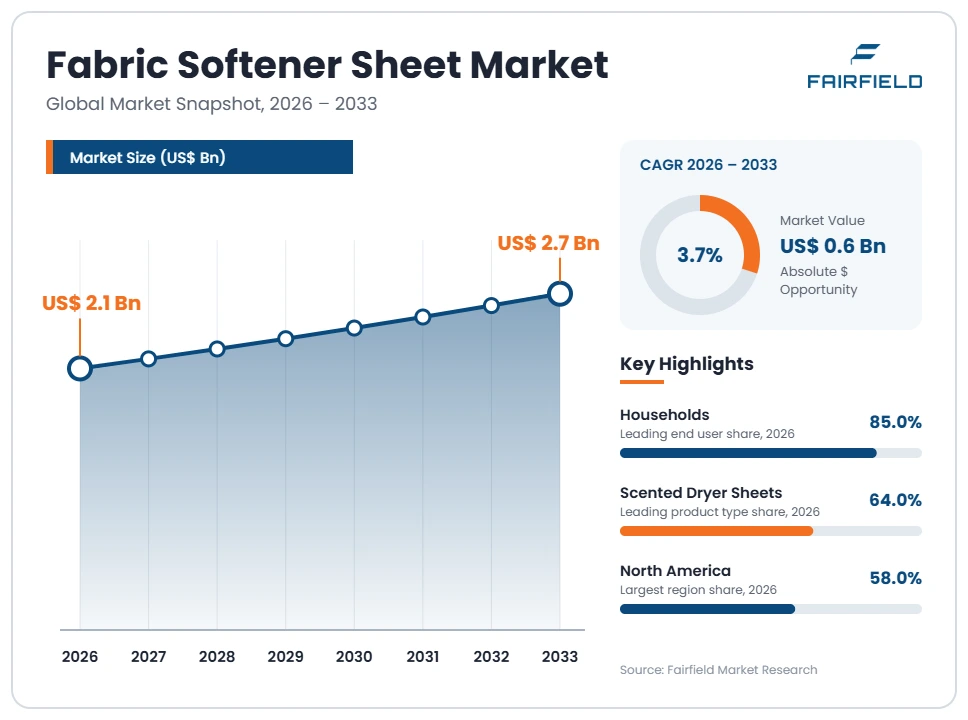
The global fabric softener sheet market size is expected to be valued at US$ 2.1 billion in 2026 and projected to reach US$ 2.7 billion by 2033, growing at a CAGR of 3.7% between 2026 and 2033.
Growth ran at roughly 2.2% annually between 2020 and 2025, when the category reached about US$ 2.0 billion. This is a small consumer segment, not a mass laundry market, because dryer sheets only sell where tumble dryers are common. Three factors shape the outlook. Pricing and premium formats contribute more than volume, since household penetration in core markets is already mature. Plant-based, concentrated and fragrance-free variants are adding value at the top of the range. Finally, dryer ownership is rising slowly in urban Asia Pacific, which widens the addressable base. Direction is modest value growth with flat to declining unit volumes in mature territories.
Key Report Takeaways
- By Product Type: Scented dryer sheets held 64% share in 2026, while plant-based and biodegradable sheets are projected to expand at a 6.9% CAGR through 2033, driven by shoppers seeking compostable alternatives to polyester-backed single-use sheets.
- By Distribution Channel: Supermarkets and hypermarkets held 36% share in 2026, while e-commerce is projected to grow at a 6.6% CAGR through 2033, helped by subscription replenishment and bulk pack economics online.
- By End User: Households held 85% share in 2026, while hospitality and healthcare laundries are projected to expand at a 5.1% CAGR through 2033, reflecting guest-experience spending and static control on synthetic linens.
- By Pack Size: Standard packs of 41 to 120 sheets held 47% share in 2026, while bulk value packs above 120 sheets are projected to grow at a 4.6% CAGR through 2033 on club-store purchasing.
- By Region: North America held 58% share in 2026, while Asia Pacific is projected to expand at a 5.8% CAGR through 2033, tracking rising apartment dryer and washer-dryer ownership in dense cities.
Global Fabric Softener Sheet Market Trends and Insights
Drivers Impact Analysis
Two forces explain most of the value growth in tumble dryer fabric care.
| Driver | Impact on CAGR Forecast | Geographic Relevance | Impact Timeline |
| Convenience and static control in dryer-equipped households | Medium | North America, Europe | Long term (≥4 years) |
| Premium scent and multi-function sheet formats lifting price per load | Medium | North America, Asia Pacific | Medium term (2–4 years) |
Single-Step Static Control Keeps Dryer Sheets in Routine Household Laundry Baskets
Convenience sustains repeat purchase of dryer sheets more than any performance claim. A sheet is dropped into the drum with no measuring, no dispenser and no risk of residue on the washing machine, which is why it holds a durable place in households that already own a tumble dryer. That habitual purchase pattern gives the category stable, low-churn volume even as adjacent laundry formats change rapidly.
The mechanism is physical and specific. Tumbling synthetic and blended fabrics generates static charge, and the cationic softening agents coated on a dryer sheet transfer under heat to neutralise it. Liquid conditioners added in the wash cannot address charge built during drying. As wardrobes shift toward polyester, elastane and performance blends, static cling becomes more noticeable, which keeps a drying-stage product relevant in ways that in-wash fabric conditioner cannot replicate.
Longer-Lasting Scent and Combination Sheets Raise Price Per Load Without Added Volume
Premium formats are lifting category value while unit volumes stay flat, and this is where most of the forecast growth sits. Manufacturers have moved from single-benefit softening sheets toward products that combine softening, static control, wrinkle reduction, odour neutralisation and extended fragrance release. Each added benefit supports a higher shelf price on a pack that costs little more to produce.
The driver behind this is competitive rather than regulatory. Scent beads and in-wash boosters taught shoppers to pay separately for fragrance intensity, and sheet brands responded by matching that performance in the dryer stage. Encapsulated fragrance technology, which releases scent gradually through wear, is the enabling development. Retailers support the shift because premium sheets deliver better margin per shelf facing than entry-level packs in a category with limited volume upside.
Restraints Impact Analysis
Two structural limits cap how large this category can realistically become.
| Restraint | Impact on CAGR Forecast | Geographic Relevance | Impact Timeline |
| Low tumble dryer ownership outside a few markets | High | Europe, Asia Pacific, Latin America, Middle East & Africa | Long term (≥4 years) |
| Single-use waste and indoor air quality scrutiny of scented sheets | Medium | North America, Europe | Medium term (2–4 years) |
Limited Tumble Dryer Ownership Caps the Addressable Base Outside North America
The addressable market is bounded by appliance ownership, and that is the hardest ceiling this category faces. A dryer sheet has no function without a tumble dryer, so household penetration of the appliance sets the maximum possible user base in every country. In much of the world, line drying remains the norm for climate, cost or housing reasons, which makes the product irrelevant rather than merely unpopular.
The underlying causes are energy cost, electricity tariffs and housing stock. Tumble dryers are among the most energy-intensive household appliances, and high residential electricity prices in several European markets discourage routine use even where a machine exists. Apartment living with limited utility space restricts installation, and heat pump dryers, while efficient, carry a higher purchase price. Appliance penetration therefore moves slowly, and no marketing investment can accelerate it meaningfully.
Single-Use Format and Fragrance Scrutiny Weigh on the Category’s Sustainability Position
Environmental and health scrutiny is eroding the category’s standing with a growing group of shoppers. A dryer sheet is used once and discarded, and most conventional sheets use a polyester or cellulose-polymer substrate that is neither recyclable through household streams nor reliably compostable. That single-use profile is increasingly out of step with how consumers evaluate laundry products.
Two specific concerns drive the pressure. Published academic work has examined volatile organic compounds emitted from scented laundry products through dryer vents, which keeps indoor air quality in public discussion. Separately, fragrance allergen declaration requirements and ingredient disclosure rules have made formulations visible to shoppers who previously saw only a scent name. Reusable wool dryer balls, marketed explicitly as a zero-waste substitute, give that concern a direct and inexpensive alternative on the same shelf.
Market Opportunities
Compostable Substrates and Fragrance-Free Variants Open a Premium Niche
Plant-based, compostable and fragrance-free sheets represent the clearest new revenue pool in this category, because they convert a sustainability objection into a price premium. Buyers who left the format over waste or sensitivity concerns can be recovered with a cellulose or bamboo substrate and a disclosed ingredient list. These products command noticeably higher shelf prices per sheet than conventional packs while addressing the objection directly rather than deflecting it.
Capture favours specialist brands and private label programmes as much as established manufacturers, since the segment rewards credibility over distribution scale. The demand comes from households with young children, eczema sufferers and fragrance-sensitive shoppers, who buy on ingredient transparency. United States Environmental Protection Agency Safer Choice certification and mandatory ingredient disclosure in California give these claims an external reference point that shoppers can verify independently.
Subscription Replenishment and Commercial Laundry Supply Create Underserved Channels
Online subscription replenishment and commercial laundry supply are two channels where dryer sheets remain underdeveloped relative to other laundry products. Sheets are light, non-spillable and consumed at a predictable rate, which makes them close to ideal for scheduled direct shipment. Subscription customers buy larger packs, switch brands less often and remove the retailer margin layer, so revenue per household rises even without higher consumption.
Hotels, serviced apartments, healthcare laundries and self-service laundromats form the second pool. These operators run high-volume synthetic linen loads where static control matters for folding speed and guest perception, and they reorder on a fixed schedule rather than on promotion. Brands that supply bulk cases through foodservice and hospitality distributors reach a buyer who purchases on throughput and cost per load rather than on shelf appeal, which protects margin from the private-label pressure found in grocery. Both channels suit manufacturers willing to sell outside conventional retail structures.
Segment Analysis
- By Product Type: Scented Sheets Hold the Base While Plant-Based Formats Advance Fastest
Scented dryer sheets accounted for 64% of revenue in 2026, reflecting that fragrance is the primary purchase trigger in this category rather than softening performance itself. Shoppers identify brands by scent name, and repeat purchase follows scent preference closely. Plant-based and biodegradable sheets are the fastest-expanding product type at a 6.9% CAGR through 2033. These use cellulose, bamboo or other plant-derived substrates in place of polyester backing, and they are usually paired with disclosed ingredient lists and recyclable cartons. Growth comes from a small base but at premium prices, so value contribution exceeds the volume implied. Fragrance-free sheets serve sensitive-skin households, while multi-function sheets bundle wrinkle release and odour control. The implication for manufacturers is that innovation budgets now flow toward substrate chemistry and ingredient transparency rather than toward further scent-range extension.
- By Distribution Channel: Grocery Retail Leads While Online Replenishment Grows Quickest
Supermarkets and hypermarkets delivered 36% of sales in 2026, because laundry care remains a routine grocery basket purchase made alongside food. Shelf position and promotional depth drive share in this channel more than brand advertising. E-commerce is growing fastest at a 6.6% CAGR to 2033, helped by subscription replenishment, larger pack economics and the practicality of shipping a light, durable product. Online listings also give sustainability-focused and fragrance-free brands a route to shoppers without securing physical distribution. Mass merchandisers and club stores supply the bulk value segment, while convenience and drug stores serve small top-up purchases at higher unit prices. The commercial implication is that brands must manage two different pack architectures, since the sizes that work in club stores differ from those that make economic sense in parcel shipping.
- By End User: Households Dominate Consumption While Hospitality Laundries Expand Faster
Households represented 85% of consumption in 2026, which is unsurprising for a product designed around domestic tumble dryer routines. This concentration makes the category highly sensitive to grocery pricing and household appliance ownership. Hospitality and healthcare laundries are the fastest-growing end user at a 5.1% CAGR through 2033. Hotels and serviced apartments use dryer sheets on synthetic and blended linens where static interferes with automated folding and affects guest perception of freshness. Healthcare laundries apply them selectively on staff uniforms and non-clinical textiles. Laundromats and self-service facilities form the third group, often selling single sheets through vending units at high effective prices. The business implication is that commercial demand, though small in absolute terms, offers steadier volumes than retail because it is tied to occupancy rather than to consumer sentiment.
- By Pack Size: Standard Packs Lead Shelves While Bulk Value Formats Gain Share
Standard packs containing 41 to 120 sheets held 47% of revenue in 2026, matching typical household replenishment cycles and fitting conventional grocery shelf dimensions. This size also carries the clearest price-per-sheet comparison, which supports promotional mechanics. Bulk value packs above 120 sheets are growing fastest at a 4.6% CAGR through 2033, driven by club-store membership shopping and online bulk ordering where shipping economics reward larger units. Households buying in bulk demonstrate higher brand loyalty because the purchase interval is long. Small packs up to 40 sheets remain important for trial, travel and convenience retail, and they carry the highest margin per sheet. The practical implication is that pack architecture, rather than formulation, now determines which channel a given product line can realistically compete in.
Geography Analysis
- Which Region Is Leading the Fabric Softener Sheet Market?
North America leads the fabric softener sheet market with 58% revenue share in 2026, a position that follows directly from tumble dryer ownership. The United States and Canada have among the highest household dryer penetration rates in the world, supported by detached housing with utility space, lower residential electricity costs than many peer economies, and cold or humid climates that make outdoor drying impractical for much of the year. Dryer sheets became a standard laundry step here decades ago, which gives the format habitual rather than discretionary status. Mexico contributes a smaller but growing share through urban apartment dryers. The regional constraint is maturity: volumes are broadly flat, so growth depends on premium formats and pack mix. Ingredient disclosure requirements in California have also made formulation transparency a competitive factor across the whole region.
- Europe Shows Selective Dryer Sheet Demand Shaped by Energy Costs and Line Drying
Europe accounted for 18% of global revenue in 2026, with the United Kingdom, Germany, France and the Nordic countries providing most of it. Demand correlates closely with dryer ownership, which is high in the United Kingdom and Nordic markets but much lower around the Mediterranean, where line drying is practical year-round. High residential electricity prices discourage frequent dryer use even in households that own a machine, capping consumption per household. Liquid fabric conditioner remains the dominant softening format by a wide margin. Regulatory attention is also higher here: the Detergents Regulation requires fragrance allergen declaration, and the framework is under revision. The opportunity lies in concentrated and plant-based sheets sold through sustainability-oriented retailers, where the waste objection is answered rather than ignored.
- Which Region Is Growing Fastest in the Fabric Softener Sheet Market?
Asia Pacific is growing fastest in the fabric softener sheet market at a 5.8% CAGR between 2026 and 2033, expanding from a modest 16% base share. The driver is appliance adoption rather than changing laundry habits. Compact washer-dryer combination units and heat pump dryers suit small urban apartments in Japan, South Korea, China and Singapore, where outdoor drying space is scarce and humidity makes indoor air drying slow. Australia already has established dryer ownership and behaves more like a mature market. As each new dryer enters a household, a potential dryer sheet user is created, which is why growth here tracks appliance shipments closely. Premium imported brands lead early adoption, while local manufacturers follow with value formats. Fragrance preferences differ markedly from Western markets, favouring lighter floral and clean profiles.
- Latin America Dryer Sheet Demand Concentrates in Urban Middle-Income Households
Latin America held 5% of global revenue in 2026, concentrated in Brazil, Mexico, Chile and Argentina. Demand sits almost entirely with urban middle and upper-income households that own a tumble dryer, which remains a minority of the population. Warm climates and widespread line drying limit the appliance’s appeal, and liquid fabric conditioner is strongly established as the softening format of choice at much lower cost per load. Price sensitivity is the principal barrier: a dryer sheet adds a per-load cost that many households see as optional. Currency volatility also affects imported premium brands. The regional opportunity lies in small, low-priced packs sold through traditional retail and pharmacy channels, which allow trial without the commitment of a full-size pack and suit weekly rather than monthly shopping patterns.
- Middle East & Africa Dryer Sheet Sales Track Appliance Ownership in Gulf Cities
Middle East & Africa represented 3% of global revenue in 2026, the smallest regional share, with the United Arab Emirates, Saudi Arabia, Israel and South Africa accounting for most of it. Demand follows apartment living and high appliance ownership in Gulf cities, where expatriate households often replicate laundry routines from their home countries. Elsewhere in the region, dryer ownership is very low and outdoor drying is both practical and free, so the product has little relevance. Barriers are substantial: limited modern grocery distribution outside major cities, import dependence for most branded packs, and low consumer awareness of what a dryer sheet does. The opportunity is narrow but real in hotel and serviced apartment laundries across the Gulf, where linen volumes are high and guest-facing quality standards justify the added cost.
Competitive Landscape
The fabric softener sheet market is highly concentrated, with a small group of multinational laundry manufacturers controlling most branded shelf space. Procter & Gamble holds the strongest position through its dryer sheet lines, with Henkel, Church & Dwight, Unilever and Colgate-Palmolive forming the rest of the branded tier. Private label is unusually strong for a fragrance-driven category, because retailers can source sheets from contract manufacturers at low cost and match the basic performance claim. Consolidation is limited simply because the category is small and attached to much larger laundry portfolios, so it rarely drives a transaction on its own.
Competition rests on fragrance identity, shelf price per sheet, multi-benefit claims and retailer relationships. Scent is the main differentiator, and brands protect it through proprietary fragrance houses and encapsulation technology. A second competitive axis has opened around ingredient transparency and substrate materials, where smaller sustainability-focused brands compete credibly without national distribution. The Clorox Company, S. C. Johnson & Son and Reckitt participate through adjacent fabric care and home care ranges, while Kao Corporation, Lion Corporation and LG Household & Health Care lead in their domestic markets with formats suited to compact dryers.
Strategic activity across the sector centres on three themes: reformulating toward plant-derived substrates and disclosed ingredient lists, extending established fragrance platforms across sheets, liquids and scent boosters, and defending shelf space against reusable alternatives. Werner & Mertz and comparable specialist manufacturers pursue the ecological positioning more narrowly.
Strategic direction is defensive in mature markets and exploratory elsewhere. Manufacturers are managing a slow-growing category for margin rather than volume, investing selectively where appliance ownership is still rising.
Recent Industry Developments
- March 2004: The European Union adopted Regulation (EC) No 648/2004 on detergents – establishing biodegradability requirements and the fragrance allergen declaration threshold that still governs how dryer sheet packs are labelled in Europe.
- January 2020: The California Cleaning Product Right to Know Act brought its online ingredient disclosure requirement into effect – obliging manufacturers to publish full formulation detail for laundry products sold in the state.
- January 2021: The same California statute extended disclosure to on-pack labelling – making ingredient transparency a visible point of comparison at the shelf rather than a website-only obligation.
- April 2023: The European Commission published its proposal to revise the detergents framework – signalling future changes to labelling, digital product passports and refill formats that will affect fabric care packaging.
Companies Covered in the Report
- Procter & Gamble
- Henkel
- Church & Dwight
- Unilever
- Colgate-Palmolive
- The Clorox Company
- S. C. Johnson & Son
- Reckitt
- Kao Corporation
- Lion Corporation
- LG Household & Health Care
- Werner & Mertz
Fabric Softener Sheet Market Report Scope
| Metric | Value |
| Study Period | 2020–2033 |
| Market Size 2026 | US$ 2.1 Billion |
| Market Size 2033 | US$ 2.7 Billion |
| CAGR 2026–2033 | 3.7% |
| Absolute Dollar Opportunity | US$ 0.6 Billion |
| Largest Market | North America (58% share in 2026) |
| Fastest-Growing Market | Asia Pacific (5.8% CAGR, 2026–2033) |
| Market Concentration | High |
| Major Players | Procter & Gamble, Henkel, Church & Dwight, Unilever, Colgate-Palmolive |
Fabric Softener Sheet Market Segmentation
Product Type
- Scented Dryer Sheets
- Fragrance-Free Dryer Sheets
- Plant-Based and Biodegradable Sheets
- Multi-Function Sheets
Distribution Channel
- Supermarkets and Hypermarkets
- Mass Merchandisers and Club Stores
- Convenience and Drug Stores
- E-Commerce
End User
- Households
- Laundromats and Self-Service Facilities
- Hospitality and Healthcare Laundries
Pack Size
- Small Packs (Up to 40 Sheets)
- Standard Packs (41 to 120 Sheets)
- Bulk Value Packs (Above 120 Sheets)
Regions
- North America
- Europe
- Asia Pacific
- Latin America
- Middle East & Africa
- Executive Summary
- Global Fabric Softener Sheet Market Snapshot
- Future Projections
- Key Report Takeaways
- Regional Snapshot
- Market Overview
- Market Definition and Report Scope
- Historical Trends 2020–2025
- Market Dynamics
- Drivers
- Single-Step Static Control Keeps Dryer Sheets in Routine Household Laundry Baskets
- Longer-Lasting Scent and Combination Sheets Raise Price Per Load Without Added Volume
- Restraints
- Limited Tumble Dryer Ownership Caps the Addressable Base Outside North America
- Single-Use Format and Fragrance Scrutiny Weigh on the Category's Sustainability Position
- Market Opportunities
- Compostable Substrates and Fragrance-Free Variants Open a Premium Niche
- Subscription Replenishment and Commercial Laundry Supply Create Underserved Channels
- Drivers
- Global Fabric Softener Sheet Market Outlook, 2020–2033
- Global Fabric Softener Sheet Market Outlook, by Product Type, Value (US$ Billion), 2020–2033
- Scented Dryer Sheets
- Fragrance-Free Dryer Sheets
- Plant-Based and Biodegradable Sheets
- Multi-Function Sheets
- Global Fabric Softener Sheet Market Outlook, by Distribution Channel, Value (US$ Billion), 2020–2033
- Supermarkets and Hypermarkets
- Mass Merchandisers and Club Stores
- Convenience and Drug Stores
- E-Commerce
- Global Fabric Softener Sheet Market Outlook, by End User, Value (US$ Billion), 2020–2033
- Households
- Laundromats and Self-Service Facilities
- Hospitality and Healthcare Laundries
- Global Fabric Softener Sheet Market Outlook, by Pack Size, Value (US$ Billion), 2020–2033
- Small Packs (Up to 40 Sheets)
- Standard Packs (41 to 120 Sheets)
- Bulk Value Packs (Above 120 Sheets)
- Global Fabric Softener Sheet Market Outlook, by Region, Value (US$ Billion), 2020–2033
- North America
- Europe
- Asia Pacific
- Latin America
- Middle East & Africa
- Global Fabric Softener Sheet Market Outlook, by Product Type, Value (US$ Billion), 2020–2033
- North America Fabric Softener Sheet Market Outlook, 2020–2033
- North America Fabric Softener Sheet Market Outlook, by Product Type, Value (US$ Billion), 2020–2033
- Scented Dryer Sheets
- Fragrance-Free Dryer Sheets
- Plant-Based and Biodegradable Sheets
- Multi-Function Sheets
- North America Fabric Softener Sheet Market Outlook, by Distribution Channel, Value (US$ Billion), 2020–2033
- Supermarkets and Hypermarkets
- Mass Merchandisers and Club Stores
- Convenience and Drug Stores
- E-Commerce
- North America Fabric Softener Sheet Market Outlook, by End User, Value (US$ Billion), 2020–2033
- Households
- Laundromats and Self-Service Facilities
- Hospitality and Healthcare Laundries
- North America Fabric Softener Sheet Market Outlook, by Pack Size, Value (US$ Billion), 2020–2033
- Small Packs (Up to 40 Sheets)
- Standard Packs (41 to 120 Sheets)
- Bulk Value Packs (Above 120 Sheets)
- North America Fabric Softener Sheet Market Outlook, by Country, Value (US$ Billion), 2020–2033
- United States Fabric Softener Sheet Market Outlook, by Product Type, 2020–2033
- United States Fabric Softener Sheet Market Outlook, by Distribution Channel, 2020–2033
- United States Fabric Softener Sheet Market Outlook, by End User, 2020–2033
- United States Fabric Softener Sheet Market Outlook, by Pack Size, 2020–2033
- Canada Fabric Softener Sheet Market Outlook, by Product Type, 2020–2033
- Canada Fabric Softener Sheet Market Outlook, by Distribution Channel, 2020–2033
- Canada Fabric Softener Sheet Market Outlook, by End User, 2020–2033
- Canada Fabric Softener Sheet Market Outlook, by Pack Size, 2020–2033
- Mexico Fabric Softener Sheet Market Outlook, by Product Type, 2020–2033
- Mexico Fabric Softener Sheet Market Outlook, by Distribution Channel, 2020–2033
- Mexico Fabric Softener Sheet Market Outlook, by End User, 2020–2033
- Mexico Fabric Softener Sheet Market Outlook, by Pack Size, 2020–2033
- North America Fabric Softener Sheet Market Outlook, by Product Type, Value (US$ Billion), 2020–2033
- Europe Fabric Softener Sheet Market Outlook, 2020–2033
- Europe Fabric Softener Sheet Market Outlook, by Product Type, Value (US$ Billion), 2020–2033
- Scented Dryer Sheets
- Fragrance-Free Dryer Sheets
- Plant-Based and Biodegradable Sheets
- Multi-Function Sheets
- Europe Fabric Softener Sheet Market Outlook, by Distribution Channel, Value (US$ Billion), 2020–2033
- Supermarkets and Hypermarkets
- Mass Merchandisers and Club Stores
- Convenience and Drug Stores
- E-Commerce
- Europe Fabric Softener Sheet Market Outlook, by End User, Value (US$ Billion), 2020–2033
- Households
- Laundromats and Self-Service Facilities
- Hospitality and Healthcare Laundries
- Europe Fabric Softener Sheet Market Outlook, by Pack Size, Value (US$ Billion), 2020–2033
- Small Packs (Up to 40 Sheets)
- Standard Packs (41 to 120 Sheets)
- Bulk Value Packs (Above 120 Sheets)
- Europe Fabric Softener Sheet Market Outlook, by Country, Value (US$ Billion), 2020–2033
- United Kingdom Fabric Softener Sheet Market Outlook, by Product Type, 2020–2033
- United Kingdom Fabric Softener Sheet Market Outlook, by Distribution Channel, 2020–2033
- United Kingdom Fabric Softener Sheet Market Outlook, by End User, 2020–2033
- United Kingdom Fabric Softener Sheet Market Outlook, by Pack Size, 2020–2033
- Germany Fabric Softener Sheet Market Outlook, by Product Type, 2020–2033
- Germany Fabric Softener Sheet Market Outlook, by Distribution Channel, 2020–2033
- Germany Fabric Softener Sheet Market Outlook, by End User, 2020–2033
- Germany Fabric Softener Sheet Market Outlook, by Pack Size, 2020–2033
- France Fabric Softener Sheet Market Outlook, by Product Type, 2020–2033
- France Fabric Softener Sheet Market Outlook, by Distribution Channel, 2020–2033
- France Fabric Softener Sheet Market Outlook, by End User, 2020–2033
- France Fabric Softener Sheet Market Outlook, by Pack Size, 2020–2033
- Nordic countries Fabric Softener Sheet Market Outlook, by Product Type, 2020–2033
- Nordic countries Fabric Softener Sheet Market Outlook, by Distribution Channel, 2020–2033
- Nordic countries Fabric Softener Sheet Market Outlook, by End User, 2020–2033
- Nordic countries Fabric Softener Sheet Market Outlook, by Pack Size, 2020–2033
- Europe Fabric Softener Sheet Market Outlook, by Product Type, Value (US$ Billion), 2020–2033
- Asia Pacific Fabric Softener Sheet Market Outlook, 2020–2033
- Asia Pacific Fabric Softener Sheet Market Outlook, by Product Type, Value (US$ Billion), 2020–2033
- Scented Dryer Sheets
- Fragrance-Free Dryer Sheets
- Plant-Based and Biodegradable Sheets
- Multi-Function Sheets
- Asia Pacific Fabric Softener Sheet Market Outlook, by Distribution Channel, Value (US$ Billion), 2020–2033
- Supermarkets and Hypermarkets
- Mass Merchandisers and Club Stores
- Convenience and Drug Stores
- E-Commerce
- Asia Pacific Fabric Softener Sheet Market Outlook, by End User, Value (US$ Billion), 2020–2033
- Households
- Laundromats and Self-Service Facilities
- Hospitality and Healthcare Laundries
- Asia Pacific Fabric Softener Sheet Market Outlook, by Pack Size, Value (US$ Billion), 2020–2033
- Small Packs (Up to 40 Sheets)
- Standard Packs (41 to 120 Sheets)
- Bulk Value Packs (Above 120 Sheets)
- Asia Pacific Fabric Softener Sheet Market Outlook, by Country, Value (US$ Billion), 2020–2033
- Japan Fabric Softener Sheet Market Outlook, by Product Type, 2020–2033
- Japan Fabric Softener Sheet Market Outlook, by Distribution Channel, 2020–2033
- Japan Fabric Softener Sheet Market Outlook, by End User, 2020–2033
- Japan Fabric Softener Sheet Market Outlook, by Pack Size, 2020–2033
- South Korea Fabric Softener Sheet Market Outlook, by Product Type, 2020–2033
- South Korea Fabric Softener Sheet Market Outlook, by Distribution Channel, 2020–2033
- South Korea Fabric Softener Sheet Market Outlook, by End User, 2020–2033
- South Korea Fabric Softener Sheet Market Outlook, by Pack Size, 2020–2033
- China Fabric Softener Sheet Market Outlook, by Product Type, 2020–2033
- China Fabric Softener Sheet Market Outlook, by Distribution Channel, 2020–2033
- China Fabric Softener Sheet Market Outlook, by End User, 2020–2033
- China Fabric Softener Sheet Market Outlook, by Pack Size, 2020–2033
- Singapore Fabric Softener Sheet Market Outlook, by Product Type, 2020–2033
- Singapore Fabric Softener Sheet Market Outlook, by Distribution Channel, 2020–2033
- Singapore Fabric Softener Sheet Market Outlook, by End User, 2020–2033
- Singapore Fabric Softener Sheet Market Outlook, by Pack Size, 2020–2033
- Australia Fabric Softener Sheet Market Outlook, by Product Type, 2020–2033
- Australia Fabric Softener Sheet Market Outlook, by Distribution Channel, 2020–2033
- Australia Fabric Softener Sheet Market Outlook, by End User, 2020–2033
- Australia Fabric Softener Sheet Market Outlook, by Pack Size, 2020–2033
- Asia Pacific Fabric Softener Sheet Market Outlook, by Product Type, Value (US$ Billion), 2020–2033
- Latin America Fabric Softener Sheet Market Outlook, 2020–2033
- Latin America Fabric Softener Sheet Market Outlook, by Product Type, Value (US$ Billion), 2020–2033
- Scented Dryer Sheets
- Fragrance-Free Dryer Sheets
- Plant-Based and Biodegradable Sheets
- Multi-Function Sheets
- Latin America Fabric Softener Sheet Market Outlook, by Distribution Channel, Value (US$ Billion), 2020–2033
- Supermarkets and Hypermarkets
- Mass Merchandisers and Club Stores
- Convenience and Drug Stores
- E-Commerce
- Latin America Fabric Softener Sheet Market Outlook, by End User, Value (US$ Billion), 2020–2033
- Households
- Laundromats and Self-Service Facilities
- Hospitality and Healthcare Laundries
- Latin America Fabric Softener Sheet Market Outlook, by Pack Size, Value (US$ Billion), 2020–2033
- Small Packs (Up to 40 Sheets)
- Standard Packs (41 to 120 Sheets)
- Bulk Value Packs (Above 120 Sheets)
- Latin America Fabric Softener Sheet Market Outlook, by Country, Value (US$ Billion), 2020–2033
- Brazil Fabric Softener Sheet Market Outlook, by Product Type, 2020–2033
- Brazil Fabric Softener Sheet Market Outlook, by Distribution Channel, 2020–2033
- Brazil Fabric Softener Sheet Market Outlook, by End User, 2020–2033
- Brazil Fabric Softener Sheet Market Outlook, by Pack Size, 2020–2033
- Mexico Fabric Softener Sheet Market Outlook, by Product Type, 2020–2033
- Mexico Fabric Softener Sheet Market Outlook, by Distribution Channel, 2020–2033
- Mexico Fabric Softener Sheet Market Outlook, by End User, 2020–2033
- Mexico Fabric Softener Sheet Market Outlook, by Pack Size, 2020–2033
- Chile Fabric Softener Sheet Market Outlook, by Product Type, 2020–2033
- Chile Fabric Softener Sheet Market Outlook, by Distribution Channel, 2020–2033
- Chile Fabric Softener Sheet Market Outlook, by End User, 2020–2033
- Chile Fabric Softener Sheet Market Outlook, by Pack Size, 2020–2033
- Argentina Fabric Softener Sheet Market Outlook, by Product Type, 2020–2033
- Argentina Fabric Softener Sheet Market Outlook, by Distribution Channel, 2020–2033
- Argentina Fabric Softener Sheet Market Outlook, by End User, 2020–2033
- Argentina Fabric Softener Sheet Market Outlook, by Pack Size, 2020–2033
- Latin America Fabric Softener Sheet Market Outlook, by Product Type, Value (US$ Billion), 2020–2033
- Middle East & Africa Fabric Softener Sheet Market Outlook, 2020–2033
- Middle East & Africa Fabric Softener Sheet Market Outlook, by Product Type, Value (US$ Billion), 2020–2033
- Scented Dryer Sheets
- Fragrance-Free Dryer Sheets
- Plant-Based and Biodegradable Sheets
- Multi-Function Sheets
- Middle East & Africa Fabric Softener Sheet Market Outlook, by Distribution Channel, Value (US$ Billion), 2020–2033
- Supermarkets and Hypermarkets
- Mass Merchandisers and Club Stores
- Convenience and Drug Stores
- E-Commerce
- Middle East & Africa Fabric Softener Sheet Market Outlook, by End User, Value (US$ Billion), 2020–2033
- Households
- Laundromats and Self-Service Facilities
- Hospitality and Healthcare Laundries
- Middle East & Africa Fabric Softener Sheet Market Outlook, by Pack Size, Value (US$ Billion), 2020–2033
- Small Packs (Up to 40 Sheets)
- Standard Packs (41 to 120 Sheets)
- Bulk Value Packs (Above 120 Sheets)
- Middle East & Africa Fabric Softener Sheet Market Outlook, by Country, Value (US$ Billion), 2020–2033
- United Arab Emirates Fabric Softener Sheet Market Outlook, by Product Type, 2020–2033
- United Arab Emirates Fabric Softener Sheet Market Outlook, by Distribution Channel, 2020–2033
- United Arab Emirates Fabric Softener Sheet Market Outlook, by End User, 2020–2033
- United Arab Emirates Fabric Softener Sheet Market Outlook, by Pack Size, 2020–2033
- Saudi Arabia Fabric Softener Sheet Market Outlook, by Product Type, 2020–2033
- Saudi Arabia Fabric Softener Sheet Market Outlook, by Distribution Channel, 2020–2033
- Saudi Arabia Fabric Softener Sheet Market Outlook, by End User, 2020–2033
- Saudi Arabia Fabric Softener Sheet Market Outlook, by Pack Size, 2020–2033
- Israel Fabric Softener Sheet Market Outlook, by Product Type, 2020–2033
- Israel Fabric Softener Sheet Market Outlook, by Distribution Channel, 2020–2033
- Israel Fabric Softener Sheet Market Outlook, by End User, 2020–2033
- Israel Fabric Softener Sheet Market Outlook, by Pack Size, 2020–2033
- South Africa Fabric Softener Sheet Market Outlook, by Product Type, 2020–2033
- South Africa Fabric Softener Sheet Market Outlook, by Distribution Channel, 2020–2033
- South Africa Fabric Softener Sheet Market Outlook, by End User, 2020–2033
- South Africa Fabric Softener Sheet Market Outlook, by Pack Size, 2020–2033
- Middle East & Africa Fabric Softener Sheet Market Outlook, by Product Type, Value (US$ Billion), 2020–2033
- Competitive Landscape
- Market Concentration and Industry Leaders
- Competitive Differentiation
- Strategic Moves and Market Direction
- Recent Industry Developments
- Company Profiles
- Procter & Gamble
- Henkel
- Church & Dwight
- Unilever
- Colgate-Palmolive
- The Clorox Company
- S. C. Johnson & Son
- Reckitt
- Kao Corporation
- Lion Corporation
- LG Household & Health Care
- Werner & Mertz
- Appendix
- Research Methodology
- Report Assumptions
- Acronyms and Abbreviations
Product Type
- Scented Dryer Sheets
- Fragrance-Free Dryer Sheets
- Plant-Based and Biodegradable Sheets
- Multi-Function Sheets
Distribution Channel
- Supermarkets and Hypermarkets
- Mass Merchandisers and Club Stores
- Convenience and Drug Stores
- E-Commerce
End User
- Households
- Laundromats and Self-Service Facilities
- Hospitality and Healthcare Laundries
Pack Size
- Small Packs (Up to 40 Sheets)
- Standard Packs (41 to 120 Sheets)
- Bulk Value Packs (Above 120 Sheets)
Regions
- North America
- Europe
- Asia Pacific
- Latin America
- Middle East & Africa
Our Research Methodology
Considering the volatility of business today, traditional approaches to strategizing a game plan can be unfruitful if not detrimental. True ambiguity is no way to determine a forecast. A myriad of predetermined factors must be accounted for such as the degree of risk involved, the magnitude of circumstances, as well as conditions or consequences that are not known or unpredictable. To circumvent binary views that cast uncertainty, the application of market research intelligence to strategically posture, move, and enable actionable outcomes is necessary.
View Methodology
Quality Assured
Rigorous Validation Process

Confidentiality Assured
End-to-end Data Security

Custom Research Services
Tailored To Your Objectives
FAQs
The fabric softener sheet market is valued at US$ 2.1 billion in 2026, covering retail and commercial sales of single-use tumble dryer sheets worldwide.
The market is projected to reach US$ 2.7 billion by 2033 at a 3.7% CAGR, adding US$ 0.6 billion in absolute dollar opportunity.
Scented dryer sheets lead with 64% revenue share in 2026, because fragrance preference rather than softening performance drives most repeat purchase decisions.
Asia Pacific grows fastest at a 5.8% CAGR to 2033, as compact washer-dryer and heat pump units spread through dense urban apartment housing.
North America holds 58% share in 2026, reflecting the highest household tumble dryer ownership and a long-established place for sheets in laundry routines.
Related Reports
Eyewear Market Size, Share, Insights, Competitive Landscape, and Forecast 2026 to 2033
The global eyewear market is valued at US$178.0 billion in 2026, reaching US$268.0 billion by 2033, growing at a 6.0% CAGR
Exotic Pets Market Size, Share, Insights, Competitive Landscape, and Forecast 2026 to 2033
The global exotic pets market is valued at US$21.4 billion in 2026, reaching US$33.6 billion by 2033, growing at a 6.7% CAGR
3D Drawing Doodle Printing Pen Market Size, Share, Insights, Competitive Landscape, and Forecast 2026 to 2033
The global 3D drawing doodle printing pen market is valued at US$0.16 billion in 2026, reaching US$0.28 billion by 2033, growing at an 8.32% CAGR
Knee High Boots Market Size, Share, Insights, Competitive Landscape, and Forecast 2026 to 2033
The global knee high boots market is valued at US$18.7 billion in 2026, reaching US$26.4 billion by 2033, growing at a 5.05% CAGR
Drop Shipping Market Size, Share, Insights, Competitive Landscape, and Forecast 2026 to 2033
The global drop shipping market is valued at US$420.0 billion in 2026, reaching US$985.0 billion by 2033, growing at a 12.95% CAGR
Esports Arenas Market Size, Share, Insights, Competitive Landscape, and Forecast 2026 to 2033
Esports Arenas Market to reach US$6.5 Bn by 2033, growing at 14.0% CAGR, driven by esports events, venue upgrades, and broadcast infrastructure.