



Eyewear Market
Eyewear Market Size, Share, Insights, Competitive Landscape, and Forecast 2026 to 2033
Eyewear Market Size and Trend Analysis
What Is the Growth Outlook for the Eyewear Market?
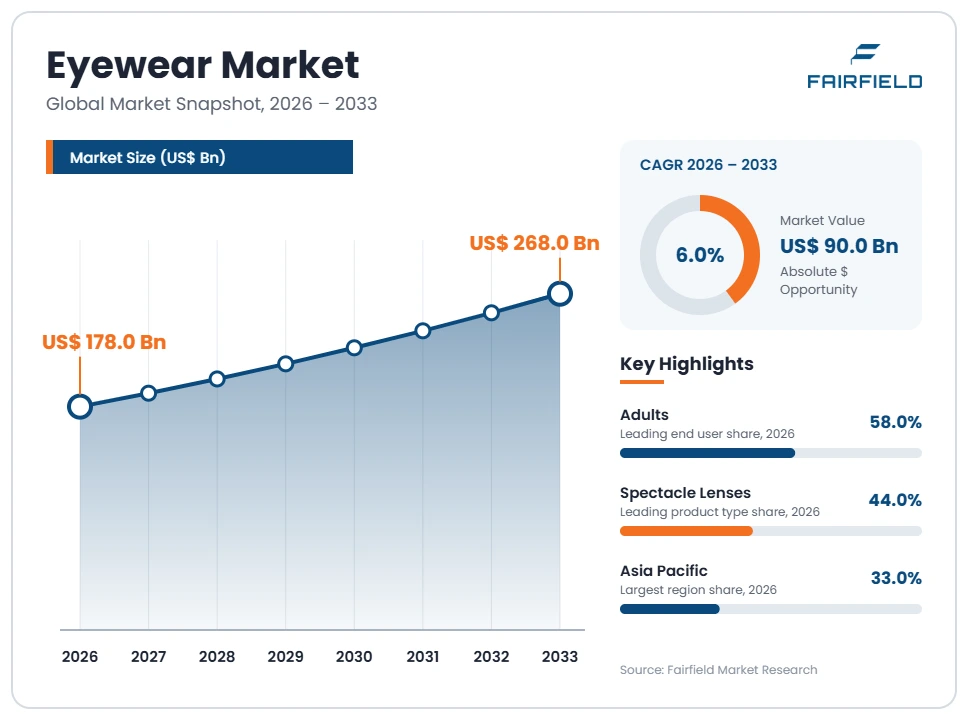
The global Eyewear market size is expected to be valued at US$ 178.0 billion in 2026 and projected to reach US$ 268.0 billion by 2033, growing at a CAGR of 6.0% between 2026 and 2033.
Spectacle and sunglass revenue grew at roughly 5.4% annually between 2020 and 2025, recovering quickly once optical practices reopened after pandemic closures. Three forces set the current pace. Myopia prevalence among children continues to rise in urbanised populations, which enlarges the lifetime prescription base rather than producing a one-off sales bump. Presbyopia in ageing populations shifts mix toward progressive lenses, which carry several times the value of a single-vision pair. Coatings, photochromic treatments and myopia-management designs raise the price of a dispensed pair even where unit volumes are flat. Revenue growth therefore runs ahead of unit growth, and the premium lens mix, not frame fashion cycles, now sets the pace.
Key Report Takeaways
- By Product Type: Spectacle Lenses held 44% share in 2026, while Sunglasses are projected to expand at a 6.9% CAGR through 2033, driven by rising ultraviolet protection awareness and the spread of branded plano styles into emerging consumer markets.
- By Lens Type: Single Vision Lenses held 47% of lens revenue in 2026, while Myopia-Management Lenses are projected to expand at a 14.2% CAGR through 2033, driven by paediatric eye care programmes and defocus lens designs.
- By Distribution Channel: Optical Retail Chains held 38% share in 2026, while Online and Direct-to-Consumer sellers are projected to expand at a 10.8% CAGR through 2033, driven by price transparency and virtual frame fitting tools.
- By End User: Adults held 58% share in 2026, while the Paediatric group is projected to expand at a 9.4% CAGR through 2033, driven by school vision screening and earlier correction of refractive error in children.
- By Geography: Asia Pacific held 33% share in 2026, while Middle East & Africa is projected to expand at a 7.6% CAGR through 2033, driven by optical retail expansion and growing public eye health investment.
Global Eyewear Market Trends and Insights
Drivers Impact Analysis
Two forces explain most of the forecast growth in prescription eyewear and ophthalmic lenses.
| Driver | Impact on CAGR Forecast | Geographic Relevance | Impact Timeline |
| Rising myopia prevalence among children in urbanised populations | High | Asia Pacific, North America, Europe | Long term (≥4 years) |
| Population ageing and presbyopia shifting mix toward progressive lenses | High | Europe, North America, Asia Pacific | Medium term (2–4 years) |
Rising Childhood Myopia Enlarges the Lifetime Prescription Base for Spectacle Lenses
Childhood myopia is the clearest long-term volume driver in vision correction. A child who becomes short-sighted at eight will typically need corrective lenses for life, with prescription changes every year or two during growth. That converts a single diagnosis into decades of repeat purchases, and it widens the base of adults who later need progressive lenses as presbyopia arrives on top of existing myopia.
The mechanism is well documented in population studies. Prevalence has risen sharply in urbanised parts of Asia Pacific and is climbing in Europe and North America, with reduced time outdoors and sustained near work consistently identified as contributing factors. The World Health Organization has highlighted uncorrected refractive error as a leading cause of vision impairment worldwide. School screening programmes that detect myopia earlier bring children into optical practices sooner, moving first purchase forward by several years.
Presbyopia in Ageing Populations Shifts Revenue Toward Higher-Value Progressive Lenses
Presbyopia is pushing average selling prices up faster than unit volumes. Nearly everyone loses near-focusing ability from around the mid-forties, so ageing populations in Japan, Germany, Italy, the United States and China generate a predictable stream of first-time progressive wearers. A progressive pair with premium coatings sells for several times the price of a basic single-vision pair, so mix alone lifts revenue in markets where unit demand is mature.
The causal mechanism is design complexity and fitting service. Modern progressive lenses are surfaced to individual prescriptions, frame geometry and wearing position, which requires digital free-form production rather than stock inventory. That manufacturing route supports differentiated pricing tiers and repeat sales as wearers trade up. Longer working lives also extend screen use into later decades, raising demand for occupational and anti-reflective designs intended for intermediate viewing distances.
Restraints Impact Analysis
Two constraints limit pricing power and raise the cost of serving the eyewear market.
| Restraint | Impact on CAGR Forecast | Geographic Relevance | Impact Timeline |
| Price compression from online and direct-to-consumer sellers | Medium | North America, Europe | Short term (≤2 years) |
| Medical device and optical standards compliance across many jurisdictions | Medium | Global | Medium term (2–4 years) |
Online and Direct-to-Consumer Pricing Compresses Margins Across Standard Eyewear
Price transparency has reset consumer expectations for a standard pair of glasses. Online sellers publish an all-in price covering frame, single-vision lenses and basic coating, which makes traditional optical pricing look opaque by comparison. Independent practices and chains respond with entry-level bundles and two-for-one offers, and the result is thinner margin on the simplest prescriptions, which are also the most common.
The cost structure explains why this is possible. Single-vision lens surfacing is highly automated, and acetate and metal frame production is concentrated in low-cost manufacturing clusters, so the marginal cost of a basic pair is small relative to its retail price. Sellers without store estates avoid rent and dispensing labour, which is where most of the traditional cost base sits. Margin therefore holds only where clinical service, complex prescriptions, premium coatings or brand licensing justify a higher price.
Medical Device and Optical Standards Obligations Raise the Cost of Serving Multiple Markets
Regulatory compliance adds fixed cost to every product range sold internationally. Corrective spectacles are regulated medical devices in the European Union under Regulation (EU) 2017/745, requiring technical documentation, registration, labelling, traceability and post-market surveillance. In the United States, 21 CFR 801.410 requires eyeglass lenses to be impact resistant and requires manufacturers to hold testing records, obligations that apply to every lens design placed on the market.
The cost source is documentation and testing rather than production. ANSI Z80.1 sets tolerance limits for prescription ophthalmic lenses, and ISO 12312-1 sets transmittance and ultraviolet requirements for sunglass filters, so each design must be tested, recorded and re-verified when materials or coatings change. Large manufacturers spread that fixed cost across millions of units. Smaller independent brands and regional producers cannot, which discourages range breadth and slows entry into new jurisdictions.
Market Opportunities
Two revenue pools sit outside the conventional frame and single-vision lens business.
Myopia-Management Spectacle Lenses Create a Premium Paediatric Revenue Pool
Myopia-management lenses are the genuine premium growth pocket in ophthalmic optics. Spectacle lenses using peripheral defocus or lenslet-array designs are dispensed to children specifically to slow the progression of short-sightedness, and they sell well above standard paediatric single-vision prices. Because children’s prescriptions change frequently, each fitted child generates repeat purchases through adolescence rather than a single transaction.
Capture depends on clinical channel access rather than retail reach. Demand is created in paediatric optometry and ophthalmology practices, where the practitioner selects the design, measures progression over time and schedules review visits. Lens manufacturers that fund clinical trials, publish multi-year progression data and train dispensing opticians are positioned to hold this business. Growing parental awareness of myopia as a long-term eye health risk, rather than a simple inconvenience, supplies the willingness to pay.
Correcting Unmet Refractive Error Opens a High-Volume Emerging Market Channel
Uncorrected refractive error represents the largest unserved volume pool in vision correction. The World Health Organization has reported that a very large number of people live with vision impairment that a pair of spectacles would address, concentrated in low- and middle-income countries where optical services are scarce. Serving that population needs durable, low-cost designs and distribution that does not depend on a high-street practice.
Capture favours manufacturers able to work through public programmes rather than consumer brands. Buyers are health ministries, school screening programmes, non-governmental organisations and development funders purchasing ready-made and adjustable spectacles in batches. The World Health Organization and the International Agency for the Prevention of Blindness have pushed national commitments on refractive error coverage, which supplies the funding route. Local assembly, trained refractionists and simple lens ranges determine who wins these tenders, not brand licensing.
Segment Analysis
- By Product Type: Spectacle Lenses Anchor Revenue While Sunglasses Expand Fastest
Spectacle Lenses held 44% of revenue in 2026, the largest product block, because lenses carry most of the technical value in a dispensed pair and because coatings and premium designs lift the price well above the frame. Free-form surfacing, anti-reflective and hard coatings, blue-light filtering and photochromic treatments all sit here. Spectacle Frames contributed 26%, and Reading Glasses around 7%, sold largely off-the-shelf.
Sunglasses are the fastest-growing product line at a 6.9% CAGR to 2033, from 23% share. Growth comes from wider ultraviolet protection awareness, prescription sunglass dispensing as a second pair, and the spread of licensed and house brands into emerging consumer markets. Because sunglasses are bought on design and brand rather than prescription, they are less tied to eye examination capacity. The implication is that lens technology drives margin while sunglasses drive unit reach.
- By Lens Type: Single Vision Dominates as Myopia-Management Designs Grow Most Quickly
Single Vision Lenses accounted for 47% of lens revenue in 2026, reflecting their use in most first prescriptions, in children and in distance correction for younger adults. They are produced at enormous scale with highly automated surfacing, which keeps unit costs low and makes them the entry point in almost every pricing ladder. Progressive and Bifocal Lenses held 28%, and Photochromic and Specialty Lenses 16%.
Myopia-Management Lenses are expanding fastest at a 14.2% CAGR through 2033, from 9% of lens revenue. Defocus and lenslet-array designs are dispensed to slow progression in children, backed by multi-year clinical follow-up, and they command premium pricing in a category that was previously the cheapest. The business implication is clear: paediatric dispensing has shifted from a low-value obligation to the most attractive clinical niche in ophthalmic lenses.
- By Distribution Channel: Optical Chains Hold Scale While Online Sellers Grow Fastest
Optical Retail Chains held 38% of distribution in 2026, because scale buying, standardised dispensing and in-store eye examination capacity let them combine competitive pricing with clinical service. Vertical integration between lens manufacture, frame brands and store networks reinforces that position in several large markets. Independent Optical Stores accounted for 29%, competing on personal service and complex dispensing, while Mass Merchandisers and Other Channels held 13%.
Online and Direct-to-Consumer sellers are growing fastest at a 10.8% CAGR to 2033, from 20% share. Virtual try-on, pupillary distance capture by smartphone, home trial programmes and transparent bundled pricing have removed much of the friction that once kept spectacle buying in-store. The consequence is a widening split: simple prescriptions migrate online and compress price, while progressive, paediatric and medically complex fittings stay in practices.
- By End User: Adults Carry Volume While Paediatric Demand Accelerates
Adults represented 58% of demand in 2026, the largest end user group, covering working-age wearers of distance correction, computer and occupational lenses, and prescription sunglasses. Screen-intensive work, longer careers and the habit of owning more than one pair sustain replacement cycles of roughly two to three years in higher-income markets. The Geriatric group accounted for 29%, dominated by progressive lenses and by eyewear dispensed after cataract surgery.
The Paediatric group is the fastest-growing end user at a 9.4% CAGR through 2033, from 13% share. School vision screening, earlier diagnosis of refractive error and the arrival of myopia-management designs have all raised both the number of children fitted and the value of each fitting. For manufacturers and practices, this makes paediatric capability, from frame durability to progression monitoring, a strategic rather than peripheral competence.
Geography Analysis
- North America Pairs High Average Selling Prices With Vision Plan Coverage
North America held 27% of revenue in 2026 and is forecast to grow near 5.1% annually through 2033. The United States supplies most of that value, supported by widespread employer-sponsored vision plans that fund an eye examination and a frame-and-lens allowance on a regular cycle. That coverage sets a predictable replacement rhythm and pushes wearers toward premium coatings and progressive designs within their benefit.
Retail structure shapes competition. Large optical chains, optometry practices and warehouse clubs coexist with online sellers that built their position on transparent pricing. 21 CFR 801.410 requires impact-resistant lenses, which standardises materials toward polycarbonate and trivex in much of the range. The clearest opportunity is paediatric myopia management, where practitioner-led dispensing creates recurring premium revenue outside the discount channel.
- Europe Combines Medical Device Regulation With a Deep Lens Manufacturing Base
Europe accounted for 26% of revenue in 2026, growing at about 4.9% annually to 2033. Germany, France, Italy and the United Kingdom dominate spending, and the region hosts much of the world’s ophthalmic lens design and premium frame manufacturing. Italian frame production and German and French lens technology give the region unusual depth on the supply side as well as the demand side.
Regulation (EU) 2017/745 governs corrective spectacles as medical devices, raising documentation and surveillance duties and favouring manufacturers with established quality systems. Mature penetration limits volume growth, so value comes from mix: premium progressives, photochromic treatments and second pairs. Large vertically integrated chains continue to take share from independents, while sustainability requirements push bio-based acetates and take-back schemes into mainstream ranges.
- Which Region Is Leading the Eyewear Market?
Asia Pacific leads the eyewear market with 33% revenue share in 2026, growing at 7.3% annually to 2033. China supplies the largest share, combining the world’s biggest population of short-sighted children with extensive domestic frame and lens manufacturing. Japan and South Korea contribute high-value demand and advanced lens technology, while India adds rapid volume growth as organised optical retail replaces unorganised dispensing.
Rising myopia prevalence is the structural engine. Government attention to children’s vision, including school screening and guidance on outdoor time, brings more children into correction earlier and supports premium myopia-management dispensing. The region is also the manufacturing base for much of the global frame supply. The main constraint is price sensitivity outside major cities, where average selling prices remain well below those in mature markets.
- Latin America Expands Organised Optical Retail Against Currency and Access Barriers
Latin America represented 8% of revenue in 2026 and is projected to grow at roughly 6.4% annually through 2033. Brazil leads, with Mexico, Argentina, Colombia and Chile following, as optical chains and franchised stores replace informal dispensing and bring standardised lens ranges and instalment payment plans to middle-income consumers.
Barriers are economic and clinical. Currency volatility and import duties raise the landed cost of lens blanks, coating equipment and branded frames, and household budgets stretch replacement cycles. Optometrists and ophthalmologists are concentrated in large cities, leaving rural populations without reliable refraction services. The clearest opportunity is public and employer-funded screening linked to affordable ready-made and single-vision ranges, which converts documented need into first-time purchases.
- Which Region Is Growing Fastest in the Eyewear Market?
Middle East & Africa is growing fastest at a 7.6% CAGR between 2026 and 2033, from 6% share in 2026. Saudi Arabia, the United Arab Emirates and Qatar drive value through rapid shopping-mall optical retail expansion, high disposable income, strong demand for branded sunglasses in a high-ultraviolet climate, and national health programmes that fund eye examinations.
South Africa, Egypt, Nigeria and Kenya supply the volume story, with young and urbanising populations and very low spectacle coverage relative to need. Constraints are severe in lower-income countries: few trained refractionists, limited lens finishing capacity and import dependence on finished goods. The growth opening lies in donor-funded and school-based programmes paired with locally assembled ready-made spectacles, which establish first-time wearers who later become repeat retail customers.
Competitive Landscape
The eyewear market is highly concentrated at the lens and brand level, even though retail dispensing remains fragmented. A small number of groups manufacture a large share of the world’s ophthalmic lenses and hold the licences to most recognised frame and sunglass brands, and several of them are vertically integrated through wholesale distribution into owned store networks and online platforms. EssilorLuxottica SA, Hoya Corporation, Carl Zeiss AG, Safilo Group S.p.A. and Fielmann Group AG occupy prominent positions across those layers. Decades of consolidation among lens makers, frame licensors and retail chains produced that structure, and independent practices now buy from the same suppliers whose stores compete with them on the high street.
Competition runs on three fronts. In lenses, vendors compete on optical design, coating durability, free-form surfacing capability, laboratory turnaround time and clinical evidence, particularly for myopia-management designs. In frames and sunglasses, competition is brand-led, decided by licence portfolios, design cycles and shelf presence. In retail, it turns on store density, examination capacity, insurance and benefit plan relationships, and price transparency. Online and direct-to-consumer sellers entered precisely against that structure, using transparent bundled pricing, virtual try-on and home trials to attack the simplest prescriptions, while regional producers in China and Italy supply private-label frames to anyone without a licensing budget.
Strategic direction is consistent across the sector. Established groups are investing in myopia management, where clinical evidence protects pricing from commodity pressure, and in free-form lens laboratories placed close to major retail markets to shorten delivery times. Several are extending direct-to-consumer and digital fitting capability rather than resisting it. Sustainability commitments, covering bio-based acetates, recycled metals and frame take-back schemes, are moving from marketing claims into procurement requirements for large retail buyers.
Recent Industry Developments
- October 2019: The World Health Organization published the World Report on Vision – documenting that at least 1 billion people live with vision impairment that could have been prevented or is still unaddressed, which framed refractive correction as a global health priority.
- May 2021: Regulation (EU) 2017/745 became fully applicable across the European Union – confirming corrective spectacles and lenses as regulated medical devices and raising documentation, traceability and post-market surveillance duties for manufacturers.
- July 2021: The United Nations General Assembly adopted its first resolution dedicated to vision – committing member states to work toward access to eye care for their populations by 2030 and giving national refractive error programmes political backing.
- 2013: ISO 12312-1 established transmittance, ultraviolet and optical quality requirements for sunglass filters for general use – creating the common technical baseline now referenced by importers and large retail buyers worldwide.
Companies Covered in the Report
- EssilorLuxottica SA
- Hoya Corporation
- Carl Zeiss AG
- Safilo Group S.p.A.
- Fielmann Group AG
- Nikon-Essilor Co., Ltd.
- Rodenstock GmbH
- Shamir Optical Industry Ltd.
- Marcolin S.p.A.
- De Rigo S.p.A.
- Marchon Eyewear, Inc.
- Warby Parker Inc.
- Seiko Optical Products Co., Ltd.
- Charmant Group
Eyewear Market Report Scope
| Metric | Value |
| Study Period | 2020–2033 |
| Market Size 2026 | US$ 178.0 Billion |
| Market Size 2033 | US$ 268.0 Billion |
| CAGR 2026–2033 | 6.0% |
| Absolute Dollar Opportunity | US$ 90.0 Billion |
| Largest Market | Asia Pacific (33% share in 2026) |
| Fastest-Growing Market | Middle East & Africa (7.6% CAGR) |
| Market Concentration | High |
| Major Players | EssilorLuxottica SA, Hoya Corporation, Carl Zeiss AG, Safilo Group S.p.A., Fielmann Group AG |
Eyewear Market Segmentation
Product Type
- Spectacle Lenses
- Spectacle Frames
- Sunglasses
- Reading Glasses
Lens Type
- Single Vision Lenses
- Progressive and Bifocal Lenses
- Myopia-Management Lenses
- Photochromic and Specialty Lenses
Distribution Channel
- Optical Retail Chains
- Independent Optical Stores
- Online and Direct-to-Consumer
- Mass Merchandisers and Other Channels
End User
- Adults
- Geriatric
- Paediatric
Regions
- North America
- Europe
- Asia Pacific
- Latin America
- Middle East & Africa
- Executive Summary
- Global Eyewear Market Snapshot
- Future Projections
- Key Report Takeaways
- Regional Snapshot
- Market Overview
- Market Definition and Report Scope
- Historical Trends 2020–2025
- Market Dynamics
- Drivers
- Rising Childhood Myopia Enlarges the Lifetime Prescription Base for Spectacle Lenses
- Presbyopia in Ageing Populations Shifts Revenue Toward Higher-Value Progressive Lenses
- Restraints
- Online and Direct-to-Consumer Pricing Compresses Margins Across Standard Eyewear
- Medical Device and Optical Standards Obligations Raise the Cost of Serving Multiple Markets
- Market Opportunities
- Myopia-Management Spectacle Lenses Create a Premium Paediatric Revenue Pool
- Correcting Unmet Refractive Error Opens a High-Volume Emerging Market Channel
- Drivers
- Global Eyewear Market Outlook, 2020–2033
- Global Eyewear Market Outlook, by Product Type, Value (US$ Billion), 2020–2033
- Spectacle Lenses
- Spectacle Frames
- Sunglasses
- Reading Glasses
- Global Eyewear Market Outlook, by Lens Type, Value (US$ Billion), 2020–2033
- Single Vision Lenses
- Progressive and Bifocal Lenses
- Myopia-Management Lenses
- Photochromic and Specialty Lenses
- Global Eyewear Market Outlook, by Distribution Channel, Value (US$ Billion), 2020–2033
- Optical Retail Chains
- Independent Optical Stores
- Online and Direct-to-Consumer
- Mass Merchandisers and Other Channels
- Global Eyewear Market Outlook, by End User, Value (US$ Billion), 2020–2033
- Adults
- Geriatric
- Paediatric
- Global Eyewear Market Outlook, by Region, Value (US$ Billion), 2020–2033
- North America
- Europe
- Asia Pacific
- Latin America
- Middle East & Africa
- Global Eyewear Market Outlook, by Product Type, Value (US$ Billion), 2020–2033
- North America Eyewear Market Outlook, 2020–2033
- North America Eyewear Market Outlook, by Product Type, Value (US$ Billion), 2020–2033
- Spectacle Lenses
- Spectacle Frames
- Sunglasses
- Reading Glasses
- North America Eyewear Market Outlook, by Lens Type, Value (US$ Billion), 2020–2033
- Single Vision Lenses
- Progressive and Bifocal Lenses
- Myopia-Management Lenses
- Photochromic and Specialty Lenses
- North America Eyewear Market Outlook, by Distribution Channel, Value (US$ Billion), 2020–2033
- Optical Retail Chains
- Independent Optical Stores
- Online and Direct-to-Consumer
- Mass Merchandisers and Other Channels
- North America Eyewear Market Outlook, by End User, Value (US$ Billion), 2020–2033
- Adults
- Geriatric
- Paediatric
- North America Eyewear Market Outlook, by Country, Value (US$ Billion), 2020–2033
- United States Eyewear Market Outlook, by Product Type, 2020–2033
- United States Eyewear Market Outlook, by Lens Type, 2020–2033
- United States Eyewear Market Outlook, by Distribution Channel, 2020–2033
- United States Eyewear Market Outlook, by End User, 2020–2033
- North America Eyewear Market Outlook, by Product Type, Value (US$ Billion), 2020–2033
- Europe Eyewear Market Outlook, 2020–2033
- Europe Eyewear Market Outlook, by Product Type, Value (US$ Billion), 2020–2033
- Spectacle Lenses
- Spectacle Frames
- Sunglasses
- Reading Glasses
- Europe Eyewear Market Outlook, by Lens Type, Value (US$ Billion), 2020–2033
- Single Vision Lenses
- Progressive and Bifocal Lenses
- Myopia-Management Lenses
- Photochromic and Specialty Lenses
- Europe Eyewear Market Outlook, by Distribution Channel, Value (US$ Billion), 2020–2033
- Optical Retail Chains
- Independent Optical Stores
- Online and Direct-to-Consumer
- Mass Merchandisers and Other Channels
- Europe Eyewear Market Outlook, by End User, Value (US$ Billion), 2020–2033
- Adults
- Geriatric
- Paediatric
- Europe Eyewear Market Outlook, by Country, Value (US$ Billion), 2020–2033
- Germany Eyewear Market Outlook, by Product Type, 2020–2033
- Germany Eyewear Market Outlook, by Lens Type, 2020–2033
- Germany Eyewear Market Outlook, by Distribution Channel, 2020–2033
- Germany Eyewear Market Outlook, by End User, 2020–2033
- France Eyewear Market Outlook, by Product Type, 2020–2033
- France Eyewear Market Outlook, by Lens Type, 2020–2033
- France Eyewear Market Outlook, by Distribution Channel, 2020–2033
- France Eyewear Market Outlook, by End User, 2020–2033
- Italy Eyewear Market Outlook, by Product Type, 2020–2033
- Italy Eyewear Market Outlook, by Lens Type, 2020–2033
- Italy Eyewear Market Outlook, by Distribution Channel, 2020–2033
- Italy Eyewear Market Outlook, by End User, 2020–2033
- United Kingdom Eyewear Market Outlook, by Product Type, 2020–2033
- United Kingdom Eyewear Market Outlook, by Lens Type, 2020–2033
- United Kingdom Eyewear Market Outlook, by Distribution Channel, 2020–2033
- United Kingdom Eyewear Market Outlook, by End User, 2020–2033
- Europe Eyewear Market Outlook, by Product Type, Value (US$ Billion), 2020–2033
- Asia Pacific Eyewear Market Outlook, 2020–2033
- Asia Pacific Eyewear Market Outlook, by Product Type, Value (US$ Billion), 2020–2033
- Spectacle Lenses
- Spectacle Frames
- Sunglasses
- Reading Glasses
- Asia Pacific Eyewear Market Outlook, by Lens Type, Value (US$ Billion), 2020–2033
- Single Vision Lenses
- Progressive and Bifocal Lenses
- Myopia-Management Lenses
- Photochromic and Specialty Lenses
- Asia Pacific Eyewear Market Outlook, by Distribution Channel, Value (US$ Billion), 2020–2033
- Optical Retail Chains
- Independent Optical Stores
- Online and Direct-to-Consumer
- Mass Merchandisers and Other Channels
- Asia Pacific Eyewear Market Outlook, by End User, Value (US$ Billion), 2020–2033
- Adults
- Geriatric
- Paediatric
- Asia Pacific Eyewear Market Outlook, by Country, Value (US$ Billion), 2020–2033
- China Eyewear Market Outlook, by Product Type, 2020–2033
- China Eyewear Market Outlook, by Lens Type, 2020–2033
- China Eyewear Market Outlook, by Distribution Channel, 2020–2033
- China Eyewear Market Outlook, by End User, 2020–2033
- Japan Eyewear Market Outlook, by Product Type, 2020–2033
- Japan Eyewear Market Outlook, by Lens Type, 2020–2033
- Japan Eyewear Market Outlook, by Distribution Channel, 2020–2033
- Japan Eyewear Market Outlook, by End User, 2020–2033
- South Korea Eyewear Market Outlook, by Product Type, 2020–2033
- South Korea Eyewear Market Outlook, by Lens Type, 2020–2033
- South Korea Eyewear Market Outlook, by Distribution Channel, 2020–2033
- South Korea Eyewear Market Outlook, by End User, 2020–2033
- India Eyewear Market Outlook, by Product Type, 2020–2033
- India Eyewear Market Outlook, by Lens Type, 2020–2033
- India Eyewear Market Outlook, by Distribution Channel, 2020–2033
- India Eyewear Market Outlook, by End User, 2020–2033
- Asia Pacific Eyewear Market Outlook, by Product Type, Value (US$ Billion), 2020–2033
- Latin America Eyewear Market Outlook, 2020–2033
- Latin America Eyewear Market Outlook, by Product Type, Value (US$ Billion), 2020–2033
- Spectacle Lenses
- Spectacle Frames
- Sunglasses
- Reading Glasses
- Latin America Eyewear Market Outlook, by Lens Type, Value (US$ Billion), 2020–2033
- Single Vision Lenses
- Progressive and Bifocal Lenses
- Myopia-Management Lenses
- Photochromic and Specialty Lenses
- Latin America Eyewear Market Outlook, by Distribution Channel, Value (US$ Billion), 2020–2033
- Optical Retail Chains
- Independent Optical Stores
- Online and Direct-to-Consumer
- Mass Merchandisers and Other Channels
- Latin America Eyewear Market Outlook, by End User, Value (US$ Billion), 2020–2033
- Adults
- Geriatric
- Paediatric
- Latin America Eyewear Market Outlook, by Country, Value (US$ Billion), 2020–2033
- Brazil Eyewear Market Outlook, by Product Type, 2020–2033
- Brazil Eyewear Market Outlook, by Lens Type, 2020–2033
- Brazil Eyewear Market Outlook, by Distribution Channel, 2020–2033
- Brazil Eyewear Market Outlook, by End User, 2020–2033
- Mexico Eyewear Market Outlook, by Product Type, 2020–2033
- Mexico Eyewear Market Outlook, by Lens Type, 2020–2033
- Mexico Eyewear Market Outlook, by Distribution Channel, 2020–2033
- Mexico Eyewear Market Outlook, by End User, 2020–2033
- Argentina Eyewear Market Outlook, by Product Type, 2020–2033
- Argentina Eyewear Market Outlook, by Lens Type, 2020–2033
- Argentina Eyewear Market Outlook, by Distribution Channel, 2020–2033
- Argentina Eyewear Market Outlook, by End User, 2020–2033
- Colombia Eyewear Market Outlook, by Product Type, 2020–2033
- Colombia Eyewear Market Outlook, by Lens Type, 2020–2033
- Colombia Eyewear Market Outlook, by Distribution Channel, 2020–2033
- Colombia Eyewear Market Outlook, by End User, 2020–2033
- Chile Eyewear Market Outlook, by Product Type, 2020–2033
- Chile Eyewear Market Outlook, by Lens Type, 2020–2033
- Chile Eyewear Market Outlook, by Distribution Channel, 2020–2033
- Chile Eyewear Market Outlook, by End User, 2020–2033
- Latin America Eyewear Market Outlook, by Product Type, Value (US$ Billion), 2020–2033
- Middle East & Africa Eyewear Market Outlook, 2020–2033
- Middle East & Africa Eyewear Market Outlook, by Product Type, Value (US$ Billion), 2020–2033
- Spectacle Lenses
- Spectacle Frames
- Sunglasses
- Reading Glasses
- Middle East & Africa Eyewear Market Outlook, by Lens Type, Value (US$ Billion), 2020–2033
- Single Vision Lenses
- Progressive and Bifocal Lenses
- Myopia-Management Lenses
- Photochromic and Specialty Lenses
- Middle East & Africa Eyewear Market Outlook, by Distribution Channel, Value (US$ Billion), 2020–2033
- Optical Retail Chains
- Independent Optical Stores
- Online and Direct-to-Consumer
- Mass Merchandisers and Other Channels
- Middle East & Africa Eyewear Market Outlook, by End User, Value (US$ Billion), 2020–2033
- Adults
- Geriatric
- Paediatric
- Middle East & Africa Eyewear Market Outlook, by Country, Value (US$ Billion), 2020–2033
- Saudi Arabia Eyewear Market Outlook, by Product Type, 2020–2033
- Saudi Arabia Eyewear Market Outlook, by Lens Type, 2020–2033
- Saudi Arabia Eyewear Market Outlook, by Distribution Channel, 2020–2033
- Saudi Arabia Eyewear Market Outlook, by End User, 2020–2033
- United Arab Emirates Eyewear Market Outlook, by Product Type, 2020–2033
- United Arab Emirates Eyewear Market Outlook, by Lens Type, 2020–2033
- United Arab Emirates Eyewear Market Outlook, by Distribution Channel, 2020–2033
- United Arab Emirates Eyewear Market Outlook, by End User, 2020–2033
- Qatar Eyewear Market Outlook, by Product Type, 2020–2033
- Qatar Eyewear Market Outlook, by Lens Type, 2020–2033
- Qatar Eyewear Market Outlook, by Distribution Channel, 2020–2033
- Qatar Eyewear Market Outlook, by End User, 2020–2033
- South Africa Eyewear Market Outlook, by Product Type, 2020–2033
- South Africa Eyewear Market Outlook, by Lens Type, 2020–2033
- South Africa Eyewear Market Outlook, by Distribution Channel, 2020–2033
- South Africa Eyewear Market Outlook, by End User, 2020–2033
- Egypt Eyewear Market Outlook, by Product Type, 2020–2033
- Egypt Eyewear Market Outlook, by Lens Type, 2020–2033
- Egypt Eyewear Market Outlook, by Distribution Channel, 2020–2033
- Egypt Eyewear Market Outlook, by End User, 2020–2033
- Nigeria Eyewear Market Outlook, by Product Type, 2020–2033
- Nigeria Eyewear Market Outlook, by Lens Type, 2020–2033
- Nigeria Eyewear Market Outlook, by Distribution Channel, 2020–2033
- Nigeria Eyewear Market Outlook, by End User, 2020–2033
- Kenya Eyewear Market Outlook, by Product Type, 2020–2033
- Kenya Eyewear Market Outlook, by Lens Type, 2020–2033
- Kenya Eyewear Market Outlook, by Distribution Channel, 2020–2033
- Kenya Eyewear Market Outlook, by End User, 2020–2033
- Middle East & Africa Eyewear Market Outlook, by Product Type, Value (US$ Billion), 2020–2033
- Competitive Landscape
- Market Concentration and Industry Leaders
- Competitive Differentiation
- Strategic Moves and Market Direction
- Recent Industry Developments
- Company Profiles
- EssilorLuxottica SA
- Hoya Corporation
- Carl Zeiss AG
- Safilo Group S.p.A.
- Fielmann Group AG
- Nikon-Essilor Co., Ltd.
- Rodenstock GmbH
- Shamir Optical Industry Ltd.
- Marcolin S.p.A.
- De Rigo S.p.A.
- Marchon Eyewear, Inc.
- Warby Parker Inc.
- Seiko Optical Products Co., Ltd.
- Charmant Group
- Appendix
- Research Methodology
- Report Assumptions
- Acronyms and Abbreviations
Product Type
- Spectacle Lenses
- Spectacle Frames
- Sunglasses
- Reading Glasses
Lens Type
- Single Vision Lenses
- Progressive and Bifocal Lenses
- Myopia-Management Lenses
- Photochromic and Specialty Lenses
Distribution Channel
- Optical Retail Chains
- Independent Optical Stores
- Online and Direct-to-Consumer
- Mass Merchandisers and Other Channels
End User
- Adults
- Geriatric
- Paediatric
Regions
- North America
- Europe
- Asia Pacific
- Latin America
- Middle East & Africa
Our Research Methodology
Considering the volatility of business today, traditional approaches to strategizing a game plan can be unfruitful if not detrimental. True ambiguity is no way to determine a forecast. A myriad of predetermined factors must be accounted for such as the degree of risk involved, the magnitude of circumstances, as well as conditions or consequences that are not known or unpredictable. To circumvent binary views that cast uncertainty, the application of market research intelligence to strategically posture, move, and enable actionable outcomes is necessary.
View Methodology
Quality Assured
Rigorous Validation Process

Confidentiality Assured
End-to-end Data Security

Custom Research Services
Tailored To Your Objectives
FAQs
The global market is valued at US$ 178.0 billion in 2026, covering spectacle frames and lenses, sunglasses, reading glasses and lens treatments worldwide.
Revenue is projected to reach US$ 268.0 billion by 2033, expanding at a 6.0% CAGR and creating an absolute opportunity of US$ 90.0 billion.
Spectacle Lenses lead with 44% revenue share in 2026, because lenses carry most of the technical value and premium coatings in each dispensed pair.
Myopia-Management Lenses grow fastest at a 14.2% CAGR, as paediatric practices dispense defocus designs intended to slow progression of short-sightedness in children.
Asia Pacific holds 33% share in 2026, supported by high myopia prevalence, a vast population base and extensive domestic frame and lens manufacturing.
Related Reports
Fabric Softener Sheet Market Size, Share, Insights, Competitive Landscape, and Forecast 2026 to 2033
The global fabric softener sheet market is valued at US$2.1 billion in 2026, reaching US$2.7 billion by 2033, growing at a 3.7% CAGR
Exotic Pets Market Size, Share, Insights, Competitive Landscape, and Forecast 2026 to 2033
The global exotic pets market is valued at US$21.4 billion in 2026, reaching US$33.6 billion by 2033, growing at a 6.7% CAGR
3D Drawing Doodle Printing Pen Market Size, Share, Insights, Competitive Landscape, and Forecast 2026 to 2033
The global 3D drawing doodle printing pen market is valued at US$0.16 billion in 2026, reaching US$0.28 billion by 2033, growing at an 8.32% CAGR
Knee High Boots Market Size, Share, Insights, Competitive Landscape, and Forecast 2026 to 2033
The global knee high boots market is valued at US$18.7 billion in 2026, reaching US$26.4 billion by 2033, growing at a 5.05% CAGR
Drop Shipping Market Size, Share, Insights, Competitive Landscape, and Forecast 2026 to 2033
The global drop shipping market is valued at US$420.0 billion in 2026, reaching US$985.0 billion by 2033, growing at a 12.95% CAGR
Esports Arenas Market Size, Share, Insights, Competitive Landscape, and Forecast 2026 to 2033
Esports Arenas Market to reach US$6.5 Bn by 2033, growing at 14.0% CAGR, driven by esports events, venue upgrades, and broadcast infrastructure.