



Fertility Market
Fertility Market Size, Share, Insights, Competitive Landscape, and Forecast 2026 to 2033
Report Overview
Fertility Market Size and Trend Analysis
How Fast Is the Fertility Market Growing?
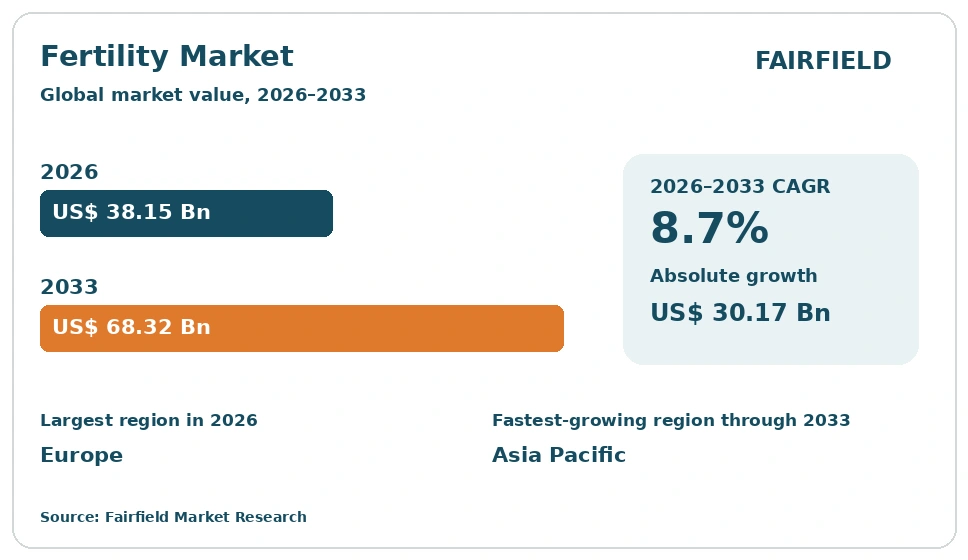
The global fertility market size is expected to be valued at US$ 38.15 billion in 2026 and projected to reach US$ 68.32 billion by 2033, growing at a CAGR of 8.7% between 2026 and 2033.
Between 2020 and 2025, the market grew at a CAGR of about 7.9%, as clinics paused treatment in early 2020, then demand rebounded strongly with delayed parenthood, wider insurance and employer coverage, and rapid growth of clinic networks. The fertility market covers products and services that help people conceive or preserve their ability to have children. It includes assisted reproductive technology such as IVF treatment, intracytoplasmic sperm injection, and frozen embryo transfer, along with intrauterine insemination, egg and sperm freezing, donor programs, and fertility drugs and hormonal therapy. Products include culture media, consumables, incubators, microscopes, and genetic and diagnostic tests. Services are delivered by fertility clinics, hospitals, surgical centers, and cryobanks. Growth comes from later childbearing, falling fertility rates, rising awareness, and broader insurance coverage. In November 2026, Ivy Fertility acquired six Kindbody clinic locations in the United States.
Key Report Takeaways
- By Treatment Type: Assisted Reproductive Technology held about 62% share in 2025, while Fertility Preservation is projected to expand at a 12.1% CAGR through 2033, driven by egg freezing among working women, employer benefits, and preservation before cancer treatment.
- By Product and Service Type: Clinic Services held about 58% share in 2025, while Fertility Drugs is projected to expand at a 9.5% CAGR through 2033, driven by more IVF cycles, ovarian stimulation protocols, and lower drug prices through new purchasing programs.
- By End User: Fertility Clinics held about 67% share in 2025, while Hospitals is projected to expand at a 9.6% CAGR through 2033, driven by integrated reproductive medicine departments, public funding programs, and hospital-based IVF units in emerging markets.
- By Region: Europe held about 34% share in 2025, while Asia Pacific is projected to expand at a 10.4% CAGR through 2033, driven by rising infertility, government support for births, and fast clinic growth in China, India, and Japan.
Global Fertility Market Trends and Insights
Drivers Impact Analysis
Two drivers carry the strongest influence on fertility market demand during the forecast period.
| Driver | Impact on CAGR Forecast | Geographic Relevance | Impact Timeline |
| Delayed parenthood and rising infertility | High | Global | Long term (≥4 years) |
| Wider insurance, employer, and government support | Medium | North America, Europe, Asia Pacific | Medium term (2-4 years) |
Delayed Parenthood Is Driving the Fertility Market
Delayed parenthood and rising infertility are the strongest driver of the fertility market. More people need help to conceive.
The mechanism is the link between age and fertility. People in most countries are marrying and having children later because of education, careers, housing costs, and changing social norms, and a woman’s fertility declines significantly after her mid-thirties. About one in six adults worldwide experiences infertility at some point, according to the World Health Organization. Obesity, diabetes, polycystic ovary syndrome, endometriosis, and falling sperm quality add to the problem. Same-sex couples and single parents increasingly use donor eggs, donor sperm, and gestational carriers to build families. As a result, more people are turning to IVF treatment and other services, and the number of IVF cycles performed worldwide continues to rise each year. These trends support long-term demand.
Wider Support Is Expanding the Fertility Market
Wider insurance, employer, and government support is expanding the fertility market. Treatment is becoming more affordable.
The cause is policy action on low birth rates and workplace competition. Countries such as Japan, China, South Korea, Singapore, and several in Europe now fund or subsidize IVF to address falling births. In the United States, more states require insurance coverage, and large employers offer fertility benefits through managers such as Progyny and Carrot Fertility. In October 2025, the White House announced a deal with EMD Serono to lower prices for IVF drugs through a direct purchase program. Telehealth consultations, financing plans, and lower-cost clinic models such as mild stimulation IVF also widen access. Public awareness campaigns encourage earlier testing for both women and men. These trends expand sales.
Restraints Impact Analysis
Two restraints limit how quickly the fertility market grows.
| Restraint | Impact on CAGR Forecast | Geographic Relevance | Impact Timeline |
| High treatment costs and limited coverage | High | Global | Long term (≥4 years) |
| Legal, ethical, and regulatory restrictions | Medium | North America, Europe, Middle East & Africa | Medium term (2-4 years) |
High Costs Slow the Fertility Market
High treatment costs and limited coverage slow the fertility market. Many people cannot afford treatment.
The specific causes are expensive procedures and low success per cycle. A single IVF cycle in the United States often costs more than US$ 15,000 before drugs, and many patients need several cycles to achieve a pregnancy. Success rates fall sharply with age, so older patients often need donor eggs, which add further cost. Many insurance plans exclude fertility treatment or limit the number of covered cycles, and public funding in many countries has strict age and eligibility limits. Patients in India, Brazil, Indonesia, and Nigeria usually pay out of pocket. Travel for treatment adds to costs for people in rural areas. These factors slow growth by limiting access to people with higher incomes or generous benefits.
Regulatory Restrictions Restrict the Fertility Market
Legal, ethical, and regulatory restrictions restrict the fertility market. Rules on treatment vary widely.
The underlying causes are differing laws and views on embryos, donors, and surrogacy. Some countries ban or limit egg donation, surrogacy, or treatment for single people and same-sex couples, and legal questions about embryo status in parts of the United States have created uncertainty. Rules on genetic testing of embryos, donor anonymity, and the number of embryos that can be transferred also vary from country to country. Some patients travel abroad to avoid strict national rules, which shifts revenue between markets. Strict laboratory licensing and inspection requirements raise costs for new clinics. Shortages of trained embryologists and reproductive specialists limit how quickly clinics can expand. Debates over surrogacy and donor payments continue in many countries. These factors restrict growth.
Market Opportunities
Fertility Preservation Opens a Fast-Growth Revenue Pool
Fertility preservation opens a fast-growth revenue pool in the fertility market. More people are freezing eggs and embryos.
Providers can capture this opportunity. Egg freezing has become a mainstream option for women who want to delay parenthood, and improved vitrification techniques have raised success rates. Large employers in North America and Europe now cover egg freezing as a benefit, and awareness campaigns are reaching younger women through social media. Cancer patients freeze eggs, sperm, or ovarian tissue before chemotherapy, and transgender people preserve fertility before gender-affirming treatment. Cryobanks and preservation centers need long-term storage, creating recurring annual revenue. In March 2026, CSG.BIO acquired Hanabusa IVF and Asian Egg Bank to expand its fertility and preservation network. Companies offering affordable freezing, storage, and counseling can grow quickly.
Clinic Networks and Emerging Markets Create a Growth Revenue Pool
Clinic networks and emerging markets create a growth revenue pool in the fertility market. Demand is outpacing clinic capacity in many countries.
Operators can capture this opportunity. Investors are building multi-site clinic networks that share laboratories, staff, and technology to lower costs and improve results. In November 2026, Ivy Fertility reached 35 locations in 12 states after buying six Kindbody sites. In India, China, Indonesia, and Vietnam, rising incomes and awareness are driving demand, and many cities still have few clinics. Artificial intelligence for embryo selection can raise success rates. Lower-cost models such as shared laboratories and mild stimulation protocols can reach middle-income patients. Partnerships with employers and insurers bring steady patient referrals. Companies that expand networks with standard quality and transparent pricing can gain share.
Segment Analysis
By Treatment Type: Assisted Reproductive Technology Leads While Fertility Preservation Grows Fastest
Assisted Reproductive Technology held about 62% share in 2025. Assisted reproductive technology includes IVF, intracytoplasmic sperm injection, frozen embryo transfer, and donor egg and embryo cycles, and it delivers the highest success rates for many types of infertility. Frozen embryo transfers have become more common as freezing methods improved, and genetic testing of embryos is widely used in some markets.
Fertility Preservation is the fastest-growing treatment type, expanding at a 12.1% CAGR through 2033. Egg, sperm, and embryo freezing for social and medical reasons is rising quickly, supported by employer benefits and better freezing results. Artificial insemination, including intrauterine insemination, and fertility drugs and hormonal therapy form other segments, often used as first steps before IVF. For the market, preservation growth adds recurring storage revenue.
By Product and Service Type: Clinic Services Lead While Fertility Drugs Grow Fastest
Clinic Services held about 58% share in 2025. Consultations, monitoring, egg retrieval, laboratory work, embryo transfer, and storage are delivered by fertility clinics and hospitals, and they account for most patient spending. Large clinic networks such as IVI RMA Global, Virtus Health, and Monash IVF Group operate across many countries.
Fertility Drugs is the fastest-growing product and service type, expanding at a 9.5% CAGR through 2033. Gonadotropins, ovulation triggers, and hormonal support from Merck KGaA, Ferring, Organon, and Gedeon Richter are needed in nearly every IVF cycle, and lower prices are widening access. Consumables and culture media, equipment, and testing and diagnostics form other segments. For the market, drug growth follows rising cycle numbers.
By End User: Fertility Clinics Lead While Hospitals Grow Fastest
Fertility Clinics held about 67% share in 2025. Specialized clinics perform most IVF and preservation procedures, offering dedicated laboratories, specialist doctors, and patient support, and private equity investment has created large regional and national networks.
Hospitals is the fastest-growing end user, expanding at a 9.6% CAGR through 2033. Public and university hospitals are adding reproductive medicine units, especially in Asia Pacific and Europe, where governments fund treatment. Hospitals also treat underlying conditions such as endometriosis, fibroids, and blocked tubes, and they manage complex and high-risk pregnancies after treatment. Surgical centers, cryobanks and preservation centers, and research institutes form other end users, with cryobanks growing alongside egg freezing and donor programs. For the market, hospital growth widens public access.
Geography Analysis
North America Shapes the Fertility Market Through Employer Benefits and Clinic Networks
North America is a major fertility market. The United States performs a large number of IVF cycles each year, with high prices, advanced laboratories, and wide use of embryo genetic testing. Employer fertility benefits through Progyny and others are expanding, and more states require insurance coverage. Clinic networks such as Ivy Fertility, US Fertility, and IVI RMA are consolidating the market. CooperSurgical and other suppliers are based in the region. Canada adds public funding in some provinces, including Ontario and Quebec. Key barriers include high costs and legal uncertainty over embryos. One change shaping the region is lower drug prices.
Which Region Is Leading the Fertility Market?
Europe is leading the fertility market with about 34% share in 2025. Spain, France, Germany, the United Kingdom, Italy, Belgium, and Denmark perform large numbers of treatment cycles, and many countries fund IVF through public health systems. Spain is a major destination for patients from other countries seeking donor eggs. Merck KGaA, Ferring, Vitrolife, and Gedeon Richter are based in the region, and clinic groups such as IVI RMA and Eugin operate widely. Key barriers include different national laws and age limits. One change shaping the region is cross-border fertility care.
Which Region Is Growing Fastest in the Fertility Market?
Asia Pacific is growing fastest in the fertility market, expanding at a 10.4% CAGR through 2033. China has a very large number of IVF cycles and new policies to support births, including insurance coverage for some treatments. Japan began covering IVF under national insurance in 2022, and South Korea and Singapore fund treatment to address very low birth rates. India has a fast-growing private clinic market, with chains such as Indira IVF expanding rapidly, while Australia has established networks such as Monash IVF and Virtus. Key barriers include cost and uneven regulation. One change shaping the region is government support.
Latin America Grows the Fertility Market Through Private Clinics
Latin America is a growing fertility market. Brazil, Mexico, Argentina, Colombia, and Chile have growing private clinic networks, and Mexico attracts patients from the United States seeking lower-cost treatment. Argentina has a law requiring coverage of fertility treatment, and Brazil has a large number of IVF clinics in major cities. Clinic groups are investing in modern laboratories and egg banks, and regional networks operate across several countries. Key barriers include high out-of-pocket costs, economic swings, uneven regulation, and limited public funding in most countries. One opportunity is fertility tourism from North America.
Middle East & Africa Builds the Fertility Market Through High Demand and Investment
Middle East & Africa is a growing fertility market. Israel has one of the world’s highest rates of IVF use, with generous public funding, while Saudi Arabia, the United Arab Emirates, and Egypt have large and growing clinic sectors serving strong demand for children. South Africa and Nigeria have expanding private clinics, and Ghana and Kenya are seeing new IVF centers open in major cities. Government programs in the United Arab Emirates and Saudi Arabia fund treatment for citizens. Key barriers include religious and legal limits on donor treatment and cost. One opportunity is new clinic networks in wealthy countries.
Competitive Landscape
The fertility market is highly fragmented. Merck KGaA (EMD Serono), CooperSurgical, Vitrolife Group, IVI RMA Global, and Ferring Pharmaceuticals are leading players, while Organon, Gedeon Richter, FUJIFILM Irvine Scientific, Thermo Fisher Scientific, Progyny, Virtus Health, and Monash IVF Group compete strongly. Drug and device companies supply medicines, culture media, consumables, and laboratory equipment, while thousands of independent clinics and a growing number of large networks deliver treatment.
Companies compete on success rates, price, patient experience, laboratory quality, access to donor programs, and insurance and employer partnerships. Drug makers compete on efficacy, convenience, and price, while device and media suppliers focus on laboratory results and reliability. Clinic networks backed by private equity are buying independent practices to gain scale, share laboratory expertise, and negotiate better contracts with payers and benefits managers.
Strategic moves show how competition is changing. In October 2025, the White House announced a deal with EMD Serono to lower IVF drug prices. In March 2026, CSG.BIO acquired Hanabusa IVF and Asian Egg Bank to expand its fertility and preservation platform. In November 2026, Ivy Fertility bought six Kindbody clinic locations, reaching 35 sites. These moves show competition shifting toward lower costs, wider access, and clinic consolidation.
Three themes shape vendor strategy. First, clinic operators are consolidating to gain scale and improve results. Second, companies are investing in fertility preservation and donor services. Third, they are expanding in Asia Pacific, where government support and demand are rising fastest.
Fertility Market Industry Leaders
- Merck KGaA (EMD Serono)
- CooperSurgical
- Vitrolife Group
- IVI RMA Global
- Ferring Pharmaceuticals
Recent Industry Developments
- November 2026: Ivy Fertility acquired six Kindbody clinic locations in the Midwest of the United States, reopening them as Sage Reproductive Center and reaching 35 locations in 12 states - shows consolidation in the fertility market.
- March 2026: CSG.BIO acquired Hanabusa IVF and Asian Egg Bank, adding a San Diego clinic and donor egg services to its fertility and preservation platform - expands assisted reproductive technology services.
- October 2025: The White House announced an agreement with EMD Serono to lower prices for IVF drugs through a direct purchase program - aims to make IVF treatment more affordable.
Companies Covered in the Report
- Merck KGaA (EMD Serono)
- CooperSurgical
- Vitrolife Group
- IVI RMA Global
- Ferring Pharmaceuticals
- Organon
- Gedeon Richter
- FUJIFILM Irvine Scientific
- Thermo Fisher Scientific
- Progyny
- Virtus Health
- Monash IVF Group
Fertility Market Report Scope
This report covers the fertility market, including assisted reproductive technology, artificial insemination, fertility preservation, and fertility drugs and hormonal therapy, spanning clinic services, fertility drugs, consumables and media, equipment, and testing, delivered through fertility clinics, hospitals, surgical centers, cryobanks, and research institutes. The base year is 2025, and the forecast period runs from 2026 to 2033. All values are expressed in US$ Billion.
| Treatment Type | Assisted Reproductive Technology, Artificial Insemination, Fertility Preservation, Fertility Drugs and Hormonal Therapy |
| Product and Service Type | Clinic Services, Fertility Drugs, Consumables and Media, Equipment, Testing and Diagnostics |
| End User | Fertility Clinics, Hospitals, Surgical Centers, Cryobanks and Preservation Centers, Research Institutes |
| Regions | North America, Europe, Asia Pacific, Latin America, Middle East & Africa |
1. Executive Summary
1.1 Global Fertility Market Snapshot
1.2 Future Projections, 2026–2033
1.3 Key Industry Highlights
1.4 Regional Snapshot
2. Market Overview
2.1 Market Definition and Report Scope
2.2 Historical Market Trends
2.3 Market Dynamics
2.3.1 Drivers
2.3.1.1 Delayed Parenthood Is Driving the Fertility Market
2.3.1.2 Wider Support Is Expanding the Fertility Market
2.3.2 Restraints
2.3.2.1 High Costs Slow the Fertility Market
2.3.2.2 Regulatory Restrictions Restrict the Fertility Market
2.3.3 Market Opportunities
2.3.3.1 Fertility Preservation Opens a Fast-Growth Revenue Pool
2.3.3.2 Clinic Networks and Emerging Markets Create a Growth Revenue Pool
3. Global Fertility Market Outlook, 2020–2033
3.1 Global Fertility Market Outlook, by Treatment Type, Value (US$ Billion), 2020–2033
3.1.1 Assisted Reproductive Technology
3.1.2 Artificial Insemination
3.1.3 Fertility Preservation
3.1.4 Fertility Drugs and Hormonal Therapy
3.2 Global Fertility Market Outlook, by Product and Service Type, Value (US$ Billion), 2020–2033
3.2.1 Clinic Services
3.2.2 Fertility Drugs
3.2.3 Consumables and Media
3.2.4 Equipment
3.2.5 Testing and Diagnostics
3.3 Global Fertility Market Outlook, by End User, Value (US$ Billion), 2020–2033
3.3.1 Fertility Clinics
3.3.2 Hospitals
3.3.3 Surgical Centers
3.3.4 Cryobanks and Preservation Centers
3.3.5 Research Institutes
3.4 Global Fertility Market Outlook, by Region, Value (US$ Billion), 2020–2033
3.4.1 North America
3.4.2 Europe
3.4.3 Asia Pacific
3.4.4 Latin America
3.4.5 Middle East & Africa
4. North America Fertility Market Outlook, 2020–2033
4.1 North America Fertility Market Outlook, by Treatment Type, Value (US$ Billion), 2020–2033
4.1.1 Assisted Reproductive Technology
4.1.2 Artificial Insemination
4.1.3 Fertility Preservation
4.1.4 Fertility Drugs and Hormonal Therapy
4.2 North America Fertility Market Outlook, by Product and Service Type, Value (US$ Billion), 2020–2033
4.2.1 Clinic Services
4.2.2 Fertility Drugs
4.2.3 Consumables and Media
4.2.4 Equipment
4.2.5 Testing and Diagnostics
4.3 North America Fertility Market Outlook, by End User, Value (US$ Billion), 2020–2033
4.3.1 Fertility Clinics
4.3.2 Hospitals
4.3.3 Surgical Centers
4.3.4 Cryobanks and Preservation Centers
4.3.5 Research Institutes
4.4 North America Fertility Market Outlook, by Country, Value (US$ Billion), 2020–2033
4.4.1 United States Fertility Market Outlook, by Treatment Type, 2020–2033
4.4.2 United States Fertility Market Outlook, by Product and Service Type, 2020–2033
4.4.3 United States Fertility Market Outlook, by End User, 2020–2033
4.4.4 Canada Fertility Market Outlook, by Treatment Type, 2020–2033
4.4.5 Canada Fertility Market Outlook, by Product and Service Type, 2020–2033
4.4.6 Canada Fertility Market Outlook, by End User, 2020–2033
5. Europe Fertility Market Outlook, 2020–2033
5.1 Europe Fertility Market Outlook, by Treatment Type, Value (US$ Billion), 2020–2033
5.1.1 Assisted Reproductive Technology
5.1.2 Artificial Insemination
5.1.3 Fertility Preservation
5.1.4 Fertility Drugs and Hormonal Therapy
5.2 Europe Fertility Market Outlook, by Product and Service Type, Value (US$ Billion), 2020–2033
5.2.1 Clinic Services
5.2.2 Fertility Drugs
5.2.3 Consumables and Media
5.2.4 Equipment
5.2.5 Testing and Diagnostics
5.3 Europe Fertility Market Outlook, by End User, Value (US$ Billion), 2020–2033
5.3.1 Fertility Clinics
5.3.2 Hospitals
5.3.3 Surgical Centers
5.3.4 Cryobanks and Preservation Centers
5.3.5 Research Institutes
5.4 Europe Fertility Market Outlook, by Country, Value (US$ Billion), 2020–2033
5.4.1 Spain Fertility Market Outlook, by Treatment Type, 2020–2033
5.4.2 Spain Fertility Market Outlook, by Product and Service Type, 2020–2033
5.4.3 Spain Fertility Market Outlook, by End User, 2020–2033
5.4.4 France Fertility Market Outlook, by Treatment Type, 2020–2033
5.4.5 France Fertility Market Outlook, by Product and Service Type, 2020–2033
5.4.6 France Fertility Market Outlook, by End User, 2020–2033
5.4.7 Germany Fertility Market Outlook, by Treatment Type, 2020–2033
5.4.8 Germany Fertility Market Outlook, by Product and Service Type, 2020–2033
5.4.9 Germany Fertility Market Outlook, by End User, 2020–2033
5.4.10 United Kingdom Fertility Market Outlook, by Treatment Type, 2020–2033
5.4.11 United Kingdom Fertility Market Outlook, by Product and Service Type, 2020–2033
5.4.12 United Kingdom Fertility Market Outlook, by End User, 2020–2033
5.4.13 Italy Fertility Market Outlook, by Treatment Type, 2020–2033
5.4.14 Italy Fertility Market Outlook, by Product and Service Type, 2020–2033
5.4.15 Italy Fertility Market Outlook, by End User, 2020–2033
5.4.16 Belgium Fertility Market Outlook, by Treatment Type, 2020–2033
5.4.17 Belgium Fertility Market Outlook, by Product and Service Type, 2020–2033
5.4.18 Belgium Fertility Market Outlook, by End User, 2020–2033
5.4.19 Denmark Fertility Market Outlook, by Treatment Type, 2020–2033
5.4.20 Denmark Fertility Market Outlook, by Product and Service Type, 2020–2033
5.4.21 Denmark Fertility Market Outlook, by End User, 2020–2033
6. Asia Pacific Fertility Market Outlook, 2020–2033
6.1 Asia Pacific Fertility Market Outlook, by Treatment Type, Value (US$ Billion), 2020–2033
6.1.1 Assisted Reproductive Technology
6.1.2 Artificial Insemination
6.1.3 Fertility Preservation
6.1.4 Fertility Drugs and Hormonal Therapy
6.2 Asia Pacific Fertility Market Outlook, by Product and Service Type, Value (US$ Billion), 2020–2033
6.2.1 Clinic Services
6.2.2 Fertility Drugs
6.2.3 Consumables and Media
6.2.4 Equipment
6.2.5 Testing and Diagnostics
6.3 Asia Pacific Fertility Market Outlook, by End User, Value (US$ Billion), 2020–2033
6.3.1 Fertility Clinics
6.3.2 Hospitals
6.3.3 Surgical Centers
6.3.4 Cryobanks and Preservation Centers
6.3.5 Research Institutes
6.4 Asia Pacific Fertility Market Outlook, by Country, Value (US$ Billion), 2020–2033
6.4.1 China Fertility Market Outlook, by Treatment Type, 2020–2033
6.4.2 China Fertility Market Outlook, by Product and Service Type, 2020–2033
6.4.3 China Fertility Market Outlook, by End User, 2020–2033
6.4.4 Japan Fertility Market Outlook, by Treatment Type, 2020–2033
6.4.5 Japan Fertility Market Outlook, by Product and Service Type, 2020–2033
6.4.6 Japan Fertility Market Outlook, by End User, 2020–2033
6.4.7 South Korea Fertility Market Outlook, by Treatment Type, 2020–2033
6.4.8 South Korea Fertility Market Outlook, by Product and Service Type, 2020–2033
6.4.9 South Korea Fertility Market Outlook, by End User, 2020–2033
6.4.10 Singapore Fertility Market Outlook, by Treatment Type, 2020–2033
6.4.11 Singapore Fertility Market Outlook, by Product and Service Type, 2020–2033
6.4.12 Singapore Fertility Market Outlook, by End User, 2020–2033
6.4.13 India Fertility Market Outlook, by Treatment Type, 2020–2033
6.4.14 India Fertility Market Outlook, by Product and Service Type, 2020–2033
6.4.15 India Fertility Market Outlook, by End User, 2020–2033
6.4.16 Australia Fertility Market Outlook, by Treatment Type, 2020–2033
6.4.17 Australia Fertility Market Outlook, by Product and Service Type, 2020–2033
6.4.18 Australia Fertility Market Outlook, by End User, 2020–2033
7. Latin America Fertility Market Outlook, 2020–2033
7.1 Latin America Fertility Market Outlook, by Treatment Type, Value (US$ Billion), 2020–2033
7.1.1 Assisted Reproductive Technology
7.1.2 Artificial Insemination
7.1.3 Fertility Preservation
7.1.4 Fertility Drugs and Hormonal Therapy
7.2 Latin America Fertility Market Outlook, by Product and Service Type, Value (US$ Billion), 2020–2033
7.2.1 Clinic Services
7.2.2 Fertility Drugs
7.2.3 Consumables and Media
7.2.4 Equipment
7.2.5 Testing and Diagnostics
7.3 Latin America Fertility Market Outlook, by End User, Value (US$ Billion), 2020–2033
7.3.1 Fertility Clinics
7.3.2 Hospitals
7.3.3 Surgical Centers
7.3.4 Cryobanks and Preservation Centers
7.3.5 Research Institutes
7.4 Latin America Fertility Market Outlook, by Country, Value (US$ Billion), 2020–2033
7.4.1 Brazil Fertility Market Outlook, by Treatment Type, 2020–2033
7.4.2 Brazil Fertility Market Outlook, by Product and Service Type, 2020–2033
7.4.3 Brazil Fertility Market Outlook, by End User, 2020–2033
7.4.4 Mexico Fertility Market Outlook, by Treatment Type, 2020–2033
7.4.5 Mexico Fertility Market Outlook, by Product and Service Type, 2020–2033
7.4.6 Mexico Fertility Market Outlook, by End User, 2020–2033
7.4.7 Argentina Fertility Market Outlook, by Treatment Type, 2020–2033
7.4.8 Argentina Fertility Market Outlook, by Product and Service Type, 2020–2033
7.4.9 Argentina Fertility Market Outlook, by End User, 2020–2033
7.4.10 Colombia Fertility Market Outlook, by Treatment Type, 2020–2033
7.4.11 Colombia Fertility Market Outlook, by Product and Service Type, 2020–2033
7.4.12 Colombia Fertility Market Outlook, by End User, 2020–2033
7.4.13 Chile Fertility Market Outlook, by Treatment Type, 2020–2033
7.4.14 Chile Fertility Market Outlook, by Product and Service Type, 2020–2033
7.4.15 Chile Fertility Market Outlook, by End User, 2020–2033
8. Middle East & Africa Fertility Market Outlook, 2020–2033
8.1 Middle East & Africa Fertility Market Outlook, by Treatment Type, Value (US$ Billion), 2020–2033
8.1.1 Assisted Reproductive Technology
8.1.2 Artificial Insemination
8.1.3 Fertility Preservation
8.1.4 Fertility Drugs and Hormonal Therapy
8.2 Middle East & Africa Fertility Market Outlook, by Product and Service Type, Value (US$ Billion), 2020–2033
8.2.1 Clinic Services
8.2.2 Fertility Drugs
8.2.3 Consumables and Media
8.2.4 Equipment
8.2.5 Testing and Diagnostics
8.3 Middle East & Africa Fertility Market Outlook, by End User, Value (US$ Billion), 2020–2033
8.3.1 Fertility Clinics
8.3.2 Hospitals
8.3.3 Surgical Centers
8.3.4 Cryobanks and Preservation Centers
8.3.5 Research Institutes
8.4 Middle East & Africa Fertility Market Outlook, by Country, Value (US$ Billion), 2020–2033
8.4.1 Israel Fertility Market Outlook, by Treatment Type, 2020–2033
8.4.2 Israel Fertility Market Outlook, by Product and Service Type, 2020–2033
8.4.3 Israel Fertility Market Outlook, by End User, 2020–2033
8.4.4 Saudi Arabia Fertility Market Outlook, by Treatment Type, 2020–2033
8.4.5 Saudi Arabia Fertility Market Outlook, by Product and Service Type, 2020–2033
8.4.6 Saudi Arabia Fertility Market Outlook, by End User, 2020–2033
8.4.7 United Arab Emirates Fertility Market Outlook, by Treatment Type, 2020–2033
8.4.8 United Arab Emirates Fertility Market Outlook, by Product and Service Type, 2020–2033
8.4.9 United Arab Emirates Fertility Market Outlook, by End User, 2020–2033
8.4.10 Egypt Fertility Market Outlook, by Treatment Type, 2020–2033
8.4.11 Egypt Fertility Market Outlook, by Product and Service Type, 2020–2033
8.4.12 Egypt Fertility Market Outlook, by End User, 2020–2033
8.4.13 South Africa Fertility Market Outlook, by Treatment Type, 2020–2033
8.4.14 South Africa Fertility Market Outlook, by Product and Service Type, 2020–2033
8.4.15 South Africa Fertility Market Outlook, by End User, 2020–2033
8.4.16 Nigeria Fertility Market Outlook, by Treatment Type, 2020–2033
8.4.17 Nigeria Fertility Market Outlook, by Product and Service Type, 2020–2033
8.4.18 Nigeria Fertility Market Outlook, by End User, 2020–2033
8.4.19 Ghana Fertility Market Outlook, by Treatment Type, 2020–2033
8.4.20 Ghana Fertility Market Outlook, by Product and Service Type, 2020–2033
8.4.21 Ghana Fertility Market Outlook, by End User, 2020–2033
8.4.22 Kenya Fertility Market Outlook, by Treatment Type, 2020–2033
8.4.23 Kenya Fertility Market Outlook, by Product and Service Type, 2020–2033
8.4.24 Kenya Fertility Market Outlook, by End User, 2020–2033
9. Competitive Landscape
9.1 Industry Leaders
9.2 Recent Industry Developments
9.3 Company Profiles
9.3.1 Merck KGaA (EMD Serono)
9.3.2 CooperSurgical
9.3.3 Vitrolife Group
9.3.4 IVI RMA Global
9.3.5 Ferring Pharmaceuticals
9.3.6 Organon
9.3.7 Gedeon Richter
9.3.8 FUJIFILM Irvine Scientific
9.3.9 Thermo Fisher Scientific
9.3.10 Progyny
9.3.11 Virtus Health
9.3.12 Monash IVF Group
10. Appendix
10.1 Research Methodology
10.2 Report Assumptions
10.3 Acronyms and Abbreviations
| Treatment Type | Assisted Reproductive Technology, Artificial Insemination, Fertility Preservation, Fertility Drugs and Hormonal Therapy |
| Product and Service Type | Clinic Services, Fertility Drugs, Consumables and Media, Equipment, Testing and Diagnostics |
| End User | Fertility Clinics, Hospitals, Surgical Centers, Cryobanks and Preservation Centers, Research Institutes |
| Regions | North America, Europe, Asia Pacific, Latin America, Middle East & Africa |
Our Research Methodology
Considering the volatility of business today, traditional approaches to strategizing a game plan can be unfruitful if not detrimental. True ambiguity is no way to determine a forecast. A myriad of predetermined factors must be accounted for such as the degree of risk involved, the magnitude of circumstances, as well as conditions or consequences that are not known or unpredictable. To circumvent binary views that cast uncertainty, the application of market research intelligence to strategically posture, move, and enable actionable outcomes is necessary.
View Methodology
Quality Assured
Rigorous Validation Process

Confidentiality Assured
End-to-end Data Security

Custom Research Services
Tailored To Your Objectives
FAQs
The fertility market is valued at US$ 38.15 billion in 2026, led by assisted reproductive technology, fertility clinics, and Europe.
The market is projected to reach US$ 68.32 billion by 2033, growing at an 8.7% CAGR and adding US$ 30.17 billion.
Fertility preservation is growing fastest at a 12.1% CAGR through 2033, driven by egg freezing, employer benefits, and cancer patient preservation.
Asia Pacific is growing fastest at a 10.4% CAGR through 2033, driven by government support and clinic growth in China and India.
Europe holds the largest share at about 34% in 2025, supported by public IVF funding, many clinics, and cross-border fertility care.
Related Reports
Pantoprazole Sodium Market Size, Share, Insights, Competitive Landscape, and Forecast 2026 to 2033
The global pantoprazole sodium market is valued at US$2.36 billion in 2026, reaching US$3.57 billion by 2033, growing at a 6.1% CAGR
Immunotherapy Market Size, Share, Insights, Competitive Landscape, and Forecast 2026 to 2033
The global immunotherapy market is valued at US$274.5 billion in 2026, reaching US$521.4 billion by 2033, growing at a 9.6% CAGR
Hydroxychloroquine Market Size, Share, Insights, Competitive Landscape, and Forecast 2026 to 2033
The global hydroxychloroquine market is valued at US$1.71 billion in 2026, reaching US$2.66 billion by 2033, growing at a 6.6% CAGR
Hormone Replacement Therapy Market Size, Share, Insights, Competitive Landscape, and Forecast 2026 to 2033
The global hormone replacement therapy market is valued at US$27.3 billion in 2026, reaching US$45.6 billion by 2033, growing at a 7.6% CAGR
Healthcare Regulatory Affairs Outsourcing Market Size, Share, Insights, Competitive Landscape, and Forecast 2026 to 2033
The global healthcare regulatory affairs outsourcing market is valued at US$8.6 billion in 2026, reaching US$17.6 billion by 2033, growing at a 10.8% CAGR
Genetic Disease Therapy Market Size, Share, Insights, Competitive Landscape, and Forecast 2026 to 2033
The global genetic disease therapy market is valued at US$18.6 billion in 2026, reaching US$39.6 billion by 2033, growing at an 11.4% CAGR