



Hydroxychloroquine Market
Hydroxychloroquine Market Size, Share, Insights, Competitive Landscape, and Forecast 2026 to 2033
Hydroxychloroquine Market Size and Trend Analysis
How Fast Is the Hydroxychloroquine Market Growing?
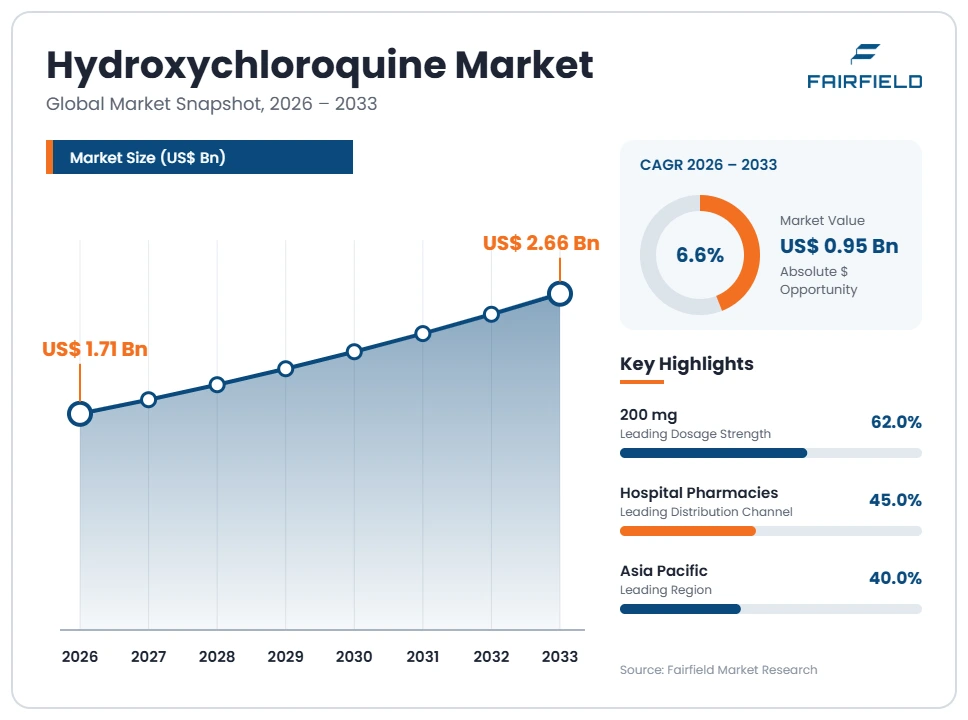
The global hydroxychloroquine market size is expected to be valued at US$ 1.71 billion in 2026 and projected to reach US$ 2.66 billion by 2033, growing at a CAGR of 6.6% between 2026 and 2033.
Between 2020 and 2025, the market moved sharply, as demand spiked in 2020 during early COVID-19 use and stockpiling, causing shortages, then fell back once trials showed no benefit for COVID-19, before steady growth resumed in its core uses. The hydroxychloroquine market covers hydroxychloroquine sulfate, an oral medicine sold mainly as 200 mg tablets under the Plaquenil brand and many generic names, along with 300 mg and 400 mg strengths and active ingredient. It is one of the oldest antimalarial drugs and is now used mostly as a disease-modifying treatment for rheumatoid arthritis, systemic lupus erythematosus, discoid lupus, Sjögren’s disease, and other autoimmune conditions, as well as for malaria prevention and treatment. It is a cornerstone of lupus treatment because it reduces flares and improves survival. Growth comes from rising autoimmune disease diagnosis and low-cost generics. In August 2025, the American College of Rheumatology recommended hydroxychloroquine for all lupus patients.
Key Report Takeaways
- By Application: Malaria held about 38% share in 2025, while Lupus is projected to expand at a 7.4% CAGR through 2033, driven by updated guidelines recommending hydroxychloroquine for nearly every lupus patient and rising diagnosis among women worldwide.
- By Dosage Strength: 200 mg held about 62% share in 2025, while 400 mg is projected to expand at a 7.2% CAGR through 2033, driven by once-daily dosing convenience, weight-based prescribing, and better adherence among long-term users.
- By Distribution Channel: Hospital Pharmacies held about 45% share in 2025, while Online Pharmacies is projected to expand at a 9.2% CAGR through 2033, driven by repeat prescriptions for chronic conditions, home delivery, and lower prices for generics.
- By Region: Asia Pacific held about 40% share in 2025, while India is projected to expand at a 7.9% CAGR through 2033, driven by a large patient base, strong domestic manufacturing, malaria programs, and rising rheumatology care.
Global Hydroxychloroquine Market Trends and Insights
Drivers Impact Analysis
Two drivers carry the strongest influence on hydroxychloroquine market demand during the forecast period.
| Driver | Impact on CAGR Forecast | Geographic Relevance | Impact Timeline |
| Rising prevalence and diagnosis of autoimmune diseases | High | Global | Long term (≥4 years) |
| Malaria burden and public health programs | Medium | Asia Pacific, Middle East & Africa, Latin America | Medium term (2-4 years) |
Autoimmune Disease Is Driving the Hydroxychloroquine Market
Rising prevalence and diagnosis of autoimmune diseases is the strongest driver of the hydroxychloroquine market. More patients need long-term treatment.
The mechanism is the drug’s role as a first-line, long-term therapy. Rheumatoid arthritis affects tens of millions of people worldwide, and lupus mainly affects women of childbearing age, with higher rates in people of African, Asian, and Hispanic descent. Hydroxychloroquine calms the immune system with a good safety record, low cost, and few interactions, so doctors often prescribe it for years or for life. In August 2025, the American College of Rheumatology updated its lupus guideline, strongly recommending hydroxychloroquine for all lupus patients unless they cannot take it. It is also widely used in combination with methotrexate and sulfasalazine for rheumatoid arthritis. Better awareness, more rheumatologists, and improved blood tests are finding more patients earlier. These trends support steady, long-term demand.
Malaria Programs Are Expanding the Hydroxychloroquine Market
Malaria burden and public health programs are expanding the hydroxychloroquine market. Malaria remains a major health threat.
The cause is the continued spread of malaria in tropical regions. Hundreds of millions of malaria cases occur each year, mainly in Middle East & Africa and parts of Asia Pacific, and travelers from non-endemic countries need protection when visiting affected areas. Hydroxychloroquine remains useful for treating and preventing malaria in regions where parasites are still sensitive to it. Government and donor-funded malaria programs buy large volumes of affordable antimalarials. Climate change may expand the areas where malaria spreads. Low-cost generic production in India supports supply to public programs. Travel clinics in North America and Europe prescribe it for visitors to areas where parasites remain sensitive, and some military health services stock it for personnel. These trends expand sales of antimalarial drugs.
Restraints Impact Analysis
Two restraints limit how quickly the hydroxychloroquine market grows.
| Restraint | Impact on CAGR Forecast | Geographic Relevance | Impact Timeline |
| Eye toxicity and safety monitoring requirements | High | Global | Long term (≥4 years) |
| Drug resistance and generic price pressure | Medium | Middle East & Africa, Asia Pacific | Medium term (2-4 years) |
Safety Monitoring Slows the Hydroxychloroquine Market
Eye toxicity and safety monitoring requirements slow the hydroxychloroquine market. Long-term use carries some risks.
The specific causes are known side effects at high doses or over many years. Hydroxychloroquine can damage the retina, especially after more than five years of use or at doses above about 5 mg per kilogram of body weight a day, and this damage can be permanent. Guidelines require baseline and yearly eye exams after five years, which add cost and are hard to access in some countries. Heart rhythm problems, low blood sugar, and skin reactions can also occur. Concerns over heart effects grew during the COVID-19 period and remain on product labels. Doctors now prescribe lower doses than in the past, which reduces the amount of drug used per patient. These factors slow volume growth.
Resistance and Price Pressure Restrict the Hydroxychloroquine Market
Drug resistance and generic price pressure restrict the hydroxychloroquine market. Malaria parasites have adapted.
The underlying causes are widespread resistance and many suppliers. Chloroquine-resistant malaria is common across Middle East & Africa and much of Asia Pacific, so health agencies recommend artemisinin-based combination therapies instead for most cases. As a result, malaria use is shrinking in many countries and is now limited mainly to sensitive regions and travelers. Dozens of generic makers in India, China, Europe, and the United States compete on price, and government tenders push prices down further. Low margins discourage investment in new capacity and can lead to supply gaps when a producer exits. Newer biologic medicines for rheumatoid arthritis and lupus also compete for treatment budgets, though they are usually added to hydroxychloroquine rather than replacing it. These factors restrict growth.
Market Opportunities
Lupus and Autoimmune Care Open a Fast-Growth Revenue Pool
Lupus and autoimmune care open a fast-growth revenue pool in the hydroxychloroquine market. Guidelines now favor wider use.
Manufacturers can capture this opportunity. Updated lupus treatment guidelines recommend hydroxychloroquine as background therapy for nearly all patients, including during pregnancy, and new biologic drugs such as Roche’s Gazyva, approved for lupus nephritis in October 2025, are added on top of standard therapy rather than replacing it. Research is also exploring use in Sjögren’s disease, antiphospholipid syndrome, and pregnancy complications. Rising diagnosis in India, China, Brazil, and Middle East & Africa adds many new patients each year. Patient programs that support adherence and eye screening can help maintain long-term use. Companies with reliable, quality-assured supply and strong rheumatology networks can grow sales steadily.
New Formulations and Emerging Markets Create a Growth Revenue Pool
New formulations and emerging markets create a growth revenue pool in the hydroxychloroquine market. Patients want easier dosing.
Producers can capture this opportunity. Once-daily higher strengths, smaller coated tablets, and liquid forms for children and people who struggle to swallow can improve adherence over years of use. Transdermal patch technology is being explored to reduce stomach side effects and keep blood levels steady. Growing health insurance coverage in Asia Pacific, Latin America, and Middle East & Africa brings more patients into regular care. Branded generics are popular with doctors in India, Brazil, and Middle East & Africa, and pharmacies often recommend trusted local brands. Online pharmacies make it easier for patients in smaller towns to buy refills. Companies offering differentiated formats and branded generics can earn better margins.
Segment Analysis
- By Application: Malaria Leads While Lupus Grows Fastest
Malaria held about 38% share in 2025. Hydroxychloroquine is used to prevent and treat malaria in areas where parasites remain sensitive and as preventive medicine for travelers. Public health programs and travel clinics buy large volumes, and the drug’s low cost and long safety record keep it in use in some national programs.
Lupus is the fastest-growing application, expanding at a 7.4% CAGR through 2033. Guidelines in the United States and Europe recommend hydroxychloroquine for nearly all patients with systemic lupus erythematosus because it reduces flares, organ damage, and blood clot risk, and improves survival. Rheumatoid arthritis forms another large application, often in combination therapy, while Sjögren’s disease, skin conditions, and other uses form further segments. For the market, lupus growth adds long-term users.
- By Dosage Strength: 200 mg Leads While 400 mg Grows Fastest
200 mg held about 62% share in 2025. The 200 mg tablet is the standard strength worldwide and allows doctors to adjust doses by taking one, two, or a combination of tablets based on body weight. It is produced by many generic makers and is the most widely stocked form in pharmacies.
400 mg is the fastest-growing strength, expanding at a 7.2% CAGR through 2033. Once-daily 400 mg tablets reduce the number of pills patients take, which can improve adherence for long-term users with lupus or rheumatoid arthritis. The 300 mg strength forms another segment, supporting weight-based dosing that limits eye toxicity risk. Doctors increasingly calculate doses from actual body weight, which favors a wider range of strengths. For the market, higher-strength growth adds convenience value.
- By Distribution Channel: Hospital Pharmacies Lead While Online Pharmacies Grow Fastest
Hospital Pharmacies held about 45% share in 2025. Hospitals and specialist clinics start many patients on treatment for lupus and rheumatoid arthritis, and hospital pharmacies supply malaria programs and inpatient use. Public hospital tenders buy large volumes, and government programs supply malaria medicines through hospitals and clinics in endemic regions.
Online Pharmacies is the fastest-growing channel, expanding at a 9.2% CAGR through 2033. Patients on long-term therapy increasingly order refills online for convenience and lower prices, especially in India, China, the United States, and Europe. Retail pharmacies form another large channel, dispensing most outpatient prescriptions and offering generic substitution that lowers costs for patients and insurers. For the market, online growth supports adherence.
Geography Analysis
- Why Is North America Important to the Hydroxychloroquine Market?
North America is important to the hydroxychloroquine market because of high autoimmune disease diagnosis, strong specialist care, and guidelines that shape global practice. The United States has large numbers of patients with rheumatoid arthritis and lupus, and the American College of Rheumatology’s 2025 lupus guideline strongly recommends hydroxychloroquine for all patients. Generic makers such as Teva, Amneal, Viatris, Zydus, and Dr. Reddy’s supply most U.S. prescriptions. The 2020 shortage led to closer supply monitoring. Canada adds rheumatology demand. Key barriers include eye screening costs and low generic prices. One change shaping the region is wider use in lupus.
- Europe Shapes the Hydroxychloroquine Market Through Rheumatology Practice
Europe is a major hydroxychloroquine market. France, Germany, the United Kingdom, Italy, and Spain have large numbers of patients with lupus and rheumatoid arthritis, and European rheumatology guidelines recommend hydroxychloroquine for lupus patients. Sanofi, which owns the original Plaquenil brand, is based in France, and generic makers supply hospitals and pharmacies across the region. Travelers to malaria areas add preventive use, and national health systems cover the drug for chronic conditions. Key barriers include tender-based pricing, reference pricing rules, and eye screening requirements. One opportunity is supporting adherence in long-term lupus care.
- Which Region Is Leading the Hydroxychloroquine Market?
Asia Pacific is leading the hydroxychloroquine market with about 40% share in 2025, and India is the fastest-growing country, expanding at a 7.9% CAGR through 2033. India is the world’s leading producer of hydroxychloroquine active ingredient and tablets, with companies such as Ipca Laboratories, Zydus, Sun Pharma, Lupin, Cipla, Torrent, and Laurus Labs. Large populations, malaria in some areas, and rising rheumatology care in India, China, Indonesia, and Vietnam support demand. Japan approved hydroxychloroquine later than other countries and use is growing. Key barriers include price competition and limited eye screening. One change shaping the region is rising autoimmune diagnosis.
- Latin America Grows the Hydroxychloroquine Market Through Autoimmune Care
Latin America is a growing hydroxychloroquine market. Brazil, Mexico, Argentina, Colombia, and Peru have large numbers of lupus patients, with higher rates among people of mixed and indigenous descent, and public health systems supply hydroxychloroquine as a low-cost essential medicine. Malaria persists in parts of the Amazon basin, where public programs supply antimalarials. Local producers compete with imports from India, and lupus patient groups are pushing for better access to specialists. Key barriers include limited public budgets, uneven access to rheumatologists, and currency swings. One opportunity is expanding rheumatology services in public health systems.
- Middle East & Africa Builds the Hydroxychloroquine Market Through Malaria and Lupus Care
Middle East & Africa is a growing hydroxychloroquine market. Nigeria, the Democratic Republic of the Congo, Uganda, and Mozambique carry a large share of the world’s malaria burden, though resistance limits hydroxychloroquine use for treatment. Saudi Arabia, the United Arab Emirates, Egypt, and South Africa are expanding specialist care for lupus and rheumatoid arthritis, and lupus is common among women in many countries of the region. Local generic production is growing in Egypt and South Africa. Key barriers include drug resistance, limited specialist care, and reliance on imports. One opportunity is autoimmune disease care in growing urban hospitals.
Competitive Landscape
The hydroxychloroquine market is highly fragmented, with the top ten companies holding less than a quarter of sales. Sanofi, Sun Pharmaceutical Industries, Ipca Laboratories, Zydus Lifesciences, and Teva Pharmaceutical Industries are leading players, while Viatris, Dr. Reddy’s Laboratories, Amneal Pharmaceuticals, Lupin, Cipla, Torrent Pharmaceuticals, and Laurus Labs compete strongly. Sanofi owns the original Plaquenil brand, but generics supply most prescriptions worldwide, and many producers in India make both tablets and active ingredient.
Companies compete on price, manufacturing quality, regulatory approvals, supply reliability, and distribution reach. Integrated producers that make their own active ingredient have a cost advantage and can respond quickly to demand changes, as the 2020 shortage showed. Strong quality records matter because regulatory problems at one plant can disrupt supply in many countries, and buyers now favor suppliers with multiple sites.
Strategic moves show how competition is changing. In August 2025, the American College of Rheumatology updated its lupus guideline, strongly recommending hydroxychloroquine for all lupus patients. In October 2025, the FDA approved Roche’s Gazyva for lupus nephritis on top of standard therapy. In January 2026, supply reports showed no national shortage in the United States. These moves show steady demand as a background therapy.
Three themes shape vendor strategy. First, generic makers are securing active ingredient supply to protect margins. Second, they are offering higher-strength and easier-to-use formats. Third, they are expanding in Asia Pacific, Latin America, and Middle East & Africa, where autoimmune diagnosis is rising.
Hydroxychloroquine Market Industry Leaders
Sanofi Sun Pharmaceutical Industries Ipca Laboratories Zydus Lifesciences Teva Pharmaceutical Industries
Recent Industry Developments
- January 2026: Supply reports showed no active FDA-declared national shortage of hydroxychloroquine in the United States, with generic tablets supplied by Dr. Reddy’s, Viatris, Amneal, Zydus, and others - signals stable supply in the hydroxychloroquine market.
- October 2025: The FDA approved Roche’s Gazyva for lupus nephritis in combination with standard therapy - adds new options for lupus treatment alongside hydroxychloroquine background therapy.
- August 2025: The American College of Rheumatology published its first update to lupus treatment guidelines in more than two decades, strongly recommending hydroxychloroquine for all patients - supports long-term demand.
Companies Covered in the Report
- Sanofi
- Sun Pharmaceutical Industries
- Ipca Laboratories
- Zydus Lifesciences
- Teva Pharmaceutical Industries
- Viatris
- Dr. Reddy’s Laboratories
- Amneal Pharmaceuticals
- Lupin
- Cipla
- Torrent Pharmaceuticals
- Laurus Labs
Hydroxychloroquine Market Report Scope
| Metric | Value |
| Study Period | 2020-2033 |
| Market Size 2026 | US$ 1.71 Billion |
| Market Size 2033 | US$ 2.66 Billion |
| CAGR 2026-2033 | 6.6% |
| Absolute Dollar Opportunity | US$ 0.95 Billion |
| Largest Market | Asia Pacific |
| Fastest-Growing Market | India |
| Market Concentration | Highly Fragmented |
| Major Players | Sanofi, Sun Pharmaceutical Industries, Ipca Laboratories, Zydus Lifesciences, Teva Pharmaceutical Industries |
Hydroxychloroquine Market Segmentation
- Executive Summary
- Global Hydroxychloroquine Market Snapshot
- Future Projections, 2026–2033
- Key Industry Highlights
- Regional Snapshot
- Market Overview
- Market Definition and Report Scope
- Historical Market Trends
- Market Dynamics
- Drivers
- Autoimmune Disease Is Driving the Hydroxychloroquine Market
- Malaria Programs Are Expanding the Hydroxychloroquine Market
- Restraints
- Safety Monitoring Slows the Hydroxychloroquine Market
- Resistance and Price Pressure Restrict the Hydroxychloroquine Market
- Market Opportunities
- Lupus and Autoimmune Care Open a Fast-Growth Revenue Pool
- New Formulations and Emerging Markets Create a Growth Revenue Pool
- Drivers
- Global Hydroxychloroquine Market Outlook, 2020–2033
- Global Hydroxychloroquine Market Outlook, by Application, Value (US$ Billion), 2020–2033
- Malaria
- Lupus
- Rheumatoid Arthritis
- Others
- Global Hydroxychloroquine Market Outlook, by Dosage Strength, Value (US$ Billion), 2020–2033
- 200 mg
- 300 mg
- 400 mg
- Global Hydroxychloroquine Market Outlook, by Distribution Channel, Value (US$ Billion), 2020–2033
- Hospital Pharmacies
- Retail Pharmacies
- Online Pharmacies
- Global Hydroxychloroquine Market Outlook, by Region, Value (US$ Billion), 2020–2033
- North America
- Europe
- Asia Pacific
- Latin America
- Middle East & Africa
- Global Hydroxychloroquine Market Outlook, by Application, Value (US$ Billion), 2020–2033
- North America Hydroxychloroquine Market Outlook, 2020–2033
- North America Hydroxychloroquine Market Outlook, by Application, Value (US$ Billion), 2020–2033
- Malaria
- Lupus
- Rheumatoid Arthritis
- Others
- North America Hydroxychloroquine Market Outlook, by Dosage Strength, Value (US$ Billion), 2020–2033
- 200 mg
- 300 mg
- 400 mg
- North America Hydroxychloroquine Market Outlook, by Distribution Channel, Value (US$ Billion), 2020–2033
- Hospital Pharmacies
- Retail Pharmacies
- Online Pharmacies
- North America Hydroxychloroquine Market Outlook, by Country, Value (US$ Billion), 2020–2033
- United States Hydroxychloroquine Market Outlook, by Application, 2020–2033
- United States Hydroxychloroquine Market Outlook, by Dosage Strength, 2020–2033
- United States Hydroxychloroquine Market Outlook, by Distribution Channel, 2020–2033
- Canada Hydroxychloroquine Market Outlook, by Application, 2020–2033
- Canada Hydroxychloroquine Market Outlook, by Dosage Strength, 2020–2033
- Canada Hydroxychloroquine Market Outlook, by Distribution Channel, 2020–2033
- North America Hydroxychloroquine Market Outlook, by Application, Value (US$ Billion), 2020–2033
- Europe Hydroxychloroquine Market Outlook, 2020–2033
- Europe Hydroxychloroquine Market Outlook, by Application, Value (US$ Billion), 2020–2033
- Malaria
- Lupus
- Rheumatoid Arthritis
- Others
- Europe Hydroxychloroquine Market Outlook, by Dosage Strength, Value (US$ Billion), 2020–2033
- 200 mg
- 300 mg
- 400 mg
- Europe Hydroxychloroquine Market Outlook, by Distribution Channel, Value (US$ Billion), 2020–2033
- Hospital Pharmacies
- Retail Pharmacies
- Online Pharmacies
- Europe Hydroxychloroquine Market Outlook, by Country, Value (US$ Billion), 2020–2033
- France Hydroxychloroquine Market Outlook, by Application, 2020–2033
- France Hydroxychloroquine Market Outlook, by Dosage Strength, 2020–2033
- France Hydroxychloroquine Market Outlook, by Distribution Channel, 2020–2033
- Germany Hydroxychloroquine Market Outlook, by Application, 2020–2033
- Germany Hydroxychloroquine Market Outlook, by Dosage Strength, 2020–2033
- Germany Hydroxychloroquine Market Outlook, by Distribution Channel, 2020–2033
- United Kingdom Hydroxychloroquine Market Outlook, by Application, 2020–2033
- United Kingdom Hydroxychloroquine Market Outlook, by Dosage Strength, 2020–2033
- United Kingdom Hydroxychloroquine Market Outlook, by Distribution Channel, 2020–2033
- Italy Hydroxychloroquine Market Outlook, by Application, 2020–2033
- Italy Hydroxychloroquine Market Outlook, by Dosage Strength, 2020–2033
- Italy Hydroxychloroquine Market Outlook, by Distribution Channel, 2020–2033
- Spain Hydroxychloroquine Market Outlook, by Application, 2020–2033
- Spain Hydroxychloroquine Market Outlook, by Dosage Strength, 2020–2033
- Spain Hydroxychloroquine Market Outlook, by Distribution Channel, 2020–2033
- Europe Hydroxychloroquine Market Outlook, by Application, Value (US$ Billion), 2020–2033
- Asia Pacific Hydroxychloroquine Market Outlook, 2020–2033
- Asia Pacific Hydroxychloroquine Market Outlook, by Application, Value (US$ Billion), 2020–2033
- Malaria
- Lupus
- Rheumatoid Arthritis
- Others
- Asia Pacific Hydroxychloroquine Market Outlook, by Dosage Strength, Value (US$ Billion), 2020–2033
- 200 mg
- 300 mg
- 400 mg
- Asia Pacific Hydroxychloroquine Market Outlook, by Distribution Channel, Value (US$ Billion), 2020–2033
- Hospital Pharmacies
- Retail Pharmacies
- Online Pharmacies
- Asia Pacific Hydroxychloroquine Market Outlook, by Country, Value (US$ Billion), 2020–2033
- India Hydroxychloroquine Market Outlook, by Application, 2020–2033
- India Hydroxychloroquine Market Outlook, by Dosage Strength, 2020–2033
- India Hydroxychloroquine Market Outlook, by Distribution Channel, 2020–2033
- China Hydroxychloroquine Market Outlook, by Application, 2020–2033
- China Hydroxychloroquine Market Outlook, by Dosage Strength, 2020–2033
- China Hydroxychloroquine Market Outlook, by Distribution Channel, 2020–2033
- Indonesia Hydroxychloroquine Market Outlook, by Application, 2020–2033
- Indonesia Hydroxychloroquine Market Outlook, by Dosage Strength, 2020–2033
- Indonesia Hydroxychloroquine Market Outlook, by Distribution Channel, 2020–2033
- Vietnam Hydroxychloroquine Market Outlook, by Application, 2020–2033
- Vietnam Hydroxychloroquine Market Outlook, by Dosage Strength, 2020–2033
- Vietnam Hydroxychloroquine Market Outlook, by Distribution Channel, 2020–2033
- Japan Hydroxychloroquine Market Outlook, by Application, 2020–2033
- Japan Hydroxychloroquine Market Outlook, by Dosage Strength, 2020–2033
- Japan Hydroxychloroquine Market Outlook, by Distribution Channel, 2020–2033
- Asia Pacific Hydroxychloroquine Market Outlook, by Application, Value (US$ Billion), 2020–2033
- Latin America Hydroxychloroquine Market Outlook, 2020–2033
- Latin America Hydroxychloroquine Market Outlook, by Application, Value (US$ Billion), 2020–2033
- Malaria
- Lupus
- Rheumatoid Arthritis
- Others
- Latin America Hydroxychloroquine Market Outlook, by Dosage Strength, Value (US$ Billion), 2020–2033
- 200 mg
- 300 mg
- 400 mg
- Latin America Hydroxychloroquine Market Outlook, by Distribution Channel, Value (US$ Billion), 2020–2033
- Hospital Pharmacies
- Retail Pharmacies
- Online Pharmacies
- Latin America Hydroxychloroquine Market Outlook, by Country, Value (US$ Billion), 2020–2033
- Brazil Hydroxychloroquine Market Outlook, by Application, 2020–2033
- Brazil Hydroxychloroquine Market Outlook, by Dosage Strength, 2020–2033
- Brazil Hydroxychloroquine Market Outlook, by Distribution Channel, 2020–2033
- Mexico Hydroxychloroquine Market Outlook, by Application, 2020–2033
- Mexico Hydroxychloroquine Market Outlook, by Dosage Strength, 2020–2033
- Mexico Hydroxychloroquine Market Outlook, by Distribution Channel, 2020–2033
- Argentina Hydroxychloroquine Market Outlook, by Application, 2020–2033
- Argentina Hydroxychloroquine Market Outlook, by Dosage Strength, 2020–2033
- Argentina Hydroxychloroquine Market Outlook, by Distribution Channel, 2020–2033
- Colombia Hydroxychloroquine Market Outlook, by Application, 2020–2033
- Colombia Hydroxychloroquine Market Outlook, by Dosage Strength, 2020–2033
- Colombia Hydroxychloroquine Market Outlook, by Distribution Channel, 2020–2033
- Peru Hydroxychloroquine Market Outlook, by Application, 2020–2033
- Peru Hydroxychloroquine Market Outlook, by Dosage Strength, 2020–2033
- Peru Hydroxychloroquine Market Outlook, by Distribution Channel, 2020–2033
- Latin America Hydroxychloroquine Market Outlook, by Application, Value (US$ Billion), 2020–2033
- Middle East & Africa Hydroxychloroquine Market Outlook, 2020–2033
- Middle East & Africa Hydroxychloroquine Market Outlook, by Application, Value (US$ Billion), 2020–2033
- Malaria
- Lupus
- Rheumatoid Arthritis
- Others
- Middle East & Africa Hydroxychloroquine Market Outlook, by Dosage Strength, Value (US$ Billion), 2020–2033
- 200 mg
- 300 mg
- 400 mg
- Middle East & Africa Hydroxychloroquine Market Outlook, by Distribution Channel, Value (US$ Billion), 2020–2033
- Hospital Pharmacies
- Retail Pharmacies
- Online Pharmacies
- Middle East & Africa Hydroxychloroquine Market Outlook, by Country, Value (US$ Billion), 2020–2033
- Nigeria Hydroxychloroquine Market Outlook, by Application, 2020–2033
- Nigeria Hydroxychloroquine Market Outlook, by Dosage Strength, 2020–2033
- Nigeria Hydroxychloroquine Market Outlook, by Distribution Channel, 2020–2033
- Saudi Arabia Hydroxychloroquine Market Outlook, by Application, 2020–2033
- Saudi Arabia Hydroxychloroquine Market Outlook, by Dosage Strength, 2020–2033
- Saudi Arabia Hydroxychloroquine Market Outlook, by Distribution Channel, 2020–2033
- United Arab Emirates Hydroxychloroquine Market Outlook, by Application, 2020–2033
- United Arab Emirates Hydroxychloroquine Market Outlook, by Dosage Strength, 2020–2033
- United Arab Emirates Hydroxychloroquine Market Outlook, by Distribution Channel, 2020–2033
- Egypt Hydroxychloroquine Market Outlook, by Application, 2020–2033
- Egypt Hydroxychloroquine Market Outlook, by Dosage Strength, 2020–2033
- Egypt Hydroxychloroquine Market Outlook, by Distribution Channel, 2020–2033
- South Africa Hydroxychloroquine Market Outlook, by Application, 2020–2033
- South Africa Hydroxychloroquine Market Outlook, by Dosage Strength, 2020–2033
- South Africa Hydroxychloroquine Market Outlook, by Distribution Channel, 2020–2033
- Middle East & Africa Hydroxychloroquine Market Outlook, by Application, Value (US$ Billion), 2020–2033
- Competitive Landscape
- Industry Leaders
- Recent Industry Developments
- Company Profiles
- Sanofi
- Sun Pharmaceutical Industries
- Ipca Laboratories
- Zydus Lifesciences
- Teva Pharmaceutical Industries
- Viatris
- Dr. Reddy's Laboratories
- Amneal Pharmaceuticals
- Lupin
- Cipla
- Torrent Pharmaceuticals
- Laurus Labs
- Appendix
- Research Methodology
- Report Assumptions
- Acronyms and Abbreviations
Application
- Malaria
- Lupus
- Rheumatoid Arthritis
- Others
Dosage Strength
- 200 mg
- 300 mg
- 400 mg
Distribution Channel
- Hospital Pharmacies
- Retail Pharmacies
- Online Pharmacies
Regions
- North America
- Europe
- Asia Pacific
- Latin America
- Middle East & Africa
Our Research Methodology
Considering the volatility of business today, traditional approaches to strategizing a game plan can be unfruitful if not detrimental. True ambiguity is no way to determine a forecast. A myriad of predetermined factors must be accounted for such as the degree of risk involved, the magnitude of circumstances, as well as conditions or consequences that are not known or unpredictable. To circumvent binary views that cast uncertainty, the application of market research intelligence to strategically posture, move, and enable actionable outcomes is necessary.
View Methodology
Quality Assured
Rigorous Validation Process

Confidentiality Assured
End-to-end Data Security

Custom Research Services
Tailored To Your Objectives
FAQs
The hydroxychloroquine market is valued at US$ 1.71 billion in 2026, led by malaria use, 200 mg tablets, and Asia Pacific.
The market is projected to reach US$ 2.66 billion by 2033, growing at a 6.6% CAGR and adding US$ 0.95 billion.
Lupus is growing fastest at a 7.4% CAGR through 2033, driven by guidelines recommending hydroxychloroquine for nearly all lupus patients.
India is growing fastest at a 7.9% CAGR through 2033, driven by strong domestic manufacturing, malaria programs, and rising rheumatology care.
Asia Pacific holds the largest share at about 40% in 2025, supported by large populations and leading generic production in India.
Related Reports
Pantoprazole Sodium Market Size, Share, Insights, Competitive Landscape, and Forecast 2026 to 2033
The global pantoprazole sodium market is valued at US$2.36 billion in 2026, reaching US$3.57 billion by 2033, growing at a 6.1% CAGR
Immunotherapy Market Size, Share, Insights, Competitive Landscape, and Forecast 2026 to 2033
The global immunotherapy market is valued at US$274.5 billion in 2026, reaching US$521.4 billion by 2033, growing at a 9.6% CAGR
Hormone Replacement Therapy Market Size, Share, Insights, Competitive Landscape, and Forecast 2026 to 2033
The global hormone replacement therapy market is valued at US$27.3 billion in 2026, reaching US$45.6 billion by 2033, growing at a 7.6% CAGR
Healthcare Regulatory Affairs Outsourcing Market Size, Share, Insights, Competitive Landscape, and Forecast 2026 to 2033
The global healthcare regulatory affairs outsourcing market is valued at US$8.6 billion in 2026, reaching US$17.6 billion by 2033, growing at a 10.8% CAGR
Genetic Disease Therapy Market Size, Share, Insights, Competitive Landscape, and Forecast 2026 to 2033
The global genetic disease therapy market is valued at US$18.6 billion in 2026, reaching US$39.6 billion by 2033, growing at an 11.4% CAGR
Fertility Market Size, Share, Insights, Competitive Landscape, and Forecast 2026 to 2033
Explore the fertility market outlook for 2026–2033, including treatment trends, growth drivers, regional insights, and competitive developments.