



Pantoprazole Sodium Market
Pantoprazole Sodium Market Size, Share, Insights, Competitive Landscape, and Forecast 2026 to 2033
Pantoprazole Sodium Market Size and Trend Analysis
How Fast Is the Pantoprazole Sodium Market Growing?
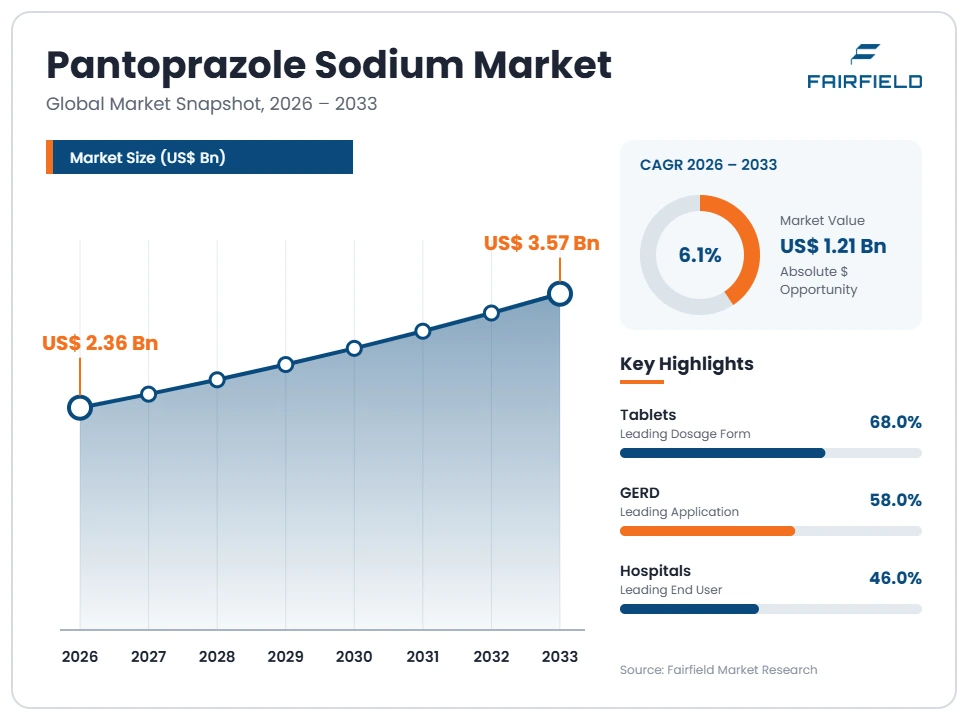
The global pantoprazole sodium market size is expected to be valued at US$ 2.36 billion in 2026 and projected to reach US$ 3.57 billion by 2033, growing at a CAGR of 6.1% between 2026 and 2033.
Between 2020 and 2025, the market grew at a CAGR of about 5.4%, as hospital use of intravenous pantoprazole rose during the pandemic, then outpatient prescriptions recovered and generic competition kept volumes rising while prices fell. The pantoprazole sodium market covers pantoprazole, a proton pump inhibitor that reduces stomach acid by blocking the acid pump in the stomach lining. It is sold as delayed-release tablets, oral suspension granules, and powder for intravenous injection, mainly in 20 mg and 40 mg strengths, under brands such as Protonix and many generic names. It is used for GERD treatment, erosive esophagitis, peptic ulcers, Helicobacter pylori eradication with antibiotics, Zollinger-Ellison syndrome, and prevention of stress ulcers and bleeding in hospital patients. Growth comes from rising digestive disease, aging populations, and wider access to generic medicines. In June 2026, Jubilant Pharmova won tentative U.S. approval for a generic pantoprazole oral suspension.
Key Report Takeaways
- By Dosage Form: Tablets held about 68% share in 2025, while Injection is projected to expand at a 6.9% CAGR through 2033, driven by hospital use for upper gastrointestinal bleeding, stress ulcer prevention in intensive care, and surgical patients unable to take oral medicines.
- By Application: GERD held about 58% share in 2025, while Peptic Ulcer and H. pylori Infection is projected to expand at a 6.8% CAGR through 2033, driven by eradication programs, rising diagnosis, and combination therapy with antibiotics in Asia Pacific.
- By End User: Hospitals held about 46% share in 2025, while Online Pharmacies is projected to expand at an 8.7% CAGR through 2033, driven by e-prescriptions, home delivery of chronic medicines, and lower prices for refill orders.
- By Region: North America held about 38% share in 2025, while Asia Pacific is projected to expand at a 7.4% CAGR through 2033, driven by large patient populations, rising healthcare access, and strong generic manufacturing in India and China.
Global Pantoprazole Sodium Market Trends and Insights
Drivers Impact Analysis
Two drivers carry the strongest influence on pantoprazole sodium market demand during the forecast period.
| Driver | Impact on CAGR Forecast | Geographic Relevance | Impact Timeline |
| Rising prevalence of GERD and acid-related disorders | High | Global | Long term (≥4 years) |
| Hospital use for bleeding and stress ulcer prevention | Medium | North America, Europe, Asia Pacific | Medium term (2-4 years) |
Rising GERD Prevalence Is Driving the Pantoprazole Sodium Market
Rising prevalence of GERD and acid-related disorders is the strongest driver of the pantoprazole sodium market. Acid problems are very common.
The mechanism is the growing number of people with reflux and ulcers. Gastroesophageal reflux disease affects a large share of adults in North America and Europe, and rates are rising in Asia Pacific as diets change and obesity increases. Smoking, alcohol, stress, and long-term use of painkillers such as aspirin and anti-inflammatory drugs also damage the stomach lining. Pantoprazole is one of the most widely prescribed proton pump inhibitors because it works well, has fewer drug interactions than some rivals, and is available as low-cost generics. Older adults take more medicines that irritate the stomach and often need protection. Doctors also prescribe pantoprazole alongside blood thinners and steroids. As populations age and diagnosis improves, the number of long-term users grows steadily, supporting demand.
Hospital Use Is Expanding the Pantoprazole Sodium Market
Hospital use for bleeding and stress ulcer prevention is expanding the pantoprazole sodium market. Intravenous pantoprazole is a hospital staple.
The cause is the need for fast acid control in seriously ill patients. Patients with upper gastrointestinal bleeding, such as bleeding ulcers, receive intravenous pantoprazole to reduce acid and help clots form. Intensive care patients on ventilators or with severe illness are at risk of stress ulcers, and many hospitals use pantoprazole to prevent them. Surgical patients who cannot swallow also receive the injection. Hospital capacity is growing in China, India, Saudi Arabia, and Brazil, and intensive care units are expanding. Generic injection approvals in the United States add supply and help ease past shortages. Guidelines for managing bleeding ulcers recommend high-dose intravenous acid suppression before and after endoscopy. These trends expand sales of the injection form.
Restraints Impact Analysis
Two restraints limit how quickly the pantoprazole sodium market grows.
| Restraint | Impact on CAGR Forecast | Geographic Relevance | Impact Timeline |
| Generic price erosion and competition | High | North America, Europe, Asia Pacific | Medium term (2-4 years) |
| Safety concerns and newer acid blockers | Medium | North America, Asia Pacific | Long term (≥4 years) |
Generic Price Erosion Slows the Pantoprazole Sodium Market
Generic price erosion and competition slow the pantoprazole sodium market. Many companies sell the same medicine.
The specific causes are patent expiry and strong generic manufacturing. Pantoprazole lost patent protection years ago, and dozens of manufacturers in India, China, Europe, and the United States now produce tablets, injections, and active ingredient. Pharmacy benefit managers, hospital purchasing groups, and government tenders push prices down, and volume-based procurement in China has cut prices sharply. Some tablet versions are also sold over the counter in certain countries, which lowers prices further. Smaller producers face thin margins and may exit, causing occasional shortages. Large buyers often switch suppliers each year based on the lowest bid. These factors limit value growth even as the number of patients and prescriptions rises, so revenue grows more slowly than volume.
Safety Concerns Restrict the Pantoprazole Sodium Market
Safety concerns and newer acid blockers restrict the pantoprazole sodium market. Doctors are reviewing long-term use.
The underlying causes are possible side effects and new competition. Long-term proton pump inhibitor use has been linked in studies to lower magnesium and vitamin B12 levels, bone fractures, kidney problems, and certain infections, and health groups encourage doctors to stop unnecessary prescriptions. Potassium-competitive acid blockers such as vonoprazan and tegoprazan offer faster acid control and are gaining use in Japan, South Korea, China, and the United States. Regulators in several countries have added warnings to labels, and some insurers limit how long patients can receive the drug without review. Older patients taking many medicines are a focus of deprescribing efforts. Some patients also switch to lifestyle changes or cheaper antacids for mild symptoms. These factors restrict growth.
Market Opportunities
New Formulations Open a Fast-Growth Revenue Pool
New formulations open a fast-growth revenue pool in the pantoprazole sodium market. Not every patient can swallow tablets.
Manufacturers can capture this opportunity. Children, older adults, and patients with feeding tubes need liquid or granule forms that are easy to swallow and dose accurately. In June 2026, Jubilant Pharmova received tentative U.S. approval for a generic pantoprazole oral suspension, with final approval expected after a patent expires in December 2026. Ready-to-use injections and prefilled syringes can save time for hospital staff and reduce dosing errors. Fixed-dose combinations with other drugs for H. pylori eradication or with painkillers for stomach protection offer further options. Hospitals value products that cut preparation time. Companies that develop differentiated, easy-to-use formulations can avoid some price competition and win better margins.
Emerging Market Access Creates a Growth Revenue Pool
Emerging market access creates a growth revenue pool in the pantoprazole sodium market. Many patients are still untreated.
Producers can capture this opportunity. Rising incomes, health insurance programs, and more pharmacies in India, Indonesia, Vietnam, Nigeria, Egypt, and Brazil are increasing access to medicines. H. pylori infection is very common in many of these countries and is a major cause of ulcers and stomach cancer, so eradication programs need acid-reducing drugs. Hospital construction and new intensive care units add demand for injections, and online pharmacies are reaching patients in smaller towns. Doctors in these markets often prescribe branded generics, and pharmacists influence choices for repeat purchases. Local manufacturing partnerships help meet government preferences for domestic production. Companies with low-cost manufacturing, strong distribution, and branded generics can gain share.
Segment Analysis
- By Dosage Form: Tablets Lead While Injection Grows Fastest
Tablets held about 68% share in 2025. Delayed-release tablets are the most common form for long-term treatment of reflux, ulcers, and stomach protection, and they are cheap, easy to store, and widely available as generics in 20 mg and 40 mg strengths. The 40 mg strength accounts for more than half of the market by dose, as it is the standard adult dose for most conditions. Patients often take tablets for months or years, creating steady repeat demand.
Injection is the fastest-growing dosage form, expanding at a 6.9% CAGR through 2033. Intravenous pantoprazole is used in hospitals for bleeding ulcers, stress ulcer prevention in intensive care, and patients who cannot take oral medicines. New generic approvals in the United States, including Alembic Pharmaceuticals’ approval in April 2025, are adding supply. Oral suspension and granules form other segments. For the market, injection growth adds hospital value.
- By Application: GERD Leads While Peptic Ulcer and H. pylori Infection Grows Fastest
GERD held about 58% share in 2025. Gastroesophageal reflux disease is one of the most common digestive conditions in the world, causing heartburn, regurgitation, and damage to the esophagus, and pantoprazole is a standard first-line treatment. Many patients need long-term or repeat treatment, and erosive esophagitis requires higher doses for healing.
Peptic Ulcer and H. pylori Infection is the fastest-growing application, expanding at a 6.8% CAGR through 2033. H. pylori infects a large share of people in Asia Pacific, Latin America, and Middle East & Africa, and eradication therapy combines pantoprazole with antibiotics. Screening programs to prevent stomach cancer in Japan, South Korea, and China are increasing treatment. Zollinger-Ellison syndrome, stress ulcer prevention, and other uses form further segments. For the market, ulcer growth widens use.
- By End User: Hospitals Lead While Online Pharmacies Grow Fastest
Hospitals held about 46% share in 2025. Hospitals use both injections and tablets for inpatients, intensive care patients, and surgical cases, and hospital pharmacies buy large volumes through tenders and purchasing groups. Discharge prescriptions also start many patients on long-term therapy.
Online Pharmacies is the fastest-growing end user, expanding at an 8.7% CAGR through 2033. Patients on long-term pantoprazole increasingly order refills online for convenience and lower prices, supported by e-prescriptions and home delivery in India, China, the United States, and Europe. Retail pharmacies and clinics form other end users, with retail pharmacies dispensing most outpatient prescriptions and selling over-the-counter versions where allowed. For the market, online growth widens access.
Geography Analysis
- Which Region Is Leading the Pantoprazole Sodium Market?
North America is leading the pantoprazole sodium market with about 38% share in 2025. The United States has high rates of reflux disease, obesity, and long-term use of medicines that irritate the stomach, along with wide insurance coverage for prescriptions. Pfizer’s Protonix brand and many generic versions from Teva, Aurobindo, Sun Pharma, and others are widely prescribed, and hospitals use large volumes of intravenous pantoprazole. The FDA continues to approve new generic products. Canada and Mexico add demand. Key barriers include generic price pressure and campaigns to reduce long-term proton pump inhibitor use. One change shaping the region is competition from newer acid blockers.
- Europe Shapes the Pantoprazole Sodium Market Through Generic Use
Europe is a major pantoprazole sodium market. Germany, the United Kingdom, France, Italy, and Spain have large numbers of patients with reflux and ulcers, and pantoprazole is one of the most commonly used proton pump inhibitors in the region. Pantoprazole was first developed in Germany, and European generic makers such as Sandoz and Krka supply large volumes. Some low-dose versions are sold without a prescription, and hospitals use injections widely in intensive care. Key barriers include tender pricing, reference pricing rules, and efforts to cut unnecessary prescriptions. One opportunity is hospital injections and new formulations.
- Which Region Is Growing Fastest in the Pantoprazole Sodium Market?
Asia Pacific is growing fastest in the pantoprazole sodium market, expanding at a 7.4% CAGR through 2033. India is a leading producer of pantoprazole tablets, injections, and active ingredient, with companies such as Sun Pharma, Dr. Reddy’s, Aurobindo, Alkem, and Torrent supplying domestic and export markets. China has large hospital use and many local producers. High H. pylori rates and rising reflux in Japan, South Korea, Indonesia, and Vietnam support demand. Key barriers include price cuts under bulk buying in China and competition from newer acid blockers. One change shaping the region is growing access to care.
- Latin America Grows the Pantoprazole Sodium Market Through Expanding Access
Latin America is a growing pantoprazole sodium market. Brazil, Mexico, Argentina, Colombia, and Chile have high rates of H. pylori infection and rising reflux disease linked to changing diets and obesity. Public health systems and private pharmacies supply both branded and generic pantoprazole, and local producers compete with imports from India. Hospital use of injections is growing as intensive care capacity expands, and pharmacies sell large volumes of affordable generics. Key barriers include limited public budgets, currency swings, and price controls in some countries, along with slow medicine registration. One opportunity is branded generics in retail pharmacies.
- Middle East & Africa Builds the Pantoprazole Sodium Market Through Healthcare Investment
Middle East & Africa is an emerging pantoprazole sodium market. Saudi Arabia, the United Arab Emirates, and Egypt have large populations with reflux and H. pylori infection, and governments are expanding hospitals and medicine access. Egypt has strong local generic production and exports to neighboring countries. South Africa, Nigeria, and Kenya add demand as access to care improves, and H. pylori infection rates are high across much of the region. Key barriers include limited budgets, uneven access, weak supply chains, and reliance on imports in many countries. One opportunity is local manufacturing of affordable generics supported by national programs.
Competitive Landscape
The pantoprazole sodium market is highly fragmented. Pfizer, Teva Pharmaceutical Industries, Sun Pharmaceutical Industries, Aurobindo Pharma, and Dr. Reddy’s Laboratories are leading players, while Lupin, Alkem Laboratories, Torrent Pharmaceuticals, Alembic Pharmaceuticals, Jubilant Pharmova, Hetero Labs, and Viatris compete strongly. Pfizer owns the original Protonix brand, but generics now supply most prescriptions, and dozens of manufacturers in India, China, and Europe produce tablets, injections, and active ingredient.
Companies compete on price, regulatory approvals, manufacturing quality, supply reliability, and distribution reach. Because the product is the same across makers, winning hospital tenders, pharmacy benefit contracts, and pharmacy shelf space depends largely on cost and consistent supply. Companies that make their own active ingredient have a cost advantage, while strong quality records help them avoid regulatory problems that can halt sales.
Strategic moves show how competition is changing. In July 2024, the FDA approved Phathom Pharmaceuticals’ Voquezna for heartburn in non-erosive GERD, adding a new class of competition. In April 2025, Alembic Pharmaceuticals won U.S. approval for a generic pantoprazole injection. In June 2026, Jubilant Pharmova received tentative approval for a generic oral suspension. These moves show competition shifting toward new forms and new drug classes.
Three themes shape vendor strategy. First, generic makers are adding injection and liquid forms to escape tablet price pressure. Second, they are integrating active ingredient production to lower costs. Third, they are expanding in Asia Pacific, Latin America, and Middle East & Africa, where access to medicines is growing.
Pantoprazole Sodium Market Industry Leaders
Pfizer Teva Pharmaceutical Industries Sun Pharmaceutical Industries Aurobindo Pharma Dr. Reddy’s Laboratories
Recent Industry Developments
- June 2026: Jubilant Pharmova received tentative USFDA approval for a generic pantoprazole sodium delayed-release oral suspension, 40 mg per packet, with final approval expected after a patent expires in December 2026 - adds liquid options to the pantoprazole sodium market.
- April 2025: Alembic Pharmaceuticals received USFDA approval for pantoprazole sodium for injection, 40 mg per vial, a generic of Protonix I.V. with U.S. sales of about US$ 48 million - expands hospital supply.
- July 2024: The FDA approved Phathom Pharmaceuticals’ Voquezna for heartburn linked to non-erosive GERD - adds competition for proton pump inhibitor therapy in GERD treatment.
Companies Covered in the Report
- Pfizer
- Teva Pharmaceutical Industries
- Sun Pharmaceutical Industries
- Aurobindo Pharma
- Dr. Reddy’s Laboratories
- Lupin
- Alkem Laboratories
- Torrent Pharmaceuticals
- Alembic Pharmaceuticals
- Jubilant Pharmova
- Hetero Labs
- Viatris
Pantoprazole Sodium Market Report Scope
| Metric | Value |
| Study Period | 2020-2033 |
| Market Size 2026 | US$ 2.36 Billion |
| Market Size 2033 | US$ 3.57 Billion |
| CAGR 2026-2033 | 6.1% |
| Absolute Dollar Opportunity | US$ 1.21 Billion |
| Largest Market | North America |
| Fastest-Growing Market | Asia Pacific |
| Market Concentration | Highly Fragmented |
| Major Players | Pfizer, Teva Pharmaceutical Industries, Sun Pharmaceutical Industries, Aurobindo Pharma, Dr. Reddy’s Laboratories |
Pantoprazole Sodium Market Segmentation
- Executive Summary
- Global Pantoprazole Sodium Market Snapshot
- Future Projections, 2026–2033
- Key Industry Highlights
- Regional Snapshot
- Market Overview
- Market Definition and Report Scope
- Historical Market Trends
- Market Dynamics
- Drivers
- Rising GERD Prevalence Is Driving the Pantoprazole Sodium Market
- Hospital Use Is Expanding the Pantoprazole Sodium Market
- Restraints
- Generic Price Erosion Slows the Pantoprazole Sodium Market
- Safety Concerns Restrict the Pantoprazole Sodium Market
- Market Opportunities
- New Formulations Open a Fast-Growth Revenue Pool
- Emerging Market Access Creates a Growth Revenue Pool
- Drivers
- Global Pantoprazole Sodium Market Outlook, 2020–2033
- Global Pantoprazole Sodium Market Outlook, by Dosage Form, Value (US$ Billion), 2020–2033
- Tablets
- Injection
- Oral Suspension and Granules
- Global Pantoprazole Sodium Market Outlook, by Application, Value (US$ Billion), 2020–2033
- GERD
- Peptic Ulcer and H. pylori Infection
- Zollinger-Ellison Syndrome
- Others
- Global Pantoprazole Sodium Market Outlook, by End User, Value (US$ Billion), 2020–2033
- Hospitals
- Retail Pharmacies
- Online Pharmacies
- Clinics
- Global Pantoprazole Sodium Market Outlook, by Region, Value (US$ Billion), 2020–2033
- North America
- Europe
- Asia Pacific
- Latin America
- Middle East & Africa
- Global Pantoprazole Sodium Market Outlook, by Dosage Form, Value (US$ Billion), 2020–2033
- North America Pantoprazole Sodium Market Outlook, 2020–2033
- North America Pantoprazole Sodium Market Outlook, by Dosage Form, Value (US$ Billion), 2020–2033
- Tablets
- Injection
- Oral Suspension and Granules
- North America Pantoprazole Sodium Market Outlook, by Application, Value (US$ Billion), 2020–2033
- GERD
- Peptic Ulcer and H. pylori Infection
- Zollinger-Ellison Syndrome
- Others
- North America Pantoprazole Sodium Market Outlook, by End User, Value (US$ Billion), 2020–2033
- Hospitals
- Retail Pharmacies
- Online Pharmacies
- Clinics
- North America Pantoprazole Sodium Market Outlook, by Country, Value (US$ Billion), 2020–2033
- United States Pantoprazole Sodium Market Outlook, by Dosage Form, 2020–2033
- United States Pantoprazole Sodium Market Outlook, by Application, 2020–2033
- United States Pantoprazole Sodium Market Outlook, by End User, 2020–2033
- Canada Pantoprazole Sodium Market Outlook, by Dosage Form, 2020–2033
- Canada Pantoprazole Sodium Market Outlook, by Application, 2020–2033
- Canada Pantoprazole Sodium Market Outlook, by End User, 2020–2033
- Mexico Pantoprazole Sodium Market Outlook, by Dosage Form, 2020–2033
- Mexico Pantoprazole Sodium Market Outlook, by Application, 2020–2033
- Mexico Pantoprazole Sodium Market Outlook, by End User, 2020–2033
- North America Pantoprazole Sodium Market Outlook, by Dosage Form, Value (US$ Billion), 2020–2033
- Europe Pantoprazole Sodium Market Outlook, 2020–2033
- Europe Pantoprazole Sodium Market Outlook, by Dosage Form, Value (US$ Billion), 2020–2033
- Tablets
- Injection
- Oral Suspension and Granules
- Europe Pantoprazole Sodium Market Outlook, by Application, Value (US$ Billion), 2020–2033
- GERD
- Peptic Ulcer and H. pylori Infection
- Zollinger-Ellison Syndrome
- Others
- Europe Pantoprazole Sodium Market Outlook, by End User, Value (US$ Billion), 2020–2033
- Hospitals
- Retail Pharmacies
- Online Pharmacies
- Clinics
- Europe Pantoprazole Sodium Market Outlook, by Country, Value (US$ Billion), 2020–2033
- Germany Pantoprazole Sodium Market Outlook, by Dosage Form, 2020–2033
- Germany Pantoprazole Sodium Market Outlook, by Application, 2020–2033
- Germany Pantoprazole Sodium Market Outlook, by End User, 2020–2033
- United Kingdom Pantoprazole Sodium Market Outlook, by Dosage Form, 2020–2033
- United Kingdom Pantoprazole Sodium Market Outlook, by Application, 2020–2033
- United Kingdom Pantoprazole Sodium Market Outlook, by End User, 2020–2033
- France Pantoprazole Sodium Market Outlook, by Dosage Form, 2020–2033
- France Pantoprazole Sodium Market Outlook, by Application, 2020–2033
- France Pantoprazole Sodium Market Outlook, by End User, 2020–2033
- Italy Pantoprazole Sodium Market Outlook, by Dosage Form, 2020–2033
- Italy Pantoprazole Sodium Market Outlook, by Application, 2020–2033
- Italy Pantoprazole Sodium Market Outlook, by End User, 2020–2033
- Spain Pantoprazole Sodium Market Outlook, by Dosage Form, 2020–2033
- Spain Pantoprazole Sodium Market Outlook, by Application, 2020–2033
- Spain Pantoprazole Sodium Market Outlook, by End User, 2020–2033
- Europe Pantoprazole Sodium Market Outlook, by Dosage Form, Value (US$ Billion), 2020–2033
- Asia Pacific Pantoprazole Sodium Market Outlook, 2020–2033
- Asia Pacific Pantoprazole Sodium Market Outlook, by Dosage Form, Value (US$ Billion), 2020–2033
- Tablets
- Injection
- Oral Suspension and Granules
- Asia Pacific Pantoprazole Sodium Market Outlook, by Application, Value (US$ Billion), 2020–2033
- GERD
- Peptic Ulcer and H. pylori Infection
- Zollinger-Ellison Syndrome
- Others
- Asia Pacific Pantoprazole Sodium Market Outlook, by End User, Value (US$ Billion), 2020–2033
- Hospitals
- Retail Pharmacies
- Online Pharmacies
- Clinics
- Asia Pacific Pantoprazole Sodium Market Outlook, by Country, Value (US$ Billion), 2020–2033
- India Pantoprazole Sodium Market Outlook, by Dosage Form, 2020–2033
- India Pantoprazole Sodium Market Outlook, by Application, 2020–2033
- India Pantoprazole Sodium Market Outlook, by End User, 2020–2033
- China Pantoprazole Sodium Market Outlook, by Dosage Form, 2020–2033
- China Pantoprazole Sodium Market Outlook, by Application, 2020–2033
- China Pantoprazole Sodium Market Outlook, by End User, 2020–2033
- Japan Pantoprazole Sodium Market Outlook, by Dosage Form, 2020–2033
- Japan Pantoprazole Sodium Market Outlook, by Application, 2020–2033
- Japan Pantoprazole Sodium Market Outlook, by End User, 2020–2033
- South Korea Pantoprazole Sodium Market Outlook, by Dosage Form, 2020–2033
- South Korea Pantoprazole Sodium Market Outlook, by Application, 2020–2033
- South Korea Pantoprazole Sodium Market Outlook, by End User, 2020–2033
- Indonesia Pantoprazole Sodium Market Outlook, by Dosage Form, 2020–2033
- Indonesia Pantoprazole Sodium Market Outlook, by Application, 2020–2033
- Indonesia Pantoprazole Sodium Market Outlook, by End User, 2020–2033
- Vietnam Pantoprazole Sodium Market Outlook, by Dosage Form, 2020–2033
- Vietnam Pantoprazole Sodium Market Outlook, by Application, 2020–2033
- Vietnam Pantoprazole Sodium Market Outlook, by End User, 2020–2033
- Asia Pacific Pantoprazole Sodium Market Outlook, by Dosage Form, Value (US$ Billion), 2020–2033
- Latin America Pantoprazole Sodium Market Outlook, 2020–2033
- Latin America Pantoprazole Sodium Market Outlook, by Dosage Form, Value (US$ Billion), 2020–2033
- Tablets
- Injection
- Oral Suspension and Granules
- Latin America Pantoprazole Sodium Market Outlook, by Application, Value (US$ Billion), 2020–2033
- GERD
- Peptic Ulcer and H. pylori Infection
- Zollinger-Ellison Syndrome
- Others
- Latin America Pantoprazole Sodium Market Outlook, by End User, Value (US$ Billion), 2020–2033
- Hospitals
- Retail Pharmacies
- Online Pharmacies
- Clinics
- Latin America Pantoprazole Sodium Market Outlook, by Country, Value (US$ Billion), 2020–2033
- Brazil Pantoprazole Sodium Market Outlook, by Dosage Form, 2020–2033
- Brazil Pantoprazole Sodium Market Outlook, by Application, 2020–2033
- Brazil Pantoprazole Sodium Market Outlook, by End User, 2020–2033
- Mexico Pantoprazole Sodium Market Outlook, by Dosage Form, 2020–2033
- Mexico Pantoprazole Sodium Market Outlook, by Application, 2020–2033
- Mexico Pantoprazole Sodium Market Outlook, by End User, 2020–2033
- Argentina Pantoprazole Sodium Market Outlook, by Dosage Form, 2020–2033
- Argentina Pantoprazole Sodium Market Outlook, by Application, 2020–2033
- Argentina Pantoprazole Sodium Market Outlook, by End User, 2020–2033
- Colombia Pantoprazole Sodium Market Outlook, by Dosage Form, 2020–2033
- Colombia Pantoprazole Sodium Market Outlook, by Application, 2020–2033
- Colombia Pantoprazole Sodium Market Outlook, by End User, 2020–2033
- Chile Pantoprazole Sodium Market Outlook, by Dosage Form, 2020–2033
- Chile Pantoprazole Sodium Market Outlook, by Application, 2020–2033
- Chile Pantoprazole Sodium Market Outlook, by End User, 2020–2033
- Latin America Pantoprazole Sodium Market Outlook, by Dosage Form, Value (US$ Billion), 2020–2033
- Middle East & Africa Pantoprazole Sodium Market Outlook, 2020–2033
- Middle East & Africa Pantoprazole Sodium Market Outlook, by Dosage Form, Value (US$ Billion), 2020–2033
- Tablets
- Injection
- Oral Suspension and Granules
- Middle East & Africa Pantoprazole Sodium Market Outlook, by Application, Value (US$ Billion), 2020–2033
- GERD
- Peptic Ulcer and H. pylori Infection
- Zollinger-Ellison Syndrome
- Others
- Middle East & Africa Pantoprazole Sodium Market Outlook, by End User, Value (US$ Billion), 2020–2033
- Hospitals
- Retail Pharmacies
- Online Pharmacies
- Clinics
- Middle East & Africa Pantoprazole Sodium Market Outlook, by Country, Value (US$ Billion), 2020–2033
- Saudi Arabia Pantoprazole Sodium Market Outlook, by Dosage Form, 2020–2033
- Saudi Arabia Pantoprazole Sodium Market Outlook, by Application, 2020–2033
- Saudi Arabia Pantoprazole Sodium Market Outlook, by End User, 2020–2033
- United Arab Emirates Pantoprazole Sodium Market Outlook, by Dosage Form, 2020–2033
- United Arab Emirates Pantoprazole Sodium Market Outlook, by Application, 2020–2033
- United Arab Emirates Pantoprazole Sodium Market Outlook, by End User, 2020–2033
- Egypt Pantoprazole Sodium Market Outlook, by Dosage Form, 2020–2033
- Egypt Pantoprazole Sodium Market Outlook, by Application, 2020–2033
- Egypt Pantoprazole Sodium Market Outlook, by End User, 2020–2033
- South Africa Pantoprazole Sodium Market Outlook, by Dosage Form, 2020–2033
- South Africa Pantoprazole Sodium Market Outlook, by Application, 2020–2033
- South Africa Pantoprazole Sodium Market Outlook, by End User, 2020–2033
- Nigeria Pantoprazole Sodium Market Outlook, by Dosage Form, 2020–2033
- Nigeria Pantoprazole Sodium Market Outlook, by Application, 2020–2033
- Nigeria Pantoprazole Sodium Market Outlook, by End User, 2020–2033
- Kenya Pantoprazole Sodium Market Outlook, by Dosage Form, 2020–2033
- Kenya Pantoprazole Sodium Market Outlook, by Application, 2020–2033
- Kenya Pantoprazole Sodium Market Outlook, by End User, 2020–2033
- Middle East & Africa Pantoprazole Sodium Market Outlook, by Dosage Form, Value (US$ Billion), 2020–2033
- Competitive Landscape
- Industry Leaders
- Recent Industry Developments
- Company Profiles
- Pfizer
- Teva Pharmaceutical Industries
- Sun Pharmaceutical Industries
- Aurobindo Pharma
- Dr. Reddy's Laboratories
- Lupin
- Alkem Laboratories
- Torrent Pharmaceuticals
- Alembic Pharmaceuticals
- Jubilant Pharmova
- Hetero Labs
- Viatris
- Appendix
- Research Methodology
- Report Assumptions
- Acronyms and Abbreviations
Dosage Form
- Tablets
- Injection
- Oral Suspension and Granules
Application
- GERD
- Peptic Ulcer and H. pylori Infection
- Zollinger-Ellison Syndrome
- Others
End User
- Hospitals
- Retail Pharmacies
- Online Pharmacies
- Clinics
Regions
- North America
- Europe
- Asia Pacific
- Latin America
- Middle East & Africa
Our Research Methodology
Considering the volatility of business today, traditional approaches to strategizing a game plan can be unfruitful if not detrimental. True ambiguity is no way to determine a forecast. A myriad of predetermined factors must be accounted for such as the degree of risk involved, the magnitude of circumstances, as well as conditions or consequences that are not known or unpredictable. To circumvent binary views that cast uncertainty, the application of market research intelligence to strategically posture, move, and enable actionable outcomes is necessary.
View Methodology
Quality Assured
Rigorous Validation Process

Confidentiality Assured
End-to-end Data Security

Custom Research Services
Tailored To Your Objectives
FAQs
The pantoprazole sodium market is valued at US$ 2.36 billion in 2026, led by tablets, GERD treatment, and North America.
The market is projected to reach US$ 3.57 billion by 2033, growing at a 6.1% CAGR and adding US$ 1.21 billion.
Injection is growing fastest at a 6.9% CAGR through 2033, driven by hospital use for bleeding ulcers and stress ulcer prevention.
Asia Pacific is growing fastest at a 7.4% CAGR through 2033, driven by large patient numbers and generic production in India.
North America holds the largest share at about 38% in 2025, supported by high reflux rates, broad coverage, and hospital injection use.
Related Reports
Immunotherapy Market Size, Share, Insights, Competitive Landscape, and Forecast 2026 to 2033
The global immunotherapy market is valued at US$274.5 billion in 2026, reaching US$521.4 billion by 2033, growing at a 9.6% CAGR
Hydroxychloroquine Market Size, Share, Insights, Competitive Landscape, and Forecast 2026 to 2033
The global hydroxychloroquine market is valued at US$1.71 billion in 2026, reaching US$2.66 billion by 2033, growing at a 6.6% CAGR
Hormone Replacement Therapy Market Size, Share, Insights, Competitive Landscape, and Forecast 2026 to 2033
The global hormone replacement therapy market is valued at US$27.3 billion in 2026, reaching US$45.6 billion by 2033, growing at a 7.6% CAGR
Healthcare Regulatory Affairs Outsourcing Market Size, Share, Insights, Competitive Landscape, and Forecast 2026 to 2033
The global healthcare regulatory affairs outsourcing market is valued at US$8.6 billion in 2026, reaching US$17.6 billion by 2033, growing at a 10.8% CAGR
Genetic Disease Therapy Market Size, Share, Insights, Competitive Landscape, and Forecast 2026 to 2033
The global genetic disease therapy market is valued at US$18.6 billion in 2026, reaching US$39.6 billion by 2033, growing at an 11.4% CAGR
Fertility Market Size, Share, Insights, Competitive Landscape, and Forecast 2026 to 2033
Explore the fertility market outlook for 2026–2033, including treatment trends, growth drivers, regional insights, and competitive developments.