



Healthcare Regulatory Affairs Outsourcing Market
Healthcare Regulatory Affairs Outsourcing Market Size, Share, Insights, Competitive Landscape, and Forecast 2026 to 2033
Healthcare Regulatory Affairs Outsourcing Market Size and Trend Analysis
What Is Driving Healthcare Regulatory Affairs Outsourcing Growth?
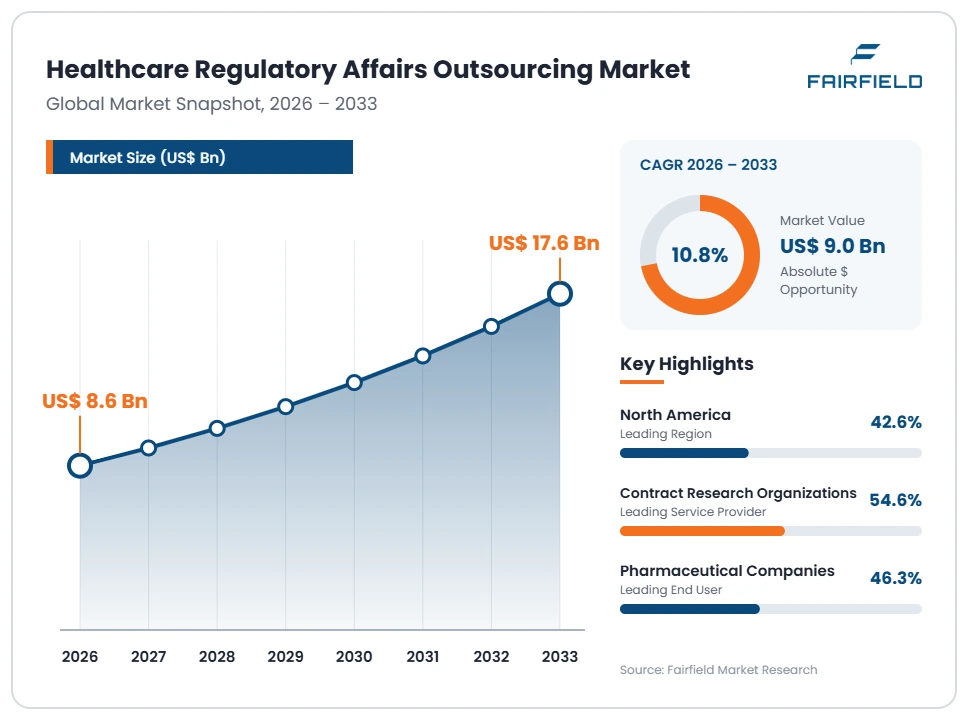
The global Healthcare Regulatory Affairs Outsourcing market size is expected to be valued at US$ 8.6 billion in 2026 and projected to reach US$ 17.6 billion by 2033, growing at a CAGR of 10.8% between 2026 and 2033. Growth is anchored in the widening gap between global filing requirements and in-house regulatory capacity. Sponsors are shifting dossier preparation, publishing, product registration and lifecycle maintenance to external specialists to protect launch timelines. Device and diagnostics regulation adds a second demand stream alongside pharmaceuticals. Between 2020 and 2025 the market grew at roughly a 9.4% CAGR, and the absolute dollar opportunity to 2033 stands at US$ 9.0 billion.
Key Report Takeaways
- By Service Type: Regulatory submissions and dossier publishing led with 29.4% share in 2026, while post-approval lifecycle maintenance and labelling is projected to expand at a 12.6% CAGR through 2033, driven by widening post-marketing variation and labelling update obligations.
- By Product Type: Small molecule drugs led with 41.5% share in 2026, while biologics and biosimilars are projected to expand at a 12.9% CAGR through 2033, driven by crowded biosimilar pipelines entering several national registration routes at once.
- By Service Provider: Contract research organizations led with 54.6% share in 2026, while technology and publishing solution providers are projected to expand at a 13.4% CAGR through 2033, driven by sponsor demand for structured content and automated submission assembly.
- By End User: Pharmaceutical companies led with 46.3% share in 2026, while biotechnology companies are projected to expand at a 12.8% CAGR through 2033, driven by venture-funded developers that run approval programmes without any internal regulatory department.
- By Region: North America led with 42.6% share in 2026, while Asia Pacific is projected to expand at a 13.9% CAGR through 2033; Europe, Latin America and Middle East & Africa add steady registration and renewal workloads.
Global Healthcare Regulatory Affairs Outsourcing Market Trends and Insights
Market Growth Drivers
Rising Regulatory Complexity Across Global Markets Expands Outsourced Submission Volumes
Sponsors are outsourcing more regulatory work because filing rules differ sharply across more than one hundred national authorities. A single product launch can demand separate dossiers, translations, local representation and country-specific evidence packages. Internal regulatory teams rarely scale fast enough to absorb that workload without delaying approvals, so companies buy external capacity for submission assembly, publishing and lifecycle maintenance.
The underlying trend is the steady move toward electronic submission standards and structured data by agencies including the U.S. Food and Drug Administration, the European Medicines Agency, Japan’s Pharmaceuticals and Medical Devices Agency and China’s National Medical Products Administration. Meeting these formats requires trained publishers, validated software and current regional knowledge. Specialist providers maintain that infrastructure across many clients at once, which makes outsourcing faster and cheaper than rebuilding the same capability inside every sponsor organisation.
Cost Pressure and Uneven Pipeline Demand Favour Flexible External Teams
Budget discipline is pushing sponsors to convert fixed regulatory headcount into variable external spend. Regulatory workload rises sharply around filings and renewals, then falls between milestones, so permanent teams sit idle or become bottlenecks. Outsourcing smooths that curve, letting companies pay for capacity only when submissions, registrations or responses to agency questions are actually in progress.
Behind this sits the broader adoption of functional service provider arrangements, where a single vendor manages an entire regulatory function under one long-term contract with agreed service levels. Providers support these models through delivery centres in lower-cost locations such as India and Central Europe, paired with senior strategists based in the main approval markets. Portfolio prioritisation after pipeline reviews reinforces the shift, because sponsors protect scientific staff first and move administrative regulatory work outside.
Market Restraints
Data Confidentiality and Loss of Internal Control Slow Outsourcing Adoption
Concerns about control and confidentiality hold back contract values, especially for lead assets. Regulatory dossiers contain manufacturing detail, clinical data and commercial strategy, so sponsors hesitate to place them with third parties. Many companies therefore outsource routine renewals and translations while keeping pivotal submissions in house, which caps the share of total regulatory spend that reaches external providers.
The caution is reinforced by tightening data protection and cross-border transfer rules in several jurisdictions, which complicate the use of offshore delivery teams. Audit obligations add further friction, because sponsors remain fully accountable to agencies for everything a vendor files on their behalf. Qualifying a provider therefore demands documented quality system reviews, computer system validation checks and continuing performance oversight. These steps lengthen sales cycles and discourage smaller sponsors from switching vendors frequently.
Shortage of Experienced Regulatory Professionals Constrains Provider Capacity
A thin talent pool limits how quickly providers can grow, which restrains market expansion. Senior regulatory specialists need scientific training plus years of agency interaction experience, and that combination cannot be produced quickly. Vendors consequently turn down work, stage project starts or staff engagements with junior teams, which raises rework risk and weakens client confidence in outsourced delivery.
Wage inflation follows the scarcity, steadily eroding the cost advantage that first motivated outsourcing. Competition for the same professionals runs across sponsors, providers and the regulatory agencies themselves, and attrition stays high in established offshore delivery hubs. Providers respond with structured training academies, university partnerships and internal certification paths, but these programmes take years to produce independent reviewers. Until supply improves, capacity rather than demand sets the pace of growth in several service lines.
Market Opportunities
Medical Device and Diagnostics Regulation Opens a Second Revenue Stream
Device and diagnostics regulation creates substantial new revenue for providers that previously served only pharmaceutical clients. Manufacturers face heavier technical documentation, clinical evidence and post-market surveillance duties than before, and many hold large legacy portfolios that must be brought to current standards. That backlog converts directly into outsourced authoring, gap assessment and remediation work.
The opportunity is widened by the structure of the device industry, where thousands of small and mid-sized manufacturers operate without dedicated regulatory departments. These companies need external help for technical files, notified body interaction and product registrations across multiple countries. Diagnostics firms face similar pressure as classification rules tighten. Providers building dedicated device practices, with reviewers experienced in both engineering and clinical evidence, can serve a client base that pharmaceutical-focused competitors are not equipped to reach.
Artificial Intelligence and Structured Content Reshape Regulatory Writing Economics
Automation gives providers a route to higher margins and a stronger competitive position. Tools that draft document sections, check consistency and reuse approved content reduce the hours needed for routine authoring and publishing. Providers that pass part of that saving to clients while keeping the rest can grow revenue without hiring proportionally, which eases the capacity limits now holding the market back.
This rests on the broader industry move toward structured content management, where regulatory text is stored as reusable components rather than finished documents. Component reuse shortens variation and renewal cycles, which are the highest-volume recurring activities in lifecycle maintenance. Agencies are also expanding their structured data submission expectations, making component-based content progressively more valuable over time. Providers combining validated platforms with human review are best placed to capture this shift.
Segment Analysis
- Which Service Type Leads Regulatory Affairs Outsourcing Spending?
Regulatory submissions and dossier publishing led the market with 29.4% share in 2026, because every product entering any market must pass through this step. The work is volume-driven, repeatable and format-sensitive, which makes it the easiest activity to hand to a specialist. Regulatory writing follows at 21.8%, while product registration and clinical trial applications hold 19.2% and consulting and strategy 17.3%.
Post-approval lifecycle maintenance and labelling is the fastest-growing service, expanding at a 12.6% CAGR between 2026 and 2033. Growth reflects the accumulation of approved products that require variations, renewals, safety labelling updates and periodic reports in every market where they are sold. Validated publishing platforms and structured content tools make this recurring work economical to outsource at scale. For the wider market, the shift converts regulatory outsourcing from project revenue into predictable annuity revenue.
- Small Molecule Portfolios Anchor Demand While Biologics Accelerate Fastest
Small molecule drugs accounted for 41.5% of outsourced regulatory spending in 2026, reflecting the sheer number of branded and generic products filed, renewed and maintained worldwide. Generic and hybrid applications in particular generate high-volume, lower-complexity work that suits external delivery. Medical devices held 21.4% and in-vitro diagnostics 12.3%, both rising from a smaller base.
Biologics and biosimilars form the fastest-growing category at a 12.9% CAGR through 2033. Biologic dossiers carry heavier manufacturing, comparability and immunogenicity content, and biosimilar developers typically pursue several national approval routes at once to protect launch sequencing. Few of these sponsors maintain the specialist reviewers that such filings demand. The result pushes providers to recruit biologics-trained writers and manufacturing experts, lifting average contract values and gradually shifting the revenue mix toward complex, higher-priced regulatory services.
- Contract Research Organizations Hold Scale Advantages Over Niche Providers
Contract research organizations captured 54.6% share in 2026, because sponsors prefer one partner spanning clinical development, submissions and post-approval support. Scale brings global office networks, local agent capability and validated systems that smaller firms cannot match. Specialist regulatory consultancies held 31.2%, retaining work where deep country knowledge or a single device category matters more than breadth.
Technology and publishing solution providers are growing fastest at a 13.4% CAGR through 2033. Demand comes from sponsors adopting structured content authoring, submission management platforms and automated quality checks to cut cycle times. These vendors increasingly bundle managed services with software, moving beyond licences into delivery. Their rise pressures labour-based pricing across the market and pushes larger organizations toward technology-enabled models, blurring the historic line between service firms and software suppliers.
- Pharmaceutical Sponsors Dominate Spending as Biotechs Outsource Entirely
Pharmaceutical companies generated 46.3% of demand in 2026, reflecting broad portfolios, large approved product bases and continuous global filing activity. Their outsourcing is selective, concentrating on publishing, translations, renewals and local representation while strategy stays internal. Medical device manufacturers contributed 19.4%, and academic institutes and other users 7.2%.
Biotechnology companies are the fastest-growing end user at a 12.8% CAGR through 2033. Many clinical-stage developers run trial applications and marketing submissions with no internal regulatory department, so they outsource the entire function rather than selected tasks. These engagements begin earlier in development and carry higher strategic content, including agency meeting preparation and designation requests. For providers, the segment delivers richer margins but demands senior consultants, reinforcing the talent constraints that already shape capacity planning across the market.
Geography Analysis
- Which Region Is Leading the Healthcare Regulatory Affairs Outsourcing Market?
North America led the market with 42.6% share in 2026, driven by the concentration of pharmaceutical, biotechnology and device sponsors filing with the U.S. Food and Drug Administration. The United States contributes the overwhelming majority, with Canada adding steady registration and labelling work. Dense venture funding creates a continuous stream of small developers that outsource regulatory operations completely.
Regional leadership also rests on infrastructure. Providers maintain large submission publishing centres, validated technology platforms and senior consultants experienced in agency interaction near major biopharmaceutical clusters. Device manufacturers add further volume through premarket notifications, quality documentation and post-market reporting. Pricing pressure from sponsors has pushed delivery of routine tasks offshore, yet strategy, agency meetings and final quality review remain in the region, keeping high-value revenue anchored in North America through the forecast period.
- Europe Balances Dual Pharmaceutical and Device Regulatory Workloads
Europe held 28.4% share in 2026, supported by centralised and national approval routes overseen by the European Medicines Agency and member state authorities. Germany, Switzerland, the United Kingdom, France and Ireland supply most demand through large manufacturing bases and established biopharmaceutical clusters.
Two forces sustain outsourcing here. First, tightened medical device and diagnostics documentation standards created a large remediation backlog that manufacturers cannot clear internally. Second, divergence between the United Kingdom and the European Union after regulatory separation obliges many companies to maintain parallel filings and local representation. Multilingual labelling and translation requirements across member states add continuous volume. Providers with in-country affiliates, notified body familiarity and strong quality systems capture most of this work, while Central European delivery centres handle high-volume publishing tasks cost-effectively.
- Which Region Is Growing Fastest in the Healthcare Regulatory Affairs Outsourcing Market?
Asia Pacific is growing fastest, advancing at a 13.9% CAGR between 2026 and 2033 from 20.1% share in 2026. China, Japan, India, South Korea and Australia drive the expansion as domestic developers pursue approvals at home and in Western markets simultaneously.
Growth has clear causes. Regulatory systems overseen by bodies such as the National Medical Products Administration and the Pharmaceuticals and Medical Devices Agency have modernised and now attract earlier filings from global sponsors. Local biotechnology firms are maturing from licensing partners into independent applicants that need international dossier expertise. India combines a vast generic export industry with the region’s deepest pool of regulatory operations talent, making it both a demand centre and a global delivery hub. Rising clinical trial activity reinforces application volumes across the region.
- Latin America Builds Registration Capacity Around Brazil and Mexico
Latin America represented 5.3% share in 2026, with Brazil, Mexico, Argentina and Colombia accounting for most activity. Demand centres on product registration, local representation and renewal filings for multinational sponsors entering or maintaining positions in the region.
Country-specific documentation, Spanish and Portuguese translation and in-country legal representative requirements make outsourcing close to mandatory for foreign companies. Registration timelines vary widely between national agencies, so sponsors rely on providers that track changing requirements and manage submission queues locally. Expanding public procurement of medicines and devices increases the value of holding valid local registrations. Regional providers are building capability through partnerships with global firms, gradually widening the range of services available beyond basic registration support toward lifecycle maintenance and pharmacovigilance-linked labelling work.
- Middle East & Africa Expands Through Gulf Market Harmonisation
Middle East & Africa held 3.6% share in 2026, the smallest regional position but a steadily widening one. Saudi Arabia, the United Arab Emirates, Israel, Egypt and South Africa generate the bulk of activity through import registrations and growing local manufacturing ambitions.
Harmonisation efforts across Gulf states are simplifying multi-country submissions, which encourages sponsors to register wider portfolios than before. National investment programmes aimed at local pharmaceutical production create new approval and site-related documentation work. Across Africa, continental regulatory strengthening initiatives are improving agency capacity and predictability, making formal registration routes more attractive than informal supply. Limited local regulatory employment pools mean most of this work goes to external specialists, so outsourcing penetration is proportionally higher here than in mature regions.
Competitive Landscape
The healthcare regulatory affairs outsourcing market is moderately concentrated at the top and highly fragmented below it. A small group of global contract research organizations handles multi-region submission programmes for large sponsors, while hundreds of boutique consultancies serve single countries, single device classes or single therapeutic areas. Consolidation has steadily pulled specialist regulatory firms into larger clinical development platforms, because sponsors increasingly prefer one vendor across trials, filings and post-approval work. That shift signals a market moving from task-based purchasing toward long-term functional partnerships.
Vendors compete mainly on regulatory intelligence depth, submission quality, turnaround speed and local presence in registration markets. Validated publishing platforms, structured content authoring and robust quality systems now matter as much as scientific writing skill. Providers holding in-country affiliates and local agent status win work that purely offshore competitors cannot accept. Newer entrants built around regulatory software and automated document assembly are gaining ground, because sponsors want reusable content and faster variation handling. Their arrival pressures traditional labour-based pricing and pushes established firms toward technology-enabled delivery models.
Strategic activity centres on building capability rather than buying revenue. Providers are adding regional regulatory offices, expanding medical device and diagnostics practices, and investing in automation for document drafting and quality review. Acquisitions of niche consultancies matter competitively because they transfer scarce local expertise that cannot be recruited quickly. Partnerships between service firms and technology vendors matter because they close capability gaps without heavy internal development. Vendor strategy is converging on integrated regulatory platforms, broader geographic coverage and outcome-linked commercial models rather than hourly billing.
Industry Leaders
- IQVIA Holdings Inc.
- ICON plc
- Parexel International Corporation
- Thermo Fisher Scientific Inc.
- Fortrea Holdings Inc.
- Charles River Laboratories International, Inc.
- Certara, Inc.
- Freyr Solutions
Companies Covered in the Report
- IQVIA Holdings Inc.
- ICON plc
- Parexel International Corporation
- Thermo Fisher Scientific Inc.
- Fortrea Holdings Inc.
- Charles River Laboratories International, Inc.
- Certara, Inc.
- Freyr Solutions
- Syneos Health, Inc.
- Medpace Holdings, Inc.
- WuXi AppTec Co., Ltd.
- ProPharma Group
- PharmaLex GmbH
- NAMSA
- Veeva Systems Inc.
- SGS SA
Healthcare Regulatory Affairs Outsourcing Market Report Scope
| Metric | Value |
| Study Period | 2020–2033 |
| Market Size 2026 | US$ 8.6 Billion |
| Market Size 2033 | US$ 17.6 Billion |
| CAGR 2026–2033 | 10.8% |
| Absolute Dollar Opportunity | US$ 9.0 Billion |
| Largest Market | North America (42.6% share in 2026) |
| Fastest-Growing Market | Asia Pacific (13.9% CAGR 2026–2033) |
| Market Concentration | Moderately Concentrated |
| Major Players | IQVIA Holdings Inc., ICON plc, Parexel International Corporation, Thermo Fisher Scientific Inc., Fortrea Holdings Inc. |
Healthcare Regulatory Affairs Outsourcing Market Segmentation
- Executive Summary
- Global Healthcare Regulatory Affairs Outsourcing Market Snapshot
- Future Projections, 2026–2033
- Key Industry Highlights
- Regional Snapshot
- Market Overview
- Market Definition and Report Scope
- Historical Market Trends
- Market Dynamics
- Drivers
- Rising Regulatory Complexity Across Global Markets Expands Outsourced Submission Volumes
- Cost Pressure and Uneven Pipeline Demand Favour Flexible External Teams
- Restraints
- Data Confidentiality and Loss of Internal Control Slow Outsourcing Adoption
- Shortage of Experienced Regulatory Professionals Constrains Provider Capacity
- Market Opportunities
- Medical Device and Diagnostics Regulation Opens a Second Revenue Stream
- Artificial Intelligence and Structured Content Reshape Regulatory Writing Economics
- Drivers
- Global Healthcare Regulatory Affairs Outsourcing Market Outlook, 2026–2033
- Global Healthcare Regulatory Affairs Outsourcing Market Outlook, by Service Type, Value (US$ Billion), 2026–2033
- Regulatory Submissions and Dossier Publishing
- Regulatory Writing
- Product Registration and Clinical Trial Applications
- Regulatory Consulting and Strategy
- Post-Approval Lifecycle Maintenance and Labelling
- Global Healthcare Regulatory Affairs Outsourcing Market Outlook, by Product Type, Value (US$ Billion), 2026–2033
- Small Molecule Drugs
- Biologics and Biosimilars
- Medical Devices
- In-vitro Diagnostics
- Global Healthcare Regulatory Affairs Outsourcing Market Outlook, by Service Provider, Value (US$ Billion), 2026–2033
- Contract Research Organizations
- Specialist Regulatory Consultancies
- Technology and Publishing Solution Providers
- Global Healthcare Regulatory Affairs Outsourcing Market Outlook, by End User, Value (US$ Billion), 2026–2033
- Pharmaceutical Companies
- Biotechnology Companies
- Medical Device Manufacturers
- Academic and Research Institutes and Others
- Global Healthcare Regulatory Affairs Outsourcing Market Outlook, by Region, Value (US$ Billion), 2026–2033
- North America
- Europe
- Asia Pacific
- Latin America
- Middle East & Africa
- Global Healthcare Regulatory Affairs Outsourcing Market Outlook, by Service Type, Value (US$ Billion), 2026–2033
- North America Healthcare Regulatory Affairs Outsourcing Market Outlook, 2026–2033
- North America Healthcare Regulatory Affairs Outsourcing Market Outlook, by Service Type, Value (US$ Billion), 2026–2033
- Regulatory Submissions and Dossier Publishing
- Regulatory Writing
- Product Registration and Clinical Trial Applications
- Regulatory Consulting and Strategy
- Post-Approval Lifecycle Maintenance and Labelling
- North America Healthcare Regulatory Affairs Outsourcing Market Outlook, by Product Type, Value (US$ Billion), 2026–2033
- Small Molecule Drugs
- Biologics and Biosimilars
- Medical Devices
- In-vitro Diagnostics
- North America Healthcare Regulatory Affairs Outsourcing Market Outlook, by Service Provider, Value (US$ Billion), 2026–2033
- Contract Research Organizations
- Specialist Regulatory Consultancies
- Technology and Publishing Solution Providers
- North America Healthcare Regulatory Affairs Outsourcing Market Outlook, by End User, Value (US$ Billion), 2026–2033
- Pharmaceutical Companies
- Biotechnology Companies
- Medical Device Manufacturers
- Academic and Research Institutes and Others
- North America Healthcare Regulatory Affairs Outsourcing Market Outlook, by Country, Value (US$ Billion), 2026–2033
- United States Healthcare Regulatory Affairs Outsourcing Market Outlook, by Service Type, 2026–2033
- United States Healthcare Regulatory Affairs Outsourcing Market Outlook, by Product Type, 2026–2033
- United States Healthcare Regulatory Affairs Outsourcing Market Outlook, by Service Provider, 2026–2033
- United States Healthcare Regulatory Affairs Outsourcing Market Outlook, by End User, 2026–2033
- Canada Healthcare Regulatory Affairs Outsourcing Market Outlook, by Service Type, 2026–2033
- Canada Healthcare Regulatory Affairs Outsourcing Market Outlook, by Product Type, 2026–2033
- Canada Healthcare Regulatory Affairs Outsourcing Market Outlook, by Service Provider, 2026–2033
- Canada Healthcare Regulatory Affairs Outsourcing Market Outlook, by End User, 2026–2033
- North America Healthcare Regulatory Affairs Outsourcing Market Outlook, by Service Type, Value (US$ Billion), 2026–2033
- Europe Healthcare Regulatory Affairs Outsourcing Market Outlook, 2026–2033
- Europe Healthcare Regulatory Affairs Outsourcing Market Outlook, by Service Type, Value (US$ Billion), 2026–2033
- Regulatory Submissions and Dossier Publishing
- Regulatory Writing
- Product Registration and Clinical Trial Applications
- Regulatory Consulting and Strategy
- Post-Approval Lifecycle Maintenance and Labelling
- Europe Healthcare Regulatory Affairs Outsourcing Market Outlook, by Product Type, Value (US$ Billion), 2026–2033
- Small Molecule Drugs
- Biologics and Biosimilars
- Medical Devices
- In-vitro Diagnostics
- Europe Healthcare Regulatory Affairs Outsourcing Market Outlook, by Service Provider, Value (US$ Billion), 2026–2033
- Contract Research Organizations
- Specialist Regulatory Consultancies
- Technology and Publishing Solution Providers
- Europe Healthcare Regulatory Affairs Outsourcing Market Outlook, by End User, Value (US$ Billion), 2026–2033
- Pharmaceutical Companies
- Biotechnology Companies
- Medical Device Manufacturers
- Academic and Research Institutes and Others
- Europe Healthcare Regulatory Affairs Outsourcing Market Outlook, by Country, Value (US$ Billion), 2026–2033
- Germany Healthcare Regulatory Affairs Outsourcing Market Outlook, by Service Type, 2026–2033
- Germany Healthcare Regulatory Affairs Outsourcing Market Outlook, by Product Type, 2026–2033
- Germany Healthcare Regulatory Affairs Outsourcing Market Outlook, by Service Provider, 2026–2033
- Germany Healthcare Regulatory Affairs Outsourcing Market Outlook, by End User, 2026–2033
- Switzerland Healthcare Regulatory Affairs Outsourcing Market Outlook, by Service Type, 2026–2033
- Switzerland Healthcare Regulatory Affairs Outsourcing Market Outlook, by Product Type, 2026–2033
- Switzerland Healthcare Regulatory Affairs Outsourcing Market Outlook, by Service Provider, 2026–2033
- Switzerland Healthcare Regulatory Affairs Outsourcing Market Outlook, by End User, 2026–2033
- United Kingdom Healthcare Regulatory Affairs Outsourcing Market Outlook, by Service Type, 2026–2033
- United Kingdom Healthcare Regulatory Affairs Outsourcing Market Outlook, by Product Type, 2026–2033
- United Kingdom Healthcare Regulatory Affairs Outsourcing Market Outlook, by Service Provider, 2026–2033
- United Kingdom Healthcare Regulatory Affairs Outsourcing Market Outlook, by End User, 2026–2033
- France Healthcare Regulatory Affairs Outsourcing Market Outlook, by Service Type, 2026–2033
- France Healthcare Regulatory Affairs Outsourcing Market Outlook, by Product Type, 2026–2033
- France Healthcare Regulatory Affairs Outsourcing Market Outlook, by Service Provider, 2026–2033
- France Healthcare Regulatory Affairs Outsourcing Market Outlook, by End User, 2026–2033
- Ireland Healthcare Regulatory Affairs Outsourcing Market Outlook, by Service Type, 2026–2033
- Ireland Healthcare Regulatory Affairs Outsourcing Market Outlook, by Product Type, 2026–2033
- Ireland Healthcare Regulatory Affairs Outsourcing Market Outlook, by Service Provider, 2026–2033
- Ireland Healthcare Regulatory Affairs Outsourcing Market Outlook, by End User, 2026–2033
- Europe Healthcare Regulatory Affairs Outsourcing Market Outlook, by Service Type, Value (US$ Billion), 2026–2033
- Asia Pacific Healthcare Regulatory Affairs Outsourcing Market Outlook, 2026–2033
- Asia Pacific Healthcare Regulatory Affairs Outsourcing Market Outlook, by Service Type, Value (US$ Billion), 2026–2033
- Regulatory Submissions and Dossier Publishing
- Regulatory Writing
- Product Registration and Clinical Trial Applications
- Regulatory Consulting and Strategy
- Post-Approval Lifecycle Maintenance and Labelling
- Asia Pacific Healthcare Regulatory Affairs Outsourcing Market Outlook, by Product Type, Value (US$ Billion), 2026–2033
- Small Molecule Drugs
- Biologics and Biosimilars
- Medical Devices
- In-vitro Diagnostics
- Asia Pacific Healthcare Regulatory Affairs Outsourcing Market Outlook, by Service Provider, Value (US$ Billion), 2026–2033
- Contract Research Organizations
- Specialist Regulatory Consultancies
- Technology and Publishing Solution Providers
- Asia Pacific Healthcare Regulatory Affairs Outsourcing Market Outlook, by End User, Value (US$ Billion), 2026–2033
- Pharmaceutical Companies
- Biotechnology Companies
- Medical Device Manufacturers
- Academic and Research Institutes and Others
- Asia Pacific Healthcare Regulatory Affairs Outsourcing Market Outlook, by Country, Value (US$ Billion), 2026–2033
- China Healthcare Regulatory Affairs Outsourcing Market Outlook, by Service Type, 2026–2033
- China Healthcare Regulatory Affairs Outsourcing Market Outlook, by Product Type, 2026–2033
- China Healthcare Regulatory Affairs Outsourcing Market Outlook, by Service Provider, 2026–2033
- China Healthcare Regulatory Affairs Outsourcing Market Outlook, by End User, 2026–2033
- Japan Healthcare Regulatory Affairs Outsourcing Market Outlook, by Service Type, 2026–2033
- Japan Healthcare Regulatory Affairs Outsourcing Market Outlook, by Product Type, 2026–2033
- Japan Healthcare Regulatory Affairs Outsourcing Market Outlook, by Service Provider, 2026–2033
- Japan Healthcare Regulatory Affairs Outsourcing Market Outlook, by End User, 2026–2033
- India Healthcare Regulatory Affairs Outsourcing Market Outlook, by Service Type, 2026–2033
- India Healthcare Regulatory Affairs Outsourcing Market Outlook, by Product Type, 2026–2033
- India Healthcare Regulatory Affairs Outsourcing Market Outlook, by Service Provider, 2026–2033
- India Healthcare Regulatory Affairs Outsourcing Market Outlook, by End User, 2026–2033
- South Korea Healthcare Regulatory Affairs Outsourcing Market Outlook, by Service Type, 2026–2033
- South Korea Healthcare Regulatory Affairs Outsourcing Market Outlook, by Product Type, 2026–2033
- South Korea Healthcare Regulatory Affairs Outsourcing Market Outlook, by Service Provider, 2026–2033
- South Korea Healthcare Regulatory Affairs Outsourcing Market Outlook, by End User, 2026–2033
- Australia Healthcare Regulatory Affairs Outsourcing Market Outlook, by Service Type, 2026–2033
- Australia Healthcare Regulatory Affairs Outsourcing Market Outlook, by Product Type, 2026–2033
- Australia Healthcare Regulatory Affairs Outsourcing Market Outlook, by Service Provider, 2026–2033
- Australia Healthcare Regulatory Affairs Outsourcing Market Outlook, by End User, 2026–2033
- Asia Pacific Healthcare Regulatory Affairs Outsourcing Market Outlook, by Service Type, Value (US$ Billion), 2026–2033
- Latin America Healthcare Regulatory Affairs Outsourcing Market Outlook, 2026–2033
- Latin America Healthcare Regulatory Affairs Outsourcing Market Outlook, by Service Type, Value (US$ Billion), 2026–2033
- Regulatory Submissions and Dossier Publishing
- Regulatory Writing
- Product Registration and Clinical Trial Applications
- Regulatory Consulting and Strategy
- Post-Approval Lifecycle Maintenance and Labelling
- Latin America Healthcare Regulatory Affairs Outsourcing Market Outlook, by Product Type, Value (US$ Billion), 2026–2033
- Small Molecule Drugs
- Biologics and Biosimilars
- Medical Devices
- In-vitro Diagnostics
- Latin America Healthcare Regulatory Affairs Outsourcing Market Outlook, by Service Provider, Value (US$ Billion), 2026–2033
- Contract Research Organizations
- Specialist Regulatory Consultancies
- Technology and Publishing Solution Providers
- Latin America Healthcare Regulatory Affairs Outsourcing Market Outlook, by End User, Value (US$ Billion), 2026–2033
- Pharmaceutical Companies
- Biotechnology Companies
- Medical Device Manufacturers
- Academic and Research Institutes and Others
- Latin America Healthcare Regulatory Affairs Outsourcing Market Outlook, by Country, Value (US$ Billion), 2026–2033
- Brazil Healthcare Regulatory Affairs Outsourcing Market Outlook, by Service Type, 2026–2033
- Brazil Healthcare Regulatory Affairs Outsourcing Market Outlook, by Product Type, 2026–2033
- Brazil Healthcare Regulatory Affairs Outsourcing Market Outlook, by Service Provider, 2026–2033
- Brazil Healthcare Regulatory Affairs Outsourcing Market Outlook, by End User, 2026–2033
- Mexico Healthcare Regulatory Affairs Outsourcing Market Outlook, by Service Type, 2026–2033
- Mexico Healthcare Regulatory Affairs Outsourcing Market Outlook, by Product Type, 2026–2033
- Mexico Healthcare Regulatory Affairs Outsourcing Market Outlook, by Service Provider, 2026–2033
- Mexico Healthcare Regulatory Affairs Outsourcing Market Outlook, by End User, 2026–2033
- Argentina Healthcare Regulatory Affairs Outsourcing Market Outlook, by Service Type, 2026–2033
- Argentina Healthcare Regulatory Affairs Outsourcing Market Outlook, by Product Type, 2026–2033
- Argentina Healthcare Regulatory Affairs Outsourcing Market Outlook, by Service Provider, 2026–2033
- Argentina Healthcare Regulatory Affairs Outsourcing Market Outlook, by End User, 2026–2033
- Colombia Healthcare Regulatory Affairs Outsourcing Market Outlook, by Service Type, 2026–2033
- Colombia Healthcare Regulatory Affairs Outsourcing Market Outlook, by Product Type, 2026–2033
- Colombia Healthcare Regulatory Affairs Outsourcing Market Outlook, by Service Provider, 2026–2033
- Colombia Healthcare Regulatory Affairs Outsourcing Market Outlook, by End User, 2026–2033
- Latin America Healthcare Regulatory Affairs Outsourcing Market Outlook, by Service Type, Value (US$ Billion), 2026–2033
- Middle East & Africa Healthcare Regulatory Affairs Outsourcing Market Outlook, 2026–2033
- Middle East & Africa Healthcare Regulatory Affairs Outsourcing Market Outlook, by Service Type, Value (US$ Billion), 2026–2033
- Regulatory Submissions and Dossier Publishing
- Regulatory Writing
- Product Registration and Clinical Trial Applications
- Regulatory Consulting and Strategy
- Post-Approval Lifecycle Maintenance and Labelling
- Middle East & Africa Healthcare Regulatory Affairs Outsourcing Market Outlook, by Product Type, Value (US$ Billion), 2026–2033
- Small Molecule Drugs
- Biologics and Biosimilars
- Medical Devices
- In-vitro Diagnostics
- Middle East & Africa Healthcare Regulatory Affairs Outsourcing Market Outlook, by Service Provider, Value (US$ Billion), 2026–2033
- Contract Research Organizations
- Specialist Regulatory Consultancies
- Technology and Publishing Solution Providers
- Middle East & Africa Healthcare Regulatory Affairs Outsourcing Market Outlook, by End User, Value (US$ Billion), 2026–2033
- Pharmaceutical Companies
- Biotechnology Companies
- Medical Device Manufacturers
- Academic and Research Institutes and Others
- Middle East & Africa Healthcare Regulatory Affairs Outsourcing Market Outlook, by Country and Subregion, Value (US$ Billion), 2026–2033
- Saudi Arabia Healthcare Regulatory Affairs Outsourcing Market Outlook, by Service Type, 2026–2033
- Saudi Arabia Healthcare Regulatory Affairs Outsourcing Market Outlook, by Product Type, 2026–2033
- Saudi Arabia Healthcare Regulatory Affairs Outsourcing Market Outlook, by Service Provider, 2026–2033
- Saudi Arabia Healthcare Regulatory Affairs Outsourcing Market Outlook, by End User, 2026–2033
- United Arab Emirates Healthcare Regulatory Affairs Outsourcing Market Outlook, by Service Type, 2026–2033
- United Arab Emirates Healthcare Regulatory Affairs Outsourcing Market Outlook, by Product Type, 2026–2033
- United Arab Emirates Healthcare Regulatory Affairs Outsourcing Market Outlook, by Service Provider, 2026–2033
- United Arab Emirates Healthcare Regulatory Affairs Outsourcing Market Outlook, by End User, 2026–2033
- Israel Healthcare Regulatory Affairs Outsourcing Market Outlook, by Service Type, 2026–2033
- Israel Healthcare Regulatory Affairs Outsourcing Market Outlook, by Product Type, 2026–2033
- Israel Healthcare Regulatory Affairs Outsourcing Market Outlook, by Service Provider, 2026–2033
- Israel Healthcare Regulatory Affairs Outsourcing Market Outlook, by End User, 2026–2033
- Egypt Healthcare Regulatory Affairs Outsourcing Market Outlook, by Service Type, 2026–2033
- Egypt Healthcare Regulatory Affairs Outsourcing Market Outlook, by Product Type, 2026–2033
- Egypt Healthcare Regulatory Affairs Outsourcing Market Outlook, by Service Provider, 2026–2033
- Egypt Healthcare Regulatory Affairs Outsourcing Market Outlook, by End User, 2026–2033
- South Africa Healthcare Regulatory Affairs Outsourcing Market Outlook, by Service Type, 2026–2033
- South Africa Healthcare Regulatory Affairs Outsourcing Market Outlook, by Product Type, 2026–2033
- South Africa Healthcare Regulatory Affairs Outsourcing Market Outlook, by Service Provider, 2026–2033
- South Africa Healthcare Regulatory Affairs Outsourcing Market Outlook, by End User, 2026–2033
- Gulf states Healthcare Regulatory Affairs Outsourcing Market Outlook, by Service Type, 2026–2033
- Gulf states Healthcare Regulatory Affairs Outsourcing Market Outlook, by Product Type, 2026–2033
- Gulf states Healthcare Regulatory Affairs Outsourcing Market Outlook, by Service Provider, 2026–2033
- Gulf states Healthcare Regulatory Affairs Outsourcing Market Outlook, by End User, 2026–2033
- Middle East & Africa Healthcare Regulatory Affairs Outsourcing Market Outlook, by Service Type, Value (US$ Billion), 2026–2033
- Competitive Landscape
- Industry Leaders
- Company Profiles
- IQVIA Holdings Inc.
- ICON plc
- Parexel International Corporation
- Thermo Fisher Scientific Inc.
- Fortrea Holdings Inc.
- Charles River Laboratories International, Inc.
- Certara, Inc.
- Freyr Solutions
- Syneos Health, Inc.
- Medpace Holdings, Inc.
- WuXi AppTec Co., Ltd.
- ProPharma Group
- PharmaLex GmbH
- NAMSA
- Veeva Systems Inc.
- SGS SA
- Appendix
- Research Methodology
- Report Assumptions
- Acronyms and Abbreviations
Service Type
- Regulatory Submissions and Dossier Publishing
- Regulatory Writing
- Product Registration and Clinical Trial Applications
- Regulatory Consulting and Strategy
- Post-Approval Lifecycle Maintenance and Labelling
Product Type
- Small Molecule Drugs
- Biologics and Biosimilars
- Medical Devices
- In-vitro Diagnostics
Service Provider
- Contract Research Organizations
- Specialist Regulatory Consultancies
- Technology and Publishing Solution Providers
End User
- Pharmaceutical Companies
- Biotechnology Companies
- Medical Device Manufacturers
- Academic and Research Institutes and Others
Region
- North America
- Europe
- Asia Pacific
- Latin America
- Middle East & Africa
Our Research Methodology
Considering the volatility of business today, traditional approaches to strategizing a game plan can be unfruitful if not detrimental. True ambiguity is no way to determine a forecast. A myriad of predetermined factors must be accounted for such as the degree of risk involved, the magnitude of circumstances, as well as conditions or consequences that are not known or unpredictable. To circumvent binary views that cast uncertainty, the application of market research intelligence to strategically posture, move, and enable actionable outcomes is necessary.
View Methodology
Quality Assured
Rigorous Validation Process

Confidentiality Assured
End-to-end Data Security

Custom Research Services
Tailored To Your Objectives
FAQs
The market is valued at US$ 8.6 billion in 2026 and is projected to reach US$ 17.6 billion by 2033 worldwide.
The market is expected to grow at a 10.8% CAGR between 2026 and 2033, adding an absolute opportunity of US$ 9.0 billion.
Regulatory submissions and dossier publishing led with 29.4% share in 2026, supported by rising electronic filing volumes across major regulatory agencies worldwide.
Asia Pacific is the fastest-growing region, advancing at a 13.9% CAGR through 2033 as clinical and registration activity shifts toward the region.
Related Reports
Pantoprazole Sodium Market Size, Share, Insights, Competitive Landscape, and Forecast 2026 to 2033
The global pantoprazole sodium market is valued at US$2.36 billion in 2026, reaching US$3.57 billion by 2033, growing at a 6.1% CAGR
Immunotherapy Market Size, Share, Insights, Competitive Landscape, and Forecast 2026 to 2033
The global immunotherapy market is valued at US$274.5 billion in 2026, reaching US$521.4 billion by 2033, growing at a 9.6% CAGR
Hydroxychloroquine Market Size, Share, Insights, Competitive Landscape, and Forecast 2026 to 2033
The global hydroxychloroquine market is valued at US$1.71 billion in 2026, reaching US$2.66 billion by 2033, growing at a 6.6% CAGR
Hormone Replacement Therapy Market Size, Share, Insights, Competitive Landscape, and Forecast 2026 to 2033
The global hormone replacement therapy market is valued at US$27.3 billion in 2026, reaching US$45.6 billion by 2033, growing at a 7.6% CAGR
Genetic Disease Therapy Market Size, Share, Insights, Competitive Landscape, and Forecast 2026 to 2033
The global genetic disease therapy market is valued at US$18.6 billion in 2026, reaching US$39.6 billion by 2033, growing at an 11.4% CAGR
Fertility Market Size, Share, Insights, Competitive Landscape, and Forecast 2026 to 2033
Explore the fertility market outlook for 2026–2033, including treatment trends, growth drivers, regional insights, and competitive developments.