



Firestopping Sealants Market
Firestopping Sealants Market Insights, Competitive Landscape, and Market Forecast 2026–2033
Global Firestopping Sealants Market Forecast
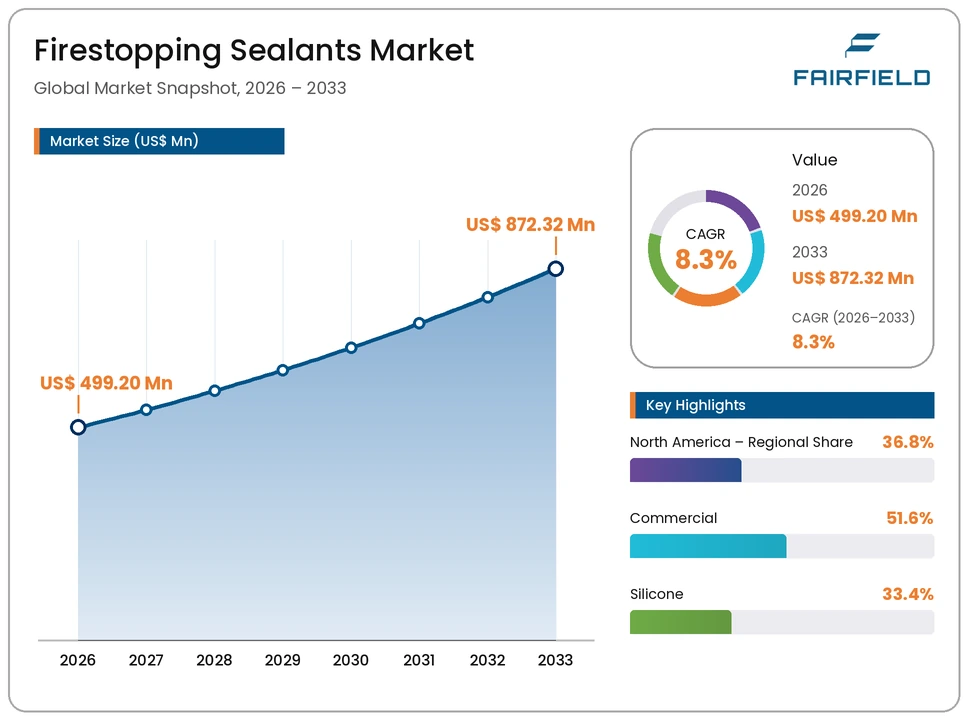
The global firestopping sealants market is expected to be valued at US$ 499.20 Million in 2026 and is projected to reach US$ 872.32 Million by 2033, growing at a CAGR of 8.3% between 2026 and 2033. This trajectory reflects sustained demand from commercial construction, industrial retrofits, and increasingly rigorous enforcement of through-penetration firestop systems across major economies. Historical growth from 2020 to 2025 tracked at 7.7% CAGR, establishing a durable upward base.
Key Highlights
- North America held 36.8% of the global firestopping sealants market in 2026, supported by stringent building codes and strong fire safety compliance requirements.
- The firestopping sealants market is projected to grow at a CAGR of 8.3%, adding approximately US$ 373 Million in incremental value by 2033.
- Silicone firestopping sealants accounted for 33.4% of the market in 2026 due to their superior flexibility, adhesion, and fire resistance.
- Intumescent sealants are expected to be the fastest-growing product segment, driven by rising demand from data center and commercial construction projects.
- Retrofit and building remediation projects represent the largest growth opportunity, supported by stricter fire safety regulations and increasing building upgrades.
Key Growth Determinants
- Escalating Global Fire Safety Regulations and Code Enforcement
Regulatory tightening is the single most consequential demand driver in the firestopping sealants industry. The International Code Council (ICC) updated its International Building Code in 2024 to impose stricter through-penetration firestop requirements for high-rise mixed-use structures directly expanding the specification volume for compliant sealant systems. The European Union's Construction Products Regulation (CPR) revision, advancing through legislative stages since 2022, is tightening fire performance classifications under EN 1366 test standards, compelling specifiers in Germany, France, and the Netherlands to upgrade legacy installations. Passive fire protection contractors are encountering heightened inspection regimes, making third-party-tested firestop assemblies the kind supplied by established manufacturers a non-negotiable procurement criterion rather than a value-add.
Key Growth Barriers
- High Installation Complexity and Contractor Skill Gaps
Firestopping sealant systems are not commodity products correct application requires trained passive fire protection installers who understand annular space ratios, substrate compatibility, and fire-resistance ratings. The Firestop Contractors International Association (FCIA) has documented persistent shortfalls in certified installer availability, particularly in fast-growing markets across Southeast Asia and Latin America. Misapplied firestop systems fail certification inspections and create liability exposure for contractors, slowing project timelines and deterring specifiers unfamiliar with the compliance landscape from engaging premium products.
Firestopping Sealants Market Opportunities
- Retrofit and Remediation of Existing Building Stock
The most underexploited commercial thesis in this market is the retrofit opportunity. Hundreds of thousands of commercial and public buildings across North America and Europe were constructed before modern passive fire protection standards took effect. The UK government's post-Grenfell remediation programme has already committed over £5 billion to building safety works, a portion of which covers firestopping remediation in multi-occupancy residential blocks. Insurance underwriters are independently driving the same trend major carriers such as Lloyd's of London have begun requiring passive fire protection audit reports as a condition of commercial property policy renewal, opening a new non-regulatory demand channel for inspection and re-sealing services.
Market Segmentation Analysis
- Product Type Analysis
Silicone firestopping sealants account for 33.4% of the global firestopping sealants market in 2026, equivalent to US$ 166.73 Million. Silicone's dominance reflects its unmatched performance across extreme temperature cycles, joint movement, and multi-substrate adhesion properties essential in commercial high-rise construction and healthcare facilities where MEP service penetrations must accommodate structural movement without compromising fire resistance ratings.
Mechanical, electrical, and plumbing contractors consistently specify silicone sealants for HVAC ductwork penetrations and curtain wall assemblies, where flexible sealing under ASTM E814 or UL 1479 fire test conditions is a code requirement rather than a preference. 3M Company's FireDam Silicone 2000 series exemplifies the gold-standard specification product in this segment.
Intumescent firestopping sealants are the fastest growing product segment, propelled by mandatory adoption in cable management systems within data centres and battery energy storage facilities. Specified Technologies Inc. (STI) introduced its SpecSeal ESS Elastomeric Firestop Sealant with enhanced intumescent performance in 2024, targeting the hyperscale data centre sector, where fire compartmentalisation requirements are intensifying alongside rack density increases.
- End-user Analysis
The commercial end-user segment accounts for 51.6% of the global firestopping sealants market in 2026, equivalent to US$ 257.59 Million. Commercial construction dominates because of the sheer density of fire-rated compartment boundaries, service penetrations, and jurisdictional inspection requirements embedded in non-residential building codes. Office towers, retail centres, and hospitality developments require firestop-rated assemblies at every floor penetration and fire wall junction a specification pattern enforced by building control authorities and fire marshals in virtually every major market. Healthcare facilities represent a particularly specification-intensive sub-segment: The Joint Commission in the United States requires hospitals to maintain documented firestop assembly records as part of its accreditation standard EC.02.06.01, creating durable recurring demand for tested and listed sealant systems.
The industrial end-user segment is the fastest growing category, driven by expansion in liquefied natural gas (LNG) terminals, petrochemical refineries, and battery gigafactories. Sika AG has been actively targeting industrial passive fire protection through its FireStop product portfolio since 2023, pursuing EPC (engineering, procurement, and construction) contractors managing facilities where fire compartmentalisation failures carry catastrophic consequence and where premium-priced, engineered firestop solutions command strong margins.
Regional Insights
- North America Firestopping Sealants Market Trends and Insights
North America accounts for 36.8% of the global firestopping sealants market in 2026, representing US$ 183.71 Million. The region's leadership reflects a mature building code infrastructure enforced through state-level adoption of NFPA 101 and IBC standards, combined with active insurance-driven demand for documented firestop compliance. Federal infrastructure spending under the Bipartisan Infrastructure Law continues to sustain public-sector construction through 2026, maintaining healthy specification volume across hospitals, transit hubs, and federal facilities.
U.S. Firestopping Sealants Market Size
The U.S. firestopping sealants market represents 85.7% of the North America regional market in 2026, equivalent to US$ 157.44 Million. Demand is anchored by stringent enforcement of the International Fire Code (IFC) at the municipal level, combined with high awareness among general contractors of liability exposure from non-compliant penetration sealing. The accelerating data centre construction cycle particularly in Virginia, Texas, and Arizona is opening a structurally new demand channel through 2033.
- Canada Firestopping Sealants Market Size
The Canada firestopping sealants market represents 14.3% of the North America regional market in 2026, equivalent to US$ 26.27 Million. The National Building Code of Canada (NBC) 2020 edition introduced tighter compartmentalisation requirements for mid-rise wood-frame structures, expanding firestopping sealant specification beyond high-rise concrete construction for the first time. Urban densification projects in Toronto and Vancouver represent a sustained forward demand signal through the forecast period.
- Asia Pacific Firestopping Sealants Market Trends and Insights
Asia Pacific accounts for 23.6% of the global firestopping sealants market in 2026, representing US$ 117.81 Million, and is the fastest growing regional market at an estimated 9.8% CAGR. China's enforcement of revised GB 50016 fire protection code provisions, combined with India's rapid commercial construction expansion under its Smart Cities Mission, is generating structural demand acceleration. Both markets are transitioning from reactive fire safety to proactive passive protection specification a shift that consistently benefits firestopping sealant volume and average selling prices.
China Firestopping Sealants Market Size
The China firestopping sealants market represents 38.4% of the Asia Pacific regional market in 2026, equivalent to US$ 45.24 Million. Mandatory compliance with GB 50016-2014 (2018 edition) fire protection design standards is the primary demand driver, as local authorities have intensified enforcement following high-profile commercial building fires. Rising domestic manufacturing capacity from producers such as Bostik and regional Chinese formulators signals competitive pricing pressure ahead.
Japan Firestopping Sealants Market Size
The Japan firestopping sealants market represents 18.9% of the Asia Pacific regional market in 2026, equivalent to US$ 22.27 Million. Japan's Building Standard Law revisions and active seismic retrofitting programmes which require re-evaluation of fire compartmentalisation whenever structural elements are modified sustain consistent sealant demand. The country's ageing commercial building stock represents a durable retrofit opportunity through 2033.
India Firestopping Sealants Market Size
The India firestopping sealants market represents 17.2% of the Asia Pacific regional market in 2026, equivalent to US$ 20.26 Million. Rapid commercial real estate development in Bengaluru, Hyderabad, and Mumbai, combined with enforcement of the National Building Code of India (NBC) 2016 fire protection provisions, is pulling firestopping sealant adoption into mainstream contractor specification. Growing awareness among Indian fire safety consultants of through-penetration firestop assembly requirements positions this market for above-regional-average growth toward 2033.
Competitive Landscape
The firestopping sealants industry is moderately consolidated at the premium specification tier, where 3M Company, Hilti Group, Sika AG, and Tremco Incorporated command disproportionate share through their tested and listed product libraries, installer training programmes, and relationships with building code authorities. Competitive differentiation turns on the breadth of UL-listed or FM Approved firestop assembly combinations a technical catalogue asset that takes years to build and constitutes a genuine barrier to entry. Mid-tier and regional players compete primarily on price within commodity installation segments but struggle to displace incumbents in specified commercial and industrial projects where liability documentation is mandatory.
Companies Covered in Firestopping Sealants Market
- 3M Company
- Hilti Group
- Sika AG
- BASF SE
- Fosroc, Inc.
- H.B. Fuller Company
- Tremco Incorporated
- RPM International Inc.
- Promat International
- Specified Technologies Inc. (STI)
- Pecora Corporation
- Nelson Firestop (Emerson Electric Co.)
Market Segmentation
By Product Type
- Elastomeric
- Intumescent
- Silicone
- Acrylic
- Others
By End-user
- Residential
- Commercial
- Industrial
By Region
- North America
- Europe
- Asia Pacific
- Latin America
- Middle East & Africa
- Executive Summary
- Global Firestopping Sealants Market Snapshot
- Future Projections
- Key Market Trends
- Regional Snapshot, by Value, 2026
- Analyst Recommendations
- Market Overview
- Market Definitions and Segmentations
- Market Dynamics
- Drivers
- Restraints
- Market Opportunities
- Value Chain Analysis
- COVID-19 Impact Analysis
- Porter's Five Forces Analysis
- Impact of Russia-Ukraine Conflict
- PESTLE Analysis
- Regulatory Analysis
- Price Trend Analysis
- Current Prices and Future Projections, 2025-2033
- Price Impact Factors
- Global Firestopping Sealants Market Outlook, 2020 - 2033
- Global Firestopping Sealants Market Outlook, by Product Type, Value (US$ Mn), 2020-2033
- Elastomeric
- Intumescent
- Silicone
- Acrylic
- Others
- Global Firestopping Sealants Market Outlook, by End-user, Value (US$ Mn), 2020-2033
- Residential
- Commercial
- Industrial
- Global Firestopping Sealants Market Outlook, by Region, Value (US$ Mn), 2020-2033
- North America
- Europe
- Asia Pacific
- Latin America
- Middle East & Africa
- Global Firestopping Sealants Market Outlook, by Product Type, Value (US$ Mn), 2020-2033
- North America Firestopping Sealants Market Outlook, 2020 - 2033
- North America Firestopping Sealants Market Outlook, by Product Type, Value (US$ Mn), 2020-2033
- Elastomeric
- Intumescent
- Silicone
- Acrylic
- Others
- North America Firestopping Sealants Market Outlook, by End-user, Value (US$ Mn), 2020-2033
- Residential
- Commercial
- Industrial
- North America Firestopping Sealants Market Outlook, by Country, Value (US$ Mn), 2020-2033
- U.S. Firestopping Sealants Market Outlook, by Product Type, 2020-2033
- U.S. Firestopping Sealants Market Outlook, by End-user, 2020-2033
- Canada Firestopping Sealants Market Outlook, by Product Type, 2020-2033
- Canada Firestopping Sealants Market Outlook, by End-user, 2020-2033
- BPS Analysis/Market Attractiveness Analysis
- North America Firestopping Sealants Market Outlook, by Product Type, Value (US$ Mn), 2020-2033
- Europe Firestopping Sealants Market Outlook, 2020 - 2033
- Europe Firestopping Sealants Market Outlook, by Product Type, Value (US$ Mn), 2020-2033
- Elastomeric
- Intumescent
- Silicone
- Acrylic
- Others
- Europe Firestopping Sealants Market Outlook, by End-user, Value (US$ Mn), 2020-2033
- Residential
- Commercial
- Industrial
- Europe Firestopping Sealants Market Outlook, by Country, Value (US$ Mn), 2020-2033
- Germany Firestopping Sealants Market Outlook, by Product Type, 2020-2033
- Germany Firestopping Sealants Market Outlook, by End-user, 2020-2033
- Italy Firestopping Sealants Market Outlook, by Product Type, 2020-2033
- Italy Firestopping Sealants Market Outlook, by End-user, 2020-2033
- France Firestopping Sealants Market Outlook, by Product Type, 2020-2033
- France Firestopping Sealants Market Outlook, by End-user, 2020-2033
- U.K. Firestopping Sealants Market Outlook, by Product Type, 2020-2033
- U.K. Firestopping Sealants Market Outlook, by End-user, 2020-2033
- Spain Firestopping Sealants Market Outlook, by Product Type, 2020-2033
- Spain Firestopping Sealants Market Outlook, by End-user, 2020-2033
- Russia Firestopping Sealants Market Outlook, by Product Type, 2020-2033
- Russia Firestopping Sealants Market Outlook, by End-user, 2020-2033
- Rest of Europe Firestopping Sealants Market Outlook, by Product Type, 2020-2033
- Rest of Europe Firestopping Sealants Market Outlook, by End-user, 2020-2033
- BPS Analysis/Market Attractiveness Analysis
- Europe Firestopping Sealants Market Outlook, by Product Type, Value (US$ Mn), 2020-2033
- Asia Pacific Firestopping Sealants Market Outlook, 2020 - 2033
- Asia Pacific Firestopping Sealants Market Outlook, by Product Type, Value (US$ Mn), 2020-2033
- Elastomeric
- Intumescent
- Silicone
- Acrylic
- Others
- Asia Pacific Firestopping Sealants Market Outlook, by End-user, Value (US$ Mn), 2020-2033
- Residential
- Commercial
- Industrial
- Asia Pacific Firestopping Sealants Market Outlook, by Country, Value (US$ Mn), 2020-2033
- China Firestopping Sealants Market Outlook, by Product Type, 2020-2033
- China Firestopping Sealants Market Outlook, by End-user, 2020-2033
- Japan Firestopping Sealants Market Outlook, by Product Type, 2020-2033
- Japan Firestopping Sealants Market Outlook, by End-user, 2020-2033
- South Korea Firestopping Sealants Market Outlook, by Product Type, 2020-2033
- South Korea Firestopping Sealants Market Outlook, by End-user, 2020-2033
- India Firestopping Sealants Market Outlook, by Product Type, 2020-2033
- India Firestopping Sealants Market Outlook, by End-user, 2020-2033
- Southeast Asia Firestopping Sealants Market Outlook, by Product Type, 2020-2033
- Southeast Asia Firestopping Sealants Market Outlook, by End-user, 2020-2033
- Rest of SAO Firestopping Sealants Market Outlook, by Product Type, 2020-2033
- Rest of SAO Firestopping Sealants Market Outlook, by End-user, 2020-2033
- BPS Analysis/Market Attractiveness Analysis
- Asia Pacific Firestopping Sealants Market Outlook, by Product Type, Value (US$ Mn), 2020-2033
- Latin America Firestopping Sealants Market Outlook, 2020 - 2033
- Latin America Firestopping Sealants Market Outlook, by Product Type, Value (US$ Mn), 2020-2033
- Elastomeric
- Intumescent
- Silicone
- Acrylic
- Others
- Latin America Firestopping Sealants Market Outlook, by End-user, Value (US$ Mn), 2020-2033
- Residential
- Commercial
- Industrial
- Latin America Firestopping Sealants Market Outlook, by Country, Value (US$ Mn), 2020-2033
- Brazil Firestopping Sealants Market Outlook, by Product Type, 2020-2033
- Brazil Firestopping Sealants Market Outlook, by End-user, 2020-2033
- Mexico Firestopping Sealants Market Outlook, by Product Type, 2020-2033
- Mexico Firestopping Sealants Market Outlook, by End-user, 2020-2033
- Argentina Firestopping Sealants Market Outlook, by Product Type, 2020-2033
- Argentina Firestopping Sealants Market Outlook, by End-user, 2020-2033
- Rest of LATAM Firestopping Sealants Market Outlook, by Product Type, 2020-2033
- Rest of LATAM Firestopping Sealants Market Outlook, by End-user, 2020-2033
- BPS Analysis/Market Attractiveness Analysis
- Latin America Firestopping Sealants Market Outlook, by Product Type, Value (US$ Mn), 2020-2033
- Middle East & Africa Firestopping Sealants Market Outlook, 2020 - 2033
- Middle East & Africa Firestopping Sealants Market Outlook, by Product Type, Value (US$ Mn), 2020-2033
- Elastomeric
- Intumescent
- Silicone
- Acrylic
- Others
- Middle East & Africa Firestopping Sealants Market Outlook, by End-user, Value (US$ Mn), 2020-2033
- Residential
- Commercial
- Industrial
- Middle East & Africa Firestopping Sealants Market Outlook, by Country, Value (US$ Mn), 2020-2033
- GCC Firestopping Sealants Market Outlook, by Product Type, 2020-2033
- GCC Firestopping Sealants Market Outlook, by End-user, 2020-2033
- South Africa Firestopping Sealants Market Outlook, by Product Type, 2020-2033
- South Africa Firestopping Sealants Market Outlook, by End-user, 2020-2033
- Egypt Firestopping Sealants Market Outlook, by Product Type, 2020-2033
- Egypt Firestopping Sealants Market Outlook, by End-user, 2020-2033
- Nigeria Firestopping Sealants Market Outlook, by Product Type, 2020-2033
- Nigeria Firestopping Sealants Market Outlook, by End-user, 2020-2033
- Rest of Middle East Firestopping Sealants Market Outlook, by Product Type, 2020-2033
- Rest of Middle East Firestopping Sealants Market Outlook, by End-user, 2020-2033
- BPS Analysis/Market Attractiveness Analysis
- Middle East & Africa Firestopping Sealants Market Outlook, by Product Type, Value (US$ Mn), 2020-2033
- Competitive Landscape
- Company Vs Segment Heatmap
- Company Market Share Analysis, 2025
- Competitive Dashboard
- Company Profiles
- 3M Company
- Company Overview
- Product Portfolio
- Financial Overview
- Business Strategies and Developments
- Hilti Group
- Sika AG
- BASF SE
- Fosroc, Inc.
- H.B. Fuller Company
- Tremco Incorporated
- RPM International Inc.
- Promat International
- Specified Technologies Inc. (STI)
- Pecora Corporation
- Nelson Firestop (Emerson Electric Co.)
- 3M Company
- Appendix
- Research Methodology
- Report Assumptions
- Acronyms and Abbreviations
By Product Type
- Elastomeric
- Intumescent
- Silicone
- Acrylic
- Others
By End-user
- Residential
- Commercial
- Industrial
By Region
- North America
- Europe
- Asia Pacific
- Latin America
- Middle East & Africa
Our Research Methodology
Considering the volatility of business today, traditional approaches to strategizing a game plan can be unfruitful if not detrimental. True ambiguity is no way to determine a forecast. A myriad of predetermined factors must be accounted for such as the degree of risk involved, the magnitude of circumstances, as well as conditions or consequences that are not known or unpredictable. To circumvent binary views that cast uncertainty, the application of market research intelligence to strategically posture, move, and enable actionable outcomes is necessary.
View Methodology
Quality Assured
Rigorous Validation Process

Confidentiality Assured
End-to-end Data Security

Custom Research Services
Tailored To Your Objectives
FAQs
The global firestopping sealants market is valued at US$ 499.20 Million in 2026 and is forecast to reach US$ 872.32 Million by 2033, at a CAGR of 8.3%.
Market growth is driven by stricter fire safety regulations and increasing construction of data centers, industrial facilities, and high-rise buildings.
Silicone firestopping sealants lead the market with a 33.4% share due to their superior flexibility, durability, and fire resistance.
North America dominates with a 36.8% market share, supported by stringent building codes, strong regulatory enforcement, and high retrofit demand.
The greatest opportunity lies in industrial retrofit and fire safety upgrades, driven by increasing investments in critical infrastructure and energy facilities.
Related Reports
Carbon Black Market Size, Share, Insights, Competitive Landscape, and Forecast 2026 to 2033
Carbon black market to reach US$ 25.9 billion by 2033 at 3.5% CAGR. Explore product types, applications, regions and key companies.
Industrial And Institutional Cleaning Chemicals Market Size, Share, Insights, Competitive Landscape, and Forecast 2026 to 2033
Industrial and institutional cleaning chemicals market to reach US$103.4 billion by 2033 at 5.4% CAGR. Explore segments, regions and key players.
Helium Market Size, Share, Insights, Competitive Landscape, and Forecast 2026 to 2033
Helium market is forecast to grow from US$5.47 billion in 2026 to US$8.12 billion by 2033 at 5.81% CAGR. Explore segments, regions and companies.
Helium in Semiconductor Market Size, Share, Insights, Competitive Landscape, and Forecast 2026 to 2033
Helium in semiconductor market outlook 2026–2033: process functions, delivery arrangements, recovered helium, regional demand, and leading gas suppliers.
Heavy Metal Testing Market Size, Share, Insights, Competitive Landscape, and Forecast 2026 to 2033
The global heavy metal testing market is valued at US$3.20 billion in 2026, reaching US$5.20 billion by 2033, growing at a 7.18% CAGR
Titanium Alloy Market Size, Share, Insights, Competitive Landscape, and Forecast 2026 to 2033
The global titanium alloy market is valued at US$6.20 billion in 2026, reaching US$8.80 billion by 2033, growing at a 5.13% CAGR