



Industrial And Institutional Cleaning Chemicals Market
Industrial And Institutional Cleaning Chemicals Market Size, Share, Insights, Competitive Landscape, and Forecast 2026 to 2033
Industrial And Institutional Cleaning Chemicals Market Size and Trend Analysis
How Big Is the Professional Cleaning Chemicals Market?
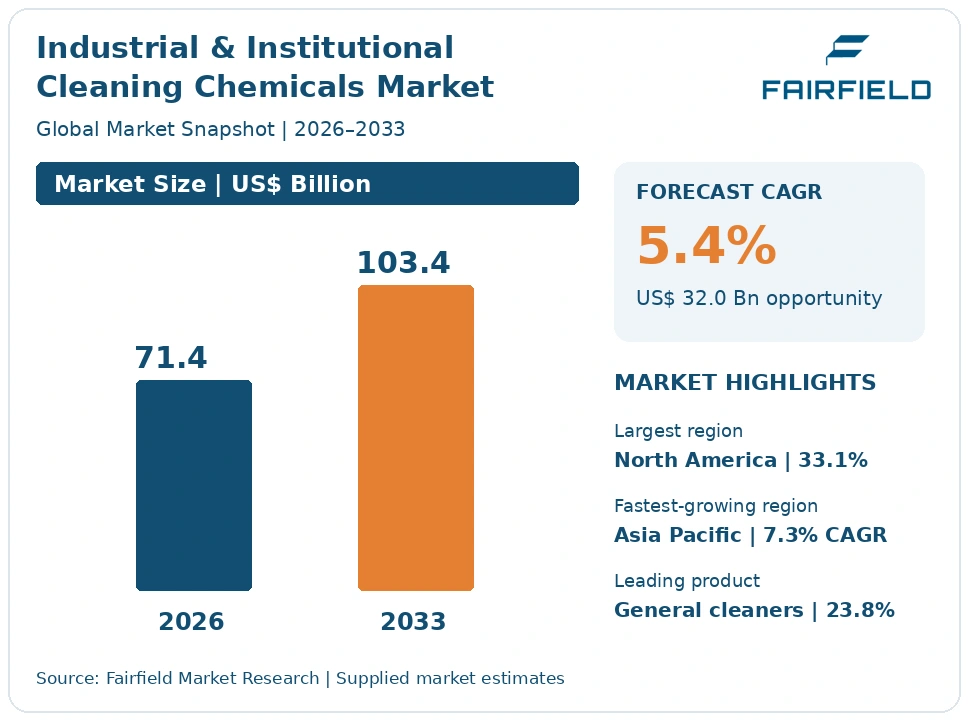
The global Industrial And Institutional Cleaning Chemicals market size is expected to be valued at US$ 71.4 billion in 2026 and projected to reach US$ 103.4 billion by 2033, growing at a CAGR of 5.4% between 2026 and 2033.
The sector grew at roughly a 4.6% CAGR between 2020 and 2025, with a hygiene spike in 2020 and 2021 followed by two years of normalisation. These figures cover chemical formulations only. Dispensing equipment, hygiene auditing and service contracts are excluded, although they strongly influence which supplier holds the account. Three factors set the direction of travel. Food safety documentation keeps sanitation volumes rising in processing plants. Outsourcing of cleaning labour concentrates purchasing with suppliers who provide dispensers and training. Concentrate formats lift value per shipped litre while cutting freight. The market is mature and service-wrapped, so growth is steady rather than sharp, and share moves through contracts rather than through new chemistry.
Key Report Takeaways
- By Product Type: General purpose cleaners held 23.8% share in 2026, while disinfectants and sanitizers are projected to expand at a 6.9% CAGR through 2033, driven by infection-prevention auditing in hospitals and documented surface protocols in long-term care facilities.
- By Ingredient Type: Surfactants held 31.2% share in 2026, while enzymes are projected to expand at a 7.4% CAGR through 2033, driven by low-temperature laundry programmes that cut energy use per kilogram of processed linen.
- By Form: Liquids held 57.6% share in 2026, while solid concentrates are projected to expand at a 7.6% CAGR through 2033, driven by dilution-control dispensers that remove shipped water and shrink plastic packaging volumes.
- By End Use: Foodservice held 21.4% share in 2026, while food and beverage processing is projected to expand at a 7.0% CAGR through 2033, driven by clean-in-place chemistry in dairy, brewing and ready-to-eat plants.
- By Geography: North America held 33.1% share in 2026, while Asia Pacific is projected to expand at a 7.3% CAGR through 2033, driven by hotel and hospital construction and the formalisation of contract cleaning.
Global Industrial And Institutional Cleaning Chemicals Market Trends and Insights
Drivers Impact Analysis
Two demand forces explain most of the forecast growth in professional cleaning chemistry.
| Driver | Impact on CAGR Forecast | Geographic Relevance | Impact Timeline |
| Documented food safety sanitation in processing and foodservice | High | Global, strongest in North America and Europe | Long term (≥4 years) |
| Outsourcing of cleaning labour to building service contractors | Medium | North America, Europe, Asia Pacific | Medium term (2–4 years) |
Food Safety Documentation Converts Sanitation Rules Into Steady Chemical Volume
Food safety enforcement is the most reliable demand pull in professional sanitation chemistry. Processors, restaurant groups and grocery prepared-food counters now treat documented cleaning as a licence to operate. Each audit cycle turns into measurable chemical consumption, because written sanitation procedures specify the product, the dilution, the contact time and the verification method. That specification holds a supplier in the account for years and raises usage per site.
The mechanism is both regulatory and contractual. Under the US Food and Drug Administration preventive controls framework, food facilities must keep written sanitation controls and supporting records. Retail buyers reinforce this through third-party scheme audits that demand validated chemistry and dosing evidence. Clean-in-place circuits in dairy, brewing and beverage plants consume caustic, acid and chlorinated additives on fixed cycles. As plants add lines for ready-to-eat products, consumption scales with installed stainless steel rather than with headcount.
Outsourced Facility Cleaning Pulls Chemical Purchasing Into Dispenser-Linked Programmes
Outsourcing of cleaning labour is steadily concentrating chemical purchasing. Building service contractors now clean a large share of offices, schools, airports and hospitals in developed economies. They standardise chemistry across hundreds of sites to control training, liability and cost per cleanable square metre. A single contract win therefore moves a block of consumption from one supplier to another, which makes programme design more important than unit price.
The causal chain starts with labour. Wage inflation and chronic recruitment difficulty push facility owners to hand cleaning to specialists. Contractors then favour suppliers who install closed-loop dispensers, supply colour-coded training in several languages, and issue the compliance documentation that clients request. Trade bodies such as ISSA have pushed standardised cleaning verification, which reinforces the same effect. Dilution control also reduces chemical overuse and product damage claims, so contractors treat the dispenser estate as part of the service they sell.
Restraints Impact Analysis
Two structural constraints hold back faster expansion in institutional cleaning chemistry.
| Restraint | Impact on CAGR Forecast | Geographic Relevance | Impact Timeline |
| Cost and duration of biocidal active substance approval and product authorisation | High | Europe, with spillover to export markets | Long term (≥4 years) |
| Volatility in surfactant and caustic feedstock costs | Medium | Global | Short term (≤2 years) |
Biocide Authorisation Costs Narrow Disinfectant Portfolios for Smaller Formulators
Disinfectant portfolios are expensive to keep legal, and that cost falls hardest on small and mid-sized formulators. Under the Biocidal Products Regulation (EU) No 528/2012, a disinfectant needs an approved active substance and an authorised product before it can be sold. The result is portfolio pruning. Formulators drop marginal stock-keeping units, narrow their active substance choices, and delay launches into categories where the authorisation payback looks thin.
The cost sources are specific rather than general. Active substance dossiers require toxicology, environmental fate and exposure modelling. Product authorisation requires efficacy testing to standards such as EN 1276 and EN 13697, for every organism, surface and contact time claimed on the label. National authorisations and product-family filings add fees and translation work. A parallel burden exists in the United States, where antimicrobial products are registered as pesticides with the Environmental Protection Agency and every efficacy claim must be supported.
Surfactant and Caustic Feedstock Swings Compress Margin on Commodity Cleaner Lines
Raw material volatility compresses margin on the highest-volume, lowest-differentiation products. General purpose cleaners, floor care and commercial laundry powders carry a heavy share of commodity inputs. When input costs move sharply, suppliers cannot reprice national contracts quickly, because most institutional business sits under annual agreements with fixed price schedules and indexation clauses that lag the market by one or two quarters.
The specific cost sources are identifiable. Linear alkylbenzene sulphonate tracks benzene and refinery economics. Fatty alcohol ethoxylates track palm kernel and coconut oleochemical prices, which respond to harvest and export policy. Caustic soda tracks chlor-alkali operating rates, and sodium hypochlorite follows the same chain. Solvent grades track petrochemical cracker margins. Packaging resin and freight add a further layer. Because many buyers treat commodity cleaners as interchangeable, suppliers absorb part of each increase rather than lose a multi-site account.
Market Opportunities
Solid and Ultra-Concentrate Formats Open a Freight, Packaging and Carbon Revenue Pool
Concentrated and solid formats open a revenue pool that sits outside traditional litre-for-litre competition. Shipping a ready-to-use cleaner means shipping mostly water. Solid blocks, capsules and ultra-concentrates cut transport weight and plastic use dramatically, and they let suppliers price on performance per use rather than on volume. That shift raises realised value per kilogram of active chemistry and makes the account harder for a commodity rival to copy.
The buyers who create this demand are large, reporting organisations. Hotel groups, healthcare systems, universities and national contractors now carry published packaging and emissions targets, and cleaning supply is an easy line to improve. Suppliers with an installed dispenser estate capture the pool most readily, because dilution control is what makes concentrates safe for frontline staff. Programmes such as Safer Choice from the Environmental Protection Agency and the EU Ecolabel give procurement teams a defensible selection rule.
Digital Hygiene Verification Adds a Recurring Audit and Data Revenue Layer
Digital hygiene verification creates a recurring revenue layer on top of the chemical sale. Connected dispensers, handheld surface testing and mobile inspection apps generate dosing and cleaning records that customers increasingly need for their own audits. Suppliers can charge for that evidence as a subscription, which raises account value and makes switching chemistry a data migration rather than a simple purchasing decision.
Demand comes first from regulated and reputation-sensitive settings. Hospitals need environmental cleaning evidence for infection prevention committees. Food plants need sanitation verification to close out audit findings. Hotel groups want cross-property hygiene scoring. The supporting development is cheap connectivity in dispensing hardware, combined with inspection software that maps results to a documented procedure. Independent distributors and smaller formulators can participate by reselling platforms rather than building them, which keeps the pool open beyond the largest suppliers.
Segment Analysis
By Product Type: General Purpose Cleaners Hold Volume While Disinfectants Set the Growth Pace
General purpose cleaners held 23.8% share in 2026, the largest single product position. They lead because every facility type buys them daily, across floors, washrooms, glass and hard surfaces, and because dispenser-fed dilution makes them the natural anchor product in a programme. Disinfectants and sanitizers are the fastest-growing product line at a 6.9% CAGR through 2033. Growth comes from hospital infection-prevention programmes, long-term care protocols and food contact surface sanitising, where efficacy claims carry legal weight. Degreasers, commercial laundry chemicals, warewashing products and vehicle care fill the remainder, each tied to a specific asset base. The business implication is that suppliers defend volume with general purpose chemistry but defend margin with registered disinfectants, where approval costs limit the number of credible competitors and where customers pay for documented kill claims rather than for appearance alone.
By Ingredient Type: Surfactants Dominate Formulation Spend as Enzymes Scale Quickly
Surfactants held 31.2% share of ingredient spend in 2026, reflecting their presence in almost every cleaner, detergent and degreaser sold into institutional channels. Anionic and non-ionic grades dominate because they deliver soil removal at low cost and tolerate hard water when paired with chelants. Enzymes are the fastest-growing ingredient class at a 7.4% CAGR through 2033. Protease, amylase and lipase blends let commercial laundries and warewashing systems work at lower temperatures, cutting energy cost per cycle, and they handle protein and starch soils that surfactants alone struggle with. Solvents, chelating agents, pH regulators and registered biocidal actives make up the balance. Biodegradability requirements under the EU Detergents Regulation continue to steer surfactant selection. For formulators, the practical consequence is a slow migration of value from bulk surfactant volume toward performance additives that are harder to substitute.
By Form: Liquid Concentrates Remain Standard While Solid Formats Grow Fastest
Liquids held 57.6% share in 2026 and remain the default format for institutional cleaning chemistry. They dose accurately through venturi and metering dispensers, suit nearly every application, and need no reformulation when a customer changes equipment. Solid concentrates are the fastest-growing form at a 7.6% CAGR through 2033. Blocks, capsules and dissolvable sachets cut shipped water, reduce pallet count and lower plastic consumption, which appeals to buyers with packaging reduction targets. Powders retain a role in commercial laundry and warewashing, while gels and foams serve clinging applications such as washroom descaling and vertical surface degreasing. The commercial implication is logistical rather than chemical. Suppliers who convert accounts to solids shrink their own freight and warehousing cost per unit of active sold, and they tie the customer to proprietary dispensing hardware that competitors cannot easily displace.
By End Use: Foodservice Leads Consumption While Food and Beverage Processing Accelerates
Foodservice held 21.4% share in 2026, the largest end-use position, because restaurants, caterers and institutional kitchens run warewashing, surface sanitising and floor care every operating day. Site density also matters, since chains standardise chemistry across thousands of outlets. Food and beverage processing is the fastest-growing end use at a 7.0% CAGR through 2033, led by clean-in-place chemistry in dairy, brewing, beverage and ready-to-eat plants, where sanitation is validated and recorded rather than visual. Healthcare, hospitality, building service contractors, retail and general manufacturing account for the remainder. Each has a distinct chemistry mix, from surgical-grade disinfection to vehicle care in transport depots. For suppliers, the implication is that technical service capability now decides which end uses are profitable, because processing accounts require engineering support that general cleaning accounts do not.
Geography Analysis
Which Region Is Leading the Industrial And Institutional Cleaning Chemicals Market?
North America leads the market with 33.1% share in 2026. The region’s position rests on a large installed base of chain foodservice, hospital systems and outsourced facility management, all of which buy on documented programmes rather than spot purchases. The United States supplies most of this demand, with Canada and Mexico adding processing and hospitality volume. Antimicrobial products are registered with the Environmental Protection Agency, and label claims are enforced, which rewards suppliers that can fund registration and defend efficacy data. Sanitation record-keeping in food plants is well established and audited by retail customers. Growth is steady rather than rapid, at roughly 4.4% annually, because penetration is already high. The clearest change underway is conversion of ready-to-use products to dispensed concentrates inside large national accounts seeking packaging reduction.
Europe’s Biocide Authorisation Regime Reshapes Professional Hygiene Supply
Europe holds 26.8% share in 2026 and is the most tightly regulated market for professional hygiene chemistry. Germany, France, the United Kingdom, Italy and the Nordic countries account for most consumption, supported by dense hospital networks, food processing capacity and a mature contract cleaning industry. Two instruments shape supply. The Detergents Regulation (EC) No 648/2004 sets surfactant biodegradability and ingredient disclosure rules, while the Biocidal Products Regulation (EU) No 528/2012 governs disinfectant approval. Together they raise the fixed cost of a compliant portfolio and favour suppliers with regulatory departments. The EU Ecolabel is widely written into public procurement tenders, so certification often decides bid eligibility. Growth sits near 4.2% annually. The main change is the proposed revision of the detergents framework, which would add digital product information and cover microbial cleaning products explicitly.
Which Region Is Growing Fastest in the Industrial And Institutional Cleaning Chemicals Market?
Asia Pacific is growing fastest, at a 7.3% CAGR between 2026 and 2033, from 27.4% share in 2026. Growth is driven by hotel and hospital construction, rapid expansion of organised foodservice chains, and the shift of cleaning work from in-house staff to professional contractors. China, India, Japan, Australia and Indonesia contribute most of the volume, with India adding the steepest incremental demand as quick-service restaurant and hospital networks scale. Dairy and packaged food capacity expansion is lifting clean-in-place chemical consumption. Local formulators compete aggressively on price in general purpose cleaning, so multinational suppliers concentrate on warewashing, laundry and food plant programmes where dispensing and technical service justify a premium. The structural change to watch is hygiene standardisation written into hotel and restaurant franchise agreements, which pulls chain accounts toward documented chemical programmes.
Latin America Builds Scale Through Protein Processing and Hospitality Hygiene
Latin America accounts for 7.3% share in 2026, anchored by Brazil and Mexico, with Chile, Colombia and Argentina adding steady volume. Export-oriented protein processing is the strongest demand source, because poultry, beef and fish plants shipping to foreign buyers must satisfy importing-country sanitation audits. Tourism-driven hospitality in coastal markets provides a second base of warewashing and laundry consumption. Barriers are real. Currency volatility raises the landed cost of imported actives, informal cleaning labour limits dispenser adoption, and enforcement of hygiene rules varies widely between national and municipal authorities. Distribution is fragmented, so suppliers rely on regional distributors who also carry equipment. The main opportunity is conversion of export-grade processing plants to validated, documented chemical programmes, since those customers already face the audit pressure that justifies higher specification products.
Middle East & Africa Demand Follows Hospital, Hotel and Catering Construction
Middle East & Africa holds 5.4% share in 2026, the smallest regional position but a visible growth pocket. The United Arab Emirates, Saudi Arabia and Qatar drive most spending through hotel, airport, stadium and hospital construction, together with large contract catering operations serving labour accommodation and oil and gas sites. South Africa, Egypt, Nigeria and Kenya add food processing and healthcare demand. Barriers include heavy reliance on imported finished products, long supply lines that complicate service response, and uneven enforcement of hygiene standards outside the Gulf states. Water scarcity also shapes product choice toward low-rinse and concentrated systems. The clearest opportunity is facility management outsourcing, which is expanding quickly in Gulf cities and brings the standardised, dispenser-based chemical purchasing that smaller independent buyers rarely adopt.
Competitive Landscape
The market is moderately concentrated. A handful of global suppliers hold a substantial combined share of institutional volume, yet thousands of regional formulators and private-label manufacturers remain active in general purpose cleaning, where barriers are low. Concentration rises sharply in registered disinfectants, commercial warewashing and food plant sanitation, because those categories demand regulatory dossiers, dispensing hardware and field service engineers. It falls in floor care, washroom products and janitorial commodities, where local blenders compete effectively on price and delivery speed. Solenis LLC and Diversey now operate as one hygiene and water treatment group, a combination that illustrates how scale is assembled in this sector.
Competition is rarely about formulation novelty. Suppliers compete on dispensing equipment reliability, dilution accuracy, training support, hygiene auditing, regulatory documentation and the ability to serve a multinational account under one agreement. Chemistry itself is largely interchangeable at the commodity end. New entrants typically arrive through adjacent routes, including oleochemical producers moving downstream, ingredient suppliers such as Stepan Company and BASF SE supporting private-label formulators, and software vendors adding hygiene verification layers.
Strategic positions differ by heritage. Ecolab Inc. anchors its position in service density and institutional account coverage. Zep Inc., Spartan Chemical Company Inc. and Betco Corporation compete through distributor networks in janitorial and maintenance channels. Christeyns NV focuses on laundry and food hygiene. Consumer-rooted brands such as The Clorox Company and Reckitt Benckiser Group plc extend recognised disinfectant labels into professional channels.
Strategic direction across the sector points the same way: concentrate chemistry, connect dispensers, certify products against recognised environmental schemes, and sell compliance evidence alongside the drum.
Industrial And Institutional Cleaning Chemicals Industry Leaders
- Ecolab Inc.
- Solenis LLC
- Diversey
- Stepan Company
- Zep Inc.
Recent Industry Developments
October 2005: Regulation (EC) No 648/2004 on detergents became applicable across the European Union, requiring ultimate aerobic biodegradability for surfactants and ingredient data sheets for medical personnel – it remains the baseline formulation constraint for professional cleaning products sold in the bloc.
September 2013: The Biocidal Products Regulation (EU) No 528/2012 entered into application, requiring approved active substances and authorised products for disinfectants – it raised the fixed regulatory cost of a disinfectant portfolio and favoured larger suppliers.
September 2015: The US Food and Drug Administration finalised the Preventive Controls for Human Food rule under the Food Safety Modernization Act, mandating written sanitation controls and records – it converted plant cleaning from practice into documented, auditable chemical consumption.
April 2023: The European Commission adopted a proposal to revise the detergents framework, introducing digital product passports and explicit rules for microbial cleaning products – it signals a compliance step that will favour suppliers with established regulatory capability.
Industrial And Institutional Cleaning Chemicals Market Report Scope
| Metric | Value |
| Study Period | 2020–2033 |
| Market Size 2026 | US$ 71.4 Billion |
| Market Size 2033 | US$ 103.4 Billion |
| CAGR 2026–2033 | 5.4% |
| Absolute Dollar Opportunity | US$ 32.0 Billion |
| Largest Market | North America, 33.1% share in 2026 |
| Fastest-Growing Market | Asia Pacific, 7.3% CAGR |
| Market Concentration | Medium |
| Major Players | Ecolab Inc., Solenis LLC, Diversey, Stepan Company, Zep Inc. |
This report covers chemical formulations sold to businesses and institutions for professional cleaning, disinfection, warewashing, laundry, vehicle care and food plant sanitation. Dispensing equipment, hygiene auditing and service contracts are excluded from the sizing, as are retail consumer cleaning products. The base year is 2025, the forecast period runs from 2026 to 2033, and all values are reported in US$ Billion at manufacturer level.
Industrial And Institutional Cleaning Chemicals Market Segmentation
Product Type
- General Purpose Cleaners
- Disinfectants and Sanitizers
- Commercial Laundry Chemicals
- Warewashing and Dishwashing Chemicals
- Degreasers and Specialty Cleaners
- Vehicle Care Chemicals
Ingredient Type
- Surfactants
- Solvents
- Chelating Agents
- pH Regulators
- Enzymes
- Biocidal Active Ingredients
Form
- Liquids
- Powders
- Solid Concentrates
- Gels
- Foams and Aerosols
End Use
- Foodservice
- Healthcare
- Hospitality and Lodging
- Food and Beverage Processing
- Building Service Contractors
- Retail
- Manufacturing and Industrial
Regions
- North America
- Europe
- Asia Pacific
- Latin America
- Middle East & Africa
- Executive Summary
- Global Industrial And Institutional Cleaning Chemicals Market Snapshot
- Future Projections
- Key Report Takeaways
- Regional Snapshot
- Market Overview
- Market Definition and Report Scope
- Historical Trends 2020–2025
- Market Dynamics
- Drivers
- Food Safety Documentation Converts Sanitation Rules Into Steady Chemical Volume
- Outsourced Facility Cleaning Pulls Chemical Purchasing Into Dispenser-Linked Programmes
- Restraints
- Biocide Authorisation Costs Narrow Disinfectant Portfolios for Smaller Formulators
- Surfactant and Caustic Feedstock Swings Compress Margin on Commodity Cleaner Lines
- Market Opportunities
- Solid and Ultra-Concentrate Formats Open a Freight, Packaging and Carbon Revenue Pool
- Digital Hygiene Verification Adds a Recurring Audit and Data Revenue Layer
- Drivers
- Global Industrial And Institutional Cleaning Chemicals Market Outlook, 2020–2033
- Global Industrial And Institutional Cleaning Chemicals Market Outlook, by Product Type, Value (US$ Billion), 2020–2033
- General Purpose Cleaners
- Disinfectants and Sanitizers
- Commercial Laundry Chemicals
- Warewashing and Dishwashing Chemicals
- Degreasers and Specialty Cleaners
- Vehicle Care Chemicals
- Global Industrial And Institutional Cleaning Chemicals Market Outlook, by Ingredient Type, Value (US$ Billion), 2020–2033
- Surfactants
- Solvents
- Chelating Agents
- pH Regulators
- Enzymes
- Biocidal Active Ingredients
- Global Industrial And Institutional Cleaning Chemicals Market Outlook, by Form, Value (US$ Billion), 2020–2033
- Liquids
- Powders
- Solid Concentrates
- Gels
- Foams and Aerosols
- Global Industrial And Institutional Cleaning Chemicals Market Outlook, by End Use, Value (US$ Billion), 2020–2033
- Foodservice
- Healthcare
- Hospitality and Lodging
- Food and Beverage Processing
- Building Service Contractors
- Retail
- Manufacturing and Industrial
- Global Industrial And Institutional Cleaning Chemicals Market Outlook, by Region, Value (US$ Billion), 2020–2033
- North America
- Europe
- Asia Pacific
- Latin America
- Middle East & Africa
- Global Industrial And Institutional Cleaning Chemicals Market Outlook, by Product Type, Value (US$ Billion), 2020–2033
- North America Industrial And Institutional Cleaning Chemicals Market Outlook, 2020–2033
- North America Industrial And Institutional Cleaning Chemicals Market Outlook, by Product Type, Value (US$ Billion), 2020–2033
- General Purpose Cleaners
- Disinfectants and Sanitizers
- Commercial Laundry Chemicals
- Warewashing and Dishwashing Chemicals
- Degreasers and Specialty Cleaners
- Vehicle Care Chemicals
- North America Industrial And Institutional Cleaning Chemicals Market Outlook, by Ingredient Type, Value (US$ Billion), 2020–2033
- Surfactants
- Solvents
- Chelating Agents
- pH Regulators
- Enzymes
- Biocidal Active Ingredients
- North America Industrial And Institutional Cleaning Chemicals Market Outlook, by Form, Value (US$ Billion), 2020–2033
- Liquids
- Powders
- Solid Concentrates
- Gels
- Foams and Aerosols
- North America Industrial And Institutional Cleaning Chemicals Market Outlook, by End Use, Value (US$ Billion), 2020–2033
- Foodservice
- Healthcare
- Hospitality and Lodging
- Food and Beverage Processing
- Building Service Contractors
- Retail
- Manufacturing and Industrial
- North America Industrial And Institutional Cleaning Chemicals Market Outlook, by Country, Value (US$ Billion), 2020–2033
- United States Industrial And Institutional Cleaning Chemicals Market Outlook, by Product Type, 2020–2033
- United States Industrial And Institutional Cleaning Chemicals Market Outlook, by Ingredient Type, 2020–2033
- United States Industrial And Institutional Cleaning Chemicals Market Outlook, by Form, 2020–2033
- United States Industrial And Institutional Cleaning Chemicals Market Outlook, by End Use, 2020–2033
- Canada Industrial And Institutional Cleaning Chemicals Market Outlook, by Product Type, 2020–2033
- Canada Industrial And Institutional Cleaning Chemicals Market Outlook, by Ingredient Type, 2020–2033
- Canada Industrial And Institutional Cleaning Chemicals Market Outlook, by Form, 2020–2033
- Canada Industrial And Institutional Cleaning Chemicals Market Outlook, by End Use, 2020–2033
- Mexico Industrial And Institutional Cleaning Chemicals Market Outlook, by Product Type, 2020–2033
- Mexico Industrial And Institutional Cleaning Chemicals Market Outlook, by Ingredient Type, 2020–2033
- Mexico Industrial And Institutional Cleaning Chemicals Market Outlook, by Form, 2020–2033
- Mexico Industrial And Institutional Cleaning Chemicals Market Outlook, by End Use, 2020–2033
- North America Industrial And Institutional Cleaning Chemicals Market Outlook, by Product Type, Value (US$ Billion), 2020–2033
- Europe Industrial And Institutional Cleaning Chemicals Market Outlook, 2020–2033
- Europe Industrial And Institutional Cleaning Chemicals Market Outlook, by Product Type, Value (US$ Billion), 2020–2033
- General Purpose Cleaners
- Disinfectants and Sanitizers
- Commercial Laundry Chemicals
- Warewashing and Dishwashing Chemicals
- Degreasers and Specialty Cleaners
- Vehicle Care Chemicals
- Europe Industrial And Institutional Cleaning Chemicals Market Outlook, by Ingredient Type, Value (US$ Billion), 2020–2033
- Surfactants
- Solvents
- Chelating Agents
- pH Regulators
- Enzymes
- Biocidal Active Ingredients
- Europe Industrial And Institutional Cleaning Chemicals Market Outlook, by Form, Value (US$ Billion), 2020–2033
- Liquids
- Powders
- Solid Concentrates
- Gels
- Foams and Aerosols
- Europe Industrial And Institutional Cleaning Chemicals Market Outlook, by End Use, Value (US$ Billion), 2020–2033
- Foodservice
- Healthcare
- Hospitality and Lodging
- Food and Beverage Processing
- Building Service Contractors
- Retail
- Manufacturing and Industrial
- Europe Industrial And Institutional Cleaning Chemicals Market Outlook, by Country, Value (US$ Billion), 2020–2033
- Germany Industrial And Institutional Cleaning Chemicals Market Outlook, by Product Type, 2020–2033
- Germany Industrial And Institutional Cleaning Chemicals Market Outlook, by Ingredient Type, 2020–2033
- Germany Industrial And Institutional Cleaning Chemicals Market Outlook, by Form, 2020–2033
- Germany Industrial And Institutional Cleaning Chemicals Market Outlook, by End Use, 2020–2033
- France Industrial And Institutional Cleaning Chemicals Market Outlook, by Product Type, 2020–2033
- France Industrial And Institutional Cleaning Chemicals Market Outlook, by Ingredient Type, 2020–2033
- France Industrial And Institutional Cleaning Chemicals Market Outlook, by Form, 2020–2033
- France Industrial And Institutional Cleaning Chemicals Market Outlook, by End Use, 2020–2033
- United Kingdom Industrial And Institutional Cleaning Chemicals Market Outlook, by Product Type, 2020–2033
- United Kingdom Industrial And Institutional Cleaning Chemicals Market Outlook, by Ingredient Type, 2020–2033
- United Kingdom Industrial And Institutional Cleaning Chemicals Market Outlook, by Form, 2020–2033
- United Kingdom Industrial And Institutional Cleaning Chemicals Market Outlook, by End Use, 2020–2033
- Italy Industrial And Institutional Cleaning Chemicals Market Outlook, by Product Type, 2020–2033
- Italy Industrial And Institutional Cleaning Chemicals Market Outlook, by Ingredient Type, 2020–2033
- Italy Industrial And Institutional Cleaning Chemicals Market Outlook, by Form, 2020–2033
- Italy Industrial And Institutional Cleaning Chemicals Market Outlook, by End Use, 2020–2033
- Nordic countries Industrial And Institutional Cleaning Chemicals Market Outlook, by Product Type, 2020–2033
- Nordic countries Industrial And Institutional Cleaning Chemicals Market Outlook, by Ingredient Type, 2020–2033
- Nordic countries Industrial And Institutional Cleaning Chemicals Market Outlook, by Form, 2020–2033
- Nordic countries Industrial And Institutional Cleaning Chemicals Market Outlook, by End Use, 2020–2033
- Europe Industrial And Institutional Cleaning Chemicals Market Outlook, by Product Type, Value (US$ Billion), 2020–2033
- Asia Pacific Industrial And Institutional Cleaning Chemicals Market Outlook, 2020–2033
- Asia Pacific Industrial And Institutional Cleaning Chemicals Market Outlook, by Product Type, Value (US$ Billion), 2020–2033
- General Purpose Cleaners
- Disinfectants and Sanitizers
- Commercial Laundry Chemicals
- Warewashing and Dishwashing Chemicals
- Degreasers and Specialty Cleaners
- Vehicle Care Chemicals
- Asia Pacific Industrial And Institutional Cleaning Chemicals Market Outlook, by Ingredient Type, Value (US$ Billion), 2020–2033
- Surfactants
- Solvents
- Chelating Agents
- pH Regulators
- Enzymes
- Biocidal Active Ingredients
- Asia Pacific Industrial And Institutional Cleaning Chemicals Market Outlook, by Form, Value (US$ Billion), 2020–2033
- Liquids
- Powders
- Solid Concentrates
- Gels
- Foams and Aerosols
- Asia Pacific Industrial And Institutional Cleaning Chemicals Market Outlook, by End Use, Value (US$ Billion), 2020–2033
- Foodservice
- Healthcare
- Hospitality and Lodging
- Food and Beverage Processing
- Building Service Contractors
- Retail
- Manufacturing and Industrial
- Asia Pacific Industrial And Institutional Cleaning Chemicals Market Outlook, by Country, Value (US$ Billion), 2020–2033
- China Industrial And Institutional Cleaning Chemicals Market Outlook, by Product Type, 2020–2033
- China Industrial And Institutional Cleaning Chemicals Market Outlook, by Ingredient Type, 2020–2033
- China Industrial And Institutional Cleaning Chemicals Market Outlook, by Form, 2020–2033
- China Industrial And Institutional Cleaning Chemicals Market Outlook, by End Use, 2020–2033
- India Industrial And Institutional Cleaning Chemicals Market Outlook, by Product Type, 2020–2033
- India Industrial And Institutional Cleaning Chemicals Market Outlook, by Ingredient Type, 2020–2033
- India Industrial And Institutional Cleaning Chemicals Market Outlook, by Form, 2020–2033
- India Industrial And Institutional Cleaning Chemicals Market Outlook, by End Use, 2020–2033
- Japan Industrial And Institutional Cleaning Chemicals Market Outlook, by Product Type, 2020–2033
- Japan Industrial And Institutional Cleaning Chemicals Market Outlook, by Ingredient Type, 2020–2033
- Japan Industrial And Institutional Cleaning Chemicals Market Outlook, by Form, 2020–2033
- Japan Industrial And Institutional Cleaning Chemicals Market Outlook, by End Use, 2020–2033
- Australia Industrial And Institutional Cleaning Chemicals Market Outlook, by Product Type, 2020–2033
- Australia Industrial And Institutional Cleaning Chemicals Market Outlook, by Ingredient Type, 2020–2033
- Australia Industrial And Institutional Cleaning Chemicals Market Outlook, by Form, 2020–2033
- Australia Industrial And Institutional Cleaning Chemicals Market Outlook, by End Use, 2020–2033
- Indonesia Industrial And Institutional Cleaning Chemicals Market Outlook, by Product Type, 2020–2033
- Indonesia Industrial And Institutional Cleaning Chemicals Market Outlook, by Ingredient Type, 2020–2033
- Indonesia Industrial And Institutional Cleaning Chemicals Market Outlook, by Form, 2020–2033
- Indonesia Industrial And Institutional Cleaning Chemicals Market Outlook, by End Use, 2020–2033
- Asia Pacific Industrial And Institutional Cleaning Chemicals Market Outlook, by Product Type, Value (US$ Billion), 2020–2033
- Latin America Industrial And Institutional Cleaning Chemicals Market Outlook, 2020–2033
- Latin America Industrial And Institutional Cleaning Chemicals Market Outlook, by Product Type, Value (US$ Billion), 2020–2033
- General Purpose Cleaners
- Disinfectants and Sanitizers
- Commercial Laundry Chemicals
- Warewashing and Dishwashing Chemicals
- Degreasers and Specialty Cleaners
- Vehicle Care Chemicals
- Latin America Industrial And Institutional Cleaning Chemicals Market Outlook, by Ingredient Type, Value (US$ Billion), 2020–2033
- Surfactants
- Solvents
- Chelating Agents
- pH Regulators
- Enzymes
- Biocidal Active Ingredients
- Latin America Industrial And Institutional Cleaning Chemicals Market Outlook, by Form, Value (US$ Billion), 2020–2033
- Liquids
- Powders
- Solid Concentrates
- Gels
- Foams and Aerosols
- Latin America Industrial And Institutional Cleaning Chemicals Market Outlook, by End Use, Value (US$ Billion), 2020–2033
- Foodservice
- Healthcare
- Hospitality and Lodging
- Food and Beverage Processing
- Building Service Contractors
- Retail
- Manufacturing and Industrial
- Latin America Industrial And Institutional Cleaning Chemicals Market Outlook, by Country, Value (US$ Billion), 2020–2033
- Brazil Industrial And Institutional Cleaning Chemicals Market Outlook, by Product Type, 2020–2033
- Brazil Industrial And Institutional Cleaning Chemicals Market Outlook, by Ingredient Type, 2020–2033
- Brazil Industrial And Institutional Cleaning Chemicals Market Outlook, by Form, 2020–2033
- Brazil Industrial And Institutional Cleaning Chemicals Market Outlook, by End Use, 2020–2033
- Mexico Industrial And Institutional Cleaning Chemicals Market Outlook, by Product Type, 2020–2033
- Mexico Industrial And Institutional Cleaning Chemicals Market Outlook, by Ingredient Type, 2020–2033
- Mexico Industrial And Institutional Cleaning Chemicals Market Outlook, by Form, 2020–2033
- Mexico Industrial And Institutional Cleaning Chemicals Market Outlook, by End Use, 2020–2033
- Chile Industrial And Institutional Cleaning Chemicals Market Outlook, by Product Type, 2020–2033
- Chile Industrial And Institutional Cleaning Chemicals Market Outlook, by Ingredient Type, 2020–2033
- Chile Industrial And Institutional Cleaning Chemicals Market Outlook, by Form, 2020–2033
- Chile Industrial And Institutional Cleaning Chemicals Market Outlook, by End Use, 2020–2033
- Colombia Industrial And Institutional Cleaning Chemicals Market Outlook, by Product Type, 2020–2033
- Colombia Industrial And Institutional Cleaning Chemicals Market Outlook, by Ingredient Type, 2020–2033
- Colombia Industrial And Institutional Cleaning Chemicals Market Outlook, by Form, 2020–2033
- Colombia Industrial And Institutional Cleaning Chemicals Market Outlook, by End Use, 2020–2033
- Argentina Industrial And Institutional Cleaning Chemicals Market Outlook, by Product Type, 2020–2033
- Argentina Industrial And Institutional Cleaning Chemicals Market Outlook, by Ingredient Type, 2020–2033
- Argentina Industrial And Institutional Cleaning Chemicals Market Outlook, by Form, 2020–2033
- Argentina Industrial And Institutional Cleaning Chemicals Market Outlook, by End Use, 2020–2033
- Latin America Industrial And Institutional Cleaning Chemicals Market Outlook, by Product Type, Value (US$ Billion), 2020–2033
- Middle East & Africa Industrial And Institutional Cleaning Chemicals Market Outlook, 2020–2033
- Middle East & Africa Industrial And Institutional Cleaning Chemicals Market Outlook, by Product Type, Value (US$ Billion), 2020–2033
- General Purpose Cleaners
- Disinfectants and Sanitizers
- Commercial Laundry Chemicals
- Warewashing and Dishwashing Chemicals
- Degreasers and Specialty Cleaners
- Vehicle Care Chemicals
- Middle East & Africa Industrial And Institutional Cleaning Chemicals Market Outlook, by Ingredient Type, Value (US$ Billion), 2020–2033
- Surfactants
- Solvents
- Chelating Agents
- pH Regulators
- Enzymes
- Biocidal Active Ingredients
- Middle East & Africa Industrial And Institutional Cleaning Chemicals Market Outlook, by Form, Value (US$ Billion), 2020–2033
- Liquids
- Powders
- Solid Concentrates
- Gels
- Foams and Aerosols
- Middle East & Africa Industrial And Institutional Cleaning Chemicals Market Outlook, by End Use, Value (US$ Billion), 2020–2033
- Foodservice
- Healthcare
- Hospitality and Lodging
- Food and Beverage Processing
- Building Service Contractors
- Retail
- Manufacturing and Industrial
- Middle East & Africa Industrial And Institutional Cleaning Chemicals Market Outlook, by Country, Value (US$ Billion), 2020–2033
- United Arab Emirates Industrial And Institutional Cleaning Chemicals Market Outlook, by Product Type, 2020–2033
- United Arab Emirates Industrial And Institutional Cleaning Chemicals Market Outlook, by Ingredient Type, 2020–2033
- United Arab Emirates Industrial And Institutional Cleaning Chemicals Market Outlook, by Form, 2020–2033
- United Arab Emirates Industrial And Institutional Cleaning Chemicals Market Outlook, by End Use, 2020–2033
- Saudi Arabia Industrial And Institutional Cleaning Chemicals Market Outlook, by Product Type, 2020–2033
- Saudi Arabia Industrial And Institutional Cleaning Chemicals Market Outlook, by Ingredient Type, 2020–2033
- Saudi Arabia Industrial And Institutional Cleaning Chemicals Market Outlook, by Form, 2020–2033
- Saudi Arabia Industrial And Institutional Cleaning Chemicals Market Outlook, by End Use, 2020–2033
- Qatar Industrial And Institutional Cleaning Chemicals Market Outlook, by Product Type, 2020–2033
- Qatar Industrial And Institutional Cleaning Chemicals Market Outlook, by Ingredient Type, 2020–2033
- Qatar Industrial And Institutional Cleaning Chemicals Market Outlook, by Form, 2020–2033
- Qatar Industrial And Institutional Cleaning Chemicals Market Outlook, by End Use, 2020–2033
- South Africa Industrial And Institutional Cleaning Chemicals Market Outlook, by Product Type, 2020–2033
- South Africa Industrial And Institutional Cleaning Chemicals Market Outlook, by Ingredient Type, 2020–2033
- South Africa Industrial And Institutional Cleaning Chemicals Market Outlook, by Form, 2020–2033
- South Africa Industrial And Institutional Cleaning Chemicals Market Outlook, by End Use, 2020–2033
- Egypt Industrial And Institutional Cleaning Chemicals Market Outlook, by Product Type, 2020–2033
- Egypt Industrial And Institutional Cleaning Chemicals Market Outlook, by Ingredient Type, 2020–2033
- Egypt Industrial And Institutional Cleaning Chemicals Market Outlook, by Form, 2020–2033
- Egypt Industrial And Institutional Cleaning Chemicals Market Outlook, by End Use, 2020–2033
- Nigeria Industrial And Institutional Cleaning Chemicals Market Outlook, by Product Type, 2020–2033
- Nigeria Industrial And Institutional Cleaning Chemicals Market Outlook, by Ingredient Type, 2020–2033
- Nigeria Industrial And Institutional Cleaning Chemicals Market Outlook, by Form, 2020–2033
- Nigeria Industrial And Institutional Cleaning Chemicals Market Outlook, by End Use, 2020–2033
- Kenya Industrial And Institutional Cleaning Chemicals Market Outlook, by Product Type, 2020–2033
- Kenya Industrial And Institutional Cleaning Chemicals Market Outlook, by Ingredient Type, 2020–2033
- Kenya Industrial And Institutional Cleaning Chemicals Market Outlook, by Form, 2020–2033
- Kenya Industrial And Institutional Cleaning Chemicals Market Outlook, by End Use, 2020–2033
- Middle East & Africa Industrial And Institutional Cleaning Chemicals Market Outlook, by Product Type, Value (US$ Billion), 2020–2033
- Competitive Landscape
- Market Concentration and Industry Leaders
- Competitive Differentiation
- Strategic Moves and Market Direction
- Recent Industry Developments
- Company Profiles
- Ecolab Inc.
- Solenis LLC
- Diversey
- Stepan Company
- BASF SE
- Croda International Plc
- The Clorox Company
- Reckitt Benckiser Group plc
- Zep Inc.
- Spartan Chemical Company Inc.
- Betco Corporation
- Christeyns NV
- Appendix
- Research Methodology
- Report Assumptions
- Acronyms and Abbreviations
Product Type
- General Purpose Cleaners
- Disinfectants and Sanitizers
- Commercial Laundry Chemicals
- Warewashing and Dishwashing Chemicals
- Degreasers and Specialty Cleaners
- Vehicle Care Chemicals
Ingredient Type
- Surfactants
- Solvents
- Chelating Agents
- pH Regulators
- Enzymes
- Biocidal Active Ingredients
Form
- Liquids
- Powders
- Solid Concentrates
- Gels
- Foams and Aerosols
End Use
- Foodservice
- Healthcare
- Hospitality and Lodging
- Food and Beverage Processing
- Building Service Contractors
- Retail
- Manufacturing and Industrial
Regions
- North America
- Europe
- Asia Pacific
- Latin America
- Middle East & Africa
Our Research Methodology
Considering the volatility of business today, traditional approaches to strategizing a game plan can be unfruitful if not detrimental. True ambiguity is no way to determine a forecast. A myriad of predetermined factors must be accounted for such as the degree of risk involved, the magnitude of circumstances, as well as conditions or consequences that are not known or unpredictable. To circumvent binary views that cast uncertainty, the application of market research intelligence to strategically posture, move, and enable actionable outcomes is necessary.
View Methodology
Quality Assured
Rigorous Validation Process

Confidentiality Assured
End-to-end Data Security

Custom Research Services
Tailored To Your Objectives
FAQs
The market is valued at US$ 71.4 billion in 2026, covering chemical formulations only and excluding dispensing equipment, hygiene auditing and service contracts.
The market is projected to reach US$ 103.4 billion by 2033, expanding at a 5.4% CAGR and adding US$ 32.0 billion in absolute opportunity.
General purpose cleaners lead with 23.8% share in 2026, because every facility type buys them daily through dispenser-fed dilution across floors, washrooms and surfaces.
Solid concentrates grow fastest among forms at a 7.6% CAGR, while Asia Pacific leads regional growth at a 7.3% CAGR through 2033.
North America holds 33.1% share in 2026, and competition is moderately concentrated, with global suppliers strongest in registered disinfectants and food plant sanitation.
Related Reports
Helium Market Size, Share, Insights, Competitive Landscape, and Forecast 2026 to 2033
Helium market is forecast to grow from US$5.47 billion in 2026 to US$8.12 billion by 2033 at 5.81% CAGR. Explore segments, regions and companies.
Helium in Semiconductor Market Size, Share, Insights, Competitive Landscape, and Forecast 2026 to 2033
Helium in semiconductor market outlook 2026–2033: process functions, delivery arrangements, recovered helium, regional demand, and leading gas suppliers.
Heavy Metal Testing Market Size, Share, Insights, Competitive Landscape, and Forecast 2026 to 2033
The global heavy metal testing market is valued at US$3.20 billion in 2026, reaching US$5.20 billion by 2033, growing at a 7.18% CAGR
Titanium Alloy Market Size, Share, Insights, Competitive Landscape, and Forecast 2026 to 2033
The global titanium alloy market is valued at US$6.20 billion in 2026, reaching US$8.80 billion by 2033, growing at a 5.13% CAGR
Fluorosurfactant Market Size, Share, Insights, Competitive Landscape, and Forecast 2026 to 2033
The global fluorosurfactant market is valued at US$0.9 billion in 2026, reaching US$1.0 billion by 2033, growing at a 1.5% CAGR
Fluoropolymer Films Market Size, Share, Insights, Competitive Landscape, and Forecast 2026 to 2033
The global fluoropolymer films market is valued at US$3.4 billion in 2026, reaching US$5.4 billion by 2033, growing at a 6.8% CAGR