



Helium Market
Helium Market Size, Share, Insights, Competitive Landscape, and Forecast 2026 to 2033
Helium Market Size and Trend Analysis
What supports growth in the helium market?
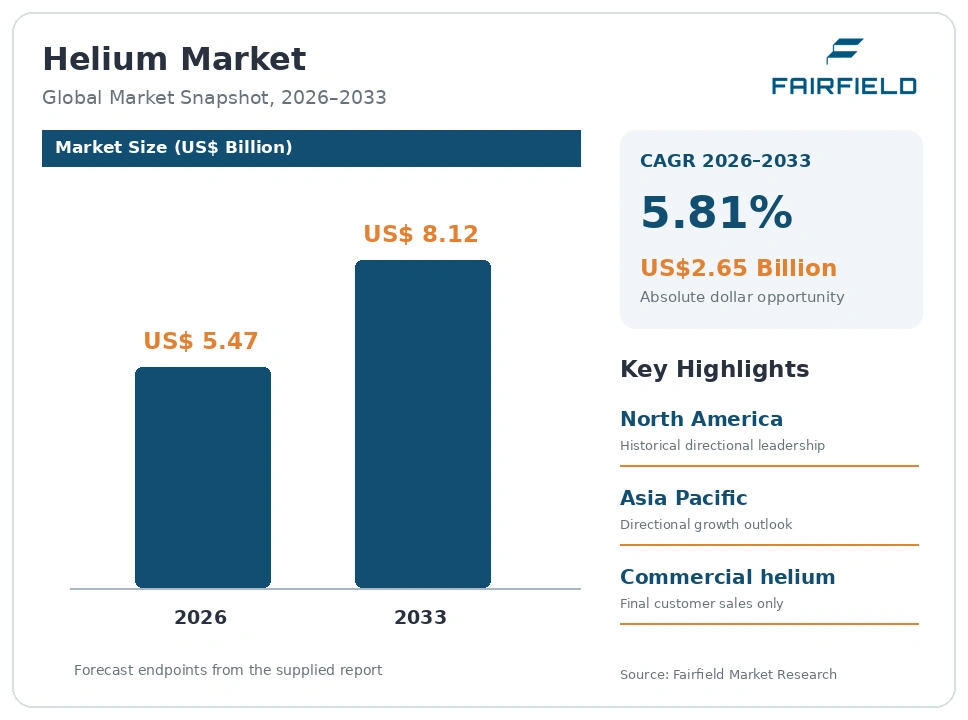
The global Helium market size is expected to be valued at US$5.47 billion in 2026 and projected to reach US$8.12 billion by 2033, growing at a CAGR of 5.81% between 2026 and 2033. The selected revenue outlook covers commercial helium supplied for industrial, medical, scientific, and other uses. It should not be confused with production volume, resource valuation, or the full value of customer equipment.
During 2020–2025, supply management and specialized applications shaped market development. A consistent historical CAGR is unavailable; the selected series values 2025 at US$5.17 billion. Semiconductor processes, cryogenic applications, and industrial testing support demand. Recovery and lower-consumption equipment can moderate fresh-gas purchases. The overall direction is therefore determined by both application requirements and delivered prices. Revenue growth cannot be interpreted as equivalent volume growth, particularly when supply conditions or contract prices change materially.
Key Report Takeaways
- By Customer Purpose: Production and Testing has documented demand in electronics, fabrication, and leak detection. Clinical and Scientific Use covers distinct cryogenic and analytical requirements, while Other Uses completes the taxonomy. Comparable shares and fastest-growth rankings are unavailable for these independently defined categories.
- By Commercial Route: Direct Contract Supply can support customers with predictable consumption and specialized requirements. Distributor Supply provides local reach and smaller-order access. Assigning each sale at the final customer boundary avoids counting upstream wholesale transfers as an additional market transaction.
- By Gas Origin: Newly Extracted Helium and Externally Recovered Helium distinguish the source of purchased product. Internal reuse is excluded from sales. Recovery can create equipment and service opportunities while reducing new-gas purchases, making revenue allocation important for market assessment.
- By Geography: North America has historical directional leadership evidence, while Asia Pacific has a strong growth outlook. Supporting forecasts use different horizons, so no regional growth rate is extended to 2033 and no older share is presented as a current estimate.
- By Supply Strategy: Linde, Air Products, Air Liquide, Messer, and Nippon Sanso document direct helium participation. Commercial differentiation depends on sourcing, purification, storage, containers, and customer support. Upstream resource access alone does not establish reliable delivered supply or market-share leadership.
Global Helium Market Trends and Insights
Drivers Impact Analysis
These qualitative impact ratings reflect demand mechanisms, without adding unsupported percentage contributions to the growth forecast.
| Driver | Impact on CAGR Forecast | Geographic Relevance | Impact Timeline |
| Specialized manufacturing and testing applications | High | North America; Europe; Asia Pacific | Medium term (2–4 years) |
| Cryogenic and analytical operating requirements | High | All five standard regions | Short term (≤2 years) |
Helium Manufacturing Demand Depends on Process Requirements
Manufacturing creates helium demand where its physical properties support a specified process or test. Semiconductor cooling, selected controlled environments, and leak detection are concrete commercial applications. Consumption depends on the actual production method, operating activity, and gas utilization. Suppliers should therefore build customer forecasts from validated process requirements instead of using broad industrial growth as a direct helium multiplier. A new factory creates potential demand only when its equipment, operating schedule, and purchasing specifications require the gas.
Messer documents electronics and testing uses, while Air Liquide identifies semiconductor cooling within its helium portfolio. Nippon Sanso Matheson also lists specialty applications and supply configurations. These disclosures verify a diverse industrial customer base without establishing equal demand across applications. Commercial value comes from matching grade, delivery, and technical support to the process. Suppliers can improve retention through dependable handling and application expertise, while customers benefit from clear specifications and realistic consumption planning.
Helium Cryogenic Applications Sustain Specialized Supply Needs
Cryogenic and analytical applications support helium purchasing where users need its thermal properties or suitable behavior within laboratory methods. Superconducting magnet systems and selected analytical instruments create distinct requirements for liquid or gaseous product. The relevant demand measure is actual replenishment and operating consumption, rather than equipment counts. Different system designs and operating practices can use materially different quantities, making a uniform consumption assumption unreliable for estimating future gas sales .
Nippon Sanso Matheson documents liquid helium for superconducting magnets and gas products for laboratories. Air Products describes liquid supply through specialized vessels, while Air Liquide lists analytical helium applications. These offerings support recurring purchasing contexts, but do not prove that every imaging technology uses helium. Suppliers can compete through application-appropriate delivery and support. Customer assessment should include equipment design, existing recovery arrangements, and consumption history, separating the gas requirement from the much larger value of medical or scientific equipment.
Restraints Impact Analysis
Resource concentration and delivery costs can limit market access and margins even where application demand remains clear.
| Restraint | Impact on CAGR Forecast | Geographic Relevance | Impact Timeline |
| Concentrated resources and supply-network exposure | High | International sourcing routes | Short term (≤2 years) |
| Specialized distribution and conservation economics | Medium | Remote and lower-volume customers | Medium term (2–4 years) |
Helium Supply Exposure Extends Beyond Resource Availability
Helium supply can be constrained by the connection between resource production, purification, liquefaction, storage, and transport. A large underground resource is not equivalent to immediately available saleable product. Equipment outages, project delays, or interrupted logistics can affect deliveries even when geological resources are substantial. Buyers therefore need to understand qualified alternative sources and deliveries. Suppliers must balance long-term commitments with infrastructure availability and inventory working capital.
Linde’s commissioned storage cavern illustrates the role of inventory infrastructure. Air Products’ disclosed production and container-management actions show that supply continuity requires coordinated operations. These examples establish relevant commercial responses, rather than proof that shortages have permanently ended. Specific costs include processing, storage, inventory financing, container turnaround, and alternative transport. Contract terms should distinguish routine service from contingency commitments. Customers can then compare the actual resilience proposition rather than assume that resource ownership or a supplier’s overall size guarantees uninterrupted supply.
Helium Distribution Costs Compete With Conservation Investment
Specialized distribution can limit the economics of serving small, dispersed, or difficult-to-reach customers. Delivered helium includes handling, containers, transport, and local support as well as the gas itself. Liquid supply adds cryogenic management requirements, while gaseous product requires suitable pressure systems. Customers may respond to these costs through improved utilization or recovery where technically appropriate. Such changes can support continued application use while reducing the fresh-gas volume purchased from an external supplier.
Air Products and Nippon Sanso Matheson document multiple supply formats, demonstrating that customer service requires more than one delivery model. The appropriate configuration depends on consumption and operating requirements. Conservation investment also has costs: collection, compression, purification, analysis, energy, and maintenance. Neither recovery nor a particular container format is universally cheapest. Suppliers should evaluate complete service economics and customers should compare total qualified delivered cost against realistic reuse alternatives, including losses and continuing maintenance responsibilities .
Market Opportunities
Helium Recovery Services Can Monetize Lower-Loss Operations
Recovery services create an opportunity to earn revenue from helping customers retain useful helium rather than simply supplying additional fresh gas. Suitable projects can include consumption audits, collection design, purification, storage, and continuing maintenance. The purchasing case depends on recoverable volume, stream composition, required quality, and operating costs. Providers should define these conditions before presenting financial benefits. A recovery project can strengthen a customer relationship even when its success reduces future new-gas purchases .
Industrial-gas suppliers, equipment specialists, and local service partners can pursue laboratories and manufacturers with recurring consumption. Expertise in gas handling and specifications offers a practical foundation, while customer-specific verification remains necessary. Opportunities are strongest where losses and collection points can be measured rather than generic averages. Contracts should allocate responsibility for purity, maintenance, and performance reporting. Equipment and service charges belong outside the gas-only market total unless externally recovered helium is separately sold to the final customer.
Helium New-Source Development Creates Qualified Supply Partnerships
New-source development offers opportunities for processing, offtake, and distribution partnerships that connect upstream projects with paying customers. Developers may have resource access but need engineering, financing, purification, or logistics support. Integrated suppliers and specialist contractors can capture value by addressing gaps. The relevant revenue pool depends on the project’s development stage and commercial commitments. A discovery or engineering study should therefore be distinguished from production, qualified delivery, and sales.
Pulsar Helium announced plant-engineering work with Chart Industries in September 2025, demonstrating the transition from resource development toward processing infrastructure. The announcement does not establish completed commercial production. Customers and offtake partners can create demand where new supply meets appropriate specifications and delivery requirements. Providers should evaluate commissioning, operating stability, and container availability alongside resource characteristics. Commercial discipline means separating prospective capacity from actual delivered output and avoiding double counting the same gas at developer, wholesaler, and final distribution stages.
Segment Analysis
By Customer Purpose: Helium Demand Requires Different Service Models
Production and Testing includes helium sold for manufacturing operations, process support, and industrial testing. Messer and Air Liquide document relevant electronics and industrial uses. Clinical and Scientific Use includes medical-related cryogenic requirements and laboratory applications, supported by Air Products and Nippon Sanso Matheson offerings. Other Uses covers remaining final customer purposes, including lifting applications. Assignment follows the principal documented customer use, preventing a single sale from entering several purpose categories.
Comparable shares and fastest-growth rates are unavailable for this independent segmentation. Its value is commercial clarity: a laboratory needing a small qualified shipment has different service requirements from a continuous industrial user. The same broad customer sector can also contain both high-consumption and low-consumption equipment. Suppliers should compare operating activity, purity, continuity, and delivery needs rather than rank opportunities using customer-sector size alone. Buyers benefit when the proposed supply configuration reflects the actual task and measured consumption profile.
By Commercial Route: Helium Direct and Distributor Sales Need Clear Boundaries
Direct Contract Supply includes final customer transactions with the supplier responsible for the contracted helium service. Distributor Supply covers purchases through a separate distribution business serving the final customer. Wholesale transfers are excluded from the final market total when the same gas is later sold onward. This boundary is necessary because a resource producer, global wholesaler, and local distributor may all participate in moving one quantity of helium to its ultimate user.
Direct contracts can support specialized requirements, predictable consumption, and coordinated infrastructure. Distributors can provide local access, packaged deliveries, and service to fragmented customers. Neither route is established as the overall leader or fastest-growing category on a comparable basis. Competition depends on service coverage, sourcing access, and delivered economics. Suppliers should assess margins after logistics and inventory costs, while customers should establish which party manages quality, containers, delivery interruptions, and technical support under the actual purchase agreement.
By Gas Origin: Helium Reuse Must Be Distinguished From New Sales
Newly Extracted Helium includes product originating from resource production and subsequent processing. Externally Recovered Helium includes gas recovered from prior use and sold through a new final customer transaction. Internal reuse is excluded because no separate sale occurs. Both categories require the quality and handling suited to use; source origin alone does not establish suitability for electronics, laboratory, or cryogenic use.
Public evidence does not establish consistent origin shares or growth rankings. Recovery can moderate primary-gas demand while creating adjacent equipment and service revenue. New-source development can expand supply diversity, but only after processing and delivery capabilities become operational. Suppliers should report gas transactions separately from recovery systems and resource investment. Customers should compare specifications, continuity, and total delivered cost, rather than assume recovered product is always suitable or newly extracted product automatically meets a specialized application’s requirements without further purification and verification.
Geography Analysis
Which Region Is Leading the Helium Market?
North America has historical directional leadership evidence in published revenue analysis, rather than a verified current share adopted here. The United States combines resource production, storage infrastructure, and varied medical, industrial, and research customers. Canada adds a resource-development and industrial supply context. Domestic availability still requires processing, containers, and local distribution before it becomes delivered customer supply.
Opportunities include specialized contracts, new-source partnerships, and recovery services. Linde’s storage investment illustrates the infrastructure supporting regional and international supply. Barriers include capital requirements, logistics costs, and the time required to bring new operations into stable production. Suppliers should distinguish regional extraction from regional consumption, because helium produced locally can be exported to customers elsewhere rather than consumed within North America.
Helium European Customers Need Import and Conservation Planning
Europe has established customer needs across laboratories, healthcare, industrial production, and aerospace. Germany, France, and the United Kingdom are relevant commercial settings. Air Liquide’s documented semiconductor-gas investment in Dresden illustrates one industrial purchasing context, although the total project value is not a helium-only investment. Regional customers require clear sourcing and handling arrangements when their gas originates outside the region.
Opportunities include local technical support, qualified delivery, and suitable recovery projects. Import logistics, specialized containers, and customer budgets can limit expansion. Suppliers should assess actual consumption rather than assume that all medical or research equipment creates the same replenishment requirement. Conservation can reduce fresh-gas purchases while sustaining the underlying application, making service revenue and gas revenue distinct elements of the regional commercial outlook.
Which Region Is Growing Fastest in the Helium Market?
Asia Pacific has a fastest-growth direction in a published outlook ending in 2031; that regional rate is not extended to 2033 here. China, Japan, South Korea, Taiwan, and India provide varied electronics, medical, and industrial customer settings. These markets differ in consumption patterns, sourcing arrangements, and service requirements, so no uniform regional operating assumption is appropriate.
Suppliers can pursue local delivery, customer qualification, and consumption-management services. Nippon Sanso’s documented helium and electronics capabilities illustrate relevant participation. Import exposure and container availability remain important constraints, while recovery can moderate external demand at suitable customer sites. The commercial opportunity depends on operating production and equipment consumption. A national factory announcement or healthcare investment does not independently establish a measurable helium requirement or a country growth ranking.
Helium Latin American Growth Depends on Delivery Economics
Latin America offers selective demand across healthcare, research, manufacturing, and industrial testing. Brazil, Mexico, and Argentina are useful customer-development settings without implying a verified national ranking. Purchasing requirements can range from specialized packaged gas to cryogenic supply. Market entry should begin with identifiable users, consumption records, and appropriate quality specifications rather than broad assumptions about regional industrial growth.
Import costs, container turnaround, geographic dispersion, and service access can constrain margins. Local distribution partners may help suppliers reach customers and maintain practical delivery schedules. Opportunities include inventory coordination, technical support, and suitable conservation projects. Buyers should evaluate the full delivered cost and responsibility for equipment and handling. Suppliers can improve commercial viability by matching routes and stock commitments to actual recurring demand rather than optimistic project pipelines.
Helium Middle East & Africa Has Distinct Production and Customer Roles
Middle East & Africa includes important sourcing locations alongside diverse customer markets. Qatar and Algeria are relevant to international helium supply, while the United Arab Emirates, Saudi Arabia, and South Africa provide potential industrial, medical, and research customer settings. Upstream output and domestic consumption should be analyzed separately. Production leadership does not automatically establish the largest regional end-user market.
Opportunities include processing partnerships, export logistics, local distribution, and selected recovery services. Project execution, transport exposure, qualification, and customer scale can limit expansion. Suppliers should assess whether proposed infrastructure serves exports, local users, or both. A credible commercial plan connects saleable product with actual delivery capacity and contracted customers, while keeping resource estimates, announced facilities, and realized helium sales distinct throughout the regional value chain.
Competitive Landscape
Competition combines globally integrated suppliers with resource developers, specialist processors, and local distributors. High concentration is an analyst judgement about integrated sourcing and distribution capability, rather than a calculated company-share result. Linde, Air Products, Air Liquide, Messer, and Nippon Sanso have directly documented helium participation. These groups serve multiple industries, and their total revenues cannot be used to rank helium suppliers or determine shares within a particular customer application.
The basis of competition includes source access, purification, liquefaction, storage, containers, and delivery support. Smaller entrants may address upstream supply or local service, but need partners or their own infrastructure to reach final customers reliably. A commercial resource discovery therefore does not immediately create a fully integrated competitor. Equally, a distributor can provide valuable customer access without owning the original resource, provided quality and supply responsibilities are clearly established.
Recent developments show different stages of competitive investment. Linde commissioned storage infrastructure, while Pulsar Helium initiated engineering work with Chart Industries. Air Products described actions involving production, liquefaction, inventory, and transport management. These are distinct moves: operating storage, project development, and network response. Treating them as equivalent additions to saleable production would overstate the effect on supply and obscure commercial implications.
Strategic direction should link upstream availability with a sustainable delivered service. Suppliers can differentiate through realistic commitments, application expertise, and appropriate recovery support. Customers should establish specifications, backup arrangements, and responsibility for containers and handling. Contracts should separate gas prices from infrastructure and service fees. An evidence-led comparison therefore focuses on demonstrated capabilities and project status, avoiding unsupported rankings, predicted winners, or the assumption that every announced investment will become near-term market revenue.
Helium Industry Leaders
- Linde
- Air Products
- Air Liquide
- Messer
- Nippon Sanso
Recent Industry Developments
July 2025: Linde commissioned a helium storage cavern, strengthening the inventory infrastructure supporting its global supply network.
September 2025: Pulsar Helium announced engineering work with Chart Industries for its planned production infrastructure, marking project development rather than completed output.
April 2026: Air Products described helium production, storage, liquefaction, and container-management actions supporting customer supply and network resilience.
Companies Covered in the Report
Linde; Air Products; Air Liquide; Messer; Nippon Sanso; Pulsar Helium; Chart Industries. The latter participates as an equipment and engineering partner, not as a directly comparable helium gas supplier.
Helium Market Report Scope
| Metric | Value |
| Study Period | 2020–2033 |
| Market Size 2026 | US$5.47 Billion |
| Market Size 2033 | US$8.12 Billion |
| CAGR 2026–2033 | 5.81% |
| Absolute Dollar Opportunity | US$2.65 Billion |
| Largest Market | North America, historical directional evidence |
| Fastest-Growing Market | Asia Pacific, directional outlook |
| Market Concentration | High, analyst judgement for integrated supply |
| Major Players | Linde, Air Products, Air Liquide, Messer, Nippon Sanso |
The Helium Market covers final customer sales of commercially supplied helium in liquid or gaseous form, including industrial, clinical, scientific, and other uses. It excludes equipment sales, resource valuations, internal reuse, and duplicated wholesale transfers. Recovery and infrastructure services are discussed as adjacent opportunities. The base year is 2025, with historical context from 2020 and a 2026–2033 forecast. Monetary values use US$ Billion, and revenue growth is distinguished from volume growth.
Helium Market Segmentation
Customer Purpose
- Production and Testing
- Clinical and Scientific Use
- Other Uses
Commercial Route
- Direct Contract Supply
- Distributor Supply
Gas Origin
- Newly Extracted Helium
- Externally Recovered Helium
Regions
- North America
- Europe
- Asia Pacific
- Latin America
- Middle East & Africa
- Executive Summary
- Global Helium Market Snapshot
- Future Projections
- Key Report Takeaways
- Regional Snapshot
- Market Overview
- Market Definition and Report Scope
- Historical Trends 2020–2025
- Market Dynamics
- Drivers
- Helium Manufacturing Demand Depends on Process Requirements
- Helium Cryogenic Applications Sustain Specialized Supply Needs
- Restraints
- Helium Supply Exposure Extends Beyond Resource Availability
- Helium Distribution Costs Compete With Conservation Investment
- Market Opportunities
- Helium Recovery Services Can Monetize Lower-Loss Operations
- Helium New-Source Development Creates Qualified Supply Partnerships
- Drivers
- Global Helium Market Outlook, 2020–2033
- Global Helium Market Outlook, by Customer Purpose, Value (US$ Billion), 2020–2033
- Production and Testing
- Clinical and Scientific Use
- Other Uses
- Global Helium Market Outlook, by Commercial Route, Value (US$ Billion), 2020–2033
- Direct Contract Supply
- Distributor Supply
- Global Helium Market Outlook, by Gas Origin, Value (US$ Billion), 2020–2033
- Newly Extracted Helium
- Externally Recovered Helium
- Global Helium Market Outlook, by Region, Value (US$ Billion), 2020–2033
- North America
- Europe
- Asia Pacific
- Latin America
- Middle East & Africa
- Global Helium Market Outlook, by Customer Purpose, Value (US$ Billion), 2020–2033
- North America Helium Market Outlook, 2020–2033
- North America Helium Market Outlook, by Customer Purpose, Value (US$ Billion), 2020–2033
- Production and Testing
- Clinical and Scientific Use
- Other Uses
- North America Helium Market Outlook, by Commercial Route, Value (US$ Billion), 2020–2033
- Direct Contract Supply
- Distributor Supply
- North America Helium Market Outlook, by Gas Origin, Value (US$ Billion), 2020–2033
- Newly Extracted Helium
- Externally Recovered Helium
- North America Helium Market Outlook, by Country, Value (US$ Billion), 2020–2033
- United States Helium Market Outlook, by Customer Purpose, 2020–2033
- United States Helium Market Outlook, by Commercial Route, 2020–2033
- United States Helium Market Outlook, by Gas Origin, 2020–2033
- Canada Helium Market Outlook, by Customer Purpose, 2020–2033
- Canada Helium Market Outlook, by Commercial Route, 2020–2033
- Canada Helium Market Outlook, by Gas Origin, 2020–2033
- North America Helium Market Outlook, by Customer Purpose, Value (US$ Billion), 2020–2033
- Europe Helium Market Outlook, 2020–2033
- Europe Helium Market Outlook, by Customer Purpose, Value (US$ Billion), 2020–2033
- Production and Testing
- Clinical and Scientific Use
- Other Uses
- Europe Helium Market Outlook, by Commercial Route, Value (US$ Billion), 2020–2033
- Direct Contract Supply
- Distributor Supply
- Europe Helium Market Outlook, by Gas Origin, Value (US$ Billion), 2020–2033
- Newly Extracted Helium
- Externally Recovered Helium
- Europe Helium Market Outlook, by Country, Value (US$ Billion), 2020–2033
- Germany Helium Market Outlook, by Customer Purpose, 2020–2033
- Germany Helium Market Outlook, by Commercial Route, 2020–2033
- Germany Helium Market Outlook, by Gas Origin, 2020–2033
- France Helium Market Outlook, by Customer Purpose, 2020–2033
- France Helium Market Outlook, by Commercial Route, 2020–2033
- France Helium Market Outlook, by Gas Origin, 2020–2033
- United Kingdom Helium Market Outlook, by Customer Purpose, 2020–2033
- United Kingdom Helium Market Outlook, by Commercial Route, 2020–2033
- United Kingdom Helium Market Outlook, by Gas Origin, 2020–2033
- Europe Helium Market Outlook, by Customer Purpose, Value (US$ Billion), 2020–2033
- Asia Pacific Helium Market Outlook, 2020–2033
- Asia Pacific Helium Market Outlook, by Customer Purpose, Value (US$ Billion), 2020–2033
- Production and Testing
- Clinical and Scientific Use
- Other Uses
- Asia Pacific Helium Market Outlook, by Commercial Route, Value (US$ Billion), 2020–2033
- Direct Contract Supply
- Distributor Supply
- Asia Pacific Helium Market Outlook, by Gas Origin, Value (US$ Billion), 2020–2033
- Newly Extracted Helium
- Externally Recovered Helium
- Asia Pacific Helium Market Outlook, by Country, Value (US$ Billion), 2020–2033
- China Helium Market Outlook, by Customer Purpose, 2020–2033
- China Helium Market Outlook, by Commercial Route, 2020–2033
- China Helium Market Outlook, by Gas Origin, 2020–2033
- Japan Helium Market Outlook, by Customer Purpose, 2020–2033
- Japan Helium Market Outlook, by Commercial Route, 2020–2033
- Japan Helium Market Outlook, by Gas Origin, 2020–2033
- South Korea Helium Market Outlook, by Customer Purpose, 2020–2033
- South Korea Helium Market Outlook, by Commercial Route, 2020–2033
- South Korea Helium Market Outlook, by Gas Origin, 2020–2033
- Taiwan Helium Market Outlook, by Customer Purpose, 2020–2033
- Taiwan Helium Market Outlook, by Commercial Route, 2020–2033
- Taiwan Helium Market Outlook, by Gas Origin, 2020–2033
- India Helium Market Outlook, by Customer Purpose, 2020–2033
- India Helium Market Outlook, by Commercial Route, 2020–2033
- India Helium Market Outlook, by Gas Origin, 2020–2033
- Asia Pacific Helium Market Outlook, by Customer Purpose, Value (US$ Billion), 2020–2033
- Latin America Helium Market Outlook, 2020–2033
- Latin America Helium Market Outlook, by Customer Purpose, Value (US$ Billion), 2020–2033
- Production and Testing
- Clinical and Scientific Use
- Other Uses
- Latin America Helium Market Outlook, by Commercial Route, Value (US$ Billion), 2020–2033
- Direct Contract Supply
- Distributor Supply
- Latin America Helium Market Outlook, by Gas Origin, Value (US$ Billion), 2020–2033
- Newly Extracted Helium
- Externally Recovered Helium
- Latin America Helium Market Outlook, by Country, Value (US$ Billion), 2020–2033
- Brazil Helium Market Outlook, by Customer Purpose, 2020–2033
- Brazil Helium Market Outlook, by Commercial Route, 2020–2033
- Brazil Helium Market Outlook, by Gas Origin, 2020–2033
- Mexico Helium Market Outlook, by Customer Purpose, 2020–2033
- Mexico Helium Market Outlook, by Commercial Route, 2020–2033
- Mexico Helium Market Outlook, by Gas Origin, 2020–2033
- Argentina Helium Market Outlook, by Customer Purpose, 2020–2033
- Argentina Helium Market Outlook, by Commercial Route, 2020–2033
- Argentina Helium Market Outlook, by Gas Origin, 2020–2033
- Latin America Helium Market Outlook, by Customer Purpose, Value (US$ Billion), 2020–2033
- Middle East & Africa Helium Market Outlook, 2020–2033
- Middle East & Africa Helium Market Outlook, by Customer Purpose, Value (US$ Billion), 2020–2033
- Production and Testing
- Clinical and Scientific Use
- Other Uses
- Middle East & Africa Helium Market Outlook, by Commercial Route, Value (US$ Billion), 2020–2033
- Direct Contract Supply
- Distributor Supply
- Middle East & Africa Helium Market Outlook, by Gas Origin, Value (US$ Billion), 2020–2033
- Newly Extracted Helium
- Externally Recovered Helium
- Middle East & Africa Helium Market Outlook, by Country, Value (US$ Billion), 2020–2033
- Qatar Helium Market Outlook, by Customer Purpose, 2020–2033
- Qatar Helium Market Outlook, by Commercial Route, 2020–2033
- Qatar Helium Market Outlook, by Gas Origin, 2020–2033
- Algeria Helium Market Outlook, by Customer Purpose, 2020–2033
- Algeria Helium Market Outlook, by Commercial Route, 2020–2033
- Algeria Helium Market Outlook, by Gas Origin, 2020–2033
- United Arab Emirates Helium Market Outlook, by Customer Purpose, 2020–2033
- United Arab Emirates Helium Market Outlook, by Commercial Route, 2020–2033
- United Arab Emirates Helium Market Outlook, by Gas Origin, 2020–2033
- Saudi Arabia Helium Market Outlook, by Customer Purpose, 2020–2033
- Saudi Arabia Helium Market Outlook, by Commercial Route, 2020–2033
- Saudi Arabia Helium Market Outlook, by Gas Origin, 2020–2033
- South Africa Helium Market Outlook, by Customer Purpose, 2020–2033
- South Africa Helium Market Outlook, by Commercial Route, 2020–2033
- South Africa Helium Market Outlook, by Gas Origin, 2020–2033
- Middle East & Africa Helium Market Outlook, by Customer Purpose, Value (US$ Billion), 2020–2033
- Competitive Landscape
- Market Concentration and Industry Leaders
- Competitive Differentiation
- Strategic Moves and Market Direction
- Recent Industry Developments
- Company Profiles
- Linde
- Air Products
- Air Liquide
- Messer
- Nippon Sanso
- Pulsar Helium
- Chart Industries
- Appendix
- Research Methodology
- Report Assumptions
- Acronyms and Abbreviations
Customer Purpose
- Production and Testing
- Clinical and Scientific Use
- Other Uses
Commercial Route
- Direct Contract Supply
- Distributor Supply
Gas Origin
- Newly Extracted Helium
- Externally Recovered Helium
Regions
- North America
- Europe
- Asia Pacific
- Latin America
- Middle East & Africa
Our Research Methodology
Considering the volatility of business today, traditional approaches to strategizing a game plan can be unfruitful if not detrimental. True ambiguity is no way to determine a forecast. A myriad of predetermined factors must be accounted for such as the degree of risk involved, the magnitude of circumstances, as well as conditions or consequences that are not known or unpredictable. To circumvent binary views that cast uncertainty, the application of market research intelligence to strategically posture, move, and enable actionable outcomes is necessary.
View Methodology
Quality Assured
Rigorous Validation Process

Confidentiality Assured
End-to-end Data Security

Custom Research Services
Tailored To Your Objectives
FAQs
The Helium Market is estimated at US$5.47 billion in 2026, covering commercial gas sales across industrial, medical, scientific, and other final customer uses.
The Helium Market is projected to reach US$8.12 billion by 2033, implying 5.81% annual growth and US$2.65 billion additional revenue opportunity overall.
A comparable leader is unavailable for the independent Customer Purpose taxonomy; actual consumption, specifications, and service requirements determine commercial attractiveness within each category.
Asia Pacific has a fastest-growth direction in a published outlook through 2031; its regional rate is not extended to 2033 within this report.
North America has historical directional leadership evidence, supported by resource production, storage, distribution, and diverse customers; a verified current regional share is unavailable.
Related Reports
Industrial And Institutional Cleaning Chemicals Market Size, Share, Insights, Competitive Landscape, and Forecast 2026 to 2033
Industrial and institutional cleaning chemicals market to reach US$103.4 billion by 2033 at 5.4% CAGR. Explore segments, regions and key players.
Helium in Semiconductor Market Size, Share, Insights, Competitive Landscape, and Forecast 2026 to 2033
Helium in semiconductor market outlook 2026–2033: process functions, delivery arrangements, recovered helium, regional demand, and leading gas suppliers.
Heavy Metal Testing Market Size, Share, Insights, Competitive Landscape, and Forecast 2026 to 2033
The global heavy metal testing market is valued at US$3.20 billion in 2026, reaching US$5.20 billion by 2033, growing at a 7.18% CAGR
Titanium Alloy Market Size, Share, Insights, Competitive Landscape, and Forecast 2026 to 2033
The global titanium alloy market is valued at US$6.20 billion in 2026, reaching US$8.80 billion by 2033, growing at a 5.13% CAGR
Fluorosurfactant Market Size, Share, Insights, Competitive Landscape, and Forecast 2026 to 2033
The global fluorosurfactant market is valued at US$0.9 billion in 2026, reaching US$1.0 billion by 2033, growing at a 1.5% CAGR
Fluoropolymer Films Market Size, Share, Insights, Competitive Landscape, and Forecast 2026 to 2033
The global fluoropolymer films market is valued at US$3.4 billion in 2026, reaching US$5.4 billion by 2033, growing at a 6.8% CAGR