



Hemophilia B Gene Therapy Market
Hemophilia B Gene Therapy Market Size, Share, Insights, Competitive Landscape, and Forecast 2026 to 2033
Report Overview
Hemophilia B Gene Therapy Market Size and Trend Analysis
How Fast Is the Hemophilia B Gene Therapy Market Growing?
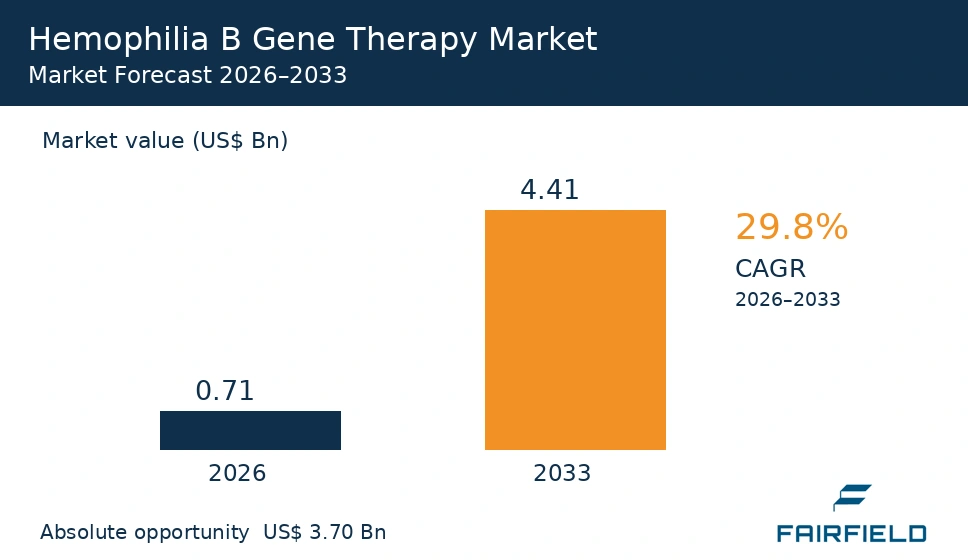
The global hemophilia B gene therapy market size is expected to be valued at US$ 0.71 billion in 2026 and projected to reach US$ 4.41 billion by 2033, growing at a CAGR of 29.8% between 2026 and 2033.
Between 2020 and 2025, the market moved from a clinical-stage field with no approved products to about US$ 0.55 billion, after CSL Behring’s Hemgenix became the first approved hemophilia B gene therapy in November 2022, followed by approvals in Europe, Canada, and China. The hemophilia B gene therapy market covers one-time treatments that give patients a working copy of the F9 gene, which carries instructions for making clotting factor IX. People with hemophilia B lack enough factor IX, so their blood does not clot properly, causing bleeding into joints and muscles. Most current therapies use an adeno-associated virus vector to deliver the gene to liver cells, which then make factor IX continuously, reducing or removing the need for regular factor infusions. Newer approaches include gene editing and engineered B cells. In March 2026, CSL Behring reported a temporary global stockout of Hemgenix linked to manufacturing complexity.
Key Report Takeaways
- By Therapy: Etranacogene Dezaparvovec held about 75% share in 2025, while Dalnacogene Ponparvovec and Other Therapies are projected to expand at a 38.0% CAGR through 2033, driven by approval in China, commercialization by Takeda, and new pipeline candidates.
- By Severity: Severe Hemophilia B held about 70% share in 2025, while Moderately Severe Hemophilia B is projected to expand at a 31.5% CAGR through 2033, driven by wider eligibility, long-term durability data, and more doctors offering gene therapy earlier.
- By Distribution Channel: Hospital Pharmacies held about 80% share in 2025, while Specialty Pharmacies are projected to expand at a 32.0% CAGR through 2033, driven by outcome-based payment programs and specialty distribution networks for high-cost therapies.
- By Region: North America held about 43% share in 2025, while Asia Pacific is projected to expand at a 34.0% CAGR through 2033, driven by the first approved gene therapy in China, large patient populations, and growing hemophilia care in Japan and India.
Global Hemophilia B Gene Therapy Market Trends and Insights
Drivers Impact Analysis
Two drivers carry the strongest influence on hemophilia B gene therapy market demand during the forecast period.
| Driver | Impact on CAGR Forecast | Geographic Relevance | Impact Timeline |
| Demand for one-time, long-lasting treatment | High | Global | Long term (≥4 years) |
| Long-term durability data and wider eligibility | Medium | North America, Europe | Medium term (2-4 years) |
One-Time Treatment Demand Is Driving the Hemophilia B Gene Therapy Market
Demand for one-time, long-lasting treatment is the strongest driver of the hemophilia B gene therapy market. Patients want freedom from regular infusions.
The mechanism is that most people with severe hemophilia B must inject factor IX products one or more times every week or two for life to prevent dangerous bleeding, which is costly, time consuming, and still allows some joint damage. A single gene therapy infusion can raise factor IX levels for many years, sharply reducing bleeding and the need for regular treatment. Lifetime factor replacement can cost millions of dollars per patient, so payers see potential long-term savings despite high upfront prices. Patient groups and hemophilia treatment centers are educating eligible adults about this option. These benefits create steady interest in gene therapy among patients, doctors, and payers across developed markets.
Durability Data Is Expanding the Hemophilia B Gene Therapy Market
Long-term durability data and wider eligibility are expanding the hemophilia B gene therapy market. Evidence is reducing doubts.
The cause is that patients and doctors were initially unsure how long gene therapy benefits would last and whether results would fade over time. In December 2025, CSL Behring presented five-year data showing that Hemgenix kept reducing bleeding and maintained factor IX levels, largely matching or improving on its original trial results. Studies also showed the therapy worked in many patients with existing antibodies to the viral vector, a group that was excluded from many earlier gene therapy trials. Payment schemes that link price to results, such as an agreement in the United Kingdom, are helping payers accept the high cost. These factors increase confidence and widen the pool of patients who can be treated.
Restraints Impact Analysis
Two restraints limit how quickly the hemophilia B gene therapy market grows.
| Restraint | Impact on CAGR Forecast | Geographic Relevance | Impact Timeline |
| Very high cost and slow patient uptake | High | Global | Medium term (2-4 years) |
| Competition from new non-factor therapies | High | North America, Europe, Asia Pacific | Long term (≥4 years) |
High Cost and Slow Uptake Slow the Hemophilia B Gene Therapy Market
Very high cost and slow patient uptake slow the hemophilia B gene therapy market. Many eligible patients are waiting.
The problem is that hemophilia B gene therapies carry list prices of about US$ 3.5 million per patient, among the highest of any medicine, and insurers often require long approval processes. Patients must also pass antibody testing, liver health checks, and long follow-up visits, while doctors worry about liver inflammation and steroid use after dosing. Many patients are satisfied with long-acting factor products and choose to wait for more data. In February 2025, Pfizer stopped selling Beqvez, citing limited interest from patients and doctors. Complex manufacturing can also disrupt supply, as shown by the Hemgenix stockout in 2026. These factors slow adoption and limit near-term revenue.
Competing Therapies Restrict the Hemophilia B Gene Therapy Market
Competition from new non-factor therapies restricts the hemophilia B gene therapy market. Patients now have more easy options.
The constraint is that several new medicines offer strong bleed protection with less frequent dosing and no permanent genetic change. Pfizer’s Hympavzi, Novo Nordisk’s Alhemo, and Sanofi’s Qfitlia are given by simple injections under the skin, some as rarely as once a month or every two months, and they work for patients with or without inhibitors. Extended half-life factor IX products already allow weekly or less frequent dosing. These options reduce the urgency for patients to choose a one-time gene therapy with uncertain lifetime durability. Gene therapy also cannot usually be repeated, because patients develop antibodies to the vector. These competing choices restrict uptake and pressure prices for gene therapy makers.
Market Opportunities
Next-Generation Gene Editing and Cell Approaches Open a Fast-Growth Revenue Pool
Next-generation gene editing and cell approaches open a fast-growth revenue pool. New methods aim to treat more patients.
The opportunity comes from technologies that could overcome the limits of current viral vector therapies, including CRISPR-based gene insertion into the liver, engineered B cells that secrete factor IX, and new vectors that avoid existing antibodies. Some approaches also aim to allow repeat dosing if factor levels fall. These approaches may work in children, whose growing livers can dilute traditional gene therapies, and in patients who were not eligible before. Be Biopharma has tested an engineered B cell medicine, and Regeneron and Intellia Therapeutics are working on gene insertion approaches. Companies that deliver durable, redosable, and safer treatments with simpler manufacturing can expand the treatable population, reduce manufacturing problems, and win premium pricing in every region.
China and Asia Pacific Access Create a Growth Revenue Pool
China and Asia Pacific access create a growth revenue pool. Large patient groups are gaining new options.
The opportunity reflects the approval of Belief BioMed’s BBM-H901 by China’s NMPA in April 2025, the first hemophilia B gene therapy in the country, with Takeda China handling commercialization in mainland China, Hong Kong, and Macau. China and India together have large numbers of people with hemophilia B, many of whom receive limited factor treatment, so a one-time therapy could make a large difference. Local manufacturing can lower costs compared with imported products, and national insurance programs are slowly adding rare disease drugs. Companies that offer affordable pricing, local production, and partnerships with hospitals and insurers can capture strong growth across Asia Pacific over the forecast period.
Segment Analysis
By Therapy: Etranacogene Dezaparvovec Leads While Dalnacogene Ponparvovec and Other Therapies Grow Fastest
Etranacogene Dezaparvovec held about 75% share in 2025. Sold as Hemgenix by CSL Behring, it was the first approved hemophilia B gene therapy and is available in North America, Europe, and other markets. It uses an AAV5 vector with a high-activity factor IX variant and has five years of follow-up data, giving it a strong lead among doctors and payers.
Dalnacogene Ponparvovec and Other Therapies are the fastest-growing segment, expanding at a 38.0% CAGR through 2033. BBM-H901 is approved in China and sold by Takeda China, while pipeline candidates using gene editing and engineered cells may reach the market later in the forecast period. For the market, new entries add competition, wider regional access, and more treatment choices for patients.
By Severity: Severe Hemophilia B Leads While Moderately Severe Hemophilia B Grows Fastest
Severe Hemophilia B held about 70% share in 2025. Patients with very low factor IX levels have frequent bleeding and the greatest need for regular treatment, making them the main candidates for gene therapy. Hemophilia treatment centers often offer gene therapy first to severe patients with joint damage or poor adherence to infusions.
Moderately Severe Hemophilia B is the fastest-growing segment, expanding at a 31.5% CAGR through 2033. Approved labels cover moderately severe patients who need regular factor treatment, and durability data are encouraging doctors to treat them earlier. Mild hemophilia B patients are generally not candidates today. For the market, broader use beyond the most severe cases increases the eligible population and supports steady growth in treated patients.
By Distribution Channel: Hospital Pharmacies Lead While Specialty Pharmacies Grow Fastest
Hospital Pharmacies held about 80% share in 2025. Gene therapies are given as a one-time infusion at qualified hemophilia treatment centers, where hospital pharmacies handle storage, preparation, and dosing under strict controls. Patients also need close liver monitoring after treatment, often for one year or longer, so most care stays within specialist hospital centers that have experience with gene therapy.
Specialty Pharmacies are the fastest-growing channel, expanding at a 32.0% CAGR through 2033. Specialty distributors help manage insurance approvals, outcome-based contracts, cold-chain delivery, and patient support services for treatment centers. Other Channels form a small segment. For the market, specialty channel growth supports access to high-cost therapies and helps manage complex payment and delivery arrangements.
Geography Analysis
Which Region Is Leading the Hemophilia B Gene Therapy Market?
North America is leading the hemophilia B gene therapy market with about 43% share in 2025. The United States has around 33,000 men living with hemophilia B, a strong network of hemophilia treatment centers, and payers willing to cover high-cost one-time therapies. CSL Behring markets Hemgenix in the region, and Regeneron, Intellia, and Be Biopharma are developing new approaches. Canada approved Hemgenix and was the first to approve Beqvez. Key barriers include high prices and slow uptake. One change shaping the region is growing use of outcome-based payment deals with private and public insurers.
Europe Shapes the Hemophilia B Gene Therapy Market Through Value-Based Access
Europe is a major hemophilia B gene therapy market. Germany, France, the United Kingdom, Italy, and Spain have well-organized hemophilia care and national reimbursement systems. Hemgenix is approved in the European Union, and the United Kingdom agreed a payment scheme linking cost to results. uniQure is based in the Netherlands, and CSL Behring has major operations in Germany and Switzerland. Key barriers include health technology assessments and price negotiations that delay access. One opportunity is outcome-based contracts that spread payments over several years, supported by national hemophilia registries that track long-term results.
Which Region Is Growing Fastest in the Hemophilia B Gene Therapy Market?
Asia Pacific is the fastest-growing hemophilia B gene therapy market, expanding at a 34.0% CAGR through 2033. China approved Belief BioMed’s BBM-H901 in April 2025, the first hemophilia B gene therapy in the country, with Takeda China leading sales. Japan has advanced hemophilia care and a fast regenerative medicine approval pathway, while India has a large, undertreated patient population. Australia and South Korea add demand through advanced hemophilia centers. Key barriers include affordability, reimbursement limits, and few trained centers. One change shaping the region is locally developed and manufactured gene therapy that may lower prices.
Latin America Grows the Hemophilia B Gene Therapy Market Through Improving Hemophilia Care
Latin America is a growing hemophilia B gene therapy market. Brazil, Mexico, Argentina, Colombia, and Chile have national hemophilia programs that supply factor products, and some leading centers have joined global gene therapy trials. Brazil runs one of the largest public hemophilia programs in the world, buying factor products for thousands of patients each year. Key barriers include very high prices, limited public budgets, currency swings, and few qualified treatment centers. One opportunity is access through clinical trials and managed entry agreements, supported by active patient groups, specialist doctor training, and international partnerships between treatment centers.
Middle East & Africa Builds the Hemophilia B Gene Therapy Market Through Specialist Centers
Middle East & Africa is an emerging hemophilia B gene therapy market. Saudi Arabia, the United Arab Emirates, and Qatar are investing in rare disease care and advanced therapies under national health plans, and some have approved gene therapies for other conditions. Israel has strong hematology expertise and clinical trial experience in gene therapy. South Africa and Egypt have growing hemophilia care programs and large undiagnosed populations. Key barriers include high costs, limited diagnosis, and few specialist centers outside large cities. One opportunity is government-funded access at specialist centers, supported by partnerships with global drug makers and growing genetic testing programs.
Competitive Landscape
The hemophilia B gene therapy market is highly consolidated. CSL Behring, uniQure N.V., Belief BioMed, Takeda Pharmaceutical Company Limited, and F. Hoffmann-La Roche Ltd (Spark Therapeutics) are leading players, while Pfizer, Be Biopharma, Regeneron, Intellia Therapeutics, and Spur Therapeutics are active or former participants, and Sanofi and Novo Nordisk compete with non-factor treatments. CSL Behring leads with Hemgenix, which was developed by uniQure, and uniQure earns royalties and milestones on its sales. Belief BioMed and Takeda lead in China with BBM-H901. Only a handful of approved products exist, so each launch has a large effect on market share.
Companies compete on durability of factor IX expression, bleeding reduction, safety, eligibility for patients with vector antibodies, manufacturing reliability, price, and outcome-based payment terms. Treatment center relationships and long-term follow-up programs are also key. Competition from simple injectable non-factor therapies is shaping how gene therapy makers position their products.
Strategic moves show how competition is changing. In February 2025, Pfizer withdrew Beqvez worldwide because of low demand. In April 2025, BBM-H901 won approval in China. In December 2025, CSL Behring presented five-year Hemgenix data, and in March 2026, it reported a temporary global stockout of the therapy.
Three themes shape vendor strategy. First, companies are building long-term evidence to win doctor and patient trust. Second, they are using outcome-based contracts to manage high prices. Third, developers are pursuing gene editing, engineered cells, and new vectors to reach children and more patients.
Hemophilia B Gene Therapy Market Industry Leaders
CSL Behring uniQure N.V. Belief BioMed Takeda Pharmaceutical Company Limited F. Hoffmann-La Roche Ltd (Spark Therapeutics)
Recent Industry Developments
- March 2026: CSL Behring announced a temporary global stockout of Hemgenix, delaying treatment for some patients, and said the disruption reflected manufacturing complexity rather than safety or efficacy - highlights supply risks in the hemophilia B gene therapy market.
- December 2025: CSL Behring presented five-year data showing Hemgenix benefits remained durable, with plans to follow patients for up to 15 years - strengthens confidence in long-term gene therapy results.
- April 2025: Belief BioMed and Takeda China received NMPA approval for BBM-H901 (dalnacogene ponparvovec), the first hemophilia B gene therapy in China - opens a large new market in Asia Pacific.
- February 2025: Pfizer stopped global development and sales of Beqvez, citing limited interest from patients and doctors - leaves Hemgenix as the main approved therapy in North America and Europe.
Companies Covered in the Report
- CSL Behring
- uniQure N.V.
- Belief BioMed
- Takeda Pharmaceutical Company Limited
- F. Hoffmann-La Roche Ltd (Spark Therapeutics)
- Pfizer Inc.
- Be Biopharma
- Regeneron Pharmaceuticals
- Intellia Therapeutics
- Spur Therapeutics
- Sanofi
- Novo Nordisk A/S
Hemophilia B Gene Therapy Market Report Scope
This report covers the hemophilia B gene therapy market, including etranacogene dezaparvovec, dalnacogene ponparvovec, and pipeline gene therapies, used to treat severe and moderately severe hemophilia B in adults, and distributed through hospital pharmacies, specialty pharmacies, and other channels. The base year is 2025, and the forecast period runs from 2026 to 2033. All values are expressed in US$ Billion.
| Therapy | Etranacogene Dezaparvovec, Dalnacogene Ponparvovec and Other Therapies |
| Severity | Severe Hemophilia B, Moderately Severe Hemophilia B |
| Distribution Channel | Hospital Pharmacies, Specialty Pharmacies, Other Channels |
| Regions | North America, Europe, Asia Pacific, Latin America, Middle East & Africa |
1. Executive Summary
1.1 Hemophilia B Gene Therapy Market Snapshot
1.2 Future Projections
1.3 Key Market Trends
1.4 Regional Snapshot
2. Market Overview
2.1 Market Definition and Report Scope
2.2 Historical Market Trends
2.3 Market Dynamics
2.3.1 Drivers
2.3.1.1 One-Time Treatment Demand Is Driving the Hemophilia B Gene Therapy Market
2.3.1.2 Durability Data Is Expanding the Hemophilia B Gene Therapy Market
2.3.2 Restraints
2.3.2.1 High Cost and Slow Uptake Slow the Hemophilia B Gene Therapy Market
2.3.2.2 Competing Therapies Restrict the Hemophilia B Gene Therapy Market
2.3.3 Market Opportunities
2.3.3.1 Next-Generation Gene Editing and Cell Approaches Open a Fast-Growth Revenue Pool
2.3.3.2 China and Asia Pacific Access Create a Growth Revenue Pool
3. Global Hemophilia B Gene Therapy Market Outlook, 2020–2033
3.1 Global Hemophilia B Gene Therapy Market Outlook, by Therapy, Value (US$ Billion), 2020–2033
3.1.1 Etranacogene Dezaparvovec
3.1.2 Dalnacogene Ponparvovec and Other Therapies
3.2 Global Hemophilia B Gene Therapy Market Outlook, by Severity, Value (US$ Billion), 2020–2033
3.2.1 Severe Hemophilia B
3.2.2 Moderately Severe Hemophilia B
3.3 Global Hemophilia B Gene Therapy Market Outlook, by Distribution Channel, Value (US$ Billion), 2020–2033
3.3.1 Hospital Pharmacies
3.3.2 Specialty Pharmacies
3.3.3 Other Channels
3.4 Global Hemophilia B Gene Therapy Market Outlook, by Region, Value (US$ Billion), 2020–2033
3.4.1 North America
3.4.2 Europe
3.4.3 Asia Pacific
3.4.4 Latin America
3.4.5 Middle East & Africa
4. North America Hemophilia B Gene Therapy Market Outlook, 2020–2033
4.1 North America Hemophilia B Gene Therapy Market Outlook, by Therapy, Value (US$ Billion), 2020–2033
4.1.1 Etranacogene Dezaparvovec
4.1.2 Dalnacogene Ponparvovec and Other Therapies
4.2 North America Hemophilia B Gene Therapy Market Outlook, by Severity, Value (US$ Billion), 2020–2033
4.2.1 Severe Hemophilia B
4.2.2 Moderately Severe Hemophilia B
4.3 North America Hemophilia B Gene Therapy Market Outlook, by Distribution Channel, Value (US$ Billion), 2020–2033
4.3.1 Hospital Pharmacies
4.3.2 Specialty Pharmacies
4.3.3 Other Channels
4.4 North America Hemophilia B Gene Therapy Market Outlook, by Country, Value (US$ Billion), 2020–2033
4.4.1 United States Hemophilia B Gene Therapy Market Outlook, by Therapy, 2020–2033
4.4.2 United States Hemophilia B Gene Therapy Market Outlook, by Severity, 2020–2033
4.4.3 United States Hemophilia B Gene Therapy Market Outlook, by Distribution Channel, 2020–2033
4.4.4 Canada Hemophilia B Gene Therapy Market Outlook, by Therapy, 2020–2033
4.4.5 Canada Hemophilia B Gene Therapy Market Outlook, by Severity, 2020–2033
4.4.6 Canada Hemophilia B Gene Therapy Market Outlook, by Distribution Channel, 2020–2033
5. Europe Hemophilia B Gene Therapy Market Outlook, 2020–2033
5.1 Europe Hemophilia B Gene Therapy Market Outlook, by Therapy, Value (US$ Billion), 2020–2033
5.1.1 Etranacogene Dezaparvovec
5.1.2 Dalnacogene Ponparvovec and Other Therapies
5.2 Europe Hemophilia B Gene Therapy Market Outlook, by Severity, Value (US$ Billion), 2020–2033
5.2.1 Severe Hemophilia B
5.2.2 Moderately Severe Hemophilia B
5.3 Europe Hemophilia B Gene Therapy Market Outlook, by Distribution Channel, Value (US$ Billion), 2020–2033
5.3.1 Hospital Pharmacies
5.3.2 Specialty Pharmacies
5.3.3 Other Channels
5.4 Europe Hemophilia B Gene Therapy Market Outlook, by Country, Value (US$ Billion), 2020–2033
5.4.1 Germany Hemophilia B Gene Therapy Market Outlook, by Therapy, 2020–2033
5.4.2 Germany Hemophilia B Gene Therapy Market Outlook, by Severity, 2020–2033
5.4.3 Germany Hemophilia B Gene Therapy Market Outlook, by Distribution Channel, 2020–2033
5.4.4 France Hemophilia B Gene Therapy Market Outlook, by Therapy, 2020–2033
5.4.5 France Hemophilia B Gene Therapy Market Outlook, by Severity, 2020–2033
5.4.6 France Hemophilia B Gene Therapy Market Outlook, by Distribution Channel, 2020–2033
5.4.7 United Kingdom Hemophilia B Gene Therapy Market Outlook, by Therapy, 2020–2033
5.4.8 United Kingdom Hemophilia B Gene Therapy Market Outlook, by Severity, 2020–2033
5.4.9 United Kingdom Hemophilia B Gene Therapy Market Outlook, by Distribution Channel, 2020–2033
5.4.10 Italy Hemophilia B Gene Therapy Market Outlook, by Therapy, 2020–2033
5.4.11 Italy Hemophilia B Gene Therapy Market Outlook, by Severity, 2020–2033
5.4.12 Italy Hemophilia B Gene Therapy Market Outlook, by Distribution Channel, 2020–2033
5.4.13 Spain Hemophilia B Gene Therapy Market Outlook, by Therapy, 2020–2033
5.4.14 Spain Hemophilia B Gene Therapy Market Outlook, by Severity, 2020–2033
5.4.15 Spain Hemophilia B Gene Therapy Market Outlook, by Distribution Channel, 2020–2033
5.4.16 Netherlands Hemophilia B Gene Therapy Market Outlook, by Therapy, 2020–2033
5.4.17 Netherlands Hemophilia B Gene Therapy Market Outlook, by Severity, 2020–2033
5.4.18 Netherlands Hemophilia B Gene Therapy Market Outlook, by Distribution Channel, 2020–2033
5.4.19 Switzerland Hemophilia B Gene Therapy Market Outlook, by Therapy, 2020–2033
5.4.20 Switzerland Hemophilia B Gene Therapy Market Outlook, by Severity, 2020–2033
5.4.21 Switzerland Hemophilia B Gene Therapy Market Outlook, by Distribution Channel, 2020–2033
6. Asia Pacific Hemophilia B Gene Therapy Market Outlook, 2020–2033
6.1 Asia Pacific Hemophilia B Gene Therapy Market Outlook, by Therapy, Value (US$ Billion), 2020–2033
6.1.1 Etranacogene Dezaparvovec
6.1.2 Dalnacogene Ponparvovec and Other Therapies
6.2 Asia Pacific Hemophilia B Gene Therapy Market Outlook, by Severity, Value (US$ Billion), 2020–2033
6.2.1 Severe Hemophilia B
6.2.2 Moderately Severe Hemophilia B
6.3 Asia Pacific Hemophilia B Gene Therapy Market Outlook, by Distribution Channel, Value (US$ Billion), 2020–2033
6.3.1 Hospital Pharmacies
6.3.2 Specialty Pharmacies
6.3.3 Other Channels
6.4 Asia Pacific Hemophilia B Gene Therapy Market Outlook, by Country, Value (US$ Billion), 2020–2033
6.4.1 China Hemophilia B Gene Therapy Market Outlook, by Therapy, 2020–2033
6.4.2 China Hemophilia B Gene Therapy Market Outlook, by Severity, 2020–2033
6.4.3 China Hemophilia B Gene Therapy Market Outlook, by Distribution Channel, 2020–2033
6.4.4 Japan Hemophilia B Gene Therapy Market Outlook, by Therapy, 2020–2033
6.4.5 Japan Hemophilia B Gene Therapy Market Outlook, by Severity, 2020–2033
6.4.6 Japan Hemophilia B Gene Therapy Market Outlook, by Distribution Channel, 2020–2033
6.4.7 India Hemophilia B Gene Therapy Market Outlook, by Therapy, 2020–2033
6.4.8 India Hemophilia B Gene Therapy Market Outlook, by Severity, 2020–2033
6.4.9 India Hemophilia B Gene Therapy Market Outlook, by Distribution Channel, 2020–2033
6.4.10 Australia Hemophilia B Gene Therapy Market Outlook, by Therapy, 2020–2033
6.4.11 Australia Hemophilia B Gene Therapy Market Outlook, by Severity, 2020–2033
6.4.12 Australia Hemophilia B Gene Therapy Market Outlook, by Distribution Channel, 2020–2033
6.4.13 South Korea Hemophilia B Gene Therapy Market Outlook, by Therapy, 2020–2033
6.4.14 South Korea Hemophilia B Gene Therapy Market Outlook, by Severity, 2020–2033
6.4.15 South Korea Hemophilia B Gene Therapy Market Outlook, by Distribution Channel, 2020–2033
7. Latin America Hemophilia B Gene Therapy Market Outlook, 2020–2033
7.1 Latin America Hemophilia B Gene Therapy Market Outlook, by Therapy, Value (US$ Billion), 2020–2033
7.1.1 Etranacogene Dezaparvovec
7.1.2 Dalnacogene Ponparvovec and Other Therapies
7.2 Latin America Hemophilia B Gene Therapy Market Outlook, by Severity, Value (US$ Billion), 2020–2033
7.2.1 Severe Hemophilia B
7.2.2 Moderately Severe Hemophilia B
7.3 Latin America Hemophilia B Gene Therapy Market Outlook, by Distribution Channel, Value (US$ Billion), 2020–2033
7.3.1 Hospital Pharmacies
7.3.2 Specialty Pharmacies
7.3.3 Other Channels
7.4 Latin America Hemophilia B Gene Therapy Market Outlook, by Country, Value (US$ Billion), 2020–2033
7.4.1 Brazil Hemophilia B Gene Therapy Market Outlook, by Therapy, 2020–2033
7.4.2 Brazil Hemophilia B Gene Therapy Market Outlook, by Severity, 2020–2033
7.4.3 Brazil Hemophilia B Gene Therapy Market Outlook, by Distribution Channel, 2020–2033
7.4.4 Mexico Hemophilia B Gene Therapy Market Outlook, by Therapy, 2020–2033
7.4.5 Mexico Hemophilia B Gene Therapy Market Outlook, by Severity, 2020–2033
7.4.6 Mexico Hemophilia B Gene Therapy Market Outlook, by Distribution Channel, 2020–2033
7.4.7 Argentina Hemophilia B Gene Therapy Market Outlook, by Therapy, 2020–2033
7.4.8 Argentina Hemophilia B Gene Therapy Market Outlook, by Severity, 2020–2033
7.4.9 Argentina Hemophilia B Gene Therapy Market Outlook, by Distribution Channel, 2020–2033
7.4.10 Colombia Hemophilia B Gene Therapy Market Outlook, by Therapy, 2020–2033
7.4.11 Colombia Hemophilia B Gene Therapy Market Outlook, by Severity, 2020–2033
7.4.12 Colombia Hemophilia B Gene Therapy Market Outlook, by Distribution Channel, 2020–2033
7.4.13 Chile Hemophilia B Gene Therapy Market Outlook, by Therapy, 2020–2033
7.4.14 Chile Hemophilia B Gene Therapy Market Outlook, by Severity, 2020–2033
7.4.15 Chile Hemophilia B Gene Therapy Market Outlook, by Distribution Channel, 2020–2033
8. Middle East & Africa Hemophilia B Gene Therapy Market Outlook, 2020–2033
8.1 Middle East & Africa Hemophilia B Gene Therapy Market Outlook, by Therapy, Value (US$ Billion), 2020–2033
8.1.1 Etranacogene Dezaparvovec
8.1.2 Dalnacogene Ponparvovec and Other Therapies
8.2 Middle East & Africa Hemophilia B Gene Therapy Market Outlook, by Severity, Value (US$ Billion), 2020–2033
8.2.1 Severe Hemophilia B
8.2.2 Moderately Severe Hemophilia B
8.3 Middle East & Africa Hemophilia B Gene Therapy Market Outlook, by Distribution Channel, Value (US$ Billion), 2020–2033
8.3.1 Hospital Pharmacies
8.3.2 Specialty Pharmacies
8.3.3 Other Channels
8.4 Middle East & Africa Hemophilia B Gene Therapy Market Outlook, by Country, Value (US$ Billion), 2020–2033
8.4.1 Saudi Arabia Hemophilia B Gene Therapy Market Outlook, by Therapy, 2020–2033
8.4.2 Saudi Arabia Hemophilia B Gene Therapy Market Outlook, by Severity, 2020–2033
8.4.3 Saudi Arabia Hemophilia B Gene Therapy Market Outlook, by Distribution Channel, 2020–2033
8.4.4 United Arab Emirates Hemophilia B Gene Therapy Market Outlook, by Therapy, 2020–2033
8.4.5 United Arab Emirates Hemophilia B Gene Therapy Market Outlook, by Severity, 2020–2033
8.4.6 United Arab Emirates Hemophilia B Gene Therapy Market Outlook, by Distribution Channel, 2020–2033
8.4.7 Qatar Hemophilia B Gene Therapy Market Outlook, by Therapy, 2020–2033
8.4.8 Qatar Hemophilia B Gene Therapy Market Outlook, by Severity, 2020–2033
8.4.9 Qatar Hemophilia B Gene Therapy Market Outlook, by Distribution Channel, 2020–2033
8.4.10 Israel Hemophilia B Gene Therapy Market Outlook, by Therapy, 2020–2033
8.4.11 Israel Hemophilia B Gene Therapy Market Outlook, by Severity, 2020–2033
8.4.12 Israel Hemophilia B Gene Therapy Market Outlook, by Distribution Channel, 2020–2033
8.4.13 South Africa Hemophilia B Gene Therapy Market Outlook, by Therapy, 2020–2033
8.4.14 South Africa Hemophilia B Gene Therapy Market Outlook, by Severity, 2020–2033
8.4.15 South Africa Hemophilia B Gene Therapy Market Outlook, by Distribution Channel, 2020–2033
8.4.16 Egypt Hemophilia B Gene Therapy Market Outlook, by Therapy, 2020–2033
8.4.17 Egypt Hemophilia B Gene Therapy Market Outlook, by Severity, 2020–2033
8.4.18 Egypt Hemophilia B Gene Therapy Market Outlook, by Distribution Channel, 2020–2033
9. Competitive Landscape
9.1 Hemophilia B Gene Therapy Market Industry Leaders
9.2 Recent Industry Developments
9.3 Company Profiles
9.3.1 CSL Behring
9.3.2 uniQure N.V.
9.3.3 Belief BioMed
9.3.4 Takeda Pharmaceutical Company Limited
9.3.5 F. Hoffmann-La Roche Ltd (Spark Therapeutics)
9.3.6 Pfizer Inc.
9.3.7 Be Biopharma
9.3.8 Regeneron Pharmaceuticals
9.3.9 Intellia Therapeutics
9.3.10 Spur Therapeutics
9.3.11 Sanofi
9.3.12 Novo Nordisk A/S
10. Appendix
10.1 Research Methodology
10.2 Report Assumptions
10.3 Acronyms and Abbreviations
| Therapy | Etranacogene Dezaparvovec, Dalnacogene Ponparvovec and Other Therapies |
| Severity | Severe Hemophilia B, Moderately Severe Hemophilia B |
| Distribution Channel | Hospital Pharmacies, Specialty Pharmacies, Other Channels |
| Regions | North America, Europe, Asia Pacific, Latin America, Middle East & Africa |
Our Research Methodology
Considering the volatility of business today, traditional approaches to strategizing a game plan can be unfruitful if not detrimental. True ambiguity is no way to determine a forecast. A myriad of predetermined factors must be accounted for such as the degree of risk involved, the magnitude of circumstances, as well as conditions or consequences that are not known or unpredictable. To circumvent binary views that cast uncertainty, the application of market research intelligence to strategically posture, move, and enable actionable outcomes is necessary.
View Methodology
Quality Assured
Rigorous Validation Process

Confidentiality Assured
End-to-end Data Security

Custom Research Services
Tailored To Your Objectives
FAQs
The global hemophilia B gene therapy market is expected to be valued at US$ 0.71 billion in 2026, driven by one-time treatment demand.
The market is projected to grow at a 29.8% CAGR from 2026 to 2033, reaching about US$ 4.41 billion by 2033.
North America leads with about 43% share, supported by strong hemophilia treatment centers, payer coverage, and early access to approved therapies.
Etranacogene Dezaparvovec dominates with about 75% share, because Hemgenix was the first approved therapy and has long-term durability data.
Key players include CSL Behring, uniQure, Belief BioMed, Takeda, and Roche, competing on durability, safety, access, and pricing.
Related Reports
Human Platelet Lysate Market Size, Share, Insights, Competitive Landscape, and Forecast 2026 to 2033
Human platelet lysate market is forecast to grow from US$60.6 million in 2026 to US$83.9 million by 2033, expanding at a CAGR of 4.8%.
Phosphoramidite Market Size, Share, Insights, Competitive Landscape, and Forecast 2026 to 2033
The phosphoramidite market is projected to reach US$ 1,833.4 million by 2033, growing at 7.7% CAGR from US$ 1,090.8 million in 2026.
New Drug Compound Testing Market Size, Share, Insights, Competitive Landscape, and Forecast 2026 to 2033
The new drug compound testing market is projected to reach US$ 36.88 billion by 2033, growing at 10.7% CAGR from US$ 18.11 billion in 2026.
Microbial Fermentation Technology Market Size, Share, Insights, Competitive Landscape, and Forecast 2026 to 2033
The microbial fermentation technology market is projected to reach US$ 61.53 billion by 2033, growing at 5.9% CAGR from US$ 41.22 billion in 2026.
Macular Edema and Macular Degeneration Market Size, Share, Insights, Competitive Landscape, and Forecast 2026 to 2033
The macular edema and macular degeneration market is projected to reach US$ 20.97 billion by 2033, growing at 7.3% CAGR from US$ 12.77 billion in 2026.
Heartworm Market Size, Share, Insights, Competitive Landscape, and Forecast 2026 to 2033
The heartworm market is projected to reach US$ 2.66 billion by 2033, growing at 7.0% CAGR from US$ 1.66 billion in 2026.