



Human Platelet Lysate Market
Human Platelet Lysate Market Size, Share, Insights, Competitive Landscape, and Forecast 2026 to 2033
Report Overview
Human Platelet Lysate Market Size and Trend Analysis
How Fast Is the Human Platelet Lysate Market Growing?
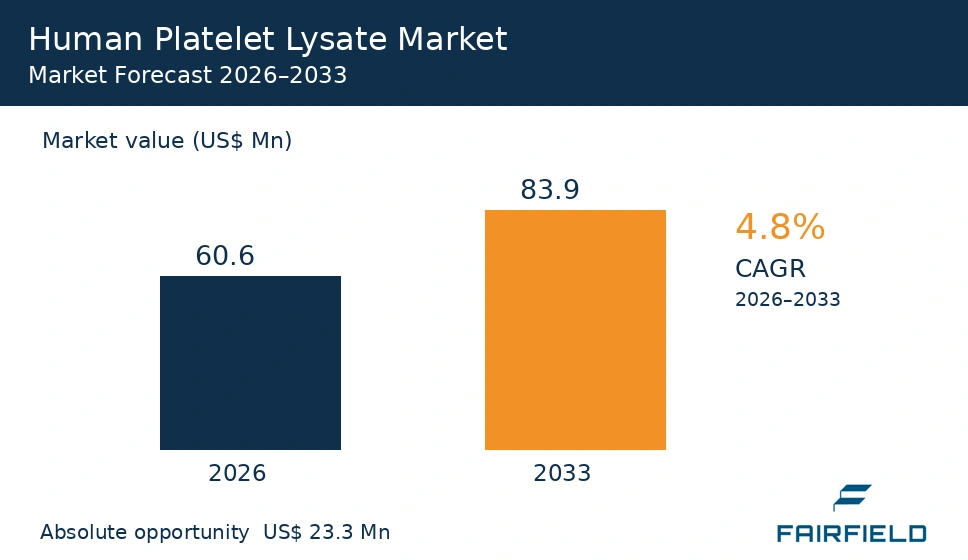
The global human platelet lysate market size is expected to be valued at US$ 60.6 million in 2026 and projected to reach US$ 83.9 million by 2033, growing at a CAGR of 4.8% between 2026 and 2033.
Between 2020 and 2025, the market grew at a CAGR of about 4.4%, rising from roughly US$ 46.5 million to about US$ 57.8 million, as cell and gene therapy research expanded, regulators encouraged animal-free culture supplements, and more mesenchymal stem cell trials moved into clinical stages. The human platelet lysate market covers growth supplements made from human platelets collected at blood banks, which are broken open to release growth factors, cytokines, and proteins that help cells grow in the laboratory. Human platelet lysate is mainly used as a safer, animal-free replacement for fetal bovine serum in the expansion of stem cells, immune cells, and other cells for research and therapy. Main products include heparin-based and heparin-free formulations, offered in research grade and GMP grade and in pathogen-reduced versions. In February 2026, PL BioScience received a material qualification certificate from Japan’s PMDA for its GMP-grade product.
Key Report Takeaways
- By Type: Heparin-Free Human Platelet Lysate held about 55% share in 2025, while Heparin-Based Human Platelet Lysate is projected to expand at a 5.4% CAGR through 2033, driven by its lower price, established protocols in research labs, and steady use in mesenchymal stem cell expansion.
- By Application: Research Use held about 62% share in 2025, while Clinical Use is projected to expand at a 6.5% CAGR through 2033, driven by more cell therapy trials, GMP-grade supply, and regulatory preference for animal-free culture supplements in manufacturing.
- By End User: Biopharmaceutical Companies held about 50% share in 2025, while Contract Research and Manufacturing Organizations are projected to expand at a 6.0% CAGR through 2033, driven by outsourced cell therapy production and process development work for biotech customers.
- By Region: North America held about 41% share in 2025, while Asia Pacific is projected to expand at a 6.5% CAGR through 2033, driven by fast regenerative medicine pathways in Japan, growing cell therapy research in China, and new GMP facilities in South Korea.
Global Human Platelet Lysate Market Trends and Insights
Drivers Impact Analysis
Two drivers carry the strongest influence on human platelet lysate market demand during the forecast period.
| Driver | Impact on CAGR Forecast | Geographic Relevance | Impact Timeline |
| Growth of cell and gene therapy development | High | Global | Long term (≥4 years) |
| Shift away from fetal bovine serum | Medium | North America, Europe | Medium term (2-4 years) |
Cell Therapy Growth Is Driving the Human Platelet Lysate Market
Growth of cell and gene therapy development is the strongest driver of the human platelet lysate market. More cells must be grown for patients.
The mechanism is that cell therapies, including mesenchymal stem cells, T cells, natural killer cells, and tissue-engineered products, require large numbers of healthy cells grown outside the body before treatment. Human platelet lysate supplies natural growth factors that help these cells multiply quickly while keeping their important properties. Hundreds of mesenchymal stem cell trials are under way worldwide for bone, cartilage, heart, immune, and inflammatory diseases, and many use platelet lysate in their manufacturing process. Approvals of new cell therapies and growing investment in regenerative medicine are increasing the number of programs moving to clinical scale. These trends create steady demand for consistent, high-quality platelet lysate supply across research labs and manufacturing sites.
Animal-Free Culture Demand Is Expanding the Human Platelet Lysate Market
The shift away from fetal bovine serum is expanding the human platelet lysate market. Developers want safer and more ethical supplements.
The cause is that fetal bovine serum, the traditional cell culture supplement, carries risks of animal viruses, prions, and immune reactions in patients, and its quality varies from batch to batch. Regulators in North America and Europe encourage developers to reduce or remove animal-derived materials from therapies given to humans. Supply of fetal bovine serum is also limited and prices can rise sharply, while ethical concerns about its collection are growing. Human platelet lysate made from expired blood bank platelets offers a sustainable, human-derived alternative that often supports faster cell growth. Gamma-irradiated and pathogen-reduced versions add extra safety. These factors encourage researchers and manufacturers to switch to platelet lysate.
Restraints Impact Analysis
Two restraints limit how quickly the human platelet lysate market grows.
| Restraint | Impact on CAGR Forecast | Geographic Relevance | Impact Timeline |
| Batch variability and donor supply limits | High | Global | Medium term (2-4 years) |
| Competition from chemically defined media | Medium | North America, Europe | Long term (≥4 years) |
Variability and Supply Limits Slow the Human Platelet Lysate Market
Batch variability and donor supply limits slow the human platelet lysate market. Natural products differ from lot to lot.
The problem is that platelet lysate is made by pooling platelets from many human donors, and the levels of growth factors can vary between batches, which affects how cells grow and requires extra testing by users. Cell therapy makers need tight consistency to meet regulatory standards, so suppliers must pool large numbers of donors and run detailed quality checks. Supply depends on blood banks and expired platelet units, which can be limited by donation rates and local rules. Testing for viruses and other infections adds cost. Heparin is often needed to prevent clotting, which can affect some cell types. These factors raise costs and make some developers cautious about switching from other supplements.
Chemically Defined Media Restrict the Human Platelet Lysate Market
Competition from chemically defined media restricts the human platelet lysate market. Some developers prefer fully synthetic formulas.
The constraint is that large media companies offer serum-free and chemically defined culture media with known ingredients, which avoid all human and animal materials and can be produced with very high consistency. Regulators view chemically defined media as easier to characterize, and many late-stage cell therapy programs aim to remove any human-derived component to simplify approval. Recombinant growth factors are becoming cheaper, making synthetic media more affordable. Some cell types, such as T cells for CAR-T therapy, grow well in these defined media. Platelet lysate suppliers must show clear benefits in growth speed, cell quality, and cost. These factors limit platelet lysate use in some therapy areas and slow its overall market growth.
Market Opportunities
GMP-Grade and Pathogen-Reduced Products Open a Fast-Growth Revenue Pool
GMP-grade and pathogen-reduced products open a fast-growth revenue pool. Clinical manufacturers need the highest quality.
The opportunity comes from cell therapy developers moving from research to clinical and commercial manufacturing, where they need GMP-grade platelet lysate with full documentation, viral safety data, and regulatory support files. Gamma-irradiated and pathogen-inactivated products offer extra protection against infectious agents. In April 2025, PL BioScience launched a gamma-irradiated GMP-grade product, and in September 2025, it expanded its Aachen headquarters to produce up to 20,000 liters of platelet lysate each year. Fibrinogen-depleted and heparin-free formats also make processing easier. Companies that offer reliable large-scale GMP supply, consistent lots, and regulatory master files can win long-term contracts with cell therapy makers worldwide.
Asia Pacific and Artificial Platelet Lysate Create a Growth Revenue Pool
Asia Pacific and artificial platelet lysate create a growth revenue pool. New markets and technologies are emerging.
The opportunity reflects fast growth in regenerative medicine across Japan, South Korea, China, India, and Australia, where governments support cell therapy research and conditional approval pathways. In February 2026, PL BioScience signed an exclusive distribution agreement with Summit Pharmaceuticals International for Japan. At the same time, researchers are developing artificial platelet lysate made from lab-grown platelets, which could remove dependence on donors, improve consistency, and lower costs. Local blood services in several countries are also exploring their own platelet lysate production. Companies that build local distribution, regulatory approvals, technical support teams, and new production methods can capture strong growth in these emerging markets and technologies.
Segment Analysis
By Type: Heparin-Free Human Platelet Lysate Leads While Heparin-Based Human Platelet Lysate Grows Fastest
Heparin-Free Human Platelet Lysate held about 55% share in 2025. Heparin-free products, often made by removing fibrinogen, avoid the need to add heparin to culture media, which simplifies processing and reduces the risk of unwanted effects on sensitive cells. Clinical manufacturers increasingly prefer these formats because they fit closed and automated systems and reduce extra materials in the final product.
Heparin-Based Human Platelet Lysate is the fastest-growing type, expanding at a 5.4% CAGR through 2033. These products are lower in price, well documented in published research, and widely used in academic labs for mesenchymal stem cell expansion. Fibrinogen-Depleted and Other Types form additional segments. For the market, both formats will grow as more labs switch from animal serum to human supplements.
By Application: Research Use Leads While Clinical Use Grows Fastest
Research Use held about 62% share in 2025. Universities, research institutes, and biotech companies use platelet lysate to grow stem cells, primary cells, and cell lines for basic research, drug testing, tissue engineering, and early product development. Large numbers of research labs provide steady demand for research-grade products in smaller volumes, and many published protocols already specify platelet lysate as the preferred supplement.
Clinical Use is the fastest-growing application, expanding at a 6.5% CAGR through 2033. Cell therapy makers use GMP-grade platelet lysate to expand cells for clinical trials and approved treatments, and each manufacturing run can require large volumes. Other Applications, such as tissue engineering and wound healing research, form a smaller segment. For the market, clinical growth raises demand for higher-value GMP products with full regulatory documentation.
By End User: Biopharmaceutical Companies Lead While Contract Research and Manufacturing Organizations Grow Fastest
Biopharmaceutical Companies held about 50% share in 2025. Cell and gene therapy developers buy platelet lysate for process development, clinical manufacturing, and quality testing, and they often sign supply agreements with qualified vendors to secure consistent lots over many years.
Contract Research and Manufacturing Organizations are the fastest-growing end user, expanding at a 6.0% CAGR through 2033. Many biotech companies outsource cell expansion and manufacturing to specialist providers with GMP facilities, trained staff, and experience in regulatory filings, rather than building their own clean rooms. Academic and Research Institutes and Hospitals form other segments, with hospitals running point-of-care cell programs. For the market, contract growth concentrates purchasing among large, quality-focused buyers that order bigger volumes.
Geography Analysis
Which Region Is Leading the Human Platelet Lysate Market?
North America is leading the human platelet lysate market with about 41% share in 2025. The United States has the largest number of cell and gene therapy developers, strong research funding, many clinical trials, and a mature network of blood banks that supply platelets. STEMCELL Technologies, BioLife Solutions, Compass Biomedical, and Mill Creek Life Sciences are based or highly active in the region. Canada adds strong regenerative medicine research and government funding for stem cell programs. Key barriers include high testing costs and competition from defined media. One change shaping the region is growth of GMP-grade demand for clinical manufacturing.
Europe Shapes the Human Platelet Lysate Market Through Regulatory Leadership
Europe is a major human platelet lysate market. Germany, France, the United Kingdom, Italy, and Austria have strong cell therapy research, and European scientists pioneered many platelet lysate protocols for mesenchymal stem cells. PL BioScience is based in Germany, and Macopharma in France, while Austria has strong blood bank expertise in pooled platelet lysate production. The European Medicines Agency encourages reducing animal-derived materials. Key barriers include donor supply rules and pricing pressure. One opportunity is GMP supply for academic cell therapy centers, supported by hospital exemption programs, public research funding, and growing numbers of advanced therapy trials across the region.
Which Region Is Growing Fastest in the Human Platelet Lysate Market?
Asia Pacific is the fastest-growing human platelet lysate market, expanding at a 6.5% CAGR through 2033. Japan has a fast-track approval system for regenerative medicine, and PL BioScience gained a PMDA certificate there in February 2026. South Korea has many approved stem cell products and growing manufacturing capacity, while China and India are expanding cell therapy research and clinical trials. Taiwan is home to AventaCell BioMedical, and Australia has active stem cell trials. Key barriers include import rules for human-derived materials. One change shaping the region is fast growth of local GMP cell manufacturing and contract production.
Latin America Grows the Human Platelet Lysate Market Through Regenerative Research
Latin America is a growing human platelet lysate market. Brazil, Mexico, Argentina, Colombia, and Chile have expanding stem cell research programs at universities and hospitals, and some countries are developing rules for advanced therapies. Brazil has strong public research institutes and blood bank networks that could support local production, and Argentina has growing advanced therapy research centers. Key barriers include limited funding, import costs, and slow regulatory pathways for cell therapies. One opportunity is research-grade supply for universities, supported by international research partnerships, growing clinical trial activity, regional distributors, and training programs in cell culture methods.
Middle East & Africa Builds the Human Platelet Lysate Market Through Research Investment
Middle East & Africa is an emerging human platelet lysate market. Saudi Arabia, the United Arab Emirates, and Qatar are investing in regenerative medicine centers and stem cell research under national health plans. Israel has a strong cell therapy sector with several companies running clinical trials. South Africa and Egypt have growing university research programs and blood transfusion services. Key barriers include limited local production, import dependence, and strict rules on human-derived materials. One opportunity is supply for new cell therapy centers, supported by government funding, international partnerships, and growing medical tourism for regenerative treatments in large cities.
Competitive Landscape
The human platelet lysate market is moderately consolidated. STEMCELL Technologies, PL BioScience GmbH, BioLife Solutions (Sexton Biotechnologies), AventaCell BioMedical, and Compass Biomedical are leading players, while Merck KGaA, Thermo Fisher Scientific, Mill Creek Life Sciences, Macopharma, Akron Biotech, Corning, and Cook Regentec compete strongly. A small group of specialist producers controls most GMP-grade supply because making platelet lysate requires access to blood bank platelets, donor testing, pooling, and validated processing. Large life science companies often sell platelet lysate alongside media, reagents, and cell culture tools, giving them wide customer reach.
Companies compete on lot-to-lot consistency, growth performance, viral safety, GMP compliance, regulatory documentation, volume capacity, heparin-free formats, and price. Long-term supply agreements with cell therapy developers are highly valuable, because switching suppliers during clinical development requires costly comparability testing.
Strategic moves show how competition is changing. In April 2025, PL BioScience launched a gamma-irradiated GMP product, and in September 2025, it expanded capacity to 20,000 liters a year. In February 2026, it won a PMDA certificate and signed a distribution deal with Summit Pharmaceuticals International in Japan. The company is also developing artificial platelet lysate from lab-grown platelets with DewCell Biotherapeutics.
Three themes shape vendor strategy. First, suppliers are adding pathogen-reduced, heparin-free, and GMP-grade products for clinical use. Second, they are expanding production capacity and donor sourcing. Third, they are building distribution and regulatory approvals in Asia Pacific to reach fast-growing cell therapy markets.
Human Platelet Lysate Market Industry Leaders
STEMCELL Technologies PL BioScience GmbH BioLife Solutions (Sexton Biotechnologies) AventaCell BioMedical Compass Biomedical
Recent Industry Developments
- February 2026: PL BioScience signed an exclusive distribution agreement with Summit Pharmaceuticals International for its GMP-grade platelet lysate in Japan - marks its first exclusive distribution partnership in the country and supports the human platelet lysate market in Asia Pacific.
- February 2026: PL BioScience received a material qualification certificate from Japan’s PMDA for its gamma-irradiated GMP-grade product - eases use of platelet lysate in Japanese regenerative medicine manufacturing.
- September 2025: PL BioScience expanded its Aachen headquarters with a new 1,200 square meter facility able to produce up to 20,000 liters of platelet lysate each year - adds large-scale GMP capacity.
- April 2025: PL BioScience launched a gamma-irradiated GMP-grade human platelet lysate manufactured in Germany using a patented process - adds a pathogen-reduced option for cell therapy makers.
Companies Covered in the Report
- STEMCELL Technologies
- PL BioScience GmbH
- BioLife Solutions (Sexton Biotechnologies)
- AventaCell BioMedical
- Compass Biomedical
- Merck KGaA
- Thermo Fisher Scientific Inc.
- Mill Creek Life Sciences
- Macopharma S.A.S.
- Akron Biotech
- Corning Incorporated
- Cook Regentec
Human Platelet Lysate Market Report Scope
This report covers the human platelet lysate market, including heparin-free, heparin-based, and fibrinogen-depleted products, in research and GMP grades, used for research and clinical applications by biopharmaceutical companies, contract research and manufacturing organizations, academic and research institutes, and hospitals. The base year is 2025, and the forecast period runs from 2026 to 2033. All values are expressed in US$ Million.
| Type | Heparin-Free Human Platelet Lysate, Heparin-Based Human Platelet Lysate, Fibrinogen-Depleted and Other Types |
| Application | Research Use, Clinical Use |
| End User | Biopharmaceutical Companies, Contract Research and Manufacturing Organizations, Academic and Research Institutes, Hospitals |
| Regions | North America, Europe, Asia Pacific, Latin America, Middle East & Africa |
1. Executive Summary
1.1 Human Platelet Lysate Market Snapshot
1.2 Future Projections
1.3 Key Market Trends
1.4 Regional Snapshot
2. Market Overview
2.1 Market Definition and Report Scope
2.2 Historical Market Trends
2.3 Market Dynamics
2.3.1 Drivers
2.3.1.1 Cell Therapy Growth Is Driving the Human Platelet Lysate Market
2.3.1.2 Animal-Free Culture Demand Is Expanding the Human Platelet Lysate Market
2.3.2 Restraints
2.3.2.1 Variability and Supply Limits Slow the Human Platelet Lysate Market
2.3.2.2 Chemically Defined Media Restrict the Human Platelet Lysate Market
2.3.3 Market Opportunities
2.3.3.1 GMP-Grade and Pathogen-Reduced Products Open a Fast-Growth Revenue Pool
2.3.3.2 Asia Pacific and Artificial Platelet Lysate Create a Growth Revenue Pool
3. Global Human Platelet Lysate Market Outlook, 2020–2033
3.1 Global Human Platelet Lysate Market Outlook, by Type, Value (US$ Million), 2020–2033
3.1.1 Heparin-Free Human Platelet Lysate
3.1.2 Heparin-Based Human Platelet Lysate
3.1.3 Fibrinogen-Depleted and Other Types
3.2 Global Human Platelet Lysate Market Outlook, by Application, Value (US$ Million), 2020–2033
3.2.1 Research Use
3.2.2 Clinical Use
3.3 Global Human Platelet Lysate Market Outlook, by End User, Value (US$ Million), 2020–2033
3.3.1 Biopharmaceutical Companies
3.3.2 Contract Research and Manufacturing Organizations
3.3.3 Academic and Research Institutes
3.3.4 Hospitals
3.4 Global Human Platelet Lysate Market Outlook, by Region, Value (US$ Million), 2020–2033
3.4.1 North America
3.4.2 Europe
3.4.3 Asia Pacific
3.4.4 Latin America
3.4.5 Middle East & Africa
4. North America Human Platelet Lysate Market Outlook, 2020–2033
4.1 North America Human Platelet Lysate Market Outlook, by Type, Value (US$ Million), 2020–2033
4.1.1 Heparin-Free Human Platelet Lysate
4.1.2 Heparin-Based Human Platelet Lysate
4.1.3 Fibrinogen-Depleted and Other Types
4.2 North America Human Platelet Lysate Market Outlook, by Application, Value (US$ Million), 2020–2033
4.2.1 Research Use
4.2.2 Clinical Use
4.3 North America Human Platelet Lysate Market Outlook, by End User, Value (US$ Million), 2020–2033
4.3.1 Biopharmaceutical Companies
4.3.2 Contract Research and Manufacturing Organizations
4.3.3 Academic and Research Institutes
4.3.4 Hospitals
4.4 North America Human Platelet Lysate Market Outlook, by Country, Value (US$ Million), 2020–2033
4.4.1 United States Human Platelet Lysate Market Outlook, by Type, 2020–2033
4.4.2 United States Human Platelet Lysate Market Outlook, by Application, 2020–2033
4.4.3 United States Human Platelet Lysate Market Outlook, by End User, 2020–2033
4.4.4 Canada Human Platelet Lysate Market Outlook, by Type, 2020–2033
4.4.5 Canada Human Platelet Lysate Market Outlook, by Application, 2020–2033
4.4.6 Canada Human Platelet Lysate Market Outlook, by End User, 2020–2033
5. Europe Human Platelet Lysate Market Outlook, 2020–2033
5.1 Europe Human Platelet Lysate Market Outlook, by Type, Value (US$ Million), 2020–2033
5.1.1 Heparin-Free Human Platelet Lysate
5.1.2 Heparin-Based Human Platelet Lysate
5.1.3 Fibrinogen-Depleted and Other Types
5.2 Europe Human Platelet Lysate Market Outlook, by Application, Value (US$ Million), 2020–2033
5.2.1 Research Use
5.2.2 Clinical Use
5.3 Europe Human Platelet Lysate Market Outlook, by End User, Value (US$ Million), 2020–2033
5.3.1 Biopharmaceutical Companies
5.3.2 Contract Research and Manufacturing Organizations
5.3.3 Academic and Research Institutes
5.3.4 Hospitals
5.4 Europe Human Platelet Lysate Market Outlook, by Country, Value (US$ Million), 2020–2033
5.4.1 Germany Human Platelet Lysate Market Outlook, by Type, 2020–2033
5.4.2 Germany Human Platelet Lysate Market Outlook, by Application, 2020–2033
5.4.3 Germany Human Platelet Lysate Market Outlook, by End User, 2020–2033
5.4.4 France Human Platelet Lysate Market Outlook, by Type, 2020–2033
5.4.5 France Human Platelet Lysate Market Outlook, by Application, 2020–2033
5.4.6 France Human Platelet Lysate Market Outlook, by End User, 2020–2033
5.4.7 United Kingdom Human Platelet Lysate Market Outlook, by Type, 2020–2033
5.4.8 United Kingdom Human Platelet Lysate Market Outlook, by Application, 2020–2033
5.4.9 United Kingdom Human Platelet Lysate Market Outlook, by End User, 2020–2033
5.4.10 Italy Human Platelet Lysate Market Outlook, by Type, 2020–2033
5.4.11 Italy Human Platelet Lysate Market Outlook, by Application, 2020–2033
5.4.12 Italy Human Platelet Lysate Market Outlook, by End User, 2020–2033
5.4.13 Austria Human Platelet Lysate Market Outlook, by Type, 2020–2033
5.4.14 Austria Human Platelet Lysate Market Outlook, by Application, 2020–2033
5.4.15 Austria Human Platelet Lysate Market Outlook, by End User, 2020–2033
6. Asia Pacific Human Platelet Lysate Market Outlook, 2020–2033
6.1 Asia Pacific Human Platelet Lysate Market Outlook, by Type, Value (US$ Million), 2020–2033
6.1.1 Heparin-Free Human Platelet Lysate
6.1.2 Heparin-Based Human Platelet Lysate
6.1.3 Fibrinogen-Depleted and Other Types
6.2 Asia Pacific Human Platelet Lysate Market Outlook, by Application, Value (US$ Million), 2020–2033
6.2.1 Research Use
6.2.2 Clinical Use
6.3 Asia Pacific Human Platelet Lysate Market Outlook, by End User, Value (US$ Million), 2020–2033
6.3.1 Biopharmaceutical Companies
6.3.2 Contract Research and Manufacturing Organizations
6.3.3 Academic and Research Institutes
6.3.4 Hospitals
6.4 Asia Pacific Human Platelet Lysate Market Outlook, by Country, Value (US$ Million), 2020–2033
6.4.1 Japan Human Platelet Lysate Market Outlook, by Type, 2020–2033
6.4.2 Japan Human Platelet Lysate Market Outlook, by Application, 2020–2033
6.4.3 Japan Human Platelet Lysate Market Outlook, by End User, 2020–2033
6.4.4 South Korea Human Platelet Lysate Market Outlook, by Type, 2020–2033
6.4.5 South Korea Human Platelet Lysate Market Outlook, by Application, 2020–2033
6.4.6 South Korea Human Platelet Lysate Market Outlook, by End User, 2020–2033
6.4.7 China Human Platelet Lysate Market Outlook, by Type, 2020–2033
6.4.8 China Human Platelet Lysate Market Outlook, by Application, 2020–2033
6.4.9 China Human Platelet Lysate Market Outlook, by End User, 2020–2033
6.4.10 India Human Platelet Lysate Market Outlook, by Type, 2020–2033
6.4.11 India Human Platelet Lysate Market Outlook, by Application, 2020–2033
6.4.12 India Human Platelet Lysate Market Outlook, by End User, 2020–2033
6.4.13 Taiwan Human Platelet Lysate Market Outlook, by Type, 2020–2033
6.4.14 Taiwan Human Platelet Lysate Market Outlook, by Application, 2020–2033
6.4.15 Taiwan Human Platelet Lysate Market Outlook, by End User, 2020–2033
6.4.16 Australia Human Platelet Lysate Market Outlook, by Type, 2020–2033
6.4.17 Australia Human Platelet Lysate Market Outlook, by Application, 2020–2033
6.4.18 Australia Human Platelet Lysate Market Outlook, by End User, 2020–2033
7. Latin America Human Platelet Lysate Market Outlook, 2020–2033
7.1 Latin America Human Platelet Lysate Market Outlook, by Type, Value (US$ Million), 2020–2033
7.1.1 Heparin-Free Human Platelet Lysate
7.1.2 Heparin-Based Human Platelet Lysate
7.1.3 Fibrinogen-Depleted and Other Types
7.2 Latin America Human Platelet Lysate Market Outlook, by Application, Value (US$ Million), 2020–2033
7.2.1 Research Use
7.2.2 Clinical Use
7.3 Latin America Human Platelet Lysate Market Outlook, by End User, Value (US$ Million), 2020–2033
7.3.1 Biopharmaceutical Companies
7.3.2 Contract Research and Manufacturing Organizations
7.3.3 Academic and Research Institutes
7.3.4 Hospitals
7.4 Latin America Human Platelet Lysate Market Outlook, by Country, Value (US$ Million), 2020–2033
7.4.1 Brazil Human Platelet Lysate Market Outlook, by Type, 2020–2033
7.4.2 Brazil Human Platelet Lysate Market Outlook, by Application, 2020–2033
7.4.3 Brazil Human Platelet Lysate Market Outlook, by End User, 2020–2033
7.4.4 Mexico Human Platelet Lysate Market Outlook, by Type, 2020–2033
7.4.5 Mexico Human Platelet Lysate Market Outlook, by Application, 2020–2033
7.4.6 Mexico Human Platelet Lysate Market Outlook, by End User, 2020–2033
7.4.7 Argentina Human Platelet Lysate Market Outlook, by Type, 2020–2033
7.4.8 Argentina Human Platelet Lysate Market Outlook, by Application, 2020–2033
7.4.9 Argentina Human Platelet Lysate Market Outlook, by End User, 2020–2033
7.4.10 Colombia Human Platelet Lysate Market Outlook, by Type, 2020–2033
7.4.11 Colombia Human Platelet Lysate Market Outlook, by Application, 2020–2033
7.4.12 Colombia Human Platelet Lysate Market Outlook, by End User, 2020–2033
7.4.13 Chile Human Platelet Lysate Market Outlook, by Type, 2020–2033
7.4.14 Chile Human Platelet Lysate Market Outlook, by Application, 2020–2033
7.4.15 Chile Human Platelet Lysate Market Outlook, by End User, 2020–2033
8. Middle East & Africa Human Platelet Lysate Market Outlook, 2020–2033
8.1 Middle East & Africa Human Platelet Lysate Market Outlook, by Type, Value (US$ Million), 2020–2033
8.1.1 Heparin-Free Human Platelet Lysate
8.1.2 Heparin-Based Human Platelet Lysate
8.1.3 Fibrinogen-Depleted and Other Types
8.2 Middle East & Africa Human Platelet Lysate Market Outlook, by Application, Value (US$ Million), 2020–2033
8.2.1 Research Use
8.2.2 Clinical Use
8.3 Middle East & Africa Human Platelet Lysate Market Outlook, by End User, Value (US$ Million), 2020–2033
8.3.1 Biopharmaceutical Companies
8.3.2 Contract Research and Manufacturing Organizations
8.3.3 Academic and Research Institutes
8.3.4 Hospitals
8.4 Middle East & Africa Human Platelet Lysate Market Outlook, by Country, Value (US$ Million), 2020–2033
8.4.1 Saudi Arabia Human Platelet Lysate Market Outlook, by Type, 2020–2033
8.4.2 Saudi Arabia Human Platelet Lysate Market Outlook, by Application, 2020–2033
8.4.3 Saudi Arabia Human Platelet Lysate Market Outlook, by End User, 2020–2033
8.4.4 United Arab Emirates Human Platelet Lysate Market Outlook, by Type, 2020–2033
8.4.5 United Arab Emirates Human Platelet Lysate Market Outlook, by Application, 2020–2033
8.4.6 United Arab Emirates Human Platelet Lysate Market Outlook, by End User, 2020–2033
8.4.7 Qatar Human Platelet Lysate Market Outlook, by Type, 2020–2033
8.4.8 Qatar Human Platelet Lysate Market Outlook, by Application, 2020–2033
8.4.9 Qatar Human Platelet Lysate Market Outlook, by End User, 2020–2033
8.4.10 Israel Human Platelet Lysate Market Outlook, by Type, 2020–2033
8.4.11 Israel Human Platelet Lysate Market Outlook, by Application, 2020–2033
8.4.12 Israel Human Platelet Lysate Market Outlook, by End User, 2020–2033
8.4.13 South Africa Human Platelet Lysate Market Outlook, by Type, 2020–2033
8.4.14 South Africa Human Platelet Lysate Market Outlook, by Application, 2020–2033
8.4.15 South Africa Human Platelet Lysate Market Outlook, by End User, 2020–2033
8.4.16 Egypt Human Platelet Lysate Market Outlook, by Type, 2020–2033
8.4.17 Egypt Human Platelet Lysate Market Outlook, by Application, 2020–2033
8.4.18 Egypt Human Platelet Lysate Market Outlook, by End User, 2020–2033
9. Competitive Landscape
9.1 Human Platelet Lysate Market Industry Leaders
9.2 Recent Industry Developments
9.3 Company Profiles
9.3.1 STEMCELL Technologies
9.3.2 PL BioScience GmbH
9.3.3 BioLife Solutions (Sexton Biotechnologies)
9.3.4 AventaCell BioMedical
9.3.5 Compass Biomedical
9.3.6 Merck KGaA
9.3.7 Thermo Fisher Scientific Inc.
9.3.8 Mill Creek Life Sciences
9.3.9 Macopharma S.A.S.
9.3.10 Akron Biotech
9.3.11 Corning Incorporated
9.3.12 Cook Regentec
10. Appendix
10.1 Research Methodology
10.2 Report Assumptions
10.3 Acronyms and Abbreviations
| Type | Heparin-Free Human Platelet Lysate, Heparin-Based Human Platelet Lysate, Fibrinogen-Depleted and Other Types |
| Application | Research Use, Clinical Use |
| End User | Biopharmaceutical Companies, Contract Research and Manufacturing Organizations, Academic and Research Institutes, Hospitals |
| Regions | North America, Europe, Asia Pacific, Latin America, Middle East & Africa |
Our Research Methodology
Considering the volatility of business today, traditional approaches to strategizing a game plan can be unfruitful if not detrimental. True ambiguity is no way to determine a forecast. A myriad of predetermined factors must be accounted for such as the degree of risk involved, the magnitude of circumstances, as well as conditions or consequences that are not known or unpredictable. To circumvent binary views that cast uncertainty, the application of market research intelligence to strategically posture, move, and enable actionable outcomes is necessary.
View Methodology
Quality Assured
Rigorous Validation Process

Confidentiality Assured
End-to-end Data Security

Custom Research Services
Tailored To Your Objectives
FAQs
The global human platelet lysate market is expected to be valued at US$ 60.6 million in 2026, driven by cell therapy manufacturing.
The market is projected to grow at a 4.8% CAGR from 2026 to 2033, reaching about US$ 83.9 million by 2033.
North America leads with about 41% share, supported by many cell therapy developers, strong research funding, and mature blood bank networks.
Heparin-Free Human Platelet Lysate dominates with about 55% share, because it simplifies processing and suits clinical cell manufacturing well.
Key players include STEMCELL Technologies, PL BioScience, BioLife Solutions, AventaCell BioMedical, and Compass Biomedical, competing on quality and supply.
Related Reports
Hemophilia B Gene Therapy Market Size, Share, Insights, Competitive Landscape, and Forecast 2026 to 2033
The hemophilia B gene therapy market is projected to reach US$ 4.41 billion by 2033, growing at 29.8% CAGR from US$ 0.71 billion in 2026.
Phosphoramidite Market Size, Share, Insights, Competitive Landscape, and Forecast 2026 to 2033
The phosphoramidite market is projected to reach US$ 1,833.4 million by 2033, growing at 7.7% CAGR from US$ 1,090.8 million in 2026.
New Drug Compound Testing Market Size, Share, Insights, Competitive Landscape, and Forecast 2026 to 2033
The new drug compound testing market is projected to reach US$ 36.88 billion by 2033, growing at 10.7% CAGR from US$ 18.11 billion in 2026.
Microbial Fermentation Technology Market Size, Share, Insights, Competitive Landscape, and Forecast 2026 to 2033
The microbial fermentation technology market is projected to reach US$ 61.53 billion by 2033, growing at 5.9% CAGR from US$ 41.22 billion in 2026.
Macular Edema and Macular Degeneration Market Size, Share, Insights, Competitive Landscape, and Forecast 2026 to 2033
The macular edema and macular degeneration market is projected to reach US$ 20.97 billion by 2033, growing at 7.3% CAGR from US$ 12.77 billion in 2026.
Heartworm Market Size, Share, Insights, Competitive Landscape, and Forecast 2026 to 2033
The heartworm market is projected to reach US$ 2.66 billion by 2033, growing at 7.0% CAGR from US$ 1.66 billion in 2026.