



Humanoid Robots in Automotive Manufacturing Market
Humanoid Robots in Automotive Manufacturing Market Size, Share, Insights, Competitive Landscape, and Forecast 2026 to 2033
Humanoid Robots in Automotive Manufacturing Market Analysis, 2026–2033
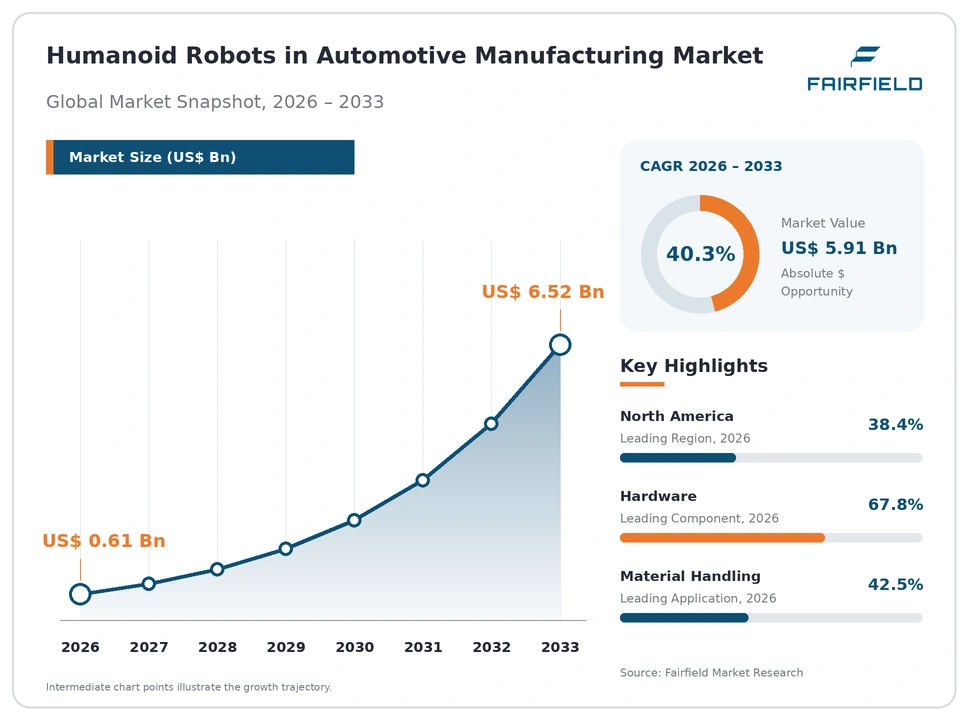
Humanoid Robots in Automotive Manufacturing Market Size and Trend Analysis
How Fast Is the Humanoid Robots in Automotive Manufacturing Market Growing?
The global humanoid robots in automotive manufacturing market size is expected to be valued at US$ 0.61 billion in 2026 and projected to reach US$ 6.52 billion by 2033, growing at a CAGR of 40.3% between 2026 and 2033.
Between 2020 and 2025, the market moved from research prototypes to factory pilots, with early trials at BMW, Mercedes-Benz, Tesla, and Chinese carmakers. Revenue stayed small because most deployments involved fewer than ten robots per plant. Three factors now drive growth: labor shortages in car plants, rapid progress in physical AI models that let robots learn tasks, and falling hardware costs. The market is shifting from pilots to fleet orders, with carmakers such as Hyundai planning thousands of units. Robots are moving from simple parts handling toward automotive assembly and inspection work.
Key Report Takeaways
- By Component: Hardware held 67.8% share in 2026, while Software & AI is projected to expand at a 44.6% CAGR through 2033, driven by foundation models that let robots learn new factory tasks quickly.
- By Application: Material Handling & Logistics held 42.5% share in 2026, while Assembly is projected to expand at a 46.1% CAGR through 2033, driven by better dexterous hands and tactile sensing.
- By Business Model: Direct Purchase held 63.2% share in 2026, while Robots-as-a-Service is projected to expand at a 47.3% CAGR through 2033, driven by carmakers’ preference for lower upfront risk.
- By Region: North America held 38.4% share in 2026, while China is projected to expand at a 46.8% CAGR through 2033, driven by government support, low-cost suppliers, and large electric vehicle plants.
Global Humanoid Robots in Automotive Manufacturing Market Trends and Insights
Drivers Impact Analysis
Two drivers carry the strongest influence on humanoid robot adoption in car plants during the forecast period.
| Driver | Impact on CAGR Forecast | Geographic Relevance | Impact Timeline |
| Labor shortages and ergonomic pressure in car plants | High | North America, Europe, Asia Pacific | Medium term (2-4 years) |
| Advances in physical AI and falling robot costs | High | North America, Asia Pacific | Long term (≥4 years) |
Labor Shortages Are Driving Humanoid Robots in Automotive Manufacturing
Labor shortages and ergonomic pressure in car plants are the strongest drivers of humanoid robots in automotive manufacturing. Carmakers struggle to fill repetitive, physically demanding jobs, and humanoids can work in spaces built for people.
The mechanism is demographic change and plant design. Aging workforces in Germany, Japan, South Korea, and China reduce the number of available factory workers. Many tasks in logistics, kitting, and final assembly still rely on manual labor because traditional industrial robots need fixed cells and costly retooling. Humanoid robots can walk, reach, and use existing tools and workstations, so carmakers can automate without rebuilding lines. Ergonomically harmful jobs, such as lifting heavy parts or working in awkward positions, cause injuries and staff turnover. Carmakers such as BMW and Mercedes-Benz say they deploy humanoids for monotonous and safety-critical tasks. These pressures turn humanoids from curiosities into practical tools.
Physical AI and Falling Costs Are Expanding Humanoid Robots in Automotive Manufacturing
Advances in physical AI and falling robot costs are expanding humanoid robots in automotive manufacturing. Better software lets robots learn tasks faster, while cheaper hardware improves the business case.
The cause is rapid progress in AI models and component supply chains. Vision-language-action models from developers such as Figure AI, Tesla, and NVIDIA allow robots to learn tasks from demonstration and simulation rather than detailed programming. Simulation platforms train robots in virtual factories before deployment. Hardware costs are falling as Chinese suppliers produce actuators, reducers, and batteries at scale. Unitree and UBTech Robotics have pushed humanoid prices down sharply compared with earlier Western models. Lower prices and faster training shorten payback periods, encouraging carmakers to move from single pilots to fleets of robots across multiple plants. Each new deployment also adds training data.
Restraints Impact Analysis
Two restraints limit how quickly humanoid robots spread across car plants.
| Restraint | Impact on CAGR Forecast | Geographic Relevance | Impact Timeline |
| High costs and unproven return on investment | High | Europe, North America | Short term (≤2 years) |
| Safety standards, reliability, and speed limitations | Medium | Global | Medium term (2-4 years) |
High Costs and Unproven Returns Slow Humanoid Robots in Automotive Manufacturing
High costs and unproven return on investment slow humanoid robots in automotive manufacturing. Many carmakers remain cautious because humanoids are new and their long-term performance is uncertain.
The specific causes are high unit prices and limited operating data. Western humanoids still cost far more than a typical industrial robot arm, and integration, training, and maintenance add further costs. Most deployments so far involve small numbers of robots in pilot projects, so carmakers have little data on uptime, lifespan, and productivity. Humanoids often work more slowly than skilled workers or dedicated machines. Car industry profit margins are under pressure from electric vehicle investments, tariffs, and price competition, making capital spending decisions harder. Tesla has acknowledged that Optimus production has lagged its targets. These factors delay large-scale orders and keep many projects at the pilot stage.
Safety and Reliability Concerns Restrict Humanoid Robots in Automotive Manufacturing
Safety standards, reliability, and speed limitations restrict humanoid robots in automotive manufacturing. Robots that walk among workers must meet strict safety requirements before they can operate freely.
The underlying causes are immature standards and technical limits. Existing industrial robot safety standards were written for fixed robots in guarded cells, not mobile bipedal machines that can fall. Standards bodies such as the International Organization for Standardization are developing new guidance for dynamically stable robots, but it is not yet complete. Battery life often limits shifts to a few hours, and hands still lack the speed and dexterity of human workers for fine tasks. Unplanned stops can disrupt tightly timed production lines. Until reliability and safety certification improve, many humanoids remain in fenced or low-traffic areas, limiting the tasks they can perform.
Market Opportunities
Robots-as-a-Service Opens a Recurring Revenue Pool
Robots-as-a-Service opens a recurring revenue pool in the humanoid robots in automotive manufacturing market. Under this model, carmakers pay a monthly or hourly fee rather than buying robots outright.
Robot developers and integrators can capture this opportunity. Robots-as-a-service contracts lower upfront costs and shift maintenance and software updates to suppliers, which suits carmakers that remain uncertain about returns. Suppliers gain steady income and operating data from every deployment, helping them improve their AI models. Agility Robotics and other developers already offer subscription-style pricing. Tier-one suppliers such as Schaeffler and Magna are also potential customers, since they run large plants with similar labor problems. Fleet management software, remote monitoring, and task updates delivered over the air add further recurring revenue for suppliers across every site they serve.
Electric Vehicle Plants and Battery Lines Create a Deployment Revenue Pool
Electric vehicle plants and battery lines create a deployment revenue pool for humanoid robots in automotive manufacturing. New factories can be designed from the start to include humanoid workers.
Carmakers building new plants can capture this opportunity. Projects such as the Hyundai Motor Group Metaplant America in Georgia plan to use humanoids alongside traditional automation. Chinese electric vehicle makers such as BYD, Geely, and Xpeng are testing humanoids in their factories, and Xpeng develops its own IRON robot. Battery module handling, parts sequencing, and visual inspection are well suited to humanoids in these new plants. Plants in India, Mexico, and Hungary also offer opportunities as new capacity comes online. Suppliers that combine robots, training, and integration services can win multi-plant contracts and long-term supply agreements.
Segment Analysis
By Component: Hardware Leads While Software & AI Gains Momentum
Hardware held 67.8% share in 2026. Hardware includes actuators, motors, reducers, sensors, cameras, batteries, and dexterous hands, which make up most of each robot’s price. Actuators and hands are the most expensive components, and suppliers in China, Japan, and Germany compete to lower their cost.
Software & AI is the fastest-growing component, expanding at a 44.6% CAGR through 2033. Physical AI models, simulation tools, and fleet management software let robots learn new tasks and work safely. Developers such as Figure AI and Tesla build their own AI models, while NVIDIA supplies computing platforms and simulation tools. Software value grows as hardware prices fall. Services such as integration, training, and maintenance form a third component. For the market, software growth raises margins and makes robots more flexible across plants.
By Application: Material Handling & Logistics Leads While Assembly Grows Fastest
Material Handling & Logistics held 42.5% share in 2026. Humanoids move totes, load parts, and sort components into sequencing trolleys, tasks that are repetitive and easier to automate. BMW uses Figure AI robots for sheet metal loading and logistics sequencing at its Spartanburg plant, and Mercedes-Benz tests Apptronik robots for parts delivery.
Assembly is the fastest-growing application, expanding at a 46.1% CAGR through 2033. Better hands, tactile sensors, and AI models allow humanoids to fit parts, fasten components, and install trim in automotive assembly lines. UBTech Robotics robots have been tested on assembly tasks at Chinese carmakers. Quality inspection and machine tending are other important applications. For the market, assembly growth opens the largest pool of manual work for automation.
By Business Model: Direct Purchase Leads While Robots-as-a-Service Grows Fastest
Direct Purchase held 63.2% share in 2026. Carmakers often buy robots directly for pilot projects, and Chinese carmakers place direct orders with local suppliers such as UBTech Robotics. Direct ownership gives carmakers control over data and deployment, and large groups with internal robotics teams prefer this model. Hyundai owns Boston Dynamics, so its robots stay within the group.
Robots-as-a-Service is the fastest-growing business model, expanding at a 47.3% CAGR through 2033. Subscription and hourly pricing lower upfront costs and shift risk to suppliers. Contracts typically include maintenance, software updates, and replacement robots, which suits carmakers testing new tasks. Suppliers gain recurring revenue and operating data. For the market, service models speed adoption by smaller plants and tier-one suppliers.
Geography Analysis
Which Region Is Leading the Humanoid Robots in Automotive Manufacturing Market?
North America is leading the humanoid robots in automotive manufacturing market with a 38.4% share in 2026. The United States is home to leading developers such as Figure AI, Tesla, Boston Dynamics, Agility Robotics, and Apptronik, supported by large venture capital funding. BMW has used Figure AI robots at Spartanburg in South Carolina, and Hyundai plans to deploy Atlas robots at its Georgia Metaplant. Tesla tests Optimus in its own factories. NVIDIA supplies AI computing and simulation platforms. Canada adds demand, with Toyota testing Agility Robotics robots. One change shaping the region is the move from single pilots to fleet orders.
Europe Advances Humanoid Robots in Automotive Manufacturing Through Premium Carmakers
Europe is an important humanoid robots in automotive manufacturing market led by premium carmakers. Germany hosts BMW, Mercedes-Benz, Volkswagen, and Audi, which face high labor costs and an aging workforce. Mercedes-Benz tests Apptronik robots in Berlin and at Kecskemét in Hungary, while BMW plans humanoid use at Leipzig. Schaeffler both makes components and deploys humanoids. Strict safety rules, works councils, and high costs slow deployment. European robotics companies such as Neura Robotics are developing humanoids. France, Italy, and the United Kingdom host carmakers and suppliers that are watching early results. The European Union Machinery Regulation will shape safety requirements for new robots. One opportunity is humanoids for ergonomically demanding jobs in older plants.
Asia Pacific Drives Humanoid Robots in Automotive Manufacturing Through China
Asia Pacific is a fast-growing humanoid robots in automotive manufacturing market. Japan and South Korea have large car industries and aging workforces, and Hyundai and Toyota invest in robotics. China is growing fastest, as detailed below. Toyota, Honda, and Nissan test humanoid and mobile robots, while Kawasaki Heavy Industries develops its own humanoid platform. Hyundai plans to use Atlas robots in South Korea as well as overseas. India offers longer-term potential as car production expands, although low labor costs slow adoption. Component suppliers across the region make actuators, sensors, and batteries at low cost, supporting global supply chains. One change shaping the region is government support for humanoid robots as a strategic industry.
Which Country Is Growing Fastest in the Humanoid Robots in Automotive Manufacturing Market?
China is growing fastest in the humanoid robots in automotive manufacturing market at a 46.8% CAGR through 2033. Government policies name humanoid robots as a strategic industry, and local governments fund development and testing centers. UBTech Robotics has supplied Walker S robots to BYD, Geely, Dongfeng Liuzhou Motor, FAW-Volkswagen, and BAIC. Xpeng develops its own humanoid, and Unitree sells low-cost robots. Large electric vehicle plants offer ideal testing grounds. Chinese suppliers of actuators, reducers, and batteries give local robot makers a strong cost advantage. Testing centers in Beijing, Shanghai, and Shenzhen collect training data for factory tasks. One opportunity is low-cost robots for export.
Latin America Explores Humanoid Robots in Automotive Manufacturing
Latin America is an early-stage humanoid robots in automotive manufacturing market. Mexico has a large car industry serving the United States, with plants operated by General Motors, Volkswagen, Nissan, and BMW. Brazil hosts plants from Stellantis, Volkswagen, and Toyota. Lower labor costs reduce the business case for humanoids compared with North America and Europe. Key barriers include high import costs and limited local robotics expertise. Tier-one suppliers in Mexico also face labor turnover in repetitive jobs. One opportunity is humanoid use in new export-focused plants, especially where carmakers apply global automation standards.
Middle East & Africa Explores Humanoid Robots in Automotive Manufacturing
Middle East & Africa is an emerging humanoid robots in automotive manufacturing market. Saudi Arabia is building a car industry through projects such as Ceer and Lucid Motors plants, and government programs support advanced manufacturing and robotics. The United Arab Emirates invests in AI and robotics research. South Africa and Morocco host car plants that export to Europe. Key barriers include limited industrial robot adoption and small production volumes. Gulf governments seek to limit reliance on foreign labor, which supports interest in automation. Sovereign funds also invest in robotics start-ups. One opportunity is humanoids in new, highly automated plants in the Gulf.
Competitive Landscape
The humanoid robots in automotive manufacturing market is highly concentrated. Figure AI, Boston Dynamics, Tesla, UBTech Robotics, and Apptronik hold most automotive deployments, alongside Agility Robotics, Unitree, Xpeng, and Neura Robotics. Many start-ups are entering, especially in China.
Companies compete on AI capability, dexterity, reliability, battery life, price, and proof of deployment in real plants. Partnerships with carmakers are a key advantage, since factory data helps train better models. Some carmakers own or invest in developers, such as Hyundai with Boston Dynamics and Mercedes-Benz with Apptronik, while Tesla and Xpeng build their own robots. Chinese suppliers compete strongly on price, while Western developers compete on AI performance and access to venture funding.
Strategic moves show how competition is changing. In March 2025, Mercedes-Benz invested a low double-digit million euro amount in Apptronik. In November 2025, UBTech Robotics began mass delivery of Walker S2 robots, with orders above 800 million yuan. In January 2026, Hyundai said it plans to deploy 30,000 Atlas robots a year from 2028. In June 2026, BMW began using Figure 03 robots at Spartanburg. These moves show competition shifting from demonstrations to production orders, with carmakers now expecting measurable productivity results.
Three themes shape vendor strategy. First, companies are building AI models trained on factory data to handle more tasks. Second, they are scaling production to lower unit costs. Third, they are offering service-based pricing to reduce customer risk.
Humanoid Robots in Automotive Manufacturing Market Industry Leaders
- Figure AI
- Boston Dynamics
- Tesla
- UBTech Robotics
- Apptronik
Recent Industry Developments
- June 2026: BMW Group announced that Figure 03 humanoid robots will start logistics sequencing work at Plant Spartanburg - follows a pilot that supported more than 30,000 BMW X3 vehicles.
- January 2026: Hyundai Motor Group outlined plans to deploy 30,000 Boston Dynamics Atlas robots a year from 2028 - signals the first fleet-scale automotive humanoid rollout.
- November 2025: UBTech Robotics began mass production and delivery of Walker S2 robots, with orders above 800 million yuan - supplies carmakers including BYD and Geely.
- March 2025: Mercedes-Benz invested in Apptronik and tested Apollo robots in Berlin and Kecskemét - deepens carmaker ownership of humanoid developers.
Companies Covered in the Report
- Figure AI
- Boston Dynamics
- Tesla
- UBTech Robotics
- Apptronik
- Agility Robotics
- Unitree Robotics
- Xpeng Robotics
- Neura Robotics
- Sanctuary AI
- Kepler Exploration Robotics
- AgiBot
Humanoid Robots in Automotive Manufacturing Market Report Scope
This report covers humanoid robots, including bipedal and wheeled humanoids, with their hardware, software, AI, and services, used in vehicle and component manufacturing for material handling, assembly, inspection, and machine tending. It excludes traditional industrial robot arms, collaborative robots, and autonomous mobile robots without humanoid form. The base year is 2025, and the forecast period runs from 2026 to 2033. All values are expressed in US$ Billion.
Component
- Hardware
- Software & AI
- Services
Application
- Material Handling & Logistics
- Assembly
- Quality Inspection
- Machine Tending
Business Model
- Direct Purchase
- Robots-as-a-Service
Regions
- North America
- Europe
- Asia Pacific
- Latin America
- Middle East & Africa
Key Questions Answered in the Report
How big is the humanoid robots in automotive manufacturing market in 2026?
The humanoid robots in automotive manufacturing market is valued at US$ 0.61 billion in 2026, led by material handling and logistics tasks.
What is the humanoid robots in automotive manufacturing market forecast to 2033?
The market is projected to reach US$ 6.52 billion by 2033, growing at a 40.3% CAGR and adding US$ 5.91 billion.
Which application is growing fastest for humanoid robots in car plants?
Assembly is growing fastest at a 46.1% CAGR through 2033, driven by better dexterous hands, tactile sensing, and AI models.
Which country is growing fastest in this market?
China is growing fastest at a 46.8% CAGR through 2033, driven by government support, low-cost suppliers, and electric vehicle plants.
Which region holds the largest humanoid robots in automotive manufacturing market share?
North America holds the largest share at 38.4% in 2026, supported by leading developers and carmaker deployments in the United States.
1. Executive Summary
1.1. Global Humanoid Robots in Automotive Manufacturing Market Snapshot
1.2. Future Projections
1.3. Key Report Takeaways
1.4. Regional Snapshot
2. Market Overview
2.1. Market Definition and Report Scope
2.2. Historical Trends 2020–2025
2.3. Market Dynamics
2.3.1. Drivers
2.3.1.1. Labor Shortages Are Driving Humanoid Robots in Automotive Manufacturing
2.3.1.2. Physical AI and Falling Costs Are Expanding Humanoid Robots in Automotive Manufacturing
2.3.2. Restraints
2.3.2.1. High Costs and Unproven Returns Slow Humanoid Robots in Automotive Manufacturing
2.3.2.2. Safety and Reliability Concerns Restrict Humanoid Robots in Automotive Manufacturing
2.3.3. Market Opportunities
2.3.3.1. Robots-as-a-Service Opens a Recurring Revenue Pool
2.3.3.2. Electric Vehicle Plants and Battery Lines Create a Deployment Revenue Pool
3. Global Humanoid Robots in Automotive Manufacturing Market Outlook, 2020-2033
3.1. Global Humanoid Robots in Automotive Manufacturing Market Outlook, by Component, Value (US$ Billion), 2020-2033
3.1.1. Hardware
3.1.2. Software & AI
3.1.3. Services
3.2. Global Humanoid Robots in Automotive Manufacturing Market Outlook, by Application, Value (US$ Billion), 2020-2033
3.2.1. Material Handling & Logistics
3.2.2. Assembly
3.2.3. Quality Inspection
3.2.4. Machine Tending
3.3. Global Humanoid Robots in Automotive Manufacturing Market Outlook, by Business Model, Value (US$ Billion), 2020-2033
3.3.1. Direct Purchase
3.3.2. Robots-as-a-Service
3.4. Global Humanoid Robots in Automotive Manufacturing Market Outlook, by Region, Value (US$ Billion), 2020-2033
3.4.1. North America
3.4.2. Europe
3.4.3. Asia Pacific
3.4.4. Latin America
3.4.5. Middle East & Africa
4. North America Humanoid Robots in Automotive Manufacturing Market Outlook, 2020-2033
4.1. North America Humanoid Robots in Automotive Manufacturing Market Outlook, by Component, Value (US$ Billion), 2020-2033
4.1.1. Hardware
4.1.2. Software & AI
4.1.3. Services
4.2. North America Humanoid Robots in Automotive Manufacturing Market Outlook, by Application, Value (US$ Billion), 2020-2033
4.2.1. Material Handling & Logistics
4.2.2. Assembly
4.2.3. Quality Inspection
4.2.4. Machine Tending
4.3. North America Humanoid Robots in Automotive Manufacturing Market Outlook, by Business Model, Value (US$ Billion), 2020-2033
4.3.1. Direct Purchase
4.3.2. Robots-as-a-Service
4.4. North America Humanoid Robots in Automotive Manufacturing Market Outlook, by Country, Value (US$ Billion), 2020-2033
4.4.1. United States Humanoid Robots in Automotive Manufacturing Market Outlook, by Component, 2020-2033
4.4.2. United States Humanoid Robots in Automotive Manufacturing Market Outlook, by Application, 2020-2033
4.4.3. United States Humanoid Robots in Automotive Manufacturing Market Outlook, by Business Model, 2020-2033
4.4.4. Canada Humanoid Robots in Automotive Manufacturing Market Outlook, by Component, 2020-2033
4.4.5. Canada Humanoid Robots in Automotive Manufacturing Market Outlook, by Application, 2020-2033
4.4.6. Canada Humanoid Robots in Automotive Manufacturing Market Outlook, by Business Model, 2020-2033
5. Europe Humanoid Robots in Automotive Manufacturing Market Outlook, 2020-2033
5.1. Europe Humanoid Robots in Automotive Manufacturing Market Outlook, by Component, Value (US$ Billion), 2020-2033
5.1.1. Hardware
5.1.2. Software & AI
5.1.3. Services
5.2. Europe Humanoid Robots in Automotive Manufacturing Market Outlook, by Application, Value (US$ Billion), 2020-2033
5.2.1. Material Handling & Logistics
5.2.2. Assembly
5.2.3. Quality Inspection
5.2.4. Machine Tending
5.3. Europe Humanoid Robots in Automotive Manufacturing Market Outlook, by Business Model, Value (US$ Billion), 2020-2033
5.3.1. Direct Purchase
5.3.2. Robots-as-a-Service
5.4. Europe Humanoid Robots in Automotive Manufacturing Market Outlook, by Country, Value (US$ Billion), 2020-2033
5.4.1. Germany Humanoid Robots in Automotive Manufacturing Market Outlook, by Component, 2020-2033
5.4.2. Germany Humanoid Robots in Automotive Manufacturing Market Outlook, by Application, 2020-2033
5.4.3. Germany Humanoid Robots in Automotive Manufacturing Market Outlook, by Business Model, 2020-2033
5.4.4. Hungary Humanoid Robots in Automotive Manufacturing Market Outlook, by Component, 2020-2033
5.4.5. Hungary Humanoid Robots in Automotive Manufacturing Market Outlook, by Application, 2020-2033
5.4.6. Hungary Humanoid Robots in Automotive Manufacturing Market Outlook, by Business Model, 2020-2033
5.4.7. France Humanoid Robots in Automotive Manufacturing Market Outlook, by Component, 2020-2033
5.4.8. France Humanoid Robots in Automotive Manufacturing Market Outlook, by Application, 2020-2033
5.4.9. France Humanoid Robots in Automotive Manufacturing Market Outlook, by Business Model, 2020-2033
5.4.10. Italy Humanoid Robots in Automotive Manufacturing Market Outlook, by Component, 2020-2033
5.4.11. Italy Humanoid Robots in Automotive Manufacturing Market Outlook, by Application, 2020-2033
5.4.12. Italy Humanoid Robots in Automotive Manufacturing Market Outlook, by Business Model, 2020-2033
5.4.13. United Kingdom Humanoid Robots in Automotive Manufacturing Market Outlook, by Component, 2020-2033
5.4.14. United Kingdom Humanoid Robots in Automotive Manufacturing Market Outlook, by Application, 2020-2033
5.4.15. United Kingdom Humanoid Robots in Automotive Manufacturing Market Outlook, by Business Model, 2020-2033
6. Asia Pacific Humanoid Robots in Automotive Manufacturing Market Outlook, 2020-2033
6.1. Asia Pacific Humanoid Robots in Automotive Manufacturing Market Outlook, by Component, Value (US$ Billion), 2020-2033
6.1.1. Hardware
6.1.2. Software & AI
6.1.3. Services
6.2. Asia Pacific Humanoid Robots in Automotive Manufacturing Market Outlook, by Application, Value (US$ Billion), 2020-2033
6.2.1. Material Handling & Logistics
6.2.2. Assembly
6.2.3. Quality Inspection
6.2.4. Machine Tending
6.3. Asia Pacific Humanoid Robots in Automotive Manufacturing Market Outlook, by Business Model, Value (US$ Billion), 2020-2033
6.3.1. Direct Purchase
6.3.2. Robots-as-a-Service
6.4. Asia Pacific Humanoid Robots in Automotive Manufacturing Market Outlook, by Country, Value (US$ Billion), 2020-2033
6.4.1. Japan Humanoid Robots in Automotive Manufacturing Market Outlook, by Component, 2020-2033
6.4.2. Japan Humanoid Robots in Automotive Manufacturing Market Outlook, by Application, 2020-2033
6.4.3. Japan Humanoid Robots in Automotive Manufacturing Market Outlook, by Business Model, 2020-2033
6.4.4. South Korea Humanoid Robots in Automotive Manufacturing Market Outlook, by Component, 2020-2033
6.4.5. South Korea Humanoid Robots in Automotive Manufacturing Market Outlook, by Application, 2020-2033
6.4.6. South Korea Humanoid Robots in Automotive Manufacturing Market Outlook, by Business Model, 2020-2033
6.4.7. China Humanoid Robots in Automotive Manufacturing Market Outlook, by Component, 2020-2033
6.4.8. China Humanoid Robots in Automotive Manufacturing Market Outlook, by Application, 2020-2033
6.4.9. China Humanoid Robots in Automotive Manufacturing Market Outlook, by Business Model, 2020-2033
6.4.10. India Humanoid Robots in Automotive Manufacturing Market Outlook, by Component, 2020-2033
6.4.11. India Humanoid Robots in Automotive Manufacturing Market Outlook, by Application, 2020-2033
6.4.12. India Humanoid Robots in Automotive Manufacturing Market Outlook, by Business Model, 2020-2033
7. Latin America Humanoid Robots in Automotive Manufacturing Market Outlook, 2020-2033
7.1. Latin America Humanoid Robots in Automotive Manufacturing Market Outlook, by Component, Value (US$ Billion), 2020-2033
7.1.1. Hardware
7.1.2. Software & AI
7.1.3. Services
7.2. Latin America Humanoid Robots in Automotive Manufacturing Market Outlook, by Application, Value (US$ Billion), 2020-2033
7.2.1. Material Handling & Logistics
7.2.2. Assembly
7.2.3. Quality Inspection
7.2.4. Machine Tending
7.3. Latin America Humanoid Robots in Automotive Manufacturing Market Outlook, by Business Model, Value (US$ Billion), 2020-2033
7.3.1. Direct Purchase
7.3.2. Robots-as-a-Service
7.4. Latin America Humanoid Robots in Automotive Manufacturing Market Outlook, by Country, Value (US$ Billion), 2020-2033
7.4.1. Mexico Humanoid Robots in Automotive Manufacturing Market Outlook, by Component, 2020-2033
7.4.2. Mexico Humanoid Robots in Automotive Manufacturing Market Outlook, by Application, 2020-2033
7.4.3. Mexico Humanoid Robots in Automotive Manufacturing Market Outlook, by Business Model, 2020-2033
7.4.4. Brazil Humanoid Robots in Automotive Manufacturing Market Outlook, by Component, 2020-2033
7.4.5. Brazil Humanoid Robots in Automotive Manufacturing Market Outlook, by Application, 2020-2033
7.4.6. Brazil Humanoid Robots in Automotive Manufacturing Market Outlook, by Business Model, 2020-2033
8. Middle East & Africa Humanoid Robots in Automotive Manufacturing Market Outlook, 2020-2033
8.1. Middle East & Africa Humanoid Robots in Automotive Manufacturing Market Outlook, by Component, Value (US$ Billion), 2020-2033
8.1.1. Hardware
8.1.2. Software & AI
8.1.3. Services
8.2. Middle East & Africa Humanoid Robots in Automotive Manufacturing Market Outlook, by Application, Value (US$ Billion), 2020-2033
8.2.1. Material Handling & Logistics
8.2.2. Assembly
8.2.3. Quality Inspection
8.2.4. Machine Tending
8.3. Middle East & Africa Humanoid Robots in Automotive Manufacturing Market Outlook, by Business Model, Value (US$ Billion), 2020-2033
8.3.1. Direct Purchase
8.3.2. Robots-as-a-Service
8.4. Middle East & Africa Humanoid Robots in Automotive Manufacturing Market Outlook, by Country, Value (US$ Billion), 2020-2033
8.4.1. Saudi Arabia Humanoid Robots in Automotive Manufacturing Market Outlook, by Component, 2020-2033
8.4.2. Saudi Arabia Humanoid Robots in Automotive Manufacturing Market Outlook, by Application, 2020-2033
8.4.3. Saudi Arabia Humanoid Robots in Automotive Manufacturing Market Outlook, by Business Model, 2020-2033
8.4.4. United Arab Emirates Humanoid Robots in Automotive Manufacturing Market Outlook, by Component, 2020-2033
8.4.5. United Arab Emirates Humanoid Robots in Automotive Manufacturing Market Outlook, by Application, 2020-2033
8.4.6. United Arab Emirates Humanoid Robots in Automotive Manufacturing Market Outlook, by Business Model, 2020-2033
8.4.7. South Africa Humanoid Robots in Automotive Manufacturing Market Outlook, by Component, 2020-2033
8.4.8. South Africa Humanoid Robots in Automotive Manufacturing Market Outlook, by Application, 2020-2033
8.4.9. South Africa Humanoid Robots in Automotive Manufacturing Market Outlook, by Business Model, 2020-2033
8.4.10. Morocco Humanoid Robots in Automotive Manufacturing Market Outlook, by Component, 2020-2033
8.4.11. Morocco Humanoid Robots in Automotive Manufacturing Market Outlook, by Application, 2020-2033
8.4.12. Morocco Humanoid Robots in Automotive Manufacturing Market Outlook, by Business Model, 2020-2033
9. Competitive Landscape
9.1. Market Concentration and Industry Leaders
9.2. Competitive Differentiation
9.3. Strategic Moves and Market Direction
9.4. Recent Industry Developments
9.5. Company Profiles
9.5.1. Figure AI
9.5.2. Boston Dynamics
9.5.3. Tesla
9.5.4. UBTech Robotics
9.5.5. Apptronik
9.5.6. Agility Robotics
9.5.7. Unitree Robotics
9.5.8. Xpeng Robotics
9.5.9. Neura Robotics
9.5.10. Sanctuary AI
9.5.11. Kepler Exploration Robotics
9.5.12. AgiBot
10. Appendix
10.1. Research Methodology
10.2. Report Assumptions
10.3. Acronyms and Abbreviations
| Segmentation | Coverage |
|---|---|
| Component | Hardware; Software & AI; Services |
| Application | Material Handling & Logistics; Assembly; Quality Inspection; Machine Tending |
| Business Model | Direct Purchase; Robots-as-a-Service |
| Regions | North America; Europe; Asia Pacific; Latin America; Middle East & Africa |
Our Research Methodology
Considering the volatility of business today, traditional approaches to strategizing a game plan can be unfruitful if not detrimental. True ambiguity is no way to determine a forecast. A myriad of predetermined factors must be accounted for such as the degree of risk involved, the magnitude of circumstances, as well as conditions or consequences that are not known or unpredictable. To circumvent binary views that cast uncertainty, the application of market research intelligence to strategically posture, move, and enable actionable outcomes is necessary.
View Methodology
Quality Assured
Rigorous Validation Process

Confidentiality Assured
End-to-end Data Security

Custom Research Services
Tailored To Your Objectives
FAQs
The humanoid robots in automotive manufacturing market is valued at US$ 0.61 billion in 2026, led by material handling and logistics tasks.
The market is projected to reach US$ 6.52 billion by 2033, growing at a 40.3% CAGR and adding US$ 5.91 billion.
Assembly is growing fastest at a 46.1% CAGR through 2033, driven by better dexterous hands, tactile sensing, and AI models.
China is growing fastest at a 46.8% CAGR through 2033, driven by government support, low-cost suppliers, and electric vehicle plants.
North America holds the largest share at 38.4% in 2026, supported by leading developers and carmaker deployments in the United States.
Related Reports
Slingshot/3 Wheeled Motorcycle Market Size, Share, Insights, Competitive Landscape, and Forecast 2026 to 2033
The slingshot and 3 wheeled motorcycle market is projected to reach US$ 1.68 billion by 2033 at a 2.9% CAGR. Explore segments and regional trends.
Bus Rapid Transit (BRT) Market Size, Share, Insights, Competitive Landscape, and Forecast 2026 to 2033
Bus rapid transit market to reach US$ 76.26 billion by 2033 at 7.5% CAGR. Explore propulsion, bus types and regional trends.
Automotive ABS and ESC Market Size, Share, Insights, Competitive Landscape, and Forecast 2026 to 2033
Automotive ABS and ESC market to reach US$ 107.69 billion by 2033 at 8.2% CAGR. Explore system, vehicle, propulsion and regional trends.
Airport Shuttle Bus Market Size, Share, Insights, Competitive Landscape, and Forecast 2026 to 2033
Airport shuttle bus market to reach US$26.57 billion by 2033 at 6.7% CAGR, driven by passenger growth, airport expansion and electric fleets.
Lane Keep Assist System Market Size, Share, Insights, Competitive Landscape, and Forecast 2026 to 2033
Explore the lane keep assist system market, reaching US$ 18.95 billion by 2033 at 14.4% CAGR, with component, vehicle and regional insights.
Foldable Electric Scooter Market Size, Share, Insights, Competitive Landscape, and Forecast 2026 to 2033
Explore the foldable electric scooter market, reaching US$ 6.9 billion by 2033 at 6.3% CAGR, with range, price tier and regional insights.