



Lane Keep Assist System Market
Lane Keep Assist System Market Size, Share, Insights, Competitive Landscape, and Forecast 2026 to 2033
Lane Keep Assist System Market Size and Trend Analysis
How Fast Is the Lane Keep Assist System Market Growing?
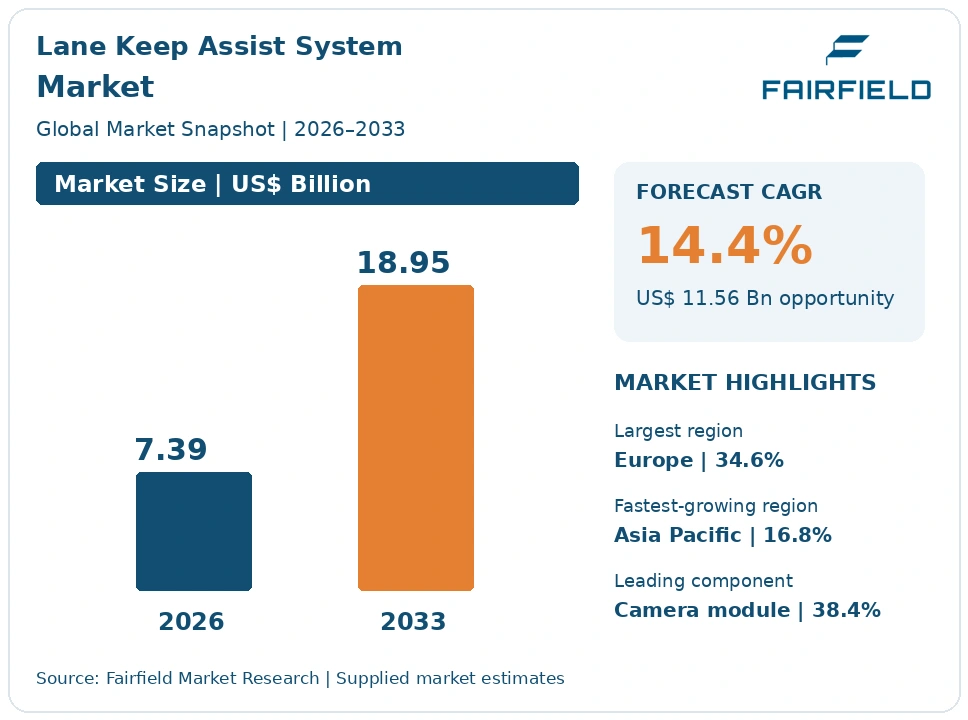
The global lane keep assist system market size is expected to be valued at US$ 7.39 billion in 2026 and projected to reach US$ 18.95 billion by 2033, growing at a CAGR of 14.4% between 2026 and 2033.
Between 2020 and 2025, the market grew at a CAGR of about 17.2%, as automakers added lane support features to mass-market models and European Union safety rules made emergency lane keeping mandatory. Three factors now drive growth: regulations and crash test ratings that reward lane support, rapid adoption of Level 2 driver assistance in China and other markets, and cheaper cameras and processors. The market is moving from simple lane departure warnings toward active lane centering that works with adaptive cruise control. Smoother steering behavior and driver monitoring are becoming key requirements for consumer acceptance.
Key Report Takeaways
- By Component: Camera Module held 38.4% share in 2026, while Electronic Control Unit is projected to expand at a 16.1% CAGR through 2033, driven by centralized ADAS domain controllers with higher computing power.
- By Function Type: Lane Keeping Assist held 46.3% share in 2026, while Lane Centering Assist is projected to expand at an 18.2% CAGR through 2033, driven by Level 2 hands-on highway driving features.
- By Vehicle Type: Passenger Cars held 81.5% share in 2026, while Commercial Vehicles are projected to expand at a 16.3% CAGR through 2033, driven by truck safety rules and fleet accident reduction goals.
- By Propulsion: Internal Combustion Engine Vehicles held 58.7% share in 2026, while Electric & Hybrid Vehicles are projected to expand at a 19.4% CAGR through 2033, driven by high standard ADAS fitment in new EV models.
- By Region: Europe held 34.6% share in 2026, while Asia Pacific is projected to expand at a 16.8% CAGR through 2033, driven by Level 2 adoption in China and India.
Global Lane Keep Assist System Market Trends and Insights
Drivers Impact Analysis
Two drivers carry the strongest influence on lane keep assist system demand during the forecast period.
| Driver | Impact on CAGR Forecast | Geographic Relevance | Impact Timeline |
| Safety regulations and NCAP ratings requiring lane support | High | Europe, North America, Asia Pacific | Medium term (2-4 years) |
| Level 2 ADAS adoption in mass-market vehicles | High | Asia Pacific, North America, Europe | Long term (≥4 years) |
Safety Regulations and NCAP Ratings Are Driving Lane Keep Assist Fitment
Safety regulations and crash test ratings are the strongest drivers of lane keep assist system fitment. Automakers add lane support because regulators require it or because buyers compare safety ratings.
The mechanism is mandatory equipment combined with rating incentives. Under the European Union General Safety Regulation, emergency lane keeping systems became mandatory for all new cars and vans registered from July 2024. Euro NCAP awards points for lane support, and its 2026 protocols, announced in December 2025, test systems in more real-world scenarios and penalize overly aggressive intervention. In the United States, the National Highway Traffic Safety Administration updated its New Car Assessment Program in November 2024 to include lane keeping assistance from model year 2026. C-NCAP in China and Bharat NCAP in India also reward advanced driver assistance systems. These rules make lane support standard across vehicle segments.
Level 2 ADAS Adoption Is Expanding Lane Centering in Mass-Market Vehicles
Level 2 driver assistance adoption is expanding lane keep assist systems from premium cars into mass-market vehicles. Consumers increasingly expect hands-on highway assistance that combines steering support with adaptive cruise control.
The cause is falling cost and rising capability of sensors and processors. Front cameras with 8-megapixel resolution and system-on-chips can now detect lane markings, road edges, and nearby vehicles at lower cost. In April 2024, Mobileye began delivering its EyeQ6 Lite chip, which improves lane-keeping assist and automated lane change and is expected to be installed in 46 million vehicles. In China, automakers such as BYD, Geely, and XPeng offer highway assistance on affordable models. Electric power steering makes steering intervention easier to implement. As a result, lane departure warning is giving way to active lane centering across vehicle segments.
Restraints Impact Analysis
Two restraints limit how quickly lane keep assist systems reach full potential.
| Restraint | Impact on CAGR Forecast | Geographic Relevance | Impact Timeline |
| Performance limits from poor lane markings and weather | Medium | Global, strongest in emerging markets | Medium term (2-4 years) |
| Driver annoyance, deactivation, and cost pressure in entry vehicles | Medium | Global | Short term (≤2 years) |
Poor Lane Markings and Weather Limit Lane Keep Assist Performance
Poor lane markings and bad weather limit lane keep assist system performance and reliability. When systems cannot detect lanes, they disengage, which reduces their safety benefits and driver confidence.
The underlying cause is reliance on cameras that need visible road markings. Faded paint, construction zones, snow, heavy rain, glare, and dirty windshields can hide lane lines or confuse sensors. Many roads in India, Indonesia, Vietnam, Latin America, and Africa have inconsistent or missing markings, especially outside major highways. Rural roads in North America and Europe can also lack clear edges. Suppliers are adding radar, high-definition maps, and AI-based road edge detection to improve performance, but these add cost and complexity. Road authorities must also maintain markings for systems to work reliably. These limits slow the use of lane keeping beyond well-marked highways and reduce perceived value in some markets.
Driver Annoyance and Cost Pressure Slow Lane Keep Assist Acceptance
Driver annoyance and cost pressure slow acceptance of lane keep assist systems. Many drivers turn off lane support when they find steering corrections intrusive, which limits real-world safety benefits.
The specific causes are system tuning, alert design, and component costs in budget vehicles. Abrupt steering inputs, frequent beeps, and false interventions on narrow roads frustrate drivers. Euro NCAP’s 2026 protocols specifically penalize overly aggressive lane support, pushing automakers to refine calibration. In the European Union, emergency lane keeping must default to on at each start, but drivers can still disable it. In entry-level vehicles sold in India, Latin America, and Africa, the cost of cameras, control units, and electronic power steering adds meaningfully to vehicle prices. These issues encourage automakers to offer lane support only on higher trims in price-sensitive markets.
Market Opportunities
Commercial Vehicle Lane Keeping Opens a Fleet Safety Revenue Pool
Commercial vehicle lane keeping opens a fleet safety revenue pool for lane keep assist system suppliers. Trucks and buses travel long distances, so preventing lane departure crashes delivers large savings in injuries, cargo losses, and insurance costs.
Suppliers with commercial vehicle steering and camera expertise can capture this demand. The European Union General Safety Regulation extends lane departure warning requirements to heavy trucks and buses. ZF introduced its OnTraX lane-keeping system for PACCAR trucks in North America, and other suppliers offer similar features. Fleet operators, logistics companies, and bus operators value lane keeping with driver monitoring to reduce fatigue-related crashes. Insurers increasingly reward fleets that use advanced safety systems. Retrofit kits also offer opportunities for existing fleets. As trucks adopt electric power steering, active lane keeping becomes easier to add, creating a new revenue stream beyond passenger cars.
Over-the-Air Software Upgrades Create a Recurring ADAS Revenue Pool
Over-the-air software upgrades create a recurring revenue pool for lane keep assist systems. Software-defined vehicles allow automakers to improve lane support after sale and sell advanced driving features by subscription.
Automakers and suppliers with strong software and computing platforms can capture this opportunity. Centralized ADAS controllers with powerful chips can run upgraded lane centering, automated lane changes, and hands-free highway driving. General Motors Super Cruise and Ford BlueCruise already offer hands-free highway assistance on mapped roads in North America, with subscription options after trial periods. Mobileye, NVIDIA, and Qualcomm supply computing platforms that support upgrades. Electric vehicle buyers and technology-oriented consumers are the main customers. Each software update can improve performance and add paid features, creating revenue that continues after the vehicle is sold.
Segment Analysis
By Component: Camera Module Leads While Electronic Control Unit Gains Momentum
Camera Module held 38.4% share in 2026. The front-facing camera is the primary sensor for detecting lane markings, road edges, and vehicles ahead, so every lane keep assist system needs one. Major suppliers produce cameras, often with Mobileye chips.
Electronic Control Unit is the fastest-growing component, expanding at a 16.1% CAGR through 2033. Automakers are moving to centralized ADAS domain controllers that process data from cameras, radar, and maps together. These controllers use powerful system-on-chips that support lane centering, automated lane changes, and over-the-air updates. Higher computing needs raise the value of control units per vehicle. Electric power steering actuators and radar sensors remain essential components. For the market, control unit growth shifts value toward software and computing platforms, favoring suppliers with strong chip partnerships.
By Function Type: Lane Keeping Assist Leads While Lane Centering Assist Grows Fastest
Lane Keeping Assist held 46.3% share in 2026. This function steers the vehicle back when it begins to drift out of its lane without signaling. It meets regulatory requirements such as emergency lane keeping in the European Union and is standard on many new cars.
Lane Centering Assist is the fastest-growing function, expanding at an 18.2% CAGR through 2033. Unlike lane keeping, which reacts at lane edges, lane centering continuously keeps the vehicle in the middle of the lane. Combined with adaptive cruise control, it forms the core of Level 2 highway assistance. Consumers value reduced fatigue on long drives. Lane departure warning remains common in entry vehicles. For the market, lane centering growth increases system complexity and value, since it requires better sensors, steering control, and driver monitoring.
By Vehicle Type: Passenger Cars Lead While Commercial Vehicles Grow Fastest
Passenger Cars held 81.5% share in 2026. High production volumes, regulatory requirements, and consumer demand for safety features make passenger cars the main market. Sedans, SUVs, and crossovers in most major markets now offer lane keeping as standard or optional equipment.
Commercial Vehicles are the fastest-growing vehicle type, expanding at a 16.3% CAGR through 2033. Regulations in the European Union require lane departure warning on new trucks and buses, while fleet operators adopt active lane keeping to reduce accidents. Long-haul trucks face high risks from driver fatigue. ZF, Bosch, and WABCO, now part of ZF, supply commercial vehicle systems. For the market, commercial vehicle growth adds higher-value systems with strong demand from cost-conscious fleet operators focused on safety.
By Propulsion: Internal Combustion Engine Vehicles Lead While Electric & Hybrid Vehicles Grow Fastest
Internal Combustion Engine Vehicles held 58.7% share in 2026. Most vehicles produced and sold worldwide still use gasoline or diesel engines, so they account for the largest volume of lane keep assist installations, especially in North America, India, and Latin America.
Electric & Hybrid Vehicles are the fastest-growing propulsion segment, expanding at a 19.4% CAGR through 2033. Electric vehicle makers such as Tesla, BYD, and XPeng typically include advanced driver assistance as standard. Electric vehicles use electrical architectures and electric power steering that simplify integration of lane keeping and over-the-air updates. Rising EV sales in China and Europe expand installations. For the market, electrified vehicle growth accelerates the shift toward lane centering and software-upgradable systems.
Geography Analysis
North America Expands Lane Keep Assist Through Hands-free Driving and NCAP Updates
North America is a major market where consumer interest in hands-free highway driving and updated safety ratings drive demand. The United States has high adoption of driver assistance packages, with General Motors Super Cruise, Ford BlueCruise, and Tesla Autopilot promoting lane centering. The National Highway Traffic Safety Administration added lane keeping assistance to its New Car Assessment Program from model year 2026. The Insurance Institute for Highway Safety evaluates partial automation safeguards. Trucks and SUVs dominate sales, supporting higher-value systems with lane centering and driver monitoring. One opportunity is lane keeping in commercial trucks used for long-haul freight.
Which Region Is Leading the Lane Keep Assist System Market?
Europe is leading the lane keep assist system market with a 34.6% share in 2026. The European Union General Safety Regulation made emergency lane keeping mandatory for all new cars and vans from July 2024, ensuring high fitment rates. Euro NCAP ratings strongly influence buyers and reward lane support performance. Germany hosts leading suppliers such as Bosch, Continental, and ZF, along with premium automakers that offer advanced lane centering. France, Italy, and Sweden add strong automotive engineering and high fitment rates. One change shaping the region is Euro NCAP’s 2026 focus on smoother, less intrusive lane support behavior.
Which Region Is Growing Fastest in the Lane Keep Assist System Market?
Asia Pacific is growing fastest in the lane keep assist system market at a 16.8% CAGR through 2033. China is the world’s largest car market, and automakers such as BYD, Geely, XPeng, and Li Auto offer highway assistance on affordable models. India is expanding ADAS adoption, with Mahindra, Tata Motors, and Hyundai offering lane keep assist, supported by Bharat NCAP. Japan and South Korea have high fitment rates and leading suppliers such as Denso and Hyundai Mobis. Poor lane markings in some countries remain a challenge. One opportunity is low-cost camera-based systems for compact cars.
Latin America Adopts Lane Keep Assist Through Safety Ratings and Imports
Latin America is an emerging market where safety ratings and imported models drive lane keep assist adoption. Brazil and Mexico are the largest vehicle markets and production hubs, with automakers adding ADAS to higher trims. Latin NCAP has raised its rating requirements, encouraging automakers to fit lane support. Argentina, Chile, and Colombia add demand through imported vehicles from China, Europe, and the United States. Key barriers include price sensitivity, poor road markings, high import taxes, and lower regulatory requirements. One opportunity is affordable ADAS packages in compact SUVs from Chinese automakers expanding in the region.
Middle East & Africa Adds Lane Keep Assist in Premium and Imported Vehicles
Middle East & Africa is a developing market where premium vehicle sales and imports drive lane keep assist adoption. Saudi Arabia and the United Arab Emirates have high demand for SUVs and luxury vehicles that include advanced driver assistance. Long, straight highway distances in the Gulf make lane centering attractive for drivers. South Africa has local vehicle production for export to Europe, which includes lane keeping systems. Key barriers include sand, heat, inconsistent road markings, and lower adoption in budget vehicles across Africa. One opportunity is lane keeping in fleet vehicles and trucks operating on long Gulf highways.
Competitive Landscape
The lane keep assist system market is moderately concentrated. Bosch, Continental, ZF, Denso, Valeo, Aptiv, Magna, and Hyundai Mobis supply complete systems or key components to automakers. Mobileye holds a strong position in vision chips and software, while NVIDIA and Qualcomm compete in centralized computing. Steering suppliers such as JTEKT, Nexteer, and ZF provide electric power steering actuators. Chinese suppliers are gaining share in China.
Companies compete on detection accuracy, smooth steering behavior, cost, integration with other ADAS features, and software updates. Automakers want scalable platforms that cover entry and premium models. Partnerships between camera makers and chip suppliers are common, such as Valeo cameras using Mobileye technology. In-house development by Tesla, BYD, and XPeng increases competition for traditional suppliers.
Strategic moves show how competition is changing. In April 2024, Mobileye began delivering its EyeQ6 Lite chip, expected in 46 million vehicles, improving lane-keeping assist and automated lane change. In July 2024, emergency lane keeping became mandatory for all new cars and vans in the European Union. In November 2024, the National Highway Traffic Safety Administration added lane keeping assistance to its rating program. In December 2025, Euro NCAP announced 2026 protocols that penalize overly aggressive lane support. These moves push suppliers toward smoother, more capable systems.
Three themes shape vendor strategy. First, companies are shifting to centralized controllers. Second, they are improving calibration and driver monitoring. Third, they are pursuing software-defined, upgradable lane support.
Lane Keep Assist System Market Industry Leaders
- Robert Bosch Continental ZF Friedrichshafen Denso Mobileye
Recent Industry Developments
December 2025: Euro NCAP announced its 2026 protocols - pushes suppliers to refine lane support tuning.
November 2024: The National Highway Traffic Safety Administration added lane keeping assistance to its New Car Assessment Program - raises fitment in North America.
July 2024: Emergency lane keeping became mandatory for all new cars and vans registered in the European Union - makes lane support standard equipment.
April 2024: Mobileye began delivering its EyeQ6 Lite chip for ADAS - lowers cost of improved lane keeping.
Lane Keep Assist System Market Report Scope
| Metric | Value |
| Study Period | 2020-2033 |
| Market Size 2026 | US$ 7.39 Billion |
| Market Size 2033 | US$ 18.95 Billion |
| CAGR 2026-2033 | 14.4% |
| Absolute Dollar Opportunity | US$ 11.56 Billion |
| Largest Market | Europe |
| Fastest-Growing Market | Asia Pacific |
| Market Concentration | Medium |
| Major Players | Robert Bosch, Continental, ZF Friedrichshafen, Denso, Mobileye |
This report covers lane keep assist systems that detect lane markings and help keep vehicles within their lane, including lane departure warning, lane keeping assist, and lane centering assist, along with cameras, control units, sensors, and steering actuators. It covers passenger and commercial vehicles and excludes hands-free Level 3 and higher automated driving systems. The base year is 2025, and the forecast period runs from 2026 to 2033. All values are expressed in US$ Billion.
Lane Keep Assist System Market Segmentation
Component
- Camera Module
- Electronic Control Unit
- Electric Power Steering Actuator
- Radar & Other Sensors
Function Type
- Lane Departure Warning
- Lane Keeping Assist
- Lane Centering Assist
Vehicle Type
- Passenger Cars
- Commercial Vehicles
Propulsion
- Internal Combustion Engine Vehicles
- Electric & Hybrid Vehicles
Regions
- North America
- Europe
- Asia Pacific
- Latin America
- Middle East & Africa
- Executive Summary
- Global Lane Keep Assist System Market Snapshot
- Future Projections
- Key Report Takeaways
- Regional Snapshot
- Market Overview
- Market Definition and Report Scope
- Historical Trends 2020–2025
- Market Dynamics
- Drivers
- Safety Regulations and NCAP Ratings Are Driving Lane Keep Assist Fitment
- Level 2 ADAS Adoption Is Expanding Lane Centering in Mass-Market Vehicles
- Restraints
- Poor Lane Markings and Weather Limit Lane Keep Assist Performance
- Driver Annoyance and Cost Pressure Slow Lane Keep Assist Acceptance
- Market Opportunities
- Commercial Vehicle Lane Keeping Opens a Fleet Safety Revenue Pool
- Over-the-Air Software Upgrades Create a Recurring ADAS Revenue Pool
- Drivers
- Global Lane Keep Assist System Market Outlook, 2020-2033
- Global Lane Keep Assist System Market Outlook, by Component, Value (US$ Billion), 2020-2033
- Camera Module
- Electronic Control Unit
- Electric Power Steering Actuator
- Radar & Other Sensors
- Global Lane Keep Assist System Market Outlook, by Function Type, Value (US$ Billion), 2020-2033
- Lane Departure Warning
- Lane Keeping Assist
- Lane Centering Assist
- Global Lane Keep Assist System Market Outlook, by Vehicle Type, Value (US$ Billion), 2020-2033
- Passenger Cars
- Commercial Vehicles
- Global Lane Keep Assist System Market Outlook, by Propulsion, Value (US$ Billion), 2020-2033
- Internal Combustion Engine Vehicles
- Electric & Hybrid Vehicles
- Global Lane Keep Assist System Market Outlook, by Region, Value (US$ Billion), 2020-2033
- North America
- Europe
- Asia Pacific
- Latin America
- Middle East & Africa
- Global Lane Keep Assist System Market Outlook, by Component, Value (US$ Billion), 2020-2033
- North America Lane Keep Assist System Market Outlook, 2020-2033
- North America Lane Keep Assist System Market Outlook, by Component, Value (US$ Billion), 2020-2033
- Camera Module
- Electronic Control Unit
- Electric Power Steering Actuator
- Radar & Other Sensors
- North America Lane Keep Assist System Market Outlook, by Function Type, Value (US$ Billion), 2020-2033
- Lane Departure Warning
- Lane Keeping Assist
- Lane Centering Assist
- North America Lane Keep Assist System Market Outlook, by Vehicle Type, Value (US$ Billion), 2020-2033
- Passenger Cars
- Commercial Vehicles
- North America Lane Keep Assist System Market Outlook, by Propulsion, Value (US$ Billion), 2020-2033
- Internal Combustion Engine Vehicles
- Electric & Hybrid Vehicles
- North America Lane Keep Assist System Market Outlook, by Country, Value (US$ Billion), 2020-2033
- United States Lane Keep Assist System Market Outlook, by Component, 2020-2033
- United States Lane Keep Assist System Market Outlook, by Function Type, 2020-2033
- United States Lane Keep Assist System Market Outlook, by Vehicle Type, 2020-2033
- United States Lane Keep Assist System Market Outlook, by Propulsion, 2020-2033
- North America Lane Keep Assist System Market Outlook, by Component, Value (US$ Billion), 2020-2033
- Europe Lane Keep Assist System Market Outlook, 2020-2033
- Europe Lane Keep Assist System Market Outlook, by Component, Value (US$ Billion), 2020-2033
- Camera Module
- Electronic Control Unit
- Electric Power Steering Actuator
- Radar & Other Sensors
- Europe Lane Keep Assist System Market Outlook, by Function Type, Value (US$ Billion), 2020-2033
- Lane Departure Warning
- Lane Keeping Assist
- Lane Centering Assist
- Europe Lane Keep Assist System Market Outlook, by Vehicle Type, Value (US$ Billion), 2020-2033
- Passenger Cars
- Commercial Vehicles
- Europe Lane Keep Assist System Market Outlook, by Propulsion, Value (US$ Billion), 2020-2033
- Internal Combustion Engine Vehicles
- Electric & Hybrid Vehicles
- Europe Lane Keep Assist System Market Outlook, by Country, Value (US$ Billion), 2020-2033
- Germany Lane Keep Assist System Market Outlook, by Component, 2020-2033
- Germany Lane Keep Assist System Market Outlook, by Function Type, 2020-2033
- Germany Lane Keep Assist System Market Outlook, by Vehicle Type, 2020-2033
- Germany Lane Keep Assist System Market Outlook, by Propulsion, 2020-2033
- France Lane Keep Assist System Market Outlook, by Component, 2020-2033
- France Lane Keep Assist System Market Outlook, by Function Type, 2020-2033
- France Lane Keep Assist System Market Outlook, by Vehicle Type, 2020-2033
- France Lane Keep Assist System Market Outlook, by Propulsion, 2020-2033
- Italy Lane Keep Assist System Market Outlook, by Component, 2020-2033
- Italy Lane Keep Assist System Market Outlook, by Function Type, 2020-2033
- Italy Lane Keep Assist System Market Outlook, by Vehicle Type, 2020-2033
- Italy Lane Keep Assist System Market Outlook, by Propulsion, 2020-2033
- Sweden Lane Keep Assist System Market Outlook, by Component, 2020-2033
- Sweden Lane Keep Assist System Market Outlook, by Function Type, 2020-2033
- Sweden Lane Keep Assist System Market Outlook, by Vehicle Type, 2020-2033
- Sweden Lane Keep Assist System Market Outlook, by Propulsion, 2020-2033
- Europe Lane Keep Assist System Market Outlook, by Component, Value (US$ Billion), 2020-2033
- Asia Pacific Lane Keep Assist System Market Outlook, 2020-2033
- Asia Pacific Lane Keep Assist System Market Outlook, by Component, Value (US$ Billion), 2020-2033
- Camera Module
- Electronic Control Unit
- Electric Power Steering Actuator
- Radar & Other Sensors
- Asia Pacific Lane Keep Assist System Market Outlook, by Function Type, Value (US$ Billion), 2020-2033
- Lane Departure Warning
- Lane Keeping Assist
- Lane Centering Assist
- Asia Pacific Lane Keep Assist System Market Outlook, by Vehicle Type, Value (US$ Billion), 2020-2033
- Passenger Cars
- Commercial Vehicles
- Asia Pacific Lane Keep Assist System Market Outlook, by Propulsion, Value (US$ Billion), 2020-2033
- Internal Combustion Engine Vehicles
- Electric & Hybrid Vehicles
- Asia Pacific Lane Keep Assist System Market Outlook, by Country, Value (US$ Billion), 2020-2033
- China Lane Keep Assist System Market Outlook, by Component, 2020-2033
- China Lane Keep Assist System Market Outlook, by Function Type, 2020-2033
- China Lane Keep Assist System Market Outlook, by Vehicle Type, 2020-2033
- China Lane Keep Assist System Market Outlook, by Propulsion, 2020-2033
- India Lane Keep Assist System Market Outlook, by Component, 2020-2033
- India Lane Keep Assist System Market Outlook, by Function Type, 2020-2033
- India Lane Keep Assist System Market Outlook, by Vehicle Type, 2020-2033
- India Lane Keep Assist System Market Outlook, by Propulsion, 2020-2033
- Japan Lane Keep Assist System Market Outlook, by Component, 2020-2033
- Japan Lane Keep Assist System Market Outlook, by Function Type, 2020-2033
- Japan Lane Keep Assist System Market Outlook, by Vehicle Type, 2020-2033
- Japan Lane Keep Assist System Market Outlook, by Propulsion, 2020-2033
- South Korea Lane Keep Assist System Market Outlook, by Component, 2020-2033
- South Korea Lane Keep Assist System Market Outlook, by Function Type, 2020-2033
- South Korea Lane Keep Assist System Market Outlook, by Vehicle Type, 2020-2033
- South Korea Lane Keep Assist System Market Outlook, by Propulsion, 2020-2033
- Indonesia Lane Keep Assist System Market Outlook, by Component, 2020-2033
- Indonesia Lane Keep Assist System Market Outlook, by Function Type, 2020-2033
- Indonesia Lane Keep Assist System Market Outlook, by Vehicle Type, 2020-2033
- Indonesia Lane Keep Assist System Market Outlook, by Propulsion, 2020-2033
- Vietnam Lane Keep Assist System Market Outlook, by Component, 2020-2033
- Vietnam Lane Keep Assist System Market Outlook, by Function Type, 2020-2033
- Vietnam Lane Keep Assist System Market Outlook, by Vehicle Type, 2020-2033
- Vietnam Lane Keep Assist System Market Outlook, by Propulsion, 2020-2033
- Asia Pacific Lane Keep Assist System Market Outlook, by Component, Value (US$ Billion), 2020-2033
- Latin America Lane Keep Assist System Market Outlook, 2020-2033
- Latin America Lane Keep Assist System Market Outlook, by Component, Value (US$ Billion), 2020-2033
- Camera Module
- Electronic Control Unit
- Electric Power Steering Actuator
- Radar & Other Sensors
- Latin America Lane Keep Assist System Market Outlook, by Function Type, Value (US$ Billion), 2020-2033
- Lane Departure Warning
- Lane Keeping Assist
- Lane Centering Assist
- Latin America Lane Keep Assist System Market Outlook, by Vehicle Type, Value (US$ Billion), 2020-2033
- Passenger Cars
- Commercial Vehicles
- Latin America Lane Keep Assist System Market Outlook, by Propulsion, Value (US$ Billion), 2020-2033
- Internal Combustion Engine Vehicles
- Electric & Hybrid Vehicles
- Latin America Lane Keep Assist System Market Outlook, by Country, Value (US$ Billion), 2020-2033
- Brazil Lane Keep Assist System Market Outlook, by Component, 2020-2033
- Brazil Lane Keep Assist System Market Outlook, by Function Type, 2020-2033
- Brazil Lane Keep Assist System Market Outlook, by Vehicle Type, 2020-2033
- Brazil Lane Keep Assist System Market Outlook, by Propulsion, 2020-2033
- Mexico Lane Keep Assist System Market Outlook, by Component, 2020-2033
- Mexico Lane Keep Assist System Market Outlook, by Function Type, 2020-2033
- Mexico Lane Keep Assist System Market Outlook, by Vehicle Type, 2020-2033
- Mexico Lane Keep Assist System Market Outlook, by Propulsion, 2020-2033
- Argentina Lane Keep Assist System Market Outlook, by Component, 2020-2033
- Argentina Lane Keep Assist System Market Outlook, by Function Type, 2020-2033
- Argentina Lane Keep Assist System Market Outlook, by Vehicle Type, 2020-2033
- Argentina Lane Keep Assist System Market Outlook, by Propulsion, 2020-2033
- Chile Lane Keep Assist System Market Outlook, by Component, 2020-2033
- Chile Lane Keep Assist System Market Outlook, by Function Type, 2020-2033
- Chile Lane Keep Assist System Market Outlook, by Vehicle Type, 2020-2033
- Chile Lane Keep Assist System Market Outlook, by Propulsion, 2020-2033
- Colombia Lane Keep Assist System Market Outlook, by Component, 2020-2033
- Colombia Lane Keep Assist System Market Outlook, by Function Type, 2020-2033
- Colombia Lane Keep Assist System Market Outlook, by Vehicle Type, 2020-2033
- Colombia Lane Keep Assist System Market Outlook, by Propulsion, 2020-2033
- Latin America Lane Keep Assist System Market Outlook, by Component, Value (US$ Billion), 2020-2033
- Middle East & Africa Lane Keep Assist System Market Outlook, 2020-2033
- Middle East & Africa Lane Keep Assist System Market Outlook, by Component, Value (US$ Billion), 2020-2033
- Camera Module
- Electronic Control Unit
- Electric Power Steering Actuator
- Radar & Other Sensors
- Middle East & Africa Lane Keep Assist System Market Outlook, by Function Type, Value (US$ Billion), 2020-2033
- Lane Departure Warning
- Lane Keeping Assist
- Lane Centering Assist
- Middle East & Africa Lane Keep Assist System Market Outlook, by Vehicle Type, Value (US$ Billion), 2020-2033
- Passenger Cars
- Commercial Vehicles
- Middle East & Africa Lane Keep Assist System Market Outlook, by Propulsion, Value (US$ Billion), 2020-2033
- Internal Combustion Engine Vehicles
- Electric & Hybrid Vehicles
- Middle East & Africa Lane Keep Assist System Market Outlook, by Country, Value (US$ Billion), 2020-2033
- Saudi Arabia Lane Keep Assist System Market Outlook, by Component, 2020-2033
- Saudi Arabia Lane Keep Assist System Market Outlook, by Function Type, 2020-2033
- Saudi Arabia Lane Keep Assist System Market Outlook, by Vehicle Type, 2020-2033
- Saudi Arabia Lane Keep Assist System Market Outlook, by Propulsion, 2020-2033
- United Arab Emirates Lane Keep Assist System Market Outlook, by Component, 2020-2033
- United Arab Emirates Lane Keep Assist System Market Outlook, by Function Type, 2020-2033
- United Arab Emirates Lane Keep Assist System Market Outlook, by Vehicle Type, 2020-2033
- United Arab Emirates Lane Keep Assist System Market Outlook, by Propulsion, 2020-2033
- South Africa Lane Keep Assist System Market Outlook, by Component, 2020-2033
- South Africa Lane Keep Assist System Market Outlook, by Function Type, 2020-2033
- South Africa Lane Keep Assist System Market Outlook, by Vehicle Type, 2020-2033
- South Africa Lane Keep Assist System Market Outlook, by Propulsion, 2020-2033
- Middle East & Africa Lane Keep Assist System Market Outlook, by Component, Value (US$ Billion), 2020-2033
- Competitive Landscape
- Market Concentration and Industry Leaders
- Competitive Differentiation
- Strategic Moves and Market Direction
- Recent Industry Developments
- Company Profiles
- Robert Bosch
- Continental
- ZF Friedrichshafen
- Denso
- Mobileye
- Valeo
- Aptiv
- Magna International
- Hyundai Mobis
- HELLA (FORVIA)
- NVIDIA
- Nexteer Automotive
- Appendix
- Research Methodology
- Report Assumptions
- Acronyms and Abbreviations
Component
- Camera Module
- Electronic Control Unit
- Electric Power Steering Actuator
- Radar & Other Sensors
Function Type
- Lane Departure Warning
- Lane Keeping Assist
- Lane Centering Assist
Vehicle Type
- Passenger Cars
- Commercial Vehicles
Propulsion
- Internal Combustion Engine Vehicles
- Electric & Hybrid Vehicles
Regions
- North America
- Europe
- Asia Pacific
- Latin America
- Middle East & Africa
Our Research Methodology
Considering the volatility of business today, traditional approaches to strategizing a game plan can be unfruitful if not detrimental. True ambiguity is no way to determine a forecast. A myriad of predetermined factors must be accounted for such as the degree of risk involved, the magnitude of circumstances, as well as conditions or consequences that are not known or unpredictable. To circumvent binary views that cast uncertainty, the application of market research intelligence to strategically posture, move, and enable actionable outcomes is necessary.
View Methodology
Quality Assured
Rigorous Validation Process

Confidentiality Assured
End-to-end Data Security

Custom Research Services
Tailored To Your Objectives
FAQs
The lane keep assist system market is valued at US$ 7.39 billion in 2026, supported by safety regulations and Level 2 driver assistance adoption.
The market is projected to reach US$ 18.95 billion by 2033, growing at a 14.4% CAGR and adding US$ 11.56 billion.
Lane Centering Assist is growing fastest at an 18.2% CAGR through 2033, driven by Level 2 hands-on highway driving features.
Asia Pacific is growing fastest at a 16.8% CAGR through 2033, driven by Level 2 adoption in China and India.
Europe holds the largest share at 34.6% in 2026, supported by mandatory emergency lane keeping under European Union safety rules.
Related Reports
Foldable Electric Scooter Market Size, Share, Insights, Competitive Landscape, and Forecast 2026 to 2033
Explore the foldable electric scooter market, reaching US$ 6.9 billion by 2033 at 6.3% CAGR, with range, price tier and regional insights.
In-car Audio System Market Size, Share, Insights, Competitive Landscape, and Forecast 2026 to 2033
Explore the in-car audio system market, reaching US$ 21.8 billion by 2033 at 6.0% CAGR, with component, system tier and regional insights.
Electric Brake Booster Market Size, Share, Insights, Competitive Landscape, and Forecast 2026 to 2033
Explore the electric brake booster market, reaching US$ 12.6 billion by 2033 at 13.5% CAGR, with architecture, vehicle and regional insights.
Axial Flux Motor Market Size, Share, Insights, Competitive Landscape, and Forecast 2026 to 2033
Explore the axial flux motor market, reaching US$ 3.6 billion by 2033 at 29.2% CAGR, with topology, application and regional insights.
Automotive Fuel System Market Size, Share, Insights, Competitive Landscape, and Forecast 2026 to 2033
Explore the automotive fuel system market, reaching US$ 134.0 billion by 2033 at 2.6% CAGR, with component, regional and competitive insights.
Railway Sleepers Market Size, Share, Insights, Competitive Landscape, and Forecast 2026 to 2033
Explore the railway sleepers market, reaching US$ 6.1 billion by 2033 at 4.1% CAGR, with material, regional and competitive insights.