



Inkjet Printers Market
Inkjet Printers Market Size, Share, Insights, Competitive Landscape, and Forecast 2026 to 2033
Inkjet Printers Market Size and Trend Analysis
How Big Is the Inkjet Printers Market Through 2033?
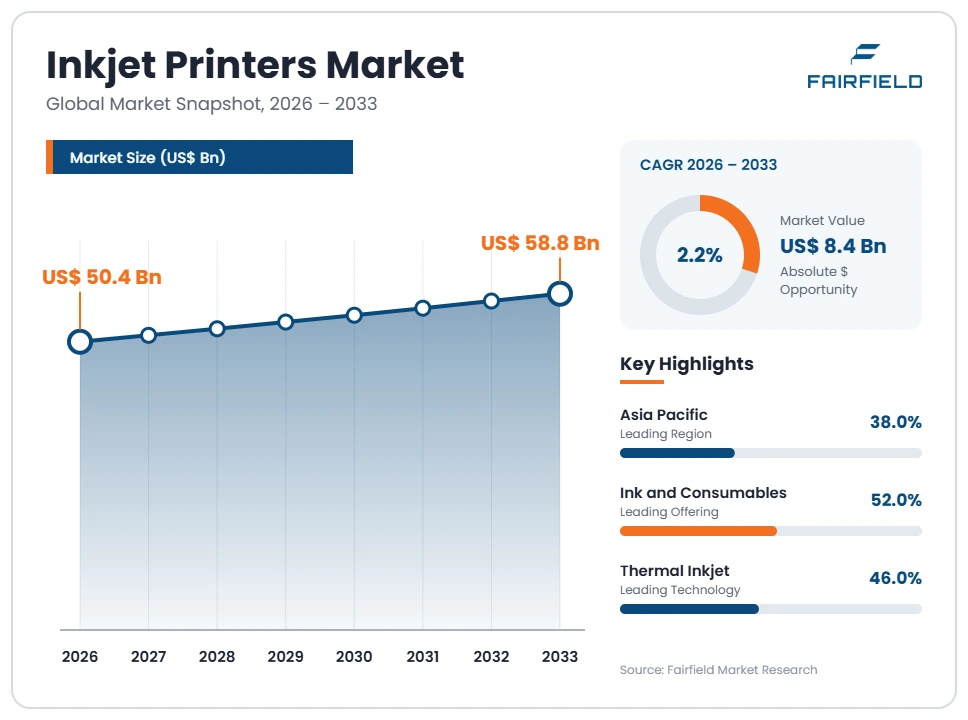
The global Inkjet Printers market size is expected to be valued at US$ 50.4 billion in 2026 and projected to reach US$ 58.8 billion by 2033, growing at a CAGR of 2.2% between 2026 and 2033.
That headline covers hardware plus the ink, cartridges and printheads consumed, and consumables remain the larger half. Between 2020 and 2025 the market grew at roughly 1.3% a year, inflated by a pandemic home-office spike that later reversed. Two opposite trajectories sit inside the single figure. Household and office page volumes keep falling as documents stay digital, which drains the razor-and-blade annuity the category was built on. Against that, single-pass industrial systems are taking work away from analogue presses in labels, corrugated packaging, ceramic tile and textiles, because digital removes plate and setup cost. The direction of travel is therefore compositional rather than expansive: a shrinking consumer base funding a growing industrial one.
Key Report Takeaways
- By Product Type: Consumer and Home Inkjet held 28% share in 2026, while Industrial Single-Pass Inkjet is projected to expand at a 9.4% CAGR through 2033, driven by short-run label and corrugated work that analogue presses cannot price economically.
- By Offering: Ink and Consumables held 52% share in 2026, while Printheads and Components are projected to expand at a 6.8% CAGR through 2033, as industrial integrators buy heads and electronics rather than finished machines.
- By Technology: Thermal Inkjet held 46% share in 2026, while Piezoelectric Drop-on-Demand is projected to expand at a 4.9% CAGR through 2033, because piezo heads tolerate the aggressive ink chemistries used on packaging substrates.
- By End Use: Household printing held 26% share in 2026, while Packaging and Labels is projected to expand at a 9.8% CAGR through 2033, supported by brand demand for versioning and late-stage customisation.
- By Geography: Asia Pacific held 38% share in 2026, while Middle East & Africa is projected to expand at a 4.6% CAGR through 2033, driven by ceramic tile decoration and regional packaging converter investment.
Global Inkjet Printers Market Trends and Insights
Drivers Impact Analysis
Two forces explain why a declining consumer category still carries a positive growth rate.
| Driver | Impact on CAGR Forecast | Geographic Relevance | Impact Timeline |
| Single-pass digital presses displacing analogue printing in labels, packaging, ceramics and textiles | High | Europe, Asia Pacific | Medium term 2–4 years |
| High-capacity ink tank machines raising hardware value per unit sold | Medium | Asia Pacific, Latin America | Short term ≤2 years |
Single-Pass Presses Take Short-Run Work Away From Analogue Printing Lines
Industrial adoption is the only part of this category growing at a genuine clip, and it grows by substitution rather than by new demand. A single-pass digital press prints a job with no plates, no cylinders and no make-ready, so the cost of a two-hundred-metre run is not far from the cost per metre of a long one. That arithmetic makes short runs, regional variants and dated promotional packaging economic for the first time.
The causal mechanism is the collapse of setup cost. Flexographic and offset work carries plate origination, mounting and washdown time that must be amortised over run length, while rotary screen printing on ceramic and textile lines carries the same burden. Brand owners responding to fragmented retail assortments and shorter promotional cycles now order smaller, more frequent batches. Converters buy digital capacity to serve those orders without surrendering the job to a competitor.
Ink Tank Machines Lift Hardware Revenue While Shrinking the Consumable Annuity
Hardware revenue per unit has risen because manufacturers redesigned the commercial model. High-capacity tank machines sell at a materially higher price than cartridge printers and include enough ink for thousands of pages, which lifts the hardware line in every regional market where they now dominate retail shelves. That shift is why hardware value has held up even as the number of pages printed at home continues to fall.
The mechanism is a deliberate response to third-party ink. Buyers in price-sensitive markets had already defected to refilling, so the annuity was leaking anyway. Selling a sealed, high-volume tank system at a higher upfront price recaptures value at the point of sale instead of over the machine’s life. The trade-off is explicit: every tank machine installed replaces a cartridge stream worth more in total, so the consumable half of the market grows more slowly than the installed base.
Restraints Impact Analysis
Two constraints hold the aggregate growth rate near the rate of inflation.
| Restraint | Impact on CAGR Forecast | Geographic Relevance | Impact Timeline |
| Structural decline in household and office page volumes | High | North America, Europe | Long term ≥4 years |
| Third-party and refilled cartridge competition eroding consumable margin | High | Global | Short term ≤2 years |
Falling Household and Office Page Volumes Erode the Consumable Half of the Market
Page volume, not printer sales, determines most of this market’s revenue, and page volume is falling in every mature economy. Documents that were once printed for signature, filing, review or travel now stay on screen. Electronic signatures, mobile boarding passes, digital invoicing mandates and cloud collaboration each removed a specific printing occasion. Fewer pages means fewer cartridge replacements, and the consumable stream is the larger and more profitable half of the category.
The underlying cause is a change in document workflow rather than a change in printer preference. Enterprises consolidating onto managed fleets print less per employee and retire desktop units at refresh. Hybrid working split the remaining volume between home and office without raising the total. Because the installed base is durable and a printer that sits idle is rarely replaced, the volume decline feeds through to hardware demand with a lag of several years.
Third-Party Cartridges and the Authentication Dispute Compress Consumable Margins
Compatible, remanufactured and refilled supplies take a large share of the aftermarket, particularly in price-sensitive regions, and they take it from the highest-margin line in the business. A manufacturer’s cartridge can cost several times a third-party equivalent, so the switching incentive is obvious wherever print quality tolerance is loose. The result is sustained pressure on the consumable gross margin that funded low hardware prices.
Manufacturers have responded with authentication chips and firmware that restrict unrecognised supplies, arguing that this protects print quality, warranty validity and security. Consumer groups, independent supply makers and right-to-repair advocates argue that the same measures restrict competition and limit consumer choice, and competition and consumer authorities in several jurisdictions have examined the practice. The dispute is unresolved, and the commercial consequence is the same either way: the consumable annuity can no longer be assumed, and pricing strategy has moved toward recovering value at the hardware sale.
Market Opportunities
Two revenue pools sit outside the declining office and household business.
Corrugated and Folding Carton Printing Opens a Short-Run Packaging Revenue Pool
Packaging printing is the largest unconverted pool available to this industry, and only a small fraction of it is digital today. Corrugated board and folding cartons are printed in enormous volume, but a growing share of orders is too short, too variant-heavy or too time-critical for plate-based production. Single-pass equipment priced per machine in the millions, plus the ink to run it, converts those jobs into recurring revenue for whoever supplies the line.
The customers are independent corrugated converters, in-house packaging plants at consumer goods producers, and e-commerce fulfilment operations printing branded shipping boards. The supporting development is regulatory as well as commercial: tightening packaging and packaging waste rules push brands toward right-sized, recyclable and clearly marked packs, which multiplies the number of distinct designs a converter must produce. Water-based inks compliant with food contact expectations are the technical gate that decides how fast this pool opens.
Digital Textile and Ceramic Decoration Creates a Recurring Ink and Printhead Pool
Textile and ceramic decoration is the clearest example of inkjet replacing an analogue process outright, and the revenue it generates is heavily weighted to consumables. Ceramic tile decoration moved substantially to digital because printing on a textured, fired surface with unlimited design variation beats rotary screen on both quality and flexibility. Apparel and soft signage are following the same path, driven by on-demand production that eliminates unsold inventory.
The buyers are tile producers, textile mills, garment decorators and print service providers, and the supplier opportunity is the ink rather than the machine. Pigment, dye-sublimation, reactive and ceramic ink volumes scale directly with square metres produced, and printheads are a wear part replaced on a predictable cycle. Suppliers that qualify ink chemistry, printhead and waveform as one system hold the recurring position, because customers rarely requalify a validated combination.
Segment Analysis
- By Product Type: Consumer Machines Still Lead Revenue While Single-Pass Industrial Systems Grow Fastest
Consumer and Home Inkjet held 28% of value in 2026, the largest product position, purely on unit volume and the cartridge or tank revenue that follows each machine. Small Office and Workgroup Inkjet contributed 24%, strengthened by business tank models competing directly against entry laser devices on cost per page. Wide-Format Inkjet took 19%, serving signage, graphics and technical printing. Production and Commercial Inkjet accounted for 14%, concentrated in transactional, book and direct mail work. Industrial Single-Pass Inkjet held 15% and is the fastest-growing product type at a 9.4% CAGR to 2033, because it competes against analogue printing rather than against other printers. The business implication is uncomfortable but clear: the segment with the largest share is the one in structural decline, and strategy increasingly means funding industrial capability from a shrinking consumer base.
- By Offering: Ink and Consumables Dominate Revenue as Printhead Sales Expand Quickest
Ink and Consumables accounted for 52% of market value in 2026, confirming that this is a consumables business with hardware attached rather than the reverse. Hardware contributed 36%, a share that has risen as tank machines carry higher list prices than the cartridge printers they replaced. Services and Support made up 3%, concentrated in managed print and industrial maintenance contracts. Printheads and Components held 9% and form the fastest-growing offering at a 6.8% CAGR through 2033. Growth here comes from industrial integrators and press builders who buy heads, drive electronics and ink delivery subsystems to embed in their own equipment, rather than buying a finished printer. For component suppliers this is the most defensible position in the value chain, because a qualified printhead and ink pairing is rarely changed once a production line is validated.
- By Technology: Thermal Heads Lead Installed Volume While Piezoelectric Systems Advance Faster
Thermal Inkjet held 46% of revenue in 2026, the leading technology, because it dominates the high-volume consumer and office segments where the printhead is integrated into a disposable or semi-disposable cartridge and manufacturing cost per nozzle is lowest. Continuous Inkjet retained 11%, entrenched in coding, marking and date printing on production lines. Piezoelectric Drop-on-Demand accounted for 43% and is the fastest-growing technology at a 4.9% CAGR to 2033. Piezo heads do not boil the fluid, so they handle solvent, UV-curable, pigment, ceramic and textile inks that thermal heads cannot, and they support the long service life a production machine requires. That chemistry tolerance is precisely what industrial and wide-format applications need, which means technology share is shifting in step with the market’s move from documents toward decorated surfaces and packaging.
- By End Use: Household Printing Holds the Largest Share While Packaging and Labels Accelerate
Household printing represented 26% of revenue in 2026, still the single largest end use despite falling page counts, followed by Office and Enterprise at 23%. Commercial Printing and Graphics took 18%, covering signage, display and graphic arts work. Industrial Coding and Marking held 8%, a small but stable stream tied to manufacturing output and traceability rules. Textiles and Apparel contributed 10%, growing on on-demand garment and soft signage production. Packaging and Labels accounted for 15% and is the fastest-growing end use at a 9.8% CAGR through 2033, as brand owners demand regional variants, promotional versions and serialised codes that only digital presses can produce economically. The implication for vendors is that end-use mix, not geography, now determines which parts of a portfolio are investable.
Geography Analysis
- North America Trades Shrinking Office Print for Commercial and Industrial Conversion
North America held 26% of global revenue in 2026, with the United States supplying most of it and Canada adding commercial print capacity. The regional picture is the clearest example of the category’s split. Office and household page volumes are falling faster here than almost anywhere, because digital document workflows, electronic signature adoption and managed print consolidation arrived early. Against that, the region hosts a deep commercial printing base converting transactional, direct mail and book work to high-speed inkjet, plus a large corrugated packaging industry serving e-commerce. State-level right-to-repair legislation has become a live commercial factor for supplies and service policy. The regional opportunity is production inkjet retrofit, where printers replacing ageing offset presses buy both the machine and a long-term ink contract.
- Europe Converts Analogue Lines Under Tightening Repair and Ecodesign Requirements
Europe accounted for 24% of revenue in 2026, led by Germany, Italy, France, the United Kingdom and Spain. The region’s distinguishing feature is regulation applied to the product itself. Ecodesign and energy labelling work on imaging equipment, the voluntary industry agreement covering imaging devices, spare parts availability rules and consumer guarantee obligations together shape how machines are designed, supported and supplied. Waste electrical and electronic equipment rules and cartridge take-back obligations add a reverse-logistics cost that vendors must carry. On the industrial side, Italy and Spain anchor the world’s largest concentration of digital ceramic tile decoration, and Germany hosts leading press engineering. Food contact and printing ink requirements, including national rules on inks for food packaging, are strict and directly determine which chemistries converters may use.
- Which Region Is Leading the Inkjet Printers Market?
Asia Pacific leads with 38% of global revenue in 2026, a position built on both manufacturing and consumption. Japan is the design and production centre for most printheads and finished machines sold worldwide, while China supplies a large share of wide-format and industrial equipment and nearly all compatible supplies. On the demand side, China, India, Indonesia and Vietnam are where high-capacity tank machines sell best, because low cost per page matters more than hardware price to small businesses and households adding a first printer. Textile and ceramic production concentrated across China, India and Pakistan makes the region the largest buyer of industrial decoration equipment. The structural risk is that the same regional supply base sustains the third-party cartridge industry that pressures manufacturer margins everywhere.
- Latin America Expands on Tank Machine Adoption and Label Converter Investment
Latin America held 7% of revenue in 2026, concentrated in Brazil, Mexico, Argentina and Colombia. Tank machines took this market earlier and more completely than most, because ink cost dominates the purchase decision and refilling was already widespread. That gives the region a comparatively healthy hardware line and a weak cartridge line. Label and flexible packaging converters in Brazil and Mexico are adding digital capacity to serve food, beverage and personal care brands wanting shorter runs. Barriers are real: import duties and currency movement raise landed equipment prices, service networks for production machines are thin outside major cities, and financing for a capital press is expensive. The change to watch is nearshoring of packaging supply to Mexico, which brings converter investment with it.
- Which Region Is Growing Fastest in the Inkjet Printers Market?
Middle East & Africa is growing fastest, at a 4.6% CAGR between 2026 and 2033, from a 5% share in 2026. Growth comes from a low base and from industrial rather than office demand. Ceramic tile manufacturing in Egypt, Turkey, Iran, Saudi Arabia and the United Arab Emirates has scaled substantially, and digital decoration is now the default specification on new lines. Packaging converters serving food and beverage producers in the Gulf and in South Africa are adding label and carton capability. Office demand is also still expanding, unlike in mature markets, as business formation and government digitisation programmes create new document workloads. The barriers are service coverage across widely dispersed markets, consumable supply chains vulnerable to customs delay, and ink storage in high ambient temperatures.
Competitive Landscape
The market is highly concentrated at the consumer and office end and markedly more fragmented in industrial applications. A small group of vertically integrated manufacturers, almost all headquartered in Japan or the United States, design their own printheads, formulate their own inks and control the retail channel, which creates a barrier no new entrant has crossed in decades. Printhead manufacture is the root of that position: the capital, process control and intellectual property required to produce nozzle plates at scale are held by very few firms. Industrial single-pass printing looks different, with press builders, integrators, ink formulators and head suppliers occupying distinct layers and competing within them.
Competition rests on different factors in each half of the market. In consumer and office products, cost per page, retail shelf position, supplies availability and increasingly reparability and energy performance decide purchases. In industrial and production systems, buyers evaluate uptime, nozzle reliability over millions of impressions, ink cost per square metre, colour consistency against a brand standard, and the supplier’s ability to integrate with existing converting lines. Entrants from the analogue press world have approached the market by combining proven web handling with bought-in printheads, which is a credible route that bypasses the printhead barrier.
Vendor positioning reflects those two logics. Canon Inc., Seiko Epson Corporation, HP Inc. and Brother Industries, Ltd. span consumer, office and commercial ranges and defend an installed base. Ricoh Company, Ltd., Konica Minolta, Inc., Kyocera Corporation and FUJIFILM Holdings Corporation supply printheads and components to third-party press builders as well as finished systems. Durst Group AG, SCREEN Holdings Co., Ltd., Mimaki Engineering Co., Ltd. and Roland DG Corporation concentrate on wide-format, textile, ceramic and packaging equipment.
Strategic direction across the field converges on three themes: shifting portfolio weight from documents toward decorated surfaces and packaging, defending supplies revenue in a policy environment that increasingly favours repair and reuse, and selling printheads and ink as components to the industrial integrators who are growing fastest.
Inkjet Printers Industry Leaders
Canon Inc.
Seiko Epson Corporation
HP Inc.
Brother Industries, Ltd.
Ricoh Company, Ltd.
Recent Industry Developments
- April 2024: The European Parliament adopted the directive on common rules promoting the repair of goods – it obliges makers of covered products to offer repair and limits practices that block independent repairers, which bears directly on supplies and service policy for imaging equipment.
- July 2024: The European Union Ecodesign for Sustainable Products Regulation entered into force – it creates the framework for durability, reparability and digital product passport requirements that will be extended to product groups by delegated act, imaging equipment among the candidates.
- July 2024: California’s right-to-repair law took effect, requiring makers of covered electronics to supply parts, tools and documentation for defined periods – it establishes a second major jurisdiction setting repair obligations on printer hardware.
- February 2025: The European Union Packaging and Packaging Waste Regulation entered into force – its design-for-recycling, minimisation and labelling obligations increase the number of distinct pack designs brands must produce, which favours digital printing economics.
Companies Covered in the Report
Canon Inc.
Seiko Epson Corporation
HP Inc.
Brother Industries, Ltd.
Ricoh Company, Ltd.
Konica Minolta, Inc.
FUJIFILM Holdings Corporation
Kyocera Corporation
Xerox Holdings Corporation
Roland DG Corporation
Mimaki Engineering Co., Ltd.
Durst Group AG
SCREEN Holdings Co., Ltd.
Domino Printing Sciences plc
Inkjet Printers Market Report Scope
| Metric | Value |
| Study Period | 2020–2033 |
| Market Size 2026 | US$ 50.4 Billion |
| Market Size 2033 | US$ 58.8 Billion |
| CAGR 2026–2033 | 2.2% |
| Absolute Dollar Opportunity | US$ 8.4 Billion |
| Largest Market | Asia Pacific, 38% share in 2026 |
| Fastest-Growing Market | Middle East & Africa, 4.6% CAGR |
| Market Concentration | High |
| Major Players | Canon Inc., Seiko Epson Corporation, HP Inc., Brother Industries, Ltd. |
Inkjet Printers Market Segmentation
- Executive Summary
- Global Inkjet Printers Market Snapshot
- Future Projections, 2026-2033
- Key Market Trends
- Regional Snapshot
- Market Overview
- Market Definition and Report Scope
- Historical Market Trends
- Market Dynamics
- Drivers Impact Analysis
- Single-Pass Presses Take Short-Run Work Away From Analogue Printing Lines
- Ink Tank Machines Lift Hardware Revenue While Shrinking the Consumable Annuity
- Restraints Impact Analysis
- Falling Household and Office Page Volumes Erode the Consumable Half of the Market
- Third-Party Cartridges and the Authentication Dispute Compress Consumable Margins
- Market Opportunities
- Corrugated and Folding Carton Printing Opens a Short-Run Packaging Revenue Pool
- Digital Textile and Ceramic Decoration Creates a Recurring Ink and Printhead Pool
- Drivers Impact Analysis
- Global Inkjet Printers Market Outlook, 2020-2033
- Global Inkjet Printers Market Outlook, by Product Type, Value (US$ Billion), 2020-2033
- Consumer and Home Inkjet
- Small Office and Workgroup Inkjet
- Production and Commercial Inkjet
- Wide-Format Inkjet
- Industrial Single-Pass Inkjet
- Global Inkjet Printers Market Outlook, by Offering, Value (US$ Billion), 2020-2033
- Hardware
- Ink and Consumables
- Printheads and Components
- Services and Support
- Global Inkjet Printers Market Outlook, by Technology, Value (US$ Billion), 2020-2033
- Thermal Inkjet
- Piezoelectric Drop-on-Demand
- Continuous Inkjet
- Global Inkjet Printers Market Outlook, by End Use, Value (US$ Billion), 2020-2033
- Household
- Office and Enterprise
- Commercial Printing and Graphics
- Packaging and Labels
- Textiles and Apparel
- Industrial Coding and Marking
- Global Inkjet Printers Market Outlook, by Region, Value (US$ Billion), 2020-2033
- North America
- Europe
- Asia Pacific
- Latin America
- Middle East & Africa
- Global Inkjet Printers Market Outlook, by Product Type, Value (US$ Billion), 2020-2033
- North America Inkjet Printers Market Outlook, 2020-2033
- North America Inkjet Printers Market Outlook, by Product Type, Value (US$ Billion), 2020-2033
- Consumer and Home Inkjet
- Small Office and Workgroup Inkjet
- Production and Commercial Inkjet
- Wide-Format Inkjet
- Industrial Single-Pass Inkjet
- North America Inkjet Printers Market Outlook, by Offering, Value (US$ Billion), 2020-2033
- Hardware
- Ink and Consumables
- Printheads and Components
- Services and Support
- North America Inkjet Printers Market Outlook, by Technology, Value (US$ Billion), 2020-2033
- Thermal Inkjet
- Piezoelectric Drop-on-Demand
- Continuous Inkjet
- North America Inkjet Printers Market Outlook, by End Use, Value (US$ Billion), 2020-2033
- Household
- Office and Enterprise
- Commercial Printing and Graphics
- Packaging and Labels
- Textiles and Apparel
- Industrial Coding and Marking
- North America Inkjet Printers Market Outlook, by Country, Value (US$ Billion), 2020-2033
- United States Inkjet Printers Market Outlook, by Product Type, 2020-2033
- United States Inkjet Printers Market Outlook, by Offering, 2020-2033
- United States Inkjet Printers Market Outlook, by Technology, 2020-2033
- United States Inkjet Printers Market Outlook, by End Use, 2020-2033
- Canada Inkjet Printers Market Outlook, by Product Type, 2020-2033
- Canada Inkjet Printers Market Outlook, by Offering, 2020-2033
- Canada Inkjet Printers Market Outlook, by Technology, 2020-2033
- Canada Inkjet Printers Market Outlook, by End Use, 2020-2033
- North America Inkjet Printers Market Outlook, by Product Type, Value (US$ Billion), 2020-2033
- Europe Inkjet Printers Market Outlook, 2020-2033
- Europe Inkjet Printers Market Outlook, by Product Type, Value (US$ Billion), 2020-2033
- Consumer and Home Inkjet
- Small Office and Workgroup Inkjet
- Production and Commercial Inkjet
- Wide-Format Inkjet
- Industrial Single-Pass Inkjet
- Europe Inkjet Printers Market Outlook, by Offering, Value (US$ Billion), 2020-2033
- Hardware
- Ink and Consumables
- Printheads and Components
- Services and Support
- Europe Inkjet Printers Market Outlook, by Technology, Value (US$ Billion), 2020-2033
- Thermal Inkjet
- Piezoelectric Drop-on-Demand
- Continuous Inkjet
- Europe Inkjet Printers Market Outlook, by End Use, Value (US$ Billion), 2020-2033
- Household
- Office and Enterprise
- Commercial Printing and Graphics
- Packaging and Labels
- Textiles and Apparel
- Industrial Coding and Marking
- Europe Inkjet Printers Market Outlook, by Country, Value (US$ Billion), 2020-2033
- Germany Inkjet Printers Market Outlook, by Product Type, 2020-2033
- Germany Inkjet Printers Market Outlook, by Offering, 2020-2033
- Germany Inkjet Printers Market Outlook, by Technology, 2020-2033
- Germany Inkjet Printers Market Outlook, by End Use, 2020-2033
- Italy Inkjet Printers Market Outlook, by Product Type, 2020-2033
- Italy Inkjet Printers Market Outlook, by Offering, 2020-2033
- Italy Inkjet Printers Market Outlook, by Technology, 2020-2033
- Italy Inkjet Printers Market Outlook, by End Use, 2020-2033
- France Inkjet Printers Market Outlook, by Product Type, 2020-2033
- France Inkjet Printers Market Outlook, by Offering, 2020-2033
- France Inkjet Printers Market Outlook, by Technology, 2020-2033
- France Inkjet Printers Market Outlook, by End Use, 2020-2033
- United Kingdom Inkjet Printers Market Outlook, by Product Type, 2020-2033
- United Kingdom Inkjet Printers Market Outlook, by Offering, 2020-2033
- United Kingdom Inkjet Printers Market Outlook, by Technology, 2020-2033
- United Kingdom Inkjet Printers Market Outlook, by End Use, 2020-2033
- Spain Inkjet Printers Market Outlook, by Product Type, 2020-2033
- Spain Inkjet Printers Market Outlook, by Offering, 2020-2033
- Spain Inkjet Printers Market Outlook, by Technology, 2020-2033
- Spain Inkjet Printers Market Outlook, by End Use, 2020-2033
- Europe Inkjet Printers Market Outlook, by Product Type, Value (US$ Billion), 2020-2033
- Asia Pacific Inkjet Printers Market Outlook, 2020-2033
- Asia Pacific Inkjet Printers Market Outlook, by Product Type, Value (US$ Billion), 2020-2033
- Consumer and Home Inkjet
- Small Office and Workgroup Inkjet
- Production and Commercial Inkjet
- Wide-Format Inkjet
- Industrial Single-Pass Inkjet
- Asia Pacific Inkjet Printers Market Outlook, by Offering, Value (US$ Billion), 2020-2033
- Hardware
- Ink and Consumables
- Printheads and Components
- Services and Support
- Asia Pacific Inkjet Printers Market Outlook, by Technology, Value (US$ Billion), 2020-2033
- Thermal Inkjet
- Piezoelectric Drop-on-Demand
- Continuous Inkjet
- Asia Pacific Inkjet Printers Market Outlook, by End Use, Value (US$ Billion), 2020-2033
- Household
- Office and Enterprise
- Commercial Printing and Graphics
- Packaging and Labels
- Textiles and Apparel
- Industrial Coding and Marking
- Asia Pacific Inkjet Printers Market Outlook, by Country, Value (US$ Billion), 2020-2033
- Japan Inkjet Printers Market Outlook, by Product Type, 2020-2033
- Japan Inkjet Printers Market Outlook, by Offering, 2020-2033
- Japan Inkjet Printers Market Outlook, by Technology, 2020-2033
- Japan Inkjet Printers Market Outlook, by End Use, 2020-2033
- China Inkjet Printers Market Outlook, by Product Type, 2020-2033
- China Inkjet Printers Market Outlook, by Offering, 2020-2033
- China Inkjet Printers Market Outlook, by Technology, 2020-2033
- China Inkjet Printers Market Outlook, by End Use, 2020-2033
- India Inkjet Printers Market Outlook, by Product Type, 2020-2033
- India Inkjet Printers Market Outlook, by Offering, 2020-2033
- India Inkjet Printers Market Outlook, by Technology, 2020-2033
- India Inkjet Printers Market Outlook, by End Use, 2020-2033
- Indonesia Inkjet Printers Market Outlook, by Product Type, 2020-2033
- Indonesia Inkjet Printers Market Outlook, by Offering, 2020-2033
- Indonesia Inkjet Printers Market Outlook, by Technology, 2020-2033
- Indonesia Inkjet Printers Market Outlook, by End Use, 2020-2033
- Vietnam Inkjet Printers Market Outlook, by Product Type, 2020-2033
- Vietnam Inkjet Printers Market Outlook, by Offering, 2020-2033
- Vietnam Inkjet Printers Market Outlook, by Technology, 2020-2033
- Vietnam Inkjet Printers Market Outlook, by End Use, 2020-2033
- Pakistan Inkjet Printers Market Outlook, by Product Type, 2020-2033
- Pakistan Inkjet Printers Market Outlook, by Offering, 2020-2033
- Pakistan Inkjet Printers Market Outlook, by Technology, 2020-2033
- Pakistan Inkjet Printers Market Outlook, by End Use, 2020-2033
- Asia Pacific Inkjet Printers Market Outlook, by Product Type, Value (US$ Billion), 2020-2033
- Latin America Inkjet Printers Market Outlook, 2020-2033
- Latin America Inkjet Printers Market Outlook, by Product Type, Value (US$ Billion), 2020-2033
- Consumer and Home Inkjet
- Small Office and Workgroup Inkjet
- Production and Commercial Inkjet
- Wide-Format Inkjet
- Industrial Single-Pass Inkjet
- Latin America Inkjet Printers Market Outlook, by Offering, Value (US$ Billion), 2020-2033
- Hardware
- Ink and Consumables
- Printheads and Components
- Services and Support
- Latin America Inkjet Printers Market Outlook, by Technology, Value (US$ Billion), 2020-2033
- Thermal Inkjet
- Piezoelectric Drop-on-Demand
- Continuous Inkjet
- Latin America Inkjet Printers Market Outlook, by End Use, Value (US$ Billion), 2020-2033
- Household
- Office and Enterprise
- Commercial Printing and Graphics
- Packaging and Labels
- Textiles and Apparel
- Industrial Coding and Marking
- Latin America Inkjet Printers Market Outlook, by Country, Value (US$ Billion), 2020-2033
- Brazil Inkjet Printers Market Outlook, by Product Type, 2020-2033
- Brazil Inkjet Printers Market Outlook, by Offering, 2020-2033
- Brazil Inkjet Printers Market Outlook, by Technology, 2020-2033
- Brazil Inkjet Printers Market Outlook, by End Use, 2020-2033
- Mexico Inkjet Printers Market Outlook, by Product Type, 2020-2033
- Mexico Inkjet Printers Market Outlook, by Offering, 2020-2033
- Mexico Inkjet Printers Market Outlook, by Technology, 2020-2033
- Mexico Inkjet Printers Market Outlook, by End Use, 2020-2033
- Argentina Inkjet Printers Market Outlook, by Product Type, 2020-2033
- Argentina Inkjet Printers Market Outlook, by Offering, 2020-2033
- Argentina Inkjet Printers Market Outlook, by Technology, 2020-2033
- Argentina Inkjet Printers Market Outlook, by End Use, 2020-2033
- Colombia Inkjet Printers Market Outlook, by Product Type, 2020-2033
- Colombia Inkjet Printers Market Outlook, by Offering, 2020-2033
- Colombia Inkjet Printers Market Outlook, by Technology, 2020-2033
- Colombia Inkjet Printers Market Outlook, by End Use, 2020-2033
- Latin America Inkjet Printers Market Outlook, by Product Type, Value (US$ Billion), 2020-2033
- Middle East & Africa Inkjet Printers Market Outlook, 2020-2033
- Middle East & Africa Inkjet Printers Market Outlook, by Product Type, Value (US$ Billion), 2020-2033
- Consumer and Home Inkjet
- Small Office and Workgroup Inkjet
- Production and Commercial Inkjet
- Wide-Format Inkjet
- Industrial Single-Pass Inkjet
- Middle East & Africa Inkjet Printers Market Outlook, by Offering, Value (US$ Billion), 2020-2033
- Hardware
- Ink and Consumables
- Printheads and Components
- Services and Support
- Middle East & Africa Inkjet Printers Market Outlook, by Technology, Value (US$ Billion), 2020-2033
- Thermal Inkjet
- Piezoelectric Drop-on-Demand
- Continuous Inkjet
- Middle East & Africa Inkjet Printers Market Outlook, by End Use, Value (US$ Billion), 2020-2033
- Household
- Office and Enterprise
- Commercial Printing and Graphics
- Packaging and Labels
- Textiles and Apparel
- Industrial Coding and Marking
- Middle East & Africa Inkjet Printers Market Outlook, by Country and Subregion, Value (US$ Billion), 2020-2033
- Egypt Inkjet Printers Market Outlook, by Product Type, 2020-2033
- Egypt Inkjet Printers Market Outlook, by Offering, 2020-2033
- Egypt Inkjet Printers Market Outlook, by Technology, 2020-2033
- Egypt Inkjet Printers Market Outlook, by End Use, 2020-2033
- Turkey Inkjet Printers Market Outlook, by Product Type, 2020-2033
- Turkey Inkjet Printers Market Outlook, by Offering, 2020-2033
- Turkey Inkjet Printers Market Outlook, by Technology, 2020-2033
- Turkey Inkjet Printers Market Outlook, by End Use, 2020-2033
- Iran Inkjet Printers Market Outlook, by Product Type, 2020-2033
- Iran Inkjet Printers Market Outlook, by Offering, 2020-2033
- Iran Inkjet Printers Market Outlook, by Technology, 2020-2033
- Iran Inkjet Printers Market Outlook, by End Use, 2020-2033
- Saudi Arabia Inkjet Printers Market Outlook, by Product Type, 2020-2033
- Saudi Arabia Inkjet Printers Market Outlook, by Offering, 2020-2033
- Saudi Arabia Inkjet Printers Market Outlook, by Technology, 2020-2033
- Saudi Arabia Inkjet Printers Market Outlook, by End Use, 2020-2033
- United Arab Emirates Inkjet Printers Market Outlook, by Product Type, 2020-2033
- United Arab Emirates Inkjet Printers Market Outlook, by Offering, 2020-2033
- United Arab Emirates Inkjet Printers Market Outlook, by Technology, 2020-2033
- United Arab Emirates Inkjet Printers Market Outlook, by End Use, 2020-2033
- Gulf Inkjet Printers Market Outlook, by Product Type, 2020-2033
- Gulf Inkjet Printers Market Outlook, by Offering, 2020-2033
- Gulf Inkjet Printers Market Outlook, by Technology, 2020-2033
- Gulf Inkjet Printers Market Outlook, by End Use, 2020-2033
- South Africa Inkjet Printers Market Outlook, by Product Type, 2020-2033
- South Africa Inkjet Printers Market Outlook, by Offering, 2020-2033
- South Africa Inkjet Printers Market Outlook, by Technology, 2020-2033
- South Africa Inkjet Printers Market Outlook, by End Use, 2020-2033
- Middle East & Africa Inkjet Printers Market Outlook, by Product Type, Value (US$ Billion), 2020-2033
- Competitive Landscape
- Industry Leaders
- Recent Industry Developments
- Company Profiles
- Canon Inc.
- Seiko Epson Corporation
- HP Inc.
- Brother Industries, Ltd.
- Ricoh Company, Ltd.
- Konica Minolta, Inc.
- FUJIFILM Holdings Corporation
- Kyocera Corporation
- Xerox Holdings Corporation
- Roland DG Corporation
- Mimaki Engineering Co., Ltd.
- Durst Group AG
- SCREEN Holdings Co., Ltd.
- Domino Printing Sciences plc
- Appendix
- Research Methodology
- Report Assumptions
- Acronyms and Abbreviations
Product Type
- Consumer and Home Inkjet
- Small Office and Workgroup Inkjet
- Production and Commercial Inkjet
- Wide-Format Inkjet
- Industrial Single-Pass Inkjet
Offering
- Hardware
- Ink and Consumables
- Printheads and Components
- Services and Support
Technology
- Thermal Inkjet
- Piezoelectric Drop-on-Demand
- Continuous Inkjet
End Use
- Household
- Office and Enterprise
- Commercial Printing and Graphics
- Packaging and Labels
- Textiles and Apparel
- Industrial Coding and Marking
Regions
- North America
- Europe
- Asia Pacific
- Latin America
- Middle East & Africa
Our Research Methodology
Considering the volatility of business today, traditional approaches to strategizing a game plan can be unfruitful if not detrimental. True ambiguity is no way to determine a forecast. A myriad of predetermined factors must be accounted for such as the degree of risk involved, the magnitude of circumstances, as well as conditions or consequences that are not known or unpredictable. To circumvent binary views that cast uncertainty, the application of market research intelligence to strategically posture, move, and enable actionable outcomes is necessary.
View Methodology
Quality Assured
Rigorous Validation Process

Confidentiality Assured
End-to-end Data Security

Custom Research Services
Tailored To Your Objectives
FAQs
The market is valued at US$ 50.4 billion in 2026, counting printer hardware together with the ink, cartridges and printheads those machines consume.
Revenue is projected to reach US$ 58.8 billion by 2033, a 2.2% CAGR and an absolute dollar opportunity of US$ 8.4 billion over the period.
Ink and Consumables lead with 52% share in 2026, confirming that supplies rather than machines generate most revenue in this category.
Industrial Single-Pass Inkjet grows fastest at a 9.4% CAGR, because it replaces analogue printing in labels, corrugated packaging, ceramics and textiles.
Asia Pacific leads with 38% share in 2026, supported by printhead manufacturing, tank machine demand and large textile and ceramic production bases.
Related Reports
LED Lighting Market Size, Share, Insights, Competitive Landscape, and Forecast 2026 to 2033
The LED lighting market is projected to grow from US$84.0 billion in 2026 to US$112.0 billion by 2033 at a 4.2% CAGR. Explore segments and trends.
LTE Advanced Pro Market Size, Share, Insights, Competitive Landscape, and Forecast 2026 to 2033
The LTE Advanced Pro market is forecast to grow from US$ 22.30 billion in 2026 to US$ 42.91 billion by 2033 at a 9.8% CAGR.
Advanced Semiconductor Cooling Systems Market Size, Share, Insights, Competitive Landscape, and Forecast 2026 to 2033
The advanced semiconductor cooling systems market is projected to grow from US$ 6.8 billion in 2026 to US$ 24.9 billion by 2033 at a 20.4% CAGR.
Plastic Transistors Market Size, Share, Insights, Competitive Landscape, and Forecast 2026 to 2033
The global plastic transistors market is valued at US$0.4 billion in 2026, reaching US$0.9 billion by 2033, growing at a 12.3% CAGR
Multi-Access Edge Computing Market Size, Share, Insights, Competitive Landscape, and Forecast 2026 to 2033
Explore the multi-access edge computing market, valued at US$ 4.2 billion in 2026 and projected to reach US$ 9.8 billion by 2033 at a 12.9% CAGR.
M-commerce Payment Market Size, Share, Insights, Competitive Landscape, and Forecast 2026 to 2033
Explore the m-commerce payment market, valued at US$ 10.05 billion in 2026 and forecast to reach US$ 22.70 billion by 2033, growing at a 12.3% CAGR.