



LTE Advanced Pro Market
LTE Advanced Pro Market Size, Share, Insights, Competitive Landscape, and Forecast 2026 to 2033
How Fast Is the LTE Advanced Pro Market Growing?
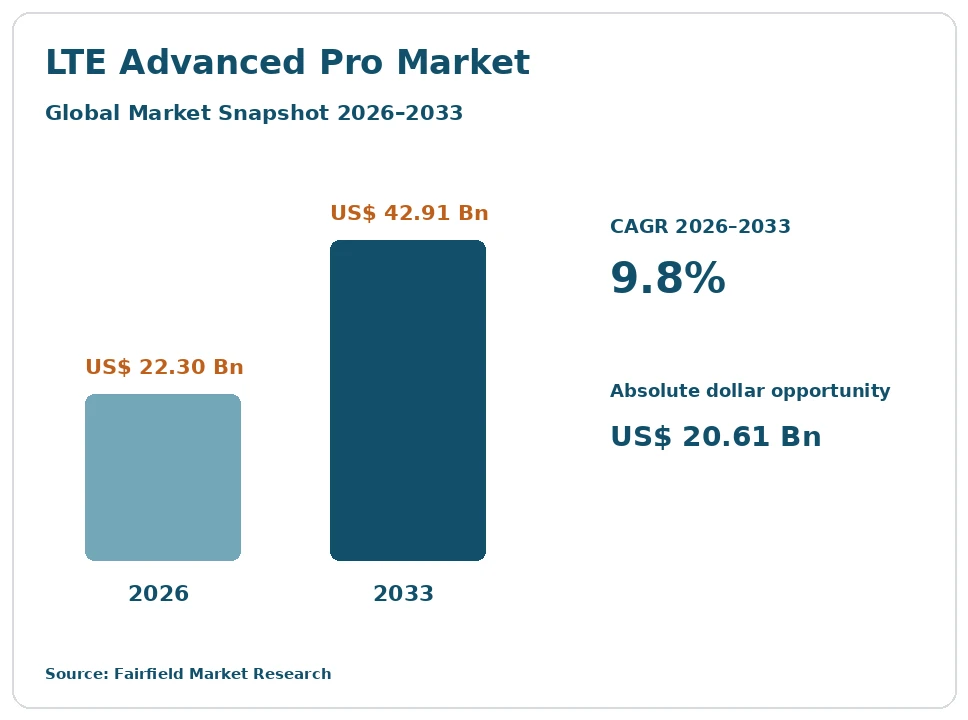
The global LTE advanced pro market size is expected to be valued at US$ 22.30 billion in 2026 and projected to reach US$ 42.91 billion by 2033, growing at a CAGR of 9.8% between 2026 and 2033.
Between 2020 and 2025, the market grew at a CAGR of about 8.9%, as pandemic lockdowns drove record mobile data use, operators upgraded LTE networks to carry the traffic, and many countries used advanced LTE as a bridge while 5G rollouts ramped up. The LTE advanced pro market covers network hardware, software, and services based on 3GPP Releases 13 and 14 and later, often called 4.5G networks, including base stations, small cells, core network software, modems, chipsets, and devices. Key features include carrier aggregation of many bands, massive MIMO antennas, licensed assisted access to unlicensed spectrum, LTE-M and NB-IoT for connected devices, and low-latency modes. These networks deliver gigabit speeds and support IoT, fixed wireless access, and mission-critical communications. Growth comes from rising data use, IoT, and the need to modernize LTE alongside 5G. The market is shifting toward software upgrades and IoT. In April 2026, Ooredoo launched Qatar’s first LTE-M network.
Key Report Takeaways
- By Component: Hardware held about 58% share in 2025, while Software is projected to expand at a 12.1% CAGR through 2033, driven by software-defined upgrades, cloud-native cores, network automation, and licenses that unlock carrier aggregation and IoT features on existing equipment.
- By Application: Mobile Broadband held about 47% share in 2025, while IoT Connectivity is projected to expand at a 13.5% CAGR through 2033, driven by smart meters, asset trackers, wearables, and industrial sensors using LTE-M and NB-IoT networks.
- By End User: Telecom Operators held about 64% share in 2025, while Enterprises are projected to expand at a 12.6% CAGR through 2033, driven by private LTE networks in mines, ports, factories, and utilities that need reliable, secure wireless coverage.
- By Region: Asia Pacific held about 43% share in 2025, while India is projected to expand at a 11.9% CAGR through 2033, driven by rising smartphone use, rural coverage programs, fixed wireless access, and low-cost IoT services across the country.
Global LTE Advanced Pro Market Trends and Insights
Drivers Impact Analysis
Two drivers carry the strongest influence on LTE advanced pro market demand during the forecast period.
| Driver | Impact on CAGR Forecast | Geographic Relevance | Impact Timeline |
| Rising mobile data use and LTE network modernization | High | Global, strongest in Asia Pacific, Middle East & Africa, and Latin America | Long term (≥4 years) |
| Growth of IoT connectivity through LTE-M and NB-IoT | High | Global | Medium term (2-4 years) |
Data Demand Is Driving the LTE Advanced Pro Market
Rising mobile data use and LTE network modernization are the strongest driver of the LTE advanced pro market. Networks must carry far more traffic.
The mechanism is fast growth in video, social media, gaming, and cloud services on phones. Global mobile data traffic keeps rising each year, and in many countries LTE still carries most traffic even after 5G launch, because 4G covers more people and more devices. Operators in India, Indonesia, Nigeria, Brazil, and Pakistan are adding LTE advanced pro features such as carrier aggregation and massive MIMO to raise capacity without full 5G investment. Even in advanced markets, LTE advanced pro supports 5G non-standalone networks, which depend on a strong LTE anchor. Fixed wireless access over LTE brings home broadband to rural areas without fiber. Software upgrades extend the life of existing base stations. These needs keep spending on advanced LTE steady.
IoT Growth Is Expanding the LTE Advanced Pro Market
Growth of IoT connectivity through LTE-M and NB-IoT is expanding the LTE advanced pro market. Billions of devices need low-power links.
The cause is the spread of connected devices in homes, cities, farms, and factories. LTE-M and NB-IoT, introduced in LTE advanced pro releases, offer low power use, long battery life, and deep indoor coverage for smart meters, trackers, alarms, and sensors. Operators such as Vodafone, AT&T, Deutsche Telekom, and Ooredoo run these networks. As 2G and 3G networks shut down, devices move to LTE-M and NB-IoT, creating a large wave of replacements in cars, alarms, meters, and payment terminals. Module prices have fallen to a few dollars, making it cheap to connect simple devices, and roaming deals let IoT devices work across borders. These trends support strong growth.
Restraints Impact Analysis
Two restraints limit how quickly the LTE advanced pro market grows.
| Restraint | Impact on CAGR Forecast | Geographic Relevance | Impact Timeline |
| Shift of operator investment toward 5G | High | North America, Europe, Asia Pacific | Long term (≥4 years) |
| High upgrade costs and spectrum limits | Medium | Latin America, Middle East & Africa | Medium term (2-4 years) |
5G Investment Slows the LTE Advanced Pro Market
The shift of operator investment toward 5G slows the LTE advanced pro market. Operators put new budgets into 5G.
The specific causes are spectrum auctions, government 5G targets, and competition. In North America, Europe, China, Japan, and South Korea, operators spend most of their network budgets on 5G standalone networks, new spectrum, and cloud cores. Some are refarming LTE spectrum to 5G, reducing LTE upgrades. Equipment makers focus research on 5G and 6G. Device makers launch more 5G phones, even in mid-range price bands. Operator capital spending has also fallen in recent years as returns weaken. These factors slow growth in advanced markets and limit new LTE investments, although LTE will remain in service for many years and still needs regular upkeep and software updates.
Upgrade Costs Restrict the LTE Advanced Pro Market
High upgrade costs and spectrum limits restrict the LTE advanced pro market. Some operators cannot afford upgrades.
The underlying causes are thin operator margins in emerging markets and limited spectrum. Carrier aggregation needs several bands, but many operators hold only one or two. Spectrum auctions can be expensive. Massive MIMO radios and backhaul upgrades cost a lot per site. Currency swings raise the cost of imported equipment, and taxes on telecom services cut operator cash flow. Rural sites often lack reliable power and fiber backhaul, adding costs for generators and microwave links. Low average revenue per user in many countries makes it hard to justify new spending, and price wars between operators cut profits further. Some regulators also delay spectrum releases, which slows capacity growth. These factors restrict upgrades in poorer markets.
Market Opportunities
Private LTE Networks Open a Fast-Growth Revenue Pool
Private LTE networks open a fast-growth revenue pool in the LTE advanced pro market. Enterprises want their own secure wireless.
Vendors can capture this opportunity. Mines, ports, airports, factories, oil fields, and utilities use private LTE networks for reliable coverage, low latency, and control over data. Shared spectrum such as CBRS in the United States makes private networks easier to set up. Nokia, Ericsson, Airspan, and Mavenir sell private network solutions, often designed to upgrade to 5G later. Private networks also support autonomous vehicles, robots, and video monitoring on large sites. Many industries need coverage in remote places where public networks are weak. Spectrum rules in Germany, Japan, and the United Kingdom also allow local licenses for enterprises. Companies offering easy, managed private networks can win.
Fixed Wireless Access Creates a Growth Revenue Pool
Fixed wireless access creates a growth revenue pool in the LTE advanced pro market. Wireless home broadband reaches areas without fiber.
Operators can capture this opportunity. LTE advanced pro routers deliver home internet in rural and suburban areas. Reliance Jio, T-Mobile, and operators across Middle East & Africa sell fixed wireless plans. Fixed wireless access is quick to install, needs no digging, and costs less than fiber in low-density areas. Operators can use spare network capacity to serve homes and small businesses, and plans are often cheaper than cable. Outdoor antennas improve speeds in weak coverage areas, and many rural families now use LTE routers as their main home internet. Government programs to close the digital divide in rural areas also support demand. Companies offering low-cost routers and capacity can grow.
Segment Analysis
By Component: Hardware Leads While Software Grows Fastest
Hardware held about 58% share in 2025. Base stations, remote radio units, massive MIMO antennas, small cells, modems, chipsets, and user devices make up most spending, because operators must install new radios and antennas to gain capacity. Huawei, Ericsson, Nokia, ZTE, and Samsung Electronics supply most network hardware, while Qualcomm and MediaTek supply chipsets.
Software is the fastest-growing component, expanding at a 12.1% CAGR through 2033. Software licenses unlock carrier aggregation, IoT, and other features on existing radios, and cloud-native core software and automation tools cut operating costs. Services such as planning, integration, and maintenance form another component. For the market, software growth adds recurring revenue and helps operators get more value from existing equipment.
By Application: Mobile Broadband Leads While IoT Connectivity Grows Fastest
Mobile Broadband held about 47% share in 2025. Smartphone data for video, social media, and apps is the main reason operators upgrade LTE networks, and LTE carries most mobile traffic in many emerging countries. Fixed wireless access and mission-critical communications form other applications. Many users in Asia Pacific, Latin America, and Middle East & Africa rely on LTE as their only internet connection, using it for work, study, banking, and entertainment.
IoT Connectivity is the fastest-growing application, expanding at a 13.5% CAGR through 2033. LTE-M and NB-IoT connect smart meters, trackers, wearables, and sensors, and 2G and 3G shutdowns move older devices to LTE. For the market, IoT growth adds many new connections.
By End User: Telecom Operators Lead While Enterprises Grow Fastest
Telecom Operators held about 64% share in 2025. Mobile operators buy most LTE advanced pro equipment and software to run public networks for consumers and businesses. Large operators such as China Mobile, Reliance Jio, Vodafone, and América Movil run hundreds of thousands of LTE sites that need regular upgrades, maintenance, and software licenses. Network sharing deals help operators cut costs.
Enterprises are the fastest-growing end user, expanding at a 12.6% CAGR through 2033. Mining, ports, utilities, manufacturing, and public safety agencies build private LTE networks. Governments form another end user, using LTE for public safety and smart city systems. Enterprises value control over coverage, security, and data. For the market, enterprise growth broadens demand.
Geography Analysis
Why Is North America Important to the LTE Advanced Pro Market?
North America is important to the LTE advanced pro market because the United States and Canada run large LTE networks that anchor 5G non-standalone service and carry nationwide LTE-M IoT services through AT&T, Verizon, and T-Mobile. The FirstNet public safety network uses advanced LTE features for police, fire, and medical teams, and CBRS shared spectrum has made the United States a leader in private LTE for enterprises. Qualcomm, Cisco, and Airspan are based there. Key barriers include the shift of budgets to 5G. One change shaping the region is private network growth.
Europe Shapes the LTE Advanced Pro Market Through IoT and 2G/3G Shutdowns
Europe is a major LTE advanced pro market. Germany, the United Kingdom, France, Italy, and Spain run large LTE networks, and operators such as Vodafone, Deutsche Telekom, Orange, and Telefónica offer LTE-M and NB-IoT nationwide. Vodafone turned on LTE-M in the United Kingdom in 2024. Shutdowns of 2G and 3G move devices to LTE. Ericsson and Nokia are based in the region. Smart meter programs in the United Kingdom, Italy, and Spain use NB-IoT and LTE-M. Key barriers include 5G focus. One opportunity is smart meter rollouts.
Which Region Is Leading the LTE Advanced Pro Market?
Asia Pacific is leading the LTE advanced pro market with about 43% share in 2025. China has the world’s largest LTE and NB-IoT networks, with hundreds of millions of IoT connections, and Huawei and ZTE are the region’s leading suppliers. India is the fastest-growing country, expanding at a 11.9% CAGR through 2033, as operators expand coverage, fixed wireless access, and IoT. Indonesia, Pakistan, Vietnam, and the Philippines add demand, as LTE remains the main mobile service for most users. Japan and South Korea use LTE as a strong base for 5G. Key barriers include price pressure. One change shaping the region is IoT growth.
Latin America Grows the LTE Advanced Pro Market Through Coverage Expansion
Latin America is a growing LTE advanced pro market. Brazil, Mexico, Argentina, Colombia, and Chile are expanding LTE coverage and capacity, and LTE still carries most mobile traffic in the region. América Movil, Telefónica, and TIM run large networks and are adding carrier aggregation and IoT services. Rural coverage obligations tied to spectrum licenses support investment, and IoT is growing in agriculture, logistics, and utilities. Many users still use 4G phones, and low-cost 4G handsets keep LTE demand strong in rural areas and smaller cities. Fixed wireless access is growing in Mexico and Brazil. Key barriers include currency swings. One opportunity is fixed wireless access.
Middle East & Africa Develops the LTE Advanced Pro Market Through Mobile Broadband
Middle East & Africa is a developing LTE advanced pro market. Nigeria, Kenya, South Africa, Egypt, and Ethiopia are expanding LTE as the main broadband service, and Ethio Telecom rolled out LTE Advanced in several towns in 2025. Qatar, Saudi Arabia, and the United Arab Emirates add LTE-M and IoT services. MTN, Airtel Africa, Vodacom, and Ooredoo lead. Mobile money services depend on reliable networks, and many people get online for the first time through 4G phones. Key barriers include affordability and power supply gaps. One change shaping the region is 4G expansion.
Competitive Landscape
The LTE advanced pro market is highly consolidated. Huawei, Ericsson, Nokia, ZTE, and Samsung Electronics are leading players, together supplying most radio access network equipment worldwide, while Cisco, Mavenir, NEC, Fujitsu, Airspan Networks, CommScope, and Parallel Wireless compete strongly. Qualcomm, MediaTek, and Intel dominate modems and chipsets. Restrictions on Huawei and ZTE equipment in the United States, United Kingdom, and parts of Europe have reshaped supplier choices.
Companies compete on capacity, spectral efficiency, energy use, software features, price, financing, and support for smooth upgrades to 5G. Operators favor vendors whose LTE equipment can be upgraded to 5G with software, protecting their investments. Open RAN vendors such as Mavenir and Parallel Wireless compete by offering lower-cost, multi-vendor networks. Energy efficiency is increasingly important because power is a large share of operator costs.
Strategic moves show how competition is changing. In August 2024, Vodafone switched on LTE-M in the United Kingdom, completing its range of IoT technologies. In December 2025, Ethio Telecom announced LTE Advanced rollouts in several towns. In April 2026, Ooredoo became the first operator in Qatar to launch LTE-M. These moves show competition shifting toward IoT connectivity and coverage expansion.
Three themes shape vendor strategy. First, companies are selling software upgrades that extend LTE equipment life. Second, they are growing private network and IoT businesses. Third, they are focusing on Asia Pacific, Middle East & Africa, and Latin America, where LTE investment remains strong.
LTE Advanced Pro Market Industry Leaders
- Huawei
- Ericsson
- Nokia
- ZTE
- Samsung Electronics
Recent Industry Developments
- April 2026: Ooredoo became the first operator in Qatar to launch LTE-M for next-generation IoT connectivity - expands IoT services built on the LTE advanced pro market.
- December 2025: Ethio Telecom announced the rollout of its 4G LTE Advanced service in several towns, including Nekemte, Bako, and Gimbi - extends 4.5G networks in Middle East & Africa.
- August 2024: Vodafone switched on LTE-M across the United Kingdom, adding to its NB-IoT, 4G, and 5G IoT options - supports the shift of devices from 2G and 3G to advanced LTE.
Companies Covered in the Report
- Huawei
- Ericsson
- Nokia
- ZTE
- Samsung Electronics
- Cisco Systems
- Mavenir
- NEC
- Qualcomm
- MediaTek
- Airspan Networks
- CommScope
LTE Advanced Pro Market Scope
This report covers the LTE advanced pro market, including hardware, software, and services, used for mobile broadband, IoT connectivity, fixed wireless access, and mission-critical communications, deployed in public and private networks for telecom operators, enterprises, and governments, across smartphones, routers, modules, and other devices. The base year is 2025, and the forecast period runs from 2026 to 2033. All values are expressed in US$ Billion.
| Metric | Value |
| Study Period | 2020-2033 |
| Market Size 2026 | US$ 22.30 Billion |
| Market Size 2033 | US$ 42.91 Billion |
| CAGR 2026-2033 | 9.8% |
| Absolute Dollar Opportunity | US$ 20.61 Billion |
| Largest Market | Asia Pacific |
| Fastest-Growing Market | India |
| Market Concentration | Highly Consolidated |
| Major Players | Huawei, Ericsson, Nokia, ZTE, Samsung Electronics |
Component
- Hardware
- Software
- Services
Application
- Mobile Broadband
- IoT Connectivity
- Fixed Wireless Access
- Mission-Critical Communications
End User
- Telecom Operators
- Enterprises
- Government
Regions
- North America
- Europe
- Asia Pacific
- Latin America
- Middle East & Africa
1. Executive Summary
1.1. Global LTE Advanced Pro Market Snapshot
1.2. Future Projections, 2026-2033
1.3. Key Market Trends
1.4. Regional Snapshot
2. Market Overview
2.1. Market Definition and Scope
2.2. Historical Market Trends, 2020-2025
2.3. Market Dynamics
2.3.1. Drivers Impact Analysis
2.3.1.1. Data Demand Is Driving the LTE Advanced Pro Market
2.3.1.2. IoT Growth Is Expanding the LTE Advanced Pro Market
2.3.2. Restraints Impact Analysis
2.3.2.1. 5G Investment Slows the LTE Advanced Pro Market
2.3.2.2. Upgrade Costs Restrict the LTE Advanced Pro Market
2.3.3. Market Opportunities
2.3.3.1. Private LTE Networks Open a Fast-Growth Revenue Pool
2.3.3.2. Fixed Wireless Access Creates a Growth Revenue Pool
3. Global LTE Advanced Pro Market Outlook, 2020-2033
3.1. Global LTE Advanced Pro Market Outlook, by Component, Value (US$ Billion), 2020-2033
3.1.1. Hardware
3.1.2. Software
3.1.3. Services
3.2. Global LTE Advanced Pro Market Outlook, by Application, Value (US$ Billion), 2020-2033
3.2.1. Mobile Broadband
3.2.2. IoT Connectivity
3.2.3. Fixed Wireless Access
3.2.4. Mission-Critical Communications
3.3. Global LTE Advanced Pro Market Outlook, by End User, Value (US$ Billion), 2020-2033
3.3.1. Telecom Operators
3.3.2. Enterprises
3.3.3. Government
3.4. Global LTE Advanced Pro Market Outlook, by Region, Value (US$ Billion), 2020-2033
3.4.1. North America
3.4.2. Europe
3.4.3. Asia Pacific
3.4.4. Latin America
3.4.5. Middle East & Africa
4. North America LTE Advanced Pro Market Outlook, 2020-2033
4.1. North America LTE Advanced Pro Market Outlook, by Component, Value (US$ Billion), 2020-2033
4.1.1. Hardware
4.1.2. Software
4.1.3. Services
4.2. North America LTE Advanced Pro Market Outlook, by Application, Value (US$ Billion), 2020-2033
4.2.1. Mobile Broadband
4.2.2. IoT Connectivity
4.2.3. Fixed Wireless Access
4.2.4. Mission-Critical Communications
4.3. North America LTE Advanced Pro Market Outlook, by End User, Value (US$ Billion), 2020-2033
4.3.1. Telecom Operators
4.3.2. Enterprises
4.3.3. Government
4.4. North America LTE Advanced Pro Market Outlook, by Country, Value (US$ Billion), 2020-2033
4.4.1. United States LTE Advanced Pro Market Outlook, by Component, 2020-2033
4.4.2. United States LTE Advanced Pro Market Outlook, by Application, 2020-2033
4.4.3. United States LTE Advanced Pro Market Outlook, by End User, 2020-2033
4.4.4. Canada LTE Advanced Pro Market Outlook, by Component, 2020-2033
4.4.5. Canada LTE Advanced Pro Market Outlook, by Application, 2020-2033
4.4.6. Canada LTE Advanced Pro Market Outlook, by End User, 2020-2033
5. Europe LTE Advanced Pro Market Outlook, 2020-2033
5.1. Europe LTE Advanced Pro Market Outlook, by Component, Value (US$ Billion), 2020-2033
5.1.1. Hardware
5.1.2. Software
5.1.3. Services
5.2. Europe LTE Advanced Pro Market Outlook, by Application, Value (US$ Billion), 2020-2033
5.2.1. Mobile Broadband
5.2.2. IoT Connectivity
5.2.3. Fixed Wireless Access
5.2.4. Mission-Critical Communications
5.3. Europe LTE Advanced Pro Market Outlook, by End User, Value (US$ Billion), 2020-2033
5.3.1. Telecom Operators
5.3.2. Enterprises
5.3.3. Government
5.4. Europe LTE Advanced Pro Market Outlook, by Country, Value (US$ Billion), 2020-2033
5.4.1. Germany LTE Advanced Pro Market Outlook, by Component, 2020-2033
5.4.2. Germany LTE Advanced Pro Market Outlook, by Application, 2020-2033
5.4.3. Germany LTE Advanced Pro Market Outlook, by End User, 2020-2033
5.4.4. United Kingdom LTE Advanced Pro Market Outlook, by Component, 2020-2033
5.4.5. United Kingdom LTE Advanced Pro Market Outlook, by Application, 2020-2033
5.4.6. United Kingdom LTE Advanced Pro Market Outlook, by End User, 2020-2033
5.4.7. France LTE Advanced Pro Market Outlook, by Component, 2020-2033
5.4.8. France LTE Advanced Pro Market Outlook, by Application, 2020-2033
5.4.9. France LTE Advanced Pro Market Outlook, by End User, 2020-2033
5.4.10. Italy LTE Advanced Pro Market Outlook, by Component, 2020-2033
5.4.11. Italy LTE Advanced Pro Market Outlook, by Application, 2020-2033
5.4.12. Italy LTE Advanced Pro Market Outlook, by End User, 2020-2033
5.4.13. Spain LTE Advanced Pro Market Outlook, by Component, 2020-2033
5.4.14. Spain LTE Advanced Pro Market Outlook, by Application, 2020-2033
5.4.15. Spain LTE Advanced Pro Market Outlook, by End User, 2020-2033
6. Asia Pacific LTE Advanced Pro Market Outlook, 2020-2033
6.1. Asia Pacific LTE Advanced Pro Market Outlook, by Component, Value (US$ Billion), 2020-2033
6.1.1. Hardware
6.1.2. Software
6.1.3. Services
6.2. Asia Pacific LTE Advanced Pro Market Outlook, by Application, Value (US$ Billion), 2020-2033
6.2.1. Mobile Broadband
6.2.2. IoT Connectivity
6.2.3. Fixed Wireless Access
6.2.4. Mission-Critical Communications
6.3. Asia Pacific LTE Advanced Pro Market Outlook, by End User, Value (US$ Billion), 2020-2033
6.3.1. Telecom Operators
6.3.2. Enterprises
6.3.3. Government
6.4. Asia Pacific LTE Advanced Pro Market Outlook, by Country, Value (US$ Billion), 2020-2033
6.4.1. China LTE Advanced Pro Market Outlook, by Component, 2020-2033
6.4.2. China LTE Advanced Pro Market Outlook, by Application, 2020-2033
6.4.3. China LTE Advanced Pro Market Outlook, by End User, 2020-2033
6.4.4. India LTE Advanced Pro Market Outlook, by Component, 2020-2033
6.4.5. India LTE Advanced Pro Market Outlook, by Application, 2020-2033
6.4.6. India LTE Advanced Pro Market Outlook, by End User, 2020-2033
6.4.7. Indonesia LTE Advanced Pro Market Outlook, by Component, 2020-2033
6.4.8. Indonesia LTE Advanced Pro Market Outlook, by Application, 2020-2033
6.4.9. Indonesia LTE Advanced Pro Market Outlook, by End User, 2020-2033
6.4.10. Pakistan LTE Advanced Pro Market Outlook, by Component, 2020-2033
6.4.11. Pakistan LTE Advanced Pro Market Outlook, by Application, 2020-2033
6.4.12. Pakistan LTE Advanced Pro Market Outlook, by End User, 2020-2033
6.4.13. Vietnam LTE Advanced Pro Market Outlook, by Component, 2020-2033
6.4.14. Vietnam LTE Advanced Pro Market Outlook, by Application, 2020-2033
6.4.15. Vietnam LTE Advanced Pro Market Outlook, by End User, 2020-2033
6.4.16. Philippines LTE Advanced Pro Market Outlook, by Component, 2020-2033
6.4.17. Philippines LTE Advanced Pro Market Outlook, by Application, 2020-2033
6.4.18. Philippines LTE Advanced Pro Market Outlook, by End User, 2020-2033
6.4.19. Japan LTE Advanced Pro Market Outlook, by Component, 2020-2033
6.4.20. Japan LTE Advanced Pro Market Outlook, by Application, 2020-2033
6.4.21. Japan LTE Advanced Pro Market Outlook, by End User, 2020-2033
6.4.22. South Korea LTE Advanced Pro Market Outlook, by Component, 2020-2033
6.4.23. South Korea LTE Advanced Pro Market Outlook, by Application, 2020-2033
6.4.24. South Korea LTE Advanced Pro Market Outlook, by End User, 2020-2033
7. Latin America LTE Advanced Pro Market Outlook, 2020-2033
7.1. Latin America LTE Advanced Pro Market Outlook, by Component, Value (US$ Billion), 2020-2033
7.1.1. Hardware
7.1.2. Software
7.1.3. Services
7.2. Latin America LTE Advanced Pro Market Outlook, by Application, Value (US$ Billion), 2020-2033
7.2.1. Mobile Broadband
7.2.2. IoT Connectivity
7.2.3. Fixed Wireless Access
7.2.4. Mission-Critical Communications
7.3. Latin America LTE Advanced Pro Market Outlook, by End User, Value (US$ Billion), 2020-2033
7.3.1. Telecom Operators
7.3.2. Enterprises
7.3.3. Government
7.4. Latin America LTE Advanced Pro Market Outlook, by Country, Value (US$ Billion), 2020-2033
7.4.1. Brazil LTE Advanced Pro Market Outlook, by Component, 2020-2033
7.4.2. Brazil LTE Advanced Pro Market Outlook, by Application, 2020-2033
7.4.3. Brazil LTE Advanced Pro Market Outlook, by End User, 2020-2033
7.4.4. Mexico LTE Advanced Pro Market Outlook, by Component, 2020-2033
7.4.5. Mexico LTE Advanced Pro Market Outlook, by Application, 2020-2033
7.4.6. Mexico LTE Advanced Pro Market Outlook, by End User, 2020-2033
7.4.7. Argentina LTE Advanced Pro Market Outlook, by Component, 2020-2033
7.4.8. Argentina LTE Advanced Pro Market Outlook, by Application, 2020-2033
7.4.9. Argentina LTE Advanced Pro Market Outlook, by End User, 2020-2033
7.4.10. Colombia LTE Advanced Pro Market Outlook, by Component, 2020-2033
7.4.11. Colombia LTE Advanced Pro Market Outlook, by Application, 2020-2033
7.4.12. Colombia LTE Advanced Pro Market Outlook, by End User, 2020-2033
7.4.13. Chile LTE Advanced Pro Market Outlook, by Component, 2020-2033
7.4.14. Chile LTE Advanced Pro Market Outlook, by Application, 2020-2033
7.4.15. Chile LTE Advanced Pro Market Outlook, by End User, 2020-2033
8. Middle East & Africa LTE Advanced Pro Market Outlook, 2020-2033
8.1. Middle East & Africa LTE Advanced Pro Market Outlook, by Component, Value (US$ Billion), 2020-2033
8.1.1. Hardware
8.1.2. Software
8.1.3. Services
8.2. Middle East & Africa LTE Advanced Pro Market Outlook, by Application, Value (US$ Billion), 2020-2033
8.2.1. Mobile Broadband
8.2.2. IoT Connectivity
8.2.3. Fixed Wireless Access
8.2.4. Mission-Critical Communications
8.3. Middle East & Africa LTE Advanced Pro Market Outlook, by End User, Value (US$ Billion), 2020-2033
8.3.1. Telecom Operators
8.3.2. Enterprises
8.3.3. Government
8.4. Middle East & Africa LTE Advanced Pro Market Outlook, by Country, Value (US$ Billion), 2020-2033
8.4.1. Nigeria LTE Advanced Pro Market Outlook, by Component, 2020-2033
8.4.2. Nigeria LTE Advanced Pro Market Outlook, by Application, 2020-2033
8.4.3. Nigeria LTE Advanced Pro Market Outlook, by End User, 2020-2033
8.4.4. Kenya LTE Advanced Pro Market Outlook, by Component, 2020-2033
8.4.5. Kenya LTE Advanced Pro Market Outlook, by Application, 2020-2033
8.4.6. Kenya LTE Advanced Pro Market Outlook, by End User, 2020-2033
8.4.7. South Africa LTE Advanced Pro Market Outlook, by Component, 2020-2033
8.4.8. South Africa LTE Advanced Pro Market Outlook, by Application, 2020-2033
8.4.9. South Africa LTE Advanced Pro Market Outlook, by End User, 2020-2033
8.4.10. Egypt LTE Advanced Pro Market Outlook, by Component, 2020-2033
8.4.11. Egypt LTE Advanced Pro Market Outlook, by Application, 2020-2033
8.4.12. Egypt LTE Advanced Pro Market Outlook, by End User, 2020-2033
8.4.13. Ethiopia LTE Advanced Pro Market Outlook, by Component, 2020-2033
8.4.14. Ethiopia LTE Advanced Pro Market Outlook, by Application, 2020-2033
8.4.15. Ethiopia LTE Advanced Pro Market Outlook, by End User, 2020-2033
8.4.16. Qatar LTE Advanced Pro Market Outlook, by Component, 2020-2033
8.4.17. Qatar LTE Advanced Pro Market Outlook, by Application, 2020-2033
8.4.18. Qatar LTE Advanced Pro Market Outlook, by End User, 2020-2033
8.4.19. Saudi Arabia LTE Advanced Pro Market Outlook, by Component, 2020-2033
8.4.20. Saudi Arabia LTE Advanced Pro Market Outlook, by Application, 2020-2033
8.4.21. Saudi Arabia LTE Advanced Pro Market Outlook, by End User, 2020-2033
8.4.22. United Arab Emirates LTE Advanced Pro Market Outlook, by Component, 2020-2033
8.4.23. United Arab Emirates LTE Advanced Pro Market Outlook, by Application, 2020-2033
8.4.24. United Arab Emirates LTE Advanced Pro Market Outlook, by End User, 2020-2033
9. Competitive Landscape
9.1. Industry Leaders
9.2. Recent Industry Developments
9.3. Company Profiles
9.3.1. Huawei
9.3.2. Ericsson
9.3.3. Nokia
9.3.4. ZTE
9.3.5. Samsung Electronics
9.3.6. Cisco Systems
9.3.7. Mavenir
9.3.8. NEC
9.3.9. Qualcomm
9.3.10. MediaTek
9.3.11. Airspan Networks
9.3.12. CommScope
10. Appendix
10.1. Research Methodology
10.2. Report Assumptions
10.3. Acronyms and Abbreviations
| Segment | Categories |
| Component | Hardware, Software, Services |
| Application | Mobile Broadband, IoT Connectivity, Fixed Wireless Access, Mission-Critical Communications |
| End User | Telecom Operators, Enterprises, Government |
| Regions | North America, Europe, Asia Pacific, Latin America, Middle East & Africa |
Our Research Methodology
Considering the volatility of business today, traditional approaches to strategizing a game plan can be unfruitful if not detrimental. True ambiguity is no way to determine a forecast. A myriad of predetermined factors must be accounted for such as the degree of risk involved, the magnitude of circumstances, as well as conditions or consequences that are not known or unpredictable. To circumvent binary views that cast uncertainty, the application of market research intelligence to strategically posture, move, and enable actionable outcomes is necessary.
View Methodology
Quality Assured
Rigorous Validation Process

Confidentiality Assured
End-to-end Data Security

Custom Research Services
Tailored To Your Objectives
FAQs
The LTE advanced pro market is valued at US$ 22.30 billion in 2026, led by network hardware and Asia Pacific.
The market is projected to reach US$ 42.91 billion by 2033, growing at a 9.8% CAGR and adding US$ 20.61 billion.
IoT connectivity is growing fastest at a 13.5% CAGR through 2033, driven by smart meters, trackers, and 2G and 3G shutdowns.
India is growing fastest at an 11.9% CAGR through 2033, driven by smartphone growth, rural coverage, fixed wireless access, and IoT.
Asia Pacific holds the largest share at about 43% in 2025, supported by huge LTE and NB-IoT networks in China.
Related Reports
Advanced Semiconductor Cooling Systems Market Size, Share, Insights, Competitive Landscape, and Forecast 2026 to 2033
The advanced semiconductor cooling systems market is projected to grow from US$ 6.8 billion in 2026 to US$ 24.9 billion by 2033 at a 20.4% CAGR.
Plastic Transistors Market Size, Share, Insights, Competitive Landscape, and Forecast 2026 to 2033
The global plastic transistors market is valued at US$0.4 billion in 2026, reaching US$0.9 billion by 2033, growing at a 12.3% CAGR
Multi-Access Edge Computing Market Size, Share, Insights, Competitive Landscape, and Forecast 2026 to 2033
Explore the multi-access edge computing market, valued at US$ 4.2 billion in 2026 and projected to reach US$ 9.8 billion by 2033 at a 12.9% CAGR.
M-commerce Payment Market Size, Share, Insights, Competitive Landscape, and Forecast 2026 to 2033
Explore the m-commerce payment market, valued at US$ 10.05 billion in 2026 and forecast to reach US$ 22.70 billion by 2033, growing at a 12.3% CAGR.
Irrigation Automation Market Size, Share, Insights, Competitive Landscape, and Forecast 2026 to 2033
Irrigation automation market to grow from US$ 6.2 billion in 2026 to US$ 18.5 billion by 2033 at a 16.9% CAGR. Explore components, end users and regional trends.
Underwater LiDAR Market Size, Share, Insights, Competitive Landscape, and Forecast 2026 to 2033
Explore the underwater LiDAR market, projected to reach US$0.9 billion by 2033 at 12.3% CAGR, with platform, application and regional insights.