



Insulated Tumbler Market
Insulated Tumbler Market Size, Share, Insights, Competitive Landscape, and Forecast 2026 to 2033
Report Overview
Insulated Tumbler Market Size and Trend Analysis
How Fast Is the Insulated Tumbler Market Growing?
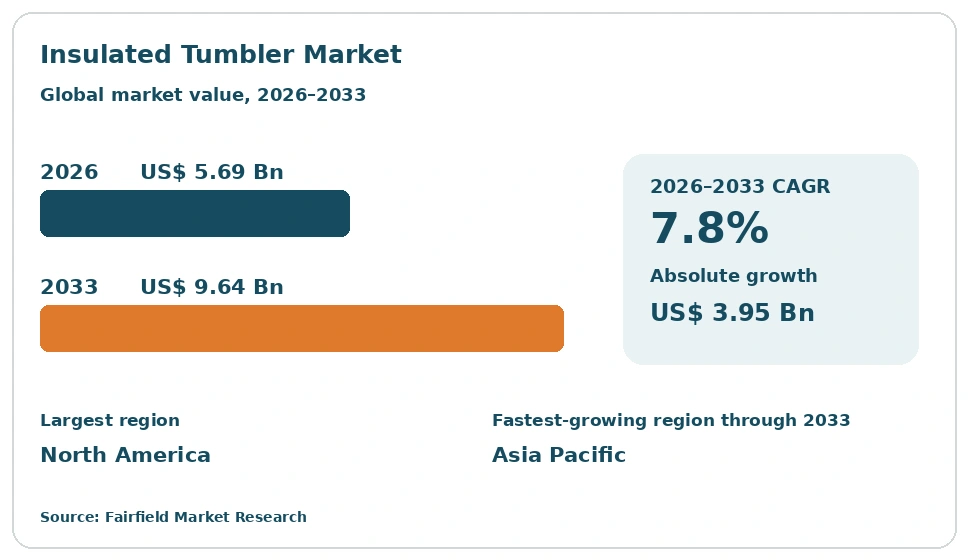
The global insulated tumbler market size is expected to be valued at US$ 5.69 billion in 2026 and projected to reach US$ 9.64 billion by 2033, growing at a CAGR of 7.8% between 2026 and 2033.
Between 2020 and 2025, the market grew at a CAGR of about 8.0%, rising from roughly US$ 3.6 billion to about US$ 5.3 billion, as viral social media trends turned large tumblers into fashion accessories, more people carried their own drinks to work, school, and the gym, and consumers cut back on single-use cups and plastic bottles. The insulated tumbler market covers cups and travel tumblers, usually made from double-wall vacuum-insulated stainless steel, that keep drinks cold or hot for many hours. Popular designs include large handled tumblers with straws, wine tumblers, travel coffee tumblers, and kids’ tumblers, with lids such as flip-straw, sliding, and screw-on designs. Tumblers are sold through mass retailers, sporting goods stores, specialty stores, brand websites, and online marketplaces. In February 2026, Stanley 1913 launched its Vitalize collection, expanding beyond tumblers into shaker bottles and bags.
Key Report Takeaways
- By Material: Stainless Steel held about 78% share in 2025, while Ceramic-Coated Tumblers are projected to expand at a 9.0% CAGR through 2033, driven by demand for clean taste, no metallic flavor, easy cleaning, and premium designs for coffee and other hot drinks.
- By Capacity: 501-1000 ml held about 48% share in 2025, while Above 1000 ml is projected to expand at a 9.1% CAGR through 2033, driven by the popularity of large handled tumblers that fit car cup holders and support daily hydration goals for consumers.
- By Distribution Channel: Supermarkets and Hypermarkets held about 38% share in 2025, while Online Retail is projected to expand at a 9.6% CAGR through 2033, driven by limited-edition color drops, social media marketing, personalization options, and fast home delivery from marketplaces and brands.
- By Region: North America held about 40% share in 2025, while Asia Pacific is projected to expand at a 9.3% CAGR through 2033, driven by rising café culture, growing outdoor activity, and strong online sales in China, Japan, and South Korea.
Global Insulated Tumbler Market Trends and Insights
Drivers Impact Analysis
Two drivers carry the strongest influence on insulated tumbler market demand during the forecast period.
| Driver | Impact on CAGR Forecast | Geographic Relevance | Impact Timeline |
| Hydration habits and social media fashion trends | High | Global | Long term (≥4 years) |
| Sustainability and reduction of single-use cups | Medium | North America, Europe, Asia Pacific | Medium term (2-4 years) |
Hydration and Style Trends Are Driving the Insulated Tumbler Market
Hydration habits and social media fashion trends are the strongest driver of the insulated tumbler market. Tumblers have become everyday accessories.
The mechanism is that health-focused consumers carry water throughout the day to meet hydration goals, and large tumblers make it easy to keep drinks cold for hours at work, school, the gym, and in the car. Social media videos, influencers, and celebrity collaborations turned tumblers such as the Stanley 1913 Quencher into must-have items, with limited-edition colors selling out within hours. Many consumers now own several tumblers to match outfits, seasons, or activities. Brands release new colors and designs every few weeks to keep interest high, and collaborations with musicians, athletes, and fashion brands attract new buyers. Gifting during holidays, birthdays, and graduations adds demand. These trends create strong, repeat purchases worldwide.
Sustainability Is Expanding the Insulated Tumbler Market
Sustainability and reduction of single-use cups are expanding the insulated tumbler market. Consumers want to cut plastic waste.
The cause is growing concern about plastic bottles, disposable coffee cups, and straws that end up in landfills and oceans. Many governments in Europe, North America, and Asia Pacific have introduced bans, fees, or targets to reduce single-use plastics, and some cities require cafés to accept reusable cups. Coffee chains offer discounts for customers who bring their own tumblers. Corporate sustainability programs give branded tumblers to employees and event guests. Insulated stainless steel tumblers last for years and can be recycled at the end of their life, and some brands now use recycled stainless steel. Schools and universities encourage refill stations. These trends support steady long-term demand.
Restraints Impact Analysis
Two restraints limit how quickly the insulated tumbler market grows.
| Restraint | Impact on CAGR Forecast | Geographic Relevance | Impact Timeline |
| Fading trends and market saturation | High | North America, Europe | Medium term (2-4 years) |
| Low-cost copies and safety concerns | Medium | Global | Long term (≥4 years) |
Fading Trends Slow the Insulated Tumbler Market
Fading trends and market saturation slow the insulated tumbler market. Many households already own several tumblers.
The problem is that the viral boom of the early 2020s pulled forward a large amount of demand, especially in the United States, and many consumers now own more tumblers than they need. Fashion trends move quickly, and the most popular brand or style can change within a season, as shown by competition between Stanley 1913, Owala, and YETI. Brands must spend heavily on new colors, collaborations, and marketing to keep sales growing, and discounting can hurt brand value. Some consumers have also criticized overconsumption and collecting large numbers of tumblers, which goes against the sustainability message. Retailers can face excess inventory when trends cool. These factors make growth less predictable.
Low-Cost Copies Restrict the Insulated Tumbler Market
Low-cost copies and safety concerns restrict the insulated tumbler market. Cheap alternatives are widely available.
The constraint is that stainless steel tumblers are relatively easy to manufacture, and many low-cost makers, mostly in China, sell look-alike products through online marketplaces and discount stores at a fraction of the price of leading brands. Counterfeit products also copy famous designs and logos, which can hurt brand reputation. Safety and quality concerns affect the category, including questions about lead used to seal the vacuum layer at the base of some tumblers and product recalls involving lids. In December 2024, Stanley 1913 recalled about 2.6 million travel mugs because lids could detach and cause burns. These issues push brands to invest in testing and communication and limit premium pricing.
Market Opportunities
Personalization and Premium Designs Open a Fast-Growth Revenue Pool
Personalization and premium designs open a fast-growth revenue pool. Consumers want tumblers that express their style.
The opportunity comes from strong demand for custom engraving, names, logos, sports team designs, and limited-edition collaborations. Brands are working with musicians, athletes, and fashion labels, such as Stanley 1913’s collaboration with KAROL G in March 2026, to create collectible products that sell out quickly. Premium features such as ceramic interior coatings, leak-proof lids, magnetic sliders, and accessories like straw caps and handles add value and encourage repeat purchases. Corporate gifting and promotional products for companies, schools, and events are also growing. Brands that combine strong design, fast product releases, personalization tools, and community marketing can win premium pricing and loyal customers across many different age groups and countries.
Asia Pacific and New Channels Create a Growth Revenue Pool
Asia Pacific and new channels create a growth revenue pool. Tumbler culture is spreading worldwide.
The opportunity reflects strong growth in coffee shop culture, outdoor recreation, and fitness in China, Japan, South Korea, India, Australia, and Indonesia, where younger consumers follow global social media trends. Japan is home to established brands such as Zojirushi, Thermos, and Tiger, while South Korea has a strong café tumbler culture. Coffee chains sell seasonal tumblers that attract collectors. E-commerce platforms, live-stream shopping, and social commerce help brands reach new buyers quickly. Global brands are expanding international distribution, and Stanley 1913 has made international growth a priority. Companies that localize designs, sizes, and marketing can capture strong growth in these large and fast-changing markets.
Segment Analysis
By Material: Stainless Steel Leads While Ceramic-Coated Tumblers Grow Fastest
Stainless Steel held about 78% share in 2025. Double-wall, vacuum-insulated stainless steel tumblers keep drinks cold or hot for many hours, resist rust and dents, and last for years, making them the standard choice for leading brands. Many use food-grade 18/8 stainless steel, and some brands now use recycled steel to support sustainability goals.
Ceramic-Coated Tumblers are the fastest-growing material, expanding at a 9.0% CAGR through 2033. A thin ceramic coating inside the stainless steel body prevents metallic taste, resists stains and odors, and is popular for coffee, tea, and flavored drinks. Plastic, Glass, and Other Materials form further segments, mostly in lower-cost and specialty designs. For the market, ceramic-coated growth supports premium pricing.
By Capacity: 501-1000 ml Leads While Above 1000 ml Grows Fastest
501-1000 ml held about 48% share in 2025. Tumblers in the 20 to 32 ounce range are popular for daily use at work, school, and the gym because they hold enough liquid without being too heavy. Many classic tumblers and travel mugs fall in this range, and they are widely used for coffee, tea, smoothies, and water by commuters and students.
Above 1000 ml is the fastest-growing capacity, expanding at a 9.1% CAGR through 2033. Large 40-ounce and bigger handled tumblers, popularized by viral trends, fit in car cup holders and help users track daily water intake. Up to 500 ml forms another segment, including kids’ tumblers and coffee cups. For the market, large-tumbler growth lifts average selling prices and supports sales of accessories such as straw caps, boots, and handles.
By Distribution Channel: Supermarkets and Hypermarkets Lead While Online Retail Grows Fastest
Supermarkets and Hypermarkets held about 38% share in 2025. Mass retailers and large chain stores sell tumblers from leading brands and private labels, often with exclusive colors that draw shoppers to stores. Wide reach and impulse buying support sales, and seasonal displays during holidays and back-to-school periods drive large volumes.
Online Retail is the fastest-growing channel, expanding at a 9.6% CAGR through 2033. Brand websites and marketplaces offer full color ranges, limited drops, personalization, and fast delivery, and social media links drive direct purchases. Specialty Stores and Other Channels, including sporting goods stores and coffee chains, form further segments. For the market, online growth supports direct-to-consumer brands, gives companies valuable customer data, and helps smaller brands reach buyers without large retail contracts.
Geography Analysis
Which Region Is Leading the Insulated Tumbler Market?
North America is leading the insulated tumbler market with about 40% share in 2025. The United States is the center of the tumbler trend, driven by social media, large drink sizes, car culture, and strong outdoor and sports participation. Stanley 1913, YETI, Owala, Hydro Flask, Simple Modern, and RTIC are based in the region, and Stanley 1913 holds an estimated 30% of the United States market. Mass retailers and sporting goods stores carry wide ranges. Key barriers include market saturation and intense competition. One change shaping the region is rapid brand rivalry among leading lifestyle brands.
Europe Shapes the Insulated Tumbler Market Through Sustainability Rules
Europe is a major insulated tumbler market. The United Kingdom, Germany, France, the Netherlands, Italy, and Spain have growing demand for reusable cups and bottles, supported by strict rules on single-use plastics and cafés that reward customers who bring their own cups. European consumers often prefer smaller tumblers and bottles than North American buyers. Brands such as Chilly’s and 24Bottles compete with global brands. Key barriers include high competition from reusable bottles and price sensitivity. One opportunity is eco-friendly designs with recycled materials, supported by strong consumer interest in sustainable, long-lasting products.
Which Region Is Growing Fastest in the Insulated Tumbler Market?
Asia Pacific is the fastest-growing insulated tumbler market, expanding at a 9.3% CAGR through 2033. China is the largest producer of stainless steel tumblers and a fast-growing consumer market, with strong online and live-stream sales. Japan has long-established brands such as Zojirushi, Thermos, and Tiger, while South Korea has a strong café tumbler culture. India, Australia, and Indonesia show rising demand from young, urban consumers. Key barriers include low-cost competition. One change shaping the region is fast growth in social commerce and live-stream shopping, which helps new brands reach young buyers.
Latin America Grows the Insulated Tumbler Market Through Social Media Trends
Latin America is a growing insulated tumbler market. Brazil and Mexico lead demand, supported by warm climates, strong social media use, and growing interest in global lifestyle brands. Stanley 1913 has run marketing events in Brazil, including a beach activation in Rio de Janeiro, and its partnership with KAROL G, a Colombian singer, connects with fans in the region. Colombia, Chile, and Argentina add demand. Key barriers include high import prices and currency swings. One opportunity is affordable local brands and online sales, supported by influencer marketing and growing outdoor and fitness activity in large cities.
Middle East & Africa Builds the Insulated Tumbler Market Through Hot Climates
Middle East & Africa is an emerging insulated tumbler market. Saudi Arabia, the United Arab Emirates, and Qatar have very hot climates where keeping drinks cold is important, along with strong coffee culture, shopping malls, and online retail. Global brands are expanding through regional retailers and e-commerce platforms. South Africa, Egypt, and Nigeria show rising demand from urban consumers. Key barriers include price sensitivity and counterfeit products. One opportunity is premium tumblers sold through malls and online platforms, supported by gifting traditions, growing tourism, and rising outdoor and sports activity among young people across the region.
Competitive Landscape
The insulated tumbler market is moderately fragmented. Stanley 1913, YETI, Owala, Hydro Flask, and Thermos are leading players, while Zojirushi, Tiger Corporation, Contigo, RTIC Outdoors, Simple Modern, Corkcicle, and Klean Kanteen compete strongly. A small number of lifestyle brands capture a large share of premium sales in North America, while established Japanese brands lead in parts of Asia Pacific. Private-label products from large retailers and many low-cost online sellers compete on price.
Companies compete on brand image, design, colors, insulation performance, lid features, durability, price, personalization, and social media presence. Fast product releases, limited-edition drops, and collaborations with celebrities, sports teams, and fashion brands keep customers engaged. Strong relationships with mass retailers and sporting goods chains matter, while direct-to-consumer websites give brands higher margins and customer data. Product safety and quality testing are growing priorities.
Strategic moves show how competition is changing. In December 2024, Stanley 1913 recalled about 2.6 million travel mugs, showing quality risks. In February 2026, it launched the Vitalize collection of bags and shaker bottles, and in March 2026, it released a collection with KAROL G. YETI and Owala continue to win customers with new colors and designs.
Three themes shape vendor strategy. First, brands are expanding beyond tumblers into bottles, bags, coolers, and food storage to become lifestyle brands. Second, they are investing in collaborations, personalization, and online sales. Third, they are growing internationally, especially in Europe, Asia Pacific, and Latin America.
Insulated Tumbler Market Industry Leaders
- Stanley 1913
- YETI
- Owala
- Hydro Flask
- Thermos
Recent Industry Developments
- March 2026: Stanley 1913 partnered with singer KAROL G to launch a limited-edition Quencher collection for festival season - shows the role of celebrity collaborations in the insulated tumbler market.
- February 2026: Stanley 1913 launched its Vitalize collection of shaker bottles, totes, and backpacks - expands the brand beyond tumblers into a wider lifestyle range and intensifies rivalry with YETI.
- December 2024: Stanley 1913 recalled about 2.6 million travel mugs because lids could detach and cause burns - highlights safety and quality pressures facing drinkware brands.
Companies Covered in the Report
- Stanley 1913
- YETI
- Owala
- Hydro Flask
- Thermos
- Zojirushi
- Tiger Corporation
- Contigo
- RTIC Outdoors
- Simple Modern
- Corkcicle
- Klean Kanteen
Insulated Tumbler Market Report Scope
This report covers the insulated tumbler market, including stainless steel, ceramic-coated, plastic, glass, and other tumblers in capacities up to 500 ml, 501-1000 ml, and above 1000 ml, sold through supermarkets and hypermarkets, online retail, specialty stores, and other channels. The base year is 2025, and the forecast period runs from 2026 to 2033. All values are expressed in US$ Billion.
| Material | Stainless Steel, Ceramic-Coated, Plastic, Glass, Other Materials |
| Capacity | Up to 500 ml, 501-1000 ml, Above 1000 ml |
| Distribution Channel | Supermarkets and Hypermarkets, Online Retail, Specialty Stores, Other Channels |
| Regions | North America, Europe, Asia Pacific, Latin America, Middle East & Africa |
1. Executive Summary
1.1 Insulated Tumbler Market Snapshot
1.2 Future Projections
1.3 Key Market Trends
1.4 Regional Snapshot
2. Market Overview
2.1 Market Definition and Report Scope
2.2 Historical Market Trends
2.3 Market Dynamics
2.3.1 Drivers
2.3.1.1 Hydration and Style Trends Are Driving the Insulated Tumbler Market
2.3.1.2 Sustainability Is Expanding the Insulated Tumbler Market
2.3.2 Restraints
2.3.2.1 Fading Trends Slow the Insulated Tumbler Market
2.3.2.2 Low-Cost Copies Restrict the Insulated Tumbler Market
2.3.3 Market Opportunities
2.3.3.1 Personalization and Premium Designs Open a Fast-Growth Revenue Pool
2.3.3.2 Asia Pacific and New Channels Create a Growth Revenue Pool
3. Global Insulated Tumbler Market Outlook, 2020–2033
3.1 Global Insulated Tumbler Market Outlook, by Material, Value (US$ Billion), 2020–2033
3.1.1 Stainless Steel
3.1.2 Ceramic-Coated
3.1.3 Plastic
3.1.4 Glass
3.1.5 Other Materials
3.2 Global Insulated Tumbler Market Outlook, by Capacity, Value (US$ Billion), 2020–2033
3.2.1 Up to 500 ml
3.2.2 501-1000 ml
3.2.3 Above 1000 ml
3.3 Global Insulated Tumbler Market Outlook, by Distribution Channel, Value (US$ Billion), 2020–2033
3.3.1 Supermarkets and Hypermarkets
3.3.2 Online Retail
3.3.3 Specialty Stores
3.3.4 Other Channels
3.4 Global Insulated Tumbler Market Outlook, by Region, Value (US$ Billion), 2020–2033
3.4.1 North America
3.4.2 Europe
3.4.3 Asia Pacific
3.4.4 Latin America
3.4.5 Middle East & Africa
4. North America Insulated Tumbler Market Outlook, 2020–2033
4.1 North America Insulated Tumbler Market Outlook, by Material, Value (US$ Billion), 2020–2033
4.1.1 Stainless Steel
4.1.2 Ceramic-Coated
4.1.3 Plastic
4.1.4 Glass
4.1.5 Other Materials
4.2 North America Insulated Tumbler Market Outlook, by Capacity, Value (US$ Billion), 2020–2033
4.2.1 Up to 500 ml
4.2.2 501-1000 ml
4.2.3 Above 1000 ml
4.3 North America Insulated Tumbler Market Outlook, by Distribution Channel, Value (US$ Billion), 2020–2033
4.3.1 Supermarkets and Hypermarkets
4.3.2 Online Retail
4.3.3 Specialty Stores
4.3.4 Other Channels
4.4 North America Insulated Tumbler Market Outlook, by Country, Value (US$ Billion), 2020–2033
4.4.1 United States Insulated Tumbler Market Outlook, by Material, 2020–2033
4.4.2 United States Insulated Tumbler Market Outlook, by Capacity, 2020–2033
4.4.3 United States Insulated Tumbler Market Outlook, by Distribution Channel, 2020–2033
5. Europe Insulated Tumbler Market Outlook, 2020–2033
5.1 Europe Insulated Tumbler Market Outlook, by Material, Value (US$ Billion), 2020–2033
5.1.1 Stainless Steel
5.1.2 Ceramic-Coated
5.1.3 Plastic
5.1.4 Glass
5.1.5 Other Materials
5.2 Europe Insulated Tumbler Market Outlook, by Capacity, Value (US$ Billion), 2020–2033
5.2.1 Up to 500 ml
5.2.2 501-1000 ml
5.2.3 Above 1000 ml
5.3 Europe Insulated Tumbler Market Outlook, by Distribution Channel, Value (US$ Billion), 2020–2033
5.3.1 Supermarkets and Hypermarkets
5.3.2 Online Retail
5.3.3 Specialty Stores
5.3.4 Other Channels
5.4 Europe Insulated Tumbler Market Outlook, by Country, Value (US$ Billion), 2020–2033
5.4.1 United Kingdom Insulated Tumbler Market Outlook, by Material, 2020–2033
5.4.2 United Kingdom Insulated Tumbler Market Outlook, by Capacity, 2020–2033
5.4.3 United Kingdom Insulated Tumbler Market Outlook, by Distribution Channel, 2020–2033
5.4.4 Germany Insulated Tumbler Market Outlook, by Material, 2020–2033
5.4.5 Germany Insulated Tumbler Market Outlook, by Capacity, 2020–2033
5.4.6 Germany Insulated Tumbler Market Outlook, by Distribution Channel, 2020–2033
5.4.7 France Insulated Tumbler Market Outlook, by Material, 2020–2033
5.4.8 France Insulated Tumbler Market Outlook, by Capacity, 2020–2033
5.4.9 France Insulated Tumbler Market Outlook, by Distribution Channel, 2020–2033
5.4.10 Netherlands Insulated Tumbler Market Outlook, by Material, 2020–2033
5.4.11 Netherlands Insulated Tumbler Market Outlook, by Capacity, 2020–2033
5.4.12 Netherlands Insulated Tumbler Market Outlook, by Distribution Channel, 2020–2033
5.4.13 Italy Insulated Tumbler Market Outlook, by Material, 2020–2033
5.4.14 Italy Insulated Tumbler Market Outlook, by Capacity, 2020–2033
5.4.15 Italy Insulated Tumbler Market Outlook, by Distribution Channel, 2020–2033
5.4.16 Spain Insulated Tumbler Market Outlook, by Material, 2020–2033
5.4.17 Spain Insulated Tumbler Market Outlook, by Capacity, 2020–2033
5.4.18 Spain Insulated Tumbler Market Outlook, by Distribution Channel, 2020–2033
6. Asia Pacific Insulated Tumbler Market Outlook, 2020–2033
6.1 Asia Pacific Insulated Tumbler Market Outlook, by Material, Value (US$ Billion), 2020–2033
6.1.1 Stainless Steel
6.1.2 Ceramic-Coated
6.1.3 Plastic
6.1.4 Glass
6.1.5 Other Materials
6.2 Asia Pacific Insulated Tumbler Market Outlook, by Capacity, Value (US$ Billion), 2020–2033
6.2.1 Up to 500 ml
6.2.2 501-1000 ml
6.2.3 Above 1000 ml
6.3 Asia Pacific Insulated Tumbler Market Outlook, by Distribution Channel, Value (US$ Billion), 2020–2033
6.3.1 Supermarkets and Hypermarkets
6.3.2 Online Retail
6.3.3 Specialty Stores
6.3.4 Other Channels
6.4 Asia Pacific Insulated Tumbler Market Outlook, by Country, Value (US$ Billion), 2020–2033
6.4.1 China Insulated Tumbler Market Outlook, by Material, 2020–2033
6.4.2 China Insulated Tumbler Market Outlook, by Capacity, 2020–2033
6.4.3 China Insulated Tumbler Market Outlook, by Distribution Channel, 2020–2033
6.4.4 Japan Insulated Tumbler Market Outlook, by Material, 2020–2033
6.4.5 Japan Insulated Tumbler Market Outlook, by Capacity, 2020–2033
6.4.6 Japan Insulated Tumbler Market Outlook, by Distribution Channel, 2020–2033
6.4.7 South Korea Insulated Tumbler Market Outlook, by Material, 2020–2033
6.4.8 South Korea Insulated Tumbler Market Outlook, by Capacity, 2020–2033
6.4.9 South Korea Insulated Tumbler Market Outlook, by Distribution Channel, 2020–2033
6.4.10 India Insulated Tumbler Market Outlook, by Material, 2020–2033
6.4.11 India Insulated Tumbler Market Outlook, by Capacity, 2020–2033
6.4.12 India Insulated Tumbler Market Outlook, by Distribution Channel, 2020–2033
6.4.13 Australia Insulated Tumbler Market Outlook, by Material, 2020–2033
6.4.14 Australia Insulated Tumbler Market Outlook, by Capacity, 2020–2033
6.4.15 Australia Insulated Tumbler Market Outlook, by Distribution Channel, 2020–2033
6.4.16 Indonesia Insulated Tumbler Market Outlook, by Material, 2020–2033
6.4.17 Indonesia Insulated Tumbler Market Outlook, by Capacity, 2020–2033
6.4.18 Indonesia Insulated Tumbler Market Outlook, by Distribution Channel, 2020–2033
7. Latin America Insulated Tumbler Market Outlook, 2020–2033
7.1 Latin America Insulated Tumbler Market Outlook, by Material, Value (US$ Billion), 2020–2033
7.1.1 Stainless Steel
7.1.2 Ceramic-Coated
7.1.3 Plastic
7.1.4 Glass
7.1.5 Other Materials
7.2 Latin America Insulated Tumbler Market Outlook, by Capacity, Value (US$ Billion), 2020–2033
7.2.1 Up to 500 ml
7.2.2 501-1000 ml
7.2.3 Above 1000 ml
7.3 Latin America Insulated Tumbler Market Outlook, by Distribution Channel, Value (US$ Billion), 2020–2033
7.3.1 Supermarkets and Hypermarkets
7.3.2 Online Retail
7.3.3 Specialty Stores
7.3.4 Other Channels
7.4 Latin America Insulated Tumbler Market Outlook, by Country, Value (US$ Billion), 2020–2033
7.4.1 Brazil Insulated Tumbler Market Outlook, by Material, 2020–2033
7.4.2 Brazil Insulated Tumbler Market Outlook, by Capacity, 2020–2033
7.4.3 Brazil Insulated Tumbler Market Outlook, by Distribution Channel, 2020–2033
7.4.4 Mexico Insulated Tumbler Market Outlook, by Material, 2020–2033
7.4.5 Mexico Insulated Tumbler Market Outlook, by Capacity, 2020–2033
7.4.6 Mexico Insulated Tumbler Market Outlook, by Distribution Channel, 2020–2033
7.4.7 Colombia Insulated Tumbler Market Outlook, by Material, 2020–2033
7.4.8 Colombia Insulated Tumbler Market Outlook, by Capacity, 2020–2033
7.4.9 Colombia Insulated Tumbler Market Outlook, by Distribution Channel, 2020–2033
7.4.10 Chile Insulated Tumbler Market Outlook, by Material, 2020–2033
7.4.11 Chile Insulated Tumbler Market Outlook, by Capacity, 2020–2033
7.4.12 Chile Insulated Tumbler Market Outlook, by Distribution Channel, 2020–2033
7.4.13 Argentina Insulated Tumbler Market Outlook, by Material, 2020–2033
7.4.14 Argentina Insulated Tumbler Market Outlook, by Capacity, 2020–2033
7.4.15 Argentina Insulated Tumbler Market Outlook, by Distribution Channel, 2020–2033
8. Middle East & Africa Insulated Tumbler Market Outlook, 2020–2033
8.1 Middle East & Africa Insulated Tumbler Market Outlook, by Material, Value (US$ Billion), 2020–2033
8.1.1 Stainless Steel
8.1.2 Ceramic-Coated
8.1.3 Plastic
8.1.4 Glass
8.1.5 Other Materials
8.2 Middle East & Africa Insulated Tumbler Market Outlook, by Capacity, Value (US$ Billion), 2020–2033
8.2.1 Up to 500 ml
8.2.2 501-1000 ml
8.2.3 Above 1000 ml
8.3 Middle East & Africa Insulated Tumbler Market Outlook, by Distribution Channel, Value (US$ Billion), 2020–2033
8.3.1 Supermarkets and Hypermarkets
8.3.2 Online Retail
8.3.3 Specialty Stores
8.3.4 Other Channels
8.4 Middle East & Africa Insulated Tumbler Market Outlook, by Country, Value (US$ Billion), 2020–2033
8.4.1 Saudi Arabia Insulated Tumbler Market Outlook, by Material, 2020–2033
8.4.2 Saudi Arabia Insulated Tumbler Market Outlook, by Capacity, 2020–2033
8.4.3 Saudi Arabia Insulated Tumbler Market Outlook, by Distribution Channel, 2020–2033
8.4.4 United Arab Emirates Insulated Tumbler Market Outlook, by Material, 2020–2033
8.4.5 United Arab Emirates Insulated Tumbler Market Outlook, by Capacity, 2020–2033
8.4.6 United Arab Emirates Insulated Tumbler Market Outlook, by Distribution Channel, 2020–2033
8.4.7 Qatar Insulated Tumbler Market Outlook, by Material, 2020–2033
8.4.8 Qatar Insulated Tumbler Market Outlook, by Capacity, 2020–2033
8.4.9 Qatar Insulated Tumbler Market Outlook, by Distribution Channel, 2020–2033
8.4.10 South Africa Insulated Tumbler Market Outlook, by Material, 2020–2033
8.4.11 South Africa Insulated Tumbler Market Outlook, by Capacity, 2020–2033
8.4.12 South Africa Insulated Tumbler Market Outlook, by Distribution Channel, 2020–2033
8.4.13 Egypt Insulated Tumbler Market Outlook, by Material, 2020–2033
8.4.14 Egypt Insulated Tumbler Market Outlook, by Capacity, 2020–2033
8.4.15 Egypt Insulated Tumbler Market Outlook, by Distribution Channel, 2020–2033
8.4.16 Nigeria Insulated Tumbler Market Outlook, by Material, 2020–2033
8.4.17 Nigeria Insulated Tumbler Market Outlook, by Capacity, 2020–2033
8.4.18 Nigeria Insulated Tumbler Market Outlook, by Distribution Channel, 2020–2033
9. Competitive Landscape
9.1 Insulated Tumbler Market Industry Leaders
9.2 Recent Industry Developments
9.3 Company Profiles
9.3.1 Stanley 1913
9.3.2 YETI
9.3.3 Owala
9.3.4 Hydro Flask
9.3.5 Thermos
9.3.6 Zojirushi
9.3.7 Tiger Corporation
9.3.8 Contigo
9.3.9 RTIC Outdoors
9.3.10 Simple Modern
9.3.11 Corkcicle
9.3.12 Klean Kanteen
10. Appendix
10.1 Research Methodology
10.2 Report Assumptions
10.3 Acronyms and Abbreviations
| Material | Stainless Steel, Ceramic-Coated, Plastic, Glass, Other Materials |
| Capacity | Up to 500 ml, 501-1000 ml, Above 1000 ml |
| Distribution Channel | Supermarkets and Hypermarkets, Online Retail, Specialty Stores, Other Channels |
| Regions | North America, Europe, Asia Pacific, Latin America, Middle East & Africa |
Our Research Methodology
Considering the volatility of business today, traditional approaches to strategizing a game plan can be unfruitful if not detrimental. True ambiguity is no way to determine a forecast. A myriad of predetermined factors must be accounted for such as the degree of risk involved, the magnitude of circumstances, as well as conditions or consequences that are not known or unpredictable. To circumvent binary views that cast uncertainty, the application of market research intelligence to strategically posture, move, and enable actionable outcomes is necessary.
View Methodology
Quality Assured
Rigorous Validation Process

Confidentiality Assured
End-to-end Data Security

Custom Research Services
Tailored To Your Objectives
FAQs
The market is valued at US$ 5.69 billion in 2026, led by stainless steel tumblers, 501-1000 ml sizes, and North America.
The market is projected to reach US$ 9.64 billion by 2033, growing at a 7.8% CAGR and adding US$ 3.95 billion.
Online Retail is growing fastest at a 9.6% CAGR through 2033, driven by limited color drops, personalization, and social media marketing.
Asia Pacific is growing fastest at a 9.3% CAGR through 2033, driven by café culture and strong online sales in China.
North America holds the largest share at about 40% in 2025, supported by strong social media trends and leading brands.
Related Reports
Bathroom Renovation Market Size, Share, Insights, Competitive Landscape, and Forecast 2026 to 2033
The global bathroom renovation market is valued at US$433.43 billion in 2026, reaching US$574.21 billion by 2033, growing at a 4.1% CAGR
Baby Wipes Market Size, Share, Insights, Competitive Landscape, and Forecast 2026 to 2033
The global baby wipes market is valued at US$6.64 billion in 2026, reaching US$11.29 billion by 2033, growing at a 7.9% CAGR
Baby Safety Products Market Size, Share, Insights, Competitive Landscape, and Forecast 2026 to 2033
Explore the baby safety products market outlook for 2026–2033, covering car seats, monitors, age groups, sales channels, regions, and key companies.
FDM Candle Market Size, Share, Insights, Competitive Landscape, and Forecast 2026 to 2033
Explore the FDM candle market outlook for 2026–2033, with product formats, wax types, retail trends, regional demand, and competitive insights.
Aloe Vera Gel Market Size, Share, Insights, Competitive Landscape, and Forecast 2026 to 2033
Explore the aloe vera gel market outlook for 2026–2033, including organic grades, application trends, regional insights, and competitive analysis.
Food Waste Disposers Market Size, Share, Insights, Competitive Landscape, and Forecast 2026 to 2033
The global food waste disposers market is valued at US$3.2 billion in 2026, reaching US$5.1 billion by 2033, growing at a 6.9% CAGR