



Microwave Devices Market
Microwave Devices Market Size, Share, Insights, Competitive Landscape, and Forecast 2026 to 2033
Microwave Devices Market Size and Trend Analysis
What Is Driving Microwave Devices Market Growth Through 2033?
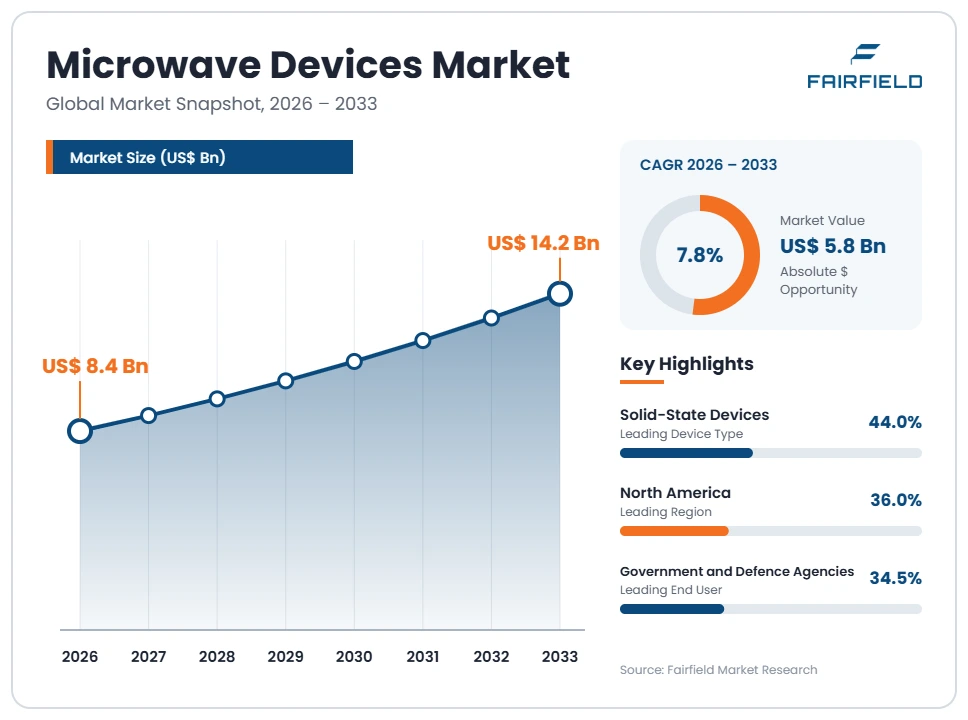
The global Microwave Devices market size is expected to be valued at US$ 8.4 billion in 2026 and projected to reach US$ 14.2 billion by 2033, growing at a CAGR of 7.8% between 2026 and 2033. Growth rests on three durable demand pools. Telecom operators keep densifying networks and adding higher frequency capacity. Satellite constellation builders need efficient transmit chains in large volumes. Defence agencies continue long-cycle radar and electronic systems renewal. Gallium nitride content is displacing older silicon and tube sockets, lifting average selling prices per unit. The absolute dollar opportunity across the period stands at US$ 5.8 billion, against historical growth of 5.6% between 2020 and 2025.
Key Report Takeaways
- By Device Type: Solid-state devices led with 44.0% share in 2026, while antennas are projected to expand at a 9.6% CAGR through 2033, driven by active electronically steered array adoption across commercial and government platforms.
- By Frequency Band: L and S band led with 29.5% share in 2026, while Ka band and above is projected to expand at a 10.8% CAGR through 2033, driven by high-throughput satellite payload capacity planning.
- By Application: Telecommunications infrastructure led with 33.0% share in 2026, while satellite communications is projected to expand at a 10.2% CAGR through 2033, driven by low earth orbit constellation ground and space segment build-out.
- By End User: Government and defence agencies led with 34.5% share in 2026, while commercial and civil operators are projected to expand at a 9.5% CAGR through 2033, driven by private network and fixed wireless access rollouts.
- By Geography: North America led with 36.0% share in 2026 across North America, Europe, Asia Pacific, Latin America and Middle East & Africa, while Asia Pacific is projected to expand at a 9.6% CAGR through 2033, driven by regional semiconductor capacity additions.
Global Microwave Devices Market Trends and Insights
Market Growth Drivers
Network Densification Multiplies Transmit Chains Per Site
Telecom infrastructure spending is the largest single pull on microwave device demand. Operators add small cells, multi-antenna radios and higher capacity backhaul links across dense urban areas. Each new radio unit carries more transmit paths than the equipment it replaces. That multiplies the count of amplifiers, filters, switches and antenna elements per site.
Fixed wireless access deployments extend this pattern beyond traditional mobile coverage planning. Operators in markets with limited fibre reach treat wireless broadband as a primary access route. Private campus networks in ports, mines and factories add a second wave of radio demand. Component suppliers see steady unit volume growth rather than a single procurement spike. Long operator upgrade cycles also give manufacturers visible order books for capacity planning across multiple years. Backhaul link refresh in mature markets sustains demand even where new site construction slows.
Satellite Constellation Build-Out Lifts High-Volume Component Orders
Satellite programmes have shifted microwave component buying from low-volume custom builds toward repeatable production runs. Constellation operators order identical payload hardware in hundreds of units rather than ones and twos. Ground station networks and user terminals add a second, larger volume stream behind every satellite launched. This change rewards suppliers that can hold yield and cost stable at scale.
The shift also changes the technical mix buyers ask for. Power efficiency matters more when solar budgets and thermal limits cap payload design margins. Compact, highly integrated transmit modules replace discrete assemblies to save mass and volume. Terminal makers push for low-cost phased array elements that suit consumer price points. Microwave device suppliers that already serve automotive or handset volumes carry a manufacturing advantage into these programmes. Ground gateway networks expanding alongside each constellation create parallel demand for high-power amplifier hardware.
Market Restraints
Long Qualification Cycles Delay Revenue From New Designs
Qualification timelines hold back how fast microwave device suppliers convert design wins into revenue. Space, defence and medical buyers require extended reliability testing before a part enters production hardware. Screening, radiation assessment and lifetime data can add years between first sample and first volume order. Suppliers carry engineering cost through that period without matching shipments.
Export licensing adds a second layer of delay for higher performance parts. Many amplifier, tube and phased array components sit under national control regimes that restrict cross-border movement. Buyers plan dual sourcing around those rules, which narrows the addressable base for any single supplier. Smaller manufacturers often lack the compliance staff to pursue regulated programmes at all. The combined effect slows how quickly new technology reaches broad commercial use. Programme schedule slips at the customer end push supplier revenue recognition further into later years.
Compound Semiconductor Supply and Cost Pressure Cap Scale
Compound semiconductor supply constrains how fast solid-state microwave output can grow. Gallium nitride and gallium arsenide wafers run on smaller diameters and lower volumes than mainstream silicon. Foundry capacity for these processes sits with a limited number of qualified sites worldwide. Device makers compete for the same slots that automotive and power electronics buyers also want.
Cost structure compounds the problem at the lower end of the market. Compound semiconductor die remain expensive against silicon alternatives for undemanding frequency and power ranges. Packaging and thermal management add further cost that price-sensitive industrial buyers resist. Vacuum tube products face a parallel issue, with specialised manufacturing skills concentrated in ageing workforces. Both constraints limit how aggressively suppliers can chase volume applications on price alone. Capacity additions announced by foundries take several years to reach qualified production output.
Market Opportunities
Gallium Nitride Replacement of Legacy Tube and Silicon Content
Gallium nitride substitution opens a large installed-base replacement opportunity for component suppliers. Many radar, broadcast and industrial systems still run on travelling wave tubes or silicon transistors. Solid-state modules offer longer service life, graceful degradation and lower maintenance overhead. Operators replacing ageing equipment now treat solid-state conversion as the default upgrade path.
The commercial value sits in the module rather than the bare device. Suppliers that package amplifiers with control, protection and thermal hardware capture more revenue per socket. Retrofit programmes also create recurring aftermarket demand for spares and refurbishment services. Falling wafer cost steadily extends the power and frequency range where substitution makes economic sense. Manufacturers with both tube and solid-state portfolios can manage that transition without losing existing accounts. Broadcast transmitter and particle accelerator operators represent a further pool of replaceable installed hardware.
Industrial Heating and Medical Platforms Widen Non-Communications Demand
Industrial and medical applications give microwave device suppliers demand that moves independently of telecom capital cycles. Solid-state generators are replacing magnetrons in drying, curing, sterilisation and materials processing equipment. Precise power control and stable frequency output improve process yield in ways tubes cannot match. Equipment builders accept higher component cost where throughput and product consistency improve.
Medical equipment adds a smaller but high-value stream. Ablation systems, diathermy devices and imaging subsystems use controlled microwave energy under tight regulatory oversight. Approval requirements raise the barrier to entry and support more stable supplier relationships. Food processing and chemical plants pursuing electrification targets form a further adjacent pool. Together these segments reduce supplier exposure to the timing risk of large communications infrastructure programmes. Equipment makers in these fields also favour long component supply agreements over spot purchasing.
Segment Analysis
- Which Device Type Holds the Largest Microwave Devices Share?
Solid-state devices held the largest share at 44.0% in 2026, covering power amplifiers, transistors and monolithic microwave integrated circuits. Their position reflects broad use across base stations, satellite payloads, radar front ends and industrial generators. Gallium nitride and gallium arsenide processes now deliver the power density that once required vacuum hardware. Buyers value the reliability, size and maintenance profile that solid-state modules bring.
Antennas form the fastest-growing device type at a 9.6% CAGR through 2033. Demand follows the shift toward electronically steered arrays in satellite terminals, radar and advanced wireless sites. Each array holds many radiating elements and matching transmit paths, which raises component content sharply per system. Vacuum electron devices retain 21.5% share where very high peak power remains necessary. The mix shift moves market value toward integrated assemblies rather than discrete parts.
- Higher Bands Grow Faster While Lower Bands Still Carry Volume
L and S band led the frequency mix with 29.5% share in 2026, supported by mobile networks, air traffic surveillance and weather radar. These bands offer favourable propagation and mature, low-cost component supply. Large installed equipment bases keep replacement demand steady year after year. Industrial heating equipment concentrated around standard allocations adds further volume.
Ka band and above is the fastest-growing category at a 10.8% CAGR through 2033. Satellite operators move to these bands to carry more throughput per spacecraft as spectrum lower down fills. Terrestrial backhaul and short-range wireless links follow the same logic where wide channels are needed. Components at these frequencies demand tighter tolerances and more advanced packaging, raising value per unit. The upward drift supports pricing even where unit volumes stay modest compared with lower bands.
- Which Application Is Growing Fastest in Microwave Devices?
Satellite communications is the fastest-growing application at a 10.2% CAGR through 2033, driven by constellation deployment and ground segment expansion. Each programme consumes payload amplifiers, gateway hardware and large volumes of user terminal components. Falling launch cost has made replenishment cycles shorter and more frequent for operators.
Telecommunications infrastructure remains the largest application with 33.0% share in 2026. Mobile network upgrades, backhaul links and fixed wireless access together generate the highest component volumes. Defence electronics holds 26.0% share through radar, electronic systems and secure communications procurement across multi-year budgets. Industrial heating and processing contributes 11.5% as solid-state generators enter manufacturing lines. Medical equipment adds 6.0% at higher value per unit. The spread across communications, government and industrial buyers gives suppliers useful protection when any single budget cycle slows.
- Commercial Buyers Close the Gap With Government Procurement
Government and defence agencies led end-user demand with 34.5% share in 2026. Multi-year procurement budgets for radar, surveillance and secure communications create predictable, specification-driven orders. These buyers accept higher unit prices for qualified, long-life hardware with assured supply. Space agencies and national research programmes add further demand at the high performance end.
Commercial and civil operators form the fastest-growing group at a 9.5% CAGR through 2033. Telecom carriers, satellite service providers and private network owners are scaling deployments faster than public budgets move. Their buying behaviour favours cost per unit, delivery lead time and supply continuity over bespoke specification. Industrial manufacturers hold 18.5% share as process heating equipment shifts to solid-state sources. The balance between the two leading groups pushes suppliers to run both programme and volume business models.
Geography Analysis
- Which Region Is Leading the Microwave Devices Market?
North America led the market with 36.0% share in 2026, expanding at a 7.0% CAGR through 2033. The United States concentrates defence electronics procurement, satellite manufacturing and compound semiconductor design in one supply base. Canada contributes space subsystems and specialised radar hardware. Sustained federal budgets for radar renewal and space programmes give suppliers long order visibility. Commercial satellite operators headquartered in the region place large, repeatable component orders for payloads and ground stations. Domestic gallium nitride foundry capacity, supported by national semiconductor funding programmes, keeps advanced device production close to the customer base. Export control requirements further favour local sourcing for sensitive applications, which protects regional supplier share.
- Europe Combines Defence Renewal With Specialised Manufacturing
Europe held 23.0% share in 2026 and is set to grow at a 6.8% CAGR through 2033. France, Germany, the United Kingdom and Italy host established radar, tube and microwave subsystem manufacturers. Coordinated defence spending increases across member states have restarted long-delayed radar and electronic systems programmes. The European Space Agency and national space budgets sustain demand for qualified payload components. Regional manufacturers hold strong positions in vacuum electron devices and high-reliability passive hardware. Telecom operators continue steady network upgrades, though at a slower pace than Asia Pacific. Efforts to secure regional semiconductor supply are directing investment toward compound semiconductor pilot lines and packaging capacity.
- Which Region Is Growing Fastest in the Microwave Devices Market?
Asia Pacific is the fastest-growing region at a 9.6% CAGR through 2033, from 29.5% share in 2026. China, Japan, South Korea, India and Taiwan each contribute distinct strengths across the supply chain. Large-scale mobile network build-outs in China and India drive the highest base station component volumes worldwide. Japanese and Korean manufacturers supply advanced passive components, packaging and compound semiconductor materials. Regional satellite programmes and domestic launch capability are expanding payload component demand. Government industrial policy across several countries funds semiconductor fabrication and test capacity directly. Rising defence budgets add radar and electronic systems procurement that was previously served by imports.
- Latin America Builds Coverage Through Operator and Satellite Investment
Latin America accounted for 6.0% share in 2026, growing at a 7.4% CAGR through 2033. Brazil and Mexico lead regional demand through mobile network expansion and spectrum licensing rounds. Wide geographies with limited fibre reach make satellite broadband and fixed wireless access practical coverage tools. Brazilian defence and space programmes support modest domestic radar and subsystem activity. Most microwave components are imported, so currency movement and tariff policy shape buying cycles. Agricultural and food processing industries provide a growing outlet for industrial microwave heating equipment. Operator consolidation in several markets is concentrating purchasing power and supporting larger single orders. Spectrum auctions scheduled across several countries should sustain equipment ordering through the period.
- Middle East & Africa Pairs Defence Spending With Connectivity Gaps
Middle East & Africa held 5.5% share in 2026 and is projected to grow at an 8.0% CAGR through 2033. Gulf states drive demand through sustained defence procurement, air traffic infrastructure and national satellite programmes. Several governments are pursuing local assembly and technology transfer arrangements with established suppliers. Across Africa, limited terrestrial backbone coverage makes satellite capacity and microwave backhaul the practical route to connectivity. Mobile operators continue extending coverage into underserved areas using point-to-point radio links. Oil, gas and mining operations deploy private wireless networks that add industrial radio demand. Infrastructure programmes tied to economic diversification plans support steady multi-year equipment spending.
Competitive Landscape
The market is moderately concentrated, with a small group of broad-line suppliers sitting above a wide base of specialists. Large semiconductor manufacturers hold the strongest positions in solid-state amplifiers and integrated circuits, where scale and process control decide cost. Vacuum electron devices remain the preserve of a handful of long-established producers with hard-to-replicate manufacturing skills. Defence prime contractors occupy a distinct position, building components in-house for their own systems while also selling merchant product. Vertical integration by system builders continues to shift share between merchant suppliers and captive production.
Competition centres on power efficiency, frequency coverage, integration and assured supply rather than price alone. Gallium nitride capability has become a basic requirement, so differentiation now rests on packaging, thermal design and module-level integration. Buyers increasingly award business to suppliers able to deliver tested subassemblies instead of discrete parts. Qualification history for space and defence programmes acts as a durable entry barrier. Newer entrants from consumer wireless and automotive radar bring volume manufacturing discipline that established microwave specialists must answer.
Strategic activity concentrates on securing compound semiconductor capacity, expanding packaging and test facilities, and acquiring module-level design capability. Capacity investment matters because wafer access limits how fast suppliers can convert demand into shipments. Acquisitions that add antenna or subsystem expertise let component makers move up the value chain toward higher-margin assemblies. Partnerships with satellite and telecom equipment builders secure design-in positions years before volume production begins. Competitive direction points toward broader portfolios, closer customer engineering relationships and supply chains that can satisfy national sourcing requirements.
Industry Leaders
- Qorvo, Inc.
- Analog Devices, Inc.
- MACOM Technology Solutions Holdings, Inc.
- Wolfspeed, Inc.
- Teledyne Technologies Incorporated
- Communications & Power Industries LLC
- Thales Group
- L3Harris Technologies, Inc.
- NXP Semiconductors N.V.
- Skyworks Solutions, Inc.
Companies Covered in the Report
- Qorvo, Inc.
- Analog Devices, Inc.
- MACOM Technology Solutions Holdings, Inc.
- Wolfspeed, Inc.
- Teledyne Technologies Incorporated
- Communications & Power Industries LLC
- Thales Group
- L3Harris Technologies, Inc.
- NXP Semiconductors N.V.
- Skyworks Solutions, Inc.
- Infineon Technologies AG
- Mitsubishi Electric Corporation
- Murata Manufacturing Co., Ltd.
- Ampleon Netherlands B.V.
- Richardson Electronics, Ltd.
Microwave Devices Market Report Scope
| Metric | Value |
| Study Period | 2020–2033 |
| Market Size 2026 | US$ 8.4 Billion |
| Market Size 2033 | US$ 14.2 Billion |
| CAGR 2026–2033 | 7.8% |
| Absolute Dollar Opportunity | US$ 5.8 Billion |
| Largest Market | North America (36.0% share in 2026) |
| Fastest-Growing Market | Asia Pacific (9.6% CAGR 2026–2033) |
| Market Concentration | Moderately Concentrated |
| Major Players | Qorvo, Inc., Analog Devices, Inc., MACOM Technology Solutions Holdings, Inc., Wolfspeed, Inc., Teledyne Technologies Incorporated |
Microwave Devices Market Segmentation
- Executive Summary
- Global Microwave Devices Market Snapshot
- Future Projections, 2026–2033
- Key Industry Highlights
- Regional Snapshot
- Market Overview
- Market Definition and Report Scope
- Historical Market Trends
- Market Dynamics
- Drivers
- Restraints
- Market Opportunities
- Global Microwave Devices Market Outlook, 2026–2033
- Global Microwave Devices Market Outlook, by Device Type, Value (US$ Billion), 2026–2033
- Solid-State Devices
- Vacuum Electron Devices
- Passive Components
- Antennas
- Oscillators and Frequency Sources
- Global Microwave Devices Market Outlook, by Frequency Band, Value (US$ Billion), 2026–2033
- L and S Band
- C Band
- X Band
- Ku and K Band
- Ka Band and Above
- Global Microwave Devices Market Outlook, by Application, Value (US$ Billion), 2026–2033
- Telecommunications Infrastructure
- Satellite Communications
- Defence Electronics
- Industrial Heating and Processing
- Medical Equipment
- Scientific and Other
- Global Microwave Devices Market Outlook, by End User, Value (US$ Billion), 2026–2033
- Government and Defence Agencies
- Commercial and Civil Operators
- Industrial Manufacturers
- Healthcare Providers
- Research Institutions
- Global Microwave Devices Market Outlook, by Region, Value (US$ Billion), 2026–2033
- North America
- Europe
- Asia Pacific
- Latin America
- Middle East & Africa
- Global Microwave Devices Market Outlook, by Device Type, Value (US$ Billion), 2026–2033
- North America Microwave Devices Market Outlook, 2026–2033
- North America Microwave Devices Market Outlook, by Device Type, Value (US$ Billion), 2026–2033
- Solid-State Devices
- Vacuum Electron Devices
- Passive Components
- Antennas
- Oscillators and Frequency Sources
- North America Microwave Devices Market Outlook, by Frequency Band, Value (US$ Billion), 2026–2033
- L and S Band
- C Band
- X Band
- Ku and K Band
- Ka Band and Above
- North America Microwave Devices Market Outlook, by Application, Value (US$ Billion), 2026–2033
- Telecommunications Infrastructure
- Satellite Communications
- Defence Electronics
- Industrial Heating and Processing
- Medical Equipment
- Scientific and Other
- North America Microwave Devices Market Outlook, by End User, Value (US$ Billion), 2026–2033
- Government and Defence Agencies
- Commercial and Civil Operators
- Industrial Manufacturers
- Healthcare Providers
- Research Institutions
- North America Microwave Devices Market Outlook, by Country, Value (US$ Billion), 2026–2033
- United States Microwave Devices Market Outlook, by Device Type, 2026–2033
- United States Microwave Devices Market Outlook, by Frequency Band, 2026–2033
- United States Microwave Devices Market Outlook, by Application, 2026–2033
- United States Microwave Devices Market Outlook, by End User, 2026–2033
- Canada Microwave Devices Market Outlook, by Device Type, 2026–2033
- Canada Microwave Devices Market Outlook, by Frequency Band, 2026–2033
- Canada Microwave Devices Market Outlook, by Application, 2026–2033
- Canada Microwave Devices Market Outlook, by End User, 2026–2033
- North America Microwave Devices Market Outlook, by Device Type, Value (US$ Billion), 2026–2033
- Europe Microwave Devices Market Outlook, 2026–2033
- Europe Microwave Devices Market Outlook, by Device Type, Value (US$ Billion), 2026–2033
- Solid-State Devices
- Vacuum Electron Devices
- Passive Components
- Antennas
- Oscillators and Frequency Sources
- Europe Microwave Devices Market Outlook, by Frequency Band, Value (US$ Billion), 2026–2033
- L and S Band
- C Band
- X Band
- Ku and K Band
- Ka Band and Above
- Europe Microwave Devices Market Outlook, by Application, Value (US$ Billion), 2026–2033
- Telecommunications Infrastructure
- Satellite Communications
- Defence Electronics
- Industrial Heating and Processing
- Medical Equipment
- Scientific and Other
- Europe Microwave Devices Market Outlook, by End User, Value (US$ Billion), 2026–2033
- Government and Defence Agencies
- Commercial and Civil Operators
- Industrial Manufacturers
- Healthcare Providers
- Research Institutions
- Europe Microwave Devices Market Outlook, by Country, Value (US$ Billion), 2026–2033
- France Microwave Devices Market Outlook, by Device Type, 2026–2033
- France Microwave Devices Market Outlook, by Frequency Band, 2026–2033
- France Microwave Devices Market Outlook, by Application, 2026–2033
- France Microwave Devices Market Outlook, by End User, 2026–2033
- Germany Microwave Devices Market Outlook, by Device Type, 2026–2033
- Germany Microwave Devices Market Outlook, by Frequency Band, 2026–2033
- Germany Microwave Devices Market Outlook, by Application, 2026–2033
- Germany Microwave Devices Market Outlook, by End User, 2026–2033
- United Kingdom Microwave Devices Market Outlook, by Device Type, 2026–2033
- United Kingdom Microwave Devices Market Outlook, by Frequency Band, 2026–2033
- United Kingdom Microwave Devices Market Outlook, by Application, 2026–2033
- United Kingdom Microwave Devices Market Outlook, by End User, 2026–2033
- Italy Microwave Devices Market Outlook, by Device Type, 2026–2033
- Italy Microwave Devices Market Outlook, by Frequency Band, 2026–2033
- Italy Microwave Devices Market Outlook, by Application, 2026–2033
- Italy Microwave Devices Market Outlook, by End User, 2026–2033
- Europe Microwave Devices Market Outlook, by Device Type, Value (US$ Billion), 2026–2033
- Asia Pacific Microwave Devices Market Outlook, 2026–2033
- Asia Pacific Microwave Devices Market Outlook, by Device Type, Value (US$ Billion), 2026–2033
- Solid-State Devices
- Vacuum Electron Devices
- Passive Components
- Antennas
- Oscillators and Frequency Sources
- Asia Pacific Microwave Devices Market Outlook, by Frequency Band, Value (US$ Billion), 2026–2033
- L and S Band
- C Band
- X Band
- Ku and K Band
- Ka Band and Above
- Asia Pacific Microwave Devices Market Outlook, by Application, Value (US$ Billion), 2026–2033
- Telecommunications Infrastructure
- Satellite Communications
- Defence Electronics
- Industrial Heating and Processing
- Medical Equipment
- Scientific and Other
- Asia Pacific Microwave Devices Market Outlook, by End User, Value (US$ Billion), 2026–2033
- Government and Defence Agencies
- Commercial and Civil Operators
- Industrial Manufacturers
- Healthcare Providers
- Research Institutions
- Asia Pacific Microwave Devices Market Outlook, by Country, Value (US$ Billion), 2026–2033
- China Microwave Devices Market Outlook, by Device Type, 2026–2033
- China Microwave Devices Market Outlook, by Frequency Band, 2026–2033
- China Microwave Devices Market Outlook, by Application, 2026–2033
- China Microwave Devices Market Outlook, by End User, 2026–2033
- Japan Microwave Devices Market Outlook, by Device Type, 2026–2033
- Japan Microwave Devices Market Outlook, by Frequency Band, 2026–2033
- Japan Microwave Devices Market Outlook, by Application, 2026–2033
- Japan Microwave Devices Market Outlook, by End User, 2026–2033
- South Korea Microwave Devices Market Outlook, by Device Type, 2026–2033
- South Korea Microwave Devices Market Outlook, by Frequency Band, 2026–2033
- South Korea Microwave Devices Market Outlook, by Application, 2026–2033
- South Korea Microwave Devices Market Outlook, by End User, 2026–2033
- India Microwave Devices Market Outlook, by Device Type, 2026–2033
- India Microwave Devices Market Outlook, by Frequency Band, 2026–2033
- India Microwave Devices Market Outlook, by Application, 2026–2033
- India Microwave Devices Market Outlook, by End User, 2026–2033
- Taiwan Microwave Devices Market Outlook, by Device Type, 2026–2033
- Taiwan Microwave Devices Market Outlook, by Frequency Band, 2026–2033
- Taiwan Microwave Devices Market Outlook, by Application, 2026–2033
- Taiwan Microwave Devices Market Outlook, by End User, 2026–2033
- Asia Pacific Microwave Devices Market Outlook, by Device Type, Value (US$ Billion), 2026–2033
- Latin America Microwave Devices Market Outlook, 2026–2033
- Latin America Microwave Devices Market Outlook, by Device Type, Value (US$ Billion), 2026–2033
- Solid-State Devices
- Vacuum Electron Devices
- Passive Components
- Antennas
- Oscillators and Frequency Sources
- Latin America Microwave Devices Market Outlook, by Frequency Band, Value (US$ Billion), 2026–2033
- L and S Band
- C Band
- X Band
- Ku and K Band
- Ka Band and Above
- Latin America Microwave Devices Market Outlook, by Application, Value (US$ Billion), 2026–2033
- Telecommunications Infrastructure
- Satellite Communications
- Defence Electronics
- Industrial Heating and Processing
- Medical Equipment
- Scientific and Other
- Latin America Microwave Devices Market Outlook, by End User, Value (US$ Billion), 2026–2033
- Government and Defence Agencies
- Commercial and Civil Operators
- Industrial Manufacturers
- Healthcare Providers
- Research Institutions
- Latin America Microwave Devices Market Outlook, by Country, Value (US$ Billion), 2026–2033
- Brazil Microwave Devices Market Outlook, by Device Type, 2026–2033
- Brazil Microwave Devices Market Outlook, by Frequency Band, 2026–2033
- Brazil Microwave Devices Market Outlook, by Application, 2026–2033
- Brazil Microwave Devices Market Outlook, by End User, 2026–2033
- Mexico Microwave Devices Market Outlook, by Device Type, 2026–2033
- Mexico Microwave Devices Market Outlook, by Frequency Band, 2026–2033
- Mexico Microwave Devices Market Outlook, by Application, 2026–2033
- Mexico Microwave Devices Market Outlook, by End User, 2026–2033
- Latin America Microwave Devices Market Outlook, by Device Type, Value (US$ Billion), 2026–2033
- Middle East & Africa Microwave Devices Market Outlook, 2026–2033
- Middle East & Africa Microwave Devices Market Outlook, by Device Type, Value (US$ Billion), 2026–2033
- Solid-State Devices
- Vacuum Electron Devices
- Passive Components
- Antennas
- Oscillators and Frequency Sources
- Middle East & Africa Microwave Devices Market Outlook, by Frequency Band, Value (US$ Billion), 2026–2033
- L and S Band
- C Band
- X Band
- Ku and K Band
- Ka Band and Above
- Middle East & Africa Microwave Devices Market Outlook, by Application, Value (US$ Billion), 2026–2033
- Telecommunications Infrastructure
- Satellite Communications
- Defence Electronics
- Industrial Heating and Processing
- Medical Equipment
- Scientific and Other
- Middle East & Africa Microwave Devices Market Outlook, by End User, Value (US$ Billion), 2026–2033
- Government and Defence Agencies
- Commercial and Civil Operators
- Industrial Manufacturers
- Healthcare Providers
- Research Institutions
- Middle East & Africa Microwave Devices Market Outlook, by Country and Subregion, Value (US$ Billion), 2026–2033
- Gulf states Microwave Devices Market Outlook, by Device Type, 2026–2033
- Gulf states Microwave Devices Market Outlook, by Frequency Band, 2026–2033
- Gulf states Microwave Devices Market Outlook, by Application, 2026–2033
- Gulf states Microwave Devices Market Outlook, by End User, 2026–2033
- Middle East & Africa Microwave Devices Market Outlook, by Device Type, Value (US$ Billion), 2026–2033
- Competitive Landscape
- Industry Leaders
- Company Profiles
- Qorvo, Inc.
- Analog Devices, Inc.
- MACOM Technology Solutions Holdings, Inc.
- Wolfspeed, Inc.
- Teledyne Technologies Incorporated
- Communications & Power Industries LLC
- Thales Group
- L3Harris Technologies, Inc.
- NXP Semiconductors N.V.
- Skyworks Solutions, Inc.
- Infineon Technologies AG
- Mitsubishi Electric Corporation
- Murata Manufacturing Co., Ltd.
- Ampleon Netherlands B.V.
- Richardson Electronics, Ltd.
- Appendix
- Research Methodology
- Report Assumptions
- Acronyms and Abbreviations
Device Type
- Solid-State Devices
- Vacuum Electron Devices
- Passive Components
- Antennas
- Oscillators and Frequency Sources
Frequency Band
- L and S Band
- C Band
- X Band
- Ku and K Band
- Ka Band and Above
Application
- Telecommunications Infrastructure
- Satellite Communications
- Defence Electronics
- Industrial Heating and Processing
- Medical Equipment
- Scientific and Other
End User
- Government and Defence Agencies
- Commercial and Civil Operators
- Industrial Manufacturers
- Healthcare Providers
- Research Institutions
Region
- North America
- Europe
- Asia Pacific
- Latin America
- Middle East & Africa
Our Research Methodology
Considering the volatility of business today, traditional approaches to strategizing a game plan can be unfruitful if not detrimental. True ambiguity is no way to determine a forecast. A myriad of predetermined factors must be accounted for such as the degree of risk involved, the magnitude of circumstances, as well as conditions or consequences that are not known or unpredictable. To circumvent binary views that cast uncertainty, the application of market research intelligence to strategically posture, move, and enable actionable outcomes is necessary.
View Methodology
Quality Assured
Rigorous Validation Process

Confidentiality Assured
End-to-end Data Security

Custom Research Services
Tailored To Your Objectives
FAQs
The Microwave Devices market is valued at US$ 8.4 billion in 2026, supported by telecom, satellite, defence and industrial heating component demand worldwide.
The market is projected to grow at a 7.8% CAGR between 2026 and 2033, reaching US$ 14.2 billion by the forecast end year.
North America leads with 36.0% share in 2026, supported by defence procurement, satellite manufacturing and domestic compound semiconductor design capability.
Solid-state devices hold 44.0% share in 2026, covering amplifiers, transistors and integrated circuits used across communications, radar and industrial systems.
Related Reports
Mobile Wallet Market Size, Share, Insights, Competitive Landscape, and Forecast 2026 to 2033
The global mobile wallet market is valued at US$8.3 billion in 2026, reaching US$38.5 billion by 2033, growing at a 24.5% CAGR
LED Drivers and Power Supplies for Horticulture Market Size, Share, Insights, Competitive Landscape, and Forecast 2026 to 2033
The global LED drivers and power supplies for horticulture market is valued at US$1.15 billion in 2026, reaching US$2.51 billion by 2033, growing at an 11.8% CAGR
Inkjet Printers Market Size, Share, Insights, Competitive Landscape, and Forecast 2026 to 2033
The global inkjet printers market is valued at US$50.4 billion in 2026, reaching US$58.8 billion by 2033, growing at a 2.2% CAGR
LED Lighting Market Size, Share, Insights, Competitive Landscape, and Forecast 2026 to 2033
The LED lighting market is projected to grow from US$84.0 billion in 2026 to US$112.0 billion by 2033 at a 4.2% CAGR. Explore segments and trends.
LTE Advanced Pro Market Size, Share, Insights, Competitive Landscape, and Forecast 2026 to 2033
The LTE Advanced Pro market is forecast to grow from US$ 22.30 billion in 2026 to US$ 42.91 billion by 2033 at a 9.8% CAGR.
Advanced Semiconductor Cooling Systems Market Size, Share, Insights, Competitive Landscape, and Forecast 2026 to 2033
The advanced semiconductor cooling systems market is projected to grow from US$ 6.8 billion in 2026 to US$ 24.9 billion by 2033 at a 20.4% CAGR.