



MRI Systems Market
MRI Systems Market Insights, Competitive Landscape, and Market Forecast - 2033
The MRI Systems Market is valued at USD 5.8 Bn in 2026 and is projected to reach USD 8.9 Bn, growing at a CAGR of 6% by 2033.
Key Highlights of the Market
- The global MRI systems market is slated to exhibit a healthy growth rate of 8.03% over the forecast period, to be valued at US$17 Bn by 2031.
- A promising growth outlook has been indicated for the MRI systems market owing to expanding healthcare infrastructure, and the rising demand for advanced diagnostics.
- The increasing incidence of several chronic ailments, including cancer and neurological illnesses, among others, along with a rising number of trauma cases, is driving the global demand for medical equipment.
- The increasing attention from key market participants is driving technological breakthroughs in MRI scanners, including the development of high-strength scanners.
- Climbing adoption of rapid MRI (rMRI) technology for emergency and trauma centers will offer a string impetus to market growth.
- North America owns 37% of the global MRI systems market share.
- The Asia Pacific region is projected to experience the highest growth rate of 7.4% throughout the forecast period.
- The expanding medical tourism sector in Asian nations is expected to enhance the expansion of the advanced medical imaging business in Asian markets.
How Does Regulatory Scenario Shape this Industry?
The regulatory scenario plays a crucial role in shaping the dynamics of the MRI systems market in several ways. Regulations in the MRI systems market ensure patient safety, image quality, and data privacy. They can influence costs, market accessibility, and drive innovation in areas like affordability and data security, shaping the overall landscape of the market.
Stringent regulations regarding patient safety during MRI scans are paramount. This influences the design and manufacturing of MRI systems, mandating features like patient monitoring, emergency stop procedures, and strict control of electromagnetic radiation. These regulations can increase development costs but ensure patient safety, a key factor for market acceptance.
Regulatory bodies establish guidelines for image quality and standardization. This ensures consistency and accuracy in diagnoses across different healthcare facilities. Manufacturers need to comply with these standards, influencing their research and development efforts to produce MRI systems that deliver high-resolution, standardized images.
Regulations might encourage the development of more affordable MRI systems, potentially increasing market accessibility. Additionally, regulations regarding insurance coverage for MRI scans can impact market demand. More insurance coverage could lead to higher MRI system adoption rates. Regulations regarding patient data privacy are crucial. This shapes how MRI systems handle and store sensitive patient information. Manufacturers need to implement robust security measures to comply with these regulations, impacting system design and potentially creating a market for data security solutions specifically designed for MRI systems.
Key Growth Determinants
Expanding Healthcare Infrastructure
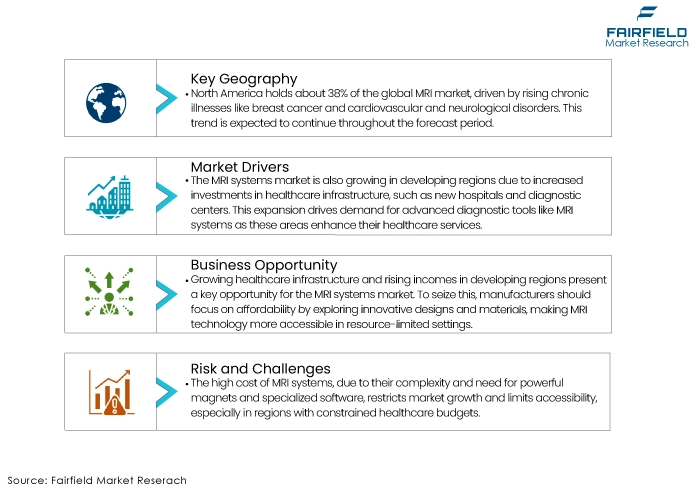
The growth of the MRI systems market is not limited to developed nations. Developing regions around the world are experiencing significant investments in healthcare infrastructure, including the establishment of new hospitals and diagnostic centres. This expansion creates a growing demand for advanced medical equipment, including MRI systems. As these regions strive to improve their healthcare services and cater to their growing populations, the need for accurate and reliable diagnostic tools like MRI becomes increasingly important.
Further, rising disposable incomes in these regions are leading to a greater focus on preventative healthcare and advanced medical treatments. This confluence of factors like infrastructure development, growing populations, and rising healthcare awareness – is creating a significant opportunity for the MRI systems market in developing regions. Manufacturers are likely to target these regions with cost-effective solutions and financing models to make MRI technology more accessible, further propelling market growth.
Rising Demand for Advanced Diagnostics
The increasing burden of chronic diseases globally is a major driver for the MRI systems market. Conditions like cancer, neurological disorders, and cardiovascular diseases are becoming more prevalent, and early diagnosis is crucial for effective treatment. MRI scans offer unparalleled soft tissue imaging, allowing for detailed visualization of abnormalities that might be missed by other techniques. This accuracy leads to better treatment outcomes and improved patient prognoses.
Additionally, growing public awareness about preventative healthcare is driving a shift towards early disease detection. MRI scans are playing a vital role in this trend, as they can identify potential issues before symptoms arise, enabling early intervention and potentially preventing disease progression. This growing demand for advanced diagnostics and early disease detection is expected to continue fuelling the MRI systems market in the coming years.
Widespread Adoption by Healthcare Facilities
Magnetic resonance imaging (MRI) equipment is widely utilized in many healthcare settings, such as hospitals and clinics, as a prevalent diagnostic imaging procedure. The apparatus employs powerful magnetic fields and radio waves to generate intricate images of the inside structures of the body. The increasing incidence of several chronic ailments, including cancer and neurological illnesses, among others, along with a rising number of trauma cases, is driving the global demand for medical equipment.
The strong emphasis placed by major contributors on developing and introducing highly improved products to meet the increasing global demand from healthcare professionals and patients is also a factor driving the growth of the magnetic resonance imaging (MRI) equipment market. The increasing attention from key market participants is driving technological breakthroughs in MRI scanners, including the development of high-strength scanners.
Traditionally, MRI scanning has employed 1.5T magnetic resonance imaging (MRI) equipment. However, in recent years, advancements in technology have led to the use of 3T MRI equipment, and even higher, such as the 7T MRI equipment. The increased field strength of the MRI equipment allows for the generation of cross-sectional images of the knee and head, specifically designed for individuals weighing above 66 lbs. These devices have diverse applications, including those for diagnostic purposes. The reason for this is that MRI technology improves the imaging process by displaying the functional and anatomical features that would otherwise be invisible at lesser strengths.
Key Growth Barriers
High Cost of MRI Systems
Despite the significant benefits of MRI technology, a major restraint on the market's growth is the high cost of MRI systems themselves. These machines are complex and require powerful magnets, specialized software, and controlled environments. This translates to a hefty upfront investment for healthcare providers, limiting accessibility, particularly in regions with limited healthcare budgets.
Furthermore, operational costs add to the burden. MRI systems require ongoing maintenance, trained personnel for operation, and the helium gas needed for cooling is a scarce resource with potentially rising costs. These combined factors can make MRI scans a relatively expensive diagnostic tool, potentially leading healthcare providers to prioritize more cost-effective alternatives for certain applications.
Declining Reimbursement Rates
Another potential hurdle for market growth is the trend of declining reimbursement rates for MRI procedures. Insurance companies and healthcare payers are increasingly scrutinizing the cost-effectiveness of medical procedures. While the diagnostic value of MRI scans is undeniable, some payers may view them as expensive compared to other imaging techniques. This can lead to reduced coverage for MRI scans, making them less affordable for patients and potentially leading healthcare providers to opt for less expensive alternatives.
Additionally, complex insurance procedures and prior authorization requirements may create hurdles for patients seeking MRI scans, further hindering market growth. Addressing these challenges through innovative financing models and demonstrating the cost-effectiveness of MRI scans in improved patient outcomes will be crucial for sustained market expansion.
Key Trends and Opportunities to Look at
Focus on Affordability and Accessibility in Developing Regions
Rapidly sophisticating healthcare infrastructure, and rising disposable incomes in developing regions present a significant opportunity for the MRI systems market. However, to fully capitalize on this opportunity, manufacturers need to address the challenge of affordability. Manufacturers can explore innovative design approaches and alternative materials to develop more affordable MRI systems without compromising on image quality. This would make MRI technology more accessible to healthcare providers in resource-limited settings.
Financing options like leasing or pay-per-use models can make MRI systems more attainable for healthcare providers, especially in regions with limited upfront capital. Governments in developing countries can play a crucial role in promoting the adoption of MRI technology by establishing financing programs and collaborating with private companies to make MRI systems more accessible.
Adoption of cloud-based solutions, and remote reading services marks an important market trend as it can allow healthcare providers in remote areas to access the expertise of radiologists located elsewhere. It potentially reduces the need for on-site specialists, making MRI scans more accessible to a wider patient population.
Fairfield’s Ranking Board
Top Segments
Medium Field Strength to Lead with over 48% Share
Based on field strength, the global MRI systems market is further sub segmented into mid and high field strength, where the mid field strength segment dominates the market segment. Machines with intermediate field strength are preferred for their capacity to acquire high-precision images. They are frequently offered at more reasonable pricing, which makes them a popular option among healthcare practitioners. The high-field segment is projected to have the highest growth rate of 7.9% during the forecast period.
Several ongoing research investigations are being conducted to evaluate the efficacy of high-field strength MRI machines in different therapeutic contexts. This sophisticated equipment is being utilized in hospitals and research centres.
Hospitals Continue to Dominate Adoption with More than 38% Market Share
Based on the end use segmentation, the global MRI systems market is further segmented into hospitals and ASCs, where the hospitals segment dominates the market. The increasing adoption of rapid MRI (rMRI) in emergency care and trauma centres, along with the expanding number of MRI installations in teaching hospitals, are anticipated to be major drivers of the expansion of this sector. During the forecast period, the imaging centres segment is expected to experience the highest growth rate, estimated at approximately 7.8%.
The growing need for non-invasive diagnostics is fuelling the creation of multiple autonomous centres that provide services, such as MRI. In response to the increasing need, numerous healthcare practitioners are establishing clinics that offer cost-effective MRI services. This tendency is fuelling the increased use of MRI technology in medical services, which is anticipated to stimulate growth in this sector throughout the projected timeframe.
The segment of ambulatory care centres is also projected to experience substantial growth. The growth can be ascribed to the rising number of government initiatives focused on improving and extending the number of ambulatory care centres, specifically to provide healthcare services to rural areas.
Regional Frontrunners
Dominance of North America Continues, Market Share Exceeds 37%
North America had the largest market share, accounting for around 38% of the global MRI systems market share. The increasing incidence of chronic illnesses in this area, such as breast cancer, cardiovascular disorders, and neurological diseases, is fuelling the need for sophisticated imaging analysis. This region is expected to maintain its supremacy during the entire projected era.
During the projected period, the growth of MRI technology is anticipated to be driven by a mix of technological developments and the rising prevalence of chronic illnesses. The Asia Pacific region is projected to experience the highest growth rate of 7.4% throughout the predicted timeframe, primarily driven by the rising number of elderly individuals and the growing need for improved imaging technologies.
Furthermore, the expanding medical tourism sector in Asian nations is expected to enhance the expansion of the advanced medical imaging business in the projected timeframe. Countries like India, China, and Japan are capitalizing on growth prospects in the healthcare service business due to their rapidly rising presence of trained healthcare workers and modern healthcare facilities and services. Moreover, these countries offer these services at a lesser cost compared to established countries in North America, and Europe.
Fairfield’s Competitive Landscape Analysis
The global MRI systems market is characterized by intense competition among key players striving to maintain and expand their market share through innovation, strategic partnerships, and geographic expansion.
The competitive dynamics within the MRI systems market are shaped by rapid technological advancements, regulatory compliance, and evolving healthcare policies globally. Companies are adapting by leveraging their core competencies in technology and service excellence to differentiate themselves and maintain competitive advantage.
Who are Leading Companies in MRI Systems Space?
- GE Healthcare
- Siemens Healthineers
- Koninklijke Philips N.V.
- Canon Medical Systems
- Hitachi Healthcare
- Hologic Inc.
- Bruker Corporation
- Esaote SPA
- Fujifilm Holdings Corporation
- Shimadzu Corporation
- Aurora Imaging Technologies, Inc.
Global MRI Systems Market is Segmented as-
By Field Strength
- Mid Field Strength
- High Field Strength
By Architecture
- Open System
- Closed System
By End Use
- Hospitals
- ASC
- Others
By Region
- North America
- Latin America
- Europe
- South Asia & Oceania
- East Asia
- Middle East & Africa
- Executive Summary
- Global MRI Systems Market Snapshot
- Future Projections
- Key Market Trends
- Regional Snapshot, by Value, 2026
- Analyst Recommendations
- Market Overview
- Market Definitions and Segmentations
- Market Dynamics
- Drivers
- Restraints
- Market Opportunities
- Value Chain Analysis
- COVID-19 Impact Analysis
- Porter's Five Forces Analysis
- Impact of Russia-Ukraine Conflict
- PESTLE Analysis
- Regulatory Analysis
- Price Trend Analysis
- Current Prices and Future Projections, 2025-2033
- Price Impact Factors
- Global MRI Systems Market Outlook, 2020 - 2033
- Global MRI Systems Market Outlook, by Field Strength, Value (US$ Mn), 2020-2033
- Mid Field Strength
- High Field Strength
- Global MRI Systems Market Outlook, by Architecture, Value (US$ Mn), 2020-2033
- Open System
- Closed System
- Global MRI Systems Market Outlook, by End Use, Value (US$ Mn), 2020-2033
- Hospitals
- ASC
- Others
- Global MRI Systems Market Outlook, by Region, Value (US$ Mn), 2020-2033
- North America
- Europe
- Asia Pacific
- Latin America
- Middle East & Africa
- Global MRI Systems Market Outlook, by Field Strength, Value (US$ Mn), 2020-2033
- North America MRI Systems Market Outlook, 2020 - 2033
- North America MRI Systems Market Outlook, by Field Strength, Value (US$ Mn), 2020-2033
- Mid Field Strength
- High Field Strength
- North America MRI Systems Market Outlook, by Architecture, Value (US$ Mn), 2020-2033
- Open System
- Closed System
- North America MRI Systems Market Outlook, by End Use, Value (US$ Mn), 2020-2033
- Hospitals
- ASC
- Others
- North America MRI Systems Market Outlook, by Country, Value (US$ Mn), 2020-2033
- U.S. MRI Systems Market Outlook, by Field Strength, 2020-2033
- U.S. MRI Systems Market Outlook, by Architecture, 2020-2033
- U.S. MRI Systems Market Outlook, by End Use, 2020-2033
- Canada MRI Systems Market Outlook, by Field Strength, 2020-2033
- Canada MRI Systems Market Outlook, by Architecture, 2020-2033
- Canada MRI Systems Market Outlook, by End Use, 2020-2033
- BPS Analysis/Market Attractiveness Analysis
- North America MRI Systems Market Outlook, by Field Strength, Value (US$ Mn), 2020-2033
- Europe MRI Systems Market Outlook, 2020 - 2033
- Europe MRI Systems Market Outlook, by Field Strength, Value (US$ Mn), 2020-2033
- Mid Field Strength
- High Field Strength
- Europe MRI Systems Market Outlook, by Architecture, Value (US$ Mn), 2020-2033
- Open System
- Closed System
- Europe MRI Systems Market Outlook, by End Use, Value (US$ Mn), 2020-2033
- Hospitals
- ASC
- Others
- Europe MRI Systems Market Outlook, by Country, Value (US$ Mn), 2020-2033
- Germany MRI Systems Market Outlook, by Field Strength, 2020-2033
- Germany MRI Systems Market Outlook, by Architecture, 2020-2033
- Germany MRI Systems Market Outlook, by End Use, 2020-2033
- Italy MRI Systems Market Outlook, by Field Strength, 2020-2033
- Italy MRI Systems Market Outlook, by Architecture, 2020-2033
- Italy MRI Systems Market Outlook, by End Use, 2020-2033
- France MRI Systems Market Outlook, by Field Strength, 2020-2033
- France MRI Systems Market Outlook, by Architecture, 2020-2033
- France MRI Systems Market Outlook, by End Use, 2020-2033
- U.K. MRI Systems Market Outlook, by Field Strength, 2020-2033
- U.K. MRI Systems Market Outlook, by Architecture, 2020-2033
- U.K. MRI Systems Market Outlook, by End Use, 2020-2033
- Spain MRI Systems Market Outlook, by Field Strength, 2020-2033
- Spain MRI Systems Market Outlook, by Architecture, 2020-2033
- Spain MRI Systems Market Outlook, by End Use, 2020-2033
- Russia MRI Systems Market Outlook, by Field Strength, 2020-2033
- Russia MRI Systems Market Outlook, by Architecture, 2020-2033
- Russia MRI Systems Market Outlook, by End Use, 2020-2033
- Rest of Europe MRI Systems Market Outlook, by Field Strength, 2020-2033
- Rest of Europe MRI Systems Market Outlook, by Architecture, 2020-2033
- Rest of Europe MRI Systems Market Outlook, by End Use, 2020-2033
- BPS Analysis/Market Attractiveness Analysis
- Europe MRI Systems Market Outlook, by Field Strength, Value (US$ Mn), 2020-2033
- Asia Pacific MRI Systems Market Outlook, 2020 - 2033
- Asia Pacific MRI Systems Market Outlook, by Field Strength, Value (US$ Mn), 2020-2033
- Mid Field Strength
- High Field Strength
- Asia Pacific MRI Systems Market Outlook, by Architecture, Value (US$ Mn), 2020-2033
- Open System
- Closed System
- Asia Pacific MRI Systems Market Outlook, by End Use, Value (US$ Mn), 2020-2033
- Hospitals
- ASC
- Others
- Asia Pacific MRI Systems Market Outlook, by Country, Value (US$ Mn), 2020-2033
- China MRI Systems Market Outlook, by Field Strength, 2020-2033
- China MRI Systems Market Outlook, by Architecture, 2020-2033
- China MRI Systems Market Outlook, by End Use, 2020-2033
- Japan MRI Systems Market Outlook, by Field Strength, 2020-2033
- Japan MRI Systems Market Outlook, by Architecture, 2020-2033
- Japan MRI Systems Market Outlook, by End Use, 2020-2033
- South Korea MRI Systems Market Outlook, by Field Strength, 2020-2033
- South Korea MRI Systems Market Outlook, by Architecture, 2020-2033
- South Korea MRI Systems Market Outlook, by End Use, 2020-2033
- India MRI Systems Market Outlook, by Field Strength, 2020-2033
- India MRI Systems Market Outlook, by Architecture, 2020-2033
- India MRI Systems Market Outlook, by End Use, 2020-2033
- Southeast Asia MRI Systems Market Outlook, by Field Strength, 2020-2033
- Southeast Asia MRI Systems Market Outlook, by Architecture, 2020-2033
- Southeast Asia MRI Systems Market Outlook, by End Use, 2020-2033
- Rest of SAO MRI Systems Market Outlook, by Field Strength, 2020-2033
- Rest of SAO MRI Systems Market Outlook, by Architecture, 2020-2033
- Rest of SAO MRI Systems Market Outlook, by End Use, 2020-2033
- BPS Analysis/Market Attractiveness Analysis
- Asia Pacific MRI Systems Market Outlook, by Field Strength, Value (US$ Mn), 2020-2033
- Latin America MRI Systems Market Outlook, 2020 - 2033
- Latin America MRI Systems Market Outlook, by Field Strength, Value (US$ Mn), 2020-2033
- Mid Field Strength
- High Field Strength
- Latin America MRI Systems Market Outlook, by Architecture, Value (US$ Mn), 2020-2033
- Open System
- Closed System
- Latin America MRI Systems Market Outlook, by End Use, Value (US$ Mn), 2020-2033
- Hospitals
- ASC
- Others
- Latin America MRI Systems Market Outlook, by Country, Value (US$ Mn), 2020-2033
- Brazil MRI Systems Market Outlook, by Field Strength, 2020-2033
- Brazil MRI Systems Market Outlook, by Architecture, 2020-2033
- Brazil MRI Systems Market Outlook, by End Use, 2020-2033
- Mexico MRI Systems Market Outlook, by Field Strength, 2020-2033
- Mexico MRI Systems Market Outlook, by Architecture, 2020-2033
- Mexico MRI Systems Market Outlook, by End Use, 2020-2033
- Argentina MRI Systems Market Outlook, by Field Strength, 2020-2033
- Argentina MRI Systems Market Outlook, by Architecture, 2020-2033
- Argentina MRI Systems Market Outlook, by End Use, 2020-2033
- Rest of LATAM MRI Systems Market Outlook, by Field Strength, 2020-2033
- Rest of LATAM MRI Systems Market Outlook, by Architecture, 2020-2033
- Rest of LATAM MRI Systems Market Outlook, by End Use, 2020-2033
- BPS Analysis/Market Attractiveness Analysis
- Latin America MRI Systems Market Outlook, by Field Strength, Value (US$ Mn), 2020-2033
- Middle East & Africa MRI Systems Market Outlook, 2020 - 2033
- Middle East & Africa MRI Systems Market Outlook, by Field Strength, Value (US$ Mn), 2020-2033
- Mid Field Strength
- High Field Strength
- Middle East & Africa MRI Systems Market Outlook, by Architecture, Value (US$ Mn), 2020-2033
- Open System
- Closed System
- Middle East & Africa MRI Systems Market Outlook, by End Use, Value (US$ Mn), 2020-2033
- Hospitals
- ASC
- Others
- Middle East & Africa MRI Systems Market Outlook, by Country, Value (US$ Mn), 2020-2033
- GCC MRI Systems Market Outlook, by Field Strength, 2020-2033
- GCC MRI Systems Market Outlook, by Architecture, 2020-2033
- GCC MRI Systems Market Outlook, by End Use, 2020-2033
- South Africa MRI Systems Market Outlook, by Field Strength, 2020-2033
- South Africa MRI Systems Market Outlook, by Architecture, 2020-2033
- South Africa MRI Systems Market Outlook, by End Use, 2020-2033
- Egypt MRI Systems Market Outlook, by Field Strength, 2020-2033
- Egypt MRI Systems Market Outlook, by Architecture, 2020-2033
- Egypt MRI Systems Market Outlook, by End Use, 2020-2033
- Nigeria MRI Systems Market Outlook, by Field Strength, 2020-2033
- Nigeria MRI Systems Market Outlook, by Architecture, 2020-2033
- Nigeria MRI Systems Market Outlook, by End Use, 2020-2033
- Rest of Middle East MRI Systems Market Outlook, by Field Strength, 2020-2033
- Rest of Middle East MRI Systems Market Outlook, by Architecture, 2020-2033
- Rest of Middle East MRI Systems Market Outlook, by End Use, 2020-2033
- BPS Analysis/Market Attractiveness Analysis
- Middle East & Africa MRI Systems Market Outlook, by Field Strength, Value (US$ Mn), 2020-2033
- Competitive Landscape
- Company Vs Segment Heatmap
- Company Market Share Analysis, 2025
- Competitive Dashboard
- Company Profiles
- GE Healthcare
- Company Overview
- Product Portfolio
- Financial Overview
- Business Strategies and Developments
- Siemens Healthineers
- Koninklijke Philips N.V.
- Canon Medical Systems
- Hitachi Healthcare
- Hologic Inc.
- Bruker Corporation
- Esaote SPA
- Fujifilm Holdings Corporation
- Shimadzu Corporation
- GE Healthcare
- Appendix
- Research Methodology
- Report Assumptions
- Acronyms and Abbreviations
|
BASE YEAR |
HISTORICAL DATA |
FORECAST PERIOD |
UNITS |
|||
 |
2025 |
 |
2019 - 2024 |
 |
2026 - 2033 |
Value: US$ Billion |
|
REPORT FEATURES |
DETAILS |
|
Field Strength Coverage |
|
|
Architecture Coverage |
|
|
End Use Coverage |
|
|
Geographical Coverage |
|
|
Leading Companies |
|
|
Report Highlights |
Key Market Indicators, Macro-micro economic impact analysis, Technological Roadmap, Key Trends, Driver, Restraints, and Future Opportunities & Revenue Pockets, Porter’s 5 Forces Analysis, Historical Trend (2019-2021), Market Estimates and Forecast, Market Dynamics, Industry Trends, Competition Landscape, Category, Region, Country-wise Trends & Analysis, COVID-19 Impact Analysis (Demand and Supply Chain) |
Our Research Methodology
Considering the volatility of business today, traditional approaches to strategizing a game plan can be unfruitful if not detrimental. True ambiguity is no way to determine a forecast. A myriad of predetermined factors must be accounted for such as the degree of risk involved, the magnitude of circumstances, as well as conditions or consequences that are not known or unpredictable. To circumvent binary views that cast uncertainty, the application of market research intelligence to strategically posture, move, and enable actionable outcomes is necessary.
View Methodology
Quality Assured
Rigorous Validation Process

Confidentiality Assured
End-to-end Data Security

Custom Research Services
Tailored To Your Objectives
FAQs
The global MRI systems market is estimated to exhibit a CAGR of 6% during the forecast period.
North America is the leading region in the market.
The global MRI systems market is segmented based on field strength, architecture and end use.
GE Healthcare, Siemens Healthineers, Koninklijke Philips N.V., Canon Medical Systems, and Hitachi Healthcare are some of the major companies in the market.
Hospitals are the dominant end users in the market.
Related Reports
Digital Therapeutics Delivery Devices Market Insights, Competitive Landscape, and Market Forecast 2033
The digital therapeutics delivery devices market will expand at a 15.5% CAGR from USD 2.10 Bn in 2026 to USD 5.76 Bn by 2033, led by wearable devices.
Global Infant Incubator Insights, Competitive Landscape, and Market Forecast 2033
Infant Incubator Market to reach US$1,306.72 Mn by 2033, growing at 5.3% CAGR, driven by preterm births, NICU expansion and transport incubators care.
Pulse Electromagnetic Field Therapy Devices Market Insights, Competitive Landscape, and Market Forecast 2026–2033
Pulse Electromagnetic Field Therapy Devices Market to reach US$930.86 Mn by 2033, driven by pain management and wearable devices.
Vaginal Rejuvenation Market Insights, Competitive Landscape, and Market Forecast 2026–2033
Vaginal Rejuvenation Market to Reach US$26.75 Billion by 2033, Driven by Rising Demand for Minimally Invasive Women's Health Solutions.
Red Light Therapy Market Insights, Competitive Landscape, and Market Forecast 2033
The red light therapy market will grow from US$587.50 Mn in 2026 to US$1,130.38 Mn by 2033 at a 9.8% CAGR, driven by clinical adoption & FDA clearances.
Sterilization Equipment Market Insights, Competitive Landscape, and Market Forecast 2033
Sterilization Equipment Market is projected to reach US$31.56 billion by 2033, driven by infection control, hospital expansion, and advanced technologies.