



Oculoplastic Surgery Market
Oculoplastic Surgery Market Size, Share, Insights, Competitive Landscape, and Forecast 2026 to 2033
Oculoplastic Surgery Market Analysis, 2026–2033
Oculoplastic Surgery Market
Oculoplastic Surgery Market Size, Share, Insights, Competitive Landscape, and Forecast 2026 to 2033
Oculoplastic Surgery Market Size and Trend Analysis
How Fast Is the Oculoplastic Surgery Market Growing?
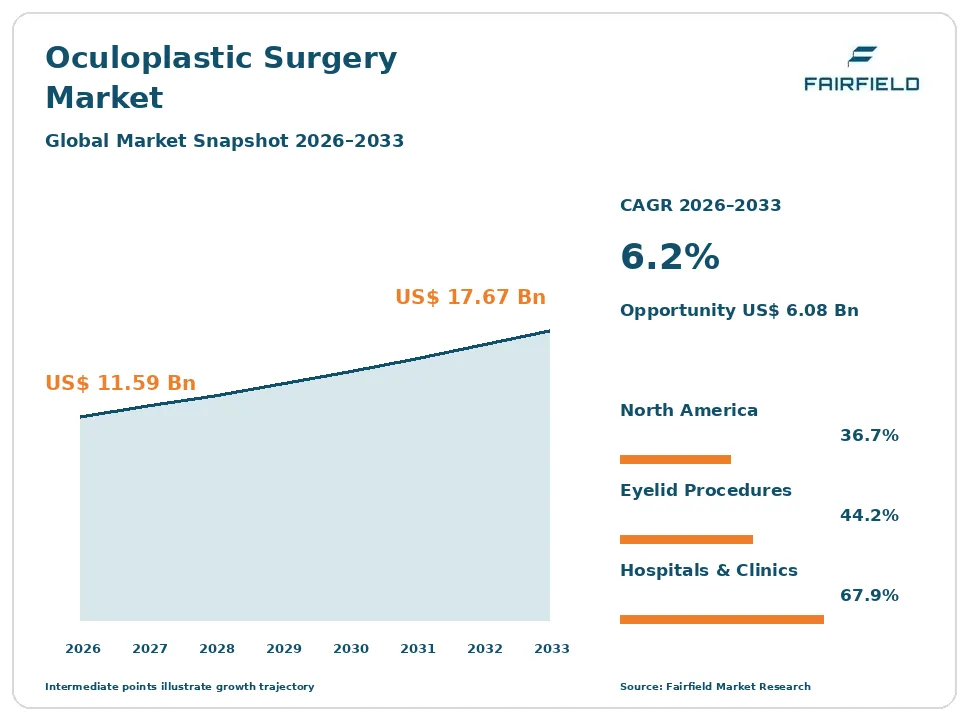
The global oculoplastic surgery market size is expected to be valued at US$ 11.59 billion in 2026 and projected to reach US$ 17.67 billion by 2033, growing at a CAGR of 6.2% between 2026 and 2033.
Between 2020 and 2025, the market grew at a CAGR of about 5.1%, falling sharply in 2020 when elective surgery stopped during the pandemic, then rebounding strongly as cosmetic procedures surged in 2021 and 2022. Three factors now drive growth: an aging population with drooping eyelids, rising demand for cosmetic eyelid surgery, and more reconstructive procedures after trauma, tumors, and thyroid eye disease. The market is shifting toward minimally invasive blepharoplasty, laser and radiofrequency tools, and outpatient procedures in ambulatory surgery centers. Custom 3D-printed implants are improving orbital surgery, while endoscopic techniques are changing lacrimal surgery. Ptosis repair is also growing as more older adults seek treatment for droopy lids that block vision.
Key Report Takeaways
- By Procedure: Eyelid Procedures held 44.2% share in 2026, while Orbital & Pediatric Procedures are projected to expand at a 7.6% CAGR through 2033, driven by trauma care, tumor removal, and custom implants.
- By Product: Implants & Consumables held 38.5% share in 2026, while Injectable Products are projected to expand at an 8.1% CAGR through 2033, driven by non-surgical periocular rejuvenation and combination treatments.
- By End Use: Hospitals & Clinics held 67.9% share in 2026, while Ambulatory Surgical Centers are projected to expand at a 7.3% CAGR through 2033, driven by lower costs and same-day discharge.
- By Region: North America held 36.7% share in 2026, while Asia Pacific is projected to expand at a 7.2% CAGR through 2033, driven by cosmetic eyelid surgery demand in South Korea, China, and Japan.
Global Oculoplastic Surgery Market Trends and Insights
Drivers Impact Analysis
Two drivers carry the strongest influence on oculoplastic surgery demand during the forecast period.
| Driver | Impact on CAGR Forecast | Geographic Relevance | Impact Timeline |
| Aging population and functional eyelid problems | High | North America, Europe, Asia Pacific | Long term (≥4 years) |
| Rising demand for cosmetic eyelid procedures | High | Asia Pacific, North America, Latin America | Medium term (2-4 years) |
Aging Populations Are Driving the Oculoplastic Surgery Market
Aging populations and functional eyelid problems are the strongest driver of the oculoplastic surgery market. Eyelids and surrounding tissues weaken with age.
The mechanism is a growing number of older adults with conditions that affect vision and comfort. Dermatochalasis, or excess upper eyelid skin, and acquired ptosis can block the upper field of vision, making reading and driving harder. Ectropion and entropion, where the lid turns out or in, cause irritation, tearing, and infection. Tear duct blockages become more common with age. The number of people aged 65 and older is rising fast in Japan, Europe, China, and the United States. Insurers often cover functional blepharoplasty and ptosis repair when visual field tests show impairment. Skin cancers around the eyes also require surgical removal and reconstruction. These factors create steady demand for oculoplastic procedures.
Cosmetic Demand Is Expanding the Oculoplastic Surgery Market
Rising demand for cosmetic eyelid procedures is expanding the oculoplastic surgery market. Eyes are central to facial appearance, so eyelid surgery is among the most popular cosmetic operations.
The cause is growing interest in looking younger and changing beauty standards. Blepharoplasty removes excess skin and fat to reduce puffiness, bags, and hooded lids. Double eyelid surgery is very popular in South Korea, China, Japan, and Taiwan. Social media, video calls, and selfies have increased awareness of facial appearance among younger adults. Brow lifts, canthoplasty, and under-eye fillers are often combined with eyelid surgery. Medical tourism to South Korea, Thailand, Turkey, Mexico, and Brazil makes procedures more affordable for international patients. Men are also seeking eyelid rejuvenation in greater numbers. These trends support strong cosmetic procedure volumes.
Restraints Impact Analysis
Two restraints limit how quickly the oculoplastic surgery market grows.
| Restraint | Impact on CAGR Forecast | Geographic Relevance | Impact Timeline |
| High costs and limited insurance for cosmetic procedures | High | Global | Short term (≤2 years) |
| Surgical risks and shortage of specialists | Medium | Global | Medium term (2-4 years) |
High Costs Slow the Oculoplastic Surgery Market
High costs and limited insurance coverage slow the oculoplastic surgery market. Cosmetic eyelid surgery is usually paid out of pocket.
The specific causes are procedure prices and economic pressure on consumers. Upper and lower blepharoplasty can cost several thousand dollars in the United States and Europe, plus anesthesia and facility fees. Insurance covers only functional procedures, and approval requires documentation such as visual field tests and photographs. Economic slowdowns and high inflation lead consumers to delay elective cosmetic surgery. Prices for implants, lasers, and instruments add costs for surgery centers. Non-surgical options such as fillers, botulinum toxin, and eye drops for mild ptosis offer cheaper alternatives for some patients. Surgery center fees and surgeon charges vary widely, which makes patients compare prices and delay decisions. These factors limit procedure growth in price-sensitive groups.
Surgical Risks and Specialist Shortages Restrict the Oculoplastic Surgery Market
Surgical risks and a shortage of trained specialists restrict the oculoplastic surgery market. Eyelid and orbital surgery requires delicate skill.
The underlying causes are the complexity of periocular anatomy and long training. Complications can include dry eye, difficulty closing the eyes, asymmetry, scarring, bleeding behind the eye, and rarely vision loss. Fear of poor results and long recovery deters some patients. Oculoplastic surgery is a subspecialty that needs fellowship training after ophthalmology residency, so the number of specialists is limited, especially in Latin America, Middle East & Africa, and rural areas. Unqualified providers in some countries perform procedures with poor outcomes, harming public confidence. Malpractice risks raise insurance costs for surgeons. Regulators in some countries are tightening rules on who can perform cosmetic eye procedures. These factors slow adoption and limit capacity.
Market Opportunities
Minimally Invasive and Outpatient Procedures Open a Growth Revenue Pool
Minimally invasive and outpatient procedures open a growth revenue pool in the oculoplastic surgery market. Patients want faster recovery and less scarring.
Device makers and surgery centers can capture this opportunity. Radiofrequency, CO2 laser, and plasma devices allow incision-light blepharoplasty and skin tightening. Transconjunctival approaches remove lower lid fat without visible scars. Ambulatory surgical centers offer lower costs and same-day discharge, and many oculoplastic procedures can be done under local anesthesia. Combination treatments that pair surgery with fillers, lasers, or toxins increase revenue per patient. New devices such as the Osheru upper eyelid lift system target non-surgical options. Training programs and cadaver courses help spread new techniques, and video sharing among surgeons speeds learning. Marketing through social media and patient reviews brings in younger cosmetic patients. Bundled packages that include follow-up visits help clinics build loyalty and repeat business.
Asia Pacific Aesthetic Growth and Reconstructive Needs Create a Volume Revenue Pool
Aesthetic growth and reconstructive needs in Asia Pacific create a volume revenue pool in the oculoplastic surgery market. The region has huge populations and strong cosmetic surgery cultures.
Clinics, device makers, and implant suppliers can capture this opportunity. South Korea is a global center for double eyelid surgery and attracts medical tourists. China has a fast-growing aesthetic medicine sector, with millions of eyelid procedures performed each year. Japan has an aging population needing functional ptosis and lid repair. India has growing private eye hospital chains and rising demand for both cosmetic and reconstructive surgery. Road traffic injuries create demand for orbital surgery. Affordable instruments and implants made locally reduce costs, and private hospital chains are adding oculoplastic departments. Medical tourism packages in South Korea and Thailand bring in patients from across the region and beyond.
Segment Analysis
By Procedure: Eyelid Procedures Lead While Orbital & Pediatric Procedures Grow Fastest
Eyelid Procedures held 44.2% share in 2026. Eyelid surgery includes upper and lower blepharoplasty, ptosis repair, double eyelid surgery, and correction of ectropion, entropion, and eyelid tumors. It covers both cosmetic and functional needs and is performed by ophthalmologists, oculoplastic surgeons, and plastic surgeons. Face and brow lifts form the second-largest group, often combined with eyelid work. Lacrimal surgery, including dacryocystorhinostomy for blocked tear ducts, is another important category.
Orbital & Pediatric Procedures are the fastest-growing procedure type, expanding at a 7.6% CAGR through 2033. Orbital surgery treats fractures, tumors, and thyroid eye disease, often with custom titanium or porous polyethylene implants. Pediatric procedures address congenital ptosis and tear duct blockages. New thyroid eye disease drugs may change when decompression is needed. For the market, orbital growth adds complex, high-value cases.
By Product: Implants & Consumables Lead While Injectable Products Grow Fastest
Implants & Consumables held 38.5% share in 2026. Orbital implants, eyelid weights, lacrimal stents and tubes, sutures, and surgical meshes are used in many procedures. Patient-specific 3D-printed implants from KLS Martin Group, Stryker, and Johnson & Johnson MedTech improve fit and outcomes in orbital surgery. Surgical instruments and laser systems form other major product groups.
Injectable Products are the fastest-growing product type, expanding at an 8.1% CAGR through 2033. Hyaluronic acid fillers for under-eye hollows and botulinum toxin for crow’s feet and brow positioning complement surgical procedures. Many patients start with injectables before considering surgery, and results last several months, encouraging repeat visits. Clinics often combine fillers with skin tightening treatments. For the market, injectable growth adds repeat revenue.
By End Use: Hospitals & Clinics Lead While Ambulatory Surgical Centers Grow Fastest
Hospitals & Clinics held 67.9% share in 2026. Hospitals handle complex orbital, trauma, tumor, and reconstructive cases that need operating rooms, imaging, and multidisciplinary teams. Eye clinics and cosmetic surgery clinics perform many eyelid and aesthetic procedures. Large eye hospital chains in India and China are expanding oculoplastic departments, and dedicated aesthetic clinics in South Korea perform high volumes of eyelid procedures.
Ambulatory Surgical Centers are the fastest-growing end use, expanding at a 7.3% CAGR through 2033. These centers offer lower costs, shorter waits, and same-day discharge for blepharoplasty, ptosis repair, and lacrimal surgery. Insurers and Medicare encourage moving suitable procedures to outpatient settings. Surgeons who own centers gain more control over schedules and costs. For the market, center growth increases procedure volumes and demand for compact equipment.
Geography Analysis
Which Region Is Leading the Oculoplastic Surgery Market?
North America is leading the oculoplastic surgery market with a 36.7% share in 2026. The United States has a large aging population, high cosmetic surgery rates, and many trained oculoplastic and facial plastic surgeons. Blepharoplasty is consistently among the most common cosmetic operations in the country. Medicare and private insurers cover functional eyelid surgery and ptosis repair. Leading device and implant makers such as Johnson & Johnson MedTech, Stryker, and Medtronic are based in the region. Canada adds demand through public and private clinics. One change shaping the region is the shift to ambulatory surgical centers.
Europe Advances the Oculoplastic Surgery Market Through Reconstructive Care
Europe is a major oculoplastic surgery market. Germany, the United Kingdom, France, Italy, and Spain have aging populations and strong public health systems that cover functional eyelid and orbital procedures. Cosmetic blepharoplasty is popular in Italy, Spain, and Germany. KLS Martin Group in Germany is a global leader in patient-specific orbital implants. Turkey attracts many medical tourists for cosmetic eyelid surgery, and Poland and the Czech Republic offer lower-cost private clinics. Key barriers include long public waiting lists and strict funding criteria for functional surgery. One opportunity is private cosmetic clinics.
Which Region Is Growing Fastest in the Oculoplastic Surgery Market?
Asia Pacific is growing fastest in the oculoplastic surgery market at a 7.2% CAGR through 2033. South Korea is a global hub for double eyelid surgery and medical tourism. China has a fast-growing aesthetic medicine sector, rising disposable incomes, and many new private clinics. Japan has a rapidly aging population needing functional lid surgery. India has expanding private eye hospital chains and growing cosmetic demand in large cities. Thailand and Singapore attract international patients with high-quality private hospitals. Australia has a strong private surgery sector. Social media drives cosmetic interest among younger adults. One opportunity is combining surgery with injectables.
Latin America Grows the Oculoplastic Surgery Market Through Aesthetic Demand
Latin America is a growing oculoplastic surgery market. Brazil is one of the world’s largest cosmetic surgery markets, with eyelid surgery among the most common procedures performed by its many plastic surgeons. Mexico and Colombia attract medical tourists from the United States and Canada for lower-cost cosmetic surgery, often combining eyelid and facial procedures. Argentina and Chile have skilled plastic surgeons and growing private clinics. Public health systems cover reconstructive procedures for trauma and tumors, but waiting times can be long. Key barriers include economic swings, currency changes, and limited oculoplastic specialists outside large cities. One opportunity is medical tourism.
Middle East & Africa Builds the Oculoplastic Surgery Market
Middle East & Africa is an emerging oculoplastic surgery market. The United Arab Emirates and Saudi Arabia have growing aesthetic clinic sectors, high incomes, and strong demand for cosmetic eyelid procedures. Dubai markets itself as a hub for medical tourism, attracting patients from across the region. Iran and Lebanon are known for cosmetic surgery, with skilled surgeons and relatively low prices. South Africa has trained surgeons and attracts some medical tourists, while Egypt has a growing private cosmetic sector. Trauma from road accidents adds demand for orbital repair. Key barriers include few specialists in many countries and limited insurance coverage. One opportunity is premium aesthetic clinics.
Competitive Landscape
The oculoplastic surgery market is fragmented. Johnson & Johnson MedTech, Bausch + Lomb, Alcon, Stryker, Medtronic, Integra LifeSciences, and Carl Zeiss Meditec supply instruments, implants, visualization, and energy devices, while specialists such as KLS Martin Group, Beaver-Visitec International, FCI Ophthalmics, Katena Products, and Sklar Surgical Instruments focus on oculoplastic tools and implants. Aesthetic companies such as AbbVie supply injectables used alongside surgery.
Companies compete on instrument precision, implant materials, customization, energy device performance, surgeon training, and price. Hospitals and surgery centers favor suppliers with broad catalogs and reliable service. Many small instrument makers in Germany, the United States, and Pakistan compete on price and craftsmanship. Partnerships with surgeon societies and training centers build brand loyalty. Patient-specific implants require imaging, design, and rapid manufacturing capabilities, which favor larger companies.
Strategic moves show how competition is changing. In December 2025, the Food and Drug Administration accepted Viridian Therapeutics’ application for veligrotug with priority review. In February 2026, RVL Pharmaceuticals reported supply challenges for Upneeq, a drop for acquired ptosis. In April 2026, Amgen reported positive Phase 3 results for subcutaneous Tepezza. In June 2026, the Food and Drug Administration approved Viridian’s Lumvoa for thyroid eye disease. These moves show non-surgical orbital and eyelid treatments shaping surgical demand.
Three themes shape vendor strategy. First, companies are developing patient-specific implants. Second, they are improving energy devices for minimally invasive procedures. Third, they are expanding in Asia Pacific, where cosmetic volumes are rising fastest.
Oculoplastic Surgery Market Industry Leaders
Johnson & Johnson MedTech Bausch + Lomb Stryker Medtronic KLS Martin Group
Recent Industry Developments
- June 2026: The Food and Drug Administration approved Viridian Therapeutics’ Lumvoa (veligrotug) for thyroid eye disease - adds a drug option that may reduce or delay some orbital decompression surgeries.
- April 2026: Amgen reported positive Phase 3 results for subcutaneous Tepezza using an on-body injector - could widen medical treatment of thyroid eye disease.
- February 2026: RVL Pharmaceuticals reported distribution and availability challenges for Upneeq - affects the main non-surgical option for mild acquired ptosis.
- December 2025: The Food and Drug Administration accepted Viridian Therapeutics’ veligrotug application with priority review - signaled faster access to new thyroid eye disease therapy.
Companies Covered in the Report
- Johnson & Johnson MedTech
- Bausch + Lomb
- Alcon
- Stryker
- Medtronic
- KLS Martin Group
- Integra LifeSciences
- Carl Zeiss Meditec
- Beaver-Visitec International
- FCI Ophthalmics
- Katena Products
- Sklar Surgical Instruments
Oculoplastic Surgery Market Report Scope
This report covers oculoplastic surgery, including eyelid, brow and face lift, orbital, lacrimal, and pediatric procedures, along with surgical instruments, implants and consumables, laser and energy systems, and injectable products used in cosmetic and reconstructive care in hospitals, clinics, and ambulatory surgical centers. It excludes drug therapies for thyroid eye disease and ptosis. The base year is 2025, and the forecast period runs from 2026 to 2033. All values are expressed in US$ Billion.
Procedure
- Eyelid Procedures
- Face & Brow Lifts
- Orbital & Pediatric Procedures
- Lacrimal Procedures
Product
- Surgical Instruments
- Implants & Consumables
- Laser & Energy Systems
- Injectable Products
End Use
- Hospitals & Clinics
- Ambulatory Surgical Centers
Regions
- North America
- Europe
- Asia Pacific
- Latin America
- Middle East & Africa
Key Questions Answered in the Report
How big is the oculoplastic surgery market in 2026?
The oculoplastic surgery market is valued at US$ 11.59 billion in 2026, led by eyelid procedures such as blepharoplasty and ptosis repair.
What is the oculoplastic surgery market forecast to 2033?
The market is projected to reach US$ 17.67 billion by 2033, growing at a 6.2% CAGR and adding US$ 6.08 billion.
Which procedure is growing fastest in the oculoplastic surgery market?
Orbital and pediatric procedures are growing fastest at a 7.6% CAGR through 2033, driven by trauma care, tumors, and custom implants.
Which region is growing fastest in the oculoplastic surgery market?
Asia Pacific is growing fastest at a 7.2% CAGR through 2033, driven by cosmetic eyelid surgery demand in South Korea and China.
Which region holds the largest oculoplastic surgery market share?
North America holds the largest share at 36.7% in 2026, supported by an aging population and high cosmetic surgery rates.
1. Executive Summary
1.1. Global Oculoplastic Surgery Market Snapshot
1.2. Future Projections
1.3. Key Report Takeaways
1.4. Regional Snapshot
2. Market Overview
2.1. Market Definition and Report Scope
2.2. Historical Trends 2020–2025
2.3. Market Dynamics
2.3.1. Drivers
2.3.1.1. Aging Populations Are Driving the Oculoplastic Surgery Market
2.3.1.2. Cosmetic Demand Is Expanding the Oculoplastic Surgery Market
2.3.2. Restraints
2.3.2.1. High Costs Slow the Oculoplastic Surgery Market
2.3.2.2. Surgical Risks and Specialist Shortages Restrict the Oculoplastic Surgery Market
2.3.3. Market Opportunities
2.3.3.1. Minimally Invasive and Outpatient Procedures Open a Growth Revenue Pool
2.3.3.2. Asia Pacific Aesthetic Growth and Reconstructive Needs Create a Volume Revenue Pool
3. Global Oculoplastic Surgery Market Outlook, 2020-2033
3.1. Global Oculoplastic Surgery Market Outlook, by Procedure, Value (US$ Billion), 2020-2033
3.1.1. Eyelid Procedures
3.1.2. Face & Brow Lifts
3.1.3. Orbital & Pediatric Procedures
3.1.4. Lacrimal Procedures
3.2. Global Oculoplastic Surgery Market Outlook, by Product, Value (US$ Billion), 2020-2033
3.2.1. Surgical Instruments
3.2.2. Implants & Consumables
3.2.3. Laser & Energy Systems
3.2.4. Injectable Products
3.3. Global Oculoplastic Surgery Market Outlook, by End Use, Value (US$ Billion), 2020-2033
3.3.1. Hospitals & Clinics
3.3.2. Ambulatory Surgical Centers
3.4. Global Oculoplastic Surgery Market Outlook, by Region, Value (US$ Billion), 2020-2033
3.4.1. North America
3.4.2. Europe
3.4.3. Asia Pacific
3.4.4. Latin America
3.4.5. Middle East & Africa
4. North America Oculoplastic Surgery Market Outlook, 2020-2033
4.1. North America Oculoplastic Surgery Market Outlook, by Procedure, Value (US$ Billion), 2020-2033
4.1.1. Eyelid Procedures
4.1.2. Face & Brow Lifts
4.1.3. Orbital & Pediatric Procedures
4.1.4. Lacrimal Procedures
4.2. North America Oculoplastic Surgery Market Outlook, by Product, Value (US$ Billion), 2020-2033
4.2.1. Surgical Instruments
4.2.2. Implants & Consumables
4.2.3. Laser & Energy Systems
4.2.4. Injectable Products
4.3. North America Oculoplastic Surgery Market Outlook, by End Use, Value (US$ Billion), 2020-2033
4.3.1. Hospitals & Clinics
4.3.2. Ambulatory Surgical Centers
4.4. North America Oculoplastic Surgery Market Outlook, by Country, Value (US$ Billion), 2020-2033
4.4.1. United States Oculoplastic Surgery Market Outlook, by Procedure, 2020-2033
4.4.2. United States Oculoplastic Surgery Market Outlook, by Product, 2020-2033
4.4.3. United States Oculoplastic Surgery Market Outlook, by End Use, 2020-2033
4.4.4. Canada Oculoplastic Surgery Market Outlook, by Procedure, 2020-2033
4.4.5. Canada Oculoplastic Surgery Market Outlook, by Product, 2020-2033
4.4.6. Canada Oculoplastic Surgery Market Outlook, by End Use, 2020-2033
5. Europe Oculoplastic Surgery Market Outlook, 2020-2033
5.1. Europe Oculoplastic Surgery Market Outlook, by Procedure, Value (US$ Billion), 2020-2033
5.1.1. Eyelid Procedures
5.1.2. Face & Brow Lifts
5.1.3. Orbital & Pediatric Procedures
5.1.4. Lacrimal Procedures
5.2. Europe Oculoplastic Surgery Market Outlook, by Product, Value (US$ Billion), 2020-2033
5.2.1. Surgical Instruments
5.2.2. Implants & Consumables
5.2.3. Laser & Energy Systems
5.2.4. Injectable Products
5.3. Europe Oculoplastic Surgery Market Outlook, by End Use, Value (US$ Billion), 2020-2033
5.3.1. Hospitals & Clinics
5.3.2. Ambulatory Surgical Centers
5.4. Europe Oculoplastic Surgery Market Outlook, by Country, Value (US$ Billion), 2020-2033
5.4.1. Germany Oculoplastic Surgery Market Outlook, by Procedure, 2020-2033
5.4.2. Germany Oculoplastic Surgery Market Outlook, by Product, 2020-2033
5.4.3. Germany Oculoplastic Surgery Market Outlook, by End Use, 2020-2033
5.4.4. United Kingdom Oculoplastic Surgery Market Outlook, by Procedure, 2020-2033
5.4.5. United Kingdom Oculoplastic Surgery Market Outlook, by Product, 2020-2033
5.4.6. United Kingdom Oculoplastic Surgery Market Outlook, by End Use, 2020-2033
5.4.7. France Oculoplastic Surgery Market Outlook, by Procedure, 2020-2033
5.4.8. France Oculoplastic Surgery Market Outlook, by Product, 2020-2033
5.4.9. France Oculoplastic Surgery Market Outlook, by End Use, 2020-2033
5.4.10. Italy Oculoplastic Surgery Market Outlook, by Procedure, 2020-2033
5.4.11. Italy Oculoplastic Surgery Market Outlook, by Product, 2020-2033
5.4.12. Italy Oculoplastic Surgery Market Outlook, by End Use, 2020-2033
5.4.13. Spain Oculoplastic Surgery Market Outlook, by Procedure, 2020-2033
5.4.14. Spain Oculoplastic Surgery Market Outlook, by Product, 2020-2033
5.4.15. Spain Oculoplastic Surgery Market Outlook, by End Use, 2020-2033
5.4.16. Turkey Oculoplastic Surgery Market Outlook, by Procedure, 2020-2033
5.4.17. Turkey Oculoplastic Surgery Market Outlook, by Product, 2020-2033
5.4.18. Turkey Oculoplastic Surgery Market Outlook, by End Use, 2020-2033
5.4.19. Poland Oculoplastic Surgery Market Outlook, by Procedure, 2020-2033
5.4.20. Poland Oculoplastic Surgery Market Outlook, by Product, 2020-2033
5.4.21. Poland Oculoplastic Surgery Market Outlook, by End Use, 2020-2033
5.4.22. Czech Republic Oculoplastic Surgery Market Outlook, by Procedure, 2020-2033
5.4.23. Czech Republic Oculoplastic Surgery Market Outlook, by Product, 2020-2033
5.4.24. Czech Republic Oculoplastic Surgery Market Outlook, by End Use, 2020-2033
6. Asia Pacific Oculoplastic Surgery Market Outlook, 2020-2033
6.1. Asia Pacific Oculoplastic Surgery Market Outlook, by Procedure, Value (US$ Billion), 2020-2033
6.1.1. Eyelid Procedures
6.1.2. Face & Brow Lifts
6.1.3. Orbital & Pediatric Procedures
6.1.4. Lacrimal Procedures
6.2. Asia Pacific Oculoplastic Surgery Market Outlook, by Product, Value (US$ Billion), 2020-2033
6.2.1. Surgical Instruments
6.2.2. Implants & Consumables
6.2.3. Laser & Energy Systems
6.2.4. Injectable Products
6.3. Asia Pacific Oculoplastic Surgery Market Outlook, by End Use, Value (US$ Billion), 2020-2033
6.3.1. Hospitals & Clinics
6.3.2. Ambulatory Surgical Centers
6.4. Asia Pacific Oculoplastic Surgery Market Outlook, by Country, Value (US$ Billion), 2020-2033
6.4.1. South Korea Oculoplastic Surgery Market Outlook, by Procedure, 2020-2033
6.4.2. South Korea Oculoplastic Surgery Market Outlook, by Product, 2020-2033
6.4.3. South Korea Oculoplastic Surgery Market Outlook, by End Use, 2020-2033
6.4.4. China Oculoplastic Surgery Market Outlook, by Procedure, 2020-2033
6.4.5. China Oculoplastic Surgery Market Outlook, by Product, 2020-2033
6.4.6. China Oculoplastic Surgery Market Outlook, by End Use, 2020-2033
6.4.7. Japan Oculoplastic Surgery Market Outlook, by Procedure, 2020-2033
6.4.8. Japan Oculoplastic Surgery Market Outlook, by Product, 2020-2033
6.4.9. Japan Oculoplastic Surgery Market Outlook, by End Use, 2020-2033
6.4.10. India Oculoplastic Surgery Market Outlook, by Procedure, 2020-2033
6.4.11. India Oculoplastic Surgery Market Outlook, by Product, 2020-2033
6.4.12. India Oculoplastic Surgery Market Outlook, by End Use, 2020-2033
6.4.13. Thailand Oculoplastic Surgery Market Outlook, by Procedure, 2020-2033
6.4.14. Thailand Oculoplastic Surgery Market Outlook, by Product, 2020-2033
6.4.15. Thailand Oculoplastic Surgery Market Outlook, by End Use, 2020-2033
6.4.16. Singapore Oculoplastic Surgery Market Outlook, by Procedure, 2020-2033
6.4.17. Singapore Oculoplastic Surgery Market Outlook, by Product, 2020-2033
6.4.18. Singapore Oculoplastic Surgery Market Outlook, by End Use, 2020-2033
6.4.19. Australia Oculoplastic Surgery Market Outlook, by Procedure, 2020-2033
6.4.20. Australia Oculoplastic Surgery Market Outlook, by Product, 2020-2033
6.4.21. Australia Oculoplastic Surgery Market Outlook, by End Use, 2020-2033
7. Latin America Oculoplastic Surgery Market Outlook, 2020-2033
7.1. Latin America Oculoplastic Surgery Market Outlook, by Procedure, Value (US$ Billion), 2020-2033
7.1.1. Eyelid Procedures
7.1.2. Face & Brow Lifts
7.1.3. Orbital & Pediatric Procedures
7.1.4. Lacrimal Procedures
7.2. Latin America Oculoplastic Surgery Market Outlook, by Product, Value (US$ Billion), 2020-2033
7.2.1. Surgical Instruments
7.2.2. Implants & Consumables
7.2.3. Laser & Energy Systems
7.2.4. Injectable Products
7.3. Latin America Oculoplastic Surgery Market Outlook, by End Use, Value (US$ Billion), 2020-2033
7.3.1. Hospitals & Clinics
7.3.2. Ambulatory Surgical Centers
7.4. Latin America Oculoplastic Surgery Market Outlook, by Country, Value (US$ Billion), 2020-2033
7.4.1. Brazil Oculoplastic Surgery Market Outlook, by Procedure, 2020-2033
7.4.2. Brazil Oculoplastic Surgery Market Outlook, by Product, 2020-2033
7.4.3. Brazil Oculoplastic Surgery Market Outlook, by End Use, 2020-2033
7.4.4. Mexico Oculoplastic Surgery Market Outlook, by Procedure, 2020-2033
7.4.5. Mexico Oculoplastic Surgery Market Outlook, by Product, 2020-2033
7.4.6. Mexico Oculoplastic Surgery Market Outlook, by End Use, 2020-2033
7.4.7. Colombia Oculoplastic Surgery Market Outlook, by Procedure, 2020-2033
7.4.8. Colombia Oculoplastic Surgery Market Outlook, by Product, 2020-2033
7.4.9. Colombia Oculoplastic Surgery Market Outlook, by End Use, 2020-2033
7.4.10. Argentina Oculoplastic Surgery Market Outlook, by Procedure, 2020-2033
7.4.11. Argentina Oculoplastic Surgery Market Outlook, by Product, 2020-2033
7.4.12. Argentina Oculoplastic Surgery Market Outlook, by End Use, 2020-2033
7.4.13. Chile Oculoplastic Surgery Market Outlook, by Procedure, 2020-2033
7.4.14. Chile Oculoplastic Surgery Market Outlook, by Product, 2020-2033
7.4.15. Chile Oculoplastic Surgery Market Outlook, by End Use, 2020-2033
8. Middle East & Africa Oculoplastic Surgery Market Outlook, 2020-2033
8.1. Middle East & Africa Oculoplastic Surgery Market Outlook, by Procedure, Value (US$ Billion), 2020-2033
8.1.1. Eyelid Procedures
8.1.2. Face & Brow Lifts
8.1.3. Orbital & Pediatric Procedures
8.1.4. Lacrimal Procedures
8.2. Middle East & Africa Oculoplastic Surgery Market Outlook, by Product, Value (US$ Billion), 2020-2033
8.2.1. Surgical Instruments
8.2.2. Implants & Consumables
8.2.3. Laser & Energy Systems
8.2.4. Injectable Products
8.3. Middle East & Africa Oculoplastic Surgery Market Outlook, by End Use, Value (US$ Billion), 2020-2033
8.3.1. Hospitals & Clinics
8.3.2. Ambulatory Surgical Centers
8.4. Middle East & Africa Oculoplastic Surgery Market Outlook, by Country, Value (US$ Billion), 2020-2033
8.4.1. United Arab Emirates Oculoplastic Surgery Market Outlook, by Procedure, 2020-2033
8.4.2. United Arab Emirates Oculoplastic Surgery Market Outlook, by Product, 2020-2033
8.4.3. United Arab Emirates Oculoplastic Surgery Market Outlook, by End Use, 2020-2033
8.4.4. Saudi Arabia Oculoplastic Surgery Market Outlook, by Procedure, 2020-2033
8.4.5. Saudi Arabia Oculoplastic Surgery Market Outlook, by Product, 2020-2033
8.4.6. Saudi Arabia Oculoplastic Surgery Market Outlook, by End Use, 2020-2033
8.4.7. Iran Oculoplastic Surgery Market Outlook, by Procedure, 2020-2033
8.4.8. Iran Oculoplastic Surgery Market Outlook, by Product, 2020-2033
8.4.9. Iran Oculoplastic Surgery Market Outlook, by End Use, 2020-2033
8.4.10. Lebanon Oculoplastic Surgery Market Outlook, by Procedure, 2020-2033
8.4.11. Lebanon Oculoplastic Surgery Market Outlook, by Product, 2020-2033
8.4.12. Lebanon Oculoplastic Surgery Market Outlook, by End Use, 2020-2033
8.4.13. South Africa Oculoplastic Surgery Market Outlook, by Procedure, 2020-2033
8.4.14. South Africa Oculoplastic Surgery Market Outlook, by Product, 2020-2033
8.4.15. South Africa Oculoplastic Surgery Market Outlook, by End Use, 2020-2033
8.4.16. Egypt Oculoplastic Surgery Market Outlook, by Procedure, 2020-2033
8.4.17. Egypt Oculoplastic Surgery Market Outlook, by Product, 2020-2033
8.4.18. Egypt Oculoplastic Surgery Market Outlook, by End Use, 2020-2033
9. Competitive Landscape
9.1. Market Concentration and Industry Leaders
9.2. Competitive Differentiation
9.3. Strategic Moves and Market Direction
9.4. Recent Industry Developments
9.5. Company Profiles
9.5.1. Johnson & Johnson MedTech
9.5.2. Bausch + Lomb
9.5.3. Alcon
9.5.4. Stryker
9.5.5. Medtronic
9.5.6. KLS Martin Group
9.5.7. Integra LifeSciences
9.5.8. Carl Zeiss Meditec
9.5.9. Beaver-Visitec International
9.5.10. FCI Ophthalmics
9.5.11. Katena Products
9.5.12. Sklar Surgical Instruments
10. Appendix
10.1. Research Methodology
10.2. Report Assumptions
10.3. Acronyms and Abbreviations
| Procedure | Eyelid Procedures, Face & Brow Lifts, Orbital & Pediatric Procedures, Lacrimal Procedures |
| Product | Surgical Instruments, Implants & Consumables, Laser & Energy Systems, Injectable Products |
| End Use | Hospitals & Clinics, Ambulatory Surgical Centers |
| Regions | North America, Europe, Asia Pacific, Latin America, Middle East & Africa |
Our Research Methodology
Considering the volatility of business today, traditional approaches to strategizing a game plan can be unfruitful if not detrimental. True ambiguity is no way to determine a forecast. A myriad of predetermined factors must be accounted for such as the degree of risk involved, the magnitude of circumstances, as well as conditions or consequences that are not known or unpredictable. To circumvent binary views that cast uncertainty, the application of market research intelligence to strategically posture, move, and enable actionable outcomes is necessary.
View Methodology
Quality Assured
Rigorous Validation Process

Confidentiality Assured
End-to-end Data Security

Custom Research Services
Tailored To Your Objectives
FAQs
The oculoplastic surgery market is valued at US$ 11.59 billion in 2026, led by eyelid procedures such as blepharoplasty and ptosis repair.
The market is projected to reach US$ 17.67 billion by 2033, growing at a 6.2% CAGR and adding US$ 6.08 billion.
Orbital and pediatric procedures are growing fastest at a 7.6% CAGR through 2033, driven by trauma care, tumors, and custom implants.
Asia Pacific is growing fastest at a 7.2% CAGR through 2033, driven by cosmetic eyelid surgery demand in South Korea and China.
North America holds the largest share at 36.7% in 2026, supported by an aging population and high cosmetic surgery rates.
Related Reports
Multi-Chamber Bags for Parenteral Nutrition Market Size, Share, Insights, Competitive Landscape, and Forecast 2026 to 2033
Multi-chamber bags for parenteral nutrition market to reach US$ 2.58 billion by 2033 at 7.0% CAGR. Explore segments and regional insights.
Lancet Market Size, Share, Insights, Competitive Landscape, and Forecast 2026 to 2033
Explore the lancet market, reaching US$ 2.43 billion by 2033 at 4.8% CAGR, with product, gauge, application and regional insights.
Hematology Analyzer Market Size, Share, Insights, Competitive Landscape, and Forecast 2026 to 2033
Explore the hematology analyzer market, projected to reach US$3.70 billion by 2033 at 4.60% CAGR, with segment, regional and company insights.
Zirconia Based Dental Materials Market Size, Share, Insights, Competitive Landscape, and Forecast 2026 to 2033
The global zirconia based dental materials market is valued at US$1.6 billion in 2026, reaching US$2.8 billion by 2033, growing at an 8.3% CAGR
Wheelchair Market Size, Share, Insights, Competitive Landscape, and Forecast 2026 to 2033
The global wheelchair market is valued at US$6.4 billion in 2026, reaching US$9.8 billion by 2033, growing at a 6.3% CAGR
3D Bioprinting Market Size, Share, Insights, Competitive Landscape, and Forecast 2026 to 2033
The global 3D bioprinting market is valued at US$2.81 billion in 2026, reaching US$10.11 billion by 2033, growing at a 20.1% CAGR