



Particle Therapy Market
Particle Therapy Market Size, Share, Insights, Competitive Landscape, and Forecast 2026 to 2033
Particle Therapy Market Size and Trend Analysis
How Fast Is the Particle Therapy Market Growing?
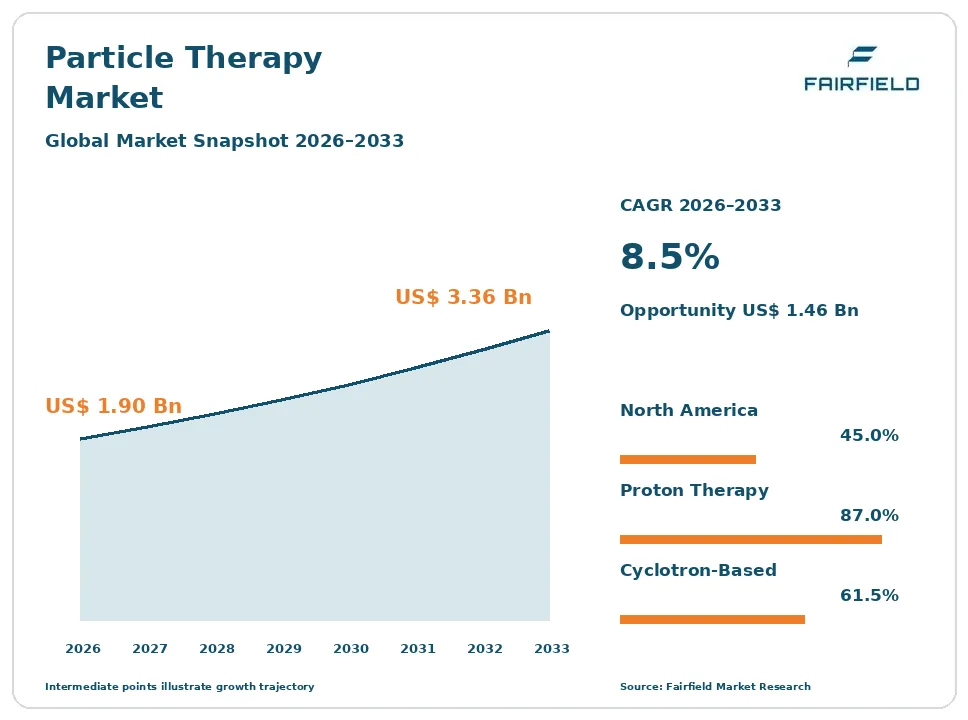
The global particle therapy market size is expected to be valued at US$ 1.90 billion in 2026 and projected to reach US$ 3.36 billion by 2033, growing at a CAGR of 8.5% between 2026 and 2033.
Between 2020 and 2025, the market grew at a CAGR of about 7.2%, as pandemic delays were followed by new orders in Asia Pacific and Europe. Three factors now drive growth: rising cancer cases, strong clinical interest in sparing healthy tissue for children and hard-to-treat tumors, and smaller, cheaper compact proton systems that fit inside hospitals. The market is shifting from large multi-room centers toward single-room systems, pencil beam scanning, adaptive planning, and new delivery methods such as arc therapy and FLASH radiotherapy. Proton therapy dominates, while carbon ion therapy is expanding in Japan, China, and Europe. Upright treatment systems that rotate the patient instead of the beam promise further cost cuts.
Key Report Takeaways
- By Particle Type: Proton Therapy held 87.0% share in 2026, while Heavy Ion Therapy is projected to expand at a 10.8% CAGR through 2033, driven by new carbon ion centers in China, Japan, and South Korea.
- By System Type: Cyclotron-Based held 61.5% share in 2026, while Synchrocyclotron-Based is projected to expand at a 10.2% CAGR through 2033, driven by compact single-room systems for hospitals.
- By Cancer Type: Prostate Cancer held 23.8% share in 2026, while Pediatric Cancers are projected to expand at a 10.1% CAGR through 2033, driven by lower long-term side effects in children.
- By Region: North America held 45.0% share in 2026, while Asia Pacific is projected to expand at an 11.2% CAGR through 2033, driven by new centers in China, India, and Taiwan.
Global Particle Therapy Market Trends and Insights
Drivers Impact Analysis
| Driver | Impact on CAGR Forecast | Geographic Relevance | Impact Timeline |
| Rising cancer burden and tissue-sparing benefits | High | Global | Long term (≥4 years) |
| Compact, lower-cost proton systems | High | North America, Europe, Asia Pacific | Medium term (2-4 years) |
Two drivers carry the strongest influence on particle therapy demand during the forecast period.
Rising Cancer Cases Are Driving the Particle Therapy Market
Rising cancer cases and the tissue-sparing benefits of particle beams are the strongest driver of the particle therapy market. More patients need precise radiation that protects healthy organs.
The mechanism is the physical advantage of protons and heavy ions. Unlike X-rays, protons release most of their energy at a set depth, called the Bragg peak, and deliver almost no dose beyond the tumor. This lowers radiation to nearby organs such as the brain, heart, spinal cord, and growing tissues in children. Global cancer cases are expected to exceed 30 million a year by 2040, with about half of patients needing radiation. Proton therapy is preferred for pediatric tumors, brain and spine tumors, head and neck cancers, eye tumors, and re-irradiation. Clinical trials are testing benefits in breast, lung, esophageal, and liver cancers. These factors support steady growth in treatment rooms and patient volumes.
Compact Systems Are Expanding the Particle Therapy Market
Compact, lower-cost proton systems are expanding the particle therapy market. Smaller machines make the technology affordable for more hospitals.
The cause is engineering progress that shrinks accelerators and gantries. Early proton centers cost more than US$ 150 million and needed large dedicated buildings. Single-room systems such as IBA’s Proteus ONE and Mevion’s S250-FIT cost a fraction of that and fit into existing radiation departments, with a typical Proteus ONE priced at €35 million to €45 million including maintenance. Superconducting synchrocyclotrons reduce size and power use. Leo Cancer Care’s upright Marie system rotates the patient instead of the beam, removing the need for a huge gantry. Pencil beam scanning improves precision and allows intensity-modulated proton therapy. These advances open the market to mid-sized hospitals.
Restraints Impact Analysis
| Restraint | Impact on CAGR Forecast | Geographic Relevance | Impact Timeline |
| High capital costs and long payback | High | Global | Long term (≥4 years) |
| Limited reimbursement and evidence gaps | Medium | North America, Europe | Medium term (2-4 years) |
Two restraints limit how quickly the particle therapy market grows.
High Costs Slow the Particle Therapy Market
High capital costs and long payback periods slow the particle therapy market. Particle therapy centers are among the most expensive medical facilities.
The specific causes are equipment, building, and staffing costs. Even compact single-room systems cost tens of millions of dollars, and multi-room proton or carbon ion centers can exceed US$ 200 million. Shielded concrete vaults, specialized power, and cooling add construction costs and years of building time. Centers need medical physicists, dosimetrists, and engineers with rare skills. Several United States proton centers faced financial difficulties and debt restructuring when patient volumes fell short of plans. High interest rates in 2023 to 2025 raised financing costs. Projects often take five or more years from contract to first patient. Rising construction and steel costs since 2022 have pushed budgets higher. These factors limit the number of new centers.
Reimbursement Gaps Restrict the Particle Therapy Market
Limited reimbursement and evidence gaps restrict the particle therapy market. Payers question whether higher costs bring better outcomes for common cancers.
The underlying causes are high treatment prices and few large randomized trials. A course of proton therapy can cost much more than advanced X-ray therapy. Many private insurers in the United States deny coverage for prostate and breast cancer, citing limited comparative evidence. National health systems in Europe restrict access to approved indications. Ongoing trials may take years to report. Modern X-ray techniques such as intensity-modulated and stereotactic radiotherapy have narrowed the gap for some tumors. Prior authorization rules delay treatment starts and push some patients to X-ray therapy. Referral patterns depend heavily on local oncologists. These factors reduce patient referrals and slow center growth.
Market Opportunities
FLASH, Arc, and Upright Therapies Open an Innovation Revenue Pool
FLASH radiotherapy, proton arc therapy, and upright treatment open an innovation revenue pool in the particle therapy market. New techniques can improve outcomes and lower costs.
Vendors and research centers can capture this opportunity. FLASH radiotherapy delivers ultra-high dose rates in less than a second, which early studies suggest may spare healthy tissue even more. Proton arc therapy, such as IBA’s DynamicARC, rotates the beam during delivery for better dose shaping. Upright systems from Leo Cancer Care are being considered by IHH Healthcare in Asia Pacific and by Fosun in China. Adaptive planning with daily imaging improves accuracy. Software upgrades and service contracts provide recurring revenue. These innovations can widen indications, shorten treatment courses, and attract new customers. Research partnerships with universities help vendors build clinical evidence.
Asia Pacific and Emerging Markets Create a Volume Revenue Pool
New centers in Asia Pacific and other emerging markets create a volume revenue pool in the particle therapy market. Many countries have few or no particle therapy centers.
Equipment makers with compact systems can capture this opportunity. China has approved many proton and carbon ion centers and has local makers such as Shinva and CGN. India has proton centers at Apollo Hospitals in Chennai and Tata Memorial in Mumbai, and more are planned. Taiwan ordered another IBA Proteus ONE in 2026. Brazil signed its first proton center contract in 2026. Governments see particle therapy as a way to keep patients from traveling abroad. Financing, leasing, and public-private partnerships help hospitals afford systems. Carbon ion therapy centers are also planned in China and South Korea, and training programs for physicists are expanding.
Segment Analysis
By Particle Type: Proton Therapy Leads While Heavy Ion Therapy Grows Fastest
Proton Therapy held 87.0% share in 2026. Proton therapy is the most widely available form of particle therapy, with more than 100 centers in the United States and many in Europe, Japan, and China. It treats pediatric, brain, head and neck, eye, prostate, lung, and liver cancers. IBA, Varian, Hitachi, Mevion, and Sumitomo supply most systems. Single-room and multi-room centers are both growing.
Heavy Ion Therapy is the fastest-growing particle type, expanding at a 10.8% CAGR through 2033. Carbon ion therapy delivers more biological damage to tumors, making it useful for radioresistant cancers such as sarcomas and some pancreatic and head and neck tumors. Japan leads with several centers, and China, South Korea, Germany, Italy, and Austria have centers. For the market, heavy ion growth adds high-value projects.
By System Type: Cyclotron-Based Leads While Synchrocyclotron-Based Grows Fastest
Cyclotron-Based held 61.5% share in 2026. Isochronous cyclotrons with pencil beam scanning produce a steady proton beam and power most multi-room centers, including IBA’s Proteus PLUS and Varian’s ProBeam. They are reliable and support high patient volumes. Synchrotron-based systems from Hitachi and Mitsubishi Electric can vary energy directly and are used for both protons and carbon ions.
Synchrocyclotron-Based is the fastest-growing system type, expanding at a 10.2% CAGR through 2033. Superconducting synchrocyclotrons are small enough to mount on or near the gantry, powering compact proton systems such as Proteus ONE and Mevion S250. Lower costs suit hospitals with limited space. Many new orders in Asia Pacific, Europe, and Latin America are single-room systems. For the market, compact growth broadens access.
By Cancer Type: Prostate Cancer Leads While Pediatric Cancers Grow Fastest
Prostate Cancer held 23.8% share in 2026. Prostate cancer is common and often treated with proton therapy in North America to reduce rectal and bladder side effects. Hypofractionated schedules shorten treatment and lower cost per patient. Brain, head and neck, lung, breast, and liver cancers form other large groups, and re-irradiation of recurrent tumors is a growing use.
Pediatric Cancers are the fastest-growing cancer type, expanding at a 10.1% CAGR through 2033. Children are especially sensitive to radiation, and protons reduce the risk of growth problems, hearing loss, learning difficulties, and second cancers. Guidelines in many countries recommend proton therapy for pediatric brain tumors, sarcomas, and other cancers. Brazil’s first center will focus on children. For the market, pediatric growth supports public funding.
Geography Analysis
Which Region Is Leading the Particle Therapy Market?
North America is leading the particle therapy market with a 45.0% share in 2026. The United States has the largest number of proton centers in the world, including major programs at MD Anderson, Mayo Clinic, Massachusetts General Hospital, and Memorial Sloan Kettering. Varian, Mevion, and IBA have large installed bases. Medicare covers proton therapy for many indications, although private insurer coverage varies. Canada opened its first proton center in Montreal and is building more. New single-room systems are being installed in community hospitals, such as BayCare’s center in Florida. One change shaping the region is the move to compact systems.
Europe Advances the Particle Therapy Market Through Public Programs
Europe is a major particle therapy market. Germany, Italy, the United Kingdom, France, and the Netherlands have established proton and carbon ion centers, many linked to university hospitals. Spain is installing ten proton systems across nine sites under a public program funded by the Amancio Ortega Foundation. The United Kingdom runs national proton centers in Manchester and London. Austria’s MedAustron offers both protons and carbon ions. Denmark and Sweden run national proton centers. Key barriers include tight health budgets and strict indication lists. One opportunity is clinical research in FLASH and arc therapy.
Which Region Is Growing Fastest in the Particle Therapy Market?
Asia Pacific is growing fastest in the particle therapy market at an 11.2% CAGR through 2033. China is building many proton and carbon ion centers and supporting local manufacturers. Japan has one of the highest numbers of particle therapy centers per person in the world, with national insurance coverage for several cancers. India has a few centers and plans for more, serving patients from neighboring countries. Taiwan and South Korea are adding new systems, and Australia has opened its first proton center in Adelaide. One opportunity is upright and compact systems for hospital groups such as IHH Healthcare.
Latin America Grows the Particle Therapy Market Through First Centers
Latin America is an emerging particle therapy market. Brazil signed its first proton therapy center contract in 2026 for a pediatric-focused center in Rio de Janeiro, developed with the National Cancer Institute. Argentina is building a proton center in Buenos Aires with local technology partner INVAP. Mexico, Colombia, and Chile send patients abroad for treatment and are studying local centers. Families often travel to the United States or Europe at high cost. Key barriers include high costs, limited reimbursement, and shortages of trained physicists. One opportunity is pediatric-focused public centers built with development bank financing.
Middle East & Africa Builds the Particle Therapy Market
Middle East & Africa is an emerging particle therapy market. Saudi Arabia has opened proton therapy at King Fahad Medical City in Riyadh under its national health transformation plan, and the United Arab Emirates is planning centers to reduce medical travel abroad. Israel has strong research and clinical interest in compact and upright systems. South Africa has the region’s longest proton experience through iThemba LABS. Egypt and Qatar are studying centers for pediatric patients. Key barriers include high costs, limited insurance coverage, and few skilled staff. One opportunity is national cancer center projects that combine proton therapy with advanced imaging and research.
Competitive Landscape
The particle therapy market is highly concentrated. IBA is the market leader by installed rooms, followed by Siemens Healthineers through Varian, Hitachi, Mevion Medical Systems, and Sumitomo Heavy Industries. Mitsubishi Electric, Toshiba Energy Systems & Solutions, ProTom International, Shinva, CGN, and Leo Cancer Care add competition, while software companies such as RaySearch Laboratories supply treatment planning.
Companies compete on clinical capabilities, footprint, cost, uptime, delivery techniques, service, and financing. Long-term maintenance contracts provide stable revenue after installation. Each contract is large, so a few wins can shift market share. Vendors often help customers with financing, site design, and staff training. Treatment planning software, imaging, and quality assurance tools are bundled into offers. Chinese makers are gaining share at home with government support.
Strategic moves show how competition is changing. In September 2025, Leo Cancer Care expanded its collaboration with IHH Healthcare to include upright proton therapy. In November 2025, Fosun partnered with Leo Cancer Care to bring upright particle therapy to China. In January 2026, IBA signed a Proteus ONE contract with MacKay Memorial Hospital in Taiwan. In June 2026, IBA signed a contract for Brazil’s first proton center. These moves show competition shifting toward compact systems and new geographies.
Three themes shape vendor strategy. First, vendors are shrinking systems to cut cost. Second, they are adding arc, adaptive, and FLASH capabilities. Third, they are expanding in Asia Pacific and Latin America.
Particle Therapy Market Industry Leaders
- IBA
- Siemens Healthineers (Varian)
- Hitachi
- Mevion Medical Systems
- Sumitomo Heavy Industries
Recent Industry Developments
- June 2026: IBA signed a contract with Fundação Severino Sombra for a Proteus ONE system - creates Brazil’s first proton therapy center, focused on children.
- January 2026: IBA signed a contract to supply a Proteus ONE to MacKay Memorial Hospital in Taiwan - expands compact proton therapy in Asia Pacific.
- November 2025: Fosun partnered with Leo Cancer Care to bring upright particle therapy to China - supports lower-cost particle centers.
- September 2025: Leo Cancer Care expanded its collaboration with IHH Healthcare to include its Marie upright proton system - could widen proton access across Asia Pacific.
Companies Covered in the Report
- IBA
- Siemens Healthineers (Varian)
- Hitachi
- Mevion Medical Systems
- Sumitomo Heavy Industries
- Mitsubishi Electric
- Toshiba Energy Systems & Solutions
- ProTom International
- Leo Cancer Care
- Shinva Medical Instrument
- China General Nuclear Power Group
- RaySearch Laboratories
Particle Therapy Market Report Scope
This report covers particle therapy systems and services, including proton and heavy ion therapy, delivered by cyclotron, synchrocyclotron, and synchrotron systems in single-room and multi-room centers, for prostate, pediatric, brain, head and neck, lung, breast, liver, and other cancers in hospitals, cancer centers, and research institutes. It excludes conventional X-ray radiotherapy. The base year is 2025, and the forecast period runs from 2026 to 2033. All values are expressed in US$ Billion.
Particle Type
- Proton Therapy
- Heavy Ion Therapy
System Type
- Cyclotron-Based
- Synchrocyclotron-Based
- Synchrotron-Based
Cancer Type
- Prostate Cancer
- Pediatric Cancers
- Brain & Head and Neck Cancers
- Lung & Breast Cancers
- Others
Regions
- North America
- Europe
- Asia Pacific
- Latin America
- Middle East & Africa
Key Questions Answered in the Report
How big is the particle therapy market in 2026?
The particle therapy market is valued at US$ 1.90 billion in 2026, led by proton therapy systems and services in North America.
What is the particle therapy market forecast to 2033?
The particle therapy market is projected to reach US$ 3.36 billion by 2033, growing at an 8.5% CAGR and adding US$ 1.46 billion.
Which particle type is growing fastest in particle therapy?
Heavy ion therapy is growing fastest at a 10.8% CAGR through 2033, driven by new carbon ion centers in China and Japan.
Which region is growing fastest in the particle therapy market?
Asia Pacific is growing fastest at an 11.2% CAGR through 2033, driven by new centers in China, India, and Taiwan.
Which region holds the largest particle therapy market share?
North America holds the largest share at 45.0% in 2026, supported by the world’s largest number of proton therapy centers.
1. Executive Summary
1.1. Global Particle Therapy Market Snapshot
1.2. Future Projections
1.3. Key Report Takeaways
1.4. Regional Snapshot
2. Market Overview
2.1. Market Definition and Report Scope
2.2. Historical Trends 2020–2025
2.3. Market Dynamics
2.3.1. Drivers
2.3.1.1. Rising Cancer Cases Are Driving the Particle Therapy Market
2.3.1.2. Compact Systems Are Expanding the Particle Therapy Market
2.3.2. Restraints
2.3.2.1. High Costs Slow the Particle Therapy Market
2.3.2.2. Reimbursement Gaps Restrict the Particle Therapy Market
2.3.3. Market Opportunities
2.3.3.1. FLASH, Arc, and Upright Therapies Open an Innovation Revenue Pool
2.3.3.2. Asia Pacific and Emerging Markets Create a Volume Revenue Pool
3. Global Particle Therapy Market Outlook, 2020-2033
3.1. Global Particle Therapy Market Outlook, by Particle Type, Value (US$ Billion), 2020-2033
3.1.1. Proton Therapy
3.1.2. Heavy Ion Therapy
3.2. Global Particle Therapy Market Outlook, by System Type, Value (US$ Billion), 2020-2033
3.2.1. Cyclotron-Based
3.2.2. Synchrocyclotron-Based
3.2.3. Synchrotron-Based
3.3. Global Particle Therapy Market Outlook, by Cancer Type, Value (US$ Billion), 2020-2033
3.3.1. Prostate Cancer
3.3.2. Pediatric Cancers
3.3.3. Brain & Head and Neck Cancers
3.3.4. Lung & Breast Cancers
3.3.5. Others
3.4. Global Particle Therapy Market Outlook, by Region, Value (US$ Billion), 2020-2033
3.4.1. North America
3.4.2. Europe
3.4.3. Asia Pacific
3.4.4. Latin America
3.4.5. Middle East & Africa
4. North America Particle Therapy Market Outlook, 2020-2033
4.1. North America Particle Therapy Market Outlook, by Particle Type, Value (US$ Billion), 2020-2033
4.1.1. Proton Therapy
4.1.2. Heavy Ion Therapy
4.2. North America Particle Therapy Market Outlook, by System Type, Value (US$ Billion), 2020-2033
4.2.1. Cyclotron-Based
4.2.2. Synchrocyclotron-Based
4.2.3. Synchrotron-Based
4.3. North America Particle Therapy Market Outlook, by Cancer Type, Value (US$ Billion), 2020-2033
4.3.1. Prostate Cancer
4.3.2. Pediatric Cancers
4.3.3. Brain & Head and Neck Cancers
4.3.4. Lung & Breast Cancers
4.3.5. Others
4.4. North America Particle Therapy Market Outlook, by Country, Value (US$ Billion), 2020-2033
4.4.1. United States Particle Therapy Market Outlook, by Particle Type, 2020-2033
4.4.2. United States Particle Therapy Market Outlook, by System Type, 2020-2033
4.4.3. United States Particle Therapy Market Outlook, by Cancer Type, 2020-2033
4.4.4. Canada Particle Therapy Market Outlook, by Particle Type, 2020-2033
4.4.5. Canada Particle Therapy Market Outlook, by System Type, 2020-2033
4.4.6. Canada Particle Therapy Market Outlook, by Cancer Type, 2020-2033
5. Europe Particle Therapy Market Outlook, 2020-2033
5.1. Europe Particle Therapy Market Outlook, by Particle Type, Value (US$ Billion), 2020-2033
5.1.1. Proton Therapy
5.1.2. Heavy Ion Therapy
5.2. Europe Particle Therapy Market Outlook, by System Type, Value (US$ Billion), 2020-2033
5.2.1. Cyclotron-Based
5.2.2. Synchrocyclotron-Based
5.2.3. Synchrotron-Based
5.3. Europe Particle Therapy Market Outlook, by Cancer Type, Value (US$ Billion), 2020-2033
5.3.1. Prostate Cancer
5.3.2. Pediatric Cancers
5.3.3. Brain & Head and Neck Cancers
5.3.4. Lung & Breast Cancers
5.3.5. Others
5.4. Europe Particle Therapy Market Outlook, by Country, Value (US$ Billion), 2020-2033
5.4.1. Germany Particle Therapy Market Outlook, by Particle Type, 2020-2033
5.4.2. Germany Particle Therapy Market Outlook, by System Type, 2020-2033
5.4.3. Germany Particle Therapy Market Outlook, by Cancer Type, 2020-2033
5.4.4. Italy Particle Therapy Market Outlook, by Particle Type, 2020-2033
5.4.5. Italy Particle Therapy Market Outlook, by System Type, 2020-2033
5.4.6. Italy Particle Therapy Market Outlook, by Cancer Type, 2020-2033
5.4.7. United Kingdom Particle Therapy Market Outlook, by Particle Type, 2020-2033
5.4.8. United Kingdom Particle Therapy Market Outlook, by System Type, 2020-2033
5.4.9. United Kingdom Particle Therapy Market Outlook, by Cancer Type, 2020-2033
5.4.10. France Particle Therapy Market Outlook, by Particle Type, 2020-2033
5.4.11. France Particle Therapy Market Outlook, by System Type, 2020-2033
5.4.12. France Particle Therapy Market Outlook, by Cancer Type, 2020-2033
5.4.13. Netherlands Particle Therapy Market Outlook, by Particle Type, 2020-2033
5.4.14. Netherlands Particle Therapy Market Outlook, by System Type, 2020-2033
5.4.15. Netherlands Particle Therapy Market Outlook, by Cancer Type, 2020-2033
5.4.16. Spain Particle Therapy Market Outlook, by Particle Type, 2020-2033
5.4.17. Spain Particle Therapy Market Outlook, by System Type, 2020-2033
5.4.18. Spain Particle Therapy Market Outlook, by Cancer Type, 2020-2033
5.4.19. Austria Particle Therapy Market Outlook, by Particle Type, 2020-2033
5.4.20. Austria Particle Therapy Market Outlook, by System Type, 2020-2033
5.4.21. Austria Particle Therapy Market Outlook, by Cancer Type, 2020-2033
5.4.22. Denmark Particle Therapy Market Outlook, by Particle Type, 2020-2033
5.4.23. Denmark Particle Therapy Market Outlook, by System Type, 2020-2033
5.4.24. Denmark Particle Therapy Market Outlook, by Cancer Type, 2020-2033
5.4.25. Sweden Particle Therapy Market Outlook, by Particle Type, 2020-2033
5.4.26. Sweden Particle Therapy Market Outlook, by System Type, 2020-2033
5.4.27. Sweden Particle Therapy Market Outlook, by Cancer Type, 2020-2033
6. Asia Pacific Particle Therapy Market Outlook, 2020-2033
6.1. Asia Pacific Particle Therapy Market Outlook, by Particle Type, Value (US$ Billion), 2020-2033
6.1.1. Proton Therapy
6.1.2. Heavy Ion Therapy
6.2. Asia Pacific Particle Therapy Market Outlook, by System Type, Value (US$ Billion), 2020-2033
6.2.1. Cyclotron-Based
6.2.2. Synchrocyclotron-Based
6.2.3. Synchrotron-Based
6.3. Asia Pacific Particle Therapy Market Outlook, by Cancer Type, Value (US$ Billion), 2020-2033
6.3.1. Prostate Cancer
6.3.2. Pediatric Cancers
6.3.3. Brain & Head and Neck Cancers
6.3.4. Lung & Breast Cancers
6.3.5. Others
6.4. Asia Pacific Particle Therapy Market Outlook, by Country, Value (US$ Billion), 2020-2033
6.4.1. China Particle Therapy Market Outlook, by Particle Type, 2020-2033
6.4.2. China Particle Therapy Market Outlook, by System Type, 2020-2033
6.4.3. China Particle Therapy Market Outlook, by Cancer Type, 2020-2033
6.4.4. Japan Particle Therapy Market Outlook, by Particle Type, 2020-2033
6.4.5. Japan Particle Therapy Market Outlook, by System Type, 2020-2033
6.4.6. Japan Particle Therapy Market Outlook, by Cancer Type, 2020-2033
6.4.7. India Particle Therapy Market Outlook, by Particle Type, 2020-2033
6.4.8. India Particle Therapy Market Outlook, by System Type, 2020-2033
6.4.9. India Particle Therapy Market Outlook, by Cancer Type, 2020-2033
6.4.10. Taiwan Particle Therapy Market Outlook, by Particle Type, 2020-2033
6.4.11. Taiwan Particle Therapy Market Outlook, by System Type, 2020-2033
6.4.12. Taiwan Particle Therapy Market Outlook, by Cancer Type, 2020-2033
6.4.13. South Korea Particle Therapy Market Outlook, by Particle Type, 2020-2033
6.4.14. South Korea Particle Therapy Market Outlook, by System Type, 2020-2033
6.4.15. South Korea Particle Therapy Market Outlook, by Cancer Type, 2020-2033
6.4.16. Australia Particle Therapy Market Outlook, by Particle Type, 2020-2033
6.4.17. Australia Particle Therapy Market Outlook, by System Type, 2020-2033
6.4.18. Australia Particle Therapy Market Outlook, by Cancer Type, 2020-2033
7. Latin America Particle Therapy Market Outlook, 2020-2033
7.1. Latin America Particle Therapy Market Outlook, by Particle Type, Value (US$ Billion), 2020-2033
7.1.1. Proton Therapy
7.1.2. Heavy Ion Therapy
7.2. Latin America Particle Therapy Market Outlook, by System Type, Value (US$ Billion), 2020-2033
7.2.1. Cyclotron-Based
7.2.2. Synchrocyclotron-Based
7.2.3. Synchrotron-Based
7.3. Latin America Particle Therapy Market Outlook, by Cancer Type, Value (US$ Billion), 2020-2033
7.3.1. Prostate Cancer
7.3.2. Pediatric Cancers
7.3.3. Brain & Head and Neck Cancers
7.3.4. Lung & Breast Cancers
7.3.5. Others
7.4. Latin America Particle Therapy Market Outlook, by Country, Value (US$ Billion), 2020-2033
7.4.1. Brazil Particle Therapy Market Outlook, by Particle Type, 2020-2033
7.4.2. Brazil Particle Therapy Market Outlook, by System Type, 2020-2033
7.4.3. Brazil Particle Therapy Market Outlook, by Cancer Type, 2020-2033
7.4.4. Argentina Particle Therapy Market Outlook, by Particle Type, 2020-2033
7.4.5. Argentina Particle Therapy Market Outlook, by System Type, 2020-2033
7.4.6. Argentina Particle Therapy Market Outlook, by Cancer Type, 2020-2033
7.4.7. Mexico Particle Therapy Market Outlook, by Particle Type, 2020-2033
7.4.8. Mexico Particle Therapy Market Outlook, by System Type, 2020-2033
7.4.9. Mexico Particle Therapy Market Outlook, by Cancer Type, 2020-2033
7.4.10. Colombia Particle Therapy Market Outlook, by Particle Type, 2020-2033
7.4.11. Colombia Particle Therapy Market Outlook, by System Type, 2020-2033
7.4.12. Colombia Particle Therapy Market Outlook, by Cancer Type, 2020-2033
7.4.13. Chile Particle Therapy Market Outlook, by Particle Type, 2020-2033
7.4.14. Chile Particle Therapy Market Outlook, by System Type, 2020-2033
7.4.15. Chile Particle Therapy Market Outlook, by Cancer Type, 2020-2033
8. Middle East & Africa Particle Therapy Market Outlook, 2020-2033
8.1. Middle East & Africa Particle Therapy Market Outlook, by Particle Type, Value (US$ Billion), 2020-2033
8.1.1. Proton Therapy
8.1.2. Heavy Ion Therapy
8.2. Middle East & Africa Particle Therapy Market Outlook, by System Type, Value (US$ Billion), 2020-2033
8.2.1. Cyclotron-Based
8.2.2. Synchrocyclotron-Based
8.2.3. Synchrotron-Based
8.3. Middle East & Africa Particle Therapy Market Outlook, by Cancer Type, Value (US$ Billion), 2020-2033
8.3.1. Prostate Cancer
8.3.2. Pediatric Cancers
8.3.3. Brain & Head and Neck Cancers
8.3.4. Lung & Breast Cancers
8.3.5. Others
8.4. Middle East & Africa Particle Therapy Market Outlook, by Country, Value (US$ Billion), 2020-2033
8.4.1. Saudi Arabia Particle Therapy Market Outlook, by Particle Type, 2020-2033
8.4.2. Saudi Arabia Particle Therapy Market Outlook, by System Type, 2020-2033
8.4.3. Saudi Arabia Particle Therapy Market Outlook, by Cancer Type, 2020-2033
8.4.4. United Arab Emirates Particle Therapy Market Outlook, by Particle Type, 2020-2033
8.4.5. United Arab Emirates Particle Therapy Market Outlook, by System Type, 2020-2033
8.4.6. United Arab Emirates Particle Therapy Market Outlook, by Cancer Type, 2020-2033
8.4.7. Israel Particle Therapy Market Outlook, by Particle Type, 2020-2033
8.4.8. Israel Particle Therapy Market Outlook, by System Type, 2020-2033
8.4.9. Israel Particle Therapy Market Outlook, by Cancer Type, 2020-2033
8.4.10. South Africa Particle Therapy Market Outlook, by Particle Type, 2020-2033
8.4.11. South Africa Particle Therapy Market Outlook, by System Type, 2020-2033
8.4.12. South Africa Particle Therapy Market Outlook, by Cancer Type, 2020-2033
8.4.13. Egypt Particle Therapy Market Outlook, by Particle Type, 2020-2033
8.4.14. Egypt Particle Therapy Market Outlook, by System Type, 2020-2033
8.4.15. Egypt Particle Therapy Market Outlook, by Cancer Type, 2020-2033
8.4.16. Qatar Particle Therapy Market Outlook, by Particle Type, 2020-2033
8.4.17. Qatar Particle Therapy Market Outlook, by System Type, 2020-2033
8.4.18. Qatar Particle Therapy Market Outlook, by Cancer Type, 2020-2033
9. Competitive Landscape
9.1. Market Concentration and Industry Leaders
9.2. Competitive Differentiation
9.3. Strategic Moves and Market Direction
9.4. Recent Industry Developments
9.5. Company Profiles
9.5.1. IBA
9.5.2. Siemens Healthineers (Varian)
9.5.3. Hitachi
9.5.4. Mevion Medical Systems
9.5.5. Sumitomo Heavy Industries
9.5.6. Mitsubishi Electric
9.5.7. Toshiba Energy Systems & Solutions
9.5.8. ProTom International
9.5.9. Leo Cancer Care
9.5.10. Shinva Medical Instrument
9.5.11. China General Nuclear Power Group
9.5.12. RaySearch Laboratories
10. Appendix
10.1. Research Methodology
10.2. Report Assumptions
10.3. Acronyms and Abbreviations
| Particle Type | Proton Therapy, Heavy Ion Therapy |
| System Type | Cyclotron-Based, Synchrocyclotron-Based, Synchrotron-Based |
| Cancer Type | Prostate Cancer, Pediatric Cancers, Brain & Head and Neck Cancers, Lung & Breast Cancers, Others |
| Regions | North America, Europe, Asia Pacific, Latin America, Middle East & Africa |
Our Research Methodology
Considering the volatility of business today, traditional approaches to strategizing a game plan can be unfruitful if not detrimental. True ambiguity is no way to determine a forecast. A myriad of predetermined factors must be accounted for such as the degree of risk involved, the magnitude of circumstances, as well as conditions or consequences that are not known or unpredictable. To circumvent binary views that cast uncertainty, the application of market research intelligence to strategically posture, move, and enable actionable outcomes is necessary.
View Methodology
Quality Assured
Rigorous Validation Process

Confidentiality Assured
End-to-end Data Security

Custom Research Services
Tailored To Your Objectives
FAQs
The particle therapy market is valued at US$ 1.90 billion in 2026, led by proton therapy systems and services in North America.
The particle therapy market is projected to reach US$ 3.36 billion by 2033, growing at an 8.5% CAGR and adding US$ 1.46 billion.
Heavy ion therapy is growing fastest at a 10.8% CAGR through 2033, driven by new carbon ion centers in China and Japan.
Asia Pacific is growing fastest at an 11.2% CAGR through 2033, driven by new centers in China, India, and Taiwan.
North America holds the largest share at 45.0% in 2026, supported by the world’s largest number of proton therapy centers.
Related Reports
Oculoplastic Surgery Market Size, Share, Insights, Competitive Landscape, and Forecast 2026 to 2033
Oculoplastic surgery market to reach US$ 17.67 billion by 2033 at a 6.2% CAGR. Explore procedures, products, end uses, companies and regional trends.
Multi-Chamber Bags for Parenteral Nutrition Market Size, Share, Insights, Competitive Landscape, and Forecast 2026 to 2033
Multi-chamber bags for parenteral nutrition market to reach US$ 2.58 billion by 2033 at 7.0% CAGR. Explore segments and regional insights.
Lancet Market Size, Share, Insights, Competitive Landscape, and Forecast 2026 to 2033
Explore the lancet market, reaching US$ 2.43 billion by 2033 at 4.8% CAGR, with product, gauge, application and regional insights.
Hematology Analyzer Market Size, Share, Insights, Competitive Landscape, and Forecast 2026 to 2033
Explore the hematology analyzer market, projected to reach US$3.70 billion by 2033 at 4.60% CAGR, with segment, regional and company insights.
Zirconia Based Dental Materials Market Size, Share, Insights, Competitive Landscape, and Forecast 2026 to 2033
The global zirconia based dental materials market is valued at US$1.6 billion in 2026, reaching US$2.8 billion by 2033, growing at an 8.3% CAGR
Wheelchair Market Size, Share, Insights, Competitive Landscape, and Forecast 2026 to 2033
The global wheelchair market is valued at US$6.4 billion in 2026, reaching US$9.8 billion by 2033, growing at a 6.3% CAGR