



OTC Analgesic Market
OTC Analgesic Market Size, Share, Insights, Competitive Landscape, and Forecast 2026 to 2033
OTC Analgesic Market Size and Trend Analysis
How Fast Is the OTC Analgesic Market Growing?
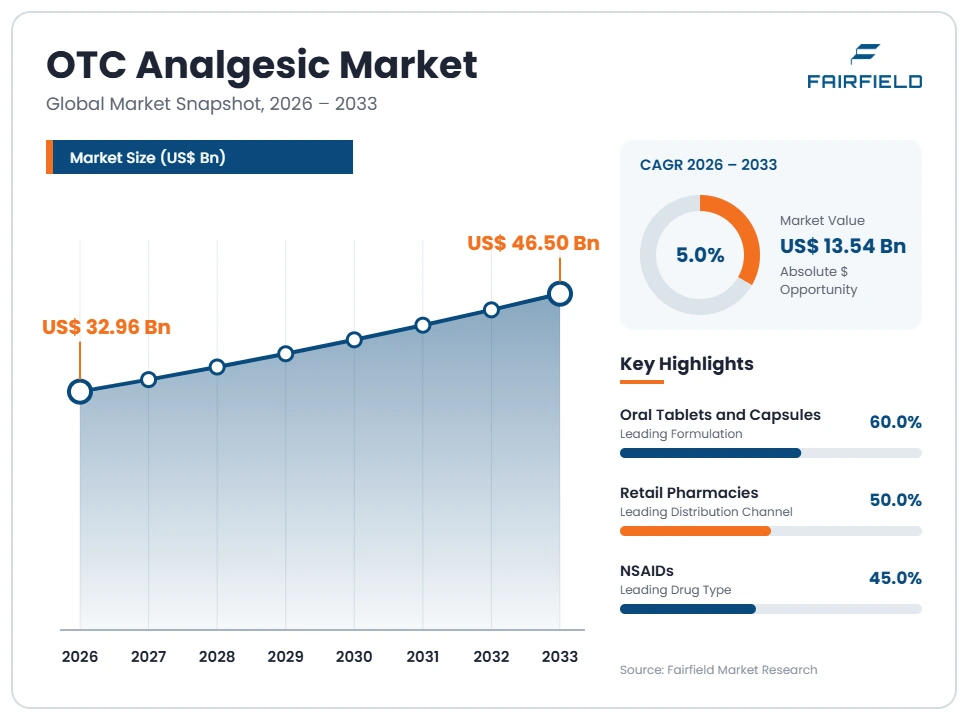
The global OTC analgesic market size is expected to be valued at US$ 32.96 billion in 2026 and projected to reach US$ 46.50 billion by 2033, growing at a CAGR of 5.0% between 2026 and 2033.
Between 2020 and 2025, the market grew at a CAGR of about 3.4%, rising from roughly US$ 26.50 billion to about US$ 31.39 billion, as the pandemic created sudden demand for fever and pain relievers, consumers turned to self-care to avoid clinic visits, and online pharmacies made medicines easier to buy. The OTC analgesic market covers pain relievers sold without a prescription in pharmacies, supermarkets, convenience stores, and online for headaches, back pain, muscle aches, toothache, menstrual cramps, minor arthritis, and fever. Main drug types include acetaminophen (paracetamol), non-steroidal anti-inflammatory drugs such as ibuprofen, naproxen, and aspirin, combination analgesics, and topical analgesics such as diclofenac gels, menthol, and lidocaine patches. Products come as tablets, capsules, liquids, effervescent powders, gels, creams, and patches. In November 2026, Kimberly-Clark completed its acquisition of Kenvue, the maker of Tylenol.
Key Report Takeaways
- By Drug Type: Non-Steroidal Anti-Inflammatory Drugs held about 45% share in 2025, while Combination and Other Analgesics are projected to expand at a 6.2% CAGR through 2033, driven by new fixed-dose products that offer longer relief and simpler dosing for persistent pain.
- By Formulation: Oral Tablets and Capsules held about 60% share in 2025, while Topical Analgesics are projected to expand at a 6.8% CAGR through 2033, driven by ageing populations, joint and muscle pain, and consumer preference for targeted relief with fewer stomach side effects.
- By Distribution Channel: Retail Pharmacies held about 50% share in 2025, while Online Pharmacies are projected to expand at a 9.0% CAGR through 2033, driven by e-commerce growth, fast home delivery, subscription purchasing, and wider use of digital health platforms.
- By Region: North America held about 44% share in 2025, while Asia Pacific is projected to expand at a 6.5% CAGR through 2033, driven by rising incomes, growing self-medication, expanding pharmacy chains, and large populations in China and India.
Global OTC Analgesic Market Trends and Insights
Drivers Impact Analysis
Two drivers carry the strongest influence on OTC analgesic market demand during the forecast period.
| Driver | Impact on CAGR Forecast | Geographic Relevance | Impact Timeline |
| Growing self-care and self-medication | High | Global | Long term (≥4 years) |
| Ageing population and chronic pain | High | North America, Europe, Asia Pacific | Long term (≥4 years) |
Self-Care Is Driving the OTC Analgesic Market
Growing self-care and self-medication are the strongest driver of the OTC analgesic market. People prefer to treat minor pain themselves.
The mechanism is that consumers increasingly manage common health problems such as headaches, colds, fever, and muscle pain without seeing a doctor, saving time and money. Rising healthcare costs, long waiting times for appointments, and limited access to doctors in rural areas push more people to choose non-prescription medicines. Pharmacists play a bigger role in advising customers, and governments encourage self-care to reduce pressure on health systems. Online health information and telehealth services also make consumers more confident about choosing products. Concerns about opioid addiction have led doctors and patients to prefer safer non-opioid options for mild to moderate pain. These trends create steady, broad demand for OTC pain relievers worldwide.
Ageing and Chronic Pain Are Expanding the OTC Analgesic Market
Ageing population and chronic pain are expanding the OTC analgesic market. Older adults use pain relievers more often.
The cause is that the number of people over sixty-five is growing quickly in North America, Europe, Japan, and China, and older adults often experience arthritis, back pain, and joint pain that need regular relief. Active lifestyles, sports, long working hours at desks, and heavy physical work also cause muscle and back pain across all age groups. Chronic pain affects a large share of adults, and many use OTC analgesics for long periods alongside other treatments. Topical products are especially popular with older people because they reduce the risk of stomach and kidney side effects. New combination products offer longer relief for persistent pain. These factors increase usage and support growth in premium products.
Restraints Impact Analysis
Two restraints limit how quickly the OTC analgesic market grows.
| Restraint | Impact on CAGR Forecast | Geographic Relevance | Impact Timeline |
| Safety concerns and side effects | High | Global | Long term (≥4 years) |
| Price competition from private labels and generics | Medium | Global | Medium term (2-4 years) |
Safety Concerns Slow the OTC Analgesic Market
Safety concerns and side effects slow the OTC analgesic market. Misuse can cause serious harm.
The problem is that common pain relievers carry real risks when used incorrectly, including liver damage from too much acetaminophen, and stomach bleeding, kidney problems, and heart risks from long-term use of NSAIDs. Regulators in many countries limit pack sizes, add warning labels, and restrict some products to pharmacies. Public debate has also affected some brands; in 2025, government claims about acetaminophen use during pregnancy created confusion for consumers, although medical groups disputed them. Accidental poisoning in children and intentional overdose remain concerns. Some consumers are cautious about regular medicine use and seek natural alternatives. Lawsuits over product safety also create financial risk for large brands. These factors limit volume growth and raise compliance costs for manufacturers.
Private Labels Restrict the OTC Analgesic Market
Price competition from private labels and generics restricts the OTC analgesic market. Many products contain the same ingredients.
The constraint is that most OTC analgesics use well-known, off-patent active ingredients, so retailers and generic makers can sell store-brand versions at much lower prices. Private-label products often sit next to branded products on pharmacy shelves, and many consumers switch to cheaper options when budgets are tight. Large retail chains and online platforms use their buying power to negotiate lower prices from suppliers. In Asia Pacific, Latin America, and Middle East & Africa, low-cost local manufacturers dominate many markets. Branded companies must spend heavily on advertising, product innovation, and new formats to justify premium prices. These factors squeeze value growth even when volumes rise.
Market Opportunities
New Formulations and Combination Products Open a Fast-Growth Revenue Pool
New formulations and combination products open a fast-growth revenue pool. Consumers want faster and longer relief.
The opportunity comes from products that improve on standard tablets, such as fast-dissolving and liquid gel capsules, extended-release formulas, fixed-dose combinations, and targeted topical patches and gels. In July 2026, the FDA approved Tylenol with Naproxen, the first OTC fixed-dose combination of acetaminophen and naproxen sodium, giving up to 12 hours of relief and earning three years of market exclusivity. Switching prescription-strength products to OTC status also opens new categories, and child-friendly flavors and dosing tools add value in pediatric pain and fever relief. Companies that invest in clinical evidence, consumer-friendly formats, and trusted brands can win premium pricing and loyal customers across every region.
Online Sales and Asia Pacific Create a Growth Revenue Pool
Online sales and Asia Pacific create a growth revenue pool. Buying habits and markets are changing.
The opportunity reflects rapid growth of online pharmacies, e-commerce marketplaces, and quick-commerce delivery apps, which let consumers order pain relievers at any time and receive them within hours. Brands can use digital marketing and subscription models to build loyalty. In Asia Pacific, rising incomes, urbanization, and expanding pharmacy chains in China, India, Indonesia, and Vietnam are increasing access to branded OTC medicines. Governments in some countries are also moving more medicines to non-prescription status, and pharmacists are gaining wider roles in advising patients on minor illnesses and pain. Companies that build strong online presence, local brands, and affordable pack sizes can capture fast growth in these markets.
Segment Analysis
- By Drug Type: Non-Steroidal Anti-Inflammatory Drugs Lead While Combination and Other Analgesics Grow Fastest
Non-Steroidal Anti-Inflammatory Drugs held about 45% share in 2025. Ibuprofen, naproxen, aspirin, and diclofenac relieve pain and reduce inflammation, making them popular for headaches, muscle aches, menstrual cramps, and arthritis. Brands such as Advil, Aleve, Nurofen, and Aspirin are widely sold around the world, and topical NSAID gels are growing quickly.
Combination and Other Analgesics are the fastest-growing segment, expanding at a 6.2% CAGR through 2033. Products that combine acetaminophen with ibuprofen or naproxen, or add caffeine, offer stronger or longer relief, and topical lidocaine and menthol products add options. Acetaminophen forms another major segment, widely used for fever and pain in children and adults. For the market, combination growth supports premium pricing and innovation.
- By Formulation: Oral Tablets and Capsules Lead While Topical Analgesics Grow Fastest
Oral Tablets and Capsules held about 60% share in 2025. Tablets, caplets, and liquid gel capsules are easy to carry, store, and dose, and they remain the most familiar format for consumers buying pain relief. Large pack sizes and private-label options keep volumes high in pharmacies and supermarkets, and new coatings make tablets easier to swallow.
Topical Analgesics are the fastest-growing formulation, expanding at a 6.8% CAGR through 2033. Gels, creams, sprays, and patches deliver relief directly to the painful area with fewer whole-body side effects, which appeals to older adults and athletes. Oral Liquids and Other Formulations form other segments, important for children. For the market, topical growth adds value from targeted products such as long-lasting patches and fast-absorbing gels for joints and muscles.
- By Distribution Channel: Retail Pharmacies Lead While Online Pharmacies Grow Fastest
Retail Pharmacies held about 50% share in 2025. Pharmacies offer trusted advice from pharmacists, wide product ranges, and pharmacy-only products, making them the main place to buy pain relievers in most countries. Large chains also sell strong private-label ranges, run loyalty programs, and offer in-store health services such as blood pressure checks and vaccinations that bring customers back regularly.
Online Pharmacies are the fastest-growing channel, expanding at a 9.0% CAGR through 2033. Consumers value home delivery, price comparison, product reviews, and subscription refills, and many retail chains now combine online ordering with in-store pickup. Supermarkets, Convenience Stores, and Hospital Pharmacies form other segments. For the market, online growth changes how brands reach consumers and increases spending on digital advertising and marketplace placement.
Geography Analysis
- Which Region Is Leading the OTC Analgesic Market?
North America is leading the OTC analgesic market with about 44% share in 2025. The United States has high consumer awareness, a strong culture of self-medication, wide product availability in pharmacies, supermarkets, and online, and heavy brand advertising. Kimberly-Clark, which now owns Tylenol through Kenvue, Perrigo, Haleon’s Advil, and Bayer’s Aleve are major players. Canada adds demand through pharmacies and supermarket chains. Key barriers include safety scrutiny and private-label competition. One change shaping the region is new combination products, store-brand growth, and fast online sales growth through large e-commerce platforms.
- Europe Shapes the OTC Analgesic Market Through Pharmacy-Led Self-Care
Europe is a major OTC analgesic market. Germany, the United Kingdom, France, Italy, and Spain have well-established pharmacy networks and strong self-care cultures. Haleon in the United Kingdom, Bayer in Germany, Reckitt with Nurofen, and Opella in France are major players. Rules on pack sizes and pharmacy-only sales are strict in some countries, such as the United Kingdom and France. Key barriers include price controls and generic competition. One opportunity is topical products and online pharmacies, supported by ageing populations, active lifestyles, and growing interest in natural pain relief ingredients.
- Which Region Is Growing Fastest in the OTC Analgesic Market?
Asia Pacific is the fastest-growing OTC analgesic market, expanding at a 6.5% CAGR through 2033. China and India have huge populations, rising incomes, and growing pharmacy chains, while Japan has one of the world’s oldest populations and strong demand for topical patches from Hisamitsu. Indonesia, Vietnam, and the Philippines are expanding modern retail, and Australia has a mature pharmacy market. Key barriers include low-cost local competition, price controls, and varied regulations across countries. One change shaping the region is fast growth of e-commerce, quick-commerce delivery, and trusted branded products among middle-class consumers.
- Latin America Grows the OTC Analgesic Market Through Pharmacy Expansion
Latin America is a growing OTC analgesic market. Brazil, Mexico, Argentina, Colombia, and Chile have large and growing pharmacy chains, strong self-medication habits, and high demand for pain, headache, and fever relief. Brazil is one of the largest pharmacy markets in the world, and Mexico has a growing network of pharmacies with attached low-cost clinics where doctors advise many customers on pain relief. Key barriers include currency swings, price controls, high inflation in some countries, and strong generic competition. One opportunity is affordable branded products and online pharmacy growth, supported by rising incomes, urbanization, and growing awareness of self-care.
- Middle East & Africa Builds the OTC Analgesic Market Through Retail Growth
Middle East & Africa is an emerging OTC analgesic market. Saudi Arabia and the United Arab Emirates have modern pharmacy chains, growing online pharmacy use, and rising health awareness, while Egypt, Nigeria, Kenya, and South Africa have large young populations and rising demand for affordable pain relief. Key barriers include counterfeit and substandard medicines, high price sensitivity, informal sales channels, and uneven regulation across countries. One opportunity is trusted branded products in modern retail, supported by expanding pharmacy chains, growing online sales in large cities, government efforts to fight counterfeit drugs, and rising awareness of safe self-medication.
Competitive Landscape
The OTC analgesic market is moderately consolidated. Kimberly-Clark Corporation (Kenvue), Haleon plc, Bayer AG, Opella Healthcare, and Perrigo Company plc are leading players, while Reckitt, Hisamitsu, Taisho, Lion Corporation, Teva, Dr. Reddy’s, and Micro Labs compete strongly. A few global consumer health companies own the best-known brands, including Tylenol, Advil, Panadol, Aleve, Aspirin, Nurofen, and Icy Hot, while Perrigo leads in store-brand products and many local companies sell low-cost generics in Asia Pacific, Latin America, and Middle East & Africa.
Companies compete on brand trust, clinical evidence, speed and duration of relief, product formats, pharmacist recommendations, advertising, shelf placement, online visibility, and price. Strong relationships with large pharmacy chains, supermarkets, and e-commerce platforms are critical to winning sales.
Strategic moves show how competition is changing. In April 2025, Opella became a standalone company after Sanofi sold a controlling stake to CD&R. In July 2026, Kenvue won FDA approval for Tylenol with Naproxen, and in November 2026, Kimberly-Clark completed its US$ 48.7 billion acquisition of Kenvue, uniting Tylenol with brands such as Kleenex and Huggies.
Three themes shape vendor strategy. First, companies are launching combination, fast-acting, and topical products to defend premium prices. Second, they are investing in e-commerce and digital marketing. Third, they are expanding in Asia Pacific and other emerging markets with local brands and affordable packs.
OTC Analgesic Market Industry Leaders
- Kimberly-Clark Corporation (Kenvue)
- Haleon plc
- Bayer AG
- Opella Healthcare
- Perrigo Company plc
Recent Industry Developments
- November 2026: Kimberly-Clark completed its acquisition of Kenvue, valued at about US$ 48.7 billion, bringing Tylenol and other consumer health brands under one company - creates one of the largest players in the OTC analgesic market.
- July 2026: Kenvue received FDA approval for Tylenol with Naproxen, the first OTC fixed-dose combination of acetaminophen and naproxen sodium, with three years of exclusivity - adds a new long-lasting non-opioid option.
- April 2025: Sanofi completed the sale of a controlling stake in its consumer health business Opella to CD&R, creating a standalone self-care company - strengthens a focused competitor with pain brands such as Icy Hot and Aspercreme.
Companies Covered in the Report
- Kimberly-Clark Corporation (Kenvue)
- Haleon plc
- Bayer AG
- Opella Healthcare
- Perrigo Company plc
- Reckitt Benckiser Group plc
- Hisamitsu Pharmaceutical Co., Inc.
- Taisho Pharmaceutical Co., Ltd.
- Lion Corporation
- Teva Pharmaceutical Industries Ltd.
- Dr. Reddy’s Laboratories Ltd.
- Micro Labs Limited
OTC Analgesic Market Report Scope
| Metric | Value |
| Study Period | 2020-2033 |
| Market Size 2026 | US$ 32.96 Billion |
| Market Size 2033 | US$ 46.50 Billion |
| CAGR 2026-2033 | 5.0% |
| Absolute Dollar Opportunity | US$ 13.54 Billion |
| Largest Market | North America |
| Fastest-Growing Market | Asia Pacific |
| Market Concentration | Moderately Consolidated |
| Major Players | Kimberly-Clark Corporation (Kenvue), Haleon plc, Bayer AG, Opella Healthcare, Perrigo Company plc |
OTC Analgesic Market Segmentation
- Executive Summary
- OTC Analgesic Market Snapshot
- Future Projections
- Key Market Trends
- Regional Snapshot
- Market Overview
- Market Definition and Report Scope
- Historical Market Trends
- Market Dynamics
- Drivers
- Self-Care Is Driving the OTC Analgesic Market
- Ageing and Chronic Pain Are Expanding the OTC Analgesic Market
- Restraints
- Safety Concerns Slow the OTC Analgesic Market
- Private Labels Restrict the OTC Analgesic Market
- Market Opportunities
- New Formulations and Combination Products Open a Fast-Growth Revenue Pool
- Online Sales and Asia Pacific Create a Growth Revenue Pool
- Drivers
- Global OTC Analgesic Market Outlook, 2020–2033
- Global OTC Analgesic Market Outlook, by Drug Type, Value (US$ Billion), 2020–2033
- Non-Steroidal Anti-Inflammatory Drugs
- Acetaminophen
- Combination and Other Analgesics
- Global OTC Analgesic Market Outlook, by Formulation, Value (US$ Billion), 2020–2033
- Oral Tablets and Capsules
- Topical Analgesics
- Oral Liquids and Other Formulations
- Global OTC Analgesic Market Outlook, by Distribution Channel, Value (US$ Billion), 2020–2033
- Retail Pharmacies
- Online Pharmacies
- Supermarkets and Convenience Stores
- Hospital Pharmacies
- Global OTC Analgesic Market Outlook, by Region, Value (US$ Billion), 2020–2033
- North America
- Europe
- Asia Pacific
- Latin America
- Middle East & Africa
- Global OTC Analgesic Market Outlook, by Drug Type, Value (US$ Billion), 2020–2033
- North America OTC Analgesic Market Outlook, 2020–2033
- North America OTC Analgesic Market Outlook, by Drug Type, Value (US$ Billion), 2020–2033
- Non-Steroidal Anti-Inflammatory Drugs
- Acetaminophen
- Combination and Other Analgesics
- North America OTC Analgesic Market Outlook, by Formulation, Value (US$ Billion), 2020–2033
- Oral Tablets and Capsules
- Topical Analgesics
- Oral Liquids and Other Formulations
- North America OTC Analgesic Market Outlook, by Distribution Channel, Value (US$ Billion), 2020–2033
- Retail Pharmacies
- Online Pharmacies
- Supermarkets and Convenience Stores
- Hospital Pharmacies
- North America OTC Analgesic Market Outlook, by Country, Value (US$ Billion), 2020–2033
- United States OTC Analgesic Market Outlook, by Drug Type, 2020–2033
- United States OTC Analgesic Market Outlook, by Formulation, 2020–2033
- United States OTC Analgesic Market Outlook, by Distribution Channel, 2020–2033
- Canada OTC Analgesic Market Outlook, by Drug Type, 2020–2033
- Canada OTC Analgesic Market Outlook, by Formulation, 2020–2033
- Canada OTC Analgesic Market Outlook, by Distribution Channel, 2020–2033
- North America OTC Analgesic Market Outlook, by Drug Type, Value (US$ Billion), 2020–2033
- Europe OTC Analgesic Market Outlook, 2020–2033
- Europe OTC Analgesic Market Outlook, by Drug Type, Value (US$ Billion), 2020–2033
- Non-Steroidal Anti-Inflammatory Drugs
- Acetaminophen
- Combination and Other Analgesics
- Europe OTC Analgesic Market Outlook, by Formulation, Value (US$ Billion), 2020–2033
- Oral Tablets and Capsules
- Topical Analgesics
- Oral Liquids and Other Formulations
- Europe OTC Analgesic Market Outlook, by Distribution Channel, Value (US$ Billion), 2020–2033
- Retail Pharmacies
- Online Pharmacies
- Supermarkets and Convenience Stores
- Hospital Pharmacies
- Europe OTC Analgesic Market Outlook, by Country, Value (US$ Billion), 2020–2033
- Germany OTC Analgesic Market Outlook, by Drug Type, 2020–2033
- Germany OTC Analgesic Market Outlook, by Formulation, 2020–2033
- Germany OTC Analgesic Market Outlook, by Distribution Channel, 2020–2033
- United Kingdom OTC Analgesic Market Outlook, by Drug Type, 2020–2033
- United Kingdom OTC Analgesic Market Outlook, by Formulation, 2020–2033
- United Kingdom OTC Analgesic Market Outlook, by Distribution Channel, 2020–2033
- France OTC Analgesic Market Outlook, by Drug Type, 2020–2033
- France OTC Analgesic Market Outlook, by Formulation, 2020–2033
- France OTC Analgesic Market Outlook, by Distribution Channel, 2020–2033
- Italy OTC Analgesic Market Outlook, by Drug Type, 2020–2033
- Italy OTC Analgesic Market Outlook, by Formulation, 2020–2033
- Italy OTC Analgesic Market Outlook, by Distribution Channel, 2020–2033
- Spain OTC Analgesic Market Outlook, by Drug Type, 2020–2033
- Spain OTC Analgesic Market Outlook, by Formulation, 2020–2033
- Spain OTC Analgesic Market Outlook, by Distribution Channel, 2020–2033
- Europe OTC Analgesic Market Outlook, by Drug Type, Value (US$ Billion), 2020–2033
- Asia Pacific OTC Analgesic Market Outlook, 2020–2033
- Asia Pacific OTC Analgesic Market Outlook, by Drug Type, Value (US$ Billion), 2020–2033
- Non-Steroidal Anti-Inflammatory Drugs
- Acetaminophen
- Combination and Other Analgesics
- Asia Pacific OTC Analgesic Market Outlook, by Formulation, Value (US$ Billion), 2020–2033
- Oral Tablets and Capsules
- Topical Analgesics
- Oral Liquids and Other Formulations
- Asia Pacific OTC Analgesic Market Outlook, by Distribution Channel, Value (US$ Billion), 2020–2033
- Retail Pharmacies
- Online Pharmacies
- Supermarkets and Convenience Stores
- Hospital Pharmacies
- Asia Pacific OTC Analgesic Market Outlook, by Country, Value (US$ Billion), 2020–2033
- China OTC Analgesic Market Outlook, by Drug Type, 2020–2033
- China OTC Analgesic Market Outlook, by Formulation, 2020–2033
- China OTC Analgesic Market Outlook, by Distribution Channel, 2020–2033
- India OTC Analgesic Market Outlook, by Drug Type, 2020–2033
- India OTC Analgesic Market Outlook, by Formulation, 2020–2033
- India OTC Analgesic Market Outlook, by Distribution Channel, 2020–2033
- Japan OTC Analgesic Market Outlook, by Drug Type, 2020–2033
- Japan OTC Analgesic Market Outlook, by Formulation, 2020–2033
- Japan OTC Analgesic Market Outlook, by Distribution Channel, 2020–2033
- Indonesia OTC Analgesic Market Outlook, by Drug Type, 2020–2033
- Indonesia OTC Analgesic Market Outlook, by Formulation, 2020–2033
- Indonesia OTC Analgesic Market Outlook, by Distribution Channel, 2020–2033
- Vietnam OTC Analgesic Market Outlook, by Drug Type, 2020–2033
- Vietnam OTC Analgesic Market Outlook, by Formulation, 2020–2033
- Vietnam OTC Analgesic Market Outlook, by Distribution Channel, 2020–2033
- Philippines OTC Analgesic Market Outlook, by Drug Type, 2020–2033
- Philippines OTC Analgesic Market Outlook, by Formulation, 2020–2033
- Philippines OTC Analgesic Market Outlook, by Distribution Channel, 2020–2033
- Australia OTC Analgesic Market Outlook, by Drug Type, 2020–2033
- Australia OTC Analgesic Market Outlook, by Formulation, 2020–2033
- Australia OTC Analgesic Market Outlook, by Distribution Channel, 2020–2033
- Asia Pacific OTC Analgesic Market Outlook, by Drug Type, Value (US$ Billion), 2020–2033
- Latin America OTC Analgesic Market Outlook, 2020–2033
- Latin America OTC Analgesic Market Outlook, by Drug Type, Value (US$ Billion), 2020–2033
- Non-Steroidal Anti-Inflammatory Drugs
- Acetaminophen
- Combination and Other Analgesics
- Latin America OTC Analgesic Market Outlook, by Formulation, Value (US$ Billion), 2020–2033
- Oral Tablets and Capsules
- Topical Analgesics
- Oral Liquids and Other Formulations
- Latin America OTC Analgesic Market Outlook, by Distribution Channel, Value (US$ Billion), 2020–2033
- Retail Pharmacies
- Online Pharmacies
- Supermarkets and Convenience Stores
- Hospital Pharmacies
- Latin America OTC Analgesic Market Outlook, by Country, Value (US$ Billion), 2020–2033
- Brazil OTC Analgesic Market Outlook, by Drug Type, 2020–2033
- Brazil OTC Analgesic Market Outlook, by Formulation, 2020–2033
- Brazil OTC Analgesic Market Outlook, by Distribution Channel, 2020–2033
- Mexico OTC Analgesic Market Outlook, by Drug Type, 2020–2033
- Mexico OTC Analgesic Market Outlook, by Formulation, 2020–2033
- Mexico OTC Analgesic Market Outlook, by Distribution Channel, 2020–2033
- Argentina OTC Analgesic Market Outlook, by Drug Type, 2020–2033
- Argentina OTC Analgesic Market Outlook, by Formulation, 2020–2033
- Argentina OTC Analgesic Market Outlook, by Distribution Channel, 2020–2033
- Colombia OTC Analgesic Market Outlook, by Drug Type, 2020–2033
- Colombia OTC Analgesic Market Outlook, by Formulation, 2020–2033
- Colombia OTC Analgesic Market Outlook, by Distribution Channel, 2020–2033
- Chile OTC Analgesic Market Outlook, by Drug Type, 2020–2033
- Chile OTC Analgesic Market Outlook, by Formulation, 2020–2033
- Chile OTC Analgesic Market Outlook, by Distribution Channel, 2020–2033
- Latin America OTC Analgesic Market Outlook, by Drug Type, Value (US$ Billion), 2020–2033
- Middle East & Africa OTC Analgesic Market Outlook, 2020–2033
- Middle East & Africa OTC Analgesic Market Outlook, by Drug Type, Value (US$ Billion), 2020–2033
- Non-Steroidal Anti-Inflammatory Drugs
- Acetaminophen
- Combination and Other Analgesics
- Middle East & Africa OTC Analgesic Market Outlook, by Formulation, Value (US$ Billion), 2020–2033
- Oral Tablets and Capsules
- Topical Analgesics
- Oral Liquids and Other Formulations
- Middle East & Africa OTC Analgesic Market Outlook, by Distribution Channel, Value (US$ Billion), 2020–2033
- Retail Pharmacies
- Online Pharmacies
- Supermarkets and Convenience Stores
- Hospital Pharmacies
- Middle East & Africa OTC Analgesic Market Outlook, by Country, Value (US$ Billion), 2020–2033
- Saudi Arabia OTC Analgesic Market Outlook, by Drug Type, 2020–2033
- Saudi Arabia OTC Analgesic Market Outlook, by Formulation, 2020–2033
- Saudi Arabia OTC Analgesic Market Outlook, by Distribution Channel, 2020–2033
- United Arab Emirates OTC Analgesic Market Outlook, by Drug Type, 2020–2033
- United Arab Emirates OTC Analgesic Market Outlook, by Formulation, 2020–2033
- United Arab Emirates OTC Analgesic Market Outlook, by Distribution Channel, 2020–2033
- Egypt OTC Analgesic Market Outlook, by Drug Type, 2020–2033
- Egypt OTC Analgesic Market Outlook, by Formulation, 2020–2033
- Egypt OTC Analgesic Market Outlook, by Distribution Channel, 2020–2033
- Nigeria OTC Analgesic Market Outlook, by Drug Type, 2020–2033
- Nigeria OTC Analgesic Market Outlook, by Formulation, 2020–2033
- Nigeria OTC Analgesic Market Outlook, by Distribution Channel, 2020–2033
- Kenya OTC Analgesic Market Outlook, by Drug Type, 2020–2033
- Kenya OTC Analgesic Market Outlook, by Formulation, 2020–2033
- Kenya OTC Analgesic Market Outlook, by Distribution Channel, 2020–2033
- South Africa OTC Analgesic Market Outlook, by Drug Type, 2020–2033
- South Africa OTC Analgesic Market Outlook, by Formulation, 2020–2033
- South Africa OTC Analgesic Market Outlook, by Distribution Channel, 2020–2033
- Middle East & Africa OTC Analgesic Market Outlook, by Drug Type, Value (US$ Billion), 2020–2033
- Competitive Landscape
- OTC Analgesic Market Industry Leaders
- Recent Industry Developments
- Company Profiles
- Kimberly-Clark Corporation (Kenvue)
- Haleon plc
- Bayer AG
- Opella Healthcare
- Perrigo Company plc
- Reckitt Benckiser Group plc
- Hisamitsu Pharmaceutical Co., Inc.
- Taisho Pharmaceutical Co., Ltd.
- Lion Corporation
- Teva Pharmaceutical Industries Ltd.
- Dr. Reddy's Laboratories Ltd.
- Micro Labs Limited
- Appendix
- Research Methodology
- Report Assumptions
- Acronyms and Abbreviations
Drug Type
- Non-Steroidal Anti-Inflammatory Drugs
- Acetaminophen
- Combination and Other Analgesics
Formulation
- Oral Tablets and Capsules
- Topical Analgesics
- Oral Liquids and Other Formulations
Distribution Channel
- Retail Pharmacies
- Online Pharmacies
- Supermarkets and Convenience Stores
- Hospital Pharmacies
Regions
- North America
- Europe
- Asia Pacific
- Latin America
- Middle East & Africa
Our Research Methodology
Considering the volatility of business today, traditional approaches to strategizing a game plan can be unfruitful if not detrimental. True ambiguity is no way to determine a forecast. A myriad of predetermined factors must be accounted for such as the degree of risk involved, the magnitude of circumstances, as well as conditions or consequences that are not known or unpredictable. To circumvent binary views that cast uncertainty, the application of market research intelligence to strategically posture, move, and enable actionable outcomes is necessary.
View Methodology
Quality Assured
Rigorous Validation Process

Confidentiality Assured
End-to-end Data Security

Custom Research Services
Tailored To Your Objectives
FAQs
The global OTC analgesic market is expected to be valued at US$ 32.96 billion in 2026, driven by growing self-care and ageing populations.
The market is projected to grow at a 5.0% CAGR from 2026 to 2033, reaching about US$ 46.50 billion by 2033.
North America leads with about 44% share, supported by strong self-medication habits, wide retail availability, and major consumer health companies.
Non-Steroidal Anti-Inflammatory Drugs dominate with about 45% share, because ibuprofen, naproxen, and aspirin relieve both pain and inflammation.
Key players include Kimberly-Clark (Kenvue), Haleon, Bayer, Opella, and Perrigo, competing on brand trust, innovation, formats, and price.
Related Reports
Human Platelet Lysate Market Size, Share, Insights, Competitive Landscape, and Forecast 2026 to 2033
Human platelet lysate market is forecast to grow from US$60.6 million in 2026 to US$83.9 million by 2033, expanding at a CAGR of 4.8%.
Hemophilia B Gene Therapy Market Size, Share, Insights, Competitive Landscape, and Forecast 2026 to 2033
The hemophilia B gene therapy market is projected to reach US$ 4.41 billion by 2033, growing at 29.8% CAGR from US$ 0.71 billion in 2026.
Phosphoramidite Market Size, Share, Insights, Competitive Landscape, and Forecast 2026 to 2033
The phosphoramidite market is projected to reach US$ 1,833.4 million by 2033, growing at 7.7% CAGR from US$ 1,090.8 million in 2026.
New Drug Compound Testing Market Size, Share, Insights, Competitive Landscape, and Forecast 2026 to 2033
The new drug compound testing market is projected to reach US$ 36.88 billion by 2033, growing at 10.7% CAGR from US$ 18.11 billion in 2026.
Microbial Fermentation Technology Market Size, Share, Insights, Competitive Landscape, and Forecast 2026 to 2033
The microbial fermentation technology market is projected to reach US$ 61.53 billion by 2033, growing at 5.9% CAGR from US$ 41.22 billion in 2026.
Macular Edema and Macular Degeneration Market Size, Share, Insights, Competitive Landscape, and Forecast 2026 to 2033
The macular edema and macular degeneration market is projected to reach US$ 20.97 billion by 2033, growing at 7.3% CAGR from US$ 12.77 billion in 2026.