



Pass by Noise Testing Market
Pass by Noise Testing Market Size, Share, Insights, Competitive Landscape, and Forecast 2026 to 2033
Pass by Noise Testing Market Size and Trend Analysis
How Fast Is the Pass by Noise Testing Market Growing?
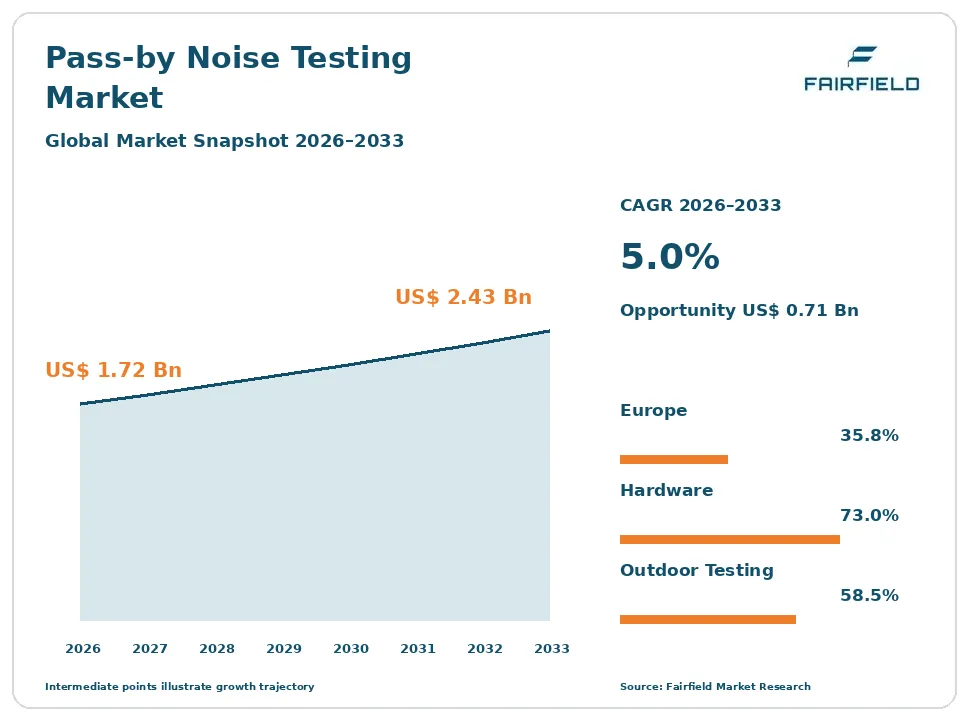
The global pass by noise testing market size is expected to be valued at US$ 1.72 billion in 2026 and projected to reach US$ 2.43 billion by 2033, growing at a CAGR of 5.0% between 2026 and 2033.
Between 2020 and 2025, the market grew at a CAGR of about 4.1%, as vehicle testing slowed during the pandemic and then recovered with new electric vehicle programs and stricter noise rules. Three factors now drive growth: tighter exterior vehicle noise limits under UNECE R51 and European Union rules, rapid electric vehicle launches that need AVAS sound testing, and carmakers’ need to cut development time. The market is shifting from outdoor test tracks toward indoor pass-by testing in semi-anechoic chambers with roller dynamometers, which works in any weather and supports faster engineering. Simulation, microphone arrays, and noise source identification software help engineers find and fix noise problems early in development.
Key Report Takeaways
- By Component: Hardware held 73.0% share in 2026, while Software is projected to expand at a 6.8% CAGR through 2033, driven by simulation, source contribution analysis, and cloud data management.
- By Test Type: Outdoor Testing held 58.5% share in 2026, while Indoor Testing is projected to expand at a 6.4% CAGR through 2033, driven by weather-independent testing and faster development cycles.
- By Propulsion: Internal Combustion Engine Vehicles held 64.2% share in 2026, while Electric Vehicles are projected to expand at a 9.4% CAGR through 2033, driven by acoustic vehicle alerting system rules and tire noise focus.
- By Region: Europe held 35.8% share in 2026, while Asia Pacific is projected to expand at a 6.6% CAGR through 2033, driven by vehicle development growth in China, India, and South Korea.
Global Pass by Noise Testing Market Trends and Insights
Drivers Impact Analysis
| Driver | Impact on CAGR Forecast | Geographic Relevance | Impact Timeline |
| Stricter vehicle noise regulations | High | Europe, Asia Pacific | Long term (≥4 years) |
| Electric vehicle development and AVAS rules | High | Asia Pacific, Europe, North America | Medium term (2-4 years) |
Two drivers carry the strongest influence on pass by noise testing demand during the forecast period.
Stricter Noise Rules Are Driving the Pass by Noise Testing Market
Stricter vehicle noise regulations are the strongest driver of the pass by noise testing market. Governments are lowering how loud vehicles may be when they pass by.
The mechanism is mandatory type-approval testing under tighter limits. European Union Regulation 540/2014, aligned with UNECE R51, cuts limits in three phases. Phase 3 limits applied to new vehicle types from July 2024 and apply to all new registrations from July 2026, lowering limits for most passenger cars by 2 dB, to 68 dB for typical models. Trucks and buses face similar cuts. Additional sound emission provisions require vehicles to stay quiet across a wider range of driving conditions. Japan, China, India, and South Korea follow or adapt UNECE R51. Each new model, engine, exhaust, and tire combination needs testing. These rules drive steady demand for test equipment and services.
Electric Vehicles Are Expanding the Pass by Noise Testing Market
Electric vehicle development and AVAS rules are expanding the pass by noise testing market. Electric cars create new acoustic challenges.
The cause is the quietness of electric drives and new safety rules. At low speeds electric vehicles are so quiet that pedestrians, cyclists, and blind people may not hear them, so UNECE R138, United States federal rules, and similar laws in China and Japan require an acoustic vehicle alerting system. Each AVAS sound must be tested for volume and frequency during approval. Without engine noise, tire and wind noise become the main sources of exterior vehicle noise, needing new measurement methods. Carmakers are launching many electric models, each requiring certification. Siemens, HBK, and HEAD acoustics offer AVAS testing and sound design tools. These trends add test volume and complexity.
Restraints Impact Analysis
| Restraint | Impact on CAGR Forecast | Geographic Relevance | Impact Timeline |
| High cost of test facilities | High | Global | Long term (≥4 years) |
| Slower vehicle development spending | Medium | North America, Europe | Short term (≤2 years) |
Two restraints limit how quickly the pass by noise testing market grows.
High Facility Costs Slow the Pass by Noise Testing Market
High costs of test facilities slow the pass by noise testing market. Pass-by testing needs specialized tracks, chambers, and instruments.
The specific causes are infrastructure requirements and skilled staff. Outdoor tests require an ISO 10844 test track with specified road surface, large open space, and stable weather, which takes years to build and maintain. Indoor pass-by testing needs a large semi-anechoic chamber with a four-wheel-drive roller dynamometer and long microphone arrays, which can cost tens of millions of dollars. Precision microphones, data acquisition systems, and software licenses add costs. Experienced acoustic engineers are scarce. Smaller carmakers and suppliers often rent time at independent test centers instead of building their own. Rising energy and construction costs since 2022 have made new facilities more expensive. These factors limit equipment sales.
Slower Development Spending Restricts the Pass by Noise Testing Market
Slower vehicle development spending restricts the pass by noise testing market. Carmakers are cutting costs in a difficult market.
The underlying causes are weaker vehicle sales and shifting electric vehicle plans. Carmakers in Europe and North America have announced cost cuts, delayed some electric models, and reduced engineering budgets in 2024 and 2025. Fewer new model launches mean fewer certification tests. Simulation can replace some physical tests during development, reducing the number of prototype vehicles built. Tariffs and trade uncertainty make investment decisions harder for carmakers and suppliers. Some test centers have spare capacity, which lowers testing prices and delays investment in new equipment. Some programs have been cancelled after development started, wasting test budgets. These factors slow equipment orders, even though regulatory testing remains necessary for every new model sold.
Market Opportunities
Indoor Testing and Simulation Open a Technology Revenue Pool
Indoor pass-by testing and simulation open a technology revenue pool in the pass by noise testing market. Carmakers want faster, repeatable testing.
Equipment and software vendors can capture this opportunity. Indoor facilities allow testing in any weather and at any time, cutting development time and costs. Microphone arrays and beamforming support noise source identification, showing exactly which parts cause noise. Simulation tools predict pass-by noise before prototypes exist, letting engineers adjust designs early. Cloud data platforms help share results across global teams. Combining test and simulation creates recurring software revenue, and digital twins of test tracks let engineers run virtual certification checks. Upgrades to existing chambers and tracks also add sales, and service contracts for calibration and software maintenance provide stable income. Testing exterior vehicle noise for new tire designs is another growing area.
Asia Pacific Vehicle Development Creates a Volume Revenue Pool
Fast-growing vehicle development in Asia Pacific creates a volume revenue pool in the pass by noise testing market. The region produces more than half of the world’s vehicles.
Test equipment makers and service providers can capture this opportunity. China has many carmakers, especially electric vehicle brands such as BYD, Geely, NIO, and Xpeng, that launch new models frequently and export to Europe, where they need certification. India is tightening vehicle noise rules and expanding test centers such as NATRAX. South Korea and Japan have large automotive development centers. New test facilities are being built across the region. Local partnerships help vendors win projects, and government-backed test centers in China and India buy complete systems. Training local engineers adds service revenue, and testing services for export certification are in high demand.
Segment Analysis
By Component: Hardware Leads While Software Grows Fastest
Hardware held 73.0% share in 2026. Hardware includes precision microphones, microphone arrays, data acquisition systems, light barriers, GPS systems, weather stations, and roller dynamometers for indoor pass-by testing. HBK, Siemens, HEAD acoustics, Müller-BBM, GRAS Sound & Vibration, and AVL supply measurement hardware. Chambers and test tracks are often built by specialized acoustic construction firms, and hardware must be calibrated regularly to meet standards.
Software is the fastest-growing component, expanding at a 6.8% CAGR through 2033. Software controls tests, processes data according to standards, produces certification reports, and supports noise source identification and source path contribution analysis. Simulation software predicts noise early in design. Subscription licensing is replacing one-time purchases. For the market, software growth adds recurring revenue.
By Test Type: Outdoor Testing Leads While Indoor Testing Grows Fastest
Outdoor Testing held 58.5% share in 2026. Outdoor tests on ISO-compliant tracks remain the reference method for type approval in many countries. Proving grounds operated by carmakers and independent centers such as UTAC, IDIADA, and NATRAX run large numbers of tests. Weather, wind, and temperature can delay outdoor testing, and track surfaces must be checked to meet ISO 10844.
Indoor Testing is the fastest-growing test type, expanding at a 6.4% CAGR through 2033. Indoor methods are now accepted for type approval in UNECE R51 and allow year-round testing. Carmakers use them for development and certification. Indoor results correlate well with outdoor results when facilities are designed correctly. For the market, indoor growth raises equipment value.
By Propulsion: Internal Combustion Engine Vehicles Lead While Electric Vehicles Grow Fastest
Internal Combustion Engine Vehicles held 64.2% share in 2026. Petrol, diesel, and hybrid vehicles need testing of engine, exhaust, intake, and tire noise to meet tighter limits. Hybrids add complexity because they switch between electric and engine modes during tests. Motorcycles have their own pass-by rules under UNECE R41, and heavy trucks and buses face separate limits. Exhaust and intake system suppliers run frequent tests during development.
Electric Vehicles are the fastest-growing propulsion type, expanding at a 9.4% CAGR through 2033. Electric vehicles need AVAS testing and greater focus on tire and road noise. Many new electric models from China require certification for export. Electric trucks and buses also need AVAS checks. For the market, electric growth adds new test types.
Geography Analysis
North America Advances the Pass by Noise Testing Market Through EV Programs
North America is a significant pass by noise testing market. The United States has large vehicle development centers in Michigan, California, and Ohio, and federal rules require minimum sound levels for quiet electric and hybrid vehicles. Carmakers test vehicles for export to Europe and Asia Pacific. Canada and Mexico add testing linked to vehicle production, and many suppliers test exhaust and tire systems locally. Proving grounds operated by carmakers and independent firms provide outdoor test capacity, and several have added indoor chambers. Key barriers include slower electric vehicle programs and budget cuts. One opportunity is AVAS testing for new electric trucks and vans.
Which Region Is Leading the Pass by Noise Testing Market?
Europe is leading the pass by noise testing market with a 35.8% share in 2026. The European Union sets the world’s strictest vehicle noise limits, with Phase 3 limits applying to all new registrations from July 2026. Germany, France, Italy, Spain, and the United Kingdom host major carmakers, suppliers, and test centers such as UTAC and IDIADA. Leading vendors Siemens Digital Industries Software, HEAD acoustics, Müller-BBM, and AVL are based in the region, and HBK has major operations in Denmark. One change shaping the region is the shift to indoor testing.
Which Region Is Growing Fastest in the Pass by Noise Testing Market?
Asia Pacific is growing fastest in the pass by noise testing market at a 6.6% CAGR through 2033. China has the world’s largest vehicle market and many electric vehicle makers that need certification for home and export markets, along with new national test centers. India is expanding test infrastructure through NATRAX and other centers. Japan and South Korea have strong automotive development, strict noise rules, and major vendors’ regional offices. Thailand and Indonesia are growing production hubs, and Chinese carmakers are building plants there. Export to Europe requires certification under UNECE R51, increasing test demand. One opportunity is new indoor test facilities.
Latin America Grows the Pass by Noise Testing Market Through Vehicle Production
Latin America is a growing pass by noise testing market. Brazil and Mexico have large vehicle production sectors and national noise rules for new vehicles. Argentina and Colombia add vehicle production and assembly. Many tests are done at carmaker sites or international centers, and global brands often certify vehicles in Europe before local launch. Brazil’s CONAMA sets vehicle noise limits that are gradually aligning with international rules. Chinese electric vehicle brands such as BYD are building plants in Brazil, adding new local testing needs. Key barriers include limited local facilities and budgets. One opportunity is regional test services.
Middle East & Africa Builds the Pass by Noise Testing Market
Middle East & Africa is an emerging pass by noise testing market. Morocco and South Africa have growing vehicle production for export to Europe, which requires compliance with European Union noise rules. Saudi Arabia’s new car plants, including Lucid and Ceer, add demand, and Egypt is attracting vehicle assembly. Vehicles sold in the United Arab Emirates and Saudi Arabia must meet regional technical standards that reference international noise rules. Carmakers often rely on European test centers for certification. Key barriers include few local test facilities and skilled staff. One opportunity is export-focused testing for Morocco’s growing auto sector.
Competitive Landscape
The pass by noise testing market is moderately concentrated. Siemens Digital Industries Software through Simcenter, HBK, HEAD acoustics, Müller-BBM VibroAkustik Systeme, and AVL List are leading suppliers, along with Acoem, HORIBA, GRAS Sound & Vibration, and Dewesoft. Test service providers such as UTAC, IDIADA, TÜV, and Bertrandt compete in testing services.
Companies compete on measurement accuracy, compliance with standards, software features, simulation integration, service, and price. Long relationships with carmakers and test centers are important, because changing systems requires retraining and validation. Vendors increasingly sell complete solutions combining hardware, software, chamber design, and services. Test service providers compete on location, capacity, accreditation, and turnaround time. Acoustic consultancies also help carmakers design quieter vehicles and prepare for new rules, and tire makers run their own pass-by tests.
Strategic moves show how competition is changing, often driven by regulation. In June 2024, Bertrandt opened its first North African site in Rabat, Morocco. In July 2024, Phase 3 noise limits began applying to new vehicle types in the European Union. In December 2025, KKR completed its acquisition of Spectris, the parent of HBK. In July 2026, Phase 3 limits began applying to all new registrations. These moves show competition shaped by regulation and ownership changes.
Three themes shape vendor strategy. First, vendors are integrating test and simulation. Second, they are expanding indoor solutions. Third, they are growing in Asia Pacific, where vehicle development is rising fastest.
Pass by Noise Testing Market Industry Leaders
- Siemens Digital Industries Software
- HBK
- HEAD acoustics
- Müller-BBM VibroAkustik Systeme
- AVL List
Recent Industry Developments
- July 2026: European Union Phase 3 vehicle noise limits under Regulation 540/2014 began applying to all new registrations - lowers passenger car limits by 2 dB.
- December 2025: KKR completed its £4.7 billion acquisition of Spectris, the parent of HBK - brings private equity ownership to a leading test equipment maker.
- July 2024: European Union Phase 3 noise limits began applying to new vehicle type approvals - required carmakers to retest new models.
- June 2024: Bertrandt opened its first North African site in Rabat, Morocco - expands engineering and testing services near export production.
Companies Covered in the Report
- Siemens Digital Industries Software
- HBK
- HEAD acoustics
- Müller-BBM VibroAkustik Systeme
- AVL List
- Acoem
- HORIBA
- GRAS Sound & Vibration
- Dewesoft
- UTAC
- Applus+ IDIADA
- Bertrandt
Pass by Noise Testing Market Report Scope
This report covers pass by noise testing hardware, software, and services, including outdoor and indoor testing, for internal combustion engine, hybrid, and electric passenger cars, commercial vehicles, and two-wheelers, used by carmakers, suppliers, test centers, and regulators. It excludes interior noise testing and general vibration testing for vehicles. The base year is 2025, and the forecast period runs from 2026 to 2033. All values are expressed in US$ Billion.
Component
- Hardware
- Software
- Services
Test Type
- Outdoor Testing
- Indoor Testing
Propulsion
- Internal Combustion Engine Vehicles
- Electric Vehicles
Regions
- North America
- Europe
- Asia Pacific
- Latin America
- Middle East & Africa
Key Questions Answered in the Report
How big is the pass by noise testing market in 2026?
The pass by noise testing market is valued at US$ 1.72 billion in 2026, led by outdoor testing hardware in Europe.
What is the pass by noise testing market forecast to 2033?
The market is projected to reach US$ 2.43 billion by 2033, growing at a 5.0% CAGR and adding US$ 0.71 billion.
Which test type is growing fastest in pass by noise testing?
Indoor testing is growing fastest at a 6.4% CAGR through 2033, driven by weather-independent testing and faster vehicle development.
Which region is growing fastest in the pass by noise testing market?
Asia Pacific is growing fastest at a 6.6% CAGR through 2033, driven by vehicle development growth in China and India.
Which region holds the largest pass by noise testing market share?
Europe holds the largest share at 35.8% in 2026, supported by the world’s strictest vehicle noise limits and leading vendors.
1. Executive Summary
1.1. Global Pass by Noise Testing Market Snapshot
1.2. Future Projections
1.3. Key Report Takeaways
1.4. Regional Snapshot
2. Market Overview
2.1. Market Definition and Report Scope
2.2. Historical Trends 2020–2025
2.3. Market Dynamics
2.3.1. Drivers
2.3.1.1. Stricter Noise Rules Are Driving the Pass by Noise Testing Market
2.3.1.2. Electric Vehicles Are Expanding the Pass by Noise Testing Market
2.3.2. Restraints
2.3.2.1. High Facility Costs Slow the Pass by Noise Testing Market
2.3.2.2. Slower Development Spending Restricts the Pass by Noise Testing Market
2.3.3. Market Opportunities
2.3.3.1. Indoor Testing and Simulation Open a Technology Revenue Pool
2.3.3.2. Asia Pacific Vehicle Development Creates a Volume Revenue Pool
3. Global Pass by Noise Testing Market Outlook, 2020-2033
3.1. Global Pass by Noise Testing Market Outlook, by Component, Value (US$ Billion), 2020-2033
3.1.1. Hardware
3.1.2. Software
3.1.3. Services
3.2. Global Pass by Noise Testing Market Outlook, by Test Type, Value (US$ Billion), 2020-2033
3.2.1. Outdoor Testing
3.2.2. Indoor Testing
3.3. Global Pass by Noise Testing Market Outlook, by Propulsion, Value (US$ Billion), 2020-2033
3.3.1. Internal Combustion Engine Vehicles
3.3.2. Electric Vehicles
3.4. Global Pass by Noise Testing Market Outlook, by Region, Value (US$ Billion), 2020-2033
3.4.1. North America
3.4.2. Europe
3.4.3. Asia Pacific
3.4.4. Latin America
3.4.5. Middle East & Africa
4. North America Pass by Noise Testing Market Outlook, 2020-2033
4.1. North America Pass by Noise Testing Market Outlook, by Component, Value (US$ Billion), 2020-2033
4.1.1. Hardware
4.1.2. Software
4.1.3. Services
4.2. North America Pass by Noise Testing Market Outlook, by Test Type, Value (US$ Billion), 2020-2033
4.2.1. Outdoor Testing
4.2.2. Indoor Testing
4.3. North America Pass by Noise Testing Market Outlook, by Propulsion, Value (US$ Billion), 2020-2033
4.3.1. Internal Combustion Engine Vehicles
4.3.2. Electric Vehicles
4.4. North America Pass by Noise Testing Market Outlook, by Country, Value (US$ Billion), 2020-2033
4.4.1. United States Pass by Noise Testing Market Outlook, by Component, 2020-2033
4.4.2. United States Pass by Noise Testing Market Outlook, by Test Type, 2020-2033
4.4.3. United States Pass by Noise Testing Market Outlook, by Propulsion, 2020-2033
4.4.4. Canada Pass by Noise Testing Market Outlook, by Component, 2020-2033
4.4.5. Canada Pass by Noise Testing Market Outlook, by Test Type, 2020-2033
4.4.6. Canada Pass by Noise Testing Market Outlook, by Propulsion, 2020-2033
4.4.7. Mexico Pass by Noise Testing Market Outlook, by Component, 2020-2033
4.4.8. Mexico Pass by Noise Testing Market Outlook, by Test Type, 2020-2033
4.4.9. Mexico Pass by Noise Testing Market Outlook, by Propulsion, 2020-2033
5. Europe Pass by Noise Testing Market Outlook, 2020-2033
5.1. Europe Pass by Noise Testing Market Outlook, by Component, Value (US$ Billion), 2020-2033
5.1.1. Hardware
5.1.2. Software
5.1.3. Services
5.2. Europe Pass by Noise Testing Market Outlook, by Test Type, Value (US$ Billion), 2020-2033
5.2.1. Outdoor Testing
5.2.2. Indoor Testing
5.3. Europe Pass by Noise Testing Market Outlook, by Propulsion, Value (US$ Billion), 2020-2033
5.3.1. Internal Combustion Engine Vehicles
5.3.2. Electric Vehicles
5.4. Europe Pass by Noise Testing Market Outlook, by Country, Value (US$ Billion), 2020-2033
5.4.1. Germany Pass by Noise Testing Market Outlook, by Component, 2020-2033
5.4.2. Germany Pass by Noise Testing Market Outlook, by Test Type, 2020-2033
5.4.3. Germany Pass by Noise Testing Market Outlook, by Propulsion, 2020-2033
5.4.4. France Pass by Noise Testing Market Outlook, by Component, 2020-2033
5.4.5. France Pass by Noise Testing Market Outlook, by Test Type, 2020-2033
5.4.6. France Pass by Noise Testing Market Outlook, by Propulsion, 2020-2033
5.4.7. Italy Pass by Noise Testing Market Outlook, by Component, 2020-2033
5.4.8. Italy Pass by Noise Testing Market Outlook, by Test Type, 2020-2033
5.4.9. Italy Pass by Noise Testing Market Outlook, by Propulsion, 2020-2033
5.4.10. Spain Pass by Noise Testing Market Outlook, by Component, 2020-2033
5.4.11. Spain Pass by Noise Testing Market Outlook, by Test Type, 2020-2033
5.4.12. Spain Pass by Noise Testing Market Outlook, by Propulsion, 2020-2033
5.4.13. United Kingdom Pass by Noise Testing Market Outlook, by Component, 2020-2033
5.4.14. United Kingdom Pass by Noise Testing Market Outlook, by Test Type, 2020-2033
5.4.15. United Kingdom Pass by Noise Testing Market Outlook, by Propulsion, 2020-2033
5.4.16. Denmark Pass by Noise Testing Market Outlook, by Component, 2020-2033
5.4.17. Denmark Pass by Noise Testing Market Outlook, by Test Type, 2020-2033
5.4.18. Denmark Pass by Noise Testing Market Outlook, by Propulsion, 2020-2033
6. Asia Pacific Pass by Noise Testing Market Outlook, 2020-2033
6.1. Asia Pacific Pass by Noise Testing Market Outlook, by Component, Value (US$ Billion), 2020-2033
6.1.1. Hardware
6.1.2. Software
6.1.3. Services
6.2. Asia Pacific Pass by Noise Testing Market Outlook, by Test Type, Value (US$ Billion), 2020-2033
6.2.1. Outdoor Testing
6.2.2. Indoor Testing
6.3. Asia Pacific Pass by Noise Testing Market Outlook, by Propulsion, Value (US$ Billion), 2020-2033
6.3.1. Internal Combustion Engine Vehicles
6.3.2. Electric Vehicles
6.4. Asia Pacific Pass by Noise Testing Market Outlook, by Country, Value (US$ Billion), 2020-2033
6.4.1. China Pass by Noise Testing Market Outlook, by Component, 2020-2033
6.4.2. China Pass by Noise Testing Market Outlook, by Test Type, 2020-2033
6.4.3. China Pass by Noise Testing Market Outlook, by Propulsion, 2020-2033
6.4.4. India Pass by Noise Testing Market Outlook, by Component, 2020-2033
6.4.5. India Pass by Noise Testing Market Outlook, by Test Type, 2020-2033
6.4.6. India Pass by Noise Testing Market Outlook, by Propulsion, 2020-2033
6.4.7. Japan Pass by Noise Testing Market Outlook, by Component, 2020-2033
6.4.8. Japan Pass by Noise Testing Market Outlook, by Test Type, 2020-2033
6.4.9. Japan Pass by Noise Testing Market Outlook, by Propulsion, 2020-2033
6.4.10. South Korea Pass by Noise Testing Market Outlook, by Component, 2020-2033
6.4.11. South Korea Pass by Noise Testing Market Outlook, by Test Type, 2020-2033
6.4.12. South Korea Pass by Noise Testing Market Outlook, by Propulsion, 2020-2033
6.4.13. Thailand Pass by Noise Testing Market Outlook, by Component, 2020-2033
6.4.14. Thailand Pass by Noise Testing Market Outlook, by Test Type, 2020-2033
6.4.15. Thailand Pass by Noise Testing Market Outlook, by Propulsion, 2020-2033
6.4.16. Indonesia Pass by Noise Testing Market Outlook, by Component, 2020-2033
6.4.17. Indonesia Pass by Noise Testing Market Outlook, by Test Type, 2020-2033
6.4.18. Indonesia Pass by Noise Testing Market Outlook, by Propulsion, 2020-2033
7. Latin America Pass by Noise Testing Market Outlook, 2020-2033
7.1. Latin America Pass by Noise Testing Market Outlook, by Component, Value (US$ Billion), 2020-2033
7.1.1. Hardware
7.1.2. Software
7.1.3. Services
7.2. Latin America Pass by Noise Testing Market Outlook, by Test Type, Value (US$ Billion), 2020-2033
7.2.1. Outdoor Testing
7.2.2. Indoor Testing
7.3. Latin America Pass by Noise Testing Market Outlook, by Propulsion, Value (US$ Billion), 2020-2033
7.3.1. Internal Combustion Engine Vehicles
7.3.2. Electric Vehicles
7.4. Latin America Pass by Noise Testing Market Outlook, by Country, Value (US$ Billion), 2020-2033
7.4.1. Brazil Pass by Noise Testing Market Outlook, by Component, 2020-2033
7.4.2. Brazil Pass by Noise Testing Market Outlook, by Test Type, 2020-2033
7.4.3. Brazil Pass by Noise Testing Market Outlook, by Propulsion, 2020-2033
7.4.4. Mexico Pass by Noise Testing Market Outlook, by Component, 2020-2033
7.4.5. Mexico Pass by Noise Testing Market Outlook, by Test Type, 2020-2033
7.4.6. Mexico Pass by Noise Testing Market Outlook, by Propulsion, 2020-2033
7.4.7. Argentina Pass by Noise Testing Market Outlook, by Component, 2020-2033
7.4.8. Argentina Pass by Noise Testing Market Outlook, by Test Type, 2020-2033
7.4.9. Argentina Pass by Noise Testing Market Outlook, by Propulsion, 2020-2033
7.4.10. Colombia Pass by Noise Testing Market Outlook, by Component, 2020-2033
7.4.11. Colombia Pass by Noise Testing Market Outlook, by Test Type, 2020-2033
7.4.12. Colombia Pass by Noise Testing Market Outlook, by Propulsion, 2020-2033
8. Middle East & Africa Pass by Noise Testing Market Outlook, 2020-2033
8.1. Middle East & Africa Pass by Noise Testing Market Outlook, by Component, Value (US$ Billion), 2020-2033
8.1.1. Hardware
8.1.2. Software
8.1.3. Services
8.2. Middle East & Africa Pass by Noise Testing Market Outlook, by Test Type, Value (US$ Billion), 2020-2033
8.2.1. Outdoor Testing
8.2.2. Indoor Testing
8.3. Middle East & Africa Pass by Noise Testing Market Outlook, by Propulsion, Value (US$ Billion), 2020-2033
8.3.1. Internal Combustion Engine Vehicles
8.3.2. Electric Vehicles
8.4. Middle East & Africa Pass by Noise Testing Market Outlook, by Country, Value (US$ Billion), 2020-2033
8.4.1. Morocco Pass by Noise Testing Market Outlook, by Component, 2020-2033
8.4.2. Morocco Pass by Noise Testing Market Outlook, by Test Type, 2020-2033
8.4.3. Morocco Pass by Noise Testing Market Outlook, by Propulsion, 2020-2033
8.4.4. South Africa Pass by Noise Testing Market Outlook, by Component, 2020-2033
8.4.5. South Africa Pass by Noise Testing Market Outlook, by Test Type, 2020-2033
8.4.6. South Africa Pass by Noise Testing Market Outlook, by Propulsion, 2020-2033
8.4.7. Saudi Arabia Pass by Noise Testing Market Outlook, by Component, 2020-2033
8.4.8. Saudi Arabia Pass by Noise Testing Market Outlook, by Test Type, 2020-2033
8.4.9. Saudi Arabia Pass by Noise Testing Market Outlook, by Propulsion, 2020-2033
8.4.10. Egypt Pass by Noise Testing Market Outlook, by Component, 2020-2033
8.4.11. Egypt Pass by Noise Testing Market Outlook, by Test Type, 2020-2033
8.4.12. Egypt Pass by Noise Testing Market Outlook, by Propulsion, 2020-2033
8.4.13. United Arab Emirates Pass by Noise Testing Market Outlook, by Component, 2020-2033
8.4.14. United Arab Emirates Pass by Noise Testing Market Outlook, by Test Type, 2020-2033
8.4.15. United Arab Emirates Pass by Noise Testing Market Outlook, by Propulsion, 2020-2033
9. Competitive Landscape
9.1. Market Concentration and Industry Leaders
9.2. Competitive Differentiation
9.3. Strategic Moves and Market Direction
9.4. Recent Industry Developments
9.5. Company Profiles
9.5.1. Siemens Digital Industries Software
9.5.2. HBK
9.5.3. HEAD acoustics
9.5.4. Müller-BBM VibroAkustik Systeme
9.5.5. AVL List
9.5.6. Acoem
9.5.7. HORIBA
9.5.8. GRAS Sound & Vibration
9.5.9. Dewesoft
9.5.10. UTAC
9.5.11. Applus+ IDIADA
9.5.12. Bertrandt
10. Appendix
10.1. Research Methodology
10.2. Report Assumptions
10.3. Acronyms and Abbreviations
| Component | Hardware, Software, Services |
| Test Type | Outdoor Testing, Indoor Testing |
| Propulsion | Internal Combustion Engine Vehicles, Electric Vehicles |
| Regions | North America, Europe, Asia Pacific, Latin America, Middle East & Africa |
Our Research Methodology
Considering the volatility of business today, traditional approaches to strategizing a game plan can be unfruitful if not detrimental. True ambiguity is no way to determine a forecast. A myriad of predetermined factors must be accounted for such as the degree of risk involved, the magnitude of circumstances, as well as conditions or consequences that are not known or unpredictable. To circumvent binary views that cast uncertainty, the application of market research intelligence to strategically posture, move, and enable actionable outcomes is necessary.
View Methodology
Quality Assured
Rigorous Validation Process

Confidentiality Assured
End-to-end Data Security

Custom Research Services
Tailored To Your Objectives
FAQs
The pass by noise testing market is valued at US$ 1.72 billion in 2026, led by outdoor testing hardware in Europe.
The market is projected to reach US$ 2.43 billion by 2033, growing at a 5.0% CAGR and adding US$ 0.71 billion.
Indoor testing is growing fastest at a 6.4% CAGR through 2033, driven by weather-independent testing and faster vehicle development.
Asia Pacific is growing fastest at a 6.6% CAGR through 2033, driven by vehicle development growth in China and India.
Europe holds the largest share at 35.8% in 2026, supported by the world’s strictest vehicle noise limits and leading vendors.
Related Reports
Electric Vehicle Sound Generator Market Size, Share, Insights, Competitive Landscape, and Forecast 2026 to 2033
Electric vehicle sound generator market to grow from US$1.2 Bn in 2026 to US$3.2 Bn by 2033 at 15.0% CAGR. Explore systems, components and regions.
On-Demand Warehousing Market Size, Share, Insights, Competitive Landscape, and Forecast 2026 to 2033
On-demand warehousing market to grow from US$17.20 Bn in 2026 to US$47.51 Bn by 2033 at 15.6% CAGR. Explore services, storage duration and regional trends.
On-Demand Trucking Market Size, Share, Insights, Competitive Landscape, and Forecast 2026 to 2033
On-demand trucking market to grow from US$11.00 Bn in 2026 to US$30.52 Bn by 2033 at 15.7% CAGR. Explore truck types, services, industries and regions.
On-Demand Transportation Market Size, Share, Insights, Competitive Landscape, and Forecast 2026 to 2033
On-demand transportation market to grow from US$289.18 Bn in 2026 to US$779.10 Bn by 2033 at 15.2% CAGR. Explore services, vehicles and regional trends.
On-Board Diagnostics (OBD) Aftermarket Size, Share, Insights, Competitive Landscape, and Forecast 2026 to 2033
On-board diagnostics (OBD) aftermarket to grow from US$4.74 Bn in 2026 to US$21.02 Bn by 2033 at 23.7% CAGR. Explore connectivity, applications and regions.
On-Board Charger Market Size, Share, Insights, Competitive Landscape, and Forecast 2026 to 2033
On-board charger market to grow from US$10.13 Bn in 2026 to US$27.16 Bn by 2033 at 15.1% CAGR. Explore propulsion, power output, vehicles and regions.