



Plastic Films and Sheets Market
Plastic Films and Sheets Market Size, Share, Insights, Competitive Landscape, and Forecast 2026 to 2033
Plastic Films and Sheets Market Analysis, 2026–2033
Plastic Films and Sheets Market
Plastic Films and Sheets Market Size, Share, Insights, Competitive Landscape, and Forecast 2026 to 2033
Plastic Films and Sheets Market Size and Trend Analysis
How Fast Is the Plastic Films and Sheets Market Growing?
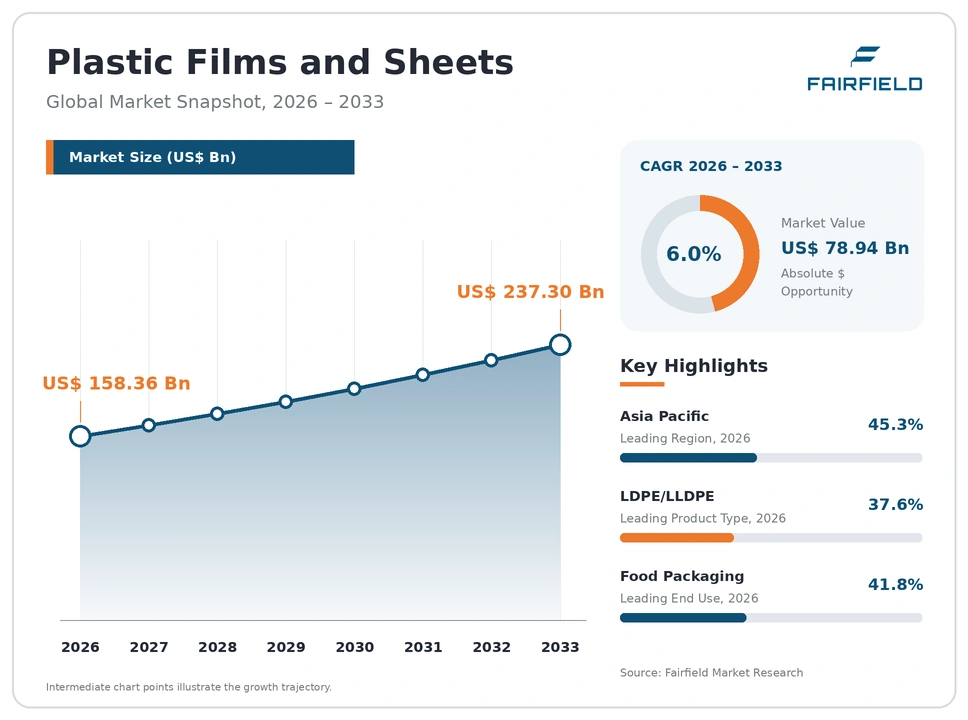
The global plastic films and sheets market size is expected to be valued at US$ 158.36 billion in 2026 and projected to reach US$ 237.30 billion by 2033, growing at a CAGR of 6.0% between 2026 and 2033.
Between 2020 and 2025, the market grew at a CAGR of about 4.6%, as pandemic demand for packaged food, e-commerce, and medical supplies offset weaker industrial use, followed by resin price swings and overcapacity in some film types. Three factors now drive growth: rising demand for flexible packaging in emerging markets, the expansion of e-commerce and cold chain logistics, and growing use of films in agriculture, construction, and healthcare. The market is shifting toward recyclable mono-material films, thinner high-performance films, and higher recycled content to meet new packaging rules.
Key Report Takeaways
- By Product Type: LDPE/LLDPE held 37.6% share in 2026, while Polyamide is projected to expand at a 7.7% CAGR through 2033, driven by high-barrier food and medical packaging.
- By Form: Films held 72.4% share in 2026, while Sheets are projected to expand at a 6.5% CAGR through 2033, driven by thermoformed food trays, blister packs, and recycled PET sheets.
- By End Use: Food Packaging held 41.8% share in 2026, while Medical & Healthcare is projected to expand at a 7.4% CAGR through 2033, driven by sterile barrier packaging and pharmaceutical blisters.
- By Region: Asia Pacific held 45.3% share in 2026, while India is projected to expand at a 8.2% CAGR through 2033, driven by packaged food consumption, organized retail, and new film capacity.
Global Plastic Films and Sheets Market Trends and Insights
Drivers Impact Analysis
Two drivers carry the strongest influence on plastic films and sheets demand during the forecast period.
| Driver | Impact on CAGR Forecast | Geographic Relevance | Impact Timeline |
| Growth of flexible packaging and packaged food | High | Asia Pacific, Latin America, Middle East & Africa | Long term (≥4 years) |
| E-commerce, logistics, and agricultural film demand | Medium | North America, Asia Pacific, Europe | Medium term (2-4 years) |
Flexible Packaging Growth Is Driving the Plastic Films and Sheets Market
Growth of flexible packaging and packaged food is the strongest driver of the plastic films and sheets market. Films protect food, extend shelf life, and use less material than rigid packaging.
The mechanism is urbanization and changing diets. Rising incomes in India, China, Indonesia, Brazil, and Nigeria increase consumption of packaged snacks, dairy, ready meals, and beverages. Organized retail and quick commerce require attractive, durable packaging. BOPP films, polyethylene films, and polyester films are used in pouches, wrappers, and labels, while multilayer barrier films keep oxygen and moisture out. Flexible packaging weighs less than glass, metal, or rigid plastic, reducing transport costs and emissions. Brand owners use printed films for marketing. These trends create steady growth in film volumes, especially in Asia Pacific.
E-commerce and Agriculture Are Expanding the Plastic Films and Sheets Market
E-commerce, logistics, and agricultural film demand are expanding the plastic films and sheets market. Films are essential for shipping, warehousing, and modern farming.
The cause is changing supply chains and food production needs. Online shopping requires mailers, protective films, bubble wrap, and stretch films to secure pallets. Cold chain logistics for fresh food, vaccines, and pharmaceuticals use insulated and barrier films. In agriculture, mulch films, greenhouse films, and silage wraps improve crop yields and reduce water use, especially in China, India, Spain, and Mexico. Construction uses films for vapor barriers, roofing membranes, and protective surface coverings. Healthcare uses films and sheets in medical device packaging, IV bags, and blister packs. Together, these uses broaden demand beyond food packaging and support growth across regions and industries.
Restraints Impact Analysis
Two restraints limit how quickly the plastic films and sheets market grows.
| Restraint | Impact on CAGR Forecast | Geographic Relevance | Impact Timeline |
| Plastic waste regulations and recycling challenges | High | Europe, North America, Asia Pacific | Medium term (2-4 years) |
| Resin price volatility and overcapacity | Medium | Asia Pacific, Europe | Short term (≤2 years) |
Plastic Waste Regulations Slow the Plastic Films and Sheets Market
Plastic waste regulations and recycling challenges slow the plastic films and sheets market. Films are among the hardest plastics to collect and recycle, making them a target for new rules.
The specific causes are multilayer designs and weak collection systems. Many films combine different plastics, aluminium, or paper, which standard recycling cannot separate. Thin, light films are often contaminated with food and are rarely collected curbside. The European Union Packaging and Packaging Waste Regulation, in force since February 2025, requires all packaging to be recyclable by 2030 and sets recycled content targets. Extended producer responsibility schemes charge higher fees for hard-to-recycle packaging. India has banned many single-use plastic items, and some countries tax plastic bags. Brands are shifting some packaging to paper. These pressures limit growth in certain film types.
Resin Price Volatility and Overcapacity Restrict the Plastic Films and Sheets Market
Resin price volatility and overcapacity restrict the plastic films and sheets market. Film makers depend on polyethylene, polypropylene, and polyester resins, whose prices follow oil and gas markets.
The underlying causes are energy price swings and rapid capacity growth. Resin prices rose sharply in 2021 and 2022, squeezing converter margins, and remain volatile. Large new capacity for polyethylene and polypropylene in China, the United States, and Saudi Arabia has lowered prices but intensified competition. China and India have added many new BOPP and BOPET film lines, creating oversupply and price pressure. Smaller film makers struggle to compete with large, efficient lines and integrated resin producers. High energy costs in Europe have led to plant closures. These factors reduce profitability, delay new investment, and push weaker producers to merge or exit.
Market Opportunities
Recyclable Mono-material and Recycled Content Films Open a Sustainable Revenue Pool
Recyclable mono-material films and recycled content films open a sustainable revenue pool in the plastic films and sheets market. Brands need packaging that meets new recyclability and recycled content rules.
Film makers and converters with advanced technology can capture this opportunity. All-polyethylene and all-polypropylene structures replace mixed-material laminates, using machine-direction-oriented polyethylene and high-barrier coatings to keep performance. Films with post-consumer recycled content are in demand from brand owners with sustainability targets. Chemical recycling can supply food-grade recycled resin for films. Amcor, Dow, and UFlex offer recyclable film solutions. Recycled PET sheets for thermoformed trays and clamshells are growing. Premium pricing and long-term supply contracts reward suppliers that help brands comply with Europe, North America, and India packaging rules.
High-barrier and Specialty Films Create a High-value Revenue Pool
High-barrier and specialty films create a high-value revenue pool in the plastic films and sheets market. Demanding applications need films with special properties.
Specialty film makers can capture this opportunity. Polyamide and EVOH barrier films protect meat, cheese, and ready meals, extending shelf life and reducing food waste. Medical films and sheets serve sterile packaging, IV bags, and pharmaceutical blisters. Electronics use polyester and polyimide films for displays, solar panels, and batteries. Agricultural films with UV stabilizers and light control improve greenhouse yields. Toray Industries, Toyobo, DuPont Teijin Films, and SKC supply specialty polyester films. These products command higher margins than commodity films and are less exposed to price competition from new capacity in Asia Pacific. Suppliers with strong research capabilities and customer qualification can build long-term partnerships with food, medical, and electronics companies.
Segment Analysis
By Product Type: LDPE/LLDPE Leads While Polyamide Gains Momentum
LDPE/LLDPE held 37.6% share in 2026. Low-density and linear low-density polyethylene films are used in stretch films, shrink films, bags, liners, agricultural films, and food packaging. They are flexible, tough, and cheap to produce, giving them the largest volume share. Dow, ExxonMobil, and SABIC supply resins, while many converters produce films. BOPP, HDPE, PVC, CPP, and polyester films form other major segments.
Polyamide is the fastest-growing product type, expanding at a 7.7% CAGR through 2033. Polyamide films offer high strength, puncture resistance, and oxygen barrier properties, making them suitable for meat, cheese, and vacuum packaging. Medical packaging and lidding films also use polyamide. Growth in chilled and processed food in Asia Pacific and Latin America drives demand. For the market, polyamide growth adds value through high-performance barrier applications.
By Form: Films Lead While Sheets Grow Fastest
Films held 72.4% share in 2026. Films are thin, flexible materials used in packaging, agriculture, construction, and industrial uses. BOPP films, polyethylene films, and polyester films dominate flexible packaging, labels, and lamination. High-speed extrusion and orientation lines produce large volumes at low cost, and India and China have added many new lines.
Sheets are the fastest-growing form, expanding at a 6.5% CAGR through 2033. Thicker plastic sheets are thermoformed into food trays, clamshells, cups, blister packs, and medical packaging. Recycled PET sheets are increasingly used for food packaging as brands pursue recycled content targets. Polycarbonate and acrylic sheets serve construction, signage, and displays. Growth in ready meals, fresh produce packaging, and pharmaceutical blisters supports demand. For the market, sheets growth adds value through thermoformed and specialty products.
By End Use: Food Packaging Leads While Medical & Healthcare Grows Fastest
Food Packaging held 41.8% share in 2026. Films and sheets package snacks, confectionery, dairy, meat, bakery, produce, and ready meals. Flexible packaging keeps food fresh, extends shelf life, and supports branding. Large consumer goods companies and retailers drive demand in Asia Pacific, North America, and Europe.
Medical & Healthcare is the fastest-growing end use, expanding at a 7.4% CAGR through 2033. Films and sheets are used in sterile barrier packaging, IV bags, pharmaceutical blisters, and medical device trays. Aging populations, growth in generic drugs, and higher healthcare spending increase demand. Strict quality rules favor qualified suppliers. Consumer goods, agriculture, construction, and industrial uses form other important segments. For the market, healthcare growth adds stable, high-value demand.
Geography Analysis
North America Advances the Plastic Films and Sheets Market Through Recyclable Packaging
North America is a large plastic films and sheets market driven by packaged food, e-commerce, and healthcare. The United States has major film producers and converters, including Amcor, Sealed Air, Novolex, and Berry Global, now part of Amcor. Low-cost polyethylene from shale gas supports film production. Several states have adopted extended producer responsibility laws for packaging, pushing recyclable films. Retail store drop-off programs collect some films. Canada and Mexico add demand. Healthcare and pharmaceutical packaging add high-value demand. One change shaping the region is the shift to recyclable mono-material films.
Europe Shapes the Plastic Films and Sheets Market Through Packaging Regulation
Europe is a mature plastic films and sheets market shaped by strict packaging rules. The Packaging and Packaging Waste Regulation requires recyclable packaging by 2030 and recycled content targets. Germany, Italy, France, Spain, and the United Kingdom have large food and packaging industries. Constantia Flexibles, Mondi, Huhtamaki, and Coveris are major film converters. High energy costs and plastic taxes in Italy and the United Kingdom pressure producers. Poland and Turkey are growing production hubs with lower costs. One opportunity is recycled content and mono-material films, supported by investments in film recycling plants.
Which Region Is Leading the Plastic Films and Sheets Market?
Asia Pacific is leading the plastic films and sheets market with a 45.3% share in 2026. China is the largest producer and consumer of plastic films, with massive capacity in BOPP, BOPET, and polyethylene films for packaging, agriculture, and electronics. Japan and South Korea host specialty film makers such as Toray Industries, Toyobo, and SKC. Indonesia, Vietnam, and Thailand have growing food processing industries. India is growing fastest, as detailed below. Agricultural films are widely used in China and Australia. One change shaping the region is rising capacity, which increases exports and price competition in other regions.
Which Country Is Growing Fastest in the Plastic Films and Sheets Market?
India is growing fastest in the plastic films and sheets market at a 8.2% CAGR through 2033. Rising incomes, organized retail, quick commerce, and packaged food consumption increase demand for flexible packaging. Indian producers such as UFlex, Cosmo First, Jindal Poly Films, and SRF export films globally, and Cosmo First commissioned a new BOPP line with 81,200 tonnes of capacity in June 2025. Plastic waste rules require recyclable packaging. JPFL Films is also adding BOPP, PET, and CPP lines in Nashik. One challenge is overcapacity in commodity BOPP and BOPET films. One opportunity is specialty films for export markets.
Latin America Expands the Plastic Films and Sheets Market Through Food and Agriculture
Latin America is a growing plastic films and sheets market driven by food processing and agriculture. Brazil and Mexico have large food, beverage, and meat industries that use barrier and shrink films. Agricultural films are widely used in Mexico, Chile, and Peru for fruit, vegetable, and berry exports to North America and Europe. Braskem supplies polyethylene and polypropylene resins. Colombia and Argentina have growing packaged food and agricultural sectors. Key barriers include currency swings, economic volatility, and imports of low-cost films from Asia Pacific. One opportunity is high-barrier films for meat and dairy exports.
Middle East & Africa Grows the Plastic Films and Sheets Market Through Petrochemical Capacity
Middle East & Africa is a growing plastic films and sheets market supported by petrochemical capacity. Saudi Arabia, the United Arab Emirates, and Qatar produce low-cost polyethylene and polypropylene resins through companies such as SABIC and Borouge. Film converters in the region export to Africa, Europe, and Asia Pacific. In Africa, Nigeria, Egypt, Kenya, and South Africa have growing packaged food markets. Key barriers include weak waste management and plastic bag bans in Kenya, Rwanda, and other countries. One opportunity is film production near low-cost resin supply.
Competitive Landscape
The plastic films and sheets market is fragmented. Amcor, Toray Industries, Sealed Air, UFlex, and Dow are among the leading players, while Toyobo, DuPont Teijin Films, Jindal Poly Films, Cosmo First, SRF, Mondi, and thousands of regional converters compete across film types and end uses.
Companies compete on film quality, barrier performance, recyclability, price, production efficiency, and customer service. Large, modern extrusion and orientation lines offer cost advantages in commodity films, while specialty films require advanced technology and customer qualification. Access to low-cost resin and recycled feedstock is important, so producers near petrochemical plants in Saudi Arabia and the United States enjoy cost benefits.
Strategic moves show how competition is changing. In August 2024, JPFL Films announced a new BOPP line at Nashik. In February 2025, the European Union Packaging and Packaging Waste Regulation entered into force. In April 2025, Amcor completed its acquisition of Berry Global, creating a global leader in films and flexible packaging. In June 2025, Cosmo First commissioned a new BOPP film line, raising its capacity by about 40%. These moves show competition shifting toward scale and recyclable products, as large groups invest in recycling technology and smaller producers specialize in niche films.
Three themes shape vendor strategy. First, companies are developing recyclable mono-material films. Second, they are consolidating to gain scale and purchasing power. Third, they are adding efficient capacity in fast-growing markets such as India.
Plastic Films and Sheets Market Industry Leaders
- Amcor
- Toray Industries
- Sealed Air
- UFlex
- Dow
Recent Industry Developments
- June 2025: Cosmo First commissioned a new BOPP film line with 81,200 tonnes of annual capacity in Aurangabad - raises its BOPP capacity by about 40%.
- April 2025: Amcor completed its acquisition of Berry Global - creates a global leader in films and flexible packaging.
- February 2025: The European Union Packaging and Packaging Waste Regulation entered into force - requires recyclable packaging by 2030.
- August 2024: JPFL Films announced a INR 250 crore investment in a new BOPP film line at Nashik - expands capacity for metallizing and packaging films.
Companies Covered in the Report
- Amcor
- Toray Industries
- Sealed Air
- UFlex
- Dow
- Toyobo
- DuPont Teijin Films
- Jindal Poly Films
- Cosmo First
- SRF
- Mondi
- Novolex
Plastic Films and Sheets Market Report Scope
This report covers plastic films and sheets, including LDPE/LLDPE, HDPE, BOPP, CPP, PVC, polyester, polyamide, and other polymer films and sheets, used in food packaging, consumer goods packaging, medical and healthcare, agriculture, construction, and industrial applications. It excludes rigid plastic containers, bottles, and plastic foam products. The base year is 2025, and the forecast period runs from 2026 to 2033. All values are expressed in US$ Billion.
Product Type
- LDPE/LLDPE
- HDPE
- BOPP
- CPP
- PVC
- Polyester
- Polyamide
- Others
Form
- Films
- Sheets
End Use
- Food Packaging
- Consumer Goods Packaging
- Medical & Healthcare
- Agriculture
- Construction
- Industrial
Regions
- North America
- Europe
- Asia Pacific
- Latin America
- Middle East & Africa
Key Questions Answered in the Report
How big is the plastic films and sheets market in 2026?
The plastic films and sheets market is valued at US$ 158.36 billion in 2026, led by polyethylene films used in food packaging.
What is the plastic films and sheets market forecast to 2033?
The market is projected to reach US$ 237.30 billion by 2033, growing at a 6.0% CAGR and adding US$ 78.94 billion.
Which product type is growing fastest in plastic films and sheets?
Polyamide is growing fastest at a 7.7% CAGR through 2033, driven by high-barrier food packaging and medical packaging demand.
Which country is growing fastest in the plastic films and sheets market?
India is growing fastest at a 8.2% CAGR through 2033, driven by packaged food, organized retail, and new film capacity.
Which region holds the largest plastic films and sheets market share?
Asia Pacific holds the largest share at 45.3% in 2026, supported by large film production capacity in China and India.
1. Executive Summary
1.1. Global Plastic Films and Sheets Market Snapshot
1.2. Future Projections
1.3. Key Report Takeaways
1.4. Regional Snapshot
2. Market Overview
2.1. Market Definition and Report Scope
2.2. Historical Trends 2020–2025
2.3. Market Dynamics
2.3.1. Drivers
2.3.1.1. Flexible Packaging Growth Is Driving the Plastic Films and Sheets Market
2.3.1.2. E-commerce and Agriculture Are Expanding the Plastic Films and Sheets Market
2.3.2. Restraints
2.3.2.1. Plastic Waste Regulations Slow the Plastic Films and Sheets Market
2.3.2.2. Resin Price Volatility and Overcapacity Restrict the Plastic Films and Sheets Market
2.3.3. Market Opportunities
2.3.3.1. Recyclable Mono-material and Recycled Content Films Open a Sustainable Revenue Pool
2.3.3.2. High-barrier and Specialty Films Create a High-value Revenue Pool
3. Global Plastic Films and Sheets Market Outlook, 2020-2033
3.1. Global Plastic Films and Sheets Market Outlook, by Product Type, Value (US$ Billion), 2020-2033
3.1.1. LDPE/LLDPE
3.1.2. HDPE
3.1.3. BOPP
3.1.4. CPP
3.1.5. PVC
3.1.6. Polyester
3.1.7. Polyamide
3.1.8. Others
3.2. Global Plastic Films and Sheets Market Outlook, by Form, Value (US$ Billion), 2020-2033
3.2.1. Films
3.2.2. Sheets
3.3. Global Plastic Films and Sheets Market Outlook, by End Use, Value (US$ Billion), 2020-2033
3.3.1. Food Packaging
3.3.2. Consumer Goods Packaging
3.3.3. Medical & Healthcare
3.3.4. Agriculture
3.3.5. Construction
3.3.6. Industrial
3.4. Global Plastic Films and Sheets Market Outlook, by Region, Value (US$ Billion), 2020-2033
3.4.1. North America
3.4.2. Europe
3.4.3. Asia Pacific
3.4.4. Latin America
3.4.5. Middle East & Africa
4. North America Plastic Films and Sheets Market Outlook, 2020-2033
4.1. North America Plastic Films and Sheets Market Outlook, by Product Type, Value (US$ Billion), 2020-2033
4.1.1. LDPE/LLDPE
4.1.2. HDPE
4.1.3. BOPP
4.1.4. CPP
4.1.5. PVC
4.1.6. Polyester
4.1.7. Polyamide
4.1.8. Others
4.2. North America Plastic Films and Sheets Market Outlook, by Form, Value (US$ Billion), 2020-2033
4.2.1. Films
4.2.2. Sheets
4.3. North America Plastic Films and Sheets Market Outlook, by End Use, Value (US$ Billion), 2020-2033
4.3.1. Food Packaging
4.3.2. Consumer Goods Packaging
4.3.3. Medical & Healthcare
4.3.4. Agriculture
4.3.5. Construction
4.3.6. Industrial
4.4. North America Plastic Films and Sheets Market Outlook, by Country, Value (US$ Billion), 2020-2033
4.4.1. United States Plastic Films and Sheets Market Outlook, by Product Type, 2020-2033
4.4.2. United States Plastic Films and Sheets Market Outlook, by Form, 2020-2033
4.4.3. United States Plastic Films and Sheets Market Outlook, by End Use, 2020-2033
4.4.4. Canada Plastic Films and Sheets Market Outlook, by Product Type, 2020-2033
4.4.5. Canada Plastic Films and Sheets Market Outlook, by Form, 2020-2033
4.4.6. Canada Plastic Films and Sheets Market Outlook, by End Use, 2020-2033
4.4.7. Mexico Plastic Films and Sheets Market Outlook, by Product Type, 2020-2033
4.4.8. Mexico Plastic Films and Sheets Market Outlook, by Form, 2020-2033
4.4.9. Mexico Plastic Films and Sheets Market Outlook, by End Use, 2020-2033
5. Europe Plastic Films and Sheets Market Outlook, 2020-2033
5.1. Europe Plastic Films and Sheets Market Outlook, by Product Type, Value (US$ Billion), 2020-2033
5.1.1. LDPE/LLDPE
5.1.2. HDPE
5.1.3. BOPP
5.1.4. CPP
5.1.5. PVC
5.1.6. Polyester
5.1.7. Polyamide
5.1.8. Others
5.2. Europe Plastic Films and Sheets Market Outlook, by Form, Value (US$ Billion), 2020-2033
5.2.1. Films
5.2.2. Sheets
5.3. Europe Plastic Films and Sheets Market Outlook, by End Use, Value (US$ Billion), 2020-2033
5.3.1. Food Packaging
5.3.2. Consumer Goods Packaging
5.3.3. Medical & Healthcare
5.3.4. Agriculture
5.3.5. Construction
5.3.6. Industrial
5.4. Europe Plastic Films and Sheets Market Outlook, by Country, Value (US$ Billion), 2020-2033
5.4.1. Germany Plastic Films and Sheets Market Outlook, by Product Type, 2020-2033
5.4.2. Germany Plastic Films and Sheets Market Outlook, by Form, 2020-2033
5.4.3. Germany Plastic Films and Sheets Market Outlook, by End Use, 2020-2033
5.4.4. Italy Plastic Films and Sheets Market Outlook, by Product Type, 2020-2033
5.4.5. Italy Plastic Films and Sheets Market Outlook, by Form, 2020-2033
5.4.6. Italy Plastic Films and Sheets Market Outlook, by End Use, 2020-2033
5.4.7. France Plastic Films and Sheets Market Outlook, by Product Type, 2020-2033
5.4.8. France Plastic Films and Sheets Market Outlook, by Form, 2020-2033
5.4.9. France Plastic Films and Sheets Market Outlook, by End Use, 2020-2033
5.4.10. Spain Plastic Films and Sheets Market Outlook, by Product Type, 2020-2033
5.4.11. Spain Plastic Films and Sheets Market Outlook, by Form, 2020-2033
5.4.12. Spain Plastic Films and Sheets Market Outlook, by End Use, 2020-2033
5.4.13. United Kingdom Plastic Films and Sheets Market Outlook, by Product Type, 2020-2033
5.4.14. United Kingdom Plastic Films and Sheets Market Outlook, by Form, 2020-2033
5.4.15. United Kingdom Plastic Films and Sheets Market Outlook, by End Use, 2020-2033
5.4.16. Poland Plastic Films and Sheets Market Outlook, by Product Type, 2020-2033
5.4.17. Poland Plastic Films and Sheets Market Outlook, by Form, 2020-2033
5.4.18. Poland Plastic Films and Sheets Market Outlook, by End Use, 2020-2033
5.4.19. Turkey Plastic Films and Sheets Market Outlook, by Product Type, 2020-2033
5.4.20. Turkey Plastic Films and Sheets Market Outlook, by Form, 2020-2033
5.4.21. Turkey Plastic Films and Sheets Market Outlook, by End Use, 2020-2033
6. Asia Pacific Plastic Films and Sheets Market Outlook, 2020-2033
6.1. Asia Pacific Plastic Films and Sheets Market Outlook, by Product Type, Value (US$ Billion), 2020-2033
6.1.1. LDPE/LLDPE
6.1.2. HDPE
6.1.3. BOPP
6.1.4. CPP
6.1.5. PVC
6.1.6. Polyester
6.1.7. Polyamide
6.1.8. Others
6.2. Asia Pacific Plastic Films and Sheets Market Outlook, by Form, Value (US$ Billion), 2020-2033
6.2.1. Films
6.2.2. Sheets
6.3. Asia Pacific Plastic Films and Sheets Market Outlook, by End Use, Value (US$ Billion), 2020-2033
6.3.1. Food Packaging
6.3.2. Consumer Goods Packaging
6.3.3. Medical & Healthcare
6.3.4. Agriculture
6.3.5. Construction
6.3.6. Industrial
6.4. Asia Pacific Plastic Films and Sheets Market Outlook, by Country, Value (US$ Billion), 2020-2033
6.4.1. China Plastic Films and Sheets Market Outlook, by Product Type, 2020-2033
6.4.2. China Plastic Films and Sheets Market Outlook, by Form, 2020-2033
6.4.3. China Plastic Films and Sheets Market Outlook, by End Use, 2020-2033
6.4.4. Japan Plastic Films and Sheets Market Outlook, by Product Type, 2020-2033
6.4.5. Japan Plastic Films and Sheets Market Outlook, by Form, 2020-2033
6.4.6. Japan Plastic Films and Sheets Market Outlook, by End Use, 2020-2033
6.4.7. South Korea Plastic Films and Sheets Market Outlook, by Product Type, 2020-2033
6.4.8. South Korea Plastic Films and Sheets Market Outlook, by Form, 2020-2033
6.4.9. South Korea Plastic Films and Sheets Market Outlook, by End Use, 2020-2033
6.4.10. Indonesia Plastic Films and Sheets Market Outlook, by Product Type, 2020-2033
6.4.11. Indonesia Plastic Films and Sheets Market Outlook, by Form, 2020-2033
6.4.12. Indonesia Plastic Films and Sheets Market Outlook, by End Use, 2020-2033
6.4.13. Vietnam Plastic Films and Sheets Market Outlook, by Product Type, 2020-2033
6.4.14. Vietnam Plastic Films and Sheets Market Outlook, by Form, 2020-2033
6.4.15. Vietnam Plastic Films and Sheets Market Outlook, by End Use, 2020-2033
6.4.16. Thailand Plastic Films and Sheets Market Outlook, by Product Type, 2020-2033
6.4.17. Thailand Plastic Films and Sheets Market Outlook, by Form, 2020-2033
6.4.18. Thailand Plastic Films and Sheets Market Outlook, by End Use, 2020-2033
6.4.19. India Plastic Films and Sheets Market Outlook, by Product Type, 2020-2033
6.4.20. India Plastic Films and Sheets Market Outlook, by Form, 2020-2033
6.4.21. India Plastic Films and Sheets Market Outlook, by End Use, 2020-2033
6.4.22. Australia Plastic Films and Sheets Market Outlook, by Product Type, 2020-2033
6.4.23. Australia Plastic Films and Sheets Market Outlook, by Form, 2020-2033
6.4.24. Australia Plastic Films and Sheets Market Outlook, by End Use, 2020-2033
7. Latin America Plastic Films and Sheets Market Outlook, 2020-2033
7.1. Latin America Plastic Films and Sheets Market Outlook, by Product Type, Value (US$ Billion), 2020-2033
7.1.1. LDPE/LLDPE
7.1.2. HDPE
7.1.3. BOPP
7.1.4. CPP
7.1.5. PVC
7.1.6. Polyester
7.1.7. Polyamide
7.1.8. Others
7.2. Latin America Plastic Films and Sheets Market Outlook, by Form, Value (US$ Billion), 2020-2033
7.2.1. Films
7.2.2. Sheets
7.3. Latin America Plastic Films and Sheets Market Outlook, by End Use, Value (US$ Billion), 2020-2033
7.3.1. Food Packaging
7.3.2. Consumer Goods Packaging
7.3.3. Medical & Healthcare
7.3.4. Agriculture
7.3.5. Construction
7.3.6. Industrial
7.4. Latin America Plastic Films and Sheets Market Outlook, by Country, Value (US$ Billion), 2020-2033
7.4.1. Brazil Plastic Films and Sheets Market Outlook, by Product Type, 2020-2033
7.4.2. Brazil Plastic Films and Sheets Market Outlook, by Form, 2020-2033
7.4.3. Brazil Plastic Films and Sheets Market Outlook, by End Use, 2020-2033
7.4.4. Mexico Plastic Films and Sheets Market Outlook, by Product Type, 2020-2033
7.4.5. Mexico Plastic Films and Sheets Market Outlook, by Form, 2020-2033
7.4.6. Mexico Plastic Films and Sheets Market Outlook, by End Use, 2020-2033
7.4.7. Chile Plastic Films and Sheets Market Outlook, by Product Type, 2020-2033
7.4.8. Chile Plastic Films and Sheets Market Outlook, by Form, 2020-2033
7.4.9. Chile Plastic Films and Sheets Market Outlook, by End Use, 2020-2033
7.4.10. Peru Plastic Films and Sheets Market Outlook, by Product Type, 2020-2033
7.4.11. Peru Plastic Films and Sheets Market Outlook, by Form, 2020-2033
7.4.12. Peru Plastic Films and Sheets Market Outlook, by End Use, 2020-2033
7.4.13. Colombia Plastic Films and Sheets Market Outlook, by Product Type, 2020-2033
7.4.14. Colombia Plastic Films and Sheets Market Outlook, by Form, 2020-2033
7.4.15. Colombia Plastic Films and Sheets Market Outlook, by End Use, 2020-2033
7.4.16. Argentina Plastic Films and Sheets Market Outlook, by Product Type, 2020-2033
7.4.17. Argentina Plastic Films and Sheets Market Outlook, by Form, 2020-2033
7.4.18. Argentina Plastic Films and Sheets Market Outlook, by End Use, 2020-2033
8. Middle East & Africa Plastic Films and Sheets Market Outlook, 2020-2033
8.1. Middle East & Africa Plastic Films and Sheets Market Outlook, by Product Type, Value (US$ Billion), 2020-2033
8.1.1. LDPE/LLDPE
8.1.2. HDPE
8.1.3. BOPP
8.1.4. CPP
8.1.5. PVC
8.1.6. Polyester
8.1.7. Polyamide
8.1.8. Others
8.2. Middle East & Africa Plastic Films and Sheets Market Outlook, by Form, Value (US$ Billion), 2020-2033
8.2.1. Films
8.2.2. Sheets
8.3. Middle East & Africa Plastic Films and Sheets Market Outlook, by End Use, Value (US$ Billion), 2020-2033
8.3.1. Food Packaging
8.3.2. Consumer Goods Packaging
8.3.3. Medical & Healthcare
8.3.4. Agriculture
8.3.5. Construction
8.3.6. Industrial
8.4. Middle East & Africa Plastic Films and Sheets Market Outlook, by Country, Value (US$ Billion), 2020-2033
8.4.1. Saudi Arabia Plastic Films and Sheets Market Outlook, by Product Type, 2020-2033
8.4.2. Saudi Arabia Plastic Films and Sheets Market Outlook, by Form, 2020-2033
8.4.3. Saudi Arabia Plastic Films and Sheets Market Outlook, by End Use, 2020-2033
8.4.4. United Arab Emirates Plastic Films and Sheets Market Outlook, by Product Type, 2020-2033
8.4.5. United Arab Emirates Plastic Films and Sheets Market Outlook, by Form, 2020-2033
8.4.6. United Arab Emirates Plastic Films and Sheets Market Outlook, by End Use, 2020-2033
8.4.7. Qatar Plastic Films and Sheets Market Outlook, by Product Type, 2020-2033
8.4.8. Qatar Plastic Films and Sheets Market Outlook, by Form, 2020-2033
8.4.9. Qatar Plastic Films and Sheets Market Outlook, by End Use, 2020-2033
8.4.10. Nigeria Plastic Films and Sheets Market Outlook, by Product Type, 2020-2033
8.4.11. Nigeria Plastic Films and Sheets Market Outlook, by Form, 2020-2033
8.4.12. Nigeria Plastic Films and Sheets Market Outlook, by End Use, 2020-2033
8.4.13. Egypt Plastic Films and Sheets Market Outlook, by Product Type, 2020-2033
8.4.14. Egypt Plastic Films and Sheets Market Outlook, by Form, 2020-2033
8.4.15. Egypt Plastic Films and Sheets Market Outlook, by End Use, 2020-2033
8.4.16. Kenya Plastic Films and Sheets Market Outlook, by Product Type, 2020-2033
8.4.17. Kenya Plastic Films and Sheets Market Outlook, by Form, 2020-2033
8.4.18. Kenya Plastic Films and Sheets Market Outlook, by End Use, 2020-2033
8.4.19. South Africa Plastic Films and Sheets Market Outlook, by Product Type, 2020-2033
8.4.20. South Africa Plastic Films and Sheets Market Outlook, by Form, 2020-2033
8.4.21. South Africa Plastic Films and Sheets Market Outlook, by End Use, 2020-2033
8.4.22. Rwanda Plastic Films and Sheets Market Outlook, by Product Type, 2020-2033
8.4.23. Rwanda Plastic Films and Sheets Market Outlook, by Form, 2020-2033
8.4.24. Rwanda Plastic Films and Sheets Market Outlook, by End Use, 2020-2033
9. Competitive Landscape
9.1. Market Concentration and Industry Leaders
9.2. Competitive Differentiation
9.3. Strategic Moves and Market Direction
9.4. Recent Industry Developments
9.5. Company Profiles
9.5.1. Amcor
9.5.2. Toray Industries
9.5.3. Sealed Air
9.5.4. UFlex
9.5.5. Dow
9.5.6. Toyobo
9.5.7. DuPont Teijin Films
9.5.8. Jindal Poly Films
9.5.9. Cosmo First
9.5.10. SRF
9.5.11. Mondi
9.5.12. Novolex
10. Appendix
10.1. Research Methodology
10.2. Report Assumptions
10.3. Acronyms and Abbreviations
| Segment | Categories |
|---|---|
| Product Type | LDPE/LLDPE, HDPE, BOPP, CPP, PVC, Polyester, Polyamide, Others |
| Form | Films, Sheets |
| End Use | Food Packaging, Consumer Goods Packaging, Medical & Healthcare, Agriculture, Construction, Industrial |
| Regions | North America, Europe, Asia Pacific, Latin America, Middle East & Africa |
Our Research Methodology
Considering the volatility of business today, traditional approaches to strategizing a game plan can be unfruitful if not detrimental. True ambiguity is no way to determine a forecast. A myriad of predetermined factors must be accounted for such as the degree of risk involved, the magnitude of circumstances, as well as conditions or consequences that are not known or unpredictable. To circumvent binary views that cast uncertainty, the application of market research intelligence to strategically posture, move, and enable actionable outcomes is necessary.
View Methodology
Quality Assured
Rigorous Validation Process

Confidentiality Assured
End-to-end Data Security

Custom Research Services
Tailored To Your Objectives
FAQs
The plastic films and sheets market is valued at US$ 158.36 billion in 2026, led by polyethylene films used in food packaging.
The market is projected to reach US$ 237.30 billion by 2033, growing at a 6.0% CAGR and adding US$ 78.94 billion.
Polyamide is growing fastest at a 7.7% CAGR through 2033, driven by high-barrier food packaging and medical packaging demand.
India is growing fastest at a 8.2% CAGR through 2033, driven by packaged food, organized retail, and new film capacity.
Asia Pacific holds the largest share at 45.3% in 2026, supported by large film production capacity in China and India.
Related Reports
D-Psicose (Allulose) Market Size, Share, Insights, Competitive Landscape, and Forecast 2026 to 2033
D-psicose (allulose) market to reach US$ 0.749 billion by 2033 at a 15.7% CAGR. Explore forms, applications, sales channels and regional trends.
Butter Packaging Market Size, Share, Insights, Competitive Landscape, and Forecast 2026 to 2033
Butter packaging market to reach US$ 4.83 billion by 2033 at a 6.4% CAGR. Explore materials, packaging types, end uses and regional trends.
Graphene-Enhanced Plastics Market Size, Share, Insights, Competitive Landscape, and Forecast 2026 to 2033
Graphene-enhanced plastics market to reach US$ 154.10 billion by 2033 at a 20.2% CAGR. Explore polymers, applications and regional trends.
Dimethylaminoethyl Methacrylate Market Size, Share, Insights, Competitive Landscape, and Forecast 2026 to 2033
Dimethylaminoethyl methacrylate market to reach US$ 0.282 billion by 2033 at a 4.5% CAGR. Explore grades, applications and regional trends.
Algae-based Building Materials Market Size, Share, Insights, Competitive Landscape, and Forecast 2026 to 2033
Algae-based building materials market to reach US$ 2.82 billion by 2033 at a 15.7% CAGR. Explore products, algae types and regional trends.
Retail Ready Packaging Market Size, Share, Insights, Competitive Landscape, and Forecast 2026 to 2033
Retail ready packaging market to reach US$ 144.96 billion by 2033 at 5.7% CAGR. Explore products, materials, retail channels and regional trends.