



Smart Elevator Market
Smart Elevator Market Insights, Competitive Landscape, and Market Forecast 2033
Global Smart Elevator Market Forecast
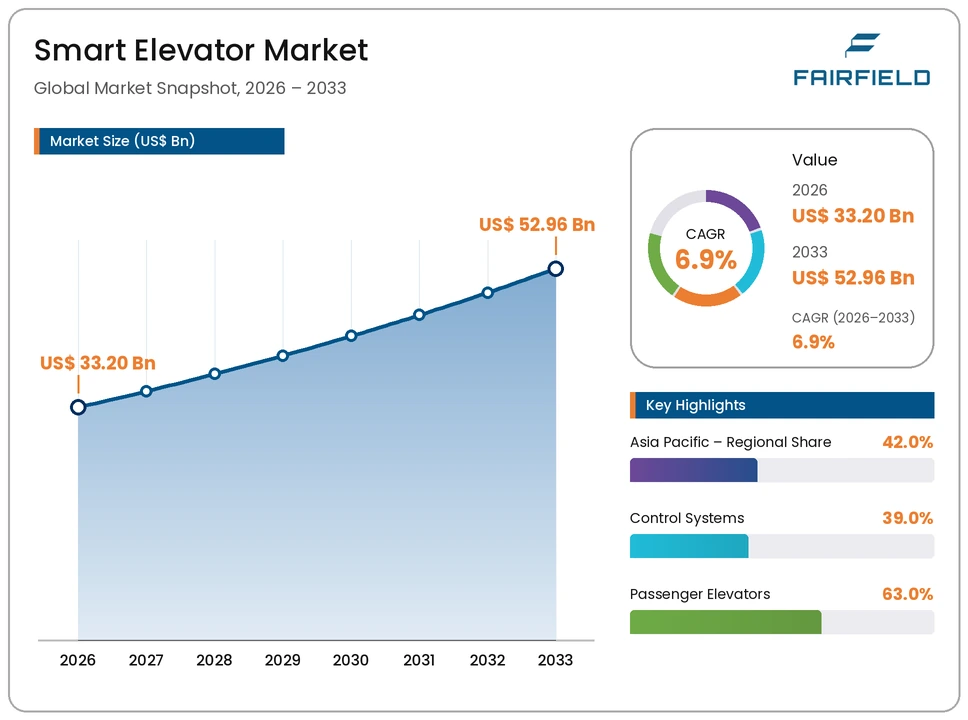
The global smart elevator market is expected to be valued at US$ 33.20 Billion in 2026 and is projected to reach US$ 52.96 Billion by 2033, growing at a CAGR of 6.9% between 2026 and 2033.
This trajectory reflects sustained investment across commercial and residential verticals, reinforced by green building certification programmes such as LEED v4.1 (administered by the U.S. Green Building Council), which award credits for energy-efficient vertical transportation systems. The historical growth rate of 5.3% CAGR between 2020 and 2025 established a durable baseline; accelerating IoT integration and AI-driven dispatch algorithms are now lifting that pace.
Key Highlights
- Asia Pacific's structural position as the smart elevator market's centre of gravity is hardening. The region commands 42% of global market value in 2026 and is expanding at approximately 8% CAGR — well above the global average — driven by coordinated high-rise construction, government smart city mandates, and the sheer volume of new elevator installations across China, India, and Southeast Asia.
- Destination control elevators are redefining the performance benchmark for high-density commercial buildings.
- Control systems anchor the smart elevator industry's revenue structure, representing 39% of total market value and generating the highest per-unit contract value of any component segment.
- Communication systems are emerging as the smart elevator segment's fastest-growing component, as OEMs pivot toward subscription-based monitoring and remote diagnostics business models.
- Mixed-use developments represent a structurally underserved opportunity within the smart elevator landscape.
Key Growth Determinants
- Proliferation of Smart Building Infrastructure and IoT-Enabled Vertical Transport
The convergence of building management systems (BMS), IoT sensor networks, and cloud-based analytics platforms is fundamentally redefining elevator operations. Smart elevators equipped with real-time condition monitoring, regenerative drives, and AI-powered destination dispatch reduce energy consumption by an estimated 25–40% compared with conventional systems, according to data published by the International Energy Agency (IEA). Major commercial real estate operators — including Brookfield Asset Management, which manages over 500 million square feet of office and retail property globally — are incorporating intelligent vertical transport into asset repositioning programmes to satisfy tenant ESG mandates and reduce lifecycle operating costs.
Key Growth Barriers
- High Capital Expenditure and Retrofit Complexity
Installing smart elevator systems in existing buildings requires substantial capital outlay — not merely for the elevator unit itself, but for the BMS integration, cabling infrastructure, and cybersecurity hardening that intelligent systems demand. Retrofit projects in legacy commercial buildings routinely encounter structural constraints that extend installation timelines and inflate total installed cost by 30–50% versus new-build deployments. For mid-market building owners operating on thin property yields, this cost barrier limits addressable demand to premium-grade assets and newly constructed developments.
Market Opportunities
- AI-Driven Predictive Maintenance as a Recurring Revenue Model
The shift from time-based to condition-based maintenance represents a structural commercial opportunity for smart elevator market participants. Elevator OEMs that embed vibration sensors, motor temperature monitors, and door-cycle counters can offer subscription-based predictive maintenance contracts — generating predictable recurring revenue while reducing tenant disruption. KONE Corporation reported that its KONE 24/7 Connected Services platform, launched commercially across European and Asian markets, monitored over 1.5 million elevators and escalators by the end of 2024, demonstrating the scalability of this model. Asset managers overseeing large commercial portfolios are receptive buyers, given the direct impact of elevator downtime on tenant satisfaction scores.
Category-wise Insights
- Component Analysis
Control systems account for 39.0% of the global smart elevator market in 2026, equivalent to US$ 12.95 Billion. This dominance reflects the foundational role that microprocessor-based controllers, variable-frequency drives (VFDs), and AI dispatch algorithms play in every intelligent elevator installation — no other component can be specified independently of the control architecture. High-rise office developers such as Skanska and Hines mandate advanced control platforms from the design stage, embedding them in base-build specifications that set the supplier relationship for the building's full lifecycle. Proprietary control ecosystems also create durable switching costs, reinforcing OEM revenue streams across modernisation and upgrade cycles.
Communication systems are the fastest-growing component segment, propelled by the rapid adoption of IP-based car-to-controller data links and cloud connectivity platforms. Otis Worldwide Corporation's Otis ONE IoT platform, expanded globally in 2023, exemplifies the direction: it streams real-time operational data from elevator components to cloud dashboards accessible by building managers and service technicians, enabling remote diagnostics and over-the-air software updates that were not commercially available before 2020.
- Application Analysis
Commercial buildings account for 46.0% of the global smart elevator market in 2026, equivalent to US$ 15.27 Billion. Corporate real estate tenants — particularly technology companies and financial services firms operating under stringent ESG reporting frameworks — are applying direct pressure on landlords to document vertical transportation energy performance. Grade-A office towers in gateway cities including London, Singapore, and New York are deploying regenerative drive technology and AI dispatch as part of BREEAM and LEED certification strategies, embedding smart elevators as mandatory infrastructure rather than premium additions.
Mixed-use buildings are the fastest-growing application segment, driven by the structural expansion of transit-oriented developments (TODs) and live-work-play complexes that combine residential, retail, hotel, and office functions within a single structure. Mitsubishi Estate's large-scale mixed-use redevelopment of the Tokiwabashi district adjacent to Tokyo Station, which broke ground in 2023, requires elevator systems capable of managing simultaneous, differentiated passenger flows across functionally distinct floors — a complexity that exclusively favours smart destination dispatch architectures.
- Elevator Type Analysis
Passenger elevators account for 63.0% of the global smart elevator market in 2026, equivalent to US$ 20.92 Billion. The scale of this segment reflects the sheer installed base of passenger lift units globally, as well as the direct alignment between passenger elevator performance and the metrics — wait time, energy consumption, and uptime — that building operators actively manage. Healthcare facility operators, including large hospital networks such as Mayo Clinic in the United States, specify smart passenger elevators with priority-routing algorithms that redirect cars to emergency floors within seconds of an alert, making intelligent control a patient safety requirement rather than a convenience upgrade.
Destination control elevators are the fastest-growing elevator type, accelerating as corporate campus developers and high-rise residential operators adopt touchless, app-integrated dispatch to address post-pandemic hygiene expectations and peak-hour efficiency demands. TK Elevator's AGILE destination control system, commercially deployed across multiple European and Asian projects since 2022, integrates with building access-control credentials to assign elevator cars automatically as employees badge into a lobby, eliminating manual floor selection entirely.
Regional Insights
- North America Smart Elevator Market Trends and Insights
North America accounts for 25.0% of the global smart elevator market in 2026, representing US$ 8.30 Billion. The region's position reflects a large commercial real estate stock undergoing active modernisation, reinforced by the U.S. Infrastructure Investment and Jobs Act (2021), which allocated funding for public transit infrastructure — including elevator upgrades in subway stations and public buildings — across federal programmes. Demand for energy-efficient retrofits in aging office towers is sustaining replacement cycles well ahead of equipment end-of-life
United States Smart Elevator Market Size
The United States smart elevator market represents 82.0% of the North America regional market in 2026, equivalent to US$ 6.81 Billion. A dominant share of this demand originates from Class A commercial office modernisation projects in major metropolitan areas, where building owners seek LEED recertification credits tied to vertical transportation efficiency. Mandatory accessibility compliance under the Americans with Disabilities Act (ADA) continues to drive elevator upgrades in mid-rise commercial and public sector buildings.
- Asia Pacific Smart Elevator Market Trends and Insights
Asia Pacific accounts for 42.0% of the global smart elevator market in 2026, representing US$ 13.94 Billion, making it both the largest and fastest-growing region at an estimated CAGR of 8.0% through 2033. Sustained high-rise construction activity across China, India, and Southeast Asia — combined with government-backed smart city programmes — is generating installation volumes that dwarf any other region. Japan's Cabinet Office Smart City Initiatives and India's Smart Cities Mission are creating structured procurement pipelines that favour intelligent vertical transport solutions at scale.
China Smart Elevator Market Size
The China smart elevator market represents 51.0% of the Asia Pacific regional market in 2026, equivalent to US$ 7.11 Billion. Domestic construction of super-tall residential and commercial towers — driven by continued urbanisation under national housing policy — sustains exceptionally high new-installation volumes. Fujitec Co. Ltd. and domestic manufacturers including CANNY Elevator are scaling intelligent drive and remote monitoring capabilities specifically for the Chinese high-density residential segment, with forward momentum supported by China's urban renewal programme targeting existing mid-rise residential stock
Japan Smart Elevator Market Size
The Japan smart elevator market represents 18.0% of the Asia Pacific regional market in 2026, equivalent to US$ 2.51 Billion. Japan's mature elevator installed base and stringent seismic safety standards — governed by the Building Standard Law of Japan — are driving a sustained replacement cycle toward smart systems with earthquake-response auto-levelling and machine-room-less (MRL) architectures. Toshiba Elevator and Building Systems Corporation remains a key domestic supplier, with forward demand supported by Tokyo's ongoing high-rise commercial development pipeline ahead of planned infrastructure investment through 2030.
India Smart Elevator Market Size
The India smart elevator market represents 16.0% of the Asia Pacific regional market in 2026, equivalent to US$ 2.23 Billion. Rapid vertical construction in tier-1 cities — Bengaluru, Hyderabad, and Mumbai — is the primary demand engine, as developers respond to the Real Estate (Regulation and Development) Act (RERA) requirements that have professionalised project delivery standards. Forward growth is reinforced by rising penetration of smart elevators in mid-market residential towers, a segment that remained largely unaddressed by premium OEMs until domestic and regional suppliers introduced cost-optimised intelligent control platforms after 2022.
Competitive Landscape
The smart elevator industry is moderately consolidated at the premium tier, with Otis Worldwide Corporation, KONE Corporation, Schindler Group, and TK Elevator collectively commanding a substantial share of new high-rise installations across North America, Europe, and Asia Pacific. Competition at this tier is won on software capability — specifically predictive maintenance platforms, destination dispatch algorithms, and BMS integration depth — rather than hardware alone. Mitsubishi Electric Corporation and Hitachi Ltd. hold structurally strong positions in Japan and select Asian markets, leveraging integrated electronics supply chains. Mid-tier competition intensifies in emerging markets, where regional manufacturers are narrowing the technology gap through licensed control systems and cloud partnerships, pressuring OEM pricing on standard commercial specifications
Companies Covered in Smart Elevator Market
- Otis Worldwide Corporation
- KONE Corporation
- Schindler Group
- TK Elevator
- Mitsubishi Electric Corporation
- Hitachi Ltd.
- Fujitec Co. Ltd.
- Hyundai Elevator Co. Ltd.
- Toshiba Elevator and Building Systems Corporation
- Johnson Lifts Pvt. Ltd.
- CANNY Elevator Co. Ltd.
- Thyssenkrupp Encasa
- Orona Group
- Kleemann Group
- Express Lift Company
Market Segmentation
By Component
- Control Systems
- Maintenance Services
- Communication Systems
- Sensors
By Application
- Commercial Buildings
- Residential Buildings
- Industrial Facilities
- Mixed-use Buildings
By Elevator Type
- Passenger Elevators
- Freight Elevators
- Machine Room-less Elevators
- Destination Control Elevators
By Regions
- North America
- Europe
- East Asia
- South Asia & Oceania
- Latin America
- Middle East & Africa
- Executive Summary
- Global Smart Elevator Market Snapshot
- Future Projections
- Key Market Trends
- Regional Snapshot, by Value, 2026
- Analyst Recommendations
- Market Overview
- Market Definitions and Segmentations
- Market Dynamics
- Drivers
- Restraints
- Market Opportunities
- Value Chain Analysis
- COVID-19 Impact Analysis
- Porter's Five Forces Analysis
- Impact of Russia-Ukraine Conflict
- PESTLE Analysis
- Regulatory Analysis
- Price Trend Analysis
- Current Prices and Future Projections, 2025-2033
- Price Impact Factors
- Global Smart Elevator Market Outlook, 2020 - 2033
- Global Smart Elevator Market Outlook, by Component, Value (US$ Bn), 2020-2033
- Control Systems
- Maintenance Services
- Communication Systems
- Sensors
- Global Smart Elevator Market Outlook, by Application, Value (US$ Bn), 2020-2033
- Commercial Buildings
- Residential Buildings
- Industrial Facilities
- Mixed-use Buildings
- Global Smart Elevator Market Outlook, by Elevator Type, Value (US$ Bn), 2020-2033
- Passenger Elevators
- Freight Elevators
- Machine Room-less Elevators
- Destination Control Elevators
- Global Smart Elevator Market Outlook, by Region, Value (US$ Bn), 2020-2033
- North America
- Europe
- Asia Pacific
- Latin America
- Middle East & Africa
- Global Smart Elevator Market Outlook, by Component, Value (US$ Bn), 2020-2033
- North America Smart Elevator Market Outlook, 2020 - 2033
- North America Smart Elevator Market Outlook, by Component, Value (US$ Bn), 2020-2033
- Control Systems
- Maintenance Services
- Communication Systems
- Sensors
- North America Smart Elevator Market Outlook, by Application, Value (US$ Bn), 2020-2033
- Commercial Buildings
- Residential Buildings
- Industrial Facilities
- Mixed-use Buildings
- North America Smart Elevator Market Outlook, by Elevator Type, Value (US$ Bn), 2020-2033
- Passenger Elevators
- Freight Elevators
- Machine Room-less Elevators
- Destination Control Elevators
- North America Smart Elevator Market Outlook, by Country, Value (US$ Bn), 2020-2033
- U.S. Smart Elevator Market Outlook, by Component, 2020-2033
- U.S. Smart Elevator Market Outlook, by Application, 2020-2033
- U.S. Smart Elevator Market Outlook, by Elevator Type, 2020-2033
- Canada Smart Elevator Market Outlook, by Component, 2020-2033
- Canada Smart Elevator Market Outlook, by Application, 2020-2033
- Canada Smart Elevator Market Outlook, by Elevator Type, 2020-2033
- BPS Analysis/Market Attractiveness Analysis
- North America Smart Elevator Market Outlook, by Component, Value (US$ Bn), 2020-2033
- Europe Smart Elevator Market Outlook, 2020 - 2033
- Europe Smart Elevator Market Outlook, by Component, Value (US$ Bn), 2020-2033
- Control Systems
- Maintenance Services
- Communication Systems
- Sensors
- Europe Smart Elevator Market Outlook, by Application, Value (US$ Bn), 2020-2033
- Commercial Buildings
- Residential Buildings
- Industrial Facilities
- Mixed-use Buildings
- Europe Smart Elevator Market Outlook, by Elevator Type, Value (US$ Bn), 2020-2033
- Passenger Elevators
- Freight Elevators
- Machine Room-less Elevators
- Destination Control Elevators
- Europe Smart Elevator Market Outlook, by Country, Value (US$ Bn), 2020-2033
- Germany Smart Elevator Market Outlook, by Component, 2020-2033
- Germany Smart Elevator Market Outlook, by Application, 2020-2033
- Germany Smart Elevator Market Outlook, by Elevator Type, 2020-2033
- Italy Smart Elevator Market Outlook, by Component, 2020-2033
- Italy Smart Elevator Market Outlook, by Application, 2020-2033
- Italy Smart Elevator Market Outlook, by Elevator Type, 2020-2033
- France Smart Elevator Market Outlook, by Component, 2020-2033
- France Smart Elevator Market Outlook, by Application, 2020-2033
- France Smart Elevator Market Outlook, by Elevator Type, 2020-2033
- U.K. Smart Elevator Market Outlook, by Component, 2020-2033
- U.K. Smart Elevator Market Outlook, by Application, 2020-2033
- U.K. Smart Elevator Market Outlook, by Elevator Type, 2020-2033
- Spain Smart Elevator Market Outlook, by Component, 2020-2033
- Spain Smart Elevator Market Outlook, by Application, 2020-2033
- Spain Smart Elevator Market Outlook, by Elevator Type, 2020-2033
- Russia Smart Elevator Market Outlook, by Component, 2020-2033
- Russia Smart Elevator Market Outlook, by Application, 2020-2033
- Russia Smart Elevator Market Outlook, by Elevator Type, 2020-2033
- Rest of Europe Smart Elevator Market Outlook, by Component, 2020-2033
- Rest of Europe Smart Elevator Market Outlook, by Application, 2020-2033
- Rest of Europe Smart Elevator Market Outlook, by Elevator Type, 2020-2033
- BPS Analysis/Market Attractiveness Analysis
- Europe Smart Elevator Market Outlook, by Component, Value (US$ Bn), 2020-2033
- Asia Pacific Smart Elevator Market Outlook, 2020 - 2033
- Asia Pacific Smart Elevator Market Outlook, by Component, Value (US$ Bn), 2020-2033
- Control Systems
- Maintenance Services
- Communication Systems
- Sensors
- Asia Pacific Smart Elevator Market Outlook, by Application, Value (US$ Bn), 2020-2033
- Commercial Buildings
- Residential Buildings
- Industrial Facilities
- Mixed-use Buildings
- Asia Pacific Smart Elevator Market Outlook, by Elevator Type, Value (US$ Bn), 2020-2033
- Passenger Elevators
- Freight Elevators
- Machine Room-less Elevators
- Destination Control Elevators
- Asia Pacific Smart Elevator Market Outlook, by Country, Value (US$ Bn), 2020-2033
- China Smart Elevator Market Outlook, by Component, 2020-2033
- China Smart Elevator Market Outlook, by Application, 2020-2033
- China Smart Elevator Market Outlook, by Elevator Type, 2020-2033
- Japan Smart Elevator Market Outlook, by Component, 2020-2033
- Japan Smart Elevator Market Outlook, by Application, 2020-2033
- Japan Smart Elevator Market Outlook, by Elevator Type, 2020-2033
- South Korea Smart Elevator Market Outlook, by Component, 2020-2033
- South Korea Smart Elevator Market Outlook, by Application, 2020-2033
- South Korea Smart Elevator Market Outlook, by Elevator Type, 2020-2033
- India Smart Elevator Market Outlook, by Component, 2020-2033
- India Smart Elevator Market Outlook, by Application, 2020-2033
- India Smart Elevator Market Outlook, by Elevator Type, 2020-2033
- Southeast Asia Smart Elevator Market Outlook, by Component, 2020-2033
- Southeast Asia Smart Elevator Market Outlook, by Application, 2020-2033
- Southeast Asia Smart Elevator Market Outlook, by Elevator Type, 2020-2033
- Rest of SAO Smart Elevator Market Outlook, by Component, 2020-2033
- Rest of SAO Smart Elevator Market Outlook, by Application, 2020-2033
- Rest of SAO Smart Elevator Market Outlook, by Elevator Type, 2020-2033
- BPS Analysis/Market Attractiveness Analysis
- Asia Pacific Smart Elevator Market Outlook, by Component, Value (US$ Bn), 2020-2033
- Latin America Smart Elevator Market Outlook, 2020 - 2033
- Latin America Smart Elevator Market Outlook, by Component, Value (US$ Bn), 2020-2033
- Control Systems
- Maintenance Services
- Communication Systems
- Sensors
- Latin America Smart Elevator Market Outlook, by Application, Value (US$ Bn), 2020-2033
- Commercial Buildings
- Residential Buildings
- Industrial Facilities
- Mixed-use Buildings
- Latin America Smart Elevator Market Outlook, by Elevator Type, Value (US$ Bn), 2020-2033
- Passenger Elevators
- Freight Elevators
- Machine Room-less Elevators
- Destination Control Elevators
- Latin America Smart Elevator Market Outlook, by Country, Value (US$ Bn), 2020-2033
- Brazil Smart Elevator Market Outlook, by Component, 2020-2033
- Brazil Smart Elevator Market Outlook, by Application, 2020-2033
- Brazil Smart Elevator Market Outlook, by Elevator Type, 2020-2033
- Mexico Smart Elevator Market Outlook, by Component, 2020-2033
- Mexico Smart Elevator Market Outlook, by Application, 2020-2033
- Mexico Smart Elevator Market Outlook, by Elevator Type, 2020-2033
- Argentina Smart Elevator Market Outlook, by Component, 2020-2033
- Argentina Smart Elevator Market Outlook, by Application, 2020-2033
- Argentina Smart Elevator Market Outlook, by Elevator Type, 2020-2033
- Rest of LATAM Smart Elevator Market Outlook, by Component, 2020-2033
- Rest of LATAM Smart Elevator Market Outlook, by Application, 2020-2033
- Rest of LATAM Smart Elevator Market Outlook, by Elevator Type, 2020-2033
- BPS Analysis/Market Attractiveness Analysis
- Latin America Smart Elevator Market Outlook, by Component, Value (US$ Bn), 2020-2033
- Middle East & Africa Smart Elevator Market Outlook, 2020 - 2033
- Middle East & Africa Smart Elevator Market Outlook, by Component, Value (US$ Bn), 2020-2033
- Control Systems
- Maintenance Services
- Communication Systems
- Sensors
- Middle East & Africa Smart Elevator Market Outlook, by Application, Value (US$ Bn), 2020-2033
- Commercial Buildings
- Residential Buildings
- Industrial Facilities
- Mixed-use Buildings
- Middle East & Africa Smart Elevator Market Outlook, by Elevator Type, Value (US$ Bn), 2020-2033
- Passenger Elevators
- Freight Elevators
- Machine Room-less Elevators
- Destination Control Elevators
- Middle East & Africa Smart Elevator Market Outlook, by Country, Value (US$ Bn), 2020-2033
- GCC Smart Elevator Market Outlook, by Component, 2020-2033
- GCC Smart Elevator Market Outlook, by Application, 2020-2033
- GCC Smart Elevator Market Outlook, by Elevator Type, 2020-2033
- South Africa Smart Elevator Market Outlook, by Component, 2020-2033
- South Africa Smart Elevator Market Outlook, by Application, 2020-2033
- South Africa Smart Elevator Market Outlook, by Elevator Type, 2020-2033
- Egypt Smart Elevator Market Outlook, by Component, 2020-2033
- Egypt Smart Elevator Market Outlook, by Application, 2020-2033
- Egypt Smart Elevator Market Outlook, by Elevator Type, 2020-2033
- Nigeria Smart Elevator Market Outlook, by Component, 2020-2033
- Nigeria Smart Elevator Market Outlook, by Application, 2020-2033
- Nigeria Smart Elevator Market Outlook, by Elevator Type, 2020-2033
- Rest of Middle East Smart Elevator Market Outlook, by Component, 2020-2033
- Rest of Middle East Smart Elevator Market Outlook, by Application, 2020-2033
- Rest of Middle East Smart Elevator Market Outlook, by Elevator Type, 2020-2033
- BPS Analysis/Market Attractiveness Analysis
- Middle East & Africa Smart Elevator Market Outlook, by Component, Value (US$ Bn), 2020-2033
- Competitive Landscape
- Company Vs Segment Heatmap
- Company Market Share Analysis, 2025
- Competitive Dashboard
- Company Profiles
- Otis Worldwide Corporation
- Company Overview
- Product Portfolio
- Financial Overview
- Business Strategies and Developments
- KONE Corporation
- Schindler Group
- TK Elevator
- Mitsubishi Electric Corporation
- Hitachi Ltd.
- Fujitec Co. Ltd.
- Hyundai Elevator Co. Ltd.
- Toshiba Elevator and Building Systems Corporation
- Johnson Lifts Pvt. Ltd.
- Otis Worldwide Corporation
- Appendix
- Research Methodology
- Report Assumptions
- Acronyms and Abbreviations
By Component
- Control Systems
- Maintenance Services
- Communication Systems
- Sensors
By Application
- Commercial Buildings
- Residential Buildings
- Industrial Facilities
- Mixed-use Buildings
By Elevator Type
- Passenger Elevators
- Freight Elevators
- Machine Room-less Elevators
- Destination Control Elevators
By Regions
- North America
- Europe
- East Asia
- South Asia & Oceania
- Latin America
- Middle East & Africa
Our Research Methodology
Considering the volatility of business today, traditional approaches to strategizing a game plan can be unfruitful if not detrimental. True ambiguity is no way to determine a forecast. A myriad of predetermined factors must be accounted for such as the degree of risk involved, the magnitude of circumstances, as well as conditions or consequences that are not known or unpredictable. To circumvent binary views that cast uncertainty, the application of market research intelligence to strategically posture, move, and enable actionable outcomes is necessary.
View Methodology
Quality Assured
Rigorous Validation Process

Confidentiality Assured
End-to-end Data Security

Custom Research Services
Tailored To Your Objectives
FAQs
The global smart elevator market is valued at US$ 33.20 Billion in 2026 and is forecast to reach US$ 52.96 Billion by 2033, advancing at a CAGR of 6.9%.
Two structural forces dominate: mandatory energy efficiency compliance under green building certification frameworks administered by bodies including the U.S. Green Building Council, and surging high-rise construction volumes across urbanising economies in Asia and the Middle East. Both dynamics are independent of cyclical real estate sentiment, sustaining durable multi-year demand.
Control systems hold 39.0% of the global smart elevator market, a position sustained by their role as the non-substitutable intelligence core of every smart elevator installation.
Asia Pacific leads with 42% of the global smart elevator market, underpinned by the world's highest new-elevator installation volumes and active government smart city programmes across China, India, and Japan.
Subscription-based predictive maintenance contracts — enabled by embedded sensor networks and cloud analytics — represent the most commercially scalable opportunity, particularly for large commercial real estate portfolios managed by institutional asset managers seeking predictable operating cost structures. OEMs with established connected elevator fleets and proprietary analytics platforms are best positioned to capture this recurring revenue stream as the installed base of IoT-enabled units expands.
Related Reports
Axial Flux Motor Market Size, Share, Insights, Competitive Landscape, and Forecast 2026 to 2033
Explore the axial flux motor market, reaching US$ 3.6 billion by 2033 at 29.2% CAGR, with topology, application and regional insights.
Automotive Fuel System Market Size, Share, Insights, Competitive Landscape, and Forecast 2026 to 2033
Explore the automotive fuel system market, reaching US$ 134.0 billion by 2033 at 2.6% CAGR, with component, regional and competitive insights.
Railway Sleepers Market Size, Share, Insights, Competitive Landscape, and Forecast 2026 to 2033
Explore the railway sleepers market, reaching US$ 6.1 billion by 2033 at 4.1% CAGR, with material, regional and competitive insights.
Heavy Duty Trucks Market Size, Share, Insights, Competitive Landscape, and Forecast 2026 to 2033
The global heavy duty trucks market is valued at US$240.00 billion in 2026, reaching US$326.60 billion by 2033, growing at a 4.50% CAGR
Warehouse Management System Market Size, Share, Insights, Competitive Landscape, and Forecast 2026 to 2033
The global warehouse management system market is valued at US$4.50 billion in 2026, reaching US$13.30 billion by 2033, growing at a 16.74% CAGR
Flying Bikes Market Size, Share, Insights, Competitive Landscape, and Forecast 2026 to 2033
The global flying bikes market is valued at US$0.03 billion in 2026, reaching US$0.08 billion by 2033, growing at a 15.0% CAGR