



Steam Turbine Aftermarket
Steam Turbine Aftermarket Size, Share, Insights, Competitive Landscape, and Forecast 2026 to 2033
How Fast Is the Steam Turbine Aftermarket Growing?
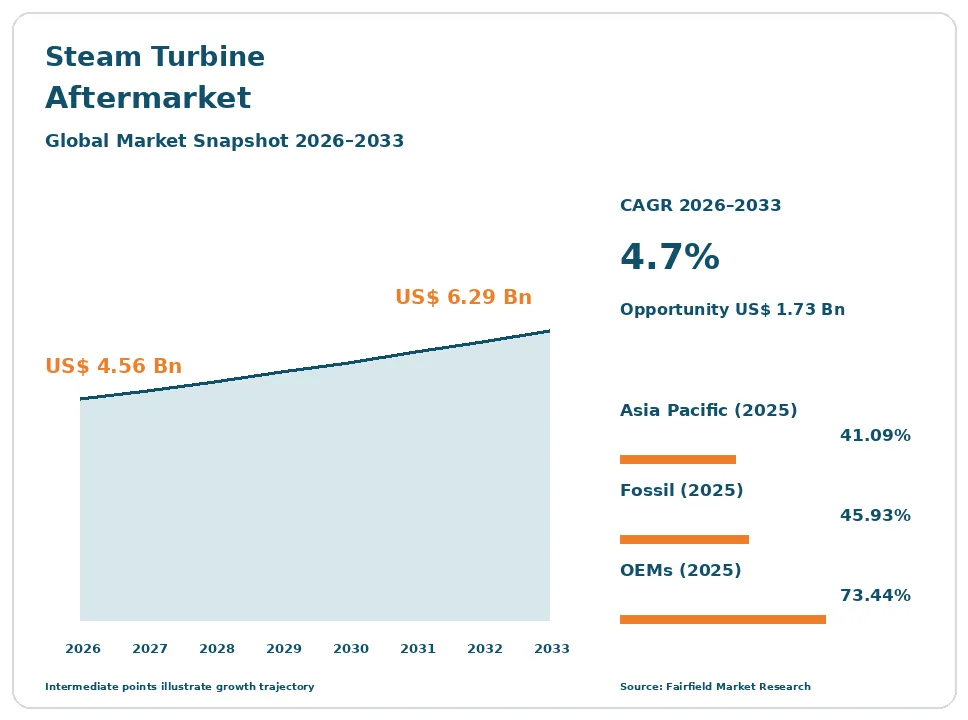
The global steam turbine aftermarket size is expected to be valued at US$ 4.56 billion in 2026 and projected to reach US$ 6.29 billion by 2033, growing at a CAGR of 4.7% between 2026 and 2033.
Between 2020 and 2025, the market grew at a CAGR of about 3.9%, as plant owners deferred some maintenance during the pandemic, then resumed overhauls and invested in upgrades to keep aging fleets reliable during energy price spikes and rising power demand. The steam turbine aftermarket covers maintenance, inspection, repair, spare parts, overhauls, upgrades, and long-term service agreements for steam turbines already installed in coal, gas combined cycle, nuclear, biomass, geothermal, solar thermal, and industrial plants. Turbines run for decades but need regular outages to inspect blades, seals, bearings, rotors, and valves. Turbine maintenance services prevent failures, restore efficiency, and extend plant life. Growth comes from a large aging installed base, life extension of nuclear and thermal plants, efficiency upgrades, and growth in industrial and geothermal turbines. The market is shifting toward digital monitoring, predictive maintenance, and flexible operation upgrades. In November 2025, Babcock & Wilcox won a contract to replace steam and reheat piping at a U.S. power plant.
Key Report Takeaways
- By Service Type: Services held 42.12% share in 2025, while Repair is projected to expand at a 4.8% CAGR through 2033, driven by aging rotors, blades, and casings that need refurbishment to extend operating life and restore efficiency.
- By Technology: Fossil held 45.93% share in 2025, while Thermal Renewable is projected to expand at a 6.3% CAGR through 2033, driven by growing biomass, geothermal, waste-to-energy, and concentrated solar power plants with steam turbines.
- By Service Provider: OEMs held 73.44% share in 2025, while Independent Service Providers are projected to expand at a 5.1% CAGR through 2033, driven by owners seeking lower-cost, flexible maintenance for older and multi-brand fleets.
- By Region: Asia Pacific held 41.09% share in 2025, while India is projected to expand at a 6.1% CAGR through 2033, driven by a large and growing thermal fleet, nuclear expansion, and government efficiency and life extension programs.
Global Steam Turbine Aftermarket Trends and Insights
Drivers Impact Analysis
Two drivers carry the strongest influence on steam turbine aftermarket demand during the forecast period.
Aging Installed Base Is Driving the Steam Turbine Aftermarket
A large aging installed base and life extension programs are the strongest driver of the steam turbine aftermarket. Old turbines need more care.
The mechanism is the age profile of the world’s steam turbine fleet. Thousands of turbines installed in coal, nuclear, and gas plants during the 1980s, 1990s, and 2000s are now decades old, and owners prefer to extend their lives rather than build costly new plants. Nuclear operators in the United States, Europe, Japan, and South Korea are extending licenses to 60 or 80 years, which requires turbine overhauls, rotor replacements, and control system upgrades. Coal plants in India and China are being upgraded to meet efficiency and emissions rules. Combined cycle plants run more flexibly to back up renewables, causing more wear from frequent starts. These factors create steady, recurring turbine maintenance services demand.
Rising Power Demand Is Expanding the Steam Turbine Aftermarket
Rising power demand and reliability requirements are expanding the steam turbine aftermarket. Grids need every plant to perform.
The cause is fast electricity demand growth from data centers, electric vehicles, and new factories, combined with tight reserve margins in many grids across North America, Asia Pacific, and Middle East & Africa. Utilities in the United States have delayed several planned coal plant retirements to protect grid reliability, and system operators are asking thermal plants to stay available during peak seasons. Some plants that were set to retire are being kept online longer, needing extra maintenance. Unplanned outages are costly when power prices are high, so owners invest in inspections and upgrades. Steam turbine upgrades can add capacity, such as Mitsubishi Power’s retrofit raising Darajat Unit 3 from 121 MW to 129 MW. These pressures support steady aftermarket spending across the forecast period.
| Driver | Impact on CAGR Forecast | Geographic Relevance | Impact Timeline |
| Large aging installed base and life extension programs | High | Global | Long term (≥4 years) |
| Rising power demand and reliability requirements | Medium | Asia Pacific, North America, Middle East & Africa | Medium term (2-4 years) |
Restraints Impact Analysis
Two restraints limit how quickly the steam turbine aftermarket grows.
Coal Retirements Slow the Steam Turbine Aftermarket
Coal plant retirements and the energy transition slow the steam turbine aftermarket. Fewer coal plants mean fewer turbines to service.
The specific causes are climate policy and cheaper renewables. Countries in Europe and North America are closing coal plants, and many utilities limit spending on plants scheduled for retirement, choosing only essential repairs. Solar, wind, and batteries are taking a larger share of generation, so some thermal plants run fewer hours, reducing wear and maintenance needs. Financing for coal projects is restricted by many banks and insurers worldwide. Some owners also sell spare parts from closed plants, which cuts demand for new parts. Plants running at low capacity factors stretch overhaul intervals to save money. These trends reduce long-term demand in mature markets, even as other regions continue to grow.
Labor Shortages Restrict the Steam Turbine Aftermarket
Skilled labor shortages and long parts lead times restrict the steam turbine aftermarket. Outages need experts and parts on time.
The underlying causes are an aging workforce and strained supply chains. Experienced turbine technicians, millwrights, welders, and engineers who know older turbine designs are retiring, and fewer young workers are entering the field, especially in North America and Europe. Outages often happen in the same spring and autumn seasons, so service crews are stretched thin. Large castings, forgings, rotors, and long last-stage blades have lead times of a year or more, and some parts for older models are no longer made, requiring reverse engineering. When outages run late because of missing parts or staff, owners lose revenue and face higher costs. Travel restrictions and visa rules can limit the movement of specialist teams across borders. These factors constrain service capacity and can delay planned work.
| Restraint | Impact on CAGR Forecast | Geographic Relevance | Impact Timeline |
| Coal plant retirements and energy transition | High | Europe, North America | Long term (≥4 years) |
| Skilled labor shortages and long parts lead times | Medium | Global | Medium term (2-4 years) |
Market Opportunities
Digital Monitoring and Predictive Maintenance Open a Fast-Growth Revenue Pool
Digital monitoring and predictive maintenance open a fast-growth revenue pool in the steam turbine aftermarket. Data can cut outage costs and prevent failures.
OEMs and service firms can capture this opportunity. Sensors and analytics track vibration, temperature, pressure, efficiency, and steam quality continuously, allowing condition-based maintenance instead of fixed schedules. Remote monitoring centers run by Siemens Energy, GE Vernova, and Mitsubishi Power watch thousands of machines and alert owners to developing problems. Digital twins help plan outages, estimate remaining life, and test upgrades before installation. Robotic inspection tools and drones reduce outage time. Owners can extend intervals between major overhauls safely, saving money. Cybersecurity and data sharing rules remain hurdles. Companies with strong digital tools, data history, and engineering expertise can win long-term service agreements that provide stable, recurring revenue.
Renewable Thermal and Industrial Turbines Create a Growth Revenue Pool
Renewable thermal and industrial turbines create a growth revenue pool in the steam turbine aftermarket. New steam uses are expanding.
Service providers can capture this opportunity. Geothermal plants in Indonesia, the Philippines, Kenya, New Zealand, and the United States use steam turbines that face corrosion and scaling from mineral-rich steam, requiring frequent service. Biomass, waste-to-energy, and concentrated solar power plants are growing in Europe, Asia Pacific, and Middle East & Africa. Industrial users in refineries, chemicals, sugar, steel, and paper rely on steam turbines for power and mechanical drive. Toshiba won a geothermal steam turbine order in Indonesia in December 2024. Local workshops near geothermal fields gain an edge. Companies serving these diverse fleets can grow faster than the overall market.
Segment Analysis
By Service Type: Services Lead While Repair Grows Fastest
Services held 42.12% share in 2025. Routine maintenance, inspections, minor and major overhauls, alignment, balancing, and outage management form the largest share of aftermarket spending, often delivered under long-term service agreements that cover a turbine for many years. These contracts give owners predictable costs and give providers stable revenue, while also sharing outage risk.
Repair is the fastest-growing service type, expanding at a 4.8% CAGR through 2033. As turbines age, rotors, blades, diaphragms, casings, and seals suffer erosion, cracking, and creep damage, and repair is often cheaper and faster than replacement. Advanced welding, coatings, and additive manufacturing are improving repair options. Spare parts and upgrades form other service types. For the market, repair growth reflects the aging fleet.
By Technology: Fossil Leads While Thermal Renewable Grows Fastest
Fossil held 45.93% share in 2025. Coal, oil, and gas combined cycle plants operate most of the world’s steam turbines, and many of them are large units that need major overhauls. Gas combined cycle plants are growing and cycling more often, increasing wear on rotors, casings, and valves. Coal units in China and India remain the largest single source of overhaul work, and many are being upgraded with new blading to raise efficiency and cut fuel use.
Thermal Renewable is the fastest-growing technology, expanding at a 6.3% CAGR through 2033. Biomass, geothermal, waste-to-energy, and concentrated solar power plants are being built to cut emissions, and their steam turbines face challenging conditions. Nuclear turbines form a high-value segment, especially with life extensions. For the market, renewable thermal growth diversifies demand.
By Service Provider: OEMs Lead While Independent Service Providers Grow Fastest
OEMs held 73.44% share in 2025. Original manufacturers such as Siemens Energy, GE Vernova, Mitsubishi Power, and Doosan Enerbility hold design data, original parts, and global service teams, and owners often trust them for major overhauls, warranty work, and performance upgrades. Long-term service agreements signed with new plants lock in OEM revenue for many years.
Independent Service Providers are the fastest-growing provider type, expanding at a 5.1% CAGR through 2033. Independents such as Sulzer and Elliott Group offer lower-cost, flexible service, reverse-engineered parts, and multi-brand expertise, which appeals to owners of older turbines whose original makers have exited the business or charge high prices. Some independents also offer faster turnaround for repairs. For the market, independent growth increases price competition.
Geography Analysis
Why Is North America Important to the Steam Turbine Aftermarket?
North America is important to the steam turbine aftermarket because it operates one of the world’s largest and oldest fleets of nuclear, coal, and gas combined cycle steam turbines. Nuclear license extensions to 80 years, delayed coal retirements due to rising power demand from data centers, and frequent cycling of combined cycle plants all increase service needs. GE Vernova, Siemens Energy, Mitsubishi Power, Babcock & Wilcox, and many independent providers serve the region. Canada is refurbishing nuclear units in Ontario. Key barriers include skilled labor shortages. One change shaping the region is extended plant operation.
Europe Shapes the Steam Turbine Aftermarket Through Nuclear and Industrial Fleets
Europe is a major steam turbine aftermarket. France, Germany, the United Kingdom, Spain, and Poland operate nuclear, gas, biomass, and waste-to-energy plants, along with large industrial and combined heat and power turbines. Coal plant closures reduce some demand, but nuclear life extensions in France and new biomass and waste-to-energy plants add work. Siemens Energy, Ansaldo Energia, and Doosan Škoda Power are key providers. Industrial users in chemicals, paper, and food processing rely on steam turbines for combined heat and power. Key barriers include coal phase-outs. One opportunity is nuclear and biomass turbine upgrades.
Which Region Is Leading the Steam Turbine Aftermarket?
Asia Pacific is leading the steam turbine aftermarket with a 41.09% share in 2025. China has the world’s largest fleet of coal and nuclear steam turbines, served by Shanghai Electric, Harbin Electric, and Dongfang Electric. India is the fastest-growing country, expanding at a 6.1% CAGR through 2033, as its large coal fleet undergoes life extension and efficiency upgrades and nuclear capacity expands, with BHEL as the main local provider. Japan, South Korea, and Indonesia add nuclear, coal, and geothermal demand. Key barriers include price competition. One change shaping the region is geothermal growth.
Latin America Grows the Steam Turbine Aftermarket Through Industrial Plants
Latin America is a growing steam turbine aftermarket. Brazil has many sugar and ethanol mills, pulp and paper plants, and biomass power plants that use steam turbines, while Mexico, Chile, and Argentina operate combined cycle and industrial turbines. Geothermal plants in Mexico and El Salvador need specialized service. Local workshops and international providers compete, and many mills schedule overhauls during the off-season between harvests. Siemens Energy, GE Vernova, and Mitsubishi Power run service centers in Brazil and Mexico. Key barriers include budget constraints and currency swings that raise imported parts costs. One opportunity is biomass and sugar mill turbine service.
Middle East & Africa Develops the Steam Turbine Aftermarket Through Combined Cycle Fleets
Middle East & Africa is a developing steam turbine aftermarket. Saudi Arabia, the United Arab Emirates, Qatar, and Kuwait operate large combined cycle and cogeneration plants, often linked to desalination, while South Africa has a large aging coal fleet that needs major refurbishment. Kenya has growing geothermal capacity in the Olkaria fields, and Egypt operates large combined cycle plants. High temperatures, dust, and humid coastal air accelerate wear on turbine components. Siemens Energy, GE Vernova, Mitsubishi Power, and Doosan Enerbility maintain service workshops in the region. Key barriers include harsh operating conditions and limited local skills. One change shaping the region is plant efficiency upgrades.
Competitive Landscape
The steam turbine aftermarket is moderately consolidated. Siemens Energy, GE Vernova, Mitsubishi Power, Doosan Enerbility, and Toshiba are leading players, while Ansaldo Energia, Shanghai Electric, Harbin Electric, BHEL, Sulzer, Elliott Group, and Baker Hughes compete strongly. Many regional workshops and independent firms serve local customers, especially for smaller industrial turbines. The top five players hold a large share of long-term service agreements for big utility units, while the long tail of independents competes for repair, parts, and smaller outage work.
Companies compete on technical expertise, response speed, parts availability, outage duration, price, digital tools, and performance guarantees. OEMs benefit from design knowledge and long-term agreements, while independent providers win on cost and flexibility for older or multi-brand fleets. Upgrade packages that improve efficiency or output help providers win larger contracts. Local presence matters because outages need crews on site quickly, so providers invest in regional workshops and spare parts warehouses. Reverse engineering capabilities allow independents to supply parts for discontinued models.
Strategic moves show how competition is changing. In November 2024, Mitsubishi Power won a geothermal steam turbine retrofit contract in Indonesia. In December 2024, Toshiba secured a geothermal steam turbine order. In November 2025, Babcock & Wilcox won a steam piping refurbishment contract in the United States. These moves show competition shifting toward upgrades and life extension.
Three themes shape vendor strategy. First, companies are expanding digital monitoring and predictive maintenance. Second, they are targeting geothermal, biomass, and nuclear life extension work. Third, they are building service capacity in Asia Pacific, where the largest fleets operate, and training new technicians to address skill shortages. Partnerships with local firms help global providers reach new customers.
Steam Turbine Aftermarket Industry Leaders
- Siemens Energy
- GE Vernova
- Mitsubishi Power
- Doosan Enerbility
- Toshiba
Recent Industry Developments
- November 2025: Babcock & Wilcox Construction won a contract worth more than US$ 17 million to install replacement steam and reheat piping on a unit at a U.S. coal-fired power plant - supports power plant services for steam systems.
- December 2024: Toshiba secured an order for a 60.3 MW steam turbine and generator for Patuha Geothermal Power Plant Unit 2 in Indonesia - expands the installed base for the steam turbine aftermarket.
- November 2024: Mitsubishi Power received a turnkey contract to retrofit the steam turbine at Darajat Geothermal Unit 3 in Indonesia, raising capacity from 121 MW to 129 MW - shows demand for turbine maintenance services and upgrades.
Companies Covered in the Report
- Siemens Energy
- GE Vernova
- Mitsubishi Power
- Doosan Enerbility
- Toshiba
- Ansaldo Energia
- Shanghai Electric
- Harbin Electric
- BHEL
- Sulzer
- Elliott Group
- Baker Hughes
Steam Turbine Aftermarket Scope
This report covers steam turbine aftermarket services, including maintenance services, repair, spare parts, upgrades, and long-term service agreements, for fossil, nuclear, and thermal renewable plants, across capacities from below 50 MW to above 300 MW, delivered by OEMs and independent service providers to power generation and industrial end users. The base year is 2025, and the forecast period runs from 2026 to 2033. All values are expressed in US$ Billion.
Service Type
- Services
- Repair
- Spare Parts
- Upgrades
Technology
- Fossil
- Nuclear
- Thermal Renewable
Service Provider
- OEMs
- Independent Service Providers
Regions
- North America
- Europe
- Asia Pacific
- Latin America
- Middle East & Africa
- 1. Executive Summary
- 1.1. Global Steam Turbine Aftermarket Snapshot
- 1.2. Future Projections, 2026-2033
- 1.3. Key Market Trends
- 1.4. Regional Snapshot
- 2. Market Overview
- 2.1. Market Definition and Report Scope
- 2.2. Historical Market Trends, 2020-2025
- 2.3. Market Dynamics
- 2.3.1. Drivers Impact Analysis
- 2.3.1.1. Aging Installed Base Is Driving the Steam Turbine Aftermarket
- 2.3.1.2. Rising Power Demand Is Expanding the Steam Turbine Aftermarket
- 2.3.2. Restraints Impact Analysis
- 2.3.2.1. Coal Retirements Slow the Steam Turbine Aftermarket
- 2.3.2.2. Labor Shortages Restrict the Steam Turbine Aftermarket
- 2.3.3. Market Opportunities
- 2.3.3.1. Digital Monitoring and Predictive Maintenance Open a Fast-Growth Revenue Pool
- 2.3.3.2. Renewable Thermal and Industrial Turbines Create a Growth Revenue Pool
- 2.3.1. Drivers Impact Analysis
- 3. Global Steam Turbine Aftermarket Outlook, 2020-2033
- 3.1. Global Steam Turbine Aftermarket Outlook, by Service Type, Value (US$ Billion), 2020-2033
- 3.1.1. Services
- 3.1.2. Repair
- 3.1.3. Spare Parts
- 3.1.4. Upgrades
- 3.2. Global Steam Turbine Aftermarket Outlook, by Technology, Value (US$ Billion), 2020-2033
- 3.2.1. Fossil
- 3.2.2. Nuclear
- 3.2.3. Thermal Renewable
- 3.3. Global Steam Turbine Aftermarket Outlook, by Service Provider, Value (US$ Billion), 2020-2033
- 3.3.1. OEMs
- 3.3.2. Independent Service Providers
- 3.4. Global Steam Turbine Aftermarket Outlook, by Region, Value (US$ Billion), 2020-2033
- 3.4.1. North America
- 3.4.2. Europe
- 3.4.3. Asia Pacific
- 3.4.4. Latin America
- 3.4.5. Middle East & Africa
- 3.1. Global Steam Turbine Aftermarket Outlook, by Service Type, Value (US$ Billion), 2020-2033
- 4. North America Steam Turbine Aftermarket Outlook, 2020-2033
- 4.1. North America Steam Turbine Aftermarket Outlook, by Service Type, Value (US$ Billion), 2020-2033
- 4.1.1. Services
- 4.1.2. Repair
- 4.1.3. Spare Parts
- 4.1.4. Upgrades
- 4.2. North America Steam Turbine Aftermarket Outlook, by Technology, Value (US$ Billion), 2020-2033
- 4.2.1. Fossil
- 4.2.2. Nuclear
- 4.2.3. Thermal Renewable
- 4.3. North America Steam Turbine Aftermarket Outlook, by Service Provider, Value (US$ Billion), 2020-2033
- 4.3.1. OEMs
- 4.3.2. Independent Service Providers
- 4.4. North America Steam Turbine Aftermarket Outlook, by Country, Value (US$ Billion), 2020-2033
- 4.4.1. Canada Steam Turbine Aftermarket Outlook, by Service Type, 2020-2033
- 4.4.2. Canada Steam Turbine Aftermarket Outlook, by Technology, 2020-2033
- 4.4.3. Canada Steam Turbine Aftermarket Outlook, by Service Provider, 2020-2033
- 4.1. North America Steam Turbine Aftermarket Outlook, by Service Type, Value (US$ Billion), 2020-2033
- 5. Europe Steam Turbine Aftermarket Outlook, 2020-2033
- 5.1. Europe Steam Turbine Aftermarket Outlook, by Service Type, Value (US$ Billion), 2020-2033
- 5.1.1. Services
- 5.1.2. Repair
- 5.1.3. Spare Parts
- 5.1.4. Upgrades
- 5.2. Europe Steam Turbine Aftermarket Outlook, by Technology, Value (US$ Billion), 2020-2033
- 5.2.1. Fossil
- 5.2.2. Nuclear
- 5.2.3. Thermal Renewable
- 5.3. Europe Steam Turbine Aftermarket Outlook, by Service Provider, Value (US$ Billion), 2020-2033
- 5.3.1. OEMs
- 5.3.2. Independent Service Providers
- 5.4. Europe Steam Turbine Aftermarket Outlook, by Country, Value (US$ Billion), 2020-2033
- 5.4.1. France Steam Turbine Aftermarket Outlook, by Service Type, 2020-2033
- 5.4.2. France Steam Turbine Aftermarket Outlook, by Technology, 2020-2033
- 5.4.3. France Steam Turbine Aftermarket Outlook, by Service Provider, 2020-2033
- 5.4.4. Germany Steam Turbine Aftermarket Outlook, by Service Type, 2020-2033
- 5.4.5. Germany Steam Turbine Aftermarket Outlook, by Technology, 2020-2033
- 5.4.6. Germany Steam Turbine Aftermarket Outlook, by Service Provider, 2020-2033
- 5.4.7. United Kingdom Steam Turbine Aftermarket Outlook, by Service Type, 2020-2033
- 5.4.8. United Kingdom Steam Turbine Aftermarket Outlook, by Technology, 2020-2033
- 5.4.9. United Kingdom Steam Turbine Aftermarket Outlook, by Service Provider, 2020-2033
- 5.4.10. Spain Steam Turbine Aftermarket Outlook, by Service Type, 2020-2033
- 5.4.11. Spain Steam Turbine Aftermarket Outlook, by Technology, 2020-2033
- 5.4.12. Spain Steam Turbine Aftermarket Outlook, by Service Provider, 2020-2033
- 5.4.13. Poland Steam Turbine Aftermarket Outlook, by Service Type, 2020-2033
- 5.4.14. Poland Steam Turbine Aftermarket Outlook, by Technology, 2020-2033
- 5.4.15. Poland Steam Turbine Aftermarket Outlook, by Service Provider, 2020-2033
- 5.1. Europe Steam Turbine Aftermarket Outlook, by Service Type, Value (US$ Billion), 2020-2033
- 6. Asia Pacific Steam Turbine Aftermarket Outlook, 2020-2033
- 6.1. Asia Pacific Steam Turbine Aftermarket Outlook, by Service Type, Value (US$ Billion), 2020-2033
- 6.1.1. Services
- 6.1.2. Repair
- 6.1.3. Spare Parts
- 6.1.4. Upgrades
- 6.2. Asia Pacific Steam Turbine Aftermarket Outlook, by Technology, Value (US$ Billion), 2020-2033
- 6.2.1. Fossil
- 6.2.2. Nuclear
- 6.2.3. Thermal Renewable
- 6.3. Asia Pacific Steam Turbine Aftermarket Outlook, by Service Provider, Value (US$ Billion), 2020-2033
- 6.3.1. OEMs
- 6.3.2. Independent Service Providers
- 6.4. Asia Pacific Steam Turbine Aftermarket Outlook, by Country, Value (US$ Billion), 2020-2033
- 6.4.1. China Steam Turbine Aftermarket Outlook, by Service Type, 2020-2033
- 6.4.2. China Steam Turbine Aftermarket Outlook, by Technology, 2020-2033
- 6.4.3. China Steam Turbine Aftermarket Outlook, by Service Provider, 2020-2033
- 6.4.4. India Steam Turbine Aftermarket Outlook, by Service Type, 2020-2033
- 6.4.5. India Steam Turbine Aftermarket Outlook, by Technology, 2020-2033
- 6.4.6. India Steam Turbine Aftermarket Outlook, by Service Provider, 2020-2033
- 6.4.7. Japan Steam Turbine Aftermarket Outlook, by Service Type, 2020-2033
- 6.4.8. Japan Steam Turbine Aftermarket Outlook, by Technology, 2020-2033
- 6.4.9. Japan Steam Turbine Aftermarket Outlook, by Service Provider, 2020-2033
- 6.4.10. South Korea Steam Turbine Aftermarket Outlook, by Service Type, 2020-2033
- 6.4.11. South Korea Steam Turbine Aftermarket Outlook, by Technology, 2020-2033
- 6.4.12. South Korea Steam Turbine Aftermarket Outlook, by Service Provider, 2020-2033
- 6.4.13. Indonesia Steam Turbine Aftermarket Outlook, by Service Type, 2020-2033
- 6.4.14. Indonesia Steam Turbine Aftermarket Outlook, by Technology, 2020-2033
- 6.4.15. Indonesia Steam Turbine Aftermarket Outlook, by Service Provider, 2020-2033
- 6.1. Asia Pacific Steam Turbine Aftermarket Outlook, by Service Type, Value (US$ Billion), 2020-2033
- 7. Latin America Steam Turbine Aftermarket Outlook, 2020-2033
- 7.1. Latin America Steam Turbine Aftermarket Outlook, by Service Type, Value (US$ Billion), 2020-2033
- 7.1.1. Services
- 7.1.2. Repair
- 7.1.3. Spare Parts
- 7.1.4. Upgrades
- 7.2. Latin America Steam Turbine Aftermarket Outlook, by Technology, Value (US$ Billion), 2020-2033
- 7.2.1. Fossil
- 7.2.2. Nuclear
- 7.2.3. Thermal Renewable
- 7.3. Latin America Steam Turbine Aftermarket Outlook, by Service Provider, Value (US$ Billion), 2020-2033
- 7.3.1. OEMs
- 7.3.2. Independent Service Providers
- 7.4. Latin America Steam Turbine Aftermarket Outlook, by Country, Value (US$ Billion), 2020-2033
- 7.4.1. Brazil Steam Turbine Aftermarket Outlook, by Service Type, 2020-2033
- 7.4.2. Brazil Steam Turbine Aftermarket Outlook, by Technology, 2020-2033
- 7.4.3. Brazil Steam Turbine Aftermarket Outlook, by Service Provider, 2020-2033
- 7.4.4. Mexico Steam Turbine Aftermarket Outlook, by Service Type, 2020-2033
- 7.4.5. Mexico Steam Turbine Aftermarket Outlook, by Technology, 2020-2033
- 7.4.6. Mexico Steam Turbine Aftermarket Outlook, by Service Provider, 2020-2033
- 7.4.7. Chile Steam Turbine Aftermarket Outlook, by Service Type, 2020-2033
- 7.4.8. Chile Steam Turbine Aftermarket Outlook, by Technology, 2020-2033
- 7.4.9. Chile Steam Turbine Aftermarket Outlook, by Service Provider, 2020-2033
- 7.4.10. Argentina Steam Turbine Aftermarket Outlook, by Service Type, 2020-2033
- 7.4.11. Argentina Steam Turbine Aftermarket Outlook, by Technology, 2020-2033
- 7.4.12. Argentina Steam Turbine Aftermarket Outlook, by Service Provider, 2020-2033
- 7.4.13. El Salvador Steam Turbine Aftermarket Outlook, by Service Type, 2020-2033
- 7.4.14. El Salvador Steam Turbine Aftermarket Outlook, by Technology, 2020-2033
- 7.4.15. El Salvador Steam Turbine Aftermarket Outlook, by Service Provider, 2020-2033
- 7.1. Latin America Steam Turbine Aftermarket Outlook, by Service Type, Value (US$ Billion), 2020-2033
- 8. Middle East & Africa Steam Turbine Aftermarket Outlook, 2020-2033
- 8.1. Middle East & Africa Steam Turbine Aftermarket Outlook, by Service Type, Value (US$ Billion), 2020-2033
- 8.1.1. Services
- 8.1.2. Repair
- 8.1.3. Spare Parts
- 8.1.4. Upgrades
- 8.2. Middle East & Africa Steam Turbine Aftermarket Outlook, by Technology, Value (US$ Billion), 2020-2033
- 8.2.1. Fossil
- 8.2.2. Nuclear
- 8.2.3. Thermal Renewable
- 8.3. Middle East & Africa Steam Turbine Aftermarket Outlook, by Service Provider, Value (US$ Billion), 2020-2033
- 8.3.1. OEMs
- 8.3.2. Independent Service Providers
- 8.4. Middle East & Africa Steam Turbine Aftermarket Outlook, by Country, Value (US$ Billion), 2020-2033
- 8.4.1. Saudi Arabia Steam Turbine Aftermarket Outlook, by Service Type, 2020-2033
- 8.4.2. Saudi Arabia Steam Turbine Aftermarket Outlook, by Technology, 2020-2033
- 8.4.3. Saudi Arabia Steam Turbine Aftermarket Outlook, by Service Provider, 2020-2033
- 8.4.4. United Arab Emirates Steam Turbine Aftermarket Outlook, by Service Type, 2020-2033
- 8.4.5. United Arab Emirates Steam Turbine Aftermarket Outlook, by Technology, 2020-2033
- 8.4.6. United Arab Emirates Steam Turbine Aftermarket Outlook, by Service Provider, 2020-2033
- 8.4.7. Qatar Steam Turbine Aftermarket Outlook, by Service Type, 2020-2033
- 8.4.8. Qatar Steam Turbine Aftermarket Outlook, by Technology, 2020-2033
- 8.4.9. Qatar Steam Turbine Aftermarket Outlook, by Service Provider, 2020-2033
- 8.4.10. Kuwait Steam Turbine Aftermarket Outlook, by Service Type, 2020-2033
- 8.4.11. Kuwait Steam Turbine Aftermarket Outlook, by Technology, 2020-2033
- 8.4.12. Kuwait Steam Turbine Aftermarket Outlook, by Service Provider, 2020-2033
- 8.4.13. South Africa Steam Turbine Aftermarket Outlook, by Service Type, 2020-2033
- 8.4.14. South Africa Steam Turbine Aftermarket Outlook, by Technology, 2020-2033
- 8.4.15. South Africa Steam Turbine Aftermarket Outlook, by Service Provider, 2020-2033
- 8.4.16. Kenya Steam Turbine Aftermarket Outlook, by Service Type, 2020-2033
- 8.4.17. Kenya Steam Turbine Aftermarket Outlook, by Technology, 2020-2033
- 8.4.18. Kenya Steam Turbine Aftermarket Outlook, by Service Provider, 2020-2033
- 8.4.19. Egypt Steam Turbine Aftermarket Outlook, by Service Type, 2020-2033
- 8.4.20. Egypt Steam Turbine Aftermarket Outlook, by Technology, 2020-2033
- 8.4.21. Egypt Steam Turbine Aftermarket Outlook, by Service Provider, 2020-2033
- 8.1. Middle East & Africa Steam Turbine Aftermarket Outlook, by Service Type, Value (US$ Billion), 2020-2033
- 9. Competitive Landscape
- 9.1. Market Concentration and Industry Leaders
- 9.2. Competitive Differentiation
- 9.3. Strategic Initiatives
- 9.4. Recent Industry Developments
- 9.5. Company Profiles
- 9.5.1. Siemens Energy
- 9.5.2. GE Vernova
- 9.5.3. Mitsubishi Power
- 9.5.4. Doosan Enerbility
- 9.5.5. Toshiba
- 9.5.6. Ansaldo Energia
- 9.5.7. Shanghai Electric
- 9.5.8. Harbin Electric
- 9.5.9. BHEL
- 9.5.10. Sulzer
- 9.5.11. Elliott Group
- 9.5.12. Baker Hughes
- 10. Appendix
- 10.1. Research Methodology
- 10.2. Report Assumptions
- 10.3. Acronyms and Abbreviations
| Service Type | Services, Repair, Spare Parts, Upgrades |
| Technology | Fossil, Nuclear, Thermal Renewable |
| Service Provider | OEMs, Independent Service Providers |
| Regions | North America, Europe, Asia Pacific, Latin America, Middle East & Africa |
Our Research Methodology
Considering the volatility of business today, traditional approaches to strategizing a game plan can be unfruitful if not detrimental. True ambiguity is no way to determine a forecast. A myriad of predetermined factors must be accounted for such as the degree of risk involved, the magnitude of circumstances, as well as conditions or consequences that are not known or unpredictable. To circumvent binary views that cast uncertainty, the application of market research intelligence to strategically posture, move, and enable actionable outcomes is necessary.
View Methodology
Quality Assured
Rigorous Validation Process

Confidentiality Assured
End-to-end Data Security

Custom Research Services
Tailored To Your Objectives
FAQs
The steam turbine aftermarket is valued at US$ 4.56 billion in 2026, led by maintenance services and Asia Pacific.
The market is projected to reach US$ 6.29 billion by 2033, growing at a 4.7% CAGR and adding US$ 1.73 billion.
Thermal renewable is growing fastest at a 6.3% CAGR through 2033, driven by biomass, geothermal, and waste-to-energy plants.
India is growing fastest at a 6.1% CAGR through 2033, driven by a large thermal fleet and nuclear expansion programs.
Asia Pacific holds the largest share at 41.09% in 2025, supported by large coal, gas, and nuclear fleets in China and India.
Related Reports
Power EPC Market Size, Share, Insights, Competitive Landscape, and Forecast 2026 to 2033
Power EPC Market is projected to rise from US$ 780.56 billion in 2026 to US$ 1,220.97 billion by 2033 at a 6.6% CAGR. Explore generation and project trends.
Port Electrification Market Size, Share, Insights, Competitive Landscape, and Forecast 2026 to 2033
Explore the port electrification market, valued at US$ 6.8 billion in 2026 and forecast to reach US$ 16.4 billion by 2033, growing at a 13.4% CAGR.
Polycrystalline Solar Cell Market Size, Share, Insights, Competitive Landscape, and Forecast 2026 to 2033
Explore the polycrystalline solar cell market, valued at US$ 5.4 billion in 2026 and projected to reach US$ 6.6 billion by 2033, growing at 2.9% CAGR.
Synchronous Condenser Market Size, Share, Insights, Competitive Landscape, and Forecast 2026 to 2033
The global synchronous condenser market is valued at US$1.20 billion in 2026, reaching US$1.50 billion by 2033, growing at a 3.2% CAGR
Water and Wastewater Treatment Market Size, Share, Insights, Competitive Landscape, and Forecast 2026 to 2033
Water and wastewater treatment market to reach US$ 508.0 billion by 2033 from US$ 345.0 billion in 2026 at a 5.7% CAGR. Explore trends, segments and regions.
Vehicle-to-Grid Technology Market Size, Share, Insights, Competitive Landscape, and Forecast 2026 to 2033
Explore the vehicle-to-grid technology market, forecast to reach US$6.9 billion by 2033 at 28.4% CAGR, with component, application and regional insights.