



Toroidal Transformers Market
Toroidal Transformers Market Size, Share, Insights, Competitive Landscape, and Forecast 2026 to 2033
Toroidal Transformers Market Size and Trend Analysis
What Is the Outlook for Ring-Core Transformer Demand?
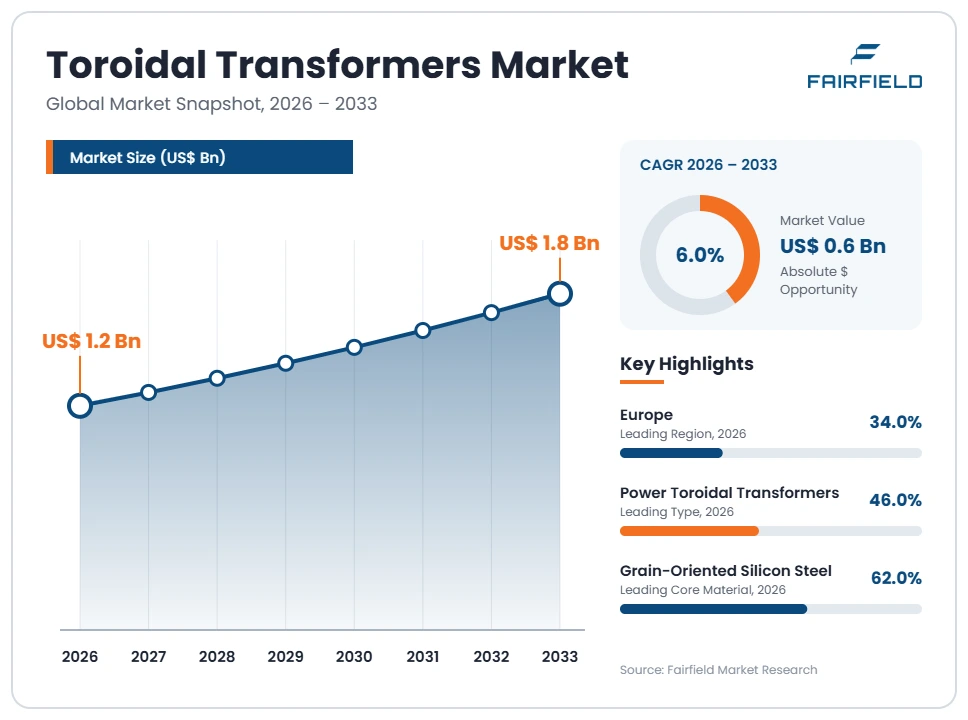
The global toroidal transformers market size is expected to be valued at US$ 1.2 billion in 2026 and projected to reach US$ 1.8 billion by 2033, growing at a CAGR of 6.0% between 2026 and 2033. Stated precisely, the market moves from about US$ 1,200 million to US$ 1,800 million.
Growth between 2020 and 2025 ran at roughly 4.6% a year, lifting value to near US$ 1,133 million, with supply disruption and electrical steel pricing holding back part of that period. Three factors support the forecast. Medical equipment makers keep specifying ring cores because low leakage current eases compliance with IEC 60601-1. Professional audio and architectural lighting buyers value low stray magnetic field and quiet operation. Industrial automation, test equipment and charging applications add steady volume. This remains a component niche rather than a mass market, and switch-mode power supplies continue to remove line-frequency transformers from many cost-driven designs.
Key Report Takeaways
- By Type: Power toroidal transformers held 46% share in 2026, while isolation units are projected to expand at a 7.3% CAGR through 2033, driven by safety separation requirements in medical and laboratory equipment.
- By Power Rating: The 101–500 VA band held 34% share in 2026, while units above 1,000 VA should grow at a 7.6% CAGR, reflecting larger inverter, charging and uninterruptible power supply builds.
- By Core Material: Grain-oriented silicon steel held 62% share in 2026, while amorphous and nanocrystalline cores are forecast to advance at an 8.4% CAGR, because designers want lower no-load loss.
- By Application: Medical equipment held 23% share in 2026, while renewable inverters and electric vehicle charging are set to rise at an 8.8% CAGR, supported by isolation and earth leakage requirements.
- By Geography: Europe held 34% share in 2026, while Asia Pacific is projected to grow at a 7.4% CAGR through 2033, led by electronics manufacturing capacity in China, India and Vietnam.
Global Toroidal Transformers Market Trends and Insights
Drivers Impact Analysis
Two demand sources explain most of the incremental volume for ring-core magnetics through 2033.
| Driver | Impact on CAGR Forecast | Geographic Relevance | Impact Timeline |
| Medical electrical equipment safety requirements favouring low leakage current designs | High | Europe, North America | Long term ≥4 years |
| Noise and stray field limits in professional audio and architectural lighting | Medium | Global | Medium term 2–4 years |
Medical Equipment Safety Rules Keep Specifying Low Leakage Toroidal Designs
Medical device manufacturing is the most reliable source of demand for toroidal transformers, and it buys on compliance rather than on price. IEC 60601-1 sets limits on patient leakage current and requires defined means of protection between mains and applied parts. A ring core with a single continuous winding path and controlled interwinding capacitance helps designers meet those limits without extra filtering, which keeps the toroidal format specified across imaging, dialysis, surgical and laboratory equipment.
The mechanism is certification economics. Requalifying a medical power supply after a magnetics change costs engineering time, test house fees and documentation updates, so approved designs persist across product generations. Reinforced insulation, electrostatic screens between primary and secondary, and tested creepage and clearance distances are built into the part itself. IEC 61558 parts covering safety isolating transformers reinforce the same construction requirements for the wider equipment market.
Audible Noise and Stray Field Limits Sustain Audio and Lighting Demand
Equipment where hum and magnetic interference are unacceptable continues to pull ring cores through at premium prices. Professional sound amplifiers, studio equipment, high-end consumer audio, broadcast racks and architectural lighting controllers all sit close to sensitive electronics or to listeners. A toroidal core leaks far less flux than a laminated EI core of similar rating and runs quieter, because the wound ring has no air gap at a lamination joint to vibrate.
The cause is geometry. Magnetic flux follows the continuous circular path of the strip-wound core, so external field falls sharply compared with stacked laminations, and mechanical movement that produces audible buzz is largely eliminated. Designers of dimmable lighting and instrumentation also value the reduced interference footprint, since it shortens electromagnetic compatibility testing. That saved test cycle frequently justifies the higher unit cost of the magnetics.
Restraints Impact Analysis
Two structural pressures cap the growth rate of this component niche regardless of end-market strength.
| Restraint | Impact on CAGR Forecast | Geographic Relevance | Impact Timeline |
| Design substitution by switch-mode power supplies removing line-frequency magnetics | High | Global | Long term ≥4 years |
| Grain-oriented electrical steel cost and allocation | Medium | Europe, Asia Pacific | Short term ≤2 years |
Switch-Mode Power Supply Substitution Removes the Line-Frequency Transformer Entirely
The most serious limit on ring-core demand is a design decision taken before the magnetics are specified. Switch-mode power supplies operate at high frequency, so they use small ferrite transformers and deliver the same output in a fraction of the volume and weight. When an equipment designer chooses that topology, the line-frequency toroidal transformer disappears from the bill of materials completely rather than losing a competitive bid.
The cause is a combination of efficiency rules, shipping cost and semiconductor progress. Wide bandgap devices and better controllers have pushed switch-mode efficiency and reliability to levels that satisfy demanding applications, including many medical ones. Standby power and average efficiency requirements penalise heavy line-frequency designs. Toroidal transformers consequently hold ground where field emission, audible noise, galvanic isolation or waveform fidelity matter more than mass and standby loss.
Electrical Steel Pricing and Availability Compress Manufacturer Margins
Core material cost sets the floor under toroidal transformer pricing and squeezes producers when strip supply tightens. Grain-oriented silicon steel typically represents the single largest input cost in a finished unit, ahead of copper winding wire and insulation. Toroidal manufacturers buy narrow slit strip in modest tonnages, which places them behind large power and distribution transformer builders in supplier queues.
The underlying cause is concentrated capacity and competing demand. Grain-oriented strip is produced by a limited number of mills, and grid investment, efficiency regulation and electrification absorb much of that output. Lead times for specific grades and widths stretch when utility orders rise, and smaller buyers face both higher prices and allocation. Copper price volatility compounds the problem, because winding cost moves with the same commodity cycle and cannot be hedged easily at small volumes.
Market Opportunities
Electric Vehicle Charging and Inverter Isolation Open a Higher-Rating Revenue Pool
Isolation duties inside charging equipment and renewable inverters create a higher-value revenue pool than the traditional low-rating catalogue business. Charging units, battery test systems and grid-tied inverter auxiliaries need galvanic separation, control-circuit supplies and earth leakage behaviour that passes installation standards. These builds sit above 1,000 VA far more often than medical or audio work, so each unit carries more copper, more core and a higher selling price.
Established magnetics makers with custom design capability are best placed to capture it, since specifications arrive as drawings rather than catalogue numbers. Demand comes from charging equipment manufacturers, inverter builders and industrial battery testing laboratories. Rising installation of distributed generation and depot charging supports volume, while safety separation requirements drawn from IEC 61558 keep the isolation transformer inside the design rather than engineered out.
Custom Low-Noise Magnetics for Laboratory and Metrology Equipment Create Premium Niches
Precision instrumentation offers a small but durable premium niche where price sensitivity is unusually low. Metrology benches, electron microscopes, magnetoencephalography rooms, semiconductor test gear and scientific amplifiers all fail their own specifications if stray magnetic fields or mains hum intrude. Buyers in these segments will pay several times a commodity price for magnetics with specified residual field, extra screening or potted construction.
Manufacturers with in-house winding, magnetic screening and residual field test capability can capture this work, typically through direct engineering relationships rather than through catalogue distribution. The demand base is scientific instrument makers, national measurement laboratories, universities and semiconductor equipment suppliers. Growth in research funding and in advanced semiconductor metrology supports order flow, and IEC 61010 safety requirements for laboratory equipment push designers toward constructions that toroidal builders already supply as standard practice.
Segment Analysis
- By Type: Power Units Lead While Isolation Transformers Gain Momentum
Power toroidal transformers held the largest share at 46% in 2026, because step-down supply duty inside equipment accounts for most installed units across audio, lighting, industrial control and consumer applications. Isolation toroidal transformers are the fastest-growing type at a 7.3% CAGR to 2033, as medical, laboratory and charging equipment designers need defined galvanic separation with screened windings. Autotransformers serve voltage conversion between regional mains standards, and current or signal types occupy small instrumentation volumes. Supporting this shift are safety standards that reward reinforced insulation and specified creepage distances. The business implication is a move up the value curve. Isolation work is specified by engineers rather than purchasing departments, carries documentation and test requirements that deter commodity suppliers, and sustains margins that plain power units cannot defend against low-cost competition.
- By Power Rating: The 101–500 VA Band Dominates as Larger Units Scale Faster
The 101–500 VA band led with 34% share in 2026, matching the supply needs of medical consoles, audio amplifiers, lighting controllers and instrument racks that make up the core of this niche. Units above 1,000 VA form the fastest-growing rating band at a 7.6% CAGR through 2033, pulled by uninterruptible power supplies, charging equipment, inverter auxiliaries and industrial test systems. The up to 100 VA band remains large in unit count but small in value, while 501–1,000 VA serves mid-range professional equipment. Material intensity explains the revenue effect clearly. A larger rating consumes more grain-oriented strip and winding wire, so value grows faster than unit volume, and manufacturers with heavier winding machinery and thermal test capacity gain a structural advantage over purely small-signal producers.
- By Core Material: Silicon Steel Holds the Base While Amorphous Cores Advance
Grain-oriented silicon steel accounted for 62% of 2026 value, the dominant core material, because strip-wound silicon steel delivers acceptable loss at a cost the niche can bear and is supported by mature slitting and winding equipment. Amorphous and nanocrystalline cores are growing fastest at an 8.4% CAGR, since their lower core loss suits always-on equipment and high-frequency auxiliary duties where standby consumption is scrutinised. Nickel-iron alloys serve precision and audio signal applications that need high permeability, and ferrite appears in higher-frequency variants. Price is the practical brake on substitution. Advanced core materials cost considerably more per kilogram and are harder to wind without cracking, so adoption concentrates in designs where measured efficiency, size or thermal performance justifies the premium rather than across the catalogue.
- By Application: Medical Equipment Leads With Charging and Inverter Demand Rising Quickest
Medical equipment was the leading application at 23% share in 2026, reflecting strict leakage current limits, long product lifecycles and buyers who treat requalification as more expensive than component price. Renewable inverters and electric vehicle charging form the fastest-growing application at an 8.8% CAGR to 2033, driven by isolation duties and by higher average ratings per unit. Audio and professional sound, lighting, uninterruptible power supplies and industrial control plus test equipment make up the remainder, each buying for a specific physical property rather than for cost. The implication for suppliers is portfolio balance. Medical and audio deliver predictable repeat orders against frozen designs, while charging and inverter work supplies growth but demands heavier manufacturing capability and faster engineering response to customer drawings.
Geography Analysis
- North American Medical and Audio Manufacturing Sustains Steady Component Demand
North America holds 24% of 2026 revenue, with the United States accounting for most of it and Mexico contributing contract manufacturing capacity. Demand is anchored in medical device production, professional audio and broadcast equipment, laboratory instruments and industrial control panels. Buyers in these categories qualify a magnetics supplier once and keep that part for many years, which rewards manufacturers with documented quality systems and domestic technical support. Regional producers compete on short lead times, engineering responsiveness and the ability to build prototype quantities quickly rather than on unit price. Reshoring of medical and defence-adjacent electronics has modestly strengthened local sourcing. The main barrier is cost competition from imported units on standard ratings. The notable change is growth in charging infrastructure and battery test equipment, which pulls demand toward heavier custom builds.
- Which Region Is Leading the Toroidal Transformers Market?
Europe leads with 34% share in 2026, supported by Germany, Italy, the United Kingdom, Poland and the Nordic countries. The region combines long-established ring-core manufacturing with a dense base of buyers that value the format. Medical device makers, professional audio brands, architectural lighting companies and laboratory instrument producers all concentrate here. Regulatory practice reinforces the position, since IEC 61558 and IEC 60601-1 compliance is embedded in design culture, and RoHS documentation under EN IEC 63000 is routine. The Ecodesign Regulation (EU) 2019/1783 governs larger power and distribution transformers, and many toroidal units fall below its power thresholds, so its direct effect on this niche is limited rather than universal. Energy prices and electrical steel costs pressure margins. The opportunity lies in higher-rating isolation work tied to charging equipment.
- Which Region Is Growing Fastest in the Toroidal Transformers Market?
Asia Pacific is growing fastest at a 7.4% CAGR between 2026 and 2033, from a 31% share in 2026. China supplies the largest manufacturing base, covering both domestic demand and export of finished equipment that contains ring-core magnetics. India is adding capacity quickly as medical device assembly, lighting manufacture and industrial automation expand under local production incentives. Vietnam, Thailand and Malaysia benefit from electronics assembly relocation, while Japan and South Korea supply precision instrumentation and high-end audio. Local winding capacity keeps prices competitive and shortens lead times for regional equipment builders. The constraint is quality variation among smaller producers, which makes supplier audits essential for regulated applications. The opportunity is upgrading from commodity output toward certified medical-grade and isolation products that command higher prices.
- Latin American Demand Follows Medical and Industrial Equipment Assembly
Latin America accounts for 6% of 2026 revenue, led by Brazil and Mexico, with Argentina and Chile adding smaller volumes. Demand follows equipment assembly rather than standalone component consumption, so medical device plants, industrial control builders, lighting manufacturers and audio equipment producers set the pace. Mexico is the stronger base because its manufacturing corridors supply electronics into the wider regional market under integrated supply chains. Barriers are significant: most ring cores and finished units are imported, currency movement makes pricing unstable, and import duties plus freight add meaningfully to landed cost. Local winding capacity exists but is concentrated in a few producers with limited certification scope. The change worth watching is gradual qualification of regional suppliers for medical and industrial work, which would reduce exposure to import cost swings.
- Middle East & Africa Adoption Tracks Infrastructure and Healthcare Investment
Middle East & Africa represents 5% of the market in 2026, the smallest share, with the United Arab Emirates, Saudi Arabia, Turkey and South Africa forming the active markets. Hospital construction and medical equipment imports create most of the pull, since ring cores arrive inside imaging systems, dialysis machines and laboratory instruments. Architectural lighting in large commercial and hospitality developments provides a second source of demand, where low audible noise matters in occupied spaces. Turkey has the strongest local magnetics manufacturing capability in the group. Barriers include minimal domestic component production, reliance on distributors carrying limited stock, and procurement practice that favours complete systems over specified components. The opportunity sits in replacement and service demand, as the installed base of imported medical and broadcast equipment ages and needs qualified spare magnetics.
Competitive Landscape
The market is fragmented, with low concentration and no supplier holding a position that shapes global pricing. Dozens of specialist magnetics manufacturers operate across Europe, Asia Pacific and North America, most of them privately held and many with revenue measured in tens of millions of dollars. Noratel International AS, Block Transformatoren-Elektronik GmbH, Hammond Manufacturing Company Limited, Talema Group LLC and Myrra SAS are among the more visible names, alongside regional producers serving national equipment industries. Consolidation happens quietly, usually when a family-owned winder is absorbed by a larger magnetics group seeking capacity or a certified customer list, rather than through large public transactions.
Competition runs on engineering service rather than catalogue price. Equipment makers judge suppliers on the ability to turn a specification into a working prototype quickly, on documented compliance with IEC 61558 and IEC 60601-1, on batch consistency, and on willingness to hold stock against uneven call-offs. Custom design work dominates revenue at the upper end, while standard ratings face steady pressure from low-cost imports. New competition arrives less from rival winders than from switch-mode power supply vendors offering a complete module that removes the magnetics decision from the customer.
Strategic activity centres on capacity for larger ratings, automation of winding and testing to offset labour cost, expansion of certification scope for medical and laboratory applications, and closer engineering support for inverter and charging customers. Several producers are adding amorphous and nanocrystalline core handling capability. The prevailing direction is specialisation: rather than chasing volume against commodity suppliers, manufacturers defend applications where low stray field, quiet operation and certified isolation are design requirements that cannot be engineered away.
Recent Industry Developments
- October 2019: The European Commission adopted Regulation (EU) 2019/1783, amending the ecodesign requirements for power transformers – it tightened loss limits for larger transformers while leaving many low-rating toroidal units below the covered power thresholds.
- August 2020: The International Electrotechnical Commission published Amendment 2 to IEC 60601-1 for medical electrical equipment – it reinforced the leakage current and insulation expectations that make ring-core designs attractive to medical power supply engineers.
- July 2021: Tier 2 requirements under the European Union ecodesign rules for transformers took effect – it raised efficiency expectations across the wider transformer industry and increased competition for high-grade electrical steel.
- April 2024: The United States Department of Energy issued its final energy conservation standards rule for distribution transformers – it reshaped demand for grain-oriented and amorphous core material, affecting input availability for smaller magnetics producers.
Companies Covered in the Report
- Noratel International AS
- Block Transformatoren-Elektronik GmbH
- Hammond Manufacturing Company Limited
- Talema Group LLC
- Myrra SAS
- Toroid Corporation of Maryland
- Triad Magnetics
- Avel Lindberg Limited
- Amgis, LLC
- Plitron Manufacturing Inc.
- Sedlbauer AG
- Antrim Transformers
Toroidal Transformers Market Report Scope
| Metric | Value |
| Study Period | 2020–2033 |
| Market Size 2026 | US$ 1.2 Billion |
| Market Size 2033 | US$ 1.8 Billion |
| CAGR 2026–2033 | 6.0% |
| Absolute Dollar Opportunity | US$ 0.6 Billion |
| Largest Market | Europe (34% share in 2026) |
| Fastest-Growing Market | Asia Pacific (7.4% CAGR 2026–2033) |
| Market Concentration | Low |
| Major Players | Noratel International AS, Block Transformatoren-Elektronik GmbH, Hammond Manufacturing Company Limited, Talema Group LLC, Myrra SAS |
Toroidal Transformers Market Segmentation
Type
- Power Toroidal Transformers
- Isolation Toroidal Transformers
- Autotransformers
- Current and Signal Transformers
Power Rating
- Up to 100 VA
- 101–500 VA
- 501–1,000 VA
- Above 1,000 VA
Core Material
- Grain-Oriented Silicon Steel
- Nickel-Iron Alloy
- Amorphous and Nanocrystalline
- Ferrite
Application
- Medical Equipment
- Audio and Professional Sound
- Lighting
- Uninterruptible Power Supplies
- Industrial Control and Test Equipment
- Renewable Inverters and Electric Vehicle Charging
Regions
- North America
- Europe
- Asia Pacific
- Latin America
- Middle East & Africa
- Executive Summary
- Global Toroidal Transformers Market Snapshot
- Future Projections
- Key Report Takeaways
- Regional Snapshot
- Market Overview
- Market Definition and Report Scope
- Historical Trends 2020–2025
- Market Dynamics
- Drivers
- Medical Equipment Safety Rules Keep Specifying Low Leakage Toroidal Designs
- Audible Noise and Stray Field Limits Sustain Audio and Lighting Demand
- Restraints
- Switch-Mode Power Supply Substitution Removes the Line-Frequency Transformer Entirely
- Electrical Steel Pricing and Availability Compress Manufacturer Margins
- Market Opportunities
- Electric Vehicle Charging and Inverter Isolation Open a Higher-Rating Revenue Pool
- Custom Low-Noise Magnetics for Laboratory and Metrology Equipment Create Premium Niches
- Drivers
- Global Toroidal Transformers Market Outlook, 2020–2033
- Global Toroidal Transformers Market Outlook, by Type, Value (US$ Billion), 2020–2033
- Power Toroidal Transformers
- Isolation Toroidal Transformers
- Autotransformers
- Current and Signal Transformers
- Global Toroidal Transformers Market Outlook, by Power Rating, Value (US$ Billion), 2020–2033
- Up to 100 VA
- 101–500 VA
- 501–1,000 VA
- Above 1,000 VA
- Global Toroidal Transformers Market Outlook, by Core Material, Value (US$ Billion), 2020–2033
- Grain-Oriented Silicon Steel
- Nickel-Iron Alloy
- Amorphous and Nanocrystalline
- Ferrite
- Global Toroidal Transformers Market Outlook, by Application, Value (US$ Billion), 2020–2033
- Medical Equipment
- Audio and Professional Sound
- Lighting
- Uninterruptible Power Supplies
- Industrial Control and Test Equipment
- Renewable Inverters and Electric Vehicle Charging
- Global Toroidal Transformers Market Outlook, by Region, Value (US$ Billion), 2020–2033
- North America
- Europe
- Asia Pacific
- Latin America
- Middle East & Africa
- Global Toroidal Transformers Market Outlook, by Type, Value (US$ Billion), 2020–2033
- North America Toroidal Transformers Market Outlook, 2020–2033
- North America Toroidal Transformers Market Outlook, by Type, Value (US$ Billion), 2020–2033
- Power Toroidal Transformers
- Isolation Toroidal Transformers
- Autotransformers
- Current and Signal Transformers
- North America Toroidal Transformers Market Outlook, by Power Rating, Value (US$ Billion), 2020–2033
- Up to 100 VA
- 101–500 VA
- 501–1,000 VA
- Above 1,000 VA
- North America Toroidal Transformers Market Outlook, by Core Material, Value (US$ Billion), 2020–2033
- Grain-Oriented Silicon Steel
- Nickel-Iron Alloy
- Amorphous and Nanocrystalline
- Ferrite
- North America Toroidal Transformers Market Outlook, by Application, Value (US$ Billion), 2020–2033
- Medical Equipment
- Audio and Professional Sound
- Lighting
- Uninterruptible Power Supplies
- Industrial Control and Test Equipment
- Renewable Inverters and Electric Vehicle Charging
- North America Toroidal Transformers Market Outlook, by Country, Value (US$ Billion), 2020–2033
- United States Toroidal Transformers Market Outlook, by Type, 2020–2033
- United States Toroidal Transformers Market Outlook, by Power Rating, 2020–2033
- United States Toroidal Transformers Market Outlook, by Core Material, 2020–2033
- United States Toroidal Transformers Market Outlook, by Application, 2020–2033
- Mexico Toroidal Transformers Market Outlook, by Type, 2020–2033
- Mexico Toroidal Transformers Market Outlook, by Power Rating, 2020–2033
- Mexico Toroidal Transformers Market Outlook, by Core Material, 2020–2033
- Mexico Toroidal Transformers Market Outlook, by Application, 2020–2033
- North America Toroidal Transformers Market Outlook, by Type, Value (US$ Billion), 2020–2033
- Europe Toroidal Transformers Market Outlook, 2020–2033
- Europe Toroidal Transformers Market Outlook, by Type, Value (US$ Billion), 2020–2033
- Power Toroidal Transformers
- Isolation Toroidal Transformers
- Autotransformers
- Current and Signal Transformers
- Europe Toroidal Transformers Market Outlook, by Power Rating, Value (US$ Billion), 2020–2033
- Up to 100 VA
- 101–500 VA
- 501–1,000 VA
- Above 1,000 VA
- Europe Toroidal Transformers Market Outlook, by Core Material, Value (US$ Billion), 2020–2033
- Grain-Oriented Silicon Steel
- Nickel-Iron Alloy
- Amorphous and Nanocrystalline
- Ferrite
- Europe Toroidal Transformers Market Outlook, by Application, Value (US$ Billion), 2020–2033
- Medical Equipment
- Audio and Professional Sound
- Lighting
- Uninterruptible Power Supplies
- Industrial Control and Test Equipment
- Renewable Inverters and Electric Vehicle Charging
- Europe Toroidal Transformers Market Outlook, by Country, Value (US$ Billion), 2020–2033
- Germany Toroidal Transformers Market Outlook, by Type, 2020–2033
- Germany Toroidal Transformers Market Outlook, by Power Rating, 2020–2033
- Germany Toroidal Transformers Market Outlook, by Core Material, 2020–2033
- Germany Toroidal Transformers Market Outlook, by Application, 2020–2033
- Italy Toroidal Transformers Market Outlook, by Type, 2020–2033
- Italy Toroidal Transformers Market Outlook, by Power Rating, 2020–2033
- Italy Toroidal Transformers Market Outlook, by Core Material, 2020–2033
- Italy Toroidal Transformers Market Outlook, by Application, 2020–2033
- United Kingdom Toroidal Transformers Market Outlook, by Type, 2020–2033
- United Kingdom Toroidal Transformers Market Outlook, by Power Rating, 2020–2033
- United Kingdom Toroidal Transformers Market Outlook, by Core Material, 2020–2033
- United Kingdom Toroidal Transformers Market Outlook, by Application, 2020–2033
- Poland Toroidal Transformers Market Outlook, by Type, 2020–2033
- Poland Toroidal Transformers Market Outlook, by Power Rating, 2020–2033
- Poland Toroidal Transformers Market Outlook, by Core Material, 2020–2033
- Poland Toroidal Transformers Market Outlook, by Application, 2020–2033
- Nordic countries Toroidal Transformers Market Outlook, by Type, 2020–2033
- Nordic countries Toroidal Transformers Market Outlook, by Power Rating, 2020–2033
- Nordic countries Toroidal Transformers Market Outlook, by Core Material, 2020–2033
- Nordic countries Toroidal Transformers Market Outlook, by Application, 2020–2033
- Europe Toroidal Transformers Market Outlook, by Type, Value (US$ Billion), 2020–2033
- Asia Pacific Toroidal Transformers Market Outlook, 2020–2033
- Asia Pacific Toroidal Transformers Market Outlook, by Type, Value (US$ Billion), 2020–2033
- Power Toroidal Transformers
- Isolation Toroidal Transformers
- Autotransformers
- Current and Signal Transformers
- Asia Pacific Toroidal Transformers Market Outlook, by Power Rating, Value (US$ Billion), 2020–2033
- Up to 100 VA
- 101–500 VA
- 501–1,000 VA
- Above 1,000 VA
- Asia Pacific Toroidal Transformers Market Outlook, by Core Material, Value (US$ Billion), 2020–2033
- Grain-Oriented Silicon Steel
- Nickel-Iron Alloy
- Amorphous and Nanocrystalline
- Ferrite
- Asia Pacific Toroidal Transformers Market Outlook, by Application, Value (US$ Billion), 2020–2033
- Medical Equipment
- Audio and Professional Sound
- Lighting
- Uninterruptible Power Supplies
- Industrial Control and Test Equipment
- Renewable Inverters and Electric Vehicle Charging
- Asia Pacific Toroidal Transformers Market Outlook, by Country, Value (US$ Billion), 2020–2033
- China Toroidal Transformers Market Outlook, by Type, 2020–2033
- China Toroidal Transformers Market Outlook, by Power Rating, 2020–2033
- China Toroidal Transformers Market Outlook, by Core Material, 2020–2033
- China Toroidal Transformers Market Outlook, by Application, 2020–2033
- India Toroidal Transformers Market Outlook, by Type, 2020–2033
- India Toroidal Transformers Market Outlook, by Power Rating, 2020–2033
- India Toroidal Transformers Market Outlook, by Core Material, 2020–2033
- India Toroidal Transformers Market Outlook, by Application, 2020–2033
- Vietnam Toroidal Transformers Market Outlook, by Type, 2020–2033
- Vietnam Toroidal Transformers Market Outlook, by Power Rating, 2020–2033
- Vietnam Toroidal Transformers Market Outlook, by Core Material, 2020–2033
- Vietnam Toroidal Transformers Market Outlook, by Application, 2020–2033
- Thailand Toroidal Transformers Market Outlook, by Type, 2020–2033
- Thailand Toroidal Transformers Market Outlook, by Power Rating, 2020–2033
- Thailand Toroidal Transformers Market Outlook, by Core Material, 2020–2033
- Thailand Toroidal Transformers Market Outlook, by Application, 2020–2033
- Malaysia Toroidal Transformers Market Outlook, by Type, 2020–2033
- Malaysia Toroidal Transformers Market Outlook, by Power Rating, 2020–2033
- Malaysia Toroidal Transformers Market Outlook, by Core Material, 2020–2033
- Malaysia Toroidal Transformers Market Outlook, by Application, 2020–2033
- Japan Toroidal Transformers Market Outlook, by Type, 2020–2033
- Japan Toroidal Transformers Market Outlook, by Power Rating, 2020–2033
- Japan Toroidal Transformers Market Outlook, by Core Material, 2020–2033
- Japan Toroidal Transformers Market Outlook, by Application, 2020–2033
- South Korea Toroidal Transformers Market Outlook, by Type, 2020–2033
- South Korea Toroidal Transformers Market Outlook, by Power Rating, 2020–2033
- South Korea Toroidal Transformers Market Outlook, by Core Material, 2020–2033
- South Korea Toroidal Transformers Market Outlook, by Application, 2020–2033
- Asia Pacific Toroidal Transformers Market Outlook, by Type, Value (US$ Billion), 2020–2033
- Latin America Toroidal Transformers Market Outlook, 2020–2033
- Latin America Toroidal Transformers Market Outlook, by Type, Value (US$ Billion), 2020–2033
- Power Toroidal Transformers
- Isolation Toroidal Transformers
- Autotransformers
- Current and Signal Transformers
- Latin America Toroidal Transformers Market Outlook, by Power Rating, Value (US$ Billion), 2020–2033
- Up to 100 VA
- 101–500 VA
- 501–1,000 VA
- Above 1,000 VA
- Latin America Toroidal Transformers Market Outlook, by Core Material, Value (US$ Billion), 2020–2033
- Grain-Oriented Silicon Steel
- Nickel-Iron Alloy
- Amorphous and Nanocrystalline
- Ferrite
- Latin America Toroidal Transformers Market Outlook, by Application, Value (US$ Billion), 2020–2033
- Medical Equipment
- Audio and Professional Sound
- Lighting
- Uninterruptible Power Supplies
- Industrial Control and Test Equipment
- Renewable Inverters and Electric Vehicle Charging
- Latin America Toroidal Transformers Market Outlook, by Country, Value (US$ Billion), 2020–2033
- Brazil Toroidal Transformers Market Outlook, by Type, 2020–2033
- Brazil Toroidal Transformers Market Outlook, by Power Rating, 2020–2033
- Brazil Toroidal Transformers Market Outlook, by Core Material, 2020–2033
- Brazil Toroidal Transformers Market Outlook, by Application, 2020–2033
- Mexico Toroidal Transformers Market Outlook, by Type, 2020–2033
- Mexico Toroidal Transformers Market Outlook, by Power Rating, 2020–2033
- Mexico Toroidal Transformers Market Outlook, by Core Material, 2020–2033
- Mexico Toroidal Transformers Market Outlook, by Application, 2020–2033
- Argentina Toroidal Transformers Market Outlook, by Type, 2020–2033
- Argentina Toroidal Transformers Market Outlook, by Power Rating, 2020–2033
- Argentina Toroidal Transformers Market Outlook, by Core Material, 2020–2033
- Argentina Toroidal Transformers Market Outlook, by Application, 2020–2033
- Chile Toroidal Transformers Market Outlook, by Type, 2020–2033
- Chile Toroidal Transformers Market Outlook, by Power Rating, 2020–2033
- Chile Toroidal Transformers Market Outlook, by Core Material, 2020–2033
- Chile Toroidal Transformers Market Outlook, by Application, 2020–2033
- Latin America Toroidal Transformers Market Outlook, by Type, Value (US$ Billion), 2020–2033
- Middle East & Africa Toroidal Transformers Market Outlook, 2020–2033
- Middle East & Africa Toroidal Transformers Market Outlook, by Type, Value (US$ Billion), 2020–2033
- Power Toroidal Transformers
- Isolation Toroidal Transformers
- Autotransformers
- Current and Signal Transformers
- Middle East & Africa Toroidal Transformers Market Outlook, by Power Rating, Value (US$ Billion), 2020–2033
- Up to 100 VA
- 101–500 VA
- 501–1,000 VA
- Above 1,000 VA
- Middle East & Africa Toroidal Transformers Market Outlook, by Core Material, Value (US$ Billion), 2020–2033
- Grain-Oriented Silicon Steel
- Nickel-Iron Alloy
- Amorphous and Nanocrystalline
- Ferrite
- Middle East & Africa Toroidal Transformers Market Outlook, by Application, Value (US$ Billion), 2020–2033
- Medical Equipment
- Audio and Professional Sound
- Lighting
- Uninterruptible Power Supplies
- Industrial Control and Test Equipment
- Renewable Inverters and Electric Vehicle Charging
- Middle East & Africa Toroidal Transformers Market Outlook, by Country, Value (US$ Billion), 2020–2033
- United Arab Emirates Toroidal Transformers Market Outlook, by Type, 2020–2033
- United Arab Emirates Toroidal Transformers Market Outlook, by Power Rating, 2020–2033
- United Arab Emirates Toroidal Transformers Market Outlook, by Core Material, 2020–2033
- United Arab Emirates Toroidal Transformers Market Outlook, by Application, 2020–2033
- Saudi Arabia Toroidal Transformers Market Outlook, by Type, 2020–2033
- Saudi Arabia Toroidal Transformers Market Outlook, by Power Rating, 2020–2033
- Saudi Arabia Toroidal Transformers Market Outlook, by Core Material, 2020–2033
- Saudi Arabia Toroidal Transformers Market Outlook, by Application, 2020–2033
- Turkey Toroidal Transformers Market Outlook, by Type, 2020–2033
- Turkey Toroidal Transformers Market Outlook, by Power Rating, 2020–2033
- Turkey Toroidal Transformers Market Outlook, by Core Material, 2020–2033
- Turkey Toroidal Transformers Market Outlook, by Application, 2020–2033
- South Africa Toroidal Transformers Market Outlook, by Type, 2020–2033
- South Africa Toroidal Transformers Market Outlook, by Power Rating, 2020–2033
- South Africa Toroidal Transformers Market Outlook, by Core Material, 2020–2033
- South Africa Toroidal Transformers Market Outlook, by Application, 2020–2033
- Middle East & Africa Toroidal Transformers Market Outlook, by Type, Value (US$ Billion), 2020–2033
- Competitive Landscape
- Market Concentration and Industry Leaders
- Competitive Differentiation
- Strategic Moves and Market Direction
- Recent Industry Developments
- Company Profiles
- Noratel International AS
- Block Transformatoren-Elektronik GmbH
- Hammond Manufacturing Company Limited
- Talema Group LLC
- Myrra SAS
- Toroid Corporation of Maryland
- Triad Magnetics
- Avel Lindberg Limited
- Amgis, LLC
- Plitron Manufacturing Inc.
- Sedlbauer AG
- Antrim Transformers
- Appendix
- Research Methodology
- Report Assumptions
- Acronyms and Abbreviations
Type
- Power Toroidal Transformers
- Isolation Toroidal Transformers
- Autotransformers
- Current and Signal Transformers
Power Rating
- Up to 100 VA
- 101–500 VA
- 501–1,000 VA
- Above 1,000 VA
Core Material
- Grain-Oriented Silicon Steel
- Nickel-Iron Alloy
- Amorphous and Nanocrystalline
- Ferrite
Application
- Medical Equipment
- Audio and Professional Sound
- Lighting
- Uninterruptible Power Supplies
- Industrial Control and Test Equipment
- Renewable Inverters and Electric Vehicle Charging
Regions
- North America
- Europe
- Asia Pacific
- Latin America
- Middle East & Africa
Our Research Methodology
Considering the volatility of business today, traditional approaches to strategizing a game plan can be unfruitful if not detrimental. True ambiguity is no way to determine a forecast. A myriad of predetermined factors must be accounted for such as the degree of risk involved, the magnitude of circumstances, as well as conditions or consequences that are not known or unpredictable. To circumvent binary views that cast uncertainty, the application of market research intelligence to strategically posture, move, and enable actionable outcomes is necessary.
View Methodology
Quality Assured
Rigorous Validation Process

Confidentiality Assured
End-to-end Data Security

Custom Research Services
Tailored To Your Objectives
FAQs
The market is valued at US$ 1.2 billion in 2026, equal to about US$ 1,200 million of ring-core transformer shipments to equipment manufacturers worldwide.
The market is projected to reach US$ 1.8 billion by 2033 at a 6.0% CAGR, adding US$ 0.6 billion across the forecast period.
Medical equipment leads with 23% share in 2026, because leakage current limits and long qualification cycles keep ring-core designs locked into approved power supplies.
Asia Pacific grows fastest at a 7.4% CAGR to 2033, supported by electronics and medical equipment manufacturing in China, India and Vietnam.
Concentration is low and the supplier base is fragmented, with many privately held specialist winders competing on engineering service and certification rather than price.
Related Reports
Intelligent Pumps Market Size, Share, Insights, Competitive Landscape, and Forecast 2026 to 2033
The global intelligent pumps market is valued at US$10.8 billion in 2026, reaching US$19.6 billion by 2033, growing at an 8.9% CAGR
Automated Mooring Systems Market Size, Share, Insights, Competitive Landscape, and Forecast 2026 to 2033
The global automated mooring systems market is valued at US$0.5 billion in 2026, reaching US$1.1 billion by 2033, growing at an 11.9% CAGR
Sustainable Alternative Fuels Market Size, Share, Insights, Competitive Landscape, and Forecast 2026 to 2033
The global sustainable alternative fuels market is valued at US$58.0 billion in 2026, reaching US$165.0 billion by 2033, growing at a 16.1% CAGR
Marine Lithium-ion Battery Market Size, Share, Insights, Competitive Landscape, and Forecast 2026 to 2033
The global marine lithium-ion battery market is valued at US$1.1 billion in 2026, reaching US$3.6 billion by 2033, growing at an 18.5% CAGR
IoT in Energy Market Size, Share, Insights, Competitive Landscape, and Forecast 2026 to 2033
The global IoT in energy market is valued at US$30.0 billion in 2026, reaching US$68.0 billion by 2033, growing at a 12.4% CAGR
Zinc-ion Battery Market Size, Share, Insights, Competitive Landscape, and Forecast 2026 to 2033
The global zinc-ion battery market is valued at US$0.413 billion in 2026, reaching US$0.548 billion by 2033, growing at a 4.1% CAGR