



Torque Sensors for Robotic Systems Market
Torque Sensors for Robotic Systems Market Size, Share, Insights, Competitive Landscape, and Forecast 2026 to 2033
Torque Sensors for Robotic Systems Market Analysis, 2026–2033
Torque Sensors for Robotic Systems Market
Torque Sensors for Robotic Systems Market Size, Share, Insights, Competitive Landscape, and Forecast 2026 to 2033
Torque Sensors for Robotic Systems Market Size and Trend Analysis
How Fast Is the Torque Sensors for Robotic Systems Market Growing?
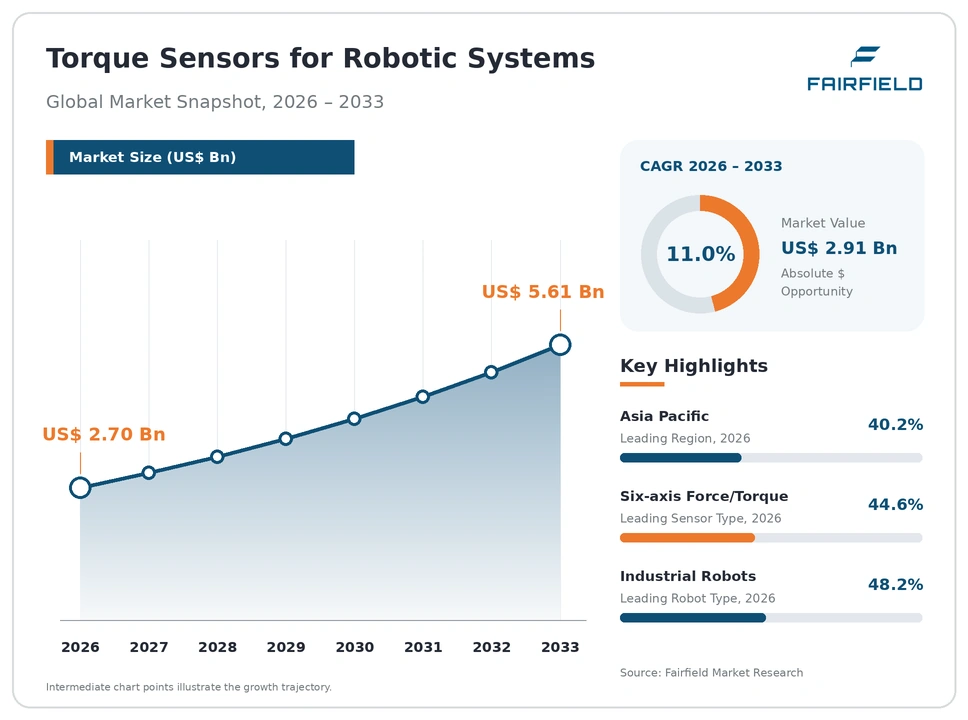
The global torque sensors for robotic systems market size is expected to be valued at US$ 2.70 billion in 2026 and projected to reach US$ 5.61 billion by 2033, growing at a CAGR of 11.0% between 2026 and 2033.
Between 2020 and 2025, the market grew at a CAGR of about 9.4%, as factory automation and collaborative robots spread quickly, despite slower industrial robot orders in 2023 and 2024. Three factors now drive growth: the rise of humanoid robots that need many joint torque sensors, wider use of force control in assembly, polishing, and surgery, and AI-based robot learning that depends on touch and force data. The market is shifting from expensive six-axis force/torque sensors toward low-cost joint sensors, digital outputs, and new sensing methods beyond the traditional strain gauge, especially from suppliers in China.
Key Report Takeaways
- By Sensor Type: Six-axis Force/Torque Sensors held 44.6% share in 2026, while Joint Torque Sensors are projected to expand at a 14.6% CAGR through 2033, driven by humanoid robots and collaborative robot arms.
- By Output: Analog held 54.8% share in 2026, while Digital is projected to expand at a 13.2% CAGR through 2033, driven by EtherCAT and other digital interfaces in modern robots.
- By Robot Type: Industrial Robots held 48.2% share in 2026, while Humanoid Robots are projected to expand at a 24.8% CAGR through 2033, driven by pilot fleets in factories and logistics.
- By Region: Asia Pacific held 40.2% share in 2026, while China is projected to expand at a 13.6% CAGR through 2033, driven by humanoid robot makers and low-cost local sensor suppliers.
Global Torque Sensors for Robotic Systems Market Trends and Insights
Drivers Impact Analysis
Two drivers carry the strongest influence on torque sensor demand in robotics during the forecast period.
| Driver | Impact on CAGR Forecast | Geographic Relevance | Impact Timeline |
| Humanoid and collaborative robot growth | High | Asia Pacific, North America, Europe | Medium term (2-4 years) |
| Force-controlled automation and AI robot learning | High | Global | Long term (≥4 years) |
Humanoid and Collaborative Robots Are Driving the Torque Sensors for Robotic Systems Market
The growth of humanoid robots and collaborative robots is the strongest driver of the torque sensors for robotic systems market. These robots work near people and must sense force to move safely.
The mechanism is more sensors per robot. Collaborative robots from Universal Robots, FANUC, ABB, and KUKA use joint torque sensors or force sensing to stop when they touch a person. A humanoid robot can use more than 20 joint torque sensors plus force sensors in its wrists and ankles. Chinese humanoid makers such as UBTech Robotics, Unitree, and AgiBot, and Western developers such as Tesla, Figure AI, and Boston Dynamics, are scaling production. Kunwei Technology in China says it has delivered more than 100 joint torque sensor models to joint module and humanoid makers. As robot volumes rise, sensor demand grows faster than robot numbers.
Force Control and AI Learning Are Expanding the Torque Sensors for Robotic Systems Market
Force-controlled automation and AI robot learning are expanding the torque sensors for robotic systems market. Many tasks need robots to feel how hard they push or grip.
The cause is new applications that position control alone cannot handle. Assembly of tight-fitting parts, screw driving, sanding, polishing, deburring, and testing require force feedback. Surgical robots use six-axis force/torque sensors to give surgeons a sense of touch, and Celera Motion launched its Sano74 sensor for surgical robot makers in October 2025. AI models for robot manipulation learn better when they receive force and touch data. Kinova and Bota Systems partnered in January 2025 to offer research robots with force-torque sensing for AI development and teaching. These uses broaden demand beyond safety into precision, quality control, and machine intelligence.
Restraints Impact Analysis
Two restraints limit how quickly the torque sensors for robotic systems market grows.
| Restraint | Impact on CAGR Forecast | Geographic Relevance | Impact Timeline |
| High sensor costs and price pressure | High | Global | Short term (≤2 years) |
| Technical challenges in accuracy, durability, and integration | Medium | Global | Medium term (2-4 years) |
High Costs and Price Pressure Slow the Torque Sensors for Robotic Systems Market
High sensor costs and price pressure slow the torque sensors for robotic systems market. Precision force sensors can cost thousands of dollars each.
The specific causes are complex manufacturing and buyer cost targets. Six-axis force/torque sensors require precise machining, careful strain gauge bonding, temperature compensation, and individual calibration, raising costs. Robot makers, especially humanoid and cobot developers, want sensors costing a fraction of current prices to make robots affordable. Chinese suppliers have cut prices sharply, pressuring Western makers’ margins and forcing redesigns. Industrial robot orders slowed in 2023 and 2024 in Europe and China, reducing demand for some sensor types. Some robot makers estimate force from motor current instead of using dedicated sensors to save money and space. These factors limit revenue growth even as unit volumes rise quickly.
Technical Challenges Restrict the Torque Sensors for Robotic Systems Market
Technical challenges in accuracy, durability, and integration restrict the torque sensors for robotic systems market. Torque sensors must work reliably in harsh conditions.
The underlying causes are physical limits and design trade-offs. Sensors face temperature changes, vibration, overload, and electrical noise that affect accuracy. Crosstalk between axes can reduce measurement quality in multi-axis sensors. Joint torque sensors must be small, light, and stiff enough not to reduce robot precision. Humanoid robots experience impacts from walking and falling, which can damage sensors. Integration with robot controllers requires software, calibration, and compatible interfaces. Lack of standards makes it harder to switch suppliers. Long-term drift and the need for periodic recalibration add maintenance costs. These challenges raise development costs and slow adoption in new robot designs.
Market Opportunities
Low-cost Joint Torque Sensors for Humanoids Open a Volume Revenue Pool
Low-cost joint torque sensors for humanoid robots open a volume revenue pool in the torque sensors for robotic systems market. Mass production of humanoids could require millions of sensors each year.
Sensor makers that can cut costs and scale production can capture this opportunity. Humanoid makers need compact, robust sensors integrated into joint modules with motors, gearboxes, and encoders. Chinese suppliers such as Kunwei Technology, which raised a 100 million yuan Series B+ round in 2026, are scaling output. New sensing methods, such as Hall-effect and capacitive designs, can lower costs; PaXini showed a Hall-effect six-axis sensor at CES 2026. Partnerships with joint module suppliers and robot makers secure design wins. Suppliers that win early platforms can grow with humanoid volumes as production moves from hundreds to thousands of units.
Surgical, Medical, and Precision Robotics Create a High-value Revenue Pool
Surgical, medical, and precision robotics create a high-value revenue pool in the torque sensors for robotic systems market. These applications need very accurate and reliable sensors.
Specialist sensor makers can capture this opportunity. Surgical robots for minimally invasive, orthopedic, spine, and dental procedures use force sensors to improve safety and give haptic feedback. Rehabilitation robots, prosthetics, and exoskeletons use torque sensors to support safe patient movement. Semiconductor and electronics assembly robots need very fine force control. These customers value precision, small size, sterilizable designs, and complete regulatory documentation over price. Celera Motion, ATI Industrial Automation, and Kistler actively target these demanding markets. Long product lifecycles and certification create stable, high-margin business. Growth in surgical robot procedures worldwide supports steady replacement and upgrade demand for these sensors.
Segment Analysis
By Sensor Type: Six-axis Force/Torque Sensors Lead While Joint Torque Sensors Grow Fastest
Six-axis Force/Torque Sensors held 44.6% share in 2026. Six-axis force/torque sensors measure forces and torques in all directions and are usually mounted at a robot’s wrist. They are used in assembly, polishing, testing, surgery, and research. ATI Industrial Automation, Robotiq, SCHUNK, and Bota Systems are leading suppliers. Single-axis rotary and reaction torque sensors form another segment.
Joint Torque Sensors are the fastest-growing sensor type, expanding at a 14.6% CAGR through 2033. These sensors are built into each robot joint to measure torque and support safe, compliant movement. Collaborative robots and humanoid robots use many joint sensors, multiplying demand per robot. Chinese suppliers are scaling production for humanoid makers. For the market, joint sensor growth shifts value toward high-volume, lower-cost designs.
By Output: Analog Leads While Digital Grows Fastest
Analog held 54.8% share in 2026. Analog sensors output voltage or current signals and are widely used in existing industrial robots and test systems. They are simple, proven, and compatible with many controllers. Many legacy robot installations use analog sensors with external amplifiers.
Digital is the fastest-growing output type, expanding at a 13.2% CAGR through 2033. Digital sensors include built-in electronics and output data through EtherCAT, CAN, USB, or Ethernet, reducing noise and wiring. Modern robots, humanoids, and research systems favor digital interfaces for easier integration and faster data. Digital sensors also support AI training by streaming precise force data. Built-in diagnostics and temperature compensation improve reliability. For the market, digital growth adds value through smarter sensors.
By Robot Type: Industrial Robots Lead While Humanoid Robots Grow Fastest
Industrial Robots held 48.2% share in 2026. Industrial robots in automotive, electronics, and metal processing use force/torque sensors for assembly, machining, and quality testing. Large installed bases in China, Japan, South Korea, Germany, and the United States support demand. Collaborative robots and surgical robots form other important segments.
Humanoid Robots are the fastest-growing robot type, expanding at a 24.8% CAGR through 2033. Humanoids need many joint torque sensors and force sensors in their hands and feet for balance and manipulation. Pilot deployments in car plants and warehouses are moving toward fleet production. China has many humanoid makers backed by government support. For the market, humanoid growth creates the largest new source of sensor demand.
Geography Analysis
North America Advances the Torque Sensors for Robotic Systems Market Through Humanoids and Surgery
North America is a major torque sensors for robotic systems market driven by humanoid developers, surgical robots, and research. The United States hosts ATI Industrial Automation, part of Novanta, and Celera Motion, also part of Novanta, as well as humanoid makers such as Tesla, Figure AI, Agility Robotics, and Boston Dynamics. Surgical robot leaders such as Intuitive Surgical use force sensing in new systems. Universities and AI labs buy sensors for robot learning research. Canada hosts Robotiq and Kinova. Mexico adds industrial robot demand from automotive plants. One change shaping the region is AI-driven robot development, which increases demand for force data.
Europe Advances the Torque Sensors for Robotic Systems Market Through Precision Sensor Makers
Europe is an important torque sensors for robotic systems market with leading precision sensor makers. Germany hosts HBK, SCHUNK, Sensodrive, and robot maker KUKA, while Switzerland hosts Kistler and Bota Systems. Denmark is home to Universal Robots and OnRobot, leaders in collaborative robots and tools. The European Union Machinery Regulation sets safety rules for robots working with people. Automotive and electronics production face pressure, slowing some robot orders. Italy and France add demand from packaging, food, and automotive automation. One opportunity is sensors for collaborative and medical robots, where European makers have strong positions.
Which Region Is Leading the Torque Sensors for Robotic Systems Market?
Asia Pacific is leading the torque sensors for robotic systems market with a 40.2% share in 2026. The region installs most of the world’s industrial robots, led by China, Japan, and South Korea. Japan hosts robot makers FANUC, Yaskawa, and Kawasaki Heavy Industries, and sensor makers such as Sintokogio and Minebea Mitsumi. South Korea has high robot density in electronics and automotive factories. China is growing fastest, as detailed below. India and Taiwan are expanding electronics manufacturing and robot use. One change shaping the region is falling sensor prices from local production.
Which Country Is Growing Fastest in the Torque Sensors for Robotic Systems Market?
China is growing fastest in the torque sensors for robotic systems market at a 13.6% CAGR through 2033. The country is the world’s largest industrial robot market and has many humanoid makers, including UBTech Robotics, Unitree, and AgiBot. Local sensor makers such as Kunwei Technology, Keli Sensing Technology, and PaXini are scaling production and cutting prices. Government policies and local funds support humanoid robots and core components such as sensors and actuators. Large electric vehicle and electronics plants add industrial robot demand. One challenge is intense price competition among local suppliers. One opportunity is supplying global humanoid makers.
Latin America Grows the Torque Sensors for Robotic Systems Market Through Automotive Automation
Latin America is a developing torque sensors for robotic systems market. Mexico has a large and growing automotive and electronics manufacturing sector that is adding industrial and collaborative robots, especially for exports to the United States. Brazil has automotive, food processing, and agricultural machinery industries that are increasing automation to raise productivity. Universities in Brazil, Mexico, and Chile run robotics and AI research programs. Key barriers include high import costs, currency swings, limited local technical support, and a shortage of automation engineers. One opportunity is collaborative robots for small and mid-sized factories that need flexible automation.
Middle East & Africa Explores the Torque Sensors for Robotic Systems Market
Middle East & Africa is an early-stage torque sensors for robotic systems market. Saudi Arabia and the United Arab Emirates invest in robotics, AI, and advanced manufacturing, and Saudi Arabia plans robot use in its new cities and industries. Israel has robotics and medical device start-ups that use force sensing. South Africa uses industrial robots in automotive plants run by global carmakers, and Morocco’s growing car plants add regional demand. Key barriers include limited manufacturing bases and reliance on imported robots. One opportunity is service and humanoid robots for new city projects such as NEOM, along with hospital robots.
Competitive Landscape
The torque sensors for robotic systems market is moderately concentrated. ATI Industrial Automation, HBK, Kistler, SCHUNK, and Robotiq lead in high-precision sensors, while Bota Systems, OnRobot, TE Connectivity, Honeywell, Sensodrive, and Chinese suppliers such as Kunwei Technology and Keli Sensing Technology compete strongly.
Companies compete on accuracy, robustness, size, price, interface options, software, and integration support. Western suppliers lead in precision, research, and medical applications, while Chinese suppliers compete on price and speed for humanoid and collaborative robots. Robot makers increasingly develop joint sensors in-house or with joint module partners, which changes supplier relationships. Design wins with large robot platforms are critical, since sensors stay in a robot model for years and volumes grow over time.
Strategic moves show how competition is changing. In January 2025, Kinova and Bota Systems partnered to offer force-sensing robots for AI research. In October 2025, Celera Motion launched its Sano74 sensor for surgical robots. In January 2026, PaXini showed a Hall-effect six-axis sensor for humanoids at CES 2026. In March 2026, Kunwei Technology raised 100 million yuan to expand capacity. These moves show competition shifting toward humanoid and AI applications, where volumes and growth rates are highest.
Three themes shape vendor strategy. First, companies are lowering costs through new sensing methods. Second, they are partnering closely with robot and joint module makers. Third, they are adding digital interfaces and software tools for AI model training.
Torque Sensors for Robotic Systems Market Industry Leaders
- ATI Industrial Automation (Novanta)
- HBK
- Kistler
- SCHUNK
- Robotiq
Recent Industry Developments
- March 2026: Kunwei Technology completed a 100 million yuan Series B+ round - funds capacity for joint torque sensors used by humanoid makers.
- January 2026: PaXini showed its Hall-effect six-axis force/torque sensor at CES 2026 - targets low-cost sensing for humanoid robots.
- October 2025: Celera Motion launched the Sano74 force/torque sensor for surgical robotics makers - adds precise force feedback for surgery.
- January 2025: Kinova and Bota Systems partnered to integrate force-torque sensing into research robots - supports AI robot learning.
Companies Covered in the Report
- ATI Industrial Automation (Novanta)
- HBK
- Kistler
- SCHUNK
- Robotiq
- Bota Systems
- OnRobot
- TE Connectivity
- Honeywell
- Sensodrive
- Kunwei Technology
- Keli Sensing Technology
Torque Sensors for Robotic Systems Market Report Scope
This report covers torque sensors for robotic systems, including six-axis force/torque sensors, joint torque sensors, and rotary and reaction torque sensors, with analog and digital outputs, using strain gauge and other sensing technologies, for industrial, collaborative, humanoid, surgical, and service robots. It excludes tactile skin sensors and motor current-based force estimation. The base year is 2025, and the forecast period runs from 2026 to 2033. All values are expressed in US$ Billion.
Sensor Type
- Six-axis Force/Torque Sensors
- Joint Torque Sensors
- Rotary & Reaction Torque Sensors
Output
- Analog
- Digital
Robot Type
- Industrial Robots
- Collaborative Robots
- Humanoid Robots
- Surgical & Medical Robots
- Service Robots
Regions
- North America
- Europe
- Asia Pacific
- Latin America
- Middle East & Africa
Key Questions Answered in the Report
How big is the torque sensors for robotic systems market in 2026?
The torque sensors for robotic systems market is valued at US$ 2.70 billion in 2026, led by six-axis force/torque sensors.
What is the torque sensors for robotic systems market forecast to 2033?
The market is projected to reach US$ 5.61 billion by 2033, growing at a 11.0% CAGR and adding US$ 2.91 billion.
Which robot type is growing fastest for torque sensors?
Humanoid Robots are growing fastest at a 24.8% CAGR through 2033, driven by pilot fleets in factories and logistics centers.
Which country is growing fastest in this market?
China is growing fastest at a 13.6% CAGR through 2033, driven by humanoid robot makers and low-cost local sensor suppliers.
Which region holds the largest torque sensors for robotic systems market share?
Asia Pacific holds the largest share at 40.2% in 2026, supported by large industrial robot installations in China and Japan.
1. Executive Summary
1.1. Global Torque Sensors for Robotic Systems Market Snapshot
1.2. Future Projections
1.3. Key Report Takeaways
1.4. Regional Snapshot
2. Market Overview
2.1. Market Definition and Report Scope
2.2. Historical Trends 2020–2025
2.3. Market Dynamics
2.3.1. Drivers
2.3.1.1. Humanoid and Collaborative Robots Are Driving the Torque Sensors for Robotic Systems Market
2.3.1.2. Force Control and AI Learning Are Expanding the Torque Sensors for Robotic Systems Market
2.3.2. Restraints
2.3.2.1. High Costs and Price Pressure Slow the Torque Sensors for Robotic Systems Market
2.3.2.2. Technical Challenges Restrict the Torque Sensors for Robotic Systems Market
2.3.3. Market Opportunities
2.3.3.1. Low-cost Joint Torque Sensors for Humanoids Open a Volume Revenue Pool
2.3.3.2. Surgical, Medical, and Precision Robotics Create a High-value Revenue Pool
3. Global Torque Sensors for Robotic Systems Market Outlook, 2020-2033
3.1. Global Torque Sensors for Robotic Systems Market Outlook, by Sensor Type, Value (US$ Billion), 2020-2033
3.1.1. Six-axis Force/Torque Sensors
3.1.2. Joint Torque Sensors
3.1.3. Rotary & Reaction Torque Sensors
3.2. Global Torque Sensors for Robotic Systems Market Outlook, by Output, Value (US$ Billion), 2020-2033
3.2.1. Analog
3.2.2. Digital
3.3. Global Torque Sensors for Robotic Systems Market Outlook, by Robot Type, Value (US$ Billion), 2020-2033
3.3.1. Industrial Robots
3.3.2. Collaborative Robots
3.3.3. Humanoid Robots
3.3.4. Surgical & Medical Robots
3.3.5. Service Robots
3.4. Global Torque Sensors for Robotic Systems Market Outlook, by Region, Value (US$ Billion), 2020-2033
3.4.1. North America
3.4.2. Europe
3.4.3. Asia Pacific
3.4.4. Latin America
3.4.5. Middle East & Africa
4. North America Torque Sensors for Robotic Systems Market Outlook, 2020-2033
4.1. North America Torque Sensors for Robotic Systems Market Outlook, by Sensor Type, Value (US$ Billion), 2020-2033
4.1.1. Six-axis Force/Torque Sensors
4.1.2. Joint Torque Sensors
4.1.3. Rotary & Reaction Torque Sensors
4.2. North America Torque Sensors for Robotic Systems Market Outlook, by Output, Value (US$ Billion), 2020-2033
4.2.1. Analog
4.2.2. Digital
4.3. North America Torque Sensors for Robotic Systems Market Outlook, by Robot Type, Value (US$ Billion), 2020-2033
4.3.1. Industrial Robots
4.3.2. Collaborative Robots
4.3.3. Humanoid Robots
4.3.4. Surgical & Medical Robots
4.3.5. Service Robots
4.4. North America Torque Sensors for Robotic Systems Market Outlook, by Country, Value (US$ Billion), 2020-2033
4.4.1. United States Torque Sensors for Robotic Systems Market Outlook, by Sensor Type, 2020-2033
4.4.2. United States Torque Sensors for Robotic Systems Market Outlook, by Output, 2020-2033
4.4.3. United States Torque Sensors for Robotic Systems Market Outlook, by Robot Type, 2020-2033
4.4.4. Canada Torque Sensors for Robotic Systems Market Outlook, by Sensor Type, 2020-2033
4.4.5. Canada Torque Sensors for Robotic Systems Market Outlook, by Output, 2020-2033
4.4.6. Canada Torque Sensors for Robotic Systems Market Outlook, by Robot Type, 2020-2033
4.4.7. Mexico Torque Sensors for Robotic Systems Market Outlook, by Sensor Type, 2020-2033
4.4.8. Mexico Torque Sensors for Robotic Systems Market Outlook, by Output, 2020-2033
4.4.9. Mexico Torque Sensors for Robotic Systems Market Outlook, by Robot Type, 2020-2033
5. Europe Torque Sensors for Robotic Systems Market Outlook, 2020-2033
5.1. Europe Torque Sensors for Robotic Systems Market Outlook, by Sensor Type, Value (US$ Billion), 2020-2033
5.1.1. Six-axis Force/Torque Sensors
5.1.2. Joint Torque Sensors
5.1.3. Rotary & Reaction Torque Sensors
5.2. Europe Torque Sensors for Robotic Systems Market Outlook, by Output, Value (US$ Billion), 2020-2033
5.2.1. Analog
5.2.2. Digital
5.3. Europe Torque Sensors for Robotic Systems Market Outlook, by Robot Type, Value (US$ Billion), 2020-2033
5.3.1. Industrial Robots
5.3.2. Collaborative Robots
5.3.3. Humanoid Robots
5.3.4. Surgical & Medical Robots
5.3.5. Service Robots
5.4. Europe Torque Sensors for Robotic Systems Market Outlook, by Country, Value (US$ Billion), 2020-2033
5.4.1. Germany Torque Sensors for Robotic Systems Market Outlook, by Sensor Type, 2020-2033
5.4.2. Germany Torque Sensors for Robotic Systems Market Outlook, by Output, 2020-2033
5.4.3. Germany Torque Sensors for Robotic Systems Market Outlook, by Robot Type, 2020-2033
5.4.4. Switzerland Torque Sensors for Robotic Systems Market Outlook, by Sensor Type, 2020-2033
5.4.5. Switzerland Torque Sensors for Robotic Systems Market Outlook, by Output, 2020-2033
5.4.6. Switzerland Torque Sensors for Robotic Systems Market Outlook, by Robot Type, 2020-2033
5.4.7. Denmark Torque Sensors for Robotic Systems Market Outlook, by Sensor Type, 2020-2033
5.4.8. Denmark Torque Sensors for Robotic Systems Market Outlook, by Output, 2020-2033
5.4.9. Denmark Torque Sensors for Robotic Systems Market Outlook, by Robot Type, 2020-2033
5.4.10. Italy Torque Sensors for Robotic Systems Market Outlook, by Sensor Type, 2020-2033
5.4.11. Italy Torque Sensors for Robotic Systems Market Outlook, by Output, 2020-2033
5.4.12. Italy Torque Sensors for Robotic Systems Market Outlook, by Robot Type, 2020-2033
5.4.13. France Torque Sensors for Robotic Systems Market Outlook, by Sensor Type, 2020-2033
5.4.14. France Torque Sensors for Robotic Systems Market Outlook, by Output, 2020-2033
5.4.15. France Torque Sensors for Robotic Systems Market Outlook, by Robot Type, 2020-2033
6. Asia Pacific Torque Sensors for Robotic Systems Market Outlook, 2020-2033
6.1. Asia Pacific Torque Sensors for Robotic Systems Market Outlook, by Sensor Type, Value (US$ Billion), 2020-2033
6.1.1. Six-axis Force/Torque Sensors
6.1.2. Joint Torque Sensors
6.1.3. Rotary & Reaction Torque Sensors
6.2. Asia Pacific Torque Sensors for Robotic Systems Market Outlook, by Output, Value (US$ Billion), 2020-2033
6.2.1. Analog
6.2.2. Digital
6.3. Asia Pacific Torque Sensors for Robotic Systems Market Outlook, by Robot Type, Value (US$ Billion), 2020-2033
6.3.1. Industrial Robots
6.3.2. Collaborative Robots
6.3.3. Humanoid Robots
6.3.4. Surgical & Medical Robots
6.3.5. Service Robots
6.4. Asia Pacific Torque Sensors for Robotic Systems Market Outlook, by Country, Value (US$ Billion), 2020-2033
6.4.1. China Torque Sensors for Robotic Systems Market Outlook, by Sensor Type, 2020-2033
6.4.2. China Torque Sensors for Robotic Systems Market Outlook, by Output, 2020-2033
6.4.3. China Torque Sensors for Robotic Systems Market Outlook, by Robot Type, 2020-2033
6.4.4. Japan Torque Sensors for Robotic Systems Market Outlook, by Sensor Type, 2020-2033
6.4.5. Japan Torque Sensors for Robotic Systems Market Outlook, by Output, 2020-2033
6.4.6. Japan Torque Sensors for Robotic Systems Market Outlook, by Robot Type, 2020-2033
6.4.7. South Korea Torque Sensors for Robotic Systems Market Outlook, by Sensor Type, 2020-2033
6.4.8. South Korea Torque Sensors for Robotic Systems Market Outlook, by Output, 2020-2033
6.4.9. South Korea Torque Sensors for Robotic Systems Market Outlook, by Robot Type, 2020-2033
6.4.10. India Torque Sensors for Robotic Systems Market Outlook, by Sensor Type, 2020-2033
6.4.11. India Torque Sensors for Robotic Systems Market Outlook, by Output, 2020-2033
6.4.12. India Torque Sensors for Robotic Systems Market Outlook, by Robot Type, 2020-2033
6.4.13. Taiwan Torque Sensors for Robotic Systems Market Outlook, by Sensor Type, 2020-2033
6.4.14. Taiwan Torque Sensors for Robotic Systems Market Outlook, by Output, 2020-2033
6.4.15. Taiwan Torque Sensors for Robotic Systems Market Outlook, by Robot Type, 2020-2033
7. Latin America Torque Sensors for Robotic Systems Market Outlook, 2020-2033
7.1. Latin America Torque Sensors for Robotic Systems Market Outlook, by Sensor Type, Value (US$ Billion), 2020-2033
7.1.1. Six-axis Force/Torque Sensors
7.1.2. Joint Torque Sensors
7.1.3. Rotary & Reaction Torque Sensors
7.2. Latin America Torque Sensors for Robotic Systems Market Outlook, by Output, Value (US$ Billion), 2020-2033
7.2.1. Analog
7.2.2. Digital
7.3. Latin America Torque Sensors for Robotic Systems Market Outlook, by Robot Type, Value (US$ Billion), 2020-2033
7.3.1. Industrial Robots
7.3.2. Collaborative Robots
7.3.3. Humanoid Robots
7.3.4. Surgical & Medical Robots
7.3.5. Service Robots
7.4. Latin America Torque Sensors for Robotic Systems Market Outlook, by Country, Value (US$ Billion), 2020-2033
7.4.1. Mexico Torque Sensors for Robotic Systems Market Outlook, by Sensor Type, 2020-2033
7.4.2. Mexico Torque Sensors for Robotic Systems Market Outlook, by Output, 2020-2033
7.4.3. Mexico Torque Sensors for Robotic Systems Market Outlook, by Robot Type, 2020-2033
7.4.4. Brazil Torque Sensors for Robotic Systems Market Outlook, by Sensor Type, 2020-2033
7.4.5. Brazil Torque Sensors for Robotic Systems Market Outlook, by Output, 2020-2033
7.4.6. Brazil Torque Sensors for Robotic Systems Market Outlook, by Robot Type, 2020-2033
7.4.7. Chile Torque Sensors for Robotic Systems Market Outlook, by Sensor Type, 2020-2033
7.4.8. Chile Torque Sensors for Robotic Systems Market Outlook, by Output, 2020-2033
7.4.9. Chile Torque Sensors for Robotic Systems Market Outlook, by Robot Type, 2020-2033
8. Middle East & Africa Torque Sensors for Robotic Systems Market Outlook, 2020-2033
8.1. Middle East & Africa Torque Sensors for Robotic Systems Market Outlook, by Sensor Type, Value (US$ Billion), 2020-2033
8.1.1. Six-axis Force/Torque Sensors
8.1.2. Joint Torque Sensors
8.1.3. Rotary & Reaction Torque Sensors
8.2. Middle East & Africa Torque Sensors for Robotic Systems Market Outlook, by Output, Value (US$ Billion), 2020-2033
8.2.1. Analog
8.2.2. Digital
8.3. Middle East & Africa Torque Sensors for Robotic Systems Market Outlook, by Robot Type, Value (US$ Billion), 2020-2033
8.3.1. Industrial Robots
8.3.2. Collaborative Robots
8.3.3. Humanoid Robots
8.3.4. Surgical & Medical Robots
8.3.5. Service Robots
8.4. Middle East & Africa Torque Sensors for Robotic Systems Market Outlook, by Country, Value (US$ Billion), 2020-2033
8.4.1. Saudi Arabia Torque Sensors for Robotic Systems Market Outlook, by Sensor Type, 2020-2033
8.4.2. Saudi Arabia Torque Sensors for Robotic Systems Market Outlook, by Output, 2020-2033
8.4.3. Saudi Arabia Torque Sensors for Robotic Systems Market Outlook, by Robot Type, 2020-2033
8.4.4. United Arab Emirates Torque Sensors for Robotic Systems Market Outlook, by Sensor Type, 2020-2033
8.4.5. United Arab Emirates Torque Sensors for Robotic Systems Market Outlook, by Output, 2020-2033
8.4.6. United Arab Emirates Torque Sensors for Robotic Systems Market Outlook, by Robot Type, 2020-2033
8.4.7. Israel Torque Sensors for Robotic Systems Market Outlook, by Sensor Type, 2020-2033
8.4.8. Israel Torque Sensors for Robotic Systems Market Outlook, by Output, 2020-2033
8.4.9. Israel Torque Sensors for Robotic Systems Market Outlook, by Robot Type, 2020-2033
8.4.10. South Africa Torque Sensors for Robotic Systems Market Outlook, by Sensor Type, 2020-2033
8.4.11. South Africa Torque Sensors for Robotic Systems Market Outlook, by Output, 2020-2033
8.4.12. South Africa Torque Sensors for Robotic Systems Market Outlook, by Robot Type, 2020-2033
8.4.13. Morocco Torque Sensors for Robotic Systems Market Outlook, by Sensor Type, 2020-2033
8.4.14. Morocco Torque Sensors for Robotic Systems Market Outlook, by Output, 2020-2033
8.4.15. Morocco Torque Sensors for Robotic Systems Market Outlook, by Robot Type, 2020-2033
9. Competitive Landscape
9.1. Market Concentration and Industry Leaders
9.2. Competitive Differentiation
9.3. Strategic Moves and Market Direction
9.4. Recent Industry Developments
9.5. Company Profiles
9.5.1. ATI Industrial Automation (Novanta)
9.5.2. HBK
9.5.3. Kistler
9.5.4. SCHUNK
9.5.5. Robotiq
9.5.6. Bota Systems
9.5.7. OnRobot
9.5.8. TE Connectivity
9.5.9. Honeywell
9.5.10. Sensodrive
9.5.11. Kunwei Technology
9.5.12. Keli Sensing Technology
10. Appendix
10.1. Research Methodology
10.2. Report Assumptions
10.3. Acronyms and Abbreviations
| Segment | Categories |
|---|---|
| Sensor Type | Six-axis Force/Torque Sensors, Joint Torque Sensors, Rotary & Reaction Torque Sensors |
| Output | Analog, Digital |
| Robot Type | Industrial Robots, Collaborative Robots, Humanoid Robots, Surgical & Medical Robots, Service Robots |
| Regions | North America, Europe, Asia Pacific, Latin America, Middle East & Africa |
Our Research Methodology
Considering the volatility of business today, traditional approaches to strategizing a game plan can be unfruitful if not detrimental. True ambiguity is no way to determine a forecast. A myriad of predetermined factors must be accounted for such as the degree of risk involved, the magnitude of circumstances, as well as conditions or consequences that are not known or unpredictable. To circumvent binary views that cast uncertainty, the application of market research intelligence to strategically posture, move, and enable actionable outcomes is necessary.
View Methodology
Quality Assured
Rigorous Validation Process

Confidentiality Assured
End-to-end Data Security

Custom Research Services
Tailored To Your Objectives
FAQs
The torque sensors for robotic systems market is valued at US$ 2.70 billion in 2026, led by six-axis force/torque sensors.
The market is projected to reach US$ 5.61 billion by 2033, growing at a 11.0% CAGR and adding US$ 2.91 billion.
Humanoid Robots are growing fastest at a 24.8% CAGR through 2033, driven by pilot fleets in factories and logistics centers.
China is growing fastest at a 13.6% CAGR through 2033, driven by humanoid robot makers and low-cost local sensor suppliers.
Asia Pacific holds the largest share at 40.2% in 2026, supported by large industrial robot installations in China and Japan.
Related Reports
Food and Beverage Automated Storage Retrieval System Market Size, Share, Insights, Competitive Landscape, and Forecast 2026 to 2033
Food and beverage AS/RS market to reach US$ 3.10 billion by 2033 at a 9.7% CAGR. Explore system types, temperature ranges and regional trends.
Agricultural Haying and Forage Machinery Market Size, Share, Insights, Competitive Landscape, and Forecast 2026 to 2033
Agricultural haying and forage machinery market to reach US$ 13.06 billion by 2033 at a 4.1% CAGR. Explore products, operations and regional trends.
Valve Remote Control System Market Size, Share, Insights, Competitive Landscape, and Forecast 2026 to 2033
Valve remote control system market to reach US$ 15.16 billion by 2033 at a 6.5% CAGR. Explore actuation types, applications and regional trends.
Aseptic Filling Machine Market Size, Share, Insights, Competitive Landscape, and Forecast 2026 to 2033
The aseptic filling machine market is projected to reach US$ 6.65 billion by 2033 at a 7.6% CAGR. Explore technologies and regional trends.
Multi-Effect Evaporators Market Size, Share, Insights, Competitive Landscape, and Forecast 2026 to 2033
Explore the multi-effect evaporators market, reaching US$ 2.90 billion by 2033 at 5.5% CAGR, with types, end uses and regional insights.
Industrial Belt Scale Market Size, Share, Insights, Competitive Landscape, and Forecast 2026 to 2033
Industrial belt scale market to reach US$909.1 million by 2033 at 6.0% CAGR. Explore product types, accuracy classes, regional trends and key players.