



Valve Remote Control System Market
Valve Remote Control System Market Size, Share, Insights, Competitive Landscape, and Forecast 2026 to 2033
Valve Remote Control System Market Analysis, 2026–2033
Valve Remote Control System Market
Valve Remote Control System Market Size, Share, Insights, Competitive Landscape, and Forecast 2026 to 2033
Valve Remote Control System Market Size and Trend Analysis
How Fast Is the Valve Remote Control System Market Growing?
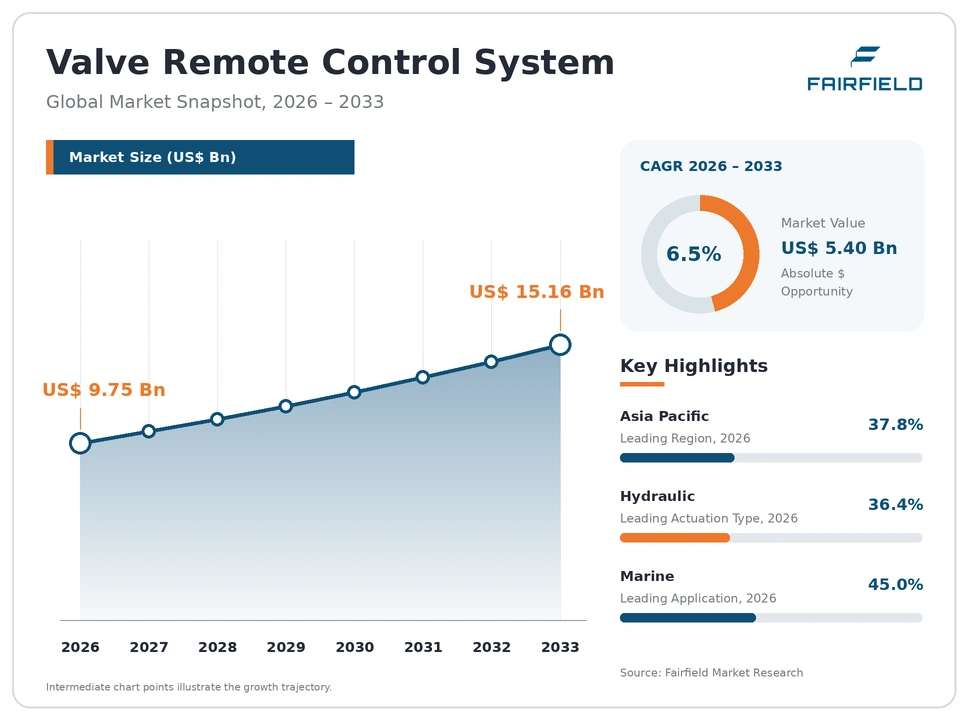
The global valve remote control system market size is expected to be valued at US$ 9.75 billion in 2026 and projected to reach US$ 15.16 billion by 2033, growing at a CAGR of 6.5% between 2026 and 2033.
Between 2020 and 2025, the market grew at a CAGR of about 5.4%, as shipbuilding orders recovered after a weak period and industrial plants resumed automation projects delayed by the pandemic. Three factors now drive growth: record orders for LNG carriers, tankers, and container ships, stricter rules on ballast water and emissions that require automated valve control, and the digitalization of process plants and water networks. The market is shifting from hydraulic actuators toward electric actuators, wireless tank monitoring, and integrated systems that support remote diagnostics and autonomous vessel operations.
Key Report Takeaways
- By Actuation Type: Hydraulic held 36.4% share in 2026, while Electric is projected to expand at a 8.2% CAGR through 2033, driven by simpler installation, lower maintenance, and energy efficiency on new vessels.
- By Component: Actuators held 35.2% share in 2026, while Sensors are projected to expand at a 7.7% CAGR through 2033, driven by remote monitoring and predictive maintenance needs.
- By Application: Marine held 45.0% share in 2026, while Chemical is projected to expand at a 7.3% CAGR through 2033, driven by plant automation and safety requirements in chemical processing.
- By Region: Asia Pacific held 37.8% share in 2026, while Europe is projected to expand at a 7.0% CAGR through 2033, driven by vessel retrofits, energy transition projects, and water network upgrades.
Global Valve Remote Control System Market Trends and Insights
Drivers Impact Analysis
Two drivers carry the strongest influence on valve remote control system demand during the forecast period.
| Driver | Impact on CAGR Forecast | Geographic Relevance | Impact Timeline |
| Shipbuilding growth and new vessel types | High | Asia Pacific, Europe | Medium term (2-4 years) |
| Industrial automation and digital plant operations | High | North America, Europe, Asia Pacific | Long term (≥4 years) |
Shipbuilding Growth Is Driving the Valve Remote Control System Market
Shipbuilding growth and new vessel types are the strongest drivers of the valve remote control system market. Every large ship uses hundreds of remotely controlled valves for cargo, ballast, fuel, and bilge systems.
The mechanism is record order books and more complex ships. Shipyards in South Korea, China, and Japan have large orders for LNG carriers, container ships, tankers, and car carriers. LNG, ammonia, and methanol carriers need many precisely controlled valves for cargo handling and safety. Dual-fuel engines add fuel supply valves. The International Maritime Organization’s ballast water management rules require automated ballast systems on most ships. Crew reductions and remote operation push owners to automate valve control from the bridge or engine control room. Each newbuild vessel requires a complete valve remote control system, creating steady demand for suppliers.
Industrial Automation Is Expanding the Valve Remote Control System Market
Industrial automation and digital plant operations are expanding the valve remote control system market. Land-based plants use remote valve control to improve safety, efficiency, and reliability.
The cause is digitalization and labor shortages. Oil and gas facilities, refineries, chemical plants, power stations, and water treatment plants use remotely actuated valves controlled from central rooms. Utilities are upgrading water and wastewater networks with automated valves to reduce leaks and respond quickly to problems. Process plants add smart actuators and tank monitoring sensors that send data to control systems for predictive maintenance. Fewer skilled field technicians make remote control more valuable. Safety rules require automated shutdown valves in hazardous areas. Energy transition projects, such as hydrogen and carbon capture plants, need new valve systems. These trends broaden demand beyond the marine sector.
Restraints Impact Analysis
Two restraints limit how quickly the valve remote control system market grows.
| Restraint | Impact on CAGR Forecast | Geographic Relevance | Impact Timeline |
| Cyclical shipbuilding and oil and gas investment | High | Asia Pacific, Middle East & Africa | Short term (≤2 years) |
| High installation costs and cybersecurity risks | Medium | Global | Medium term (2-4 years) |
Cyclical Shipbuilding and Energy Investment Slow the Valve Remote Control System Market
Cyclical shipbuilding and oil and gas investment slow the valve remote control system market. Demand depends heavily on industries with strong boom and bust cycles.
The specific causes are freight rate swings and energy price changes. Ship orders rise when freight rates are high and fall sharply when markets weaken, as seen after 2008 and in the mid-2010s. Overcapacity in some vessel segments could reduce future orders. Oil and gas companies cut capital spending when prices fall, delaying new platforms and refineries. Trade disputes and tariffs, including United States port fees on Chinese-built ships, add uncertainty for shipyards. Steel and component price swings affect project costs. Suppliers with high exposure to marine newbuilds face volatile revenue. These factors make long-term capacity planning difficult for manufacturers and their suppliers.
High Costs and Cybersecurity Risks Restrict the Valve Remote Control System Market
High installation costs and cybersecurity risks restrict the valve remote control system market. Retrofitting older ships and plants is complex and expensive.
The underlying causes are integration challenges and connected systems. Installing valve remote control on existing vessels requires piping changes, cabling, hydraulic power units, and dry-dock time, which keeps ships out of service. Small shipowners and plant operators may delay upgrades. Connected systems that allow remote access create cyber risks, and rules such as IACS UR E26 and UR E27 now require cyber resilience for new ships. Meeting these rules adds design and testing costs. Lack of standard interfaces between systems from different suppliers makes integration harder. Skilled technicians for installation and service are in short supply. These factors restrict adoption in the retrofit market, especially for older ships nearing scrapping.
Market Opportunities
Electric Actuators and Smart Valves Open a Modernization Revenue Pool
Electric actuators and smart valves open a modernization revenue pool in the valve remote control system market. Shipowners and plant operators want simpler, cleaner, and more connected systems.
Actuator makers and system integrators can capture this opportunity. Electric actuators eliminate hydraulic piping and oil leaks, reduce installation time, and lower energy use. They provide position feedback and diagnostics that support predictive maintenance. Eltorque, which has supplied more than 150,000 electric actuators to over 1,200 vessels, opened a new office in Spain in 2026 to serve shipyards. Rotork acquired Noah Actuation in South Korea in 2025 to expand its electric actuator range. Retrofit programs on existing ships and plants add demand. Suppliers offering electric and hybrid solutions, along with service contracts and remote support, can win share from hydraulic systems.
Alternative-fuel Vessels and Energy Transition Projects Create a New Revenue Pool
Alternative-fuel vessels and energy transition projects create a new revenue pool in the valve remote control system market. New fuels and processes need specialized valve control.
Specialist suppliers can capture this opportunity. Ships powered by LNG, methanol, ammonia, and hydrogen require complex fuel supply and safety valve systems. Ammonia and liquefied CO2 carriers are emerging vessel types with strict safety requirements. On land, hydrogen production plants, carbon capture facilities, offshore wind installations, and green ammonia projects need automated valves. The European Union and International Maritime Organization emissions rules push owners toward new fuels. Suppliers with classification-approved products for new fuels can command premium prices. Partnerships with shipyards, engine makers, and fuel system integrators secure early orders. These projects support long-term growth beyond traditional oil, gas, and shipping markets.
Segment Analysis
By Actuation Type: Hydraulic Leads While Electric Grows Fastest
Hydraulic held 36.4% share in 2026. Hydraulic actuators provide high force and reliability, making them the standard choice for large valves on tankers, bulk carriers, and offshore platforms. Central hydraulic power units serve many valves through piping systems. Wärtsilä, Emerson, and Nakakita supply hydraulic systems, and pneumatic actuators form a large segment in process plants.
Electric is the fastest-growing actuation type, expanding at a 8.2% CAGR through 2033. Electric actuators need only cabling, avoid oil leaks, and offer digital feedback and diagnostics. They suit modern vessels, offshore wind service ships, and water treatment plants. Improved motor and battery backup technology has increased their reliability for critical valves. Rotork, Eltorque, and Emerson offer electric solutions. Electro-hydraulic actuators combine both technologies. For the market, electric growth shifts value toward smart devices.
By Component: Actuators Lead While Sensors Grow Fastest
Actuators held 35.2% share in 2026. Actuators move valves open and closed and account for the largest share of system cost. Each vessel or plant may need hundreds of actuators of different sizes. Replacement and upgrade of actuators during ship dry-docking and plant shutdowns also create steady aftermarket demand. Control panels, software, and hydraulic power units form other components.
Sensors are the fastest-growing component, expanding at a 7.7% CAGR through 2033. Position sensors, pressure sensors, and tank monitoring systems provide real-time data on valve status and tank levels. Wireless sensors reduce cabling, weight, and installation costs on ships. Data supports remote diagnostics, predictive maintenance, and digital twins. Kongsberg Maritime has upgraded its valve control software with digital twin and remote diagnostic features. For the market, sensor growth adds intelligence to valve systems and supports service revenue.
By Application: Marine Leads While Chemical Grows Fastest
Marine held 45.0% share in 2026. Ships use valve remote control for cargo, ballast, fuel, and bilge systems, and new rules for ballast water treatment and emissions increase automation. Record orders for LNG carriers, tankers, and container ships support demand, especially at shipyards in Asia Pacific. Offshore platforms and floating production units form a related segment.
Chemical is the fastest-growing application, expanding at a 7.3% CAGR through 2033. Chemical plants handle hazardous materials that require precise and safe valve control, and new plants in China, India, and the Middle East & Africa region add demand. Safety rules require automated shutdown and isolation valves. Oil and gas, power generation, refining, and water and wastewater treatment form other applications. For the market, chemical growth diversifies demand beyond shipping.
Geography Analysis
North America Advances the Valve Remote Control System Market Through Process Industries
North America is a major valve remote control system market driven by oil and gas, chemical, power, and water industries. The United States has large refining, petrochemical, and LNG export facilities that use automated valves, and water utilities are upgrading networks with funding from federal infrastructure programs. Emerson, Flowserve, Honeywell, and Parker Hannifin are major suppliers based in the region. The U.S. Navy and government programs to rebuild domestic shipbuilding add marine demand. Canada has oil sands and pipeline operations, while Mexico adds refining demand. One change shaping the region is digital valve monitoring that reduces field visits.
Which Region Is Growing Fastest in the Valve Remote Control System Market?
Europe is growing fastest in the valve remote control system market at a 7.0% CAGR through 2033. Norway hosts Kongsberg Maritime, Eltorque, and Skarpenord, while Finland hosts Wärtsilä and Valmet, and Germany hosts Pleiger and KSB. European shipowners lead in retrofits for emissions and ballast water rules, and cruise ship and specialized vessel builders in Italy, Germany, and Finland need advanced systems. Hydrogen, carbon capture, and offshore wind projects add demand. Rotork, based in the United Kingdom, is being acquired by ABB. One opportunity is electric retrofits for existing fleets and plants.
Which Region Is Leading the Valve Remote Control System Market?
Asia Pacific is leading the valve remote control system market with a 37.8% share in 2026. China, South Korea, and Japan build most of the world’s ships, creating strong demand for marine valve systems from shipyards such as HD Hyundai Heavy Industries, Samsung Heavy Industries, Hanwha Ocean, and China State Shipbuilding Corporation. Japan hosts Nakakita, a leading marine valve control maker. China and India are also building chemical, refining, and water treatment plants. Singapore is a major hub for ship repair and offshore projects. One change shaping the region is high demand for LNG carriers.
Latin America Grows the Valve Remote Control System Market Through Offshore Oil
Latin America is a growing valve remote control system market driven by offshore oil and gas production. Brazil’s Petrobras operates many floating production, storage, and offloading units that use extensive valve remote control systems, and new units are on order. Guyana has rapidly growing offshore oil output. Mexico and Argentina have refining, pipeline, and shale gas projects. Water utilities in major cities are adding automation. Brazil also has shipyards that build support vessels and offshore modules. Key barriers include project delays, currency swings, local content rules, and reliance on imported equipment. One opportunity is valve systems for new FPSO units and offshore support vessels.
Middle East & Africa Builds the Valve Remote Control System Market Through Energy Projects
Middle East & Africa is an important valve remote control system market driven by oil, gas, petrochemical, and desalination projects. Saudi Arabia, the United Arab Emirates, and Qatar are expanding gas production, LNG export capacity, and petrochemical plants, and Qatar’s LNG expansion needs new carriers and onshore facilities. Large desalination plants across the region use many automated valves. In Africa, Nigeria, Mozambique, and Egypt have gas projects. Oman and Kuwait are upgrading refineries and water systems. Key barriers include project timing tied to oil prices and long tender processes. One opportunity is automation for desalination and water networks.
Competitive Landscape
The valve remote control system market is moderately concentrated. Emerson Electric, Wärtsilä, Rotork, Flowserve, and Kongsberg Maritime are leading players, while Honeywell, Valmet, Parker Hannifin, Nakakita, Eltorque, Pleiger, and Skarpenord compete in specific segments. The top five players hold about 40% of the market.
Companies compete on reliability, certification by classification societies, system integration, delivery time, service networks, and digital capabilities. Marine buyers value proven track records and global service, because valve failures can stop cargo operations. Process industry customers value safety certification and easy integration with existing plant control systems. Suppliers with strong relationships with shipyards in Asia Pacific gain large newbuild orders. Aftermarket service, spare parts, and retrofit work provide steadier income than newbuild projects. Chinese and Korean domestic suppliers are gaining share at local shipyards by offering lower prices.
Strategic moves show how competition is changing. In March 2025, Rotork agreed to acquire Noah Actuation, an electric actuator maker in South Korea. In February 2026, Eltorque opened an office in Vigo, Spain, to serve shipyards and shipowners. In July 2026, ABB agreed to acquire Rotork for about US$ 5.5 billion. These moves show competition shifting toward electric actuation and consolidation under large automation groups with global service networks.
Three themes shape vendor strategy. First, companies are expanding electric actuator portfolios. Second, they are adding digital monitoring and remote diagnostics. Third, they are consolidating to offer complete automation solutions.
Valve Remote Control System Market Industry Leaders
- Emerson Electric
- Wärtsilä
- Rotork
- Flowserve
- Kongsberg Maritime
Recent Industry Developments
- July 2026: ABB agreed to acquire Rotork for about US$ 5.5 billion - adds electric actuators and installed-base services to ABB’s automation business.
- February 2026: Eltorque opened a commercial office in Vigo, Spain - strengthens support for Spanish shipyards and shipowners.
- March 2025: Rotork agreed to acquire Noah Actuation for £44 million - expands its electric actuator range and presence in Asia Pacific.
Companies Covered in the Report
- Emerson Electric
- Wärtsilä
- Rotork
- Flowserve
- Kongsberg Maritime
- Honeywell International
- Valmet
- Parker Hannifin
- Nakakita
- Eltorque
- Pleiger Maschinenbau
- Skarpenord
Valve Remote Control System Market Report Scope
This report covers valve remote control systems, including hydraulic, pneumatic, electric, and electro-hydraulic actuators, control panels, sensors, software, and power units, used in marine, oil and gas, chemical, power generation, refining, and water and wastewater applications. It excludes manual valves and stand-alone valve bodies sold without remote control. The base year is 2025, and the forecast period runs from 2026 to 2033. All values are expressed in US$ Billion.
Actuation Type
- Hydraulic
- Pneumatic
- Electric
- Electro-hydraulic
Component
- Actuators
- Control Panels & Software
- Sensors
- Power Units
Application
- Marine
- Oil & Gas
- Chemical
- Power Generation
- Water & Wastewater
- Others
Regions
- North America
- Europe
- Asia Pacific
- Latin America
- Middle East & Africa
Key Questions Answered in the Report
How big is the valve remote control system market in 2026?
The valve remote control system market is valued at US$ 9.75 billion in 2026, led by marine applications and hydraulic actuation.
What is the valve remote control system market forecast to 2033?
The market is projected to reach US$ 15.16 billion by 2033, growing at a 6.5% CAGR and adding US$ 5.40 billion.
Which actuation type is growing fastest in valve remote control systems?
Electric is growing fastest at a 8.2% CAGR through 2033, driven by simpler installation, lower maintenance, and energy efficiency.
Which region is growing fastest in the valve remote control system market?
Europe is growing fastest at a 7.0% CAGR through 2033, driven by vessel retrofits, energy transition projects, and water upgrades.
Which region holds the largest valve remote control system market share?
Asia Pacific holds the largest share at 37.8% in 2026, supported by major shipbuilding in China, South Korea, and Japan.
1. Executive Summary
1.1. Global Valve Remote Control System Market Snapshot
1.2. Future Projections
1.3. Key Report Takeaways
1.4. Regional Snapshot
2. Market Overview
2.1. Market Definition and Report Scope
2.2. Historical Trends 2020–2025
2.3. Market Dynamics
2.3.1. Drivers
2.3.1.1. Shipbuilding Growth Is Driving the Valve Remote Control System Market
2.3.1.2. Industrial Automation Is Expanding the Valve Remote Control System Market
2.3.2. Restraints
2.3.2.1. Cyclical Shipbuilding and Energy Investment Slow the Valve Remote Control System Market
2.3.2.2. High Costs and Cybersecurity Risks Restrict the Valve Remote Control System Market
2.3.3. Market Opportunities
2.3.3.1. Electric Actuators and Smart Valves Open a Modernization Revenue Pool
2.3.3.2. Alternative-fuel Vessels and Energy Transition Projects Create a New Revenue Pool
3. Global Valve Remote Control System Market Outlook, 2020-2033
3.1. Global Valve Remote Control System Market Outlook, by Actuation Type, Value (US$ Billion), 2020-2033
3.1.1. Hydraulic
3.1.2. Pneumatic
3.1.3. Electric
3.1.4. Electro-hydraulic
3.2. Global Valve Remote Control System Market Outlook, by Component, Value (US$ Billion), 2020-2033
3.2.1. Actuators
3.2.2. Control Panels & Software
3.2.3. Sensors
3.2.4. Power Units
3.3. Global Valve Remote Control System Market Outlook, by Application, Value (US$ Billion), 2020-2033
3.3.1. Marine
3.3.2. Oil & Gas
3.3.3. Chemical
3.3.4. Power Generation
3.3.5. Water & Wastewater
3.3.6. Others
3.4. Global Valve Remote Control System Market Outlook, by Region, Value (US$ Billion), 2020-2033
3.4.1. North America
3.4.2. Europe
3.4.3. Asia Pacific
3.4.4. Latin America
3.4.5. Middle East & Africa
4. North America Valve Remote Control System Market Outlook, 2020-2033
4.1. North America Valve Remote Control System Market Outlook, by Actuation Type, Value (US$ Billion), 2020-2033
4.1.1. Hydraulic
4.1.2. Pneumatic
4.1.3. Electric
4.1.4. Electro-hydraulic
4.2. North America Valve Remote Control System Market Outlook, by Component, Value (US$ Billion), 2020-2033
4.2.1. Actuators
4.2.2. Control Panels & Software
4.2.3. Sensors
4.2.4. Power Units
4.3. North America Valve Remote Control System Market Outlook, by Application, Value (US$ Billion), 2020-2033
4.3.1. Marine
4.3.2. Oil & Gas
4.3.3. Chemical
4.3.4. Power Generation
4.3.5. Water & Wastewater
4.3.6. Others
4.4. North America Valve Remote Control System Market Outlook, by Country, Value (US$ Billion), 2020-2033
4.4.1. United States Valve Remote Control System Market Outlook, by Actuation Type, 2020-2033
4.4.2. United States Valve Remote Control System Market Outlook, by Component, 2020-2033
4.4.3. United States Valve Remote Control System Market Outlook, by Application, 2020-2033
4.4.4. Canada Valve Remote Control System Market Outlook, by Actuation Type, 2020-2033
4.4.5. Canada Valve Remote Control System Market Outlook, by Component, 2020-2033
4.4.6. Canada Valve Remote Control System Market Outlook, by Application, 2020-2033
4.4.7. Mexico Valve Remote Control System Market Outlook, by Actuation Type, 2020-2033
4.4.8. Mexico Valve Remote Control System Market Outlook, by Component, 2020-2033
4.4.9. Mexico Valve Remote Control System Market Outlook, by Application, 2020-2033
5. Europe Valve Remote Control System Market Outlook, 2020-2033
5.1. Europe Valve Remote Control System Market Outlook, by Actuation Type, Value (US$ Billion), 2020-2033
5.1.1. Hydraulic
5.1.2. Pneumatic
5.1.3. Electric
5.1.4. Electro-hydraulic
5.2. Europe Valve Remote Control System Market Outlook, by Component, Value (US$ Billion), 2020-2033
5.2.1. Actuators
5.2.2. Control Panels & Software
5.2.3. Sensors
5.2.4. Power Units
5.3. Europe Valve Remote Control System Market Outlook, by Application, Value (US$ Billion), 2020-2033
5.3.1. Marine
5.3.2. Oil & Gas
5.3.3. Chemical
5.3.4. Power Generation
5.3.5. Water & Wastewater
5.3.6. Others
5.4. Europe Valve Remote Control System Market Outlook, by Country, Value (US$ Billion), 2020-2033
5.4.1. Norway Valve Remote Control System Market Outlook, by Actuation Type, 2020-2033
5.4.2. Norway Valve Remote Control System Market Outlook, by Component, 2020-2033
5.4.3. Norway Valve Remote Control System Market Outlook, by Application, 2020-2033
5.4.4. Finland Valve Remote Control System Market Outlook, by Actuation Type, 2020-2033
5.4.5. Finland Valve Remote Control System Market Outlook, by Component, 2020-2033
5.4.6. Finland Valve Remote Control System Market Outlook, by Application, 2020-2033
5.4.7. Germany Valve Remote Control System Market Outlook, by Actuation Type, 2020-2033
5.4.8. Germany Valve Remote Control System Market Outlook, by Component, 2020-2033
5.4.9. Germany Valve Remote Control System Market Outlook, by Application, 2020-2033
5.4.10. Italy Valve Remote Control System Market Outlook, by Actuation Type, 2020-2033
5.4.11. Italy Valve Remote Control System Market Outlook, by Component, 2020-2033
5.4.12. Italy Valve Remote Control System Market Outlook, by Application, 2020-2033
5.4.13. United Kingdom Valve Remote Control System Market Outlook, by Actuation Type, 2020-2033
5.4.14. United Kingdom Valve Remote Control System Market Outlook, by Component, 2020-2033
5.4.15. United Kingdom Valve Remote Control System Market Outlook, by Application, 2020-2033
6. Asia Pacific Valve Remote Control System Market Outlook, 2020-2033
6.1. Asia Pacific Valve Remote Control System Market Outlook, by Actuation Type, Value (US$ Billion), 2020-2033
6.1.1. Hydraulic
6.1.2. Pneumatic
6.1.3. Electric
6.1.4. Electro-hydraulic
6.2. Asia Pacific Valve Remote Control System Market Outlook, by Component, Value (US$ Billion), 2020-2033
6.2.1. Actuators
6.2.2. Control Panels & Software
6.2.3. Sensors
6.2.4. Power Units
6.3. Asia Pacific Valve Remote Control System Market Outlook, by Application, Value (US$ Billion), 2020-2033
6.3.1. Marine
6.3.2. Oil & Gas
6.3.3. Chemical
6.3.4. Power Generation
6.3.5. Water & Wastewater
6.3.6. Others
6.4. Asia Pacific Valve Remote Control System Market Outlook, by Country, Value (US$ Billion), 2020-2033
6.4.1. China Valve Remote Control System Market Outlook, by Actuation Type, 2020-2033
6.4.2. China Valve Remote Control System Market Outlook, by Component, 2020-2033
6.4.3. China Valve Remote Control System Market Outlook, by Application, 2020-2033
6.4.4. South Korea Valve Remote Control System Market Outlook, by Actuation Type, 2020-2033
6.4.5. South Korea Valve Remote Control System Market Outlook, by Component, 2020-2033
6.4.6. South Korea Valve Remote Control System Market Outlook, by Application, 2020-2033
6.4.7. Japan Valve Remote Control System Market Outlook, by Actuation Type, 2020-2033
6.4.8. Japan Valve Remote Control System Market Outlook, by Component, 2020-2033
6.4.9. Japan Valve Remote Control System Market Outlook, by Application, 2020-2033
6.4.10. India Valve Remote Control System Market Outlook, by Actuation Type, 2020-2033
6.4.11. India Valve Remote Control System Market Outlook, by Component, 2020-2033
6.4.12. India Valve Remote Control System Market Outlook, by Application, 2020-2033
6.4.13. Singapore Valve Remote Control System Market Outlook, by Actuation Type, 2020-2033
6.4.14. Singapore Valve Remote Control System Market Outlook, by Component, 2020-2033
6.4.15. Singapore Valve Remote Control System Market Outlook, by Application, 2020-2033
7. Latin America Valve Remote Control System Market Outlook, 2020-2033
7.1. Latin America Valve Remote Control System Market Outlook, by Actuation Type, Value (US$ Billion), 2020-2033
7.1.1. Hydraulic
7.1.2. Pneumatic
7.1.3. Electric
7.1.4. Electro-hydraulic
7.2. Latin America Valve Remote Control System Market Outlook, by Component, Value (US$ Billion), 2020-2033
7.2.1. Actuators
7.2.2. Control Panels & Software
7.2.3. Sensors
7.2.4. Power Units
7.3. Latin America Valve Remote Control System Market Outlook, by Application, Value (US$ Billion), 2020-2033
7.3.1. Marine
7.3.2. Oil & Gas
7.3.3. Chemical
7.3.4. Power Generation
7.3.5. Water & Wastewater
7.3.6. Others
7.4. Latin America Valve Remote Control System Market Outlook, by Country, Value (US$ Billion), 2020-2033
7.4.1. Brazil Valve Remote Control System Market Outlook, by Actuation Type, 2020-2033
7.4.2. Brazil Valve Remote Control System Market Outlook, by Component, 2020-2033
7.4.3. Brazil Valve Remote Control System Market Outlook, by Application, 2020-2033
7.4.4. Guyana Valve Remote Control System Market Outlook, by Actuation Type, 2020-2033
7.4.5. Guyana Valve Remote Control System Market Outlook, by Component, 2020-2033
7.4.6. Guyana Valve Remote Control System Market Outlook, by Application, 2020-2033
7.4.7. Mexico Valve Remote Control System Market Outlook, by Actuation Type, 2020-2033
7.4.8. Mexico Valve Remote Control System Market Outlook, by Component, 2020-2033
7.4.9. Mexico Valve Remote Control System Market Outlook, by Application, 2020-2033
7.4.10. Argentina Valve Remote Control System Market Outlook, by Actuation Type, 2020-2033
7.4.11. Argentina Valve Remote Control System Market Outlook, by Component, 2020-2033
7.4.12. Argentina Valve Remote Control System Market Outlook, by Application, 2020-2033
8. Middle East & Africa Valve Remote Control System Market Outlook, 2020-2033
8.1. Middle East & Africa Valve Remote Control System Market Outlook, by Actuation Type, Value (US$ Billion), 2020-2033
8.1.1. Hydraulic
8.1.2. Pneumatic
8.1.3. Electric
8.1.4. Electro-hydraulic
8.2. Middle East & Africa Valve Remote Control System Market Outlook, by Component, Value (US$ Billion), 2020-2033
8.2.1. Actuators
8.2.2. Control Panels & Software
8.2.3. Sensors
8.2.4. Power Units
8.3. Middle East & Africa Valve Remote Control System Market Outlook, by Application, Value (US$ Billion), 2020-2033
8.3.1. Marine
8.3.2. Oil & Gas
8.3.3. Chemical
8.3.4. Power Generation
8.3.5. Water & Wastewater
8.3.6. Others
8.4. Middle East & Africa Valve Remote Control System Market Outlook, by Country, Value (US$ Billion), 2020-2033
8.4.1. Saudi Arabia Valve Remote Control System Market Outlook, by Actuation Type, 2020-2033
8.4.2. Saudi Arabia Valve Remote Control System Market Outlook, by Component, 2020-2033
8.4.3. Saudi Arabia Valve Remote Control System Market Outlook, by Application, 2020-2033
8.4.4. United Arab Emirates Valve Remote Control System Market Outlook, by Actuation Type, 2020-2033
8.4.5. United Arab Emirates Valve Remote Control System Market Outlook, by Component, 2020-2033
8.4.6. United Arab Emirates Valve Remote Control System Market Outlook, by Application, 2020-2033
8.4.7. Qatar Valve Remote Control System Market Outlook, by Actuation Type, 2020-2033
8.4.8. Qatar Valve Remote Control System Market Outlook, by Component, 2020-2033
8.4.9. Qatar Valve Remote Control System Market Outlook, by Application, 2020-2033
8.4.10. Nigeria Valve Remote Control System Market Outlook, by Actuation Type, 2020-2033
8.4.11. Nigeria Valve Remote Control System Market Outlook, by Component, 2020-2033
8.4.12. Nigeria Valve Remote Control System Market Outlook, by Application, 2020-2033
8.4.13. Mozambique Valve Remote Control System Market Outlook, by Actuation Type, 2020-2033
8.4.14. Mozambique Valve Remote Control System Market Outlook, by Component, 2020-2033
8.4.15. Mozambique Valve Remote Control System Market Outlook, by Application, 2020-2033
8.4.16. Egypt Valve Remote Control System Market Outlook, by Actuation Type, 2020-2033
8.4.17. Egypt Valve Remote Control System Market Outlook, by Component, 2020-2033
8.4.18. Egypt Valve Remote Control System Market Outlook, by Application, 2020-2033
8.4.19. Oman Valve Remote Control System Market Outlook, by Actuation Type, 2020-2033
8.4.20. Oman Valve Remote Control System Market Outlook, by Component, 2020-2033
8.4.21. Oman Valve Remote Control System Market Outlook, by Application, 2020-2033
8.4.22. Kuwait Valve Remote Control System Market Outlook, by Actuation Type, 2020-2033
8.4.23. Kuwait Valve Remote Control System Market Outlook, by Component, 2020-2033
8.4.24. Kuwait Valve Remote Control System Market Outlook, by Application, 2020-2033
9. Competitive Landscape
9.1. Market Concentration and Industry Leaders
9.2. Competitive Differentiation
9.3. Strategic Moves and Market Direction
9.4. Recent Industry Developments
9.5. Company Profiles
9.5.1. Emerson Electric
9.5.2. Wärtsilä
9.5.3. Rotork
9.5.4. Flowserve
9.5.5. Kongsberg Maritime
9.5.6. Honeywell International
9.5.7. Valmet
9.5.8. Parker Hannifin
9.5.9. Nakakita
9.5.10. Eltorque
9.5.11. Pleiger Maschinenbau
9.5.12. Skarpenord
10. Appendix
10.1. Research Methodology
10.2. Report Assumptions
10.3. Acronyms and Abbreviations
| Segment | Categories |
|---|---|
| Actuation Type | Hydraulic, Pneumatic, Electric, Electro-hydraulic |
| Component | Actuators, Control Panels & Software, Sensors, Power Units |
| Application | Marine, Oil & Gas, Chemical, Power Generation, Water & Wastewater, Others |
| Regions | North America, Europe, Asia Pacific, Latin America, Middle East & Africa |
Our Research Methodology
Considering the volatility of business today, traditional approaches to strategizing a game plan can be unfruitful if not detrimental. True ambiguity is no way to determine a forecast. A myriad of predetermined factors must be accounted for such as the degree of risk involved, the magnitude of circumstances, as well as conditions or consequences that are not known or unpredictable. To circumvent binary views that cast uncertainty, the application of market research intelligence to strategically posture, move, and enable actionable outcomes is necessary.
View Methodology
Quality Assured
Rigorous Validation Process

Confidentiality Assured
End-to-end Data Security

Custom Research Services
Tailored To Your Objectives
FAQs
The valve remote control system market is valued at US$ 9.75 billion in 2026, led by marine applications and hydraulic actuation.
The market is projected to reach US$ 15.16 billion by 2033, growing at a 6.5% CAGR and adding US$ 5.40 billion.
Electric is growing fastest at a 8.2% CAGR through 2033, driven by simpler installation, lower maintenance, and energy efficiency.
Europe is growing fastest at a 7.0% CAGR through 2033, driven by vessel retrofits, energy transition projects, and water upgrades.
Asia Pacific holds the largest share at 37.8% in 2026, supported by major shipbuilding in China, South Korea, and Japan.
Related Reports
Thresher Market Size, Share, Insights, Competitive Landscape, and Forecast 2026 to 2033
Thresher market to reach US$ 3.52 billion by 2033 at a 4.1% CAGR. Explore product types, crops, power sources, leading companies and regional trends.
Rotary Sprinkler System Market Size, Share, Insights, Competitive Landscape, and Forecast 2026 to 2033
Rotary sprinkler system market to reach US$ 4.99 billion by 2033 at a 5.5% CAGR. Explore product types, smart controls, applications and regional trends.
Greenhouse Multi-Layer Benching Systems Market Size, Share, Insights, Competitive Landscape, and Forecast 2026 to 2033
Greenhouse multi-layer benching systems market to reach US$ 2.09 billion by 2033 at a 7.0% CAGR. Explore benching types, crops and regional trends.
Food and Beverage Automated Storage Retrieval System Market Size, Share, Insights, Competitive Landscape, and Forecast 2026 to 2033
Food and beverage AS/RS market to reach US$ 3.10 billion by 2033 at a 9.7% CAGR. Explore system types, temperature ranges and regional trends.
Agricultural Haying and Forage Machinery Market Size, Share, Insights, Competitive Landscape, and Forecast 2026 to 2033
Agricultural haying and forage machinery market to reach US$ 13.06 billion by 2033 at a 4.1% CAGR. Explore products, operations and regional trends.
Torque Sensors for Robotic Systems Market Size, Share, Insights, Competitive Landscape, and Forecast 2026 to 2033
Torque sensors for robotic systems market to reach US$ 5.61 billion by 2033 at an 11.0% CAGR. Explore sensor types, robot types and regional trends.