



Greenhouse Multi-Layer Benching Systems Market
Greenhouse Multi-Layer Benching Systems Market Size, Share, Insights, Competitive Landscape, and Forecast 2026 to 2033
Greenhouse Multi-Layer Benching Systems Market Analysis, 2026–2033
Greenhouse Multi-Layer Benching Systems Market
Greenhouse Multi-Layer Benching Systems Market Size, Share, Insights, Competitive Landscape, and Forecast 2026 to 2033
Greenhouse Multi-Layer Benching Systems Market Size and Trend Analysis
How Fast Is the Greenhouse Multi-Layer Benching Systems Market Growing?
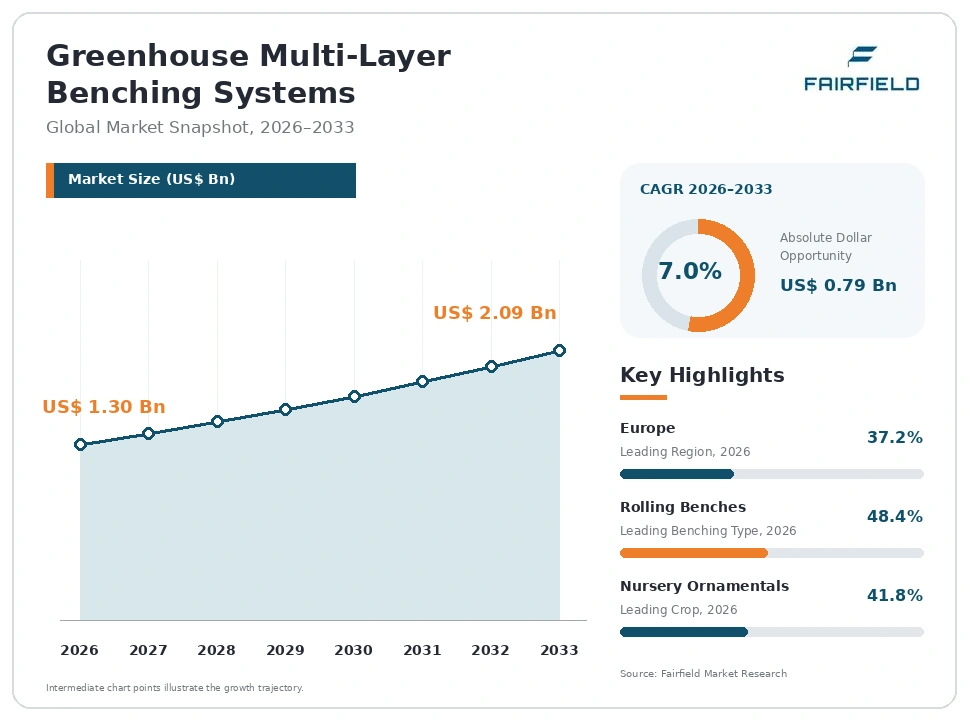
The global greenhouse multi-layer benching systems market size is expected to be valued at US$ 1.30 billion in 2026 and projected to reach US$ 2.09 billion by 2033, growing at a CAGR of 7.0% between 2026 and 2033.
Between 2020 and 2025, the market grew at a CAGR of about 5.8%, as growers invested in new glasshouses and as high energy prices in 2022 pushed Europe growers to get more output from each heated square meter. Three factors now drive growth: the need to raise crop output per square meter, labor shortages that favor automated plant handling, and rising demand for local leafy greens and herbs. The market is shifting from single-level fixed tables toward rolling benches, stacked tiers with LED lighting, ebb and flow irrigation trays, and greenhouse automation systems that move containers between growing, spacing, and shipping zones. Multi-tier propagation and vertical growing racks are spreading in young plant and microgreen production.
Key Report Takeaways
- By Benching Type: Rolling Benches held 48.4% share in 2026, while Fixed Multi-tier Racks are projected to expand at a 7.9% CAGR through 2033, driven by stacked propagation and LED-lit young plant production.
- By Crop: Nursery Ornamentals held 41.8% share in 2026, while Leafy Greens & Herbs are projected to expand at an 8.6% CAGR through 2033, driven by local food demand and hydroponic greenhouse projects.
- By Greenhouse Type: Glass Greenhouses held 56.3% share in 2026, while Poly & Film Greenhouses are projected to expand at a 7.8% CAGR through 2033, driven by lower-cost greenhouse construction in emerging markets.
- By Region: Europe held 37.2% share in 2026, while India is projected to expand at a 9.0% CAGR through 2033, driven by government-backed protected cultivation and nursery modernization.
Global Greenhouse Multi-Layer Benching Systems Market Trends and Insights
Drivers Impact Analysis
Two drivers carry the strongest influence on greenhouse multi-layer benching systems demand during the forecast period.
| Driver | Impact on CAGR Forecast | Geographic Relevance | Impact Timeline |
| Need for higher output per square meter | High | Europe, North America, Asia Pacific | Long term (≥4 years) |
| Labor shortages and greenhouse automation | High | Europe, North America | Medium term (2-4 years) |
Space Efficiency Needs Are Driving the Greenhouse Multi-Layer Benching Systems Market
The need for higher output per square meter is the strongest driver of the greenhouse multi-layer benching systems market. Greenhouse space is expensive to build, heat, and light.
The mechanism is the high cost of every growing square meter. Fixed tables with aisles between them use only about 60% to 70% of floor space for plants. Rolling benches remove most aisles and can raise use to about 85% to 90%. Stacked tiers with LED lights add a second or third growing level for propagation, cuttings, and microgreens. High energy prices in Europe since 2022 have made growers focus on output per heated square meter. Land near cities is limited and costly in the Netherlands, Japan, and South Korea. Multi-layer systems let growers increase capacity without building new greenhouses. These benefits support steady investment in modern benching.
Labor Shortages Are Expanding the Greenhouse Multi-Layer Benching Systems Market
Labor shortages and greenhouse automation are expanding the greenhouse multi-layer benching systems market. Moving plants by hand is one of the most labor-intensive tasks in greenhouses.
The cause is a shrinking and more expensive horticultural workforce. Growers in the Netherlands, Germany, the United States, and Canada struggle to hire seasonal workers. Container transport systems move rolling bench tops or trays automatically between potting, growing, spacing, and dispatch areas. Mobile gully systems for lettuce and herbs automatically space plants as they grow. Robots for spacing and sorting potted plants work with these benches. Bosman Van Zaal, Visser, and Hortiplan supply automated internal transport. Automation also improves hygiene, cuts walking time, and reduces plant damage during handling. These factors raise demand for integrated benching and logistics systems.
Restraints Impact Analysis
Two restraints limit how quickly the greenhouse multi-layer benching systems market grows.
| Restraint | Impact on CAGR Forecast | Geographic Relevance | Impact Timeline |
| High upfront investment and long payback | High | Global | Short term (≤2 years) |
| Energy and lighting costs for stacked layers | Medium | Europe, North America | Medium term (2-4 years) |
High Investment Costs Slow the Greenhouse Multi-Layer Benching Systems Market
High upfront investment and long payback periods slow the greenhouse multi-layer benching systems market. Automated multi-layer benching is a large expense for growers.
The specific causes are system cost and grower finances. Rolling benches with ebb and flow trays, container transport, and multi-tier racks with LED lighting can cost several times more per square meter than simple fixed tables. Many growers are small family businesses with limited access to capital. Higher interest rates in 2023 to 2025 raised financing costs and delayed greenhouse projects. Steel and aluminum prices have also been volatile. Returns depend on crop prices, which can fall when supply rises. Several high-profile indoor and vertical farming companies failed in 2023 and 2024, making investors more cautious. These factors slow upgrades, especially in price-sensitive markets.
Energy Costs Restrict the Greenhouse Multi-Layer Benching Systems Market
Energy and lighting costs for stacked layers restrict the greenhouse multi-layer benching systems market. Lower tiers receive little or no sunlight and need artificial light.
The underlying causes are electricity prices and the physics of stacking. Upper layers shade lower layers, so growers must install LED lights, which raise power use. Electricity prices in Germany, the Netherlands, and the United Kingdom rose sharply in 2022 and remain higher than before. Extra layers also add heat and humidity that need climate control. Some crops, such as large potted plants, cannot be grown on stacked tiers. Structural loads increase with water-filled trays and heavy pots. Retrofitting older greenhouses can be difficult because of low roof heights. These limits confine multi-layer use mainly to young plants, microgreens, herbs, and leafy greens.
Market Opportunities
Leafy Greens and Vertical Growing Open a High-Growth Revenue Pool
Leafy greens, herbs, and vertical growing open a high-growth revenue pool in the greenhouse multi-layer benching systems market. Retailers want fresh, local salads all year.
Suppliers of mobile gully systems and stacked hydroponic benches can capture this opportunity. Hydroponic greenhouses in North America and Europe grow lettuce and herbs close to cities, reducing transport and spoilage. Van der Hoeven and Hortiplan delivered a 5.5-hectare leafy greens greenhouse in Virginia in 2024, and Hortiplan partnered with Hort Americas in 2025 to support growers in North America. Panvita Group opened a new leafy greens greenhouse in Slovenia in 2025. Hybrid greenhouses that combine sunlight with stacked LED tiers can cut energy compared with fully indoor farms. Turnkey builders that bundle benches, irrigation, and climate control are well placed.
Asia Pacific Protected Cultivation Creates a Volume Revenue Pool
Protected cultivation growth in Asia Pacific creates a volume revenue pool in the greenhouse multi-layer benching systems market. Governments are promoting greenhouses to raise yields and food security.
Manufacturers with affordable, modular benches can capture this opportunity. India supports polyhouses and nurseries through national horticulture programs, and states such as Maharashtra, Karnataka, and Telangana are building high-tech nurseries. China has the largest greenhouse area in the world and is upgrading facilities for seedlings and flowers. Japan and South Korea use multi-tier systems for seedling production because land is scarce. Local production of galvanized benches and trays reduces costs for growers. Partnerships between Netherlands greenhouse builders and local firms help transfer technology. Simple rolling benches and stacked propagation racks fit small and mid-sized growers well.
Segment Analysis
By Benching Type: Rolling Benches Lead While Fixed Multi-tier Racks Grow Fastest
Rolling Benches held 48.4% share in 2026. Rolling benches sit on pipes or rails and slide sideways, so growers need only one moving aisle per bay. They raise space use to about 90% and are standard in potted plant and nursery greenhouses in Europe and North America. Many come with ebb and flow trays that flood and drain to water plants from below, saving water and fertilizer. Container transport systems move complete bench tops automatically. Fixed benches remain common in retail and research greenhouses.
Fixed Multi-tier Racks are the fastest-growing benching type, expanding at a 7.9% CAGR through 2033. These racks stack two to five growing levels with LED lighting, often for propagation, rooting cuttings, microgreens, and seedlings. They raise output per square meter sharply. Young plant producers and hybrid farms use them for vertical growing. For the market, tier growth adds lighting and control value.
By Crop: Nursery Ornamentals Lead While Leafy Greens & Herbs Grow Fastest
Nursery Ornamentals held 41.8% share in 2026. Potted plants, bedding plants, and young plant cuttings need large bench areas and frequent handling, which suits rolling benches and container transport. The Netherlands, Denmark, Germany, and the United States have large ornamental greenhouse sectors. Growers use ebb and flow benches to water thousands of pots evenly. Propagation of cuttings from Kenya and Ethiopia supports rooting stations in Europe.
Leafy Greens & Herbs are the fastest-growing crop, expanding at an 8.6% CAGR through 2033. Lettuce, basil, and other herbs grow well in mobile gully systems and stacked hydroponic benches. Retailers want local, pesticide-free greens throughout the year. Hybrid greenhouses near cities in North America, Europe, and Asia Pacific are expanding. Greenhouse automation reduces handling labor. For the market, greens growth widens demand beyond ornamentals.
By Greenhouse Type: Glass Greenhouses Lead While Poly & Film Greenhouses Grow Fastest
Glass Greenhouses held 56.3% share in 2026. Venlo-style glasshouses in the Netherlands, Belgium, Germany, Canada, and the United States host most automated benching because they are built for long life, strong climate control, and heavy equipment. Glasshouse operators invest in rolling benches, container transport, and greenhouse automation to maximize returns. Kubo Group, Certhon, Van der Hoeven, and Dalsem build these facilities.
Poly & Film Greenhouses are the fastest-growing greenhouse type, expanding at a 7.8% CAGR through 2033. Polyhouses cost less to build and suit warm climates in India, China, Mexico, Spain, and Kenya. Nurseries in these markets are upgrading from ground growing to benches to improve hygiene and drainage. For the market, film greenhouse growth extends volume demand for lower-cost benches.
Geography Analysis
North America Advances the Greenhouse Multi-Layer Benching Systems Market Through Leafy Greens
North America is a major greenhouse multi-layer benching systems market. The United States has large potted plant, bedding plant, and young plant producers in Michigan, Ohio, California, and Texas that use rolling benches and ebb and flow systems. Canada has extensive glasshouses in Ontario and British Columbia. Hydroponic leafy greens greenhouses are expanding in Virginia, Georgia, and Texas. Prospiant, Nexus Corporation, and Rough Brothers supply benching and structures. Labor shortages and rising wages push growers toward container transport and spacing robots. One change shaping the region is hybrid greenhouses with stacked LED tiers.
Which Region Is Leading the Greenhouse Multi-Layer Benching Systems Market?
Europe is leading the greenhouse multi-layer benching systems market with a 37.2% share in 2026. The Netherlands is the global center of greenhouse technology, with large glasshouses for potted plants, young plants, and vegetables. Germany, Denmark, Belgium, Spain, and Poland add strong demand. Leading suppliers including Bosman Van Zaal, Visser, Certhon, Kubo Group, Van der Hoeven, and Hortiplan are based in the region. High energy and labor costs push growers toward space-saving and automated benching. One change shaping the region is the adoption of stacked propagation tiers with LED lighting.
Which Country Is Growing Fastest in the Greenhouse Multi-Layer Benching Systems Market?
India is growing fastest in the greenhouse multi-layer benching systems market at a 9.0% CAGR through 2033, within Asia Pacific. National horticulture programs subsidize polyhouses and high-tech nurseries, and states such as Maharashtra, Karnataka, and Telangana are building seedling and flower production centers. China follows closely at about 8.6%, upgrading its large greenhouse base for seedlings and flowers. Japan and South Korea use multi-tier systems for seedlings because land is scarce. Australia has modern glasshouses for vegetables and nursery plants, and Vietnam is expanding seedling production for export crops. One opportunity is affordable rolling benches for nurseries.
Latin America Grows the Greenhouse Multi-Layer Benching Systems Market Through Exports
Latin America is a growing greenhouse multi-layer benching systems market. Mexico is expanding at about 8.1% a year, driven by protected vegetable and ornamental production for export to the United States. Colombia and Ecuador have large flower industries, and growers use benches for propagation and young plants. Brazil has growing nursery, seedling, and forestry plant sectors in São Paulo and Paraná. Chile produces fruit tree and berry nursery stock, using benches to raise plant quality for export orchards. Key barriers include financing costs and low-cost labor that slows automation. One opportunity is propagation benches for seedling nurseries.
Middle East & Africa Builds the Greenhouse Multi-Layer Benching Systems Market
Middle East & Africa is an emerging greenhouse multi-layer benching systems market. Saudi Arabia and the United Arab Emirates are investing in high-tech greenhouses and vertical growing to cut food imports, often using stacked hydroponic systems. Kenya and Ethiopia have large flower and cutting farms that supply Europe and use benches for rooting. South Africa has nursery, vegetable, and herb greenhouses near major cities. Morocco is expanding protected cultivation for tomatoes, berries, and seedlings, supported by Europe export demand. Key barriers include heat, water scarcity, and high cooling costs. One opportunity is multi-tier systems for food security projects.
Competitive Landscape
The greenhouse multi-layer benching systems market is fragmented. Specialist bench and internal transport makers such as Bosman Van Zaal, Visser, and Hortiplan compete with turnkey greenhouse builders such as Van der Hoeven, Certhon, Kubo Group, Dalsem, Prospiant, Nexus Corporation, and Rough Brothers. Climate control firms Priva and Ridder supply controls for automated systems. Many local metal fabricators in China, India, Turkey, and Spain produce low-cost benches.
Companies compete on space efficiency, durability, automation, water management, project delivery, and price. Galvanized steel and aluminum frames must resist humidity and fertilizer for decades. Leading suppliers offer complete systems including benches, ebb and flow irrigation, container transport, and software, which builds long-term relationships with growers. Turnkey builders often bundle benching with greenhouse structures and climate control.
Strategic moves show how competition is changing. In September 2024, Van der Hoeven and Hortiplan delivered the 5.5-hectare Better Future Farms leafy greens greenhouse in Virginia. In April 2025, Panvita Group started a new leafy greens greenhouse in Slovenia. In June 2025, Freya Cultivation Systems announced a demonstration greenhouse in Lithuania for its Aeroframe strawberry system. In July 2025, Hortiplan partnered with Hort Americas for North America. These moves show competition shifting toward automated leafy greens and vertical systems.
Three themes shape vendor strategy. First, companies are adding automation and robotics. Second, they are designing stacked systems with LED lighting. Third, they are expanding service networks in North America and Asia Pacific.
Greenhouse Multi-Layer Benching Systems Market Industry Leaders
- Bosman Van Zaal
- Van der Hoeven
- Prospiant
- Certhon
- Kubo Group
Recent Industry Developments
- July 2025: Hortiplan and Hort Americas formed a partnership to support mobile gully systems in North America - expands local service for automated leafy greens benching.
- June 2025: Freya Cultivation Systems announced a demonstration greenhouse in Lithuania for its Aeroframe strawberry system - promotes stacked growing for berries.
- April 2025: Panvita Group began operating a new leafy greens greenhouse in Slovenia with a €9 million investment - adds demand for hydroponic growing systems in Europe.
- September 2024: Van der Hoeven and Hortiplan unveiled the 5.5-hectare Better Future Farms leafy greens greenhouse in Virginia - shows turnkey automated benching projects in the United States.
Companies Covered in the Report
- Bosman Van Zaal
- Van der Hoeven
- Hortiplan
- Visser Horti Systems
- Prospiant
- Certhon
- Kubo Group
- Dalsem
- Nexus Corporation
- Rough Brothers
- Priva
- Ridder
Greenhouse Multi-Layer Benching Systems Market Report Scope
This report covers greenhouse multi-layer benching systems, including rolling benches, fixed multi-tier racks, ebb and flow benches, and mobile gully systems, used for nursery ornamentals, leafy greens and herbs, young plants and propagation, and other crops in glass and poly or film greenhouses. It excludes indoor vertical farm racks, greenhouse structures, and standalone lighting. The base year is 2025, and the forecast period runs from 2026 to 2033. All values are expressed in US$ Billion.
Benching Type
- Rolling Benches
- Fixed Multi-tier Racks
- Ebb & Flow Benches
- Mobile Gully Systems
Crop
- Nursery Ornamentals
- Leafy Greens & Herbs
- Young Plants & Propagation
- Others
Greenhouse Type
- Glass Greenhouses
- Poly & Film Greenhouses
Regions
- North America
- Europe
- Asia Pacific
- Latin America
- Middle East & Africa
Key Questions Answered in the Report
How big is the greenhouse multi-layer benching systems market in 2026?
The greenhouse multi-layer benching systems market is valued at US$ 1.30 billion in 2026, led by rolling benches for nursery ornamentals.
What is the greenhouse multi-layer benching systems market forecast to 2033?
The market is projected to reach US$ 2.09 billion by 2033, growing at a 7.0% CAGR and adding US$ 0.79 billion.
Which crop is growing fastest in greenhouse multi-layer benching systems?
Leafy greens and herbs are growing fastest at an 8.6% CAGR through 2033, driven by local food demand and hydroponic greenhouses.
Which country is growing fastest in the greenhouse multi-layer benching systems market?
India is growing fastest at a 9.0% CAGR through 2033, driven by subsidized polyhouses and high-tech nurseries in several states.
Which region holds the largest greenhouse multi-layer benching systems market share?
Europe holds the largest share at 37.2% in 2026, supported by advanced glasshouses and leading suppliers in the Netherlands.
1. Executive Summary
1.1. Global Greenhouse Multi-Layer Benching Systems Market Snapshot
1.2. Future Projections
1.3. Key Report Takeaways
1.4. Regional Snapshot
2. Market Overview
2.1. Market Definition and Report Scope
2.2. Historical Trends 2020–2025
2.3. Market Dynamics
2.3.1. Drivers
2.3.1.1. Space Efficiency Needs Are Driving the Greenhouse Multi-Layer Benching Systems Market
2.3.1.2. Labor Shortages Are Expanding the Greenhouse Multi-Layer Benching Systems Market
2.3.2. Restraints
2.3.2.1. High Investment Costs Slow the Greenhouse Multi-Layer Benching Systems Market
2.3.2.2. Energy Costs Restrict the Greenhouse Multi-Layer Benching Systems Market
2.3.3. Market Opportunities
2.3.3.1. Leafy Greens and Vertical Growing Open a High-Growth Revenue Pool
2.3.3.2. Asia Pacific Protected Cultivation Creates a Volume Revenue Pool
3. Global Greenhouse Multi-Layer Benching Systems Market Outlook, 2020-2033
3.1. Global Greenhouse Multi-Layer Benching Systems Market Outlook, by Benching Type, Value (US$ Billion), 2020-2033
3.1.1. Rolling Benches
3.1.2. Fixed Multi-tier Racks
3.1.3. Ebb & Flow Benches
3.1.4. Mobile Gully Systems
3.2. Global Greenhouse Multi-Layer Benching Systems Market Outlook, by Crop, Value (US$ Billion), 2020-2033
3.2.1. Nursery Ornamentals
3.2.2. Leafy Greens & Herbs
3.2.3. Young Plants & Propagation
3.2.4. Others
3.3. Global Greenhouse Multi-Layer Benching Systems Market Outlook, by Greenhouse Type, Value (US$ Billion), 2020-2033
3.3.1. Glass Greenhouses
3.3.2. Poly & Film Greenhouses
3.4. Global Greenhouse Multi-Layer Benching Systems Market Outlook, by Region, Value (US$ Billion), 2020-2033
3.4.1. North America
3.4.2. Europe
3.4.3. Asia Pacific
3.4.4. Latin America
3.4.5. Middle East & Africa
4. North America Greenhouse Multi-Layer Benching Systems Market Outlook, 2020-2033
4.1. North America Greenhouse Multi-Layer Benching Systems Market Outlook, by Benching Type, Value (US$ Billion), 2020-2033
4.1.1. Rolling Benches
4.1.2. Fixed Multi-tier Racks
4.1.3. Ebb & Flow Benches
4.1.4. Mobile Gully Systems
4.2. North America Greenhouse Multi-Layer Benching Systems Market Outlook, by Crop, Value (US$ Billion), 2020-2033
4.2.1. Nursery Ornamentals
4.2.2. Leafy Greens & Herbs
4.2.3. Young Plants & Propagation
4.2.4. Others
4.3. North America Greenhouse Multi-Layer Benching Systems Market Outlook, by Greenhouse Type, Value (US$ Billion), 2020-2033
4.3.1. Glass Greenhouses
4.3.2. Poly & Film Greenhouses
4.4. North America Greenhouse Multi-Layer Benching Systems Market Outlook, by Country, Value (US$ Billion), 2020-2033
4.4.1. United States Greenhouse Multi-Layer Benching Systems Market Outlook, by Benching Type, 2020-2033
4.4.2. United States Greenhouse Multi-Layer Benching Systems Market Outlook, by Crop, 2020-2033
4.4.3. United States Greenhouse Multi-Layer Benching Systems Market Outlook, by Greenhouse Type, 2020-2033
4.4.4. Canada Greenhouse Multi-Layer Benching Systems Market Outlook, by Benching Type, 2020-2033
4.4.5. Canada Greenhouse Multi-Layer Benching Systems Market Outlook, by Crop, 2020-2033
4.4.6. Canada Greenhouse Multi-Layer Benching Systems Market Outlook, by Greenhouse Type, 2020-2033
5. Europe Greenhouse Multi-Layer Benching Systems Market Outlook, 2020-2033
5.1. Europe Greenhouse Multi-Layer Benching Systems Market Outlook, by Benching Type, Value (US$ Billion), 2020-2033
5.1.1. Rolling Benches
5.1.2. Fixed Multi-tier Racks
5.1.3. Ebb & Flow Benches
5.1.4. Mobile Gully Systems
5.2. Europe Greenhouse Multi-Layer Benching Systems Market Outlook, by Crop, Value (US$ Billion), 2020-2033
5.2.1. Nursery Ornamentals
5.2.2. Leafy Greens & Herbs
5.2.3. Young Plants & Propagation
5.2.4. Others
5.3. Europe Greenhouse Multi-Layer Benching Systems Market Outlook, by Greenhouse Type, Value (US$ Billion), 2020-2033
5.3.1. Glass Greenhouses
5.3.2. Poly & Film Greenhouses
5.4. Europe Greenhouse Multi-Layer Benching Systems Market Outlook, by Country, Value (US$ Billion), 2020-2033
5.4.1. Netherlands Greenhouse Multi-Layer Benching Systems Market Outlook, by Benching Type, 2020-2033
5.4.2. Netherlands Greenhouse Multi-Layer Benching Systems Market Outlook, by Crop, 2020-2033
5.4.3. Netherlands Greenhouse Multi-Layer Benching Systems Market Outlook, by Greenhouse Type, 2020-2033
5.4.4. Germany Greenhouse Multi-Layer Benching Systems Market Outlook, by Benching Type, 2020-2033
5.4.5. Germany Greenhouse Multi-Layer Benching Systems Market Outlook, by Crop, 2020-2033
5.4.6. Germany Greenhouse Multi-Layer Benching Systems Market Outlook, by Greenhouse Type, 2020-2033
5.4.7. Denmark Greenhouse Multi-Layer Benching Systems Market Outlook, by Benching Type, 2020-2033
5.4.8. Denmark Greenhouse Multi-Layer Benching Systems Market Outlook, by Crop, 2020-2033
5.4.9. Denmark Greenhouse Multi-Layer Benching Systems Market Outlook, by Greenhouse Type, 2020-2033
5.4.10. Belgium Greenhouse Multi-Layer Benching Systems Market Outlook, by Benching Type, 2020-2033
5.4.11. Belgium Greenhouse Multi-Layer Benching Systems Market Outlook, by Crop, 2020-2033
5.4.12. Belgium Greenhouse Multi-Layer Benching Systems Market Outlook, by Greenhouse Type, 2020-2033
5.4.13. Spain Greenhouse Multi-Layer Benching Systems Market Outlook, by Benching Type, 2020-2033
5.4.14. Spain Greenhouse Multi-Layer Benching Systems Market Outlook, by Crop, 2020-2033
5.4.15. Spain Greenhouse Multi-Layer Benching Systems Market Outlook, by Greenhouse Type, 2020-2033
5.4.16. Poland Greenhouse Multi-Layer Benching Systems Market Outlook, by Benching Type, 2020-2033
5.4.17. Poland Greenhouse Multi-Layer Benching Systems Market Outlook, by Crop, 2020-2033
5.4.18. Poland Greenhouse Multi-Layer Benching Systems Market Outlook, by Greenhouse Type, 2020-2033
6. Asia Pacific Greenhouse Multi-Layer Benching Systems Market Outlook, 2020-2033
6.1. Asia Pacific Greenhouse Multi-Layer Benching Systems Market Outlook, by Benching Type, Value (US$ Billion), 2020-2033
6.1.1. Rolling Benches
6.1.2. Fixed Multi-tier Racks
6.1.3. Ebb & Flow Benches
6.1.4. Mobile Gully Systems
6.2. Asia Pacific Greenhouse Multi-Layer Benching Systems Market Outlook, by Crop, Value (US$ Billion), 2020-2033
6.2.1. Nursery Ornamentals
6.2.2. Leafy Greens & Herbs
6.2.3. Young Plants & Propagation
6.2.4. Others
6.3. Asia Pacific Greenhouse Multi-Layer Benching Systems Market Outlook, by Greenhouse Type, Value (US$ Billion), 2020-2033
6.3.1. Glass Greenhouses
6.3.2. Poly & Film Greenhouses
6.4. Asia Pacific Greenhouse Multi-Layer Benching Systems Market Outlook, by Country, Value (US$ Billion), 2020-2033
6.4.1. India Greenhouse Multi-Layer Benching Systems Market Outlook, by Benching Type, 2020-2033
6.4.2. India Greenhouse Multi-Layer Benching Systems Market Outlook, by Crop, 2020-2033
6.4.3. India Greenhouse Multi-Layer Benching Systems Market Outlook, by Greenhouse Type, 2020-2033
6.4.4. China Greenhouse Multi-Layer Benching Systems Market Outlook, by Benching Type, 2020-2033
6.4.5. China Greenhouse Multi-Layer Benching Systems Market Outlook, by Crop, 2020-2033
6.4.6. China Greenhouse Multi-Layer Benching Systems Market Outlook, by Greenhouse Type, 2020-2033
6.4.7. Japan Greenhouse Multi-Layer Benching Systems Market Outlook, by Benching Type, 2020-2033
6.4.8. Japan Greenhouse Multi-Layer Benching Systems Market Outlook, by Crop, 2020-2033
6.4.9. Japan Greenhouse Multi-Layer Benching Systems Market Outlook, by Greenhouse Type, 2020-2033
6.4.10. South Korea Greenhouse Multi-Layer Benching Systems Market Outlook, by Benching Type, 2020-2033
6.4.11. South Korea Greenhouse Multi-Layer Benching Systems Market Outlook, by Crop, 2020-2033
6.4.12. South Korea Greenhouse Multi-Layer Benching Systems Market Outlook, by Greenhouse Type, 2020-2033
6.4.13. Australia Greenhouse Multi-Layer Benching Systems Market Outlook, by Benching Type, 2020-2033
6.4.14. Australia Greenhouse Multi-Layer Benching Systems Market Outlook, by Crop, 2020-2033
6.4.15. Australia Greenhouse Multi-Layer Benching Systems Market Outlook, by Greenhouse Type, 2020-2033
6.4.16. Vietnam Greenhouse Multi-Layer Benching Systems Market Outlook, by Benching Type, 2020-2033
6.4.17. Vietnam Greenhouse Multi-Layer Benching Systems Market Outlook, by Crop, 2020-2033
6.4.18. Vietnam Greenhouse Multi-Layer Benching Systems Market Outlook, by Greenhouse Type, 2020-2033
7. Latin America Greenhouse Multi-Layer Benching Systems Market Outlook, 2020-2033
7.1. Latin America Greenhouse Multi-Layer Benching Systems Market Outlook, by Benching Type, Value (US$ Billion), 2020-2033
7.1.1. Rolling Benches
7.1.2. Fixed Multi-tier Racks
7.1.3. Ebb & Flow Benches
7.1.4. Mobile Gully Systems
7.2. Latin America Greenhouse Multi-Layer Benching Systems Market Outlook, by Crop, Value (US$ Billion), 2020-2033
7.2.1. Nursery Ornamentals
7.2.2. Leafy Greens & Herbs
7.2.3. Young Plants & Propagation
7.2.4. Others
7.3. Latin America Greenhouse Multi-Layer Benching Systems Market Outlook, by Greenhouse Type, Value (US$ Billion), 2020-2033
7.3.1. Glass Greenhouses
7.3.2. Poly & Film Greenhouses
7.4. Latin America Greenhouse Multi-Layer Benching Systems Market Outlook, by Country, Value (US$ Billion), 2020-2033
7.4.1. Mexico Greenhouse Multi-Layer Benching Systems Market Outlook, by Benching Type, 2020-2033
7.4.2. Mexico Greenhouse Multi-Layer Benching Systems Market Outlook, by Crop, 2020-2033
7.4.3. Mexico Greenhouse Multi-Layer Benching Systems Market Outlook, by Greenhouse Type, 2020-2033
7.4.4. Colombia Greenhouse Multi-Layer Benching Systems Market Outlook, by Benching Type, 2020-2033
7.4.5. Colombia Greenhouse Multi-Layer Benching Systems Market Outlook, by Crop, 2020-2033
7.4.6. Colombia Greenhouse Multi-Layer Benching Systems Market Outlook, by Greenhouse Type, 2020-2033
7.4.7. Ecuador Greenhouse Multi-Layer Benching Systems Market Outlook, by Benching Type, 2020-2033
7.4.8. Ecuador Greenhouse Multi-Layer Benching Systems Market Outlook, by Crop, 2020-2033
7.4.9. Ecuador Greenhouse Multi-Layer Benching Systems Market Outlook, by Greenhouse Type, 2020-2033
7.4.10. Brazil Greenhouse Multi-Layer Benching Systems Market Outlook, by Benching Type, 2020-2033
7.4.11. Brazil Greenhouse Multi-Layer Benching Systems Market Outlook, by Crop, 2020-2033
7.4.12. Brazil Greenhouse Multi-Layer Benching Systems Market Outlook, by Greenhouse Type, 2020-2033
7.4.13. Chile Greenhouse Multi-Layer Benching Systems Market Outlook, by Benching Type, 2020-2033
7.4.14. Chile Greenhouse Multi-Layer Benching Systems Market Outlook, by Crop, 2020-2033
7.4.15. Chile Greenhouse Multi-Layer Benching Systems Market Outlook, by Greenhouse Type, 2020-2033
8. Middle East & Africa Greenhouse Multi-Layer Benching Systems Market Outlook, 2020-2033
8.1. Middle East & Africa Greenhouse Multi-Layer Benching Systems Market Outlook, by Benching Type, Value (US$ Billion), 2020-2033
8.1.1. Rolling Benches
8.1.2. Fixed Multi-tier Racks
8.1.3. Ebb & Flow Benches
8.1.4. Mobile Gully Systems
8.2. Middle East & Africa Greenhouse Multi-Layer Benching Systems Market Outlook, by Crop, Value (US$ Billion), 2020-2033
8.2.1. Nursery Ornamentals
8.2.2. Leafy Greens & Herbs
8.2.3. Young Plants & Propagation
8.2.4. Others
8.3. Middle East & Africa Greenhouse Multi-Layer Benching Systems Market Outlook, by Greenhouse Type, Value (US$ Billion), 2020-2033
8.3.1. Glass Greenhouses
8.3.2. Poly & Film Greenhouses
8.4. Middle East & Africa Greenhouse Multi-Layer Benching Systems Market Outlook, by Country, Value (US$ Billion), 2020-2033
8.4.1. Saudi Arabia Greenhouse Multi-Layer Benching Systems Market Outlook, by Benching Type, 2020-2033
8.4.2. Saudi Arabia Greenhouse Multi-Layer Benching Systems Market Outlook, by Crop, 2020-2033
8.4.3. Saudi Arabia Greenhouse Multi-Layer Benching Systems Market Outlook, by Greenhouse Type, 2020-2033
8.4.4. United Arab Emirates Greenhouse Multi-Layer Benching Systems Market Outlook, by Benching Type, 2020-2033
8.4.5. United Arab Emirates Greenhouse Multi-Layer Benching Systems Market Outlook, by Crop, 2020-2033
8.4.6. United Arab Emirates Greenhouse Multi-Layer Benching Systems Market Outlook, by Greenhouse Type, 2020-2033
8.4.7. Kenya Greenhouse Multi-Layer Benching Systems Market Outlook, by Benching Type, 2020-2033
8.4.8. Kenya Greenhouse Multi-Layer Benching Systems Market Outlook, by Crop, 2020-2033
8.4.9. Kenya Greenhouse Multi-Layer Benching Systems Market Outlook, by Greenhouse Type, 2020-2033
8.4.10. Ethiopia Greenhouse Multi-Layer Benching Systems Market Outlook, by Benching Type, 2020-2033
8.4.11. Ethiopia Greenhouse Multi-Layer Benching Systems Market Outlook, by Crop, 2020-2033
8.4.12. Ethiopia Greenhouse Multi-Layer Benching Systems Market Outlook, by Greenhouse Type, 2020-2033
8.4.13. South Africa Greenhouse Multi-Layer Benching Systems Market Outlook, by Benching Type, 2020-2033
8.4.14. South Africa Greenhouse Multi-Layer Benching Systems Market Outlook, by Crop, 2020-2033
8.4.15. South Africa Greenhouse Multi-Layer Benching Systems Market Outlook, by Greenhouse Type, 2020-2033
8.4.16. Morocco Greenhouse Multi-Layer Benching Systems Market Outlook, by Benching Type, 2020-2033
8.4.17. Morocco Greenhouse Multi-Layer Benching Systems Market Outlook, by Crop, 2020-2033
8.4.18. Morocco Greenhouse Multi-Layer Benching Systems Market Outlook, by Greenhouse Type, 2020-2033
9. Competitive Landscape
9.1. Market Concentration and Industry Leaders
9.2. Competitive Differentiation
9.3. Strategic Moves and Market Direction
9.4. Recent Industry Developments
9.5. Company Profiles
9.5.1. Bosman Van Zaal
9.5.2. Van der Hoeven
9.5.3. Hortiplan
9.5.4. Visser Horti Systems
9.5.5. Prospiant
9.5.6. Certhon
9.5.7. Kubo Group
9.5.8. Dalsem
9.5.9. Nexus Corporation
9.5.10. Rough Brothers
9.5.11. Priva
9.5.12. Ridder
10. Appendix
10.1. Research Methodology
10.2. Report Assumptions
10.3. Acronyms and Abbreviations
| Segment | Categories |
|---|---|
| Benching Type | Rolling Benches, Fixed Multi-tier Racks, Ebb & Flow Benches, Mobile Gully Systems |
| Crop | Nursery Ornamentals, Leafy Greens & Herbs, Young Plants & Propagation, Others |
| Greenhouse Type | Glass Greenhouses, Poly & Film Greenhouses |
| Regions | North America, Europe, Asia Pacific, Latin America, Middle East & Africa |
Our Research Methodology
Considering the volatility of business today, traditional approaches to strategizing a game plan can be unfruitful if not detrimental. True ambiguity is no way to determine a forecast. A myriad of predetermined factors must be accounted for such as the degree of risk involved, the magnitude of circumstances, as well as conditions or consequences that are not known or unpredictable. To circumvent binary views that cast uncertainty, the application of market research intelligence to strategically posture, move, and enable actionable outcomes is necessary.
View Methodology
Quality Assured
Rigorous Validation Process

Confidentiality Assured
End-to-end Data Security

Custom Research Services
Tailored To Your Objectives
FAQs
The greenhouse multi-layer benching systems market is valued at US$ 1.30 billion in 2026, led by rolling benches for nursery ornamentals.
The market is projected to reach US$ 2.09 billion by 2033, growing at a 7.0% CAGR and adding US$ 0.79 billion.
Leafy greens and herbs are growing fastest at an 8.6% CAGR through 2033, driven by local food demand and hydroponic greenhouses.
India is growing fastest at a 9.0% CAGR through 2033, driven by subsidized polyhouses and high-tech nurseries in several states.
Europe holds the largest share at 37.2% in 2026, supported by advanced glasshouses and leading suppliers in the Netherlands.
Related Reports
Thresher Market Size, Share, Insights, Competitive Landscape, and Forecast 2026 to 2033
Thresher market to reach US$ 3.52 billion by 2033 at a 4.1% CAGR. Explore product types, crops, power sources, leading companies and regional trends.
Rotary Sprinkler System Market Size, Share, Insights, Competitive Landscape, and Forecast 2026 to 2033
Rotary sprinkler system market to reach US$ 4.99 billion by 2033 at a 5.5% CAGR. Explore product types, smart controls, applications and regional trends.
Food and Beverage Automated Storage Retrieval System Market Size, Share, Insights, Competitive Landscape, and Forecast 2026 to 2033
Food and beverage AS/RS market to reach US$ 3.10 billion by 2033 at a 9.7% CAGR. Explore system types, temperature ranges and regional trends.
Agricultural Haying and Forage Machinery Market Size, Share, Insights, Competitive Landscape, and Forecast 2026 to 2033
Agricultural haying and forage machinery market to reach US$ 13.06 billion by 2033 at a 4.1% CAGR. Explore products, operations and regional trends.
Valve Remote Control System Market Size, Share, Insights, Competitive Landscape, and Forecast 2026 to 2033
Valve remote control system market to reach US$ 15.16 billion by 2033 at a 6.5% CAGR. Explore actuation types, applications and regional trends.
Torque Sensors for Robotic Systems Market Size, Share, Insights, Competitive Landscape, and Forecast 2026 to 2033
Torque sensors for robotic systems market to reach US$ 5.61 billion by 2033 at an 11.0% CAGR. Explore sensor types, robot types and regional trends.