



Rotary Sprinkler System Market
Rotary Sprinkler System Market Size, Share, Insights, Competitive Landscape, and Forecast 2026 to 2033
Rotary Sprinkler System Market Analysis, 2026–2033
Rotary Sprinkler System Market
Rotary Sprinkler System Market Size, Share, Insights, Competitive Landscape, and Forecast 2026 to 2033
Rotary Sprinkler System Market Size and Trend Analysis
How Fast Is the Rotary Sprinkler System Market Growing?
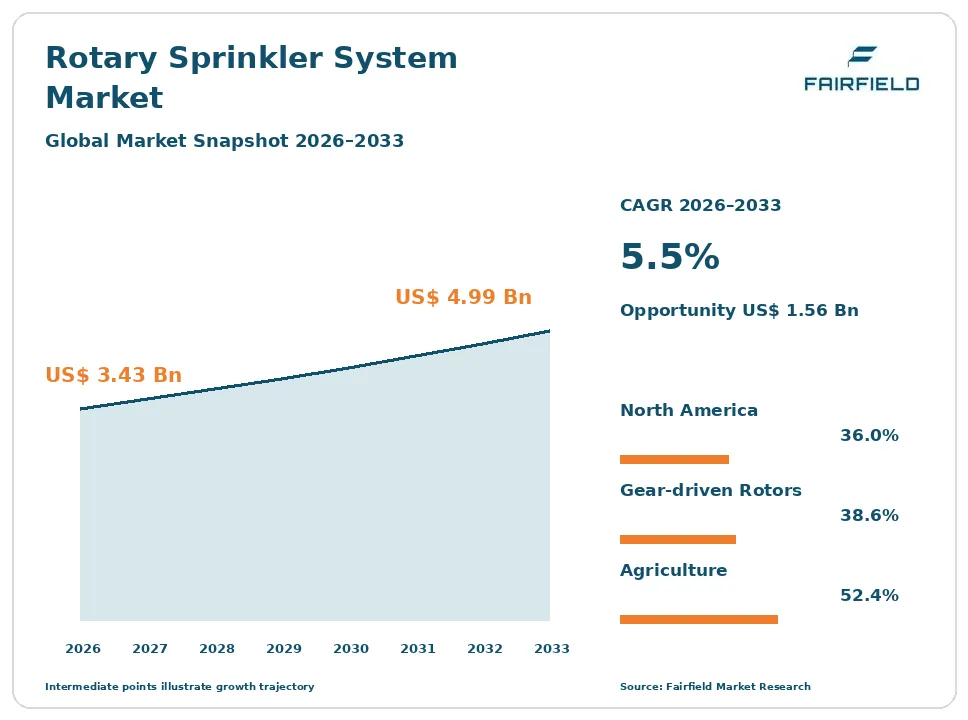
The global rotary sprinkler system market size is expected to be valued at US$ 3.43 billion in 2026 and projected to reach US$ 4.99 billion by 2033, growing at a CAGR of 5.5% between 2026 and 2033.
Between 2020 and 2025, the market grew at a CAGR of about 4.6%, as home landscaping projects rose during the pandemic and farmers invested in irrigation after repeated droughts in North America, Europe, and India. Three factors now drive growth: water scarcity, which pushes farmers and cities toward more efficient irrigation, government support for micro and sprinkler irrigation, and steady construction of homes, parks, and sports fields. The market is shifting from older impact sprinklers toward gear-driven rotors and multi-stream rotary nozzles that apply water more evenly at lower flow. Center pivot systems with rotator heads, smart irrigation controllers, and pressure-regulated bodies are improving water efficiency on farms, lawns, and golf course irrigation networks.
Key Report Takeaways
- By Product Type: Gear-driven Rotors held 38.6% share in 2026, while Rotary Nozzles & Stream Rotators are projected to expand at a 6.9% CAGR through 2033, driven by low-flow retrofits and municipal water efficiency rules.
- By Application: Agriculture held 52.4% share in 2026, while Lawn & Garden is projected to expand at a 6.4% CAGR through 2033, driven by new housing, landscaping, and replacement of older spray systems.
- By Control: Conventional held 71.2% share in 2026, while Smart is projected to expand at a 9.1% CAGR through 2033, driven by weather-based controllers, soil sensors, and utility rebates.
- By Region: North America held 36.0% share in 2026, while Asia Pacific is projected to expand at a 6.8% CAGR through 2033, driven by irrigation subsidies in India and China.
Global Rotary Sprinkler System Market Trends and Insights
Drivers Impact Analysis
Two drivers carry the strongest influence on rotary sprinkler system demand during the forecast period.
| Driver | Impact on CAGR Forecast | Geographic Relevance | Impact Timeline |
| Water scarcity and push for efficient irrigation | High | North America, Asia Pacific, Middle East & Africa | Long term (≥4 years) |
| Landscaping, sports turf, and housing growth | Medium | North America, Europe, Asia Pacific | Medium term (2-4 years) |
Water Scarcity Is Driving the Rotary Sprinkler System Market
Water scarcity and the push for efficient irrigation are the strongest drivers of the rotary sprinkler system market. Agriculture uses about 70% of global freshwater withdrawals, so small gains in irrigation efficiency save large volumes of water.
The mechanism is rising pressure on water supplies and the shift away from flood irrigation. Droughts in the United States, Spain, Italy, India, and Australia have forced farmers to grow more crops with less water. Rotary sprinklers spread water evenly over large areas at lower application rates, which reduces runoff and deep percolation compared with flood or furrow irrigation. Center pivot and linear move machines fitted with rotator heads are replacing older spray nozzles. Governments in India, China, and Saudi Arabia fund sprinkler and micro irrigation through subsidy programs. Utilities in California, Texas, and Arizona offer rebates for efficient landscape nozzles. These forces support steady demand for efficient rotary sprinklers.
Landscaping and Turf Growth Are Expanding the Rotary Sprinkler System Market
Landscaping, sports turf, and housing growth are expanding the rotary sprinkler system market. Rotors and rotary nozzles water large lawns, parks, and playing fields.
The cause is ongoing construction and higher expectations for green spaces. New homes in the United States, Canada, Australia, and the United Arab Emirates often include in-ground irrigation with gear-driven rotors. Cities are building and upgrading parks, school fields, and road medians. Golf course irrigation systems use thousands of large rotors that need replacement every 10 to 20 years, and many courses are upgrading to precise, individually controlled heads. Football, cricket, and rugby stadiums need uniform watering for safe playing surfaces. Commercial landscapes at offices, hotels, and resorts also use rotary systems. Landscape contractors prefer reliable rotors from Hunter Industries, Rain Bird, and The Toro Company. These trends sustain replacement and new installation demand.
Restraints Impact Analysis
Two restraints limit how quickly the rotary sprinkler system market grows.
| Restraint | Impact on CAGR Forecast | Geographic Relevance | Impact Timeline |
| Competition from drip and micro irrigation | High | Global | Long term (≥4 years) |
| Outdoor watering restrictions and lawn conversion | Medium | North America, Europe, Middle East & Africa | Medium term (2-4 years) |
Competition From Drip Irrigation Slows the Rotary Sprinkler System Market
Competition from drip and micro irrigation slows the rotary sprinkler system market. Drip systems deliver water directly to plant roots with less evaporation.
The specific causes are higher efficiency claims and strong policy support for drip. Drip irrigation can reach efficiencies above 90%, compared with about 70% to 85% for sprinklers, because sprinklers lose some water to wind drift and evaporation. Many subsidy programs in India, Israel, and China favor drip for orchards, vegetables, and row crops. High-value crops such as grapes, almonds, and tomatoes often switch from sprinklers to drip. Wind and high temperatures in dry regions can reduce sprinkler performance. Drip costs have fallen as manufacturing has scaled up. Some farmers combine both methods, using sprinklers only for germination or frost protection. These factors cap sprinkler share in some crops.
Watering Restrictions Restrict the Rotary Sprinkler System Market
Outdoor watering restrictions and lawn conversion restrict the rotary sprinkler system market. Cities facing drought limit when and how often people can water lawns.
The underlying causes are drought rules and changing landscape design. Cities in California, Nevada, Arizona, and Spain have imposed watering-day limits and banned non-functional turf in some commercial areas. Las Vegas and other cities pay residents to replace grass with desert landscaping, reducing the area that needs rotors. Water prices are rising in many regions, making large lawns more expensive to maintain. Some new homes use artificial turf or native plants with drip lines instead of lawns. Hosepipe bans in the United Kingdom during dry summers reduce sales of garden sprinklers. These changes reduce new lawn area in dry regions, although they also push buyers toward more efficient rotary nozzles.
Market Opportunities
Smart Irrigation Controllers Open a Connected Revenue Pool
Smart irrigation controllers and connected sprinkler systems open a high-value revenue pool in the rotary sprinkler system market. Owners want to cut water bills without losing healthy lawns or crops.
Companies that combine rotors with sensors and software can capture this opportunity. Weather-based controllers automatically adjust run times using local forecasts and evapotranspiration data. Soil moisture sensors stop watering when the ground is already wet or rain is expected. Irrigreen launched an AI-driven lawn platform with a robotic sprinkler head in 2025, and Valley Irrigation added a smart control panel for farm machines. Utilities offer rebates for certified smart controllers. Golf courses and sports fields use central control software to manage each head separately. Subscription services, remote monitoring, and data dashboards create recurring revenue for manufacturers, dealers, and contractors.
Asia Pacific and Middle East & Africa Farm Irrigation Create a Volume Revenue Pool
Farm irrigation programs in Asia Pacific and Middle East & Africa create a volume revenue pool in the rotary sprinkler system market. Large areas of farmland still rely on flood irrigation.
Manufacturers with affordable and durable products can capture this opportunity. India promotes sprinkler and drip irrigation through national micro irrigation subsidies, and states such as Rajasthan and Maharashtra have high sprinkler use. China is expanding high-standard farmland with efficient irrigation. Saudi Arabia, Egypt, and Morocco invest in water-saving irrigation for food security. Nelson Irrigation expanded its sales team in Middle East & Africa in 2025. Local manufacturing and dealer training reduce costs for small farmers. Center pivot adoption in Brazil, Kazakhstan, and South Africa adds demand for rotator heads and end guns.
Segment Analysis
By Product Type: Gear-driven Rotors Lead While Rotary Nozzles Grow Fastest
Gear-driven Rotors held 38.6% share in 2026. These pop-up heads use water flow to turn an internal gear train, rotating a stream quietly and evenly across lawns, parks, sports fields, and golf courses. Contractors favor them for reliability, adjustable arcs, and long throw distances. Hunter Industries, Rain Bird, and The Toro Company lead this category. Impact sprinklers, which use a spring-loaded arm, remain common on farms and in home gardens because they are simple and durable. Big gun sprinklers cover large fields and pastures.
Rotary Nozzles & Stream Rotators are the fastest-growing product type, expanding at a 6.9% CAGR through 2033. Multi-stream rotary nozzles fit standard spray bodies but apply water slowly, reducing runoff on slopes and clay soils. Farm rotators on center pivot machines also fall in this group. For the market, this growth supports retrofits and water efficiency upgrades.
By Application: Agriculture Leads While Lawn & Garden Grows Fastest
Agriculture held 52.4% share in 2026. Farmers use rotary sprinklers for field crops, vegetables, orchards, pastures, and nurseries, as well as for frost protection and dust control. Center pivot, linear move, solid set, and hose reel systems all rely on rotating heads. Nelson Irrigation, Senninger, Valmont, Lindsay, and Netafim serve this segment. Sports fields and golf course irrigation form another important application with high-value products.
Lawn & Garden is the fastest-growing application, expanding at a 6.4% CAGR through 2033. New housing, landscape renovations, and replacement of older fixed spray heads support demand for residential rotors and rotary nozzles. Retail sales of hose-end rotary sprinklers from GARDENA, Orbit, and Melnor also contribute. Homeowners increasingly pair rotors with smart irrigation controllers. For the market, lawn growth adds steady replacement sales.
By Control: Conventional Leads While Smart Grows Fastest
Conventional held 71.2% share in 2026. Conventional systems use timers or manual valves that run sprinklers on fixed schedules, with no sensors or remote connection. They are low cost and simple to install, which makes them common on farms, small gardens, and older landscapes, especially in Asia Pacific and Latin America. Many farm sprinklers are controlled by pump schedules.
Smart is the fastest-growing control type, expanding at a 9.1% CAGR through 2033. Smart systems use Wi-Fi controllers, weather data, soil sensors, and mobile apps to adjust watering automatically. Utility rebates in North America and Australia encourage adoption. Farm systems add remote pivot monitoring and variable rate irrigation. Rain Bird, Hunter Industries, The Toro Company, and Rachio offer smart controllers. For the market, smart growth raises value per installation.
Geography Analysis
Which Region Is Leading the Rotary Sprinkler System Market?
North America is leading the rotary sprinkler system market with a 36.0% share in 2026. The United States is the largest country market, supported by large irrigated farmland in Nebraska, Kansas, Texas, and California, where center pivot systems dominate. The region also has extensive home lawns, parks, more than 15,000 golf courses, and many sports fields. Rain Bird, Hunter Industries, The Toro Company, Nelson Irrigation, Valmont, and Lindsay are based in the United States. Canada adds demand from farms and residential landscapes. One change shaping the region is the adoption of smart irrigation controllers encouraged by utility rebates.
Europe Advances the Rotary Sprinkler System Market Through Water Efficiency
Europe is a significant rotary sprinkler system market. Spain, Italy, France, and Greece irrigate large areas of crops and are upgrading systems to cope with drought. Germany and the United Kingdom have strong garden and sports turf markets, with brands such as GARDENA and Claber selling hose-end and pop-up sprinklers. The European Union water framework rules push farmers toward efficient irrigation. Golf and football pitches across the region use rotors. Rising energy prices encourage farmers to switch to low-pressure rotator heads that cut pumping costs. Key barriers include summer hosepipe bans and slow farm investment. One opportunity is efficiency upgrades for farms in southern countries.
Which Region Is Growing Fastest in the Rotary Sprinkler System Market?
Asia Pacific is growing fastest in the rotary sprinkler system market at a 6.8% CAGR through 2033. India leads regional growth, with national subsidies for sprinkler and micro irrigation and high adoption in Rajasthan, Haryana, and Maharashtra. China is expanding efficient irrigation on high-standard farmland and building more parks and sports venues. Australia has large irrigated farms and a strong residential irrigation market. Japan, Vietnam, and Indonesia add demand for landscaping and plantation irrigation. Local manufacturers such as Jain Irrigation Systems keep prices affordable, and global brands are expanding dealer networks. One opportunity is replacing flood irrigation on small farms.
Latin America Grows the Rotary Sprinkler System Market Through Center Pivots
Latin America is a growing rotary sprinkler system market. Brazil has one of the fastest-growing center pivot areas in the world, especially for soybeans, corn, and coffee in Minas Gerais, Goiás, and Bahia. Mexico and Chile use sprinklers for vegetables, fruit, and pastures, and both face serious drought. Argentina and Peru add demand for irrigated fruit, vegetables, and grain. Residential and golf course demand is growing in Mexico and Brazil, and Valmont and Lindsay have local pivot operations. Key barriers include currency swings, high interest rates, and financing costs. One opportunity is rotator heads for new pivots.
Middle East & Africa Builds the Rotary Sprinkler System Market
Middle East & Africa is an emerging rotary sprinkler system market. Saudi Arabia and the United Arab Emirates use rotors for parks, golf courses, road landscaping, and large-scale projects. Egypt and Morocco are converting flood irrigation to sprinklers and drip for water savings, supported by government programs. South Africa and Zambia use center pivot systems for grain, sugarcane, and pasture. Nelson Irrigation expanded its sales team in the region in 2025. Key barriers include high temperatures, wind, and evaporation losses, which favor drip in some crops. One opportunity is efficient low-angle rotary heads for large farm projects.
Competitive Landscape
The rotary sprinkler system market is moderately concentrated. Rain Bird, Hunter Industries, and The Toro Company lead in landscape, residential, and golf rotors, while Nelson Irrigation, Senninger (part of Hunter Industries), Netafim, Valmont, and Lindsay lead in agricultural sprinklers. Many regional makers in India, China, Italy, and Spain compete on price.
Companies compete on water efficiency, durability, uniform distribution, product range, distributor networks, and price. Landscape contractors value reliability and easy adjustment, while farmers want low-pressure heads that save energy and water. Leaders offer complete systems with valves, controllers, and software, which builds customer loyalty. Distribution through irrigation dealers, home improvement stores, and online channels shapes reach. Patents on gear drives and multi-stream nozzles help leaders protect premium products, while low-cost producers win in price-sensitive farm markets.
Strategic moves show how competition is changing. In September 2024, Netafim introduced the GrowSphere digital irrigation and fertigation platform. In February 2025, Nelson Irrigation fully released the R7 Rotator, and in May 2025 it launched the R65VT sprinkler for the end of pivot machines. In August 2025, Irrigreen launched Irrigreen 3.0 and Valley Irrigation introduced the ICON+ Smart Panel. These moves show competition shifting toward precise, connected irrigation.
Three themes shape vendor strategy. First, companies are improving low-flow and low-pressure heads. Second, they are linking sprinklers to smart controllers and data platforms. Third, they are expanding sales in Asia Pacific and Middle East & Africa, where farm irrigation is growing fastest.
Rotary Sprinkler System Market Industry Leaders
Rain Bird Hunter Industries The Toro Company Nelson Irrigation Netafim
Recent Industry Developments
- August 2025: Irrigreen launched Irrigreen 3.0 with a new robotic sprinkler head and AI-driven controller - brings precise, digitally controlled watering to home lawns.
- August 2025: Valley Irrigation launched the ICON+ Smart Panel for its precision irrigation machines - improves remote control of pivot sprinkler systems.
- May 2025: Nelson Irrigation released the R65VT and R65i VT end of pivot sprinklers - extends coverage on center pivot fields.
- February 2025: Nelson Irrigation fully released the R7 Rotator - adds a larger rotator for solid set and pivot uses.
- September 2024: Netafim introduced GrowSphere for automated irrigation and fertigation - expands digital control of farm irrigation.
Companies Covered in the Report
- Rain Bird
- Hunter Industries
- The Toro Company
- Nelson Irrigation
- Netafim
- Valmont Industries
- Lindsay Corporation
- Jain Irrigation Systems
- GARDENA
- Orbit Irrigation
- Claber
- Irrigreen
Rotary Sprinkler System Market Report Scope
This report covers rotary sprinkler systems, including gear-driven rotors, impact sprinklers, rotary nozzles and stream rotators, and big gun sprinklers, with conventional and smart controls, used in agriculture, lawn and garden, sports turf, golf courses, and commercial landscapes. It excludes fixed spray heads, drip and micro irrigation, and fire sprinklers. The base year is 2025, and the forecast period runs from 2026 to 2033. All values are expressed in US$ Billion.
Product Type
- Gear-driven Rotors
- Impact Sprinklers
- Rotary Nozzles & Stream Rotators
- Big Gun Sprinklers
Application
- Agriculture
- Lawn & Garden
- Sports Turf & Golf Courses
- Commercial Landscapes
Control
- Conventional
- Smart
Regions
- North America
- Europe
- Asia Pacific
- Latin America
- Middle East & Africa
Key Questions Answered in the Report
How big is the rotary sprinkler system market in 2026?
The rotary sprinkler system market is valued at US$ 3.43 billion in 2026, led by agriculture and gear-driven rotors for turf.
What is the rotary sprinkler system market forecast to 2033?
The market is projected to reach US$ 4.99 billion by 2033, growing at a 5.5% CAGR and adding US$ 1.56 billion.
Which control type is growing fastest in rotary sprinkler systems?
Smart control is growing fastest at a 9.1% CAGR through 2033, driven by weather-based controllers, soil sensors, and utility rebates.
Which region is growing fastest in the rotary sprinkler system market?
Asia Pacific is growing fastest at a 6.8% CAGR through 2033, driven by irrigation subsidies and farm upgrades in India and China.
Which region holds the largest rotary sprinkler system market share?
North America holds the largest share at 36.0% in 2026, supported by center pivot farms, home lawns, and golf courses.
1. Executive Summary
1.1. Global Rotary Sprinkler System Market Snapshot
1.2. Future Projections
1.3. Key Report Takeaways
1.4. Regional Snapshot
2. Market Overview
2.1. Market Definition and Report Scope
2.2. Historical Trends 2020–2025
2.3. Market Dynamics
2.3.1. Drivers
2.3.1.1. Water Scarcity Is Driving the Rotary Sprinkler System Market
2.3.1.2. Landscaping and Turf Growth Are Expanding the Rotary Sprinkler System Market
2.3.2. Restraints
2.3.2.1. Competition From Drip Irrigation Slows the Rotary Sprinkler System Market
2.3.2.2. Watering Restrictions Restrict the Rotary Sprinkler System Market
2.3.3. Market Opportunities
2.3.3.1. Smart Irrigation Controllers Open a Connected Revenue Pool
2.3.3.2. Asia Pacific and Middle East & Africa Farm Irrigation Create a Volume Revenue Pool
3. Global Rotary Sprinkler System Market Outlook, 2020-2033
3.1. Global Rotary Sprinkler System Market Outlook, by Product Type, Value (US$ Billion), 2020-2033
3.1.1. Gear-driven Rotors
3.1.2. Impact Sprinklers
3.1.3. Rotary Nozzles & Stream Rotators
3.1.4. Big Gun Sprinklers
3.2. Global Rotary Sprinkler System Market Outlook, by Application, Value (US$ Billion), 2020-2033
3.2.1. Agriculture
3.2.2. Lawn & Garden
3.2.3. Sports Turf & Golf Courses
3.2.4. Commercial Landscapes
3.3. Global Rotary Sprinkler System Market Outlook, by Control, Value (US$ Billion), 2020-2033
3.3.1. Conventional
3.3.2. Smart
3.4. Global Rotary Sprinkler System Market Outlook, by Region, Value (US$ Billion), 2020-2033
3.4.1. North America
3.4.2. Europe
3.4.3. Asia Pacific
3.4.4. Latin America
3.4.5. Middle East & Africa
4. North America Rotary Sprinkler System Market Outlook, 2020-2033
4.1. North America Rotary Sprinkler System Market Outlook, by Product Type, Value (US$ Billion), 2020-2033
4.1.1. Gear-driven Rotors
4.1.2. Impact Sprinklers
4.1.3. Rotary Nozzles & Stream Rotators
4.1.4. Big Gun Sprinklers
4.2. North America Rotary Sprinkler System Market Outlook, by Application, Value (US$ Billion), 2020-2033
4.2.1. Agriculture
4.2.2. Lawn & Garden
4.2.3. Sports Turf & Golf Courses
4.2.4. Commercial Landscapes
4.3. North America Rotary Sprinkler System Market Outlook, by Control, Value (US$ Billion), 2020-2033
4.3.1. Conventional
4.3.2. Smart
4.4. North America Rotary Sprinkler System Market Outlook, by Country, Value (US$ Billion), 2020-2033
4.4.1. United States Rotary Sprinkler System Market Outlook, by Product Type, 2020-2033
4.4.2. United States Rotary Sprinkler System Market Outlook, by Application, 2020-2033
4.4.3. United States Rotary Sprinkler System Market Outlook, by Control, 2020-2033
4.4.4. Canada Rotary Sprinkler System Market Outlook, by Product Type, 2020-2033
4.4.5. Canada Rotary Sprinkler System Market Outlook, by Application, 2020-2033
4.4.6. Canada Rotary Sprinkler System Market Outlook, by Control, 2020-2033
5. Europe Rotary Sprinkler System Market Outlook, 2020-2033
5.1. Europe Rotary Sprinkler System Market Outlook, by Product Type, Value (US$ Billion), 2020-2033
5.1.1. Gear-driven Rotors
5.1.2. Impact Sprinklers
5.1.3. Rotary Nozzles & Stream Rotators
5.1.4. Big Gun Sprinklers
5.2. Europe Rotary Sprinkler System Market Outlook, by Application, Value (US$ Billion), 2020-2033
5.2.1. Agriculture
5.2.2. Lawn & Garden
5.2.3. Sports Turf & Golf Courses
5.2.4. Commercial Landscapes
5.3. Europe Rotary Sprinkler System Market Outlook, by Control, Value (US$ Billion), 2020-2033
5.3.1. Conventional
5.3.2. Smart
5.4. Europe Rotary Sprinkler System Market Outlook, by Country, Value (US$ Billion), 2020-2033
5.4.1. Spain Rotary Sprinkler System Market Outlook, by Product Type, 2020-2033
5.4.2. Spain Rotary Sprinkler System Market Outlook, by Application, 2020-2033
5.4.3. Spain Rotary Sprinkler System Market Outlook, by Control, 2020-2033
5.4.4. Italy Rotary Sprinkler System Market Outlook, by Product Type, 2020-2033
5.4.5. Italy Rotary Sprinkler System Market Outlook, by Application, 2020-2033
5.4.6. Italy Rotary Sprinkler System Market Outlook, by Control, 2020-2033
5.4.7. France Rotary Sprinkler System Market Outlook, by Product Type, 2020-2033
5.4.8. France Rotary Sprinkler System Market Outlook, by Application, 2020-2033
5.4.9. France Rotary Sprinkler System Market Outlook, by Control, 2020-2033
5.4.10. Greece Rotary Sprinkler System Market Outlook, by Product Type, 2020-2033
5.4.11. Greece Rotary Sprinkler System Market Outlook, by Application, 2020-2033
5.4.12. Greece Rotary Sprinkler System Market Outlook, by Control, 2020-2033
5.4.13. Germany Rotary Sprinkler System Market Outlook, by Product Type, 2020-2033
5.4.14. Germany Rotary Sprinkler System Market Outlook, by Application, 2020-2033
5.4.15. Germany Rotary Sprinkler System Market Outlook, by Control, 2020-2033
5.4.16. United Kingdom Rotary Sprinkler System Market Outlook, by Product Type, 2020-2033
5.4.17. United Kingdom Rotary Sprinkler System Market Outlook, by Application, 2020-2033
5.4.18. United Kingdom Rotary Sprinkler System Market Outlook, by Control, 2020-2033
6. Asia Pacific Rotary Sprinkler System Market Outlook, 2020-2033
6.1. Asia Pacific Rotary Sprinkler System Market Outlook, by Product Type, Value (US$ Billion), 2020-2033
6.1.1. Gear-driven Rotors
6.1.2. Impact Sprinklers
6.1.3. Rotary Nozzles & Stream Rotators
6.1.4. Big Gun Sprinklers
6.2. Asia Pacific Rotary Sprinkler System Market Outlook, by Application, Value (US$ Billion), 2020-2033
6.2.1. Agriculture
6.2.2. Lawn & Garden
6.2.3. Sports Turf & Golf Courses
6.2.4. Commercial Landscapes
6.3. Asia Pacific Rotary Sprinkler System Market Outlook, by Control, Value (US$ Billion), 2020-2033
6.3.1. Conventional
6.3.2. Smart
6.4. Asia Pacific Rotary Sprinkler System Market Outlook, by Country, Value (US$ Billion), 2020-2033
6.4.1. India Rotary Sprinkler System Market Outlook, by Product Type, 2020-2033
6.4.2. India Rotary Sprinkler System Market Outlook, by Application, 2020-2033
6.4.3. India Rotary Sprinkler System Market Outlook, by Control, 2020-2033
6.4.4. China Rotary Sprinkler System Market Outlook, by Product Type, 2020-2033
6.4.5. China Rotary Sprinkler System Market Outlook, by Application, 2020-2033
6.4.6. China Rotary Sprinkler System Market Outlook, by Control, 2020-2033
6.4.7. Australia Rotary Sprinkler System Market Outlook, by Product Type, 2020-2033
6.4.8. Australia Rotary Sprinkler System Market Outlook, by Application, 2020-2033
6.4.9. Australia Rotary Sprinkler System Market Outlook, by Control, 2020-2033
6.4.10. Japan Rotary Sprinkler System Market Outlook, by Product Type, 2020-2033
6.4.11. Japan Rotary Sprinkler System Market Outlook, by Application, 2020-2033
6.4.12. Japan Rotary Sprinkler System Market Outlook, by Control, 2020-2033
6.4.13. Vietnam Rotary Sprinkler System Market Outlook, by Product Type, 2020-2033
6.4.14. Vietnam Rotary Sprinkler System Market Outlook, by Application, 2020-2033
6.4.15. Vietnam Rotary Sprinkler System Market Outlook, by Control, 2020-2033
6.4.16. Indonesia Rotary Sprinkler System Market Outlook, by Product Type, 2020-2033
6.4.17. Indonesia Rotary Sprinkler System Market Outlook, by Application, 2020-2033
6.4.18. Indonesia Rotary Sprinkler System Market Outlook, by Control, 2020-2033
7. Latin America Rotary Sprinkler System Market Outlook, 2020-2033
7.1. Latin America Rotary Sprinkler System Market Outlook, by Product Type, Value (US$ Billion), 2020-2033
7.1.1. Gear-driven Rotors
7.1.2. Impact Sprinklers
7.1.3. Rotary Nozzles & Stream Rotators
7.1.4. Big Gun Sprinklers
7.2. Latin America Rotary Sprinkler System Market Outlook, by Application, Value (US$ Billion), 2020-2033
7.2.1. Agriculture
7.2.2. Lawn & Garden
7.2.3. Sports Turf & Golf Courses
7.2.4. Commercial Landscapes
7.3. Latin America Rotary Sprinkler System Market Outlook, by Control, Value (US$ Billion), 2020-2033
7.3.1. Conventional
7.3.2. Smart
7.4. Latin America Rotary Sprinkler System Market Outlook, by Country, Value (US$ Billion), 2020-2033
7.4.1. Brazil Rotary Sprinkler System Market Outlook, by Product Type, 2020-2033
7.4.2. Brazil Rotary Sprinkler System Market Outlook, by Application, 2020-2033
7.4.3. Brazil Rotary Sprinkler System Market Outlook, by Control, 2020-2033
7.4.4. Mexico Rotary Sprinkler System Market Outlook, by Product Type, 2020-2033
7.4.5. Mexico Rotary Sprinkler System Market Outlook, by Application, 2020-2033
7.4.6. Mexico Rotary Sprinkler System Market Outlook, by Control, 2020-2033
7.4.7. Chile Rotary Sprinkler System Market Outlook, by Product Type, 2020-2033
7.4.8. Chile Rotary Sprinkler System Market Outlook, by Application, 2020-2033
7.4.9. Chile Rotary Sprinkler System Market Outlook, by Control, 2020-2033
7.4.10. Argentina Rotary Sprinkler System Market Outlook, by Product Type, 2020-2033
7.4.11. Argentina Rotary Sprinkler System Market Outlook, by Application, 2020-2033
7.4.12. Argentina Rotary Sprinkler System Market Outlook, by Control, 2020-2033
7.4.13. Peru Rotary Sprinkler System Market Outlook, by Product Type, 2020-2033
7.4.14. Peru Rotary Sprinkler System Market Outlook, by Application, 2020-2033
7.4.15. Peru Rotary Sprinkler System Market Outlook, by Control, 2020-2033
8. Middle East & Africa Rotary Sprinkler System Market Outlook, 2020-2033
8.1. Middle East & Africa Rotary Sprinkler System Market Outlook, by Product Type, Value (US$ Billion), 2020-2033
8.1.1. Gear-driven Rotors
8.1.2. Impact Sprinklers
8.1.3. Rotary Nozzles & Stream Rotators
8.1.4. Big Gun Sprinklers
8.2. Middle East & Africa Rotary Sprinkler System Market Outlook, by Application, Value (US$ Billion), 2020-2033
8.2.1. Agriculture
8.2.2. Lawn & Garden
8.2.3. Sports Turf & Golf Courses
8.2.4. Commercial Landscapes
8.3. Middle East & Africa Rotary Sprinkler System Market Outlook, by Control, Value (US$ Billion), 2020-2033
8.3.1. Conventional
8.3.2. Smart
8.4. Middle East & Africa Rotary Sprinkler System Market Outlook, by Country, Value (US$ Billion), 2020-2033
8.4.1. Saudi Arabia Rotary Sprinkler System Market Outlook, by Product Type, 2020-2033
8.4.2. Saudi Arabia Rotary Sprinkler System Market Outlook, by Application, 2020-2033
8.4.3. Saudi Arabia Rotary Sprinkler System Market Outlook, by Control, 2020-2033
8.4.4. United Arab Emirates Rotary Sprinkler System Market Outlook, by Product Type, 2020-2033
8.4.5. United Arab Emirates Rotary Sprinkler System Market Outlook, by Application, 2020-2033
8.4.6. United Arab Emirates Rotary Sprinkler System Market Outlook, by Control, 2020-2033
8.4.7. Egypt Rotary Sprinkler System Market Outlook, by Product Type, 2020-2033
8.4.8. Egypt Rotary Sprinkler System Market Outlook, by Application, 2020-2033
8.4.9. Egypt Rotary Sprinkler System Market Outlook, by Control, 2020-2033
8.4.10. Morocco Rotary Sprinkler System Market Outlook, by Product Type, 2020-2033
8.4.11. Morocco Rotary Sprinkler System Market Outlook, by Application, 2020-2033
8.4.12. Morocco Rotary Sprinkler System Market Outlook, by Control, 2020-2033
8.4.13. South Africa Rotary Sprinkler System Market Outlook, by Product Type, 2020-2033
8.4.14. South Africa Rotary Sprinkler System Market Outlook, by Application, 2020-2033
8.4.15. South Africa Rotary Sprinkler System Market Outlook, by Control, 2020-2033
8.4.16. Zambia Rotary Sprinkler System Market Outlook, by Product Type, 2020-2033
8.4.17. Zambia Rotary Sprinkler System Market Outlook, by Application, 2020-2033
8.4.18. Zambia Rotary Sprinkler System Market Outlook, by Control, 2020-2033
9. Competitive Landscape
9.1. Market Concentration and Industry Leaders
9.2. Competitive Differentiation
9.3. Strategic Moves and Market Direction
9.4. Recent Industry Developments
9.5. Company Profiles
9.5.1. Rain Bird
9.5.2. Hunter Industries
9.5.3. The Toro Company
9.5.4. Nelson Irrigation
9.5.5. Netafim
9.5.6. Valmont Industries
9.5.7. Lindsay Corporation
9.5.8. Jain Irrigation Systems
9.5.9. GARDENA
9.5.10. Orbit Irrigation
9.5.11. Claber
9.5.12. Irrigreen
10. Appendix
10.1. Research Methodology
10.2. Report Assumptions
10.3. Acronyms and Abbreviations
| Product Type | Gear-driven Rotors, Impact Sprinklers, Rotary Nozzles & Stream Rotators, Big Gun Sprinklers |
| Application | Agriculture, Lawn & Garden, Sports Turf & Golf Courses, Commercial Landscapes |
| Control | Conventional, Smart |
| Regions | North America, Europe, Asia Pacific, Latin America, Middle East & Africa |
Our Research Methodology
Considering the volatility of business today, traditional approaches to strategizing a game plan can be unfruitful if not detrimental. True ambiguity is no way to determine a forecast. A myriad of predetermined factors must be accounted for such as the degree of risk involved, the magnitude of circumstances, as well as conditions or consequences that are not known or unpredictable. To circumvent binary views that cast uncertainty, the application of market research intelligence to strategically posture, move, and enable actionable outcomes is necessary.
View Methodology
Quality Assured
Rigorous Validation Process

Confidentiality Assured
End-to-end Data Security

Custom Research Services
Tailored To Your Objectives
FAQs
The rotary sprinkler system market is valued at US$ 3.43 billion in 2026, led by agriculture and gear-driven rotors for turf.
The market is projected to reach US$ 4.99 billion by 2033, growing at a 5.5% CAGR and adding US$ 1.56 billion.
Smart control is growing fastest at a 9.1% CAGR through 2033, driven by weather-based controllers, soil sensors, and utility rebates.
Asia Pacific is growing fastest at a 6.8% CAGR through 2033, driven by irrigation subsidies and farm upgrades in India and China.
North America holds the largest share at 36.0% in 2026, supported by center pivot farms, home lawns, and golf courses.
Related Reports
Thresher Market Size, Share, Insights, Competitive Landscape, and Forecast 2026 to 2033
Thresher market to reach US$ 3.52 billion by 2033 at a 4.1% CAGR. Explore product types, crops, power sources, leading companies and regional trends.
Greenhouse Multi-Layer Benching Systems Market Size, Share, Insights, Competitive Landscape, and Forecast 2026 to 2033
Greenhouse multi-layer benching systems market to reach US$ 2.09 billion by 2033 at a 7.0% CAGR. Explore benching types, crops and regional trends.
Food and Beverage Automated Storage Retrieval System Market Size, Share, Insights, Competitive Landscape, and Forecast 2026 to 2033
Food and beverage AS/RS market to reach US$ 3.10 billion by 2033 at a 9.7% CAGR. Explore system types, temperature ranges and regional trends.
Agricultural Haying and Forage Machinery Market Size, Share, Insights, Competitive Landscape, and Forecast 2026 to 2033
Agricultural haying and forage machinery market to reach US$ 13.06 billion by 2033 at a 4.1% CAGR. Explore products, operations and regional trends.
Valve Remote Control System Market Size, Share, Insights, Competitive Landscape, and Forecast 2026 to 2033
Valve remote control system market to reach US$ 15.16 billion by 2033 at a 6.5% CAGR. Explore actuation types, applications and regional trends.
Torque Sensors for Robotic Systems Market Size, Share, Insights, Competitive Landscape, and Forecast 2026 to 2033
Torque sensors for robotic systems market to reach US$ 5.61 billion by 2033 at an 11.0% CAGR. Explore sensor types, robot types and regional trends.