



Vehicle Anti-theft System Market
Vehicle Anti-theft System Market Insights, Competitive Landscape, and Market Forecast 2026–2033
Global Vehicle Anti-theft System Market Size and Trend Analysis
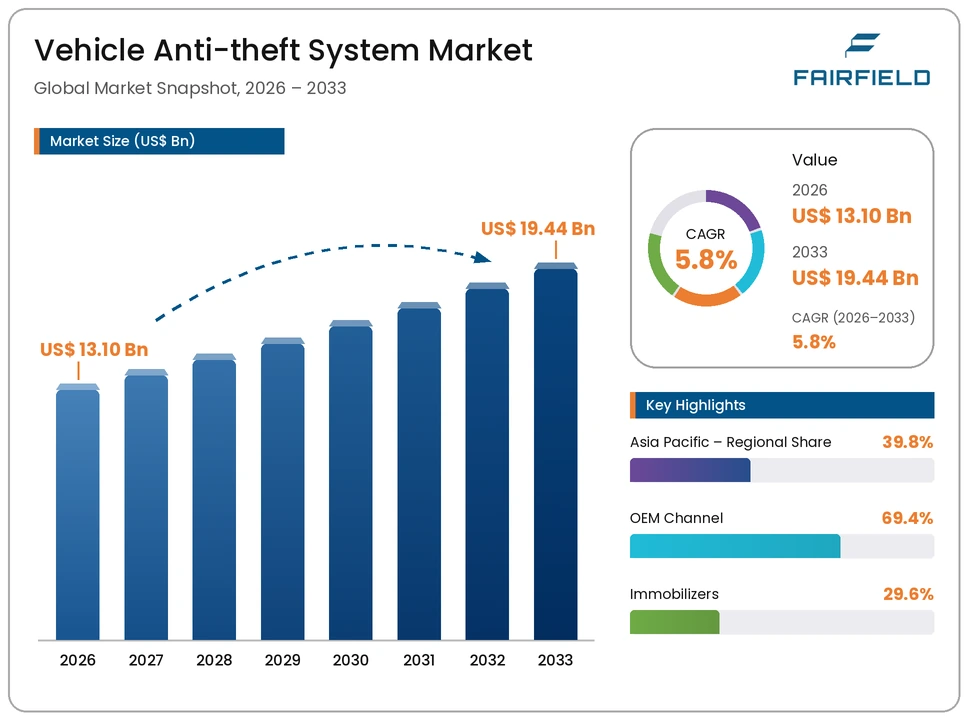
The global vehicle anti-theft system market is expected to be valued at US$ 13.10 Billion in 2026 and is projected to reach US$ 19.44 Billion by 2033, growing at a CAGR of 5.8% between 2026 and 2033. This trajectory reflects both tightening regulatory mandates notably European Union Regulation (EU) 2019/2144, which makes electronic immobilizers mandatory on all new passenger vehicles approved for EU markets and sustained consumer demand for layered protection across both OEM and aftermarket channels.
Key Highlights
- Asia Pacific held 39.8% of the global vehicle anti-theft system market in 2026, driven by strong automotive production and regulatory mandates.
- Immobilizers accounted for 29.6% of the market in 2026, supported by mandatory vehicle security regulations and insurance incentives.
- Biometric anti-theft systems are projected to be the fastest-growing segment, fueled by declining sensor costs and increasing OEM adoption.
- The OEM channel dominated with a 69.4% market share in 2026 due to the integration of anti-theft systems during vehicle manufacturing.
- Connected telematics and software-defined security platforms represent the biggest growth opportunity, driven by the shift toward cloud-connected and software-defined vehicles.
Key Growth Determinants
- Rising Vehicle Theft Complexity Driving Demand for Electronic Security Systems
Motor vehicle theft has undergone a fundamental technological shift. The Federal Bureau of Investigation (FBI) Uniform Crime Report recorded over 1 million motor vehicle thefts in the United States in 2023 a multi-year high with keyless relay theft and OBD port cloning accounting for a growing proportion of incidents. This has directly driven automaker and aftermarket supplier investment in encrypted transponder immobilizers, ultrasonic alarm sensors, and GPS-enabled stolen vehicle recovery. Robert Bosch GmbH and Continental AG both expanded their electronic immobilizer portfolios between 2023 and 2025 in direct response to insurer-led pressure for standardised electronic theft deterrence across new model lines.
Key Growth Barriers
- Relay Attack Vulnerabilities Undermining Consumer Confidence in Keyless Systems
Paradoxically, the growth of remote keyless entry has created a reputational challenge for the vehicle anti-theft system sector. Thatcham Research, the UK-based automotive security testing authority, has documented that a significant share of tested keyless vehicles remain vulnerable to relay attack despite OEM security claims. This erodes consumer trust in premium electronic solutions and slows upgrade cycles, particularly for owners of vehicles manufactured between 2018 and 2022 whose systems predate more robust ultra-wideband (UWB) positioning protocols.
Vehicle Anti-theft System Market Opportunities
- Integration of Biometric Authentication Creating a New Premium Security Tier
Biometric capture devices encompassing fingerprint ignition systems, facial recognition access, and voice-authenticated start inhibitors represent the most differentiated growth vector in the vehicle anti-theft system landscape. Hyundai Motor Company introduced a fingerprint-authenticated ignition system on the Santa Fe SUV, demonstrating consumer willingness to accept biometric friction as a security trade-off in the premium segment. As semiconductor costs for biometric sensors decline and ISO/IEC 30107-3 liveness detection standards gain automotive industry adoption, the addressable market for factory-fitted biometric security will expand substantially through 2033.
Market Segmentation Analysis
- Product Type Analysis
Immobilizers account for 29.6% of the global vehicle anti-theft system market in 2026, equivalent to US$ 3.88 Billion. Their dominance reflects a straightforward OEM procurement reality: electronic immobilizers satisfy regulatory mandates under UNECE R116 and EU Regulation 2019/2144 simultaneously, making them the default security component on every new passenger vehicle sold across regulated markets.
Insurance underwriters including Allianz SE and AXA Group routinely condition premium discounts on certified immobilizer fitment, reinforcing demand from individual buyers purchasing new vehicles in Europe and North America. Encrypted transponder-based systems, in particular, are embedded at the design stage by Tier 1 suppliers, creating a durable and sticky revenue base resistant to aftermarket substitution.
Biometric capture devices are the fastest-growing product segment. The specific catalyst is the convergence of declining capacitive fingerprint sensor costs and OEM interest in eliminating physical key systems entirely. Synaptics Incorporated launched an automotive-grade fingerprint module targeting ignition authentication in 2023, and Volkswagen AG has signalled biometric access integration across its next-generation MEB electric vehicle platform, drawing fleet operators and premium retail consumers toward systems that combine theft prevention with seamless keyless experience.
- Vehicle Type Analysis
Passenger cars account for 78.5% of the global vehicle anti-theft system market in 2026, equivalent to US$ 10.28 Billion. This dominance reflects the sheer scale of global passenger car production International Organization of Motor Vehicle Manufacturers (OICA) data shows passenger cars representing approximately 70% of total motor vehicle output globally combined with the fact that personal asset protection motivates individual buyers to specify anti-theft systems at purchase. Urban consumers across European and North American markets routinely select OEM-fitted alarm and immobilizer packages as part of trim-level specifications, embedding anti-theft spend directly into vehicle financing structures.
Commercial vehicles are the fastest-growing vehicle type segment. Fleet cargo theft particularly from last-mile logistics operators running high-value pharmaceutical, electronics, and retail distribution routes has intensified demand for GPS-integrated immobilizers and geofencing-triggered alarm systems. Volvo Trucks and Daimler Truck AG have both expanded factory-fitted telematics security options for fleet operators across European and North American markets since 2023, integrating stolen vehicle recovery directly into fleet management software platforms.
- Sales Channel Analysis
The OEM channel account for 69.4% of the global vehicle anti-theft system market in 2026, equivalent to US$ 9.09 Billion. OEM dominance reflects the structural advantage of security system integration at the vehicle design stage: immobilizers, central locking controllers, and alarm ECUs are hardwired into body control modules, making OEM fitment technically superior and cost-effective relative to aftermarket installation. Toyota Motor Corporation's global security integration strategy embedding encrypted transponder immobilizers as standard across all passenger car lines since 2022 illustrates how OEM sourcing decisions from a single manufacturer can move meaningful volume through Tier 1 supplier contracts.
The aftermarket channel is the faster-growing sales segment. Rising vehicle theft rates in markets where older vehicle populations predominate including Brazil, South Africa, and Mexico are driving owners of vehicles without factory security systems to seek aftermarket GPS trackers, alarm upgrades, and plug-in OBD immobilizer modules. Viper, distributed by Directed Electronics, has expanded its dealer network across Latin America since 2023, capitalising on growing insurance insistence on approved aftermarket security fitment as a condition of theft coverage.
Regional Insights
- Europe Vehicle Anti-theft System Market Trends and Insights
Europe account for 28.6% of the global vehicle anti-theft system market in 2026, representing US$ 3.75 Billion. The region's position reflects its regulatory density: EU Regulation 2019/2144 and aligned national insurance frameworks in the UK, Germany, and France collectively mandate anti-theft fitment as a baseline vehicle approval condition. The European Automobile Manufacturers' Association (ACEA) projects continued new vehicle registration growth through 2027, sustaining OEM-channel demand across the region.
Germany Vehicle Anti-theft System Market Size
The Germany vehicle anti-theft system market represents 27.6% of the Europe regional market in 2026, equivalent to US$ 1.03 Billion. Germany's position as Europe's largest automotive production hub home to Volkswagen AG, BMW Group, and Mercedes-Benz Group AG concentrates significant Tier 1 anti-theft component sourcing domestically. Rising keyless relay theft incidents, widely reported by Gesamtverband der Deutschen Versicherungswirtschaft (GDV), are pushing insurers toward requiring certified immobilizer fitment certificates, sustaining aftermarket demand alongside OEM volumes.
U.K. Vehicle Anti-theft System Market Size
The U.K. vehicle anti-theft system market represent 15.4% of the Europe regional market in 2026, equivalent to US$ 0.58 Billion. Thatcham Research category ratings remain the dominant specification benchmark for aftermarket security products across UK insurer networks, giving certified alarm and immobilizer suppliers a structurally protected channel. Continued elevation of vehicle theft statistics reported by the UK Home Office is expected to sustain retrofit demand through the forecast period.
- Asia Pacific Vehicle Anti-theft System Market Trends and Insights
Asia Pacific is expected to dominate the regional market command around 39.8% of the vehicle anti-theft system market in 2026, representing US$ 5.21 Billion, making it the largest and most consequential region in the vehicle anti-theft system industry. China's scale, India's compliance-driven expansion under AIS-140, and Japan's premium OEM integration capabilities together create a structurally diverse regional demand base. Rapid growth in connected vehicle penetration across Southeast Asian markets adds a further telematics-driven demand layer through the forecast period.
China Vehicle Anti-theft System Market Size
The China is lead, hold around 38.4% of the Asia Pacific regional market in 2026, equivalent to US$ 2.00 Billion. China's output of over 30 million passenger vehicles annually per OICA creates enormous OEM-channel volume for Tier 1 anti-theft suppliers. Domestic OEM consolidation around connected security platforms, accelerated by Ministry of Industry and Information Technology (MIIT) guidelines on vehicle cybersecurity issued in 2021, will increasingly favour suppliers capable of delivering integrated digital-physical security architectures.
Japan Vehicle Anti-theft System Market Size
The Japan vehicle anti-theft system market represents 20.8% of the Asia Pacific regional market in 2026, equivalent to US$ 1.08 Billion. Denso Corporation and Toyota Motor Corporation's vertically integrated supply relationships embed sophisticated anti-theft electronics across high-volume domestic platforms, anchoring OEM channel revenue. Japan's premium export vehicle volumes where security specifications must meet both UNECE R116 and destination-country standards sustain continuous product development investment by domestic Tier 1 suppliers.
India Vehicle Anti-theft System Market Size
The India vehicle anti-theft system market represents 16.7% of the Asia Pacific regional market in 2026, equivalent to US$ 0.87 Billion. AIS-140 compliance mandates have created a defined, policy-driven baseline for commercial vehicle anti-theft and tracking device fitment, anchoring near-term demand. As India's passenger car penetration rises Society of Indian Automobile Manufacturers (SIAM) data shows domestic passenger vehicle sales exceeding 4 million units in FY2024 OEM anti-theft fitment will expand in proportion, positioning India as a key incremental growth market through 2033.
Competitive Landscape
The vehicle anti-theft system market is moderately consolidated at the Tier 1 OEM supply level, with Continental AG, Robert Bosch GmbH, Denso Corporation, and Valeo S.A. commanding disproportionate share through deep OEM design-in relationships and certified compliance with international security standards.
Competition hinges primarily on ECU integration capability, cybersecurity certification credentials, and the ability to deliver software-over-the-air (SOTA) updatable security firmware not price. The aftermarket layer is considerably more fragmented, with regional specialists including Pandora Car Alarm Systems Ltd. and Meta System S.p.A. competing on Thatcham and TÜV-certification credentials, installer network depth, and insurance approval status.
Companies Covered in Vehicle Anti-theft System Market
- Continental AG
- Denso Corporation
- Robert Bosch GmbH
- Lear Corporation
- Viper (Directed Electronics)
- OnStar Corporation
- Pandora Car Alarm Systems Ltd.
- Meta System S.p.A.
- Valeo S.A.
- ZF Friedrichshafen AG
Market Segmentation
By Product Type
- Steering Locks
- Alarms
- Biometric Capture Devices
- Immobilizers
- Remote Keyless Entry
- Central Locking
By Vehicle Type
- Passenger Cars
- Commercial Vehicles
By Sales Channel
- OEM
- Aftermarket
By Region
- North America
- Europe
- Asia Pacific
- Latin America
- Middle East & Africa
- Executive Summary
- Global Vehicle Anti-theft System Market Snapshot
- Future Projections
- Key Market Trends
- Regional Snapshot, by Value, 2026
- Analyst Recommendations
- Market Overview
- Market Definitions and Segmentations
- Market Dynamics
- Drivers
- Restraints
- Market Opportunities
- Value Chain Analysis
- COVID-19 Impact Analysis
- Porter's Five Forces Analysis
- Impact of Russia-Ukraine Conflict
- PESTLE Analysis
- Regulatory Analysis
- Price Trend Analysis
- Current Prices and Future Projections, 2025-2033
- Price Impact Factors
- Global Vehicle Anti-theft System Market Outlook, 2020 - 2033
- Global Vehicle Anti-theft System Market Outlook, by Product Type, Value (US$ Bn), 2020-2033
- Steering Locks
- Alarms
- Biometric Capture Devices
- Immobilizers
- Remote Keyless Entry
- Central Locking
- Global Vehicle Anti-theft System Market Outlook, by Vehicle Type, Value (US$ Bn), 2020-2033
- Passenger Cars
- Commercial Vehicles
- Global Vehicle Anti-theft System Market Outlook, by Sales Channel, Value (US$ Bn), 2020-2033
- OEM
- Aftermarket
- Global Vehicle Anti-theft System Market Outlook, by Region, Value (US$ Bn), 2020-2033
- North America
- Europe
- Asia Pacific
- Latin America
- Middle East & Africa
- Global Vehicle Anti-theft System Market Outlook, by Product Type, Value (US$ Bn), 2020-2033
- North America Vehicle Anti-theft System Market Outlook, 2020 - 2033
- North America Vehicle Anti-theft System Market Outlook, by Product Type, Value (US$ Bn), 2020-2033
- Steering Locks
- Alarms
- Biometric Capture Devices
- Immobilizers
- Remote Keyless Entry
- Central Locking
- North America Vehicle Anti-theft System Market Outlook, by Vehicle Type, Value (US$ Bn), 2020-2033
- Passenger Cars
- Commercial Vehicles
- North America Vehicle Anti-theft System Market Outlook, by Sales Channel, Value (US$ Bn), 2020-2033
- OEM
- Aftermarket
- North America Vehicle Anti-theft System Market Outlook, by Country, Value (US$ Bn), 2020-2033
- U.S. Vehicle Anti-theft System Market Outlook, by Product Type, 2020-2033
- U.S. Vehicle Anti-theft System Market Outlook, by Vehicle Type, 2020-2033
- U.S. Vehicle Anti-theft System Market Outlook, by Sales Channel, 2020-2033
- Canada Vehicle Anti-theft System Market Outlook, by Product Type, 2020-2033
- Canada Vehicle Anti-theft System Market Outlook, by Vehicle Type, 2020-2033
- Canada Vehicle Anti-theft System Market Outlook, by Sales Channel, 2020-2033
- BPS Analysis/Market Attractiveness Analysis
- North America Vehicle Anti-theft System Market Outlook, by Product Type, Value (US$ Bn), 2020-2033
- Europe Vehicle Anti-theft System Market Outlook, 2020 - 2033
- Europe Vehicle Anti-theft System Market Outlook, by Product Type, Value (US$ Bn), 2020-2033
- Steering Locks
- Alarms
- Biometric Capture Devices
- Immobilizers
- Remote Keyless Entry
- Central Locking
- Europe Vehicle Anti-theft System Market Outlook, by Vehicle Type, Value (US$ Bn), 2020-2033
- Passenger Cars
- Commercial Vehicles
- Europe Vehicle Anti-theft System Market Outlook, by Sales Channel, Value (US$ Bn), 2020-2033
- OEM
- Aftermarket
- Europe Vehicle Anti-theft System Market Outlook, by Country, Value (US$ Bn), 2020-2033
- Germany Vehicle Anti-theft System Market Outlook, by Product Type, 2020-2033
- Germany Vehicle Anti-theft System Market Outlook, by Vehicle Type, 2020-2033
- Germany Vehicle Anti-theft System Market Outlook, by Sales Channel, 2020-2033
- Italy Vehicle Anti-theft System Market Outlook, by Product Type, 2020-2033
- Italy Vehicle Anti-theft System Market Outlook, by Vehicle Type, 2020-2033
- Italy Vehicle Anti-theft System Market Outlook, by Sales Channel, 2020-2033
- France Vehicle Anti-theft System Market Outlook, by Product Type, 2020-2033
- France Vehicle Anti-theft System Market Outlook, by Vehicle Type, 2020-2033
- France Vehicle Anti-theft System Market Outlook, by Sales Channel, 2020-2033
- U.K. Vehicle Anti-theft System Market Outlook, by Product Type, 2020-2033
- U.K. Vehicle Anti-theft System Market Outlook, by Vehicle Type, 2020-2033
- U.K. Vehicle Anti-theft System Market Outlook, by Sales Channel, 2020-2033
- Spain Vehicle Anti-theft System Market Outlook, by Product Type, 2020-2033
- Spain Vehicle Anti-theft System Market Outlook, by Vehicle Type, 2020-2033
- Spain Vehicle Anti-theft System Market Outlook, by Sales Channel, 2020-2033
- Russia Vehicle Anti-theft System Market Outlook, by Product Type, 2020-2033
- Russia Vehicle Anti-theft System Market Outlook, by Vehicle Type, 2020-2033
- Russia Vehicle Anti-theft System Market Outlook, by Sales Channel, 2020-2033
- Rest of Europe Vehicle Anti-theft System Market Outlook, by Product Type, 2020-2033
- Rest of Europe Vehicle Anti-theft System Market Outlook, by Vehicle Type, 2020-2033
- Rest of Europe Vehicle Anti-theft System Market Outlook, by Sales Channel, 2020-2033
- BPS Analysis/Market Attractiveness Analysis
- Europe Vehicle Anti-theft System Market Outlook, by Product Type, Value (US$ Bn), 2020-2033
- Asia Pacific Vehicle Anti-theft System Market Outlook, 2020 - 2033
- Asia Pacific Vehicle Anti-theft System Market Outlook, by Product Type, Value (US$ Bn), 2020-2033
- Steering Locks
- Alarms
- Biometric Capture Devices
- Immobilizers
- Remote Keyless Entry
- Central Locking
- Asia Pacific Vehicle Anti-theft System Market Outlook, by Vehicle Type, Value (US$ Bn), 2020-2033
- Passenger Cars
- Commercial Vehicles
- Asia Pacific Vehicle Anti-theft System Market Outlook, by Sales Channel, Value (US$ Bn), 2020-2033
- OEM
- Aftermarket
- Asia Pacific Vehicle Anti-theft System Market Outlook, by Country, Value (US$ Bn), 2020-2033
- China Vehicle Anti-theft System Market Outlook, by Product Type, 2020-2033
- China Vehicle Anti-theft System Market Outlook, by Vehicle Type, 2020-2033
- China Vehicle Anti-theft System Market Outlook, by Sales Channel, 2020-2033
- Japan Vehicle Anti-theft System Market Outlook, by Product Type, 2020-2033
- Japan Vehicle Anti-theft System Market Outlook, by Vehicle Type, 2020-2033
- Japan Vehicle Anti-theft System Market Outlook, by Sales Channel, 2020-2033
- South Korea Vehicle Anti-theft System Market Outlook, by Product Type, 2020-2033
- South Korea Vehicle Anti-theft System Market Outlook, by Vehicle Type, 2020-2033
- South Korea Vehicle Anti-theft System Market Outlook, by Sales Channel, 2020-2033
- India Vehicle Anti-theft System Market Outlook, by Product Type, 2020-2033
- India Vehicle Anti-theft System Market Outlook, by Vehicle Type, 2020-2033
- India Vehicle Anti-theft System Market Outlook, by Sales Channel, 2020-2033
- Southeast Asia Vehicle Anti-theft System Market Outlook, by Product Type, 2020-2033
- Southeast Asia Vehicle Anti-theft System Market Outlook, by Vehicle Type, 2020-2033
- Southeast Asia Vehicle Anti-theft System Market Outlook, by Sales Channel, 2020-2033
- Rest of SAO Vehicle Anti-theft System Market Outlook, by Product Type, 2020-2033
- Rest of SAO Vehicle Anti-theft System Market Outlook, by Vehicle Type, 2020-2033
- Rest of SAO Vehicle Anti-theft System Market Outlook, by Sales Channel, 2020-2033
- BPS Analysis/Market Attractiveness Analysis
- Asia Pacific Vehicle Anti-theft System Market Outlook, by Product Type, Value (US$ Bn), 2020-2033
- Latin America Vehicle Anti-theft System Market Outlook, 2020 - 2033
- Latin America Vehicle Anti-theft System Market Outlook, by Product Type, Value (US$ Bn), 2020-2033
- Steering Locks
- Alarms
- Biometric Capture Devices
- Immobilizers
- Remote Keyless Entry
- Central Locking
- Latin America Vehicle Anti-theft System Market Outlook, by Vehicle Type, Value (US$ Bn), 2020-2033
- Passenger Cars
- Commercial Vehicles
- Latin America Vehicle Anti-theft System Market Outlook, by Sales Channel, Value (US$ Bn), 2020-2033
- OEM
- Aftermarket
- Latin America Vehicle Anti-theft System Market Outlook, by Country, Value (US$ Bn), 2020-2033
- Brazil Vehicle Anti-theft System Market Outlook, by Product Type, 2020-2033
- Brazil Vehicle Anti-theft System Market Outlook, by Vehicle Type, 2020-2033
- Brazil Vehicle Anti-theft System Market Outlook, by Sales Channel, 2020-2033
- Mexico Vehicle Anti-theft System Market Outlook, by Product Type, 2020-2033
- Mexico Vehicle Anti-theft System Market Outlook, by Vehicle Type, 2020-2033
- Mexico Vehicle Anti-theft System Market Outlook, by Sales Channel, 2020-2033
- Argentina Vehicle Anti-theft System Market Outlook, by Product Type, 2020-2033
- Argentina Vehicle Anti-theft System Market Outlook, by Vehicle Type, 2020-2033
- Argentina Vehicle Anti-theft System Market Outlook, by Sales Channel, 2020-2033
- Rest of LATAM Vehicle Anti-theft System Market Outlook, by Product Type, 2020-2033
- Rest of LATAM Vehicle Anti-theft System Market Outlook, by Vehicle Type, 2020-2033
- Rest of LATAM Vehicle Anti-theft System Market Outlook, by Sales Channel, 2020-2033
- BPS Analysis/Market Attractiveness Analysis
- Latin America Vehicle Anti-theft System Market Outlook, by Product Type, Value (US$ Bn), 2020-2033
- Middle East & Africa Vehicle Anti-theft System Market Outlook, 2020 - 2033
- Middle East & Africa Vehicle Anti-theft System Market Outlook, by Product Type, Value (US$ Bn), 2020-2033
- Steering Locks
- Alarms
- Biometric Capture Devices
- Immobilizers
- Remote Keyless Entry
- Central Locking
- Middle East & Africa Vehicle Anti-theft System Market Outlook, by Vehicle Type, Value (US$ Bn), 2020-2033
- Passenger Cars
- Commercial Vehicles
- Middle East & Africa Vehicle Anti-theft System Market Outlook, by Sales Channel, Value (US$ Bn), 2020-2033
- OEM
- Aftermarket
- Middle East & Africa Vehicle Anti-theft System Market Outlook, by Country, Value (US$ Bn), 2020-2033
- GCC Vehicle Anti-theft System Market Outlook, by Product Type, 2020-2033
- GCC Vehicle Anti-theft System Market Outlook, by Vehicle Type, 2020-2033
- GCC Vehicle Anti-theft System Market Outlook, by Sales Channel, 2020-2033
- South Africa Vehicle Anti-theft System Market Outlook, by Product Type, 2020-2033
- South Africa Vehicle Anti-theft System Market Outlook, by Vehicle Type, 2020-2033
- South Africa Vehicle Anti-theft System Market Outlook, by Sales Channel, 2020-2033
- Egypt Vehicle Anti-theft System Market Outlook, by Product Type, 2020-2033
- Egypt Vehicle Anti-theft System Market Outlook, by Vehicle Type, 2020-2033
- Egypt Vehicle Anti-theft System Market Outlook, by Sales Channel, 2020-2033
- Nigeria Vehicle Anti-theft System Market Outlook, by Product Type, 2020-2033
- Nigeria Vehicle Anti-theft System Market Outlook, by Vehicle Type, 2020-2033
- Nigeria Vehicle Anti-theft System Market Outlook, by Sales Channel, 2020-2033
- Rest of Middle East Vehicle Anti-theft System Market Outlook, by Product Type, 2020-2033
- Rest of Middle East Vehicle Anti-theft System Market Outlook, by Vehicle Type, 2020-2033
- Rest of Middle East Vehicle Anti-theft System Market Outlook, by Sales Channel, 2020-2033
- BPS Analysis/Market Attractiveness Analysis
- Middle East & Africa Vehicle Anti-theft System Market Outlook, by Product Type, Value (US$ Bn), 2020-2033
- Competitive Landscape
- Company Vs Segment Heatmap
- Company Market Share Analysis, 2025
- Competitive Dashboard
- Company Profiles
- Continental AG
- Company Overview
- Product Portfolio
- Financial Overview
- Business Strategies and Developments
- Denso Corporation
- Robert Bosch GmbH
- Author LLC
- Viper
- OnStar Corporation
- Pandora Car Alarm Systems Ltd.
- Meta System S.p.A.
- Valeo S.A.
- ZF Friedrichshafen AG
- Continental AG
- Appendix
- Research Methodology
- Report Assumptions
- Acronyms and Abbreviations
By Product Type
- Steering Locks
- Alarms
- Biometric Capture Devices
- Immobilizers
- Remote Keyless Entry
- Central Locking
By Vehicle Type
- Passenger Cars
- Commercial Vehicles
By Sales Channel
- OEM
- Aftermarket
By Region
- North America
- Europe
- Asia Pacific
- Latin America
- Middle East & Africa
Our Research Methodology
Considering the volatility of business today, traditional approaches to strategizing a game plan can be unfruitful if not detrimental. True ambiguity is no way to determine a forecast. A myriad of predetermined factors must be accounted for such as the degree of risk involved, the magnitude of circumstances, as well as conditions or consequences that are not known or unpredictable. To circumvent binary views that cast uncertainty, the application of market research intelligence to strategically posture, move, and enable actionable outcomes is necessary.
View Methodology
Quality Assured
Rigorous Validation Process

Confidentiality Assured
End-to-end Data Security

Custom Research Services
Tailored To Your Objectives
FAQs
The global vehicle anti-theft system market is valued at US$ 13.10 Billion in 2026 and is projected to reach US$ 19.44 Billion by 2033, advancing at a 5.8% CAGR.
Market growth is driven by rising vehicle theft incidents and increasingly stringent government regulations mandating advanced anti-theft systems.
Immobilizers lead the market with a 29.6% share due to regulatory compliance requirements and widespread OEM integration.
Asia Pacific dominates with a 39.8% market share, supported by high vehicle production, regulatory mandates, and strong automotive manufacturing.
The biggest opportunity lies in software-defined, telematics-enabled anti-theft platforms, driven by the growth of connected vehicles and subscription-based security services.
Related Reports
Foldable Electric Scooter Market Size, Share, Insights, Competitive Landscape, and Forecast 2026 to 2033
Explore the foldable electric scooter market, reaching US$ 6.9 billion by 2033 at 6.3% CAGR, with range, price tier and regional insights.
In-car Audio System Market Size, Share, Insights, Competitive Landscape, and Forecast 2026 to 2033
Explore the in-car audio system market, reaching US$ 21.8 billion by 2033 at 6.0% CAGR, with component, system tier and regional insights.
Electric Brake Booster Market Size, Share, Insights, Competitive Landscape, and Forecast 2026 to 2033
Explore the electric brake booster market, reaching US$ 12.6 billion by 2033 at 13.5% CAGR, with architecture, vehicle and regional insights.
Axial Flux Motor Market Size, Share, Insights, Competitive Landscape, and Forecast 2026 to 2033
Explore the axial flux motor market, reaching US$ 3.6 billion by 2033 at 29.2% CAGR, with topology, application and regional insights.
Automotive Fuel System Market Size, Share, Insights, Competitive Landscape, and Forecast 2026 to 2033
Explore the automotive fuel system market, reaching US$ 134.0 billion by 2033 at 2.6% CAGR, with component, regional and competitive insights.
Railway Sleepers Market Size, Share, Insights, Competitive Landscape, and Forecast 2026 to 2033
Explore the railway sleepers market, reaching US$ 6.1 billion by 2033 at 4.1% CAGR, with material, regional and competitive insights.