



2D Barcode Reader Market
2D Barcode Reader Market Size, Share, Insights, Competitive Landscape, and Forecast 2026 to 2033
2D Barcode Reader Market Size and Trend Analysis
How Fast Is the 2D Barcode Reader Market Growing?
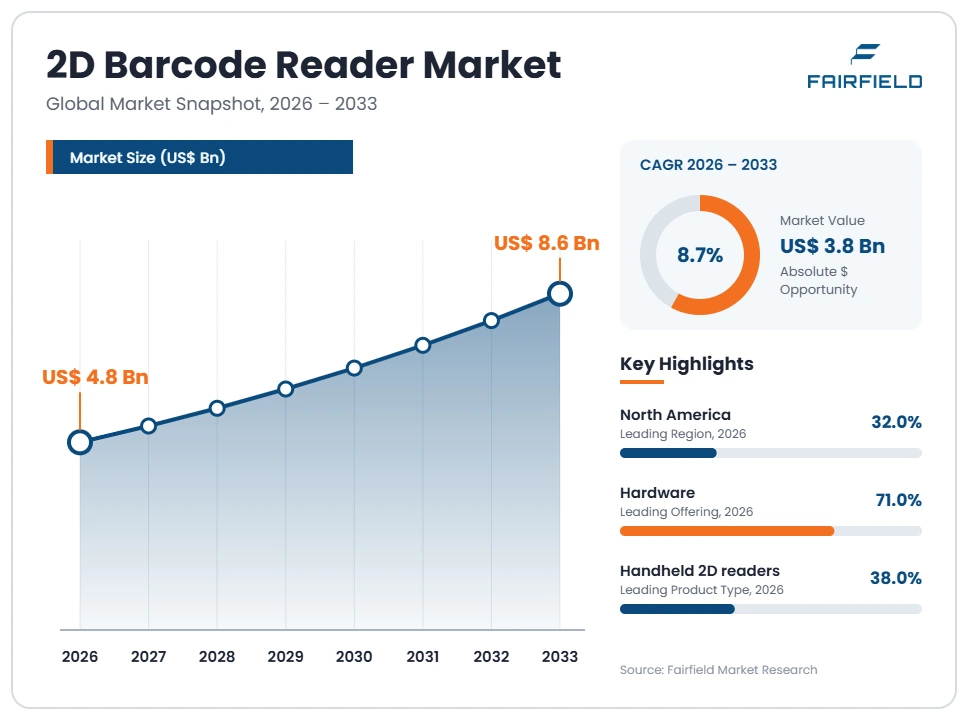
The global 2D barcode reader market size is expected to be valued at US$ 4.8 billion in 2026 and projected to reach US$ 8.6 billion by 2033, growing at a CAGR of 8.7% between 2026 and 2033.
Revenue expanded at a 7.4% CAGR between 2020 and 2025, reaching about US$ 4.42 billion at the close of 2025. Three forces explain the current trajectory. Medicine serialisation rules in the United States and the European Union made Data Matrix decoding compulsory across packaging lines and dispensing counters. Warehouse automation and parcel growth lifted installations of fixed-mount and vision-based readers. Retailers began replacing laser scanners ahead of the GS1 Sunrise 2027 milestone for two-dimensional symbols at checkout. The direction of travel is a long, standards-led replacement cycle rather than an abrupt switch. Hardware volumes are increasingly supported by attached decoding software and managed device services, which lift revenue per installed reader.
Key Report Takeaways
- By Product Type: Handheld 2D readers held 38% share in 2026, while machine-vision based readers are projected to expand at an 11.3% CAGR through 2033, driven by inline traceability on automated assembly and packaging lines.
- By Offering: Hardware held 71% share in 2026, while decoding and device management software is projected to expand at a 12.4% CAGR through 2033, driven by subscription licensing of mobile imaging toolkits.
- By Connectivity: Wired readers held 41% share in 2026, while Wi-Fi enabled readers are projected to expand at a 10.8% CAGR through 2033, driven by untethered picking workflows in large distribution centres.
- By End-use Industry: Retail and e-commerce held 29% share in 2026, while healthcare and pharmaceuticals is projected to expand at an 11.6% CAGR through 2033, driven by unique device identification and bedside verification.
- By Geography: North America held 32% share in 2026, while Asia Pacific is projected to expand at a 10.5% CAGR through 2033, driven by electronics manufacturing and rapid convenience retail modernisation.
Global 2D Barcode Reader Market Trends and Insights
Drivers Impact Analysis
Two forces account for most of the incremental reader demand expected through the forecast period.
| Driver | Impact on CAGR Forecast | Geographic Relevance | Impact Timeline |
| Medicine serialisation and device identification mandates | High | North America, Europe, Asia Pacific | Medium term 2–4 years |
| Point-of-sale migration from linear to two-dimensional symbols | High | Global | Long term ≥4 years |
Medicine Serialisation Rules Push Data Matrix Reading Into Pharmacy and Packaging Workflows
Regulated pharmaceutical traceability is the single most reliable source of 2D barcode reader demand. Every prescription pack now carries a unique identifier in a Data Matrix symbol, and that identifier must be read at several handover points. Manufacturers verify codes on packaging lines, wholesalers scan cases at goods-in, and pharmacies decommission packs at the point of dispense. Each of those steps needs an imaging reader rather than a linear laser scanner.
The mechanism is regulatory rather than discretionary. The European Union Falsified Medicines Directive and its delegated regulation require pack-level unique identifiers and verification before supply to the patient. The U.S. Drug Supply Chain Security Act requires interoperable, electronic package-level tracing across trading partners. Both regimes depend on symbologies defined by ISO/IEC 16022, and compliance audits make reader accuracy and grading against ISO/IEC 15415 a procurement requirement rather than a preference.
GS1 Sunrise 2027 Forces Point-of-Sale Hardware Refresh Across Grocery and General Merchandise
Retail checkout is the largest installed base of scanning hardware, and it is being converted to two-dimensional capability. The GS1 Sunrise 2027 initiative asks retailers and brand owners worldwide to make point-of-sale systems able to accept 2D barcodes alongside the familiar linear symbol. That capability cannot be delivered by most laser scanners, so lanes and self-checkout units require imaging engines, which converts a compliance target into a multi-year hardware refresh.
The underlying change is what the code carries. A GS1 Digital Link encoded in a QR Code can hold batch number, expiry date and a resolvable product identifier in a single symbol. Grocers use that payload for automated expiry enforcement and markdown control, while brand owners use it for consumer engagement. Scanners must therefore decode, parse and route structured application identifiers, not simply return digits.
Restraints Impact Analysis
Two constraints hold back the pace at which installed scanning fleets convert to imaging.
| Restraint | Impact on CAGR Forecast | Geographic Relevance | Impact Timeline |
| Point-of-sale software integration cost and long refresh cycles | Medium | North America, Europe | Medium term 2–4 years |
| Camera-based decoding on consumer devices displacing entry-level readers | Medium | Asia Pacific, Latin America | Long term ≥4 years |
Legacy Point-of-Sale Software Integration Slows Replacement of Installed Laser Scanners
The barrier to 2D adoption at retail is rarely the scanner itself; it is everything behind it. Checkout applications, price lookup databases and loyalty engines were written to accept a fixed-length numeric string. Feeding them a structured payload with batch and expiry fields requires middleware changes, regression testing and staff retraining. Retailers therefore defer purchases until a wider point-of-sale upgrade is already funded.
The cost sits in software certification and downtime, not hardware. A grocery chain must validate the new data flow against tax reporting, age restriction logic and returns processing before a single lane goes live. Scanning hardware itself has an eight to ten year service life, and finance teams rarely retire assets early. The result is a staggered, store-by-store rollout that spreads reader revenue across several budget cycles.
Smartphone Camera Decoding Erodes Pricing in Low-Duty Handheld Reader Segments
Consumer device cameras now decode QR Code and Data Matrix reliably, which removes the need for a dedicated reader in low-volume settings. Small retailers, field service teams, clinics and hospitality operators increasingly scan with a phone running an enterprise application. That substitution caps unit growth at the entry level and pushes average selling prices down across general-purpose handheld ranges.
The cause is component economics. High-resolution mobile image sensors, fast processors and mature decoding libraries are available at consumer volumes, so a software licence replaces a purpose-built device. Dedicated readers retain advantages in duty cycle, drop rating, motion tolerance and poorly printed or low-contrast codes, but those benefits matter only in demanding environments. Vendors consequently defend margin by moving upmarket into rugged, vision and software-attached products rather than competing on basic imaging price.
Market Opportunities
EU Digital Product Passport Opens a New Reader and Decoding Software Revenue Pool
The EU Digital Product Passport creates scanning demand far outside the industries that already use imaging readers. Under the Ecodesign for Sustainable Products Regulation (EU) 2024/1781, product groups will carry a machine-readable data carrier that links to compliance, material and repair information. Textiles, batteries, furniture, construction products and electronics will all need carriers applied, verified and read, which extends the addressable base well beyond pharmaceuticals and parcels.
The revenue accrues to vendors who combine marking verification with resolution software. Manufacturers and converters need print quality grading at the line to guarantee that carriers remain readable through the product life. Recyclers, repairers and customs authorities need rugged field readers. Retailers need checkout and shelf-edge devices that resolve a GS1 Digital Link. That chain of users creates recurring software and service revenue alongside hardware shipments.
Direct Part Mark Verification in Automotive Electronics Creates an Aftermarket for Vision Readers
Direct part marking is an underexploited revenue pool inside manufacturing, where codes are etched or dot-peened into metal and plastic rather than printed on labels. Automotive, aerospace and electronics suppliers mark components for warranty traceability and recall containment. These marks are low contrast, curved and often oil-covered, so they require controlled lighting, liquid lens optics and decoding algorithms far beyond a general-purpose reader.
Suppliers with machine-vision capability capture this demand because the sale includes optics, illumination and verification software. Tier-one automotive suppliers drive it, since original equipment manufacturers increasingly require component-level genealogy for electric drivetrain and battery assemblies. Electronics assembly adds volume through board-level marking on increasingly small substrates, where symbol size falls faster than contrast improves. Grading marks against ISO/IEC 15415 turns a one-off reader purchase into an ongoing verification and calibration relationship.
Segment Analysis
- By Product Type: Handheld Readers Lead While Machine-Vision Based Readers Gain Momentum
Handheld 2D readers held 38% share in 2026, the largest of any product category, because they suit the widest range of tasks. One corded or cordless imager serves retail checkout, pharmacy dispensing, goods-in and inventory counts, which keeps procurement simple and training costs low. Machine-vision based readers are the fastest-growing product line at an 11.3% CAGR to 2033, as manufacturers move verification inline and remove manual scanning steps. Smart cameras read codes at conveyor speed, grade print quality and reject unreadable parts without stopping production. Fixed-mount readers remain essential in parcel sortation, while mobile computers with integrated 2D imagers dominate warehouse picking. The commercial implication is a shift in value from unit volume toward optics, lighting and decoding software, where gross margins are higher and switching costs for the customer are considerably greater.
- By Offering: Hardware Dominates Revenue While Decoding Software Expands Fastest
Hardware accounted for 71% of market value in 2026, reflecting the capital nature of scanning deployments and the long service life of rugged devices. Decoding and device management software is the fastest-expanding offering at a 12.4% CAGR through 2033. Growth comes from software development kits that turn tablets and phones into enterprise scanners, and from cloud consoles that monitor battery health, firmware and scan failure rates across thousands of devices. Services, covering integration, staging and maintenance contracts, sit between the two in both size and growth. The shift matters because software converts a single hardware transaction into recurring revenue and improves customer retention. It also allows vendors to monetise sites where phone-based scanning replaces dedicated readers, protecting account value even when hardware unit shipments stay flat.
- By Connectivity: Wired Interfaces Hold the Base While Wi-Fi Readers Accelerate
Wired readers held 41% share in 2026, sustained by fixed checkout lanes, laboratory benches and industrial stations where power and data come from a single cable and reliability outweighs mobility. Wi-Fi enabled readers are growing fastest at a 10.8% CAGR to 2033, driven by large distribution centres where operators move continuously between racking, packing benches and loading docks. Bluetooth cordless scanners remain the volume choice for short-range freedom at the counter, while cellular-enabled devices serve proof-of-delivery and field service. Wireless growth depends directly on site infrastructure, so warehouse Wi-Fi upgrades and private network pilots act as a leading indicator of reader demand. For vendors, wireless models also raise attach rates for charging cradles, spare batteries and device management subscriptions, improving lifetime revenue per endpoint.
- By End-use Industry: Retail and E-commerce Lead While Healthcare and Pharmaceuticals Grow Quickest
Retail and e-commerce held 29% share in 2026, the largest vertical, because checkout lanes, self-service terminals, click-and-collect desks and fulfilment centres each need scanning at multiple touchpoints. Healthcare and pharmaceuticals is the fastest-growing vertical at an 11.6% CAGR through 2033. Hospitals scan wristbands and medication at the bedside to prevent administration errors, and the EU Medical Device Regulation obliges manufacturers to carry unique device identification on labels, pushing imaging readers into theatres and stockrooms. Transportation and logistics remains a heavy consumer of readers through parcel sortation and proof of delivery, while manufacturing drives direct part mark reading on components. The practical implication is that vendors with regulatory domain knowledge, validated workflows and healthcare-grade disinfectable housings command better pricing than those selling general-purpose scanning hardware alone.
Geography Analysis
- Which Region Is Leading the 2D Barcode Reader Market?
North America leads the 2D barcode reader market with 32% share in 2026, supported by the deepest installed base of automated logistics and regulated healthcare scanning. The United States accounts for most regional revenue, with Canada and Mexico adding cross-border distribution demand. Parcel volumes from e-commerce have driven continuous investment in fixed-mount and vision readers across sortation hubs. The U.S. Drug Supply Chain Security Act has made package-level tracing an operating requirement for manufacturers, wholesalers and dispensers, which sustains replacement cycles in pharmacy and distribution. Hospital systems add demand through barcode medication administration programmes. Regional growth is a comparatively moderate 7.6% CAGR because much of the installed base already uses imaging. The main change ahead is grocery checkout conversion, which will spread reader purchases across store estates over several budget years.
- Europe Converts Regulatory Traceability Obligations Into Steady Reader Demand
Europe holds 25% share in 2026 and grows at a 7.8% CAGR, with demand shaped more by regulation than by retail expansion. Germany, France, Italy and the United Kingdom generate most revenue through pharmaceutical manufacturing, automotive production and organised grocery. Pack-level verification under the Falsified Medicines Directive placed imaging readers in every community pharmacy, and the EU Medical Device Regulation extended identification duties across device classes. Automotive and aerospace plants use direct part mark verification for component genealogy. The structural change ahead is the Digital Product Passport, which will require machine-readable carriers across textiles, batteries and construction products. The main barrier is fragmentation: national reimbursement systems, differing retail formats and multiple languages lengthen deployment timelines, so integrators with cross-border service coverage hold a durable advantage over single-country suppliers.
- Which Region Is Growing Fastest in the 2D Barcode Reader Market?
Asia Pacific is growing fastest in the 2D barcode reader market at a 10.5% CAGR between 2026 and 2033, from 31% share in 2026. China, Japan, South Korea, Taiwan and India supply the bulk of global electronics, automotive and appliance manufacturing, where inline code reading supports yield tracking and warranty traceability. Payment behaviour reinforces adoption, since QR Code scanning is already routine in everyday commerce across China and India, which lowers the cultural barrier to two-dimensional symbols at checkout. Convenience store and modern grocery expansion is adding lanes faster than any other region. Pharmaceutical exporters in India install serialisation lines to meet destination-market rules. Domestic reader manufacturers compete aggressively on price, so the region grows faster in units than in value, compressing average selling prices.
- Latin America Builds Reader Demand Around Fiscal Invoicing and Retail Modernisation
Latin America accounts for 6% share in 2026 and expands at an 8.4% CAGR, led by Brazil and Mexico. Electronic fiscal invoicing requirements have normalised machine-readable documentation in commerce, and two-dimensional symbols on invoices and receipts are widely accepted. Retail chains are converting checkout estates as modern grocery formats displace traditional trade, while regional distribution centres add fixed-mount readers for parcel handling. Automotive and appliance plants in Mexico scan components for export supply chains. Barriers remain significant: currency volatility raises the local cost of imported hardware, import duties lengthen payback, and service networks are thin outside major cities. The clearest opportunity is pharmacy traceability, as national medicine tracking frameworks mature and oblige dispensers to verify packs before supply, which creates a broad base of low-cost reader demand.
- Middle East & Africa Adds Reader Capacity Through Logistics Hubs and Pharmacy Tracking
Middle East & Africa holds 6% share in 2026 and grows at an 8.8% CAGR, with activity concentrated in the United Arab Emirates, Saudi Arabia, Türkiye and South Africa. Transhipment hubs and new fulfilment centres install fixed-mount and vision readers to handle rising parcel throughput. National medicine traceability programmes in the Gulf states require pack-level verification, placing imaging readers in pharmacies and hospital stores. Retail development in organised grocery adds checkout demand. Barriers are structural: limited local technical service, fragmented standards adoption across markets and uneven power and network infrastructure slow deployments outside major cities. The strongest opportunity lies in logistics free zones, where greenfield facilities specify imaging and machine-vision reading from the design stage rather than retrofitting older conveyor and sortation equipment later.
Competitive Landscape
The 2D barcode reader market is moderately concentrated. A small group of automatic identification specialists holds the majority of global revenue, while dozens of regional manufacturers compete in price-sensitive handheld categories. Scale matters because customers buy fleets rather than units, and large retailers and carriers expect worldwide staging, spares and service coverage. Consolidation has been steady over two decades, as scanning specialists were absorbed into broader industrial automation and enterprise mobility groups, and as machine-vision suppliers added code reading to inspection portfolios. The result is a tiered structure: global fleet suppliers, machine-vision specialists, and value manufacturers serving small and mid-sized businesses.
Competition turns on decode performance against damaged, curved and low-contrast codes, ergonomics and durability, breadth of device management software, and the quality of channel and integration support. Certification against symbology and print quality standards is a baseline expectation in regulated sectors. New entrants rarely attack with cheaper hardware alone. The more disruptive approach comes from software vendors offering decoding toolkits that run on standard mobile devices, and from camera makers applying deep learning models to decode marks that conventional algorithms reject.
Strategic activity has centred on three moves. Vendors have acquired machine-vision and software capability to attach recurring revenue to hardware sales. They have expanded regional service and staging operations to win multinational fleet contracts. They have broadened portfolios toward rugged mobile computers so that one supplier covers checkout, warehouse and field use.
Strategic direction is converging on platform selling. Suppliers position scanning as part of a managed device estate with analytics, firmware control and predictable lifecycle costs, which deepens customer relationships and shifts the conversation away from unit price.
Recent Industry Developments
- February 2019: Commission Delegated Regulation (EU) 2016/161 under the Falsified Medicines Directive 2011/62/EU became applicable, requiring a unique identifier in a Data Matrix on prescription packs – it created a permanent imaging reader base in European pharmacies and wholesalers.
- November 2023: The enhanced drug distribution security requirements of the U.S. Drug Supply Chain Security Act took effect, with the U.S. Food and Drug Administration allowing a stabilisation period before full enforcement – it obliged trading partners to build interoperable, package-level electronic tracing.
- July 2024: The Ecodesign for Sustainable Products Regulation (EU) 2024/1781 entered into force, establishing the legal basis for the Digital Product Passport – it signals machine-readable carriers across consumer and construction product groups.
- May 2025: Unique device identification carrier requirements under the EU Medical Device Regulation extended to the final class of devices – it widened imaging reader demand across hospital stockrooms and operating theatres.
Companies Covered in the Report
- Zebra Technologies Corporation
- Honeywell International Inc.
- Cognex Corporation
- Datalogic S.p.A.
- Keyence Corporation
- SICK AG
- Omron Corporation
- Denso Wave Incorporated
- Newland Auto-ID Technology
- Opticon Sensors Europe
- CipherLab Co., Ltd.
- Code Corporation
- Socket Mobile, Inc.
- Unitech Electronics Co., Ltd.
- Panasonic Connect
2D Barcode Reader Market Report Scope
| Metric | Value |
| Study Period | 2020–2033 |
| Market Size 2026 | US$ 4.8 Billion |
| Market Size 2033 | US$ 8.6 Billion |
| CAGR 2026–2033 | 8.7% |
| Absolute Dollar Opportunity | US$ 3.8 Billion |
| Largest Market | North America (32% share in 2026) |
| Fastest-Growing Market | Asia Pacific (10.5% CAGR) |
| Market Concentration | Medium |
| Major Players | Zebra Technologies, Honeywell International, Cognex Corporation, Datalogic, Keyence Corporation |
2D Barcode Reader Market Segmentation
Product Type
- Handheld 2D readers
- Fixed-mount 2D readers
- Mobile computers with integrated 2D imagers
- Machine-vision based readers
Offering
- Hardware
- Software
- Services
Connectivity
- Wired
- Bluetooth
- Wi-Fi
- Cellular-enabled
End-use Industry
- Retail and e-commerce
- Transportation and logistics
- Manufacturing and industrial
- Healthcare and pharmaceuticals
- Other end uses
Regions
- North America
- Europe
- Asia Pacific
- Latin America
- Middle East & Africa
- Executive Summary
- Global 2D Barcode Reader Market Snapshot
- Future Projections
- Key Report Takeaways
- Regional Snapshot
- Market Overview
- Market Definition and Report Scope
- Historical Trends 2020–2025
- Market Dynamics
- Drivers
- Medicine Serialisation Rules Push Data Matrix Reading Into Pharmacy and Packaging Workflows
- GS1 Sunrise 2027 Forces Point-of-Sale Hardware Refresh Across Grocery and General Merchandise
- Restraints
- Legacy Point-of-Sale Software Integration Slows Replacement of Installed Laser Scanners
- Smartphone Camera Decoding Erodes Pricing in Low-Duty Handheld Reader Segments
- Market Opportunities
- EU Digital Product Passport Opens a New Reader and Decoding Software Revenue Pool
- Direct Part Mark Verification in Automotive Electronics Creates an Aftermarket for Vision Readers
- Drivers
- Global 2D Barcode Reader Market Outlook, 2020–2033
- Global 2D Barcode Reader Market Outlook, by Product Type, Value (US$ Billion), 2020–2033
- Handheld 2D readers
- Fixed-mount 2D readers
- Mobile computers with integrated 2D imagers
- Machine-vision based readers
- Global 2D Barcode Reader Market Outlook, by Offering, Value (US$ Billion), 2020–2033
- Hardware
- Software
- Services
- Global 2D Barcode Reader Market Outlook, by Connectivity, Value (US$ Billion), 2020–2033
- Wired
- Bluetooth
- Wi-Fi
- Cellular-enabled
- Global 2D Barcode Reader Market Outlook, by End-use Industry, Value (US$ Billion), 2020–2033
- Retail and e-commerce
- Transportation and logistics
- Manufacturing and industrial
- Healthcare and pharmaceuticals
- Other end uses
- Global 2D Barcode Reader Market Outlook, by Region, Value (US$ Billion), 2020–2033
- North America
- Europe
- Asia Pacific
- Latin America
- Middle East & Africa
- Global 2D Barcode Reader Market Outlook, by Product Type, Value (US$ Billion), 2020–2033
- North America 2D Barcode Reader Market Outlook, 2020–2033
- North America 2D Barcode Reader Market Outlook, by Product Type, Value (US$ Billion), 2020–2033
- Handheld 2D readers
- Fixed-mount 2D readers
- Mobile computers with integrated 2D imagers
- Machine-vision based readers
- North America 2D Barcode Reader Market Outlook, by Offering, Value (US$ Billion), 2020–2033
- Hardware
- Software
- Services
- North America 2D Barcode Reader Market Outlook, by Connectivity, Value (US$ Billion), 2020–2033
- Wired
- Bluetooth
- Wi-Fi
- Cellular-enabled
- North America 2D Barcode Reader Market Outlook, by End-use Industry, Value (US$ Billion), 2020–2033
- Retail and e-commerce
- Transportation and logistics
- Manufacturing and industrial
- Healthcare and pharmaceuticals
- Other end uses
- North America 2D Barcode Reader Market Outlook, by Country, Value (US$ Billion), 2020–2033
- United States 2D Barcode Reader Market Outlook, by Product Type, 2020–2033
- United States 2D Barcode Reader Market Outlook, by Offering, 2020–2033
- United States 2D Barcode Reader Market Outlook, by Connectivity, 2020–2033
- United States 2D Barcode Reader Market Outlook, by End-use Industry, 2020–2033
- Canada 2D Barcode Reader Market Outlook, by Product Type, 2020–2033
- Canada 2D Barcode Reader Market Outlook, by Offering, 2020–2033
- Canada 2D Barcode Reader Market Outlook, by Connectivity, 2020–2033
- Canada 2D Barcode Reader Market Outlook, by End-use Industry, 2020–2033
- Mexico 2D Barcode Reader Market Outlook, by Product Type, 2020–2033
- Mexico 2D Barcode Reader Market Outlook, by Offering, 2020–2033
- Mexico 2D Barcode Reader Market Outlook, by Connectivity, 2020–2033
- Mexico 2D Barcode Reader Market Outlook, by End-use Industry, 2020–2033
- North America 2D Barcode Reader Market Outlook, by Product Type, Value (US$ Billion), 2020–2033
- Europe 2D Barcode Reader Market Outlook, 2020–2033
- Europe 2D Barcode Reader Market Outlook, by Product Type, Value (US$ Billion), 2020–2033
- Handheld 2D readers
- Fixed-mount 2D readers
- Mobile computers with integrated 2D imagers
- Machine-vision based readers
- Europe 2D Barcode Reader Market Outlook, by Offering, Value (US$ Billion), 2020–2033
- Hardware
- Software
- Services
- Europe 2D Barcode Reader Market Outlook, by Connectivity, Value (US$ Billion), 2020–2033
- Wired
- Bluetooth
- Wi-Fi
- Cellular-enabled
- Europe 2D Barcode Reader Market Outlook, by End-use Industry, Value (US$ Billion), 2020–2033
- Retail and e-commerce
- Transportation and logistics
- Manufacturing and industrial
- Healthcare and pharmaceuticals
- Other end uses
- Europe 2D Barcode Reader Market Outlook, by Country, Value (US$ Billion), 2020–2033
- Germany 2D Barcode Reader Market Outlook, by Product Type, 2020–2033
- Germany 2D Barcode Reader Market Outlook, by Offering, 2020–2033
- Germany 2D Barcode Reader Market Outlook, by Connectivity, 2020–2033
- Germany 2D Barcode Reader Market Outlook, by End-use Industry, 2020–2033
- France 2D Barcode Reader Market Outlook, by Product Type, 2020–2033
- France 2D Barcode Reader Market Outlook, by Offering, 2020–2033
- France 2D Barcode Reader Market Outlook, by Connectivity, 2020–2033
- France 2D Barcode Reader Market Outlook, by End-use Industry, 2020–2033
- Italy 2D Barcode Reader Market Outlook, by Product Type, 2020–2033
- Italy 2D Barcode Reader Market Outlook, by Offering, 2020–2033
- Italy 2D Barcode Reader Market Outlook, by Connectivity, 2020–2033
- Italy 2D Barcode Reader Market Outlook, by End-use Industry, 2020–2033
- United Kingdom 2D Barcode Reader Market Outlook, by Product Type, 2020–2033
- United Kingdom 2D Barcode Reader Market Outlook, by Offering, 2020–2033
- United Kingdom 2D Barcode Reader Market Outlook, by Connectivity, 2020–2033
- United Kingdom 2D Barcode Reader Market Outlook, by End-use Industry, 2020–2033
- Europe 2D Barcode Reader Market Outlook, by Product Type, Value (US$ Billion), 2020–2033
- Asia Pacific 2D Barcode Reader Market Outlook, 2020–2033
- Asia Pacific 2D Barcode Reader Market Outlook, by Product Type, Value (US$ Billion), 2020–2033
- Handheld 2D readers
- Fixed-mount 2D readers
- Mobile computers with integrated 2D imagers
- Machine-vision based readers
- Asia Pacific 2D Barcode Reader Market Outlook, by Offering, Value (US$ Billion), 2020–2033
- Hardware
- Software
- Services
- Asia Pacific 2D Barcode Reader Market Outlook, by Connectivity, Value (US$ Billion), 2020–2033
- Wired
- Bluetooth
- Wi-Fi
- Cellular-enabled
- Asia Pacific 2D Barcode Reader Market Outlook, by End-use Industry, Value (US$ Billion), 2020–2033
- Retail and e-commerce
- Transportation and logistics
- Manufacturing and industrial
- Healthcare and pharmaceuticals
- Other end uses
- Asia Pacific 2D Barcode Reader Market Outlook, by Country, Value (US$ Billion), 2020–2033
- China 2D Barcode Reader Market Outlook, by Product Type, 2020–2033
- China 2D Barcode Reader Market Outlook, by Offering, 2020–2033
- China 2D Barcode Reader Market Outlook, by Connectivity, 2020–2033
- China 2D Barcode Reader Market Outlook, by End-use Industry, 2020–2033
- Japan 2D Barcode Reader Market Outlook, by Product Type, 2020–2033
- Japan 2D Barcode Reader Market Outlook, by Offering, 2020–2033
- Japan 2D Barcode Reader Market Outlook, by Connectivity, 2020–2033
- Japan 2D Barcode Reader Market Outlook, by End-use Industry, 2020–2033
- South Korea 2D Barcode Reader Market Outlook, by Product Type, 2020–2033
- South Korea 2D Barcode Reader Market Outlook, by Offering, 2020–2033
- South Korea 2D Barcode Reader Market Outlook, by Connectivity, 2020–2033
- South Korea 2D Barcode Reader Market Outlook, by End-use Industry, 2020–2033
- Taiwan 2D Barcode Reader Market Outlook, by Product Type, 2020–2033
- Taiwan 2D Barcode Reader Market Outlook, by Offering, 2020–2033
- Taiwan 2D Barcode Reader Market Outlook, by Connectivity, 2020–2033
- Taiwan 2D Barcode Reader Market Outlook, by End-use Industry, 2020–2033
- India 2D Barcode Reader Market Outlook, by Product Type, 2020–2033
- India 2D Barcode Reader Market Outlook, by Offering, 2020–2033
- India 2D Barcode Reader Market Outlook, by Connectivity, 2020–2033
- India 2D Barcode Reader Market Outlook, by End-use Industry, 2020–2033
- Asia Pacific 2D Barcode Reader Market Outlook, by Product Type, Value (US$ Billion), 2020–2033
- Latin America 2D Barcode Reader Market Outlook, 2020–2033
- Latin America 2D Barcode Reader Market Outlook, by Product Type, Value (US$ Billion), 2020–2033
- Handheld 2D readers
- Fixed-mount 2D readers
- Mobile computers with integrated 2D imagers
- Machine-vision based readers
- Latin America 2D Barcode Reader Market Outlook, by Offering, Value (US$ Billion), 2020–2033
- Hardware
- Software
- Services
- Latin America 2D Barcode Reader Market Outlook, by Connectivity, Value (US$ Billion), 2020–2033
- Wired
- Bluetooth
- Wi-Fi
- Cellular-enabled
- Latin America 2D Barcode Reader Market Outlook, by End-use Industry, Value (US$ Billion), 2020–2033
- Retail and e-commerce
- Transportation and logistics
- Manufacturing and industrial
- Healthcare and pharmaceuticals
- Other end uses
- Latin America 2D Barcode Reader Market Outlook, by Country, Value (US$ Billion), 2020–2033
- Brazil 2D Barcode Reader Market Outlook, by Product Type, 2020–2033
- Brazil 2D Barcode Reader Market Outlook, by Offering, 2020–2033
- Brazil 2D Barcode Reader Market Outlook, by Connectivity, 2020–2033
- Brazil 2D Barcode Reader Market Outlook, by End-use Industry, 2020–2033
- Mexico 2D Barcode Reader Market Outlook, by Product Type, 2020–2033
- Mexico 2D Barcode Reader Market Outlook, by Offering, 2020–2033
- Mexico 2D Barcode Reader Market Outlook, by Connectivity, 2020–2033
- Mexico 2D Barcode Reader Market Outlook, by End-use Industry, 2020–2033
- Latin America 2D Barcode Reader Market Outlook, by Product Type, Value (US$ Billion), 2020–2033
- Middle East & Africa 2D Barcode Reader Market Outlook, 2020–2033
- Middle East & Africa 2D Barcode Reader Market Outlook, by Product Type, Value (US$ Billion), 2020–2033
- Handheld 2D readers
- Fixed-mount 2D readers
- Mobile computers with integrated 2D imagers
- Machine-vision based readers
- Middle East & Africa 2D Barcode Reader Market Outlook, by Offering, Value (US$ Billion), 2020–2033
- Hardware
- Software
- Services
- Middle East & Africa 2D Barcode Reader Market Outlook, by Connectivity, Value (US$ Billion), 2020–2033
- Wired
- Bluetooth
- Wi-Fi
- Cellular-enabled
- Middle East & Africa 2D Barcode Reader Market Outlook, by End-use Industry, Value (US$ Billion), 2020–2033
- Retail and e-commerce
- Transportation and logistics
- Manufacturing and industrial
- Healthcare and pharmaceuticals
- Other end uses
- Middle East & Africa 2D Barcode Reader Market Outlook, by Country, Value (US$ Billion), 2020–2033
- United Arab Emirates 2D Barcode Reader Market Outlook, by Product Type, 2020–2033
- United Arab Emirates 2D Barcode Reader Market Outlook, by Offering, 2020–2033
- United Arab Emirates 2D Barcode Reader Market Outlook, by Connectivity, 2020–2033
- United Arab Emirates 2D Barcode Reader Market Outlook, by End-use Industry, 2020–2033
- Saudi Arabia 2D Barcode Reader Market Outlook, by Product Type, 2020–2033
- Saudi Arabia 2D Barcode Reader Market Outlook, by Offering, 2020–2033
- Saudi Arabia 2D Barcode Reader Market Outlook, by Connectivity, 2020–2033
- Saudi Arabia 2D Barcode Reader Market Outlook, by End-use Industry, 2020–2033
- Türkiye 2D Barcode Reader Market Outlook, by Product Type, 2020–2033
- Türkiye 2D Barcode Reader Market Outlook, by Offering, 2020–2033
- Türkiye 2D Barcode Reader Market Outlook, by Connectivity, 2020–2033
- Türkiye 2D Barcode Reader Market Outlook, by End-use Industry, 2020–2033
- South Africa 2D Barcode Reader Market Outlook, by Product Type, 2020–2033
- South Africa 2D Barcode Reader Market Outlook, by Offering, 2020–2033
- South Africa 2D Barcode Reader Market Outlook, by Connectivity, 2020–2033
- South Africa 2D Barcode Reader Market Outlook, by End-use Industry, 2020–2033
- Middle East & Africa 2D Barcode Reader Market Outlook, by Product Type, Value (US$ Billion), 2020–2033
- Competitive Landscape
- Market Concentration and Industry Leaders
- Competitive Differentiation
- Strategic Moves and Market Direction
- Recent Industry Developments
- Company Profiles
- Zebra Technologies Corporation
- Honeywell International Inc.
- Cognex Corporation
- Datalogic S.p.A.
- Keyence Corporation
- SICK AG
- Omron Corporation
- Denso Wave Incorporated
- Newland Auto-ID Technology
- Opticon Sensors Europe
- CipherLab Co., Ltd.
- Code Corporation
- Socket Mobile, Inc.
- Unitech Electronics Co., Ltd.
- Panasonic Connect
- Appendix
- Research Methodology
- Report Assumptions
- Acronyms and Abbreviations
Product Type
- Handheld 2D readers
- Fixed-mount 2D readers
- Mobile computers with integrated 2D imagers
- Machine-vision based readers
Offering
- Hardware
- Software
- Services
Connectivity
- Wired
- Bluetooth
- Wi-Fi
- Cellular-enabled
End-use Industry
- Retail and e-commerce
- Transportation and logistics
- Manufacturing and industrial
- Healthcare and pharmaceuticals
- Other end uses
Regions
- North America
- Europe
- Asia Pacific
- Latin America
- Middle East & Africa
Our Research Methodology
Considering the volatility of business today, traditional approaches to strategizing a game plan can be unfruitful if not detrimental. True ambiguity is no way to determine a forecast. A myriad of predetermined factors must be accounted for such as the degree of risk involved, the magnitude of circumstances, as well as conditions or consequences that are not known or unpredictable. To circumvent binary views that cast uncertainty, the application of market research intelligence to strategically posture, move, and enable actionable outcomes is necessary.
View Methodology
Quality Assured
Rigorous Validation Process

Confidentiality Assured
End-to-end Data Security

Custom Research Services
Tailored To Your Objectives
FAQs
The 2D barcode reader market is valued at US$ 4.8 billion in 2026, covering imaging hardware, decoding software and attached integration and support services worldwide.
The market is projected to reach US$ 8.6 billion by 2033, growing at an 8.7% CAGR and adding US$ 3.8 billion in absolute opportunity.
Handheld 2D readers lead with 38% share in 2026, because one device serves retail checkout, pharmacy dispensing, goods-in and inventory counting tasks.
Decoding and device management software grows fastest at a 12.4% CAGR, as subscription licensing turns one-off hardware sales into recurring vendor revenue.
North America holds the largest share at 32% in 2026, supported by automated parcel logistics, regulated pharmaceutical tracing and hospital medication scanning.
Related Reports
Tunnel Construction Market Size, Share, Insights, Competitive Landscape, and Forecast 2026 to 2033
The global tunnel construction market is valued at US$29.52 billion in 2026, reaching US$47.09 billion by 2033, growing at a 6.9% CAGR
Sports Analytics Market Size, Share, Insights, Competitive Landscape, and Forecast 2026 to 2033
The global sports analytics market is valued at US$7.06 billion in 2026, reaching US$23.15 billion by 2033, growing at an 18.5% CAGR
Distributed Acoustic Sensing Market Size, Share, Insights, Competitive Landscape, and Forecast 2026 to 2033
The global distributed acoustic sensing market is valued at US$0.565 billion in 2026, reaching US$1.173 billion by 2033, growing at an 11.0% CAGR
Secure Flash Drive Market Size, Share, Insights, Competitive Landscape, and Forecast 2026 to 2033
The global secure flash drive market is valued at US$0.8 billion in 2026, reaching US$1.1 billion by 2033, growing at a 4.7% CAGR
Optical I/O for AI Chips Market Size, Share, Insights, Competitive Landscape, and Forecast 2026 to 2033
The global optical I/O for AI chips market is valued at US$1.6 billion in 2026, reaching US$14.5 billion by 2033, growing at a 37.01% CAGR
Foldable Drones Market Size, Share, Insights, Competitive Landscape, and Forecast 2026 to 2033
The global foldable drones market is valued at US$3.76 billion in 2026 and is projected to reach US$7.57 billion by 2033, growing at a 10.5% CAGR.