



3D Printing Photopolymers Market
3D Printing Photopolymers Market Size, Share, Insights, Competitive Landscape, and Forecast 2026 to 2033
3D Printing Photopolymers Market Size and Trend Analysis
How Fast Is the 3D Printing Photopolymers Market Growing?
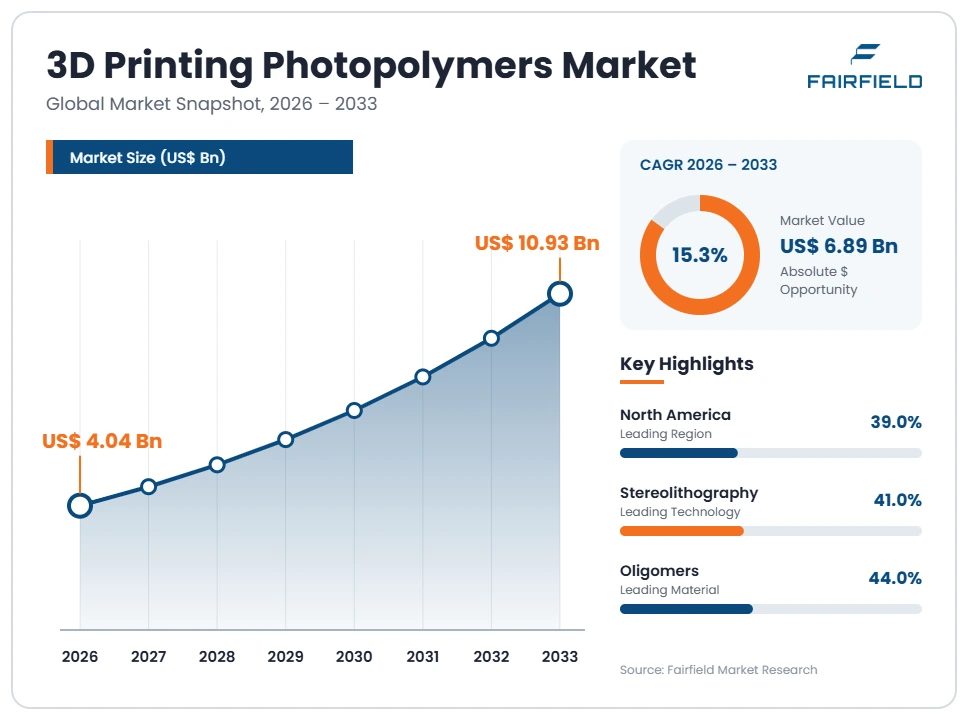
The global 3D printing photopolymers market size is expected to be valued at US$ 4.04 billion in 2026 and projected to reach US$ 10.93 billion by 2033, growing at a CAGR of 15.3% between 2026 and 2033.
Between 2020 and 2025, the market grew at a CAGR of about 14.1%, as dental labs and clinics moved to digital workflows, engineers used resin printers for fast prototyping, and desktop printers made high-resolution printing affordable for small businesses. 3D printing photopolymers are liquid photopolymer resins that harden when exposed to ultraviolet or visible light, layer by layer, in stereolithography, digital light processing, and material jetting printers. Three factors now drive growth: rapid adoption of dental 3D printing for aligners, crowns, dentures, and surgical guides, the shift from prototyping to end-use parts in automotive, aerospace, and consumer goods, and new tough, heat-resistant, and biocompatible resins. The market is shifting toward engineering-grade UV-curable materials that match common thermoplastics, open material platforms, and faster printers. In November 2025, Formlabs launched new Tough resins designed to match the performance of HDPE, polypropylene, and ABS.
Key Report Takeaways
- By Technology: Stereolithography held 41.0% share in 2026, while Digital Light Processing is projected to expand at a 17.6% CAGR through 2033, driven by faster full-layer curing, lower printer costs, and production use in dental labs.
- By Material: Oligomers held 44.0% share in 2026, while Monomers are projected to expand at a 16.4% CAGR through 2033, driven by low-viscosity formulations for faster printing and tough, flexible engineering resins.
- By Application: Dental held 28.0% share in 2026, while Medical Devices are projected to expand at a 17.0% CAGR through 2033, driven by surgical guides, anatomical models, hearing aids, and biocompatible device components.
- By Region: North America held 39.0% share in 2026, while Asia Pacific is projected to expand at a 17.2% CAGR through 2033, driven by manufacturing, dental demand, and local resin producers in China, India, Japan, and South Korea.
Global 3D Printing Photopolymers Market Trends and Insights
Drivers Impact Analysis
Two drivers carry the strongest influence on 3D printing photopolymers demand during the forecast period.
| Driver | Impact on CAGR Forecast | Geographic Relevance | Impact Timeline |
| Digital dentistry and medical applications | High | North America, Europe, Asia Pacific | Long term (≥4 years) |
| Shift to end-use production parts | High | Global | Medium term (2–4 years) |
Digital Dentistry Is Driving the 3D Printing Photopolymers Market
Digital dentistry and medical applications are the strongest driver of the 3D printing photopolymers market. Dental labs and clinics are now among the largest users of resin printers.
The mechanism is the replacement of manual dental work with digital workflows. Intraoral scanners capture a patient’s teeth, software designs the device, and resin printers produce models, aligner molds, crowns, bridges, dentures, night guards, and surgical guides in hours. Clear aligner companies print millions of models each year. Biocompatible resins cleared by regulators, such as Formlabs’ dental materials, allow printed parts to be used directly in the mouth. Hospitals print patient-specific anatomical models and surgical guides for complex operations. Hearing aid makers print custom shells. Each printed part consumes resin, so growth in the installed base of printers drives steady, recurring material sales. Dental 3D printing is expanding fastest in clinics that now print in-house.
End-Use Production Is Expanding the 3D Printing Photopolymers Market
The shift from prototyping to end-use production is expanding the 3D printing photopolymers market. Resins are now strong enough for real products.
The cause is major advances in material performance. Early photopolymer resins were brittle and suited only for visual prototypes, but new formulations offer toughness, heat resistance, flexibility, flame retardancy, and long-term stability. Carbon’s Digital Light Synthesis is used for production parts such as shoe midsoles, bike saddles, and automotive components. Stratasys, 3D Systems, and Henkel sell engineering resins for jigs, fixtures, connectors, and housings. Chemical companies such as Arkema, BASF, and Evonik supply specialty oligomers and monomers. Short runs, custom parts, and complex shapes make 3D printing cheaper than molding for many uses. These trends increase resin volumes per customer and per printer each year.
Restraints Impact Analysis
Two restraints limit how quickly the 3D printing photopolymers market grows.
| Restraint | Impact on CAGR Forecast | Geographic Relevance | Impact Timeline |
| High resin costs and limited material properties | Medium | Global | Medium term (2–4 years) |
| Health, safety, and sustainability concerns | Medium | Europe, North America | Long term (≥4 years) |
High Resin Costs Slow the 3D Printing Photopolymers Market
High resin costs and limits in material properties slow the 3D printing photopolymers market. Resins remain expensive compared with molding plastics.
The specific causes are specialty chemistry and closed ecosystems. Engineering and medical resins can cost many times more per kilogram than injection-molding plastics, which limits use for large volumes. Some printer makers lock users into their own materials, which keeps prices high. Many resins still lose strength over time, yellow under sunlight, or soften at high temperatures. Post-processing steps, such as washing and curing, add labor and cost. Part size is limited by printer build volumes. Industrial customers need long-term data on durability before replacing proven materials. These factors slow adoption for high-volume production. Supply chain teams also worry about depending on a single resin supplier for critical parts.
Safety Concerns Restrict the 3D Printing Photopolymers Market
Health, safety, and sustainability concerns restrict the 3D printing photopolymers market. Uncured resins require careful handling.
The underlying causes are chemical hazards and waste. Liquid acrylate resins can irritate skin and cause allergies, and fumes require good ventilation, which is a concern for schools, small offices, and home users. Washing printed parts generates solvent waste, usually isopropyl alcohol, that must be disposed of safely. Cured resins are thermosets that cannot be melted and recycled like many plastics. Chemical regulations in Europe restrict some substances used in formulations. Customers increasingly ask for bio-based and lower-hazard resins. These issues add costs for makers and users. Printer makers are responding with sealed resin cartridges, automated wash and cure stations, and clearer safety data sheets that reduce handling risks. Some companies now offer take-back programs for empty cartridges.
Market Opportunities
High-Performance Engineering Resins Open a Fast-Growth Revenue Pool
High-performance engineering resins open a fast-growth revenue pool in the 3D printing photopolymers market. Manufacturers want printed parts that behave like molded plastics.
Resin makers and printer companies can capture this opportunity. New tough, heat-resistant, flame-retardant, and elastomeric resins allow printed parts to replace molded components in automotive, aerospace, electronics, and consumer goods. Formlabs launched resins matched to HDPE, polypropylene, and ABS in November 2025. Ceramic-filled and conductive resins serve specialized parts. Open material platforms let chemical companies sell directly to printer users. Certification for aerospace and medical use adds value. Companies that offer reliable, well-documented materials can charge premium prices and win production contracts. Automotive and aerospace buyers need full material data sheets, flammability ratings, and long-term aging data before approving parts.
Bio-Based and Low-Hazard Resins Create a Sustainability Revenue Pool
Bio-based and low-hazard resins create a sustainability revenue pool in the 3D printing photopolymers market. Customers want safer, greener materials.
Specialty chemical companies can capture this opportunity. Resins made from plant-based raw materials, such as soybean oil and other renewable sources, reduce reliance on petroleum. Water-washable resins reduce solvent use. Low-odor and low-irritation formulations suit schools, offices, and clinics. Recycling methods for cured resin parts are being researched. Eco-labels and safety certifications help brands stand out. Companies that combine performance with safety and sustainability can win customers in Europe and among large brands with environmental targets. Dental and medical users also prefer low-odor, low-irritation resins for clinic environments. Life-cycle data showing lower carbon footprints can help resin suppliers win procurement tenders.
Segment Analysis
- By Technology: Stereolithography Leads While Digital Light Processing Grows Fastest
Stereolithography held 41.0% share in 2026. Stereolithography uses a laser to cure resin point by point, delivering high accuracy and smooth surfaces. Formlabs and 3D Systems have large installed bases of SLA printers in dental labs, engineering firms, and schools.
Digital Light Processing is the fastest-growing technology, expanding at a 17.6% CAGR through 2033. Digital light processing cures a whole layer at once with a projector or screen, making printing faster and printers cheaper. Masked SLA using LCD screens has made resin printing affordable for small businesses, hobbyists, and schools. Material jetting and continuous liquid interface printing serve specific industrial uses. For the market, DLP growth increases resin throughput per printer and lowers the cost per part.
- By Material: Oligomers Lead While Monomers Grow Fastest
Oligomers held 44.0% share in 2026. Oligomers, such as urethane acrylates and epoxy acrylates, form the backbone of photopolymer resins and determine strength, toughness, and flexibility. Arkema through Sartomer, Allnex, and Miwon are major suppliers.
Monomers are the fastest-growing material, expanding at a 16.4% CAGR through 2033. Monomers reduce resin viscosity, speed up printing, and tune final properties, which is essential for fast DLP and engineering resins. Photoinitiators and additives make up the rest of formulations. For the market, monomer growth supports faster and more capable UV-curable materials. Formulators blend oligomers, monomers, and photoinitiators in different ratios to tune hardness, elongation, color, and biocompatibility for each application. Specialty photoinitiators that work with visible light are growing with LCD printers.
- By Application: Dental Leads While Medical Devices Grow Fastest
Dental held 28.0% share in 2026. Dental 3D printing of models, aligner molds, crowns, dentures, and guides is the largest single use of resins. Clear aligner production consumes large volumes.
Medical Devices is the fastest-growing application, expanding at a 17.0% CAGR through 2033. Hospitals and device makers print surgical guides, anatomical models, hearing aid shells, and device parts with biocompatible resins. Automotive, aerospace, consumer goods, jewelry, and education are other applications. For the market, medical growth adds high-value, regulated materials. Automotive users print jigs, fixtures, connectors, and interior parts, while aerospace companies print ducting, brackets, and cabin components with flame-retardant resins. Jewelry makers use castable resins to produce detailed patterns for metal casting, and schools buy desktop printers for STEM education.
Geography Analysis
- Which Region Is Leading the 3D Printing Photopolymers Market?
North America is leading the 3D printing photopolymers market with a 39.0% share in 2026. The United States has a large dental industry, many clear aligner producers, strong aerospace and medical device sectors, and leading companies such as Formlabs, 3D Systems, and Carbon. Stratasys has major operations in the region. Canada adds dental and engineering demand. Clear aligner makers run large print farms that consume high volumes of resin. Key barriers include high resin costs and competition from low-cost imports. One change shaping the region is in-office dental printing, as dentists print models, guides, and temporary crowns while patients wait.
- Europe Builds the 3D Printing Photopolymers Market Through Chemical Expertise
Europe is a major 3D printing photopolymers market. Germany, France, the United Kingdom, Italy, and the Netherlands have strong dental, automotive, and industrial sectors. Henkel and Evonik in Germany, Arkema in France, and Photocentric in the United Kingdom are key players. Germany has a strong base of dental labs and automotive suppliers that use resin printers for tooling and parts. Research institutes in Europe develop ceramic, bio-based, and high-temperature resins. Key barriers include strict chemical regulations under REACH and high energy costs for producers. One opportunity is sustainable resins that meet European environmental rules and brand targets.
- Which Region Is Growing Fastest in the 3D Printing Photopolymers Market?
Asia Pacific is growing fastest in the 3D printing photopolymers market at a 17.2% CAGR through 2033. China has many low-cost resin printer makers and resin producers, and its dental and manufacturing sectors are expanding. Japan and South Korea have strong electronics and dental industries, and India is adopting digital dentistry. Australia has growing dental and education use. Large populations and rising incomes are increasing demand for aligners and crowns. Key barriers include price competition and quality differences among low-cost brands. One change shaping the region is local resin production, which lowers costs and shortens supply chains for users across the region.
- Latin America Grows the 3D Printing Photopolymers Market Through Dental Adoption
Latin America is a growing 3D printing photopolymers market. Brazil and Mexico have large dental markets, many dental schools, and growing aligner use, while Argentina and Colombia are adopting desktop printers. Dental schools and labs in Brazil are investing in digital workflows, and clear aligner brands are expanding across the region. Engineering firms, jewelry makers, and universities use resin printers for prototyping and casting. Distribution partners help printer brands reach smaller cities. Key barriers include import costs, currency swings, and limited local technical support. One opportunity is dental labs moving from manual work to digital production with affordable printers and resins.
- Middle East & Africa Expands the 3D Printing Photopolymers Market Through Healthcare Investment
Middle East & Africa is an emerging 3D printing photopolymers market. The United Arab Emirates and Saudi Arabia invest in 3D printing for healthcare and construction, and Israel hosts Stratasys and a strong additive manufacturing research community. Hospitals in the United Arab Emirates use printed anatomical models to plan complex surgeries, and dental clinics in Saudi Arabia are adopting digital workflows. South Africa has a growing dental and engineering user base. Universities across the region are adding 3D printing labs. Key barriers include limited distribution and high prices for imported resins. One opportunity is hospitals and dental chains investing in digital care.
Competitive Landscape
The 3D printing photopolymers market is moderately concentrated. Stratasys, 3D Systems, Formlabs, and Carbon sell printers with their own resin portfolios, while Henkel, Arkema, BASF, and Evonik supply materials and raw ingredients. Keystone Industries, Photocentric, Liqcreate, and many Chinese brands serve dental and desktop users.
Companies compete on material performance, printer compatibility, certifications, price, and technical support. Printer makers earn recurring revenue from resin sales, similar to a razor-and-blade model. Chemical companies supply raw materials to many brands and increasingly sell finished resins through open material programs. Low-cost Chinese resin brands compete strongly in desktop markets. Dental specialists focus on biocompatible, regulator-cleared products and validated workflows with leading scanners and design software. Partnerships between printer makers and chemical companies speed new material launches.
Strategic moves show how competition is changing. In April 2024, Formlabs received FDA clearance for its Dental LT Clear V2 resin. In March 2024, BASF introduced a high-temperature photopolymer resin. In November 2025, Formlabs launched new Tough resins matched to thermoplastics. These moves show competition shifting toward performance materials, regulatory clearances, and resins that can replace molded thermoplastics in real products rather than only prototypes.
Three themes shape vendor strategy. First, companies are developing engineering resins. Second, they are pursuing medical and dental certifications. Third, they are opening platforms to third-party materials. Vendors that combine reliable printers, certified materials, and strong application support are best placed to win share.
Recent Industry Developments
- November 2025: Formlabs launched Tough 1000 and upgraded Tough 2000 resins, designed to match HDPE and ABS, along with a faster large-format curing unit – pushes photopolymer resins into end-use parts.
- April 2024: Formlabs received U.S. Food and Drug Administration clearance for its Dental LT Clear V2 resin – supports dental 3D printing of devices used in the mouth.
- March 2024: BASF introduced Ultracur3D HT, a heat-resistant photopolymer resin for automotive and aerospace uses – expands high-temperature applications.
Companies Covered in the Report
- Stratasys
- 3D Systems
- Formlabs
- Henkel
- Arkema
- BASF
- Evonik Industries
- Carbon
- Keystone Industries
- Photocentric
- Liqcreate
- Shenzhen Esun Industrial
3D Printing Photopolymers Market Report Scope
| Metric | Value |
| Study Period | 2020–2033 |
| Market Size 2026 | US$ 4.04 Billion |
| Market Size 2033 | US$ 10.93 Billion |
| CAGR 2026–2033 | 15.3% |
| Absolute Dollar Opportunity | US$ 6.89 Billion |
| Largest Market | North America |
| Fastest-Growing Market | Asia Pacific |
| Market Concentration | Moderate |
| Major Players | Stratasys, 3D Systems, Formlabs, Henkel, Arkema |
3D Printing Photopolymers Market Segmentation
Technology
- Stereolithography
- Digital Light Processing
- Material Jetting
- Others
Material
- Oligomers
- Monomers
- Photoinitiators
- Additives
Application
- Dental
- Medical Devices
- Automotive
- Aerospace
- Consumer Goods
- Jewelry
- Others
Regions
- North America
- Europe
- Asia Pacific
- Latin America
- Middle East & Africa
- Executive Summary
- Global 3D Printing Photopolymers Market Snapshot
- Future Projections
- Key Report Takeaways
- Regional Snapshot
- Market Overview
- Market Definition and Report Scope
- Historical Trends 2020–2025
- Market Dynamics
- Drivers
- Digital Dentistry Is Driving the 3D Printing Photopolymers Market
- End-Use Production Is Expanding the 3D Printing Photopolymers Market
- Restraints
- High Resin Costs Slow the 3D Printing Photopolymers Market
- Safety Concerns Restrict the 3D Printing Photopolymers Market
- Market Opportunities
- High-Performance Engineering Resins Open a Fast-Growth Revenue Pool
- Bio-Based and Low-Hazard Resins Create a Sustainability Revenue Pool
- Drivers
- Global 3D Printing Photopolymers Market Outlook, 2020-2033
- Global 3D Printing Photopolymers Market Outlook, by Technology, Value (US$ Billion), 2020-2033
- Stereolithography
- Digital Light Processing
- Material Jetting
- Others
- Global 3D Printing Photopolymers Market Outlook, by Material, Value (US$ Billion), 2020-2033
- Oligomers
- Monomers
- Photoinitiators
- Additives
- Global 3D Printing Photopolymers Market Outlook, by Application, Value (US$ Billion), 2020-2033
- Dental
- Medical Devices
- Automotive
- Aerospace
- Consumer Goods
- Jewelry
- Others
- Global 3D Printing Photopolymers Market Outlook, by Region, Value (US$ Billion), 2020-2033
- North America
- Europe
- Asia Pacific
- Latin America
- Middle East & Africa
- Global 3D Printing Photopolymers Market Outlook, by Technology, Value (US$ Billion), 2020-2033
- North America 3D Printing Photopolymers Market Outlook, 2020-2033
- North America 3D Printing Photopolymers Market Outlook, by Technology, Value (US$ Billion), 2020-2033
- Stereolithography
- Digital Light Processing
- Material Jetting
- Others
- North America 3D Printing Photopolymers Market Outlook, by Material, Value (US$ Billion), 2020-2033
- Oligomers
- Monomers
- Photoinitiators
- Additives
- North America 3D Printing Photopolymers Market Outlook, by Application, Value (US$ Billion), 2020-2033
- Dental
- Medical Devices
- Automotive
- Aerospace
- Consumer Goods
- Jewelry
- Others
- North America 3D Printing Photopolymers Market Outlook, by Country, Value (US$ Billion), 2020-2033
- United States 3D Printing Photopolymers Market Outlook, by Technology, 2020-2033
- United States 3D Printing Photopolymers Market Outlook, by Material, 2020-2033
- United States 3D Printing Photopolymers Market Outlook, by Application, 2020-2033
- Canada 3D Printing Photopolymers Market Outlook, by Technology, 2020-2033
- Canada 3D Printing Photopolymers Market Outlook, by Material, 2020-2033
- Canada 3D Printing Photopolymers Market Outlook, by Application, 2020-2033
- North America 3D Printing Photopolymers Market Outlook, by Technology, Value (US$ Billion), 2020-2033
- Europe 3D Printing Photopolymers Market Outlook, 2020-2033
- Europe 3D Printing Photopolymers Market Outlook, by Technology, Value (US$ Billion), 2020-2033
- Stereolithography
- Digital Light Processing
- Material Jetting
- Others
- Europe 3D Printing Photopolymers Market Outlook, by Material, Value (US$ Billion), 2020-2033
- Oligomers
- Monomers
- Photoinitiators
- Additives
- Europe 3D Printing Photopolymers Market Outlook, by Application, Value (US$ Billion), 2020-2033
- Dental
- Medical Devices
- Automotive
- Aerospace
- Consumer Goods
- Jewelry
- Others
- Europe 3D Printing Photopolymers Market Outlook, by Country, Value (US$ Billion), 2020-2033
- Germany 3D Printing Photopolymers Market Outlook, by Technology, 2020-2033
- Germany 3D Printing Photopolymers Market Outlook, by Material, 2020-2033
- Germany 3D Printing Photopolymers Market Outlook, by Application, 2020-2033
- France 3D Printing Photopolymers Market Outlook, by Technology, 2020-2033
- France 3D Printing Photopolymers Market Outlook, by Material, 2020-2033
- France 3D Printing Photopolymers Market Outlook, by Application, 2020-2033
- United Kingdom 3D Printing Photopolymers Market Outlook, by Technology, 2020-2033
- United Kingdom 3D Printing Photopolymers Market Outlook, by Material, 2020-2033
- United Kingdom 3D Printing Photopolymers Market Outlook, by Application, 2020-2033
- Italy 3D Printing Photopolymers Market Outlook, by Technology, 2020-2033
- Italy 3D Printing Photopolymers Market Outlook, by Material, 2020-2033
- Italy 3D Printing Photopolymers Market Outlook, by Application, 2020-2033
- Netherlands 3D Printing Photopolymers Market Outlook, by Technology, 2020-2033
- Netherlands 3D Printing Photopolymers Market Outlook, by Material, 2020-2033
- Netherlands 3D Printing Photopolymers Market Outlook, by Application, 2020-2033
- Europe 3D Printing Photopolymers Market Outlook, by Technology, Value (US$ Billion), 2020-2033
- Asia Pacific 3D Printing Photopolymers Market Outlook, 2020-2033
- Asia Pacific 3D Printing Photopolymers Market Outlook, by Technology, Value (US$ Billion), 2020-2033
- Stereolithography
- Digital Light Processing
- Material Jetting
- Others
- Asia Pacific 3D Printing Photopolymers Market Outlook, by Material, Value (US$ Billion), 2020-2033
- Oligomers
- Monomers
- Photoinitiators
- Additives
- Asia Pacific 3D Printing Photopolymers Market Outlook, by Application, Value (US$ Billion), 2020-2033
- Dental
- Medical Devices
- Automotive
- Aerospace
- Consumer Goods
- Jewelry
- Others
- Asia Pacific 3D Printing Photopolymers Market Outlook, by Country, Value (US$ Billion), 2020-2033
- China 3D Printing Photopolymers Market Outlook, by Technology, 2020-2033
- China 3D Printing Photopolymers Market Outlook, by Material, 2020-2033
- China 3D Printing Photopolymers Market Outlook, by Application, 2020-2033
- Japan 3D Printing Photopolymers Market Outlook, by Technology, 2020-2033
- Japan 3D Printing Photopolymers Market Outlook, by Material, 2020-2033
- Japan 3D Printing Photopolymers Market Outlook, by Application, 2020-2033
- South Korea 3D Printing Photopolymers Market Outlook, by Technology, 2020-2033
- South Korea 3D Printing Photopolymers Market Outlook, by Material, 2020-2033
- South Korea 3D Printing Photopolymers Market Outlook, by Application, 2020-2033
- India 3D Printing Photopolymers Market Outlook, by Technology, 2020-2033
- India 3D Printing Photopolymers Market Outlook, by Material, 2020-2033
- India 3D Printing Photopolymers Market Outlook, by Application, 2020-2033
- Australia 3D Printing Photopolymers Market Outlook, by Technology, 2020-2033
- Australia 3D Printing Photopolymers Market Outlook, by Material, 2020-2033
- Australia 3D Printing Photopolymers Market Outlook, by Application, 2020-2033
- Asia Pacific 3D Printing Photopolymers Market Outlook, by Technology, Value (US$ Billion), 2020-2033
- Latin America 3D Printing Photopolymers Market Outlook, 2020-2033
- Latin America 3D Printing Photopolymers Market Outlook, by Technology, Value (US$ Billion), 2020-2033
- Stereolithography
- Digital Light Processing
- Material Jetting
- Others
- Latin America 3D Printing Photopolymers Market Outlook, by Material, Value (US$ Billion), 2020-2033
- Oligomers
- Monomers
- Photoinitiators
- Additives
- Latin America 3D Printing Photopolymers Market Outlook, by Application, Value (US$ Billion), 2020-2033
- Dental
- Medical Devices
- Automotive
- Aerospace
- Consumer Goods
- Jewelry
- Others
- Latin America 3D Printing Photopolymers Market Outlook, by Country, Value (US$ Billion), 2020-2033
- Brazil 3D Printing Photopolymers Market Outlook, by Technology, 2020-2033
- Brazil 3D Printing Photopolymers Market Outlook, by Material, 2020-2033
- Brazil 3D Printing Photopolymers Market Outlook, by Application, 2020-2033
- Mexico 3D Printing Photopolymers Market Outlook, by Technology, 2020-2033
- Mexico 3D Printing Photopolymers Market Outlook, by Material, 2020-2033
- Mexico 3D Printing Photopolymers Market Outlook, by Application, 2020-2033
- Argentina 3D Printing Photopolymers Market Outlook, by Technology, 2020-2033
- Argentina 3D Printing Photopolymers Market Outlook, by Material, 2020-2033
- Argentina 3D Printing Photopolymers Market Outlook, by Application, 2020-2033
- Colombia 3D Printing Photopolymers Market Outlook, by Technology, 2020-2033
- Colombia 3D Printing Photopolymers Market Outlook, by Material, 2020-2033
- Colombia 3D Printing Photopolymers Market Outlook, by Application, 2020-2033
- Latin America 3D Printing Photopolymers Market Outlook, by Technology, Value (US$ Billion), 2020-2033
- Middle East & Africa 3D Printing Photopolymers Market Outlook, 2020-2033
- Middle East & Africa 3D Printing Photopolymers Market Outlook, by Technology, Value (US$ Billion), 2020-2033
- Stereolithography
- Digital Light Processing
- Material Jetting
- Others
- Middle East & Africa 3D Printing Photopolymers Market Outlook, by Material, Value (US$ Billion), 2020-2033
- Oligomers
- Monomers
- Photoinitiators
- Additives
- Middle East & Africa 3D Printing Photopolymers Market Outlook, by Application, Value (US$ Billion), 2020-2033
- Dental
- Medical Devices
- Automotive
- Aerospace
- Consumer Goods
- Jewelry
- Others
- Middle East & Africa 3D Printing Photopolymers Market Outlook, by Country, Value (US$ Billion), 2020-2033
- United Arab Emirates 3D Printing Photopolymers Market Outlook, by Technology, 2020-2033
- United Arab Emirates 3D Printing Photopolymers Market Outlook, by Material, 2020-2033
- United Arab Emirates 3D Printing Photopolymers Market Outlook, by Application, 2020-2033
- Saudi Arabia 3D Printing Photopolymers Market Outlook, by Technology, 2020-2033
- Saudi Arabia 3D Printing Photopolymers Market Outlook, by Material, 2020-2033
- Saudi Arabia 3D Printing Photopolymers Market Outlook, by Application, 2020-2033
- Israel 3D Printing Photopolymers Market Outlook, by Technology, 2020-2033
- Israel 3D Printing Photopolymers Market Outlook, by Material, 2020-2033
- Israel 3D Printing Photopolymers Market Outlook, by Application, 2020-2033
- South Africa 3D Printing Photopolymers Market Outlook, by Technology, 2020-2033
- South Africa 3D Printing Photopolymers Market Outlook, by Material, 2020-2033
- South Africa 3D Printing Photopolymers Market Outlook, by Application, 2020-2033
- Middle East & Africa 3D Printing Photopolymers Market Outlook, by Technology, Value (US$ Billion), 2020-2033
- Competitive Landscape
- Market Concentration and Industry Leaders
- Competitive Differentiation
- Strategic Moves and Market Direction
- Recent Industry Developments
- Company Profiles
- Stratasys
- 3D Systems
- Formlabs
- Henkel
- Arkema
- BASF
- Evonik Industries
- Carbon
- Keystone Industries
- Photocentric
- Liqcreate
- Shenzhen Esun Industrial
- Appendix
- Research Methodology
- Report Assumptions
- Acronyms and Abbreviations
Technology
- Stereolithography
- Digital Light Processing
- Material Jetting
- Others
Material
- Oligomers
- Monomers
- Photoinitiators
- Additives
Application
- Dental
- Medical Devices
- Automotive
- Aerospace
- Consumer Goods
- Jewelry
- Others
Regions
- North America
- Europe
- Asia Pacific
- Latin America
- Middle East & Africa
Our Research Methodology
Considering the volatility of business today, traditional approaches to strategizing a game plan can be unfruitful if not detrimental. True ambiguity is no way to determine a forecast. A myriad of predetermined factors must be accounted for such as the degree of risk involved, the magnitude of circumstances, as well as conditions or consequences that are not known or unpredictable. To circumvent binary views that cast uncertainty, the application of market research intelligence to strategically posture, move, and enable actionable outcomes is necessary.
View Methodology
Quality Assured
Rigorous Validation Process

Confidentiality Assured
End-to-end Data Security

Custom Research Services
Tailored To Your Objectives
FAQs
The 3D printing photopolymers market is valued at US$ 4.04 billion in 2026, led by stereolithography and North America.
The market is projected to reach US$ 10.93 billion by 2033, growing at a 15.3% CAGR and adding US$ 6.89 billion.
Medical devices is growing fastest at a 17.0% CAGR through 2033, driven by surgical guides, anatomical models, and hearing aid shells.
Asia Pacific is growing fastest at a 17.2% CAGR through 2033, driven by manufacturing and dental demand in China and India.
North America holds the largest share at 39.0% in 2026, supported by strong dental, aerospace, and medical device industries.
Related Reports
Ultra high Molecular Weight Polyethylene Market Size, Share, Insights, Competitive Landscape, and Forecast 2026 to 2033
Explore the UHMWPE market, forecast to reach US$4.8 billion by 2033 at 7.5% CAGR, with insights into grades, applications, regions and leading companies.
Steel Drums & IBCs Market Size, Share, Insights, Competitive Landscape, and Forecast 2026 to 2033
Explore the steel drums & IBCs market, projected to reach US$29.8 billion by 2033 at 4.8% CAGR, with segment, regional and competitive insights.
Semiconductor Gases Market Size, Share, Insights, Competitive Landscape, and Forecast 2026 to 2033
The semiconductor gases market is projected to grow from US$9.6 billion in 2026 to US$16.8 billion by 2033, at an 8.3% CAGR. Explore segments and trends.
Non-load Bearing Walls Market Size, Share, Insights, Competitive Landscape, and Forecast 2026 to 2033
The non-load bearing walls market is projected to grow from US$96.0 billion in 2026 to US$136.0 billion by 2033, at a 5.1% CAGR. Explore key trends.
Nanoparticle Technology Market Size, Share, Insights, Competitive Landscape, and Forecast 2026 to 2033
The nanoparticle technology market is projected to grow from US$24.0 billion in 2026 to US$48.0 billion by 2033, at a 10.4% CAGR. Explore key trends.
Expanded PTFE (ePTFE) Market Size, Share, Insights, Competitive Landscape, and Forecast 2026 to 2033
The expanded PTFE market is projected to grow from US$2.4 billion in 2026 to US$3.8 billion by 2033, at a 6.8% CAGR. Explore segments and regional trends.