



Abaca Fiber Market
Abaca Fiber Market Size, Share, Insights, Competitive Landscape, and Forecast 2026 to 2033
Abaca Fiber Market Size and Trend Analysis
How Fast Is the Abaca Fiber Market Growing?
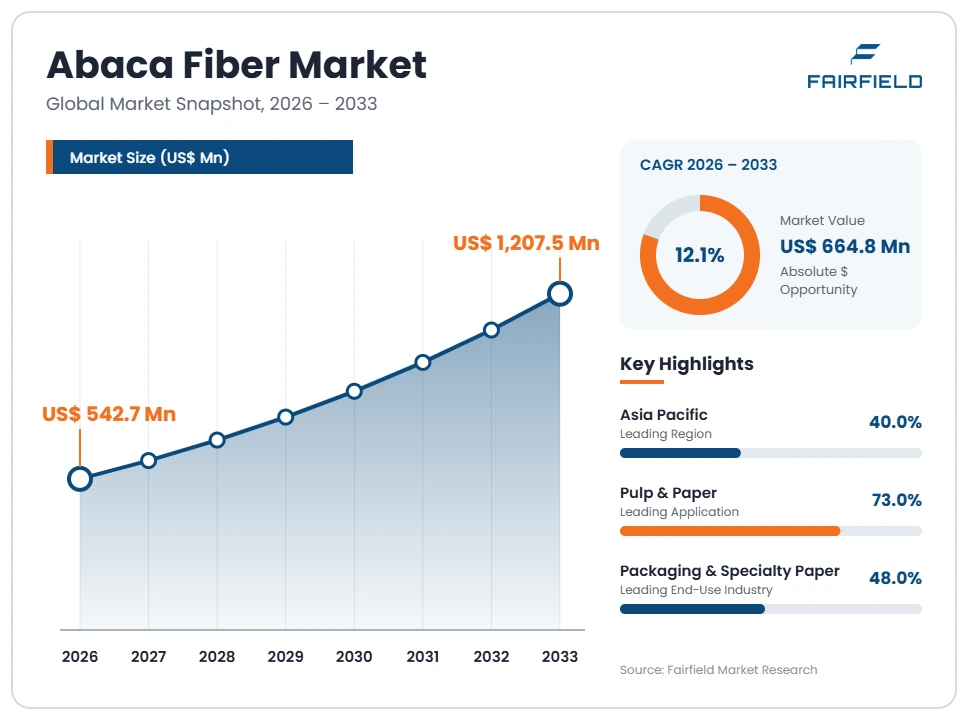
The global abaca fiber market size is expected to be valued at US$ 542.7 million in 2026 and projected to reach US$ 1,207.5 million by 2033, growing at a CAGR of 12.1% between 2026 and 2033.
Between 2020 and 2025, the market grew at a CAGR of about 9.8%, as demand for strong, biodegradable fibers rose in tea bags, coffee filters, medical papers, and packaging, while plant disease and typhoons limited supply in the Philippines. Abaca, also called Manila hemp, is a natural fiber taken from the leaf stalks of a banana-family plant native to the Philippines. It is among the strongest natural fibers and resists saltwater. Three factors now drive growth: demand for specialty paper products such as tea bags, filters, currency paper, and cigarette papers made from abaca pulp, the shift away from plastics toward natural materials, and use in automotive composites, textiles, and crafts. The market is shifting toward higher-value pulp and fabrics, traceable and fair-trade supply, and new uses in fashion. In May 2026, the Philippine Fiber Industry Development Authority reported abaca exports of 76,961 metric tons, noting that the country supplies about 87% of the world’s abaca.
Key Report Takeaways
- By Application: Pulp & Paper held 73.0% share in 2026, while Cordage is projected to expand at a 12.8% CAGR through 2033, driven by demand for strong, saltwater-resistant natural fiber ropes in marine and fishing uses.
- By End-Use Industry: Packaging & Specialty Paper held 48.0% share in 2026, while Automotive is projected to expand at a 14.5% CAGR through 2033, driven by lightweight, biodegradable composite parts for vehicle interiors.
- By Producing Country: The Philippines held 87.0% share of supply in 2026, while Ecuador is projected to expand at a 13.5% CAGR through 2033, driven by plantation investment and exports to Europe and Japan.
- By Region: Asia Pacific held 40.0% share in 2026, while China is projected to expand at a 16.4% CAGR through 2033, driven by specialty paper, tea bag, and textile manufacturing.
Global Abaca Fiber Market Trends and Insights
Drivers Impact Analysis
Two drivers carry the strongest influence on abaca fiber demand during the forecast period.
| Driver | Impact on CAGR Forecast | Geographic Relevance | Impact Timeline |
| Specialty paper and filter demand | High | Global | Long term (≥4 years) |
| Shift from plastics to natural fibers | High | Europe, North America, Asia Pacific | Long term (≥4 years) |
Specialty Paper Demand Is Driving the Abaca Fiber Market
Demand for specialty paper is the strongest driver of the abaca fiber market. Abaca pulp gives paper unique strength and porosity.
The mechanism is abaca’s special physical properties. Its long fibers make thin papers that stay strong when wet, which is essential for tea bags, coffee pods, sausage casings, vacuum cleaner bags, and medical filters. Currency papers, security papers, and cigarette papers also use abaca pulp. Specialty paper makers in Japan, Germany, the United Kingdom, and the United States buy most of the world’s abaca pulp. Pulp accounted for about US$ 71.6 million of Philippine abaca exports in just the first five months of 2025. Rising coffee and tea consumption in Asia Pacific and premium single-serve products increase demand. These uses have few substitutes with the same performance, which keeps demand steady and prices firm.
Plastic Replacement Is Expanding the Abaca Fiber Market
The shift from plastics to natural fibers is expanding the abaca fiber market. Brands and governments want biodegradable materials.
The cause is environmental concern and regulation. Bans on single-use plastics in Europe, India, and other places push makers of filters, bags, and packaging toward natural fibers. Car makers use natural fiber composites to cut vehicle weight and carbon emissions, and abaca has been used in interior parts by several automakers. Fashion brands are adopting abaca fabrics; Bananatex, a Swiss textile brand, launched a biodegradable abaca jersey fabric in February 2024. Rope and cordage made from abaca replace synthetic lines in some marine uses. Crafts, furniture, and home goods made from abaca appeal to eco-conscious shoppers. These trends broaden demand beyond paper.
Restraints Impact Analysis
Two restraints limit how quickly the abaca fiber market grows.
| Restraint | Impact on CAGR Forecast | Geographic Relevance | Impact Timeline |
| Supply concentration, disease, and typhoons | High | Asia Pacific | Long term (≥4 years) |
| Labor-intensive processing and low farmer incomes | Medium | Asia Pacific, Latin America | Medium term (2–4 years) |
Supply Risks Slow the Abaca Fiber Market
Supply concentration, plant disease, and typhoons slow the abaca fiber market. Most of the world’s abaca comes from one country.
The specific causes are geographic concentration and crop threats. The Philippines supplies about 87% of global abaca, mainly from Bicol, Eastern Visayas, and Mindanao, with Ecuador supplying most of the rest. Typhoons regularly damage plantations in the Philippines. Viral diseases such as abaca bunchy top and mosaic have destroyed large areas of farms. The Philippine Fiber Industry Development Authority has launched programs to reverse falling production. Supply shortages cause price spikes that worry buyers. Replanting takes time, and farmers may switch to other crops. These risks make supply uncertain. Buyers often hold larger inventories or sign long-term contracts to protect themselves, and some are funding farmer programs to secure future supply.
Labor-Intensive Processing Restricts the Abaca Fiber Market
Labor-intensive processing and low farmer incomes restrict the abaca fiber market. Much abaca is still stripped by hand.
The underlying causes are traditional methods and weak value capture. Farmers cut stalks, strip fiber manually or with simple machines, and sun-dry it, which is hard work and limits output. Young people are leaving farming for city jobs. The Philippines supplies most of the world’s abaca but captures only about 10% of the industry’s global revenues, as most value is added abroad. Small farmers lack access to credit, quality planting materials, and modern equipment. Grading and fiber quality can vary widely. These factors limit production growth. Government agencies and private buyers are now distributing improved stripping machines, disease-free planting materials, and training to raise both yields and fiber quality.
Market Opportunities
Abaca Composites and Textiles Open a Fast-Growth Revenue Pool
Abaca composites and textiles open a fast-growth revenue pool in the abaca fiber market. New uses can add value beyond pulp.
Material developers and brands can capture this opportunity. Automotive and construction companies are testing abaca-reinforced composites as lighter, greener alternatives to glass fiber. Fashion and accessory brands use abaca fabrics for bags, shoes, and clothing, with Bananatex a leading example. Interior designers use abaca in furniture, rugs, lamps, and wall panels. Abaca nonwovens can replace synthetic fibers in hygiene, wipes, and medical products. Higher-value uses pay farmers and processors much more per kilogram than raw fiber sold for pulp. Companies that develop consistent, certified materials can win brand partnerships. Traceability tools that link products back to farming communities appeal to brands with social and environmental goals.
Domestic Processing and Mechanization Create a Value-Addition Revenue Pool
Domestic processing and mechanization create a value-addition revenue pool in the abaca fiber market. Producing countries want to capture more value.
Processors, governments, and equipment makers can capture this opportunity. The Philippines is investing in better stripping machines, planting materials, and disease control through government programs. Turning raw fiber into pulp, yarn, fabric, rope, and finished goods in the Philippines and Ecuador keeps more value at home. Export earnings from the Philippines rose about 24% to US$ 88.6 million in January to May 2025, showing strong demand. Fair-trade and sustainability certifications can earn premiums from European and Japanese buyers. Companies that invest in local processing can secure supply and margins. Proposed laws in the Philippines aim to support the industry with funding, research, and festivals that promote abaca products.
Segment Analysis
- By Application: Pulp & Paper Leads While Cordage Grows Fastest
Pulp & Paper held 73.0% share in 2026, by far the largest use. Abaca pulp is used for tea bags, coffee filters, currency and security paper, cigarette papers, medical papers, and other specialty paper products. Specialty Pulp Manufacturing, Terranova Papers, Celulosa de Levante, and Glatfelter are leading pulp and paper players.
Cordage is the fastest-growing application, expanding at a 12.8% CAGR through 2033. Abaca ropes and twines are strong, flexible, and resistant to saltwater, which makes them valued in shipping, fishing, and decorative uses. The United States buys more than half of Philippine abaca cordage exports. Fiber crafts, textiles, and composites are other applications. For the market, cordage growth supports raw fiber demand and farmer incomes.
- By End-Use Industry: Packaging & Specialty Paper Leads While Automotive Grows Fastest
Packaging & Specialty Paper held 48.0% share in 2026. Food and beverage filters, tea bags, coffee pods, and packaging papers are the largest end uses for abaca.
Automotive is the fastest-growing end-use industry, expanding at a 14.5% CAGR through 2033. Car makers use natural fiber composites in door panels, seat backs, and trim to reduce weight and emissions. Textiles, marine, construction, and handicrafts are other end uses. For the market, automotive growth adds new industrial demand. Textile uses include fabrics for bags, shoes, hats, and home furnishings, while marine buyers use abaca rope for mooring and fishing. Construction firms are testing abaca-reinforced boards and panels as greener building materials. Handicrafts such as baskets, mats, and décor remain important for rural incomes.
- By Producing Country: The Philippines Leads While Ecuador Grows Fastest
The Philippines held 87.0% share of supply in 2026. Abaca is grown on small farms across many provinces, with Catanduanes producing about 20% of national output in 2025. The Philippine Fiber Industry Development Authority regulates fiber grading and trade.
Ecuador is the fastest-growing producing country, expanding at a 13.5% CAGR through 2033. Larger plantations and mechanized processing in Ecuador supply pulp makers in Europe and Japan. For the market, Ecuador growth diversifies supply and reduces buyers’ reliance on a single country. Farms in Ecuador are typically larger and more mechanized, giving consistent quality, while the Philippines relies on many smallholders. Other small producers include Costa Rica and Indonesia, where trial plantings are under way.
Geography Analysis
- Why Is North America Important to the Abaca Fiber Market?
North America is a major abaca fiber market. The United States imports abaca pulp for filters, specialty papers, and currency, and is the largest buyer of Philippine abaca cordage. Glatfelter and other specialty paper makers use abaca. Coffee and tea brands buy filter papers and pods made with abaca pulp, and outdoor and marine brands sell abaca ropes. Some US cigarette makers have used abaca-based filters designed to break down faster in the environment. Key barriers include supply risks from typhoons and disease in the Philippines. One opportunity is sustainable packaging that replaces plastic films and synthetic nonwovens.
- Europe Builds the Abaca Fiber Market Through Paper and Sustainability Rules
Europe is a major abaca fiber market. The United Kingdom took about half of Philippine raw fiber exports in early 2025, and Germany, Spain, and France have specialty paper makers. Celulosa de Levante in Spain and Wilhelm G. Clasen in Germany are key industry players. Strict EU rules on single-use plastics push filter and packaging makers toward natural fibers. Fashion brands in Switzerland and the Netherlands use abaca fabrics in bags, backpacks, shoes, and clothing. Key barriers include sharp price swings and limited, concentrated supply. One opportunity is plastic replacement in filters, tea bags, and packaging.
- Which Region Is Leading the Abaca Fiber Market?
Asia Pacific is leading the abaca fiber market with a 40.0% share in 2026. The Philippines grows most abaca, Japan is a major buyer of fiber and pulp, and China is the fastest-growing country at a 16.4% CAGR through 2033. Indonesia is a growing buyer. Japan has long used abaca in specialty papers and traditional crafts, and its paper makers are among the largest buyers. Australia and South Korea import specialty papers. Key barriers include typhoons and plant disease in growing areas. One change shaping the region is local processing of pulp and fabrics in the Philippines.
- Latin America Grows the Abaca Fiber Market Through Ecuadorian Production
Latin America is a growing abaca fiber market. Ecuador is the second-largest producer and exports fiber to pulp makers in Europe, Japan, and the United States. Costa Rica has small but growing production. Larger plantations in Ecuador use mechanized decortication, which produces consistent fiber grades valued by pulp makers. Production has grown as buyers seek a second source outside the Philippines. Brazil and Colombia buy specialty papers and filters made from abaca. Key barriers include limited planting area and competition from other crops such as bananas. One opportunity is expansion of plantations and local pulp processing.
- Middle East & Africa Expands the Abaca Fiber Market Through Specialty Uses
Middle East & Africa is a small abaca fiber market. Demand comes from imported specialty papers, filters, and crafts in the United Arab Emirates, Saudi Arabia, and South Africa. Hotels, restaurants, and cafés in the United Arab Emirates and Saudi Arabia use tea bags, coffee filters, and décor products that contain abaca. Some African countries with suitable climates, such as Uganda and Kenya, have researched abaca and related banana-family fibers. Key barriers include low awareness, small volumes, and full reliance on imports. One opportunity is packaging and filters for the region’s large food service sector.
Competitive Landscape
The abaca fiber market is fragmented. Specialty Pulp Manufacturing, Terranova Papers, Celulosa de Levante, and Glatfelter lead in pulp and specialty paper, while traders such as Ching Bee Trading, Wigglesworth & Co., Tag Fibers, and Wilhelm G. Clasen connect farmers with buyers. Thousands of small farmers grow abaca, mainly on family plots of a few hectares.
Companies compete on fiber quality, grading, supply reliability, price, traceability, and sustainability certifications. Long-term supplier relationships matter, because buyers need consistent grades and reliable delivery. Pulp makers often work directly with farmer groups and traders in the Philippines and Ecuador. Fashion and composite companies are newer buyers that seek certified, traceable fiber. Government agencies set grading standards and support farmers. Prices depend heavily on harvest conditions and export demand.
Strategic moves show how competition is changing. In February 2024, Bananatex launched an abaca jersey fabric. In September 2025, data showed exports up 24% in January to May. In May 2026, the Philippine Fiber Industry Development Authority reported exports of 76,961 metric tons. These moves show competition shifting toward new uses in fashion and packaging, stronger export earnings, and greater government attention to raising supply from Philippine farms after years of falling production.
Three themes shape vendor strategy. First, companies are securing supply. Second, they are adding value through local processing. Third, they are developing new uses in textiles and composites. Vendors that combine secure supply, quality control, and value-added products are best placed to win share.
Recent Industry Developments
- May 2026: The Philippine Fiber Industry Development Authority reported abaca exports of 76,961 metric tons, with the Philippines supplying about 87% of world abaca – confirms its dominant supply role.
- September 2025: Philippine abaca exports rose about 24% to US$ 88.6 million in January to May 2025, led by abaca pulp – shows strong demand.
- February 2024: Bananatex introduced a biodegradable, lightweight jersey fabric made from abaca – expands natural fiber use in fashion.
Companies Covered in the Report
- Specialty Pulp Manufacturing
- Terranova Papers
- Celulosa de Levante
- Glatfelter
- Ching Bee Trading
- Wigglesworth & Co.
- Tag Fibers
- Wilhelm G. Clasen
- Oji Fiber
- MAP Enterprises
- Simor Abaca Products
- Bananatex
Abaca Fiber Market Report Scope
| Metric | Value |
| Study Period | 2020–2033 |
| Market Size 2026 | US$ 542.7 Million |
| Market Size 2033 | US$ 1,207.5 Million |
| CAGR 2026–2033 | 12.1% |
| Absolute Dollar Opportunity | US$ 664.8 Million |
| Largest Market | Asia Pacific |
| Fastest-Growing Market | China (Asia Pacific) |
| Market Concentration | Fragmented |
| Major Players | Specialty Pulp Manufacturing, Terranova Papers, Celulosa de Levante, Glatfelter, Ching Bee Trading |
Abaca Fiber Market Segmentation
Application
- Pulp & Paper
- Cordage
- Fiber Craft
- Others
End-Use Industry
- Packaging & Specialty Paper
- Automotive
- Textiles
- Marine
- Construction
- Others
Producing Country
- Philippines
- Ecuador
- Others
Regions
- North America
- Europe
- Asia Pacific
- Latin America
- Middle East & Africa
- Executive Summary
- Global Abaca Fiber Market Snapshot
- Future Projections
- Key Report Takeaways
- Regional Snapshot
- Market Overview
- Market Definition and Report Scope
- Historical Trends 2020–2025
- Market Dynamics
- Drivers
- Specialty Paper Demand Is Driving the Abaca Fiber Market
- Plastic Replacement Is Expanding the Abaca Fiber Market
- Restraints
- Supply Risks Slow the Abaca Fiber Market
- Labor-Intensive Processing Restricts the Abaca Fiber Market
- Market Opportunities
- Abaca Composites and Textiles Open a Fast-Growth Revenue Pool
- Domestic Processing and Mechanization Create a Value-Addition Revenue Pool
- Drivers
- Global Abaca Fiber Market Outlook, 2020-2033
- Global Abaca Fiber Market Outlook, by Application, Value (US$ Million), 2020-2033
- Pulp & Paper
- Cordage
- Fiber Craft
- Others
- Global Abaca Fiber Market Outlook, by End-Use Industry, Value (US$ Million), 2020-2033
- Packaging & Specialty Paper
- Automotive
- Textiles
- Marine
- Construction
- Others
- Global Abaca Fiber Market Outlook, by Producing Country, Value (US$ Million), 2020-2033
- Philippines
- Ecuador
- Others
- Global Abaca Fiber Market Outlook, by Region, Value (US$ Million), 2020-2033
- North America
- Europe
- Asia Pacific
- Latin America
- Middle East & Africa
- Global Abaca Fiber Market Outlook, by Application, Value (US$ Million), 2020-2033
- North America Abaca Fiber Market Outlook, 2020-2033
- North America Abaca Fiber Market Outlook, by Application, Value (US$ Million), 2020-2033
- Pulp & Paper
- Cordage
- Fiber Craft
- Others
- North America Abaca Fiber Market Outlook, by End-Use Industry, Value (US$ Million), 2020-2033
- Packaging & Specialty Paper
- Automotive
- Textiles
- Marine
- Construction
- Others
- North America Abaca Fiber Market Outlook, by Producing Country, Value (US$ Million), 2020-2033
- Philippines
- Ecuador
- Others
- North America Abaca Fiber Market Outlook, by Country, Value (US$ Million), 2020-2033
- United States Abaca Fiber Market Outlook, by Application, 2020-2033
- United States Abaca Fiber Market Outlook, by End-Use Industry, 2020-2033
- United States Abaca Fiber Market Outlook, by Producing Country, 2020-2033
- North America Abaca Fiber Market Outlook, by Application, Value (US$ Million), 2020-2033
- Europe Abaca Fiber Market Outlook, 2020-2033
- Europe Abaca Fiber Market Outlook, by Application, Value (US$ Million), 2020-2033
- Pulp & Paper
- Cordage
- Fiber Craft
- Others
- Europe Abaca Fiber Market Outlook, by End-Use Industry, Value (US$ Million), 2020-2033
- Packaging & Specialty Paper
- Automotive
- Textiles
- Marine
- Construction
- Others
- Europe Abaca Fiber Market Outlook, by Producing Country, Value (US$ Million), 2020-2033
- Philippines
- Ecuador
- Others
- Europe Abaca Fiber Market Outlook, by Country, Value (US$ Million), 2020-2033
- United Kingdom Abaca Fiber Market Outlook, by Application, 2020-2033
- United Kingdom Abaca Fiber Market Outlook, by End-Use Industry, 2020-2033
- United Kingdom Abaca Fiber Market Outlook, by Producing Country, 2020-2033
- Germany Abaca Fiber Market Outlook, by Application, 2020-2033
- Germany Abaca Fiber Market Outlook, by End-Use Industry, 2020-2033
- Germany Abaca Fiber Market Outlook, by Producing Country, 2020-2033
- Spain Abaca Fiber Market Outlook, by Application, 2020-2033
- Spain Abaca Fiber Market Outlook, by End-Use Industry, 2020-2033
- Spain Abaca Fiber Market Outlook, by Producing Country, 2020-2033
- France Abaca Fiber Market Outlook, by Application, 2020-2033
- France Abaca Fiber Market Outlook, by End-Use Industry, 2020-2033
- France Abaca Fiber Market Outlook, by Producing Country, 2020-2033
- Switzerland Abaca Fiber Market Outlook, by Application, 2020-2033
- Switzerland Abaca Fiber Market Outlook, by End-Use Industry, 2020-2033
- Switzerland Abaca Fiber Market Outlook, by Producing Country, 2020-2033
- Netherlands Abaca Fiber Market Outlook, by Application, 2020-2033
- Netherlands Abaca Fiber Market Outlook, by End-Use Industry, 2020-2033
- Netherlands Abaca Fiber Market Outlook, by Producing Country, 2020-2033
- Europe Abaca Fiber Market Outlook, by Application, Value (US$ Million), 2020-2033
- Asia Pacific Abaca Fiber Market Outlook, 2020-2033
- Asia Pacific Abaca Fiber Market Outlook, by Application, Value (US$ Million), 2020-2033
- Pulp & Paper
- Cordage
- Fiber Craft
- Others
- Asia Pacific Abaca Fiber Market Outlook, by End-Use Industry, Value (US$ Million), 2020-2033
- Packaging & Specialty Paper
- Automotive
- Textiles
- Marine
- Construction
- Others
- Asia Pacific Abaca Fiber Market Outlook, by Producing Country, Value (US$ Million), 2020-2033
- Philippines
- Ecuador
- Others
- Asia Pacific Abaca Fiber Market Outlook, by Country, Value (US$ Million), 2020-2033
- Philippines Abaca Fiber Market Outlook, by Application, 2020-2033
- Philippines Abaca Fiber Market Outlook, by End-Use Industry, 2020-2033
- Philippines Abaca Fiber Market Outlook, by Producing Country, 2020-2033
- Japan Abaca Fiber Market Outlook, by Application, 2020-2033
- Japan Abaca Fiber Market Outlook, by End-Use Industry, 2020-2033
- Japan Abaca Fiber Market Outlook, by Producing Country, 2020-2033
- China Abaca Fiber Market Outlook, by Application, 2020-2033
- China Abaca Fiber Market Outlook, by End-Use Industry, 2020-2033
- China Abaca Fiber Market Outlook, by Producing Country, 2020-2033
- Indonesia Abaca Fiber Market Outlook, by Application, 2020-2033
- Indonesia Abaca Fiber Market Outlook, by End-Use Industry, 2020-2033
- Indonesia Abaca Fiber Market Outlook, by Producing Country, 2020-2033
- Australia Abaca Fiber Market Outlook, by Application, 2020-2033
- Australia Abaca Fiber Market Outlook, by End-Use Industry, 2020-2033
- Australia Abaca Fiber Market Outlook, by Producing Country, 2020-2033
- South Korea Abaca Fiber Market Outlook, by Application, 2020-2033
- South Korea Abaca Fiber Market Outlook, by End-Use Industry, 2020-2033
- South Korea Abaca Fiber Market Outlook, by Producing Country, 2020-2033
- Asia Pacific Abaca Fiber Market Outlook, by Application, Value (US$ Million), 2020-2033
- Latin America Abaca Fiber Market Outlook, 2020-2033
- Latin America Abaca Fiber Market Outlook, by Application, Value (US$ Million), 2020-2033
- Pulp & Paper
- Cordage
- Fiber Craft
- Others
- Latin America Abaca Fiber Market Outlook, by End-Use Industry, Value (US$ Million), 2020-2033
- Packaging & Specialty Paper
- Automotive
- Textiles
- Marine
- Construction
- Others
- Latin America Abaca Fiber Market Outlook, by Producing Country, Value (US$ Million), 2020-2033
- Philippines
- Ecuador
- Others
- Latin America Abaca Fiber Market Outlook, by Country, Value (US$ Million), 2020-2033
- Ecuador Abaca Fiber Market Outlook, by Application, 2020-2033
- Ecuador Abaca Fiber Market Outlook, by End-Use Industry, 2020-2033
- Ecuador Abaca Fiber Market Outlook, by Producing Country, 2020-2033
- Costa Rica Abaca Fiber Market Outlook, by Application, 2020-2033
- Costa Rica Abaca Fiber Market Outlook, by End-Use Industry, 2020-2033
- Costa Rica Abaca Fiber Market Outlook, by Producing Country, 2020-2033
- Brazil Abaca Fiber Market Outlook, by Application, 2020-2033
- Brazil Abaca Fiber Market Outlook, by End-Use Industry, 2020-2033
- Brazil Abaca Fiber Market Outlook, by Producing Country, 2020-2033
- Colombia Abaca Fiber Market Outlook, by Application, 2020-2033
- Colombia Abaca Fiber Market Outlook, by End-Use Industry, 2020-2033
- Colombia Abaca Fiber Market Outlook, by Producing Country, 2020-2033
- Latin America Abaca Fiber Market Outlook, by Application, Value (US$ Million), 2020-2033
- Middle East & Africa Abaca Fiber Market Outlook, 2020-2033
- Middle East & Africa Abaca Fiber Market Outlook, by Application, Value (US$ Million), 2020-2033
- Pulp & Paper
- Cordage
- Fiber Craft
- Others
- Middle East & Africa Abaca Fiber Market Outlook, by End-Use Industry, Value (US$ Million), 2020-2033
- Packaging & Specialty Paper
- Automotive
- Textiles
- Marine
- Construction
- Others
- Middle East & Africa Abaca Fiber Market Outlook, by Producing Country, Value (US$ Million), 2020-2033
- Philippines
- Ecuador
- Others
- Middle East & Africa Abaca Fiber Market Outlook, by Country, Value (US$ Million), 2020-2033
- United Arab Emirates Abaca Fiber Market Outlook, by Application, 2020-2033
- United Arab Emirates Abaca Fiber Market Outlook, by End-Use Industry, 2020-2033
- United Arab Emirates Abaca Fiber Market Outlook, by Producing Country, 2020-2033
- Saudi Arabia Abaca Fiber Market Outlook, by Application, 2020-2033
- Saudi Arabia Abaca Fiber Market Outlook, by End-Use Industry, 2020-2033
- Saudi Arabia Abaca Fiber Market Outlook, by Producing Country, 2020-2033
- South Africa Abaca Fiber Market Outlook, by Application, 2020-2033
- South Africa Abaca Fiber Market Outlook, by End-Use Industry, 2020-2033
- South Africa Abaca Fiber Market Outlook, by Producing Country, 2020-2033
- Uganda Abaca Fiber Market Outlook, by Application, 2020-2033
- Uganda Abaca Fiber Market Outlook, by End-Use Industry, 2020-2033
- Uganda Abaca Fiber Market Outlook, by Producing Country, 2020-2033
- Kenya Abaca Fiber Market Outlook, by Application, 2020-2033
- Kenya Abaca Fiber Market Outlook, by End-Use Industry, 2020-2033
- Kenya Abaca Fiber Market Outlook, by Producing Country, 2020-2033
- Middle East & Africa Abaca Fiber Market Outlook, by Application, Value (US$ Million), 2020-2033
- Competitive Landscape
- Market Concentration and Industry Leaders
- Competitive Differentiation
- Strategic Moves and Market Direction
- Recent Industry Developments
- Company Profiles
- Specialty Pulp Manufacturing
- Terranova Papers
- Celulosa de Levante
- Glatfelter
- Ching Bee Trading
- Wigglesworth & Co.
- Tag Fibers
- Wilhelm G. Clasen
- Oji Fiber
- MAP Enterprises
- Simor Abaca Products
- Bananatex
- Appendix
- Research Methodology
- Report Assumptions
- Acronyms and Abbreviations
Application
- Pulp & Paper
- Cordage
- Fiber Craft
- Others
End-Use Industry
- Packaging & Specialty Paper
- Automotive
- Textiles
- Marine
- Construction
- Others
Producing Country
- Philippines
- Ecuador
- Others
Regions
- North America
- Europe
- Asia Pacific
- Latin America
- Middle East & Africa
Our Research Methodology
Considering the volatility of business today, traditional approaches to strategizing a game plan can be unfruitful if not detrimental. True ambiguity is no way to determine a forecast. A myriad of predetermined factors must be accounted for such as the degree of risk involved, the magnitude of circumstances, as well as conditions or consequences that are not known or unpredictable. To circumvent binary views that cast uncertainty, the application of market research intelligence to strategically posture, move, and enable actionable outcomes is necessary.
View Methodology
Quality Assured
Rigorous Validation Process

Confidentiality Assured
End-to-end Data Security

Custom Research Services
Tailored To Your Objectives
FAQs
The abaca fiber market is valued at US$ 542.7 million in 2026, led by pulp and paper and Asia Pacific.
The market is projected to reach US$ 1,207.5 million by 2033, growing at a 12.1% CAGR and adding US$ 664.8 million.
Cordage is growing fastest at a 12.8% CAGR through 2033, driven by strong, saltwater-resistant natural fiber ropes for marine uses.
China is growing fastest at a 16.4% CAGR through 2033, driven by specialty paper, tea bag, and textile manufacturing demand.
Asia Pacific holds the largest share at 40.0% in 2026, supported by Philippine production and strong demand in Japan.
Related Reports
Semiconductor Gases Market Size, Share, Insights, Competitive Landscape, and Forecast 2026 to 2033
The semiconductor gases market is projected to grow from US$9.6 billion in 2026 to US$16.8 billion by 2033, at an 8.3% CAGR. Explore segments and trends.
Non-load Bearing Walls Market Size, Share, Insights, Competitive Landscape, and Forecast 2026 to 2033
The non-load bearing walls market is projected to grow from US$96.0 billion in 2026 to US$136.0 billion by 2033, at a 5.1% CAGR. Explore key trends.
Nanoparticle Technology Market Size, Share, Insights, Competitive Landscape, and Forecast 2026 to 2033
The nanoparticle technology market is projected to grow from US$24.0 billion in 2026 to US$48.0 billion by 2033, at a 10.4% CAGR. Explore key trends.
Expanded PTFE (ePTFE) Market Size, Share, Insights, Competitive Landscape, and Forecast 2026 to 2033
The expanded PTFE market is projected to grow from US$2.4 billion in 2026 to US$3.8 billion by 2033, at a 6.8% CAGR. Explore segments and regional trends.
Ethylene Dichloride Market Size, Share, Insights, Competitive Landscape, and Forecast 2026 to 2033
The ethylene dichloride market is projected to grow from US$24.5 billion in 2026 to US$31.0 billion by 2033, at a 3.4% CAGR. Explore segments and regions.
3D Printing Photopolymers Market Size, Share, Insights, Competitive Landscape, and Forecast 2026 to 2033
The global 3D printing photopolymers market is valued at US$4.04 billion in 2026, reaching US$10.93 billion by 2033, growing at a 15.3% CAGR