



AC-Coupled Energy Storage Inverter Market
AC-Coupled Energy Storage Inverter Market Size, Share, Insights, Competitive Landscape, and Forecast 2026 to 2033
How Fast Is the AC-Coupled Energy Storage Inverter Market Growing?
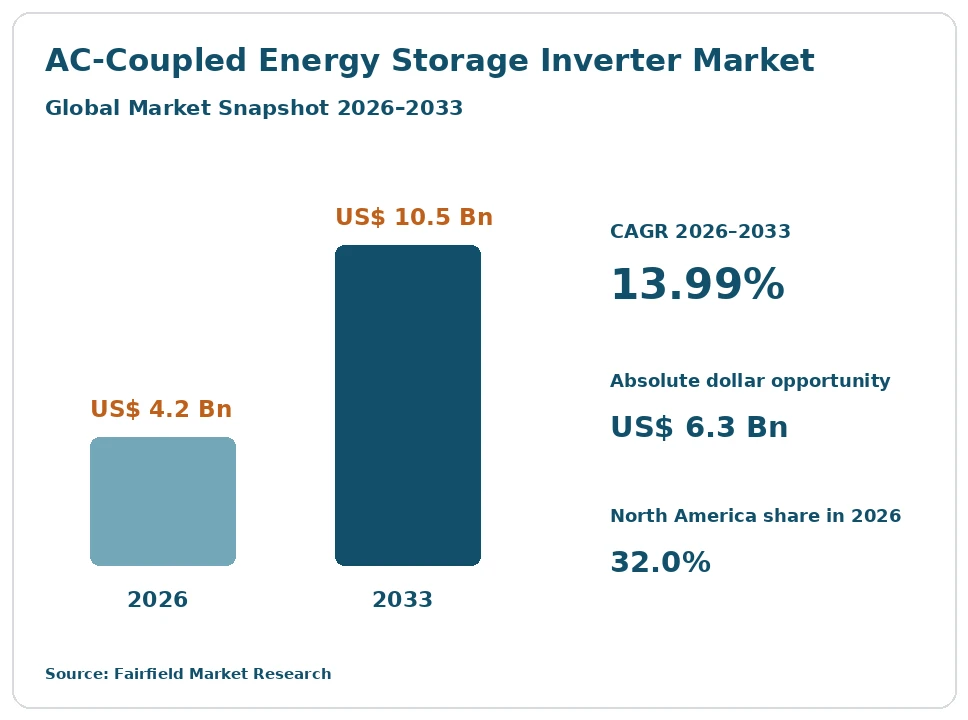
The global AC-Coupled Energy Storage Inverter market size is expected to be valued at US$ 4.2 billion in 2026 and projected to reach US$ 10.5 billion by 2033, growing at a CAGR of 13.99% between 2026 and 2033.
Shipments grew at roughly a 24.0% CAGR between 2020 and 2025, from a small base, as battery prices fell and storage moved from pilot projects into standard practice. Three factors shape the slower but still strong outlook. A very large installed solar base can only take storage on the alternating current side without replacing existing equipment. Standalone utility-scale batteries are connected at the point of common coupling by definition. Tariff changes in several markets have made self-consumption and peak shaving more valuable than export. Average selling prices per kilowatt continue to fall, so revenue grows more slowly than installed capacity does.
Key Report Takeaways
- By Application: Utility-Scale held 44.0% share in 2026, while Commercial & Industrial is projected to expand at a 16.8% CAGR through 2033, driven by demand charge management at sites with existing rooftop arrays and limited roof space for expansion.
- By Product Type: Containerized Power Conversion Systems held 41.0% share in 2026, while Hybrid & Multimode Inverters are projected to expand at a 17.5% CAGR through 2033, because single-box units cut installation labour on smaller sites.
- By Installation Type: New-Build held 58.0% share in 2026, while Retrofit is projected to expand at a 15.2% CAGR through 2033, reflecting the enormous base of operating solar systems that can add batteries without touching the original inverter.
- By Power Rating: Above 1 MW held 40.0% share in 2026, while 100 kW–1 MW is projected to expand at a 17.2% CAGR through 2033, supported by commercial sites sized between rooftop residential units and grid-scale projects.
- By Geography: North America held 32.0% share in 2026, while Middle East & Africa is projected to expand at a 19.8% CAGR through 2033, reflecting very large utility procurement programmes launched from a small installed base.
Global AC-Coupled Energy Storage Inverter Market Trends and Insights
Drivers Impact Analysis
Two forces explain why alternating current coupling keeps winning sockets even though it is less efficient than the alternative.
Retrofitting Storage Onto an Existing Solar Base Drives AC-Coupled Inverter Demand
Adding batteries to a site that already generates solar power is far simpler on the alternating current side, and that convenience creates most of the demand for these products. The existing photovoltaic inverter is left untouched, so its warranty, certification and monitoring platform all remain valid. The two systems can be sized independently, supplied by different vendors, and installed years apart without redesigning the original array.
The mechanism is installed base arithmetic. Hundreds of gigawatts of photovoltaic capacity were commissioned before storage became normal, and almost none of it was designed with a shared direct current bus. Replacing a working inverter to gain a direct current connection rarely pays back, particularly where feed-in tariffs or net metering arrangements are tied to the original equipment. Separate alternating current coupling preserves those arrangements while adding backup, self-consumption and time-shifting capability.
Grid Support Certification Makes Compliant AC-Coupled Inverters a Condition of Sale
Grid-support behaviour, not power electronics, is now the regulated part of this product, and certification decides market access. Utilities require storage inverters to ride through voltage and frequency disturbances, supply or absorb reactive power, follow ramp rate limits and accept remote curtailment. A unit that cannot demonstrate conformance simply cannot be energised, regardless of its efficiency or price.
The causal chain runs through standards and testing. IEEE 1547 defines the required performance for distributed energy resources, IEEE 1547.1 sets the conformance test procedures, and UL 1741 with its grid support supplements provides the certification that North American utilities accept. IEC 62109 covers converter safety, while IEC 61727 and IEC 62116 address utility interconnection and anti-islanding. EN 50549 and the European network codes perform the same function in Europe. Firmware development and laboratory testing therefore absorb a growing share of engineering budgets.
| Driver | Impact on CAGR Forecast | Geographic Relevance | Impact Timeline |
| Storage retrofits onto an installed solar base | High | North America, Europe, Asia Pacific | Medium term 2–4 years |
| Interconnection standards making grid support functions mandatory | Medium | North America, Europe | Long term ≥4 years |
Restraints Impact Analysis
Two constraints limit both the technical case for alternating current coupling and the speed at which orders convert into revenue.
Double Conversion Losses Push Greenfield Projects Toward DC-Coupled Designs
The extra conversion step is a genuine disadvantage, and it costs alternating current coupling the greenfield market. When solar output charges a battery through an AC-coupled architecture, the energy is inverted to alternating current, then rectified back to direct current for storage, then inverted again on discharge. Each stage loses a few percent. Direct current coupling avoids one full conversion and therefore delivers a measurably better round-trip figure.
The underlying cause is topology rather than component quality. Modern converters already operate near their practical efficiency ceiling, so the penalty cannot be engineered away without removing a stage. Direct current coupling also allows a single larger inverter to serve both generation and storage, lowering cost per watt and capturing clipped solar energy that would otherwise be lost. For a new installation designed as one system, those advantages usually outweigh the flexibility that separate alternating current coupling provides.
Interconnection Queues and Fragmented Certification Delay AC-Coupled Inverter Revenue
Approval timelines, not manufacturing capacity, are what most often hold back revenue recognition in this market. Utility interconnection studies for larger storage projects can take many months, and queue positions in congested service territories stretch further still. Equipment sits in warehouses while applications are processed, which stretches working capital for integrators and makes order forecasting unreliable for manufacturers.
The specific cost source is duplicated compliance work rather than the fee itself. A product sold across several jurisdictions needs separate certification to North American and European requirements, national grid code annexes, local anti-islanding settings and, increasingly, cybersecurity and remote control provisions. Each variant demands its own laboratory campaign, firmware build and documentation set. Smaller suppliers struggle to carry that overhead, and every standards revision triggers recertification before existing stock can be sold.
| Restraint | Impact on CAGR Forecast | Geographic Relevance | Impact Timeline |
| Round-trip efficiency penalty against direct current coupling | Medium | Global | Long term ≥4 years |
| Interconnection queues and fragmented certification requirements | High | North America, Europe, Latin America | Short term ≤2 years |
Market Opportunities
Virtual Power Plant Aggregation Turns AC-Coupled Inverters Into Grid-Services Assets
Aggregating distributed batteries into dispatchable portfolios creates a recurring revenue pool that hardware sales alone never reach. Because an alternating current coupled unit sits at the site boundary and already carries communications, metering and remote control capability, it is the natural control point for aggregation. Manufacturers can earn platform fees, licensing income and data services over the asset’s life rather than a single margin at installation.
Utilities, retailers and independent aggregators create the demand, while residential and commercial customers supply the capacity in exchange for bill credits. Interconnection standards support the model, since they already require remote curtailment and defined response behaviour that aggregation platforms can use directly. Capacity market and demand response programmes in several jurisdictions now accept aggregated behind-the-meter storage, giving the operator a contracted payment stream independent of energy arbitrage.
Commercial Peak Shaving and Ageing Solar Sites Open a Replacement Revenue Pool
Two adjacent pools are opening for mid-size equipment. Commercial and industrial sites facing demand charges can cut peak billing determinants with a modest battery, and the payback is driven by tariff structure rather than by energy prices. Separately, the earliest large wave of photovoltaic installations is approaching the end of its original inverter design life, which creates a repowering opportunity where storage is added at the same visit.
Engineering and procurement contractors, electrical contractors and energy service companies are positioned to capture this, with cold storage, manufacturing, retail and healthcare sites generating the strongest demand. New interconnection rules help, because sites replacing legacy equipment must meet current grid support requirements, which forces an upgrade rather than a like-for-like swap. Metering rules for behind-the-meter storage determine how much of the saving the customer keeps.
Segment Analysis
By Application: Utility-Scale Leads While Commercial and Industrial Expands Fastest
Utility-Scale held 44.0% of the market in 2026, the largest share, because standalone grid batteries connect at the point of common coupling and are therefore alternating current coupled by definition. Project sizes run to hundreds of megawatts, so a single award carries more converter value than thousands of homes. Residential accounted for 31.0%, dominated by retrofit installations, and Commercial & Industrial for 25.0%.
Commercial & Industrial is the fastest-growing application at a 16.8% CAGR through 2033. Demand charge management produces a calculable saving that does not depend on wholesale price volatility, and many commercial sites already have rooftop solar with no space for additional panels. Backup supply for process-critical loads adds a second justification. The implication is that mid-size equipment, long the least attractive segment for manufacturers, is becoming the most contested one.
By Product Type: Containerized Systems Hold Scale While Hybrid Units Grow Quickest
Containerized Power Conversion Systems accounted for 41.0% of market value in 2026, reflecting the dominance of utility projects where converters are supplied as integrated skids with transformers, switchgear and cooling. Bidirectional Battery Inverters followed at 34.0%, covering standalone wall-mounted and rack-mounted units for homes and smaller commercial sites. Hybrid & Multimode Inverters that also support alternating current coupling held 25.0%.
Hybrid & Multimode Inverters are the fastest-growing product type at a 17.5% CAGR through 2033. A single enclosure handling solar input, battery charging, grid interaction and backup transfer reduces installation labour, wall space and commissioning time, which matters most where labour costs exceed hardware costs. Competition from these integrated units is also compressing margins on dedicated battery inverters, pushing specialist suppliers toward higher power classes and toward firmware-differentiated grid services.
By Installation Type: New-Build Leads on Value While Retrofit Grows Faster
New-Build held 58.0% of market value in 2026, because utility-scale and large commercial projects are designed with storage from the outset and account for most converter capacity shipped. These projects specify equipment through competitive tender, and converter selection is made alongside battery, transformer and controls procurement as a single package.
Retrofit holds 42.0% and grows faster, at a 15.2% CAGR through 2033. The driver is the installed photovoltaic fleet, which was built before storage became routine and cannot accept a shared direct current bus without replacing working equipment. Retrofit also suits mixed-vendor sites where the original inverter brand is no longer available. The practical implication is that the two installation types need different commercial models: tender-driven project sales on one side, distributor and installer channels on the other.
By Power Rating: Megawatt-Class Units Lead While Mid-Range Ratings Accelerate
Above 1 MW held 40.0% of the market in 2026, driven by utility projects where converters are specified in multi-megawatt blocks and priced aggressively per kilowatt. Up to 10 kW accounted for 24.0%, reflecting large residential unit volumes at low prices per installation. 100 kW–1 MW represented 21.0% and 10–100 kW the remaining 15.0%.
The 100 kW–1 MW class is the fastest-growing rating at a 17.2% CAGR through 2033. It serves commercial buildings, light industry, agricultural sites and electric vehicle charging hubs, where loads are too large for residential equipment and too small for containerised systems. Suppliers have historically underserved this band. Growing availability of certified three-phase units in this range is closing the gap, which should raise competitive intensity and accelerate price erosion in the mid-market.
Geography Analysis
Which Region Leads the AC-Coupled Energy Storage Inverter Market?
North America leads the AC-coupled energy storage inverter market with 32.0% share in 2026 and a 13.2% CAGR through 2033. The United States accounts for most of it, combining the world’s largest utility-scale battery procurement pipeline with a residential sector that is overwhelmingly retrofit in character. Tariff reform in California moved household economics away from export credit and toward self-consumption, which made paired storage close to standard on new installations.
Certification is unusually decisive here. UL 1741 with its grid support supplements, together with UL 9540 and UL 9540A fire testing, determines what may be installed and where, and authorities having jurisdiction enforce those requirements at inspection. Canada follows similar practice with provincial variations. The main constraint is interconnection timing, since queue delays in congested utility territories postpone energisation long after equipment delivery.
Europe Pairs Storage Retrofits With Strict Network Code Compliance
Europe accounted for 26.0% of the market in 2026 and is forecast to grow at a 12.8% CAGR to 2033. Germany holds the largest installed base of household batteries, most of them added to arrays commissioned years earlier under feed-in tariffs that make replacing the original inverter financially unattractive. Italy, the Netherlands, Austria and Spain follow the same retrofit pattern.
Compliance requirements are strict and locally varied. EN 50549 and the network codes for generators and demand connection set the baseline, but each transmission operator publishes national annexes, so suppliers maintain multiple certified firmware variants. Grid fee structures and the phase-out of favourable export arrangements are shifting value toward self-consumption. The change worth watching is large-scale commercial aggregation, as more countries open balancing markets to pooled behind-the-meter assets.
Asia Pacific Combines Manufacturing Scale With Fast-Growing Domestic Deployment
Asia Pacific held 31.0% of the market in 2026 and is projected to grow at a 15.1% CAGR through 2033. China manufactures the majority of the world’s storage converters and also deploys the largest domestic volume, supported by provincial requirements that pair new renewable capacity with storage. That dual position gives regional suppliers both cost advantage and reference scale.
Australia has one of the highest household solar penetration rates anywhere, making it the clearest retrofit market in the region, while Japan, South Korea and India add utility and commercial projects. Price competition is intense and has compressed margins across the supply chain. The main opportunity is export-grade certification, since domestic manufacturers that invest in international conformance testing can address higher-priced markets with the same production lines.
Latin America Builds Storage Around Weak Grids and Commercial Self-Supply
Latin America held 6.0% of the market in 2026, with a projected 15.0% CAGR to 2033. Brazil and Chile drive most activity, the first through rapid distributed generation growth and the second through utility-scale projects attached to solar plants in the Atacama region. Mexico and Colombia add commercial self-supply installations where grid reliability is poor and diesel backup is expensive.
Barriers remain substantial. Interconnection rules for storage are still being written in several countries, financing costs are high, and import duties raise delivered equipment prices. Certified installation capability is thin outside major cities. The clearest opportunity is commercial backup, because businesses already paying for diesel generation can justify batteries on reliability grounds alone, without waiting for favourable tariff or grid service arrangements to appear.
Which Region Is Growing Fastest in the AC-Coupled Energy Storage Inverter Market?
Middle East & Africa is growing fastest in the AC-coupled energy storage inverter market, at a 19.8% CAGR through 2033 from 5.0% share in 2026. Very large utility procurement programmes in Saudi Arabia and the United Arab Emirates pair gigawatt-scale solar with multi-hour battery capacity, and because these are standalone storage blocks they connect on the alternating current side.
South Africa contributes a different pattern, where persistent load shedding has driven household and commercial battery adoption at unusual speed, almost entirely as retrofit to existing arrays. Egypt, Morocco and Jordan add utility projects. Barriers include high ambient temperatures that require derating and additional cooling, limited local certification infrastructure, and currency and financing constraints in much of Africa. The opportunity lies in mini-grid and industrial self-generation, which needs no transmission investment.
Competitive Landscape
The AC-coupled energy storage inverter market is moderately concentrated, with different structures at each end of the power range. A small number of suppliers dominate utility-scale power conversion systems, because multi-megawatt equipment demands grid code expertise, long warranty capability and the balance sheet to support performance guarantees across hundreds of megawatts. The residential and small commercial end is far more crowded, populated by established solar inverter brands, battery system integrators and newer entrants offering integrated hybrid units. Consolidation has been limited, but the gap between certified international suppliers and low-cost regional manufacturers is widening.
Competition increasingly runs on firmware and certification rather than on power stage design. Silicon carbide devices, modular topologies and higher switching frequencies are widely available, so efficiency differences between credible products are narrow. What separates suppliers is the breadth of grid codes a unit is certified against, the speed of recertification when a standard is revised, and the quality of the energy management software, remote diagnostics and aggregation interfaces supplied with it. Price competition from integrated hybrid units and from low-cost manufacturers has compressed margins throughout the mid-range, pushing specialists toward services and higher power classes.
Strategic activity focuses on channel control and software. Manufacturers are building installer certification programmes, extending warranty terms and bundling monitoring platforms to retain customers after the sale. Several have moved toward supplying complete alternating current coupled storage blocks rather than converters alone, which captures more value per site but raises inventory and safety compliance obligations. Partnerships with aggregators and retailers are becoming the route into grid service revenue.
Strategic direction is converging on compliance capability as a competitive asset. Firms are investing in in-house laboratory testing, cybersecurity hardening and modular firmware architectures, because the ability to certify quickly into a new jurisdiction now determines how fast a product can follow demand.
AC-Coupled Energy Storage Inverter Industry Leaders
- Sungrow Power Supply Co., Ltd.
- SMA Solar Technology AG
- Power Electronics S.L.
- SolarEdge Technologies, Inc.
- Delta Electronics, Inc.
Recent Industry Developments
- April 2018: The Institute of Electrical and Electronics Engineers published the revised IEEE 1547 standard for interconnecting distributed energy resources, requiring voltage and frequency ride-through, reactive power support and defined interoperability – it redefined what a grid-connected storage inverter must do.
- May 2020: IEEE 1547.1 conformance test procedures were published, giving laboratories a common method for verifying the performance required by the interconnection standard – it turned the written requirement into an enforceable certification gate.
- September 2021: UL Solutions issued Supplement SB to UL 1741, aligning grid support function certification with the revised interconnection standard – it became the practical condition of sale for storage inverters across North America.
- December 2022: The California Public Utilities Commission adopted a net billing tariff replacing retail-rate net metering for new residential solar customers – by lowering export compensation it made on-site storage central to household solar economics.
Companies Covered in the Report
- Sungrow Power Supply Co., Ltd.
- SMA Solar Technology AG
- SolarEdge Technologies, Inc.
- Enphase Energy, Inc.
- Fronius International GmbH
- Delta Electronics, Inc.
- Power Electronics S.L.
- Shenzhen Sinexcel Electric Co., Ltd.
- Hitachi Energy Ltd.
- GoodWe Technologies Co., Ltd.
- Growatt New Energy Technology Co., Ltd.
- Victron Energy B.V.
- Schneider Electric SE
- Tesla, Inc.
AC-Coupled Energy Storage Inverter Market Report Scope
This report covers power conversion systems for battery storage connected on the alternating current side of a site, including bidirectional battery inverters, containerised power conversion systems, hybrid units supporting AC coupling, and the controls and grid-support firmware sold with them. Direct current coupled systems, the batteries themselves and standalone solar inverters are excluded. Base year is 2025; the forecast period runs 2026 to 2033 in US$ Billion.
| Metric | Value |
| Study Period | 2020–2033 |
| Market Size 2026 | US$ 4.2 Billion |
| Market Size 2033 | US$ 10.5 Billion |
| CAGR 2026–2033 | 13.99% |
| Absolute Dollar Opportunity | US$ 6.3 Billion |
| Largest Market | North America (32.0% share in 2026) |
| Fastest-Growing Market | Middle East & Africa (19.8% CAGR) |
| Market Concentration | Medium |
| Major Players | Sungrow Power Supply Co., Ltd., SMA Solar Technology AG, Power Electronics S.L., SolarEdge Technologies, Inc. |
Application
- Residential
- Commercial & Industrial
- Utility-Scale
Product Type
- Bidirectional Battery Inverters
- Hybrid & Multimode Inverters
- Containerized Power Conversion Systems
Installation Type
- New-Build
- Retrofit
Power Rating
- Up to 10 kW
- 10–100 kW
- 100 kW–1 MW
- Above 1 MW
Regions
- North America
- Europe
- Asia Pacific
- Latin America
- Middle East & Africa
1. Executive Summary
1.1. Global AC-Coupled Energy Storage Inverter Market Snapshot
1.2. Future Projections, 2026-2033
1.3. Key Market Trends
1.4. Regional Snapshot
2. Market Overview
2.1. Market Definition and Report Scope
2.2. Historical Market Trends, 2020-2025
2.3. Market Dynamics
2.3.1. Drivers Impact Analysis
2.3.1.1. Retrofitting Storage Onto an Existing Solar Base Drives AC-Coupled Inverter Demand
2.3.1.2. Grid Support Certification Makes Compliant AC-Coupled Inverters a Condition of Sale
2.3.2. Restraints Impact Analysis
2.3.2.1. Double Conversion Losses Push Greenfield Projects Toward DC-Coupled Designs
2.3.2.2. Interconnection Queues and Fragmented Certification Delay AC-Coupled Inverter Revenue
2.3.3. Market Opportunities
2.3.3.1. Virtual Power Plant Aggregation Turns AC-Coupled Inverters Into Grid-Services Assets
2.3.3.2. Commercial Peak Shaving and Ageing Solar Sites Open a Replacement Revenue Pool
3. Global AC-Coupled Energy Storage Inverter Market Outlook, 2020-2033
3.1. Global AC-Coupled Energy Storage Inverter Market Outlook, by Application, Value (US$ Billion), 2020-2033
3.1.1. Residential
3.1.2. Commercial & Industrial
3.1.3. Utility-Scale
3.2. Global AC-Coupled Energy Storage Inverter Market Outlook, by Product Type, Value (US$ Billion), 2020-2033
3.2.1. Bidirectional Battery Inverters
3.2.2. Hybrid & Multimode Inverters
3.2.3. Containerized Power Conversion Systems
3.3. Global AC-Coupled Energy Storage Inverter Market Outlook, by Installation Type, Value (US$ Billion), 2020-2033
3.3.1. New-Build
3.3.2. Retrofit
3.4. Global AC-Coupled Energy Storage Inverter Market Outlook, by Power Rating, Value (US$ Billion), 2020-2033
3.4.1. Up to 10 kW
3.4.2. 10–100 kW
3.4.3. 100 kW–1 MW
3.4.4. Above 1 MW
3.5. Global AC-Coupled Energy Storage Inverter Market Outlook, by Region, Value (US$ Billion), 2020-2033
3.5.1. North America
3.5.2. Europe
3.5.3. Asia Pacific
3.5.4. Latin America
3.5.5. Middle East & Africa
4. North America AC-Coupled Energy Storage Inverter Market Outlook, 2020-2033
4.1. North America AC-Coupled Energy Storage Inverter Market Outlook, by Application, Value (US$ Billion), 2020-2033
4.1.1. Residential
4.1.2. Commercial & Industrial
4.1.3. Utility-Scale
4.2. North America AC-Coupled Energy Storage Inverter Market Outlook, by Product Type, Value (US$ Billion), 2020-2033
4.2.1. Bidirectional Battery Inverters
4.2.2. Hybrid & Multimode Inverters
4.2.3. Containerized Power Conversion Systems
4.3. North America AC-Coupled Energy Storage Inverter Market Outlook, by Installation Type, Value (US$ Billion), 2020-2033
4.3.1. New-Build
4.3.2. Retrofit
4.4. North America AC-Coupled Energy Storage Inverter Market Outlook, by Power Rating, Value (US$ Billion), 2020-2033
4.4.1. Up to 10 kW
4.4.2. 10–100 kW
4.4.3. 100 kW–1 MW
4.4.4. Above 1 MW
4.5. North America AC-Coupled Energy Storage Inverter Market Outlook, by Country, Value (US$ Billion), 2020-2033
4.5.1. United States AC-Coupled Energy Storage Inverter Market Outlook, by Application, 2020-2033
4.5.2. United States AC-Coupled Energy Storage Inverter Market Outlook, by Product Type, 2020-2033
4.5.3. United States AC-Coupled Energy Storage Inverter Market Outlook, by Installation Type, 2020-2033
4.5.4. United States AC-Coupled Energy Storage Inverter Market Outlook, by Power Rating, 2020-2033
4.5.5. Canada AC-Coupled Energy Storage Inverter Market Outlook, by Application, 2020-2033
4.5.6. Canada AC-Coupled Energy Storage Inverter Market Outlook, by Product Type, 2020-2033
4.5.7. Canada AC-Coupled Energy Storage Inverter Market Outlook, by Installation Type, 2020-2033
4.5.8. Canada AC-Coupled Energy Storage Inverter Market Outlook, by Power Rating, 2020-2033
5. Europe AC-Coupled Energy Storage Inverter Market Outlook, 2020-2033
5.1. Europe AC-Coupled Energy Storage Inverter Market Outlook, by Application, Value (US$ Billion), 2020-2033
5.1.1. Residential
5.1.2. Commercial & Industrial
5.1.3. Utility-Scale
5.2. Europe AC-Coupled Energy Storage Inverter Market Outlook, by Product Type, Value (US$ Billion), 2020-2033
5.2.1. Bidirectional Battery Inverters
5.2.2. Hybrid & Multimode Inverters
5.2.3. Containerized Power Conversion Systems
5.3. Europe AC-Coupled Energy Storage Inverter Market Outlook, by Installation Type, Value (US$ Billion), 2020-2033
5.3.1. New-Build
5.3.2. Retrofit
5.4. Europe AC-Coupled Energy Storage Inverter Market Outlook, by Power Rating, Value (US$ Billion), 2020-2033
5.4.1. Up to 10 kW
5.4.2. 10–100 kW
5.4.3. 100 kW–1 MW
5.4.4. Above 1 MW
5.5. Europe AC-Coupled Energy Storage Inverter Market Outlook, by Country, Value (US$ Billion), 2020-2033
5.5.1. Germany AC-Coupled Energy Storage Inverter Market Outlook, by Application, 2020-2033
5.5.2. Germany AC-Coupled Energy Storage Inverter Market Outlook, by Product Type, 2020-2033
5.5.3. Germany AC-Coupled Energy Storage Inverter Market Outlook, by Installation Type, 2020-2033
5.5.4. Germany AC-Coupled Energy Storage Inverter Market Outlook, by Power Rating, 2020-2033
5.5.5. Italy AC-Coupled Energy Storage Inverter Market Outlook, by Application, 2020-2033
5.5.6. Italy AC-Coupled Energy Storage Inverter Market Outlook, by Product Type, 2020-2033
5.5.7. Italy AC-Coupled Energy Storage Inverter Market Outlook, by Installation Type, 2020-2033
5.5.8. Italy AC-Coupled Energy Storage Inverter Market Outlook, by Power Rating, 2020-2033
5.5.9. Netherlands AC-Coupled Energy Storage Inverter Market Outlook, by Application, 2020-2033
5.5.10. Netherlands AC-Coupled Energy Storage Inverter Market Outlook, by Product Type, 2020-2033
5.5.11. Netherlands AC-Coupled Energy Storage Inverter Market Outlook, by Installation Type, 2020-2033
5.5.12. Netherlands AC-Coupled Energy Storage Inverter Market Outlook, by Power Rating, 2020-2033
5.5.13. Austria AC-Coupled Energy Storage Inverter Market Outlook, by Application, 2020-2033
5.5.14. Austria AC-Coupled Energy Storage Inverter Market Outlook, by Product Type, 2020-2033
5.5.15. Austria AC-Coupled Energy Storage Inverter Market Outlook, by Installation Type, 2020-2033
5.5.16. Austria AC-Coupled Energy Storage Inverter Market Outlook, by Power Rating, 2020-2033
5.5.17. Spain AC-Coupled Energy Storage Inverter Market Outlook, by Application, 2020-2033
5.5.18. Spain AC-Coupled Energy Storage Inverter Market Outlook, by Product Type, 2020-2033
5.5.19. Spain AC-Coupled Energy Storage Inverter Market Outlook, by Installation Type, 2020-2033
5.5.20. Spain AC-Coupled Energy Storage Inverter Market Outlook, by Power Rating, 2020-2033
6. Asia Pacific AC-Coupled Energy Storage Inverter Market Outlook, 2020-2033
6.1. Asia Pacific AC-Coupled Energy Storage Inverter Market Outlook, by Application, Value (US$ Billion), 2020-2033
6.1.1. Residential
6.1.2. Commercial & Industrial
6.1.3. Utility-Scale
6.2. Asia Pacific AC-Coupled Energy Storage Inverter Market Outlook, by Product Type, Value (US$ Billion), 2020-2033
6.2.1. Bidirectional Battery Inverters
6.2.2. Hybrid & Multimode Inverters
6.2.3. Containerized Power Conversion Systems
6.3. Asia Pacific AC-Coupled Energy Storage Inverter Market Outlook, by Installation Type, Value (US$ Billion), 2020-2033
6.3.1. New-Build
6.3.2. Retrofit
6.4. Asia Pacific AC-Coupled Energy Storage Inverter Market Outlook, by Power Rating, Value (US$ Billion), 2020-2033
6.4.1. Up to 10 kW
6.4.2. 10–100 kW
6.4.3. 100 kW–1 MW
6.4.4. Above 1 MW
6.5. Asia Pacific AC-Coupled Energy Storage Inverter Market Outlook, by Country, Value (US$ Billion), 2020-2033
6.5.1. China AC-Coupled Energy Storage Inverter Market Outlook, by Application, 2020-2033
6.5.2. China AC-Coupled Energy Storage Inverter Market Outlook, by Product Type, 2020-2033
6.5.3. China AC-Coupled Energy Storage Inverter Market Outlook, by Installation Type, 2020-2033
6.5.4. China AC-Coupled Energy Storage Inverter Market Outlook, by Power Rating, 2020-2033
6.5.5. Australia AC-Coupled Energy Storage Inverter Market Outlook, by Application, 2020-2033
6.5.6. Australia AC-Coupled Energy Storage Inverter Market Outlook, by Product Type, 2020-2033
6.5.7. Australia AC-Coupled Energy Storage Inverter Market Outlook, by Installation Type, 2020-2033
6.5.8. Australia AC-Coupled Energy Storage Inverter Market Outlook, by Power Rating, 2020-2033
6.5.9. Japan AC-Coupled Energy Storage Inverter Market Outlook, by Application, 2020-2033
6.5.10. Japan AC-Coupled Energy Storage Inverter Market Outlook, by Product Type, 2020-2033
6.5.11. Japan AC-Coupled Energy Storage Inverter Market Outlook, by Installation Type, 2020-2033
6.5.12. Japan AC-Coupled Energy Storage Inverter Market Outlook, by Power Rating, 2020-2033
6.5.13. South Korea AC-Coupled Energy Storage Inverter Market Outlook, by Application, 2020-2033
6.5.14. South Korea AC-Coupled Energy Storage Inverter Market Outlook, by Product Type, 2020-2033
6.5.15. South Korea AC-Coupled Energy Storage Inverter Market Outlook, by Installation Type, 2020-2033
6.5.16. South Korea AC-Coupled Energy Storage Inverter Market Outlook, by Power Rating, 2020-2033
6.5.17. India AC-Coupled Energy Storage Inverter Market Outlook, by Application, 2020-2033
6.5.18. India AC-Coupled Energy Storage Inverter Market Outlook, by Product Type, 2020-2033
6.5.19. India AC-Coupled Energy Storage Inverter Market Outlook, by Installation Type, 2020-2033
6.5.20. India AC-Coupled Energy Storage Inverter Market Outlook, by Power Rating, 2020-2033
7. Latin America AC-Coupled Energy Storage Inverter Market Outlook, 2020-2033
7.1. Latin America AC-Coupled Energy Storage Inverter Market Outlook, by Application, Value (US$ Billion), 2020-2033
7.1.1. Residential
7.1.2. Commercial & Industrial
7.1.3. Utility-Scale
7.2. Latin America AC-Coupled Energy Storage Inverter Market Outlook, by Product Type, Value (US$ Billion), 2020-2033
7.2.1. Bidirectional Battery Inverters
7.2.2. Hybrid & Multimode Inverters
7.2.3. Containerized Power Conversion Systems
7.3. Latin America AC-Coupled Energy Storage Inverter Market Outlook, by Installation Type, Value (US$ Billion), 2020-2033
7.3.1. New-Build
7.3.2. Retrofit
7.4. Latin America AC-Coupled Energy Storage Inverter Market Outlook, by Power Rating, Value (US$ Billion), 2020-2033
7.4.1. Up to 10 kW
7.4.2. 10–100 kW
7.4.3. 100 kW–1 MW
7.4.4. Above 1 MW
7.5. Latin America AC-Coupled Energy Storage Inverter Market Outlook, by Country, Value (US$ Billion), 2020-2033
7.5.1. Brazil AC-Coupled Energy Storage Inverter Market Outlook, by Application, 2020-2033
7.5.2. Brazil AC-Coupled Energy Storage Inverter Market Outlook, by Product Type, 2020-2033
7.5.3. Brazil AC-Coupled Energy Storage Inverter Market Outlook, by Installation Type, 2020-2033
7.5.4. Brazil AC-Coupled Energy Storage Inverter Market Outlook, by Power Rating, 2020-2033
7.5.5. Chile AC-Coupled Energy Storage Inverter Market Outlook, by Application, 2020-2033
7.5.6. Chile AC-Coupled Energy Storage Inverter Market Outlook, by Product Type, 2020-2033
7.5.7. Chile AC-Coupled Energy Storage Inverter Market Outlook, by Installation Type, 2020-2033
7.5.8. Chile AC-Coupled Energy Storage Inverter Market Outlook, by Power Rating, 2020-2033
7.5.9. Mexico AC-Coupled Energy Storage Inverter Market Outlook, by Application, 2020-2033
7.5.10. Mexico AC-Coupled Energy Storage Inverter Market Outlook, by Product Type, 2020-2033
7.5.11. Mexico AC-Coupled Energy Storage Inverter Market Outlook, by Installation Type, 2020-2033
7.5.12. Mexico AC-Coupled Energy Storage Inverter Market Outlook, by Power Rating, 2020-2033
7.5.13. Colombia AC-Coupled Energy Storage Inverter Market Outlook, by Application, 2020-2033
7.5.14. Colombia AC-Coupled Energy Storage Inverter Market Outlook, by Product Type, 2020-2033
7.5.15. Colombia AC-Coupled Energy Storage Inverter Market Outlook, by Installation Type, 2020-2033
7.5.16. Colombia AC-Coupled Energy Storage Inverter Market Outlook, by Power Rating, 2020-2033
8. Middle East & Africa AC-Coupled Energy Storage Inverter Market Outlook, 2020-2033
8.1. Middle East & Africa AC-Coupled Energy Storage Inverter Market Outlook, by Application, Value (US$ Billion), 2020-2033
8.1.1. Residential
8.1.2. Commercial & Industrial
8.1.3. Utility-Scale
8.2. Middle East & Africa AC-Coupled Energy Storage Inverter Market Outlook, by Product Type, Value (US$ Billion), 2020-2033
8.2.1. Bidirectional Battery Inverters
8.2.2. Hybrid & Multimode Inverters
8.2.3. Containerized Power Conversion Systems
8.3. Middle East & Africa AC-Coupled Energy Storage Inverter Market Outlook, by Installation Type, Value (US$ Billion), 2020-2033
8.3.1. New-Build
8.3.2. Retrofit
8.4. Middle East & Africa AC-Coupled Energy Storage Inverter Market Outlook, by Power Rating, Value (US$ Billion), 2020-2033
8.4.1. Up to 10 kW
8.4.2. 10–100 kW
8.4.3. 100 kW–1 MW
8.4.4. Above 1 MW
8.5. Middle East & Africa AC-Coupled Energy Storage Inverter Market Outlook, by Country, Value (US$ Billion), 2020-2033
8.5.1. Saudi Arabia AC-Coupled Energy Storage Inverter Market Outlook, by Application, 2020-2033
8.5.2. Saudi Arabia AC-Coupled Energy Storage Inverter Market Outlook, by Product Type, 2020-2033
8.5.3. Saudi Arabia AC-Coupled Energy Storage Inverter Market Outlook, by Installation Type, 2020-2033
8.5.4. Saudi Arabia AC-Coupled Energy Storage Inverter Market Outlook, by Power Rating, 2020-2033
8.5.5. United Arab Emirates AC-Coupled Energy Storage Inverter Market Outlook, by Application, 2020-2033
8.5.6. United Arab Emirates AC-Coupled Energy Storage Inverter Market Outlook, by Product Type, 2020-2033
8.5.7. United Arab Emirates AC-Coupled Energy Storage Inverter Market Outlook, by Installation Type, 2020-2033
8.5.8. United Arab Emirates AC-Coupled Energy Storage Inverter Market Outlook, by Power Rating, 2020-2033
8.5.9. South Africa AC-Coupled Energy Storage Inverter Market Outlook, by Application, 2020-2033
8.5.10. South Africa AC-Coupled Energy Storage Inverter Market Outlook, by Product Type, 2020-2033
8.5.11. South Africa AC-Coupled Energy Storage Inverter Market Outlook, by Installation Type, 2020-2033
8.5.12. South Africa AC-Coupled Energy Storage Inverter Market Outlook, by Power Rating, 2020-2033
8.5.13. Egypt AC-Coupled Energy Storage Inverter Market Outlook, by Application, 2020-2033
8.5.14. Egypt AC-Coupled Energy Storage Inverter Market Outlook, by Product Type, 2020-2033
8.5.15. Egypt AC-Coupled Energy Storage Inverter Market Outlook, by Installation Type, 2020-2033
8.5.16. Egypt AC-Coupled Energy Storage Inverter Market Outlook, by Power Rating, 2020-2033
8.5.17. Morocco AC-Coupled Energy Storage Inverter Market Outlook, by Application, 2020-2033
8.5.18. Morocco AC-Coupled Energy Storage Inverter Market Outlook, by Product Type, 2020-2033
8.5.19. Morocco AC-Coupled Energy Storage Inverter Market Outlook, by Installation Type, 2020-2033
8.5.20. Morocco AC-Coupled Energy Storage Inverter Market Outlook, by Power Rating, 2020-2033
8.5.21. Jordan AC-Coupled Energy Storage Inverter Market Outlook, by Application, 2020-2033
8.5.22. Jordan AC-Coupled Energy Storage Inverter Market Outlook, by Product Type, 2020-2033
8.5.23. Jordan AC-Coupled Energy Storage Inverter Market Outlook, by Installation Type, 2020-2033
8.5.24. Jordan AC-Coupled Energy Storage Inverter Market Outlook, by Power Rating, 2020-2033
9. Competitive Landscape
9.1. Market Concentration and Industry Leaders
9.2. Competitive Differentiation
9.3. Strategic Initiatives
9.4. Recent Industry Developments
9.5. Company Profiles
9.5.1. Sungrow Power Supply Co., Ltd.
9.5.2. SMA Solar Technology AG
9.5.3. SolarEdge Technologies, Inc.
9.5.4. Enphase Energy, Inc.
9.5.5. Fronius International GmbH
9.5.6. Delta Electronics, Inc.
9.5.7. Power Electronics S.L.
9.5.8. Shenzhen Sinexcel Electric Co., Ltd.
9.5.9. Hitachi Energy Ltd.
9.5.10. GoodWe Technologies Co., Ltd.
9.5.11. Growatt New Energy Technology Co., Ltd.
9.5.12. Victron Energy B.V.
9.5.13. Schneider Electric SE
9.5.14. Tesla, Inc.
10. Appendix
10.1. Research Methodology
10.2. Report Assumptions
10.3. Acronyms and Abbreviations
| Segment | Categories |
|---|---|
| Application | Residential, Commercial & Industrial, Utility-Scale |
| Product Type | Bidirectional Battery Inverters, Hybrid & Multimode Inverters, Containerized Power Conversion Systems |
| Installation Type | New-Build, Retrofit |
| Power Rating | Up to 10 kW, 10–100 kW, 100 kW–1 MW, Above 1 MW |
| Regions | North America, Europe, Asia Pacific, Latin America, Middle East & Africa |
Our Research Methodology
Considering the volatility of business today, traditional approaches to strategizing a game plan can be unfruitful if not detrimental. True ambiguity is no way to determine a forecast. A myriad of predetermined factors must be accounted for such as the degree of risk involved, the magnitude of circumstances, as well as conditions or consequences that are not known or unpredictable. To circumvent binary views that cast uncertainty, the application of market research intelligence to strategically posture, move, and enable actionable outcomes is necessary.
View Methodology
Quality Assured
Rigorous Validation Process

Confidentiality Assured
End-to-end Data Security

Custom Research Services
Tailored To Your Objectives
FAQs
The market is valued at US$ 4.2 billion in 2026, covering alternating current side power conversion systems, excluding batteries and standalone solar inverters.
The market is projected to reach US$ 10.5 billion by 2033, expanding at a 13.99% CAGR and adding US$ 6.3 billion in absolute opportunity.
Utility-Scale leads with 44.0% share in 2026, because standalone grid batteries connect at the point of common coupling by design.
Hybrid & Multimode Inverters grow fastest by product type at a 17.5% CAGR, while the 100 kW–1 MW rating expands at 17.2% through 2033.
North America holds 32.0% share in 2026, supported by utility battery procurement and strict certification rules that shape which products may be installed.
Related Reports
Enhanced Oil Recovery Market Size, Share, Insights, Competitive Landscape, and Forecast 2026 to 2033
The global enhanced oil recovery market is valued at US$46.5 billion in 2026, reaching US$58.9 billion by 2033, growing at a 3.43% CAGR
Biochar Gasification Market Size, Share, Insights, Competitive Landscape, and Forecast 2026 to 2033
The global biochar gasification market is valued at US$0.6 billion in 2026, reaching US$1.4 billion by 2033, growing at a 12.87% CAGR
Steam Turbine Aftermarket Size, Share, Insights, Competitive Landscape, and Forecast 2026 to 2033
The Steam Turbine Aftermarket is projected to rise from US$ 4.56 billion in 2026 to US$ 6.29 billion by 2033 at a 4.7% CAGR. Explore key service trends.
Power EPC Market Size, Share, Insights, Competitive Landscape, and Forecast 2026 to 2033
Power EPC Market is projected to rise from US$ 780.56 billion in 2026 to US$ 1,220.97 billion by 2033 at a 6.6% CAGR. Explore generation and project trends.
Port Electrification Market Size, Share, Insights, Competitive Landscape, and Forecast 2026 to 2033
Explore the port electrification market, valued at US$ 6.8 billion in 2026 and forecast to reach US$ 16.4 billion by 2033, growing at a 13.4% CAGR.
Polycrystalline Solar Cell Market Size, Share, Insights, Competitive Landscape, and Forecast 2026 to 2033
Explore the polycrystalline solar cell market, valued at US$ 5.4 billion in 2026 and projected to reach US$ 6.6 billion by 2033, growing at 2.9% CAGR.