



Alcoholic Ingredients Market
Alcoholic Ingredients Market Size, Share, Insights, Competitive Landscape, and Forecast 2026 to 2033
Alcoholic Ingredients Market
Alcoholic Ingredients Market Size and Trend Analysis
How Fast Is the Alcoholic Ingredients Market Growing?
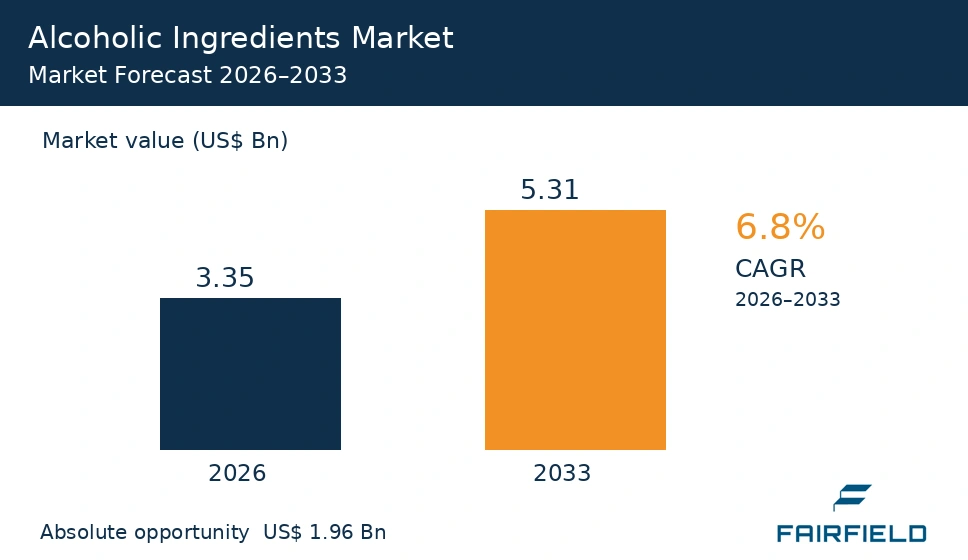
The global alcoholic ingredients market size is expected to be valued at US$ 3.35 billion in 2026 and projected to reach US$ 5.31 billion by 2033, growing at a CAGR of 6.8% between 2026 and 2033.
Between 2020 and 2025, the market grew at a CAGR of about 6.2%, rising from roughly US$ 2.32 billion to about US$ 3.14 billion, as bars and restaurants reopened after the pandemic, craft and premium drinks gained popularity, and brewers and distillers launched more flavored and low-alcohol products. The alcoholic ingredients market covers yeast, enzymes, colorants, flavors and salts, and other inputs used to make beer, spirits, wine, whisky, brandy, cider, and ready-to-drink beverages. These ingredients control fermentation, improve yield, add color, aroma, and taste, and support clarity and shelf life. They are supplied by fermentation, enzyme, and flavor companies to large brewers, distilleries, wineries, craft producers, and beverage makers. In September 2026, Lallemand launched Solyve as a dedicated food and beverage enzyme business.
Key Report Takeaways
-
By Ingredient Type: Yeast held about 34% share in 2025, while Flavors and Salts are projected to expand at an 8.2% CAGR through 2033, driven by fast growth in flavored spirits, hard seltzers, ready-to-drink cocktails, and fruit and botanical beers.
-
By Beverage Type: Beer held about 42% share in 2025, while Spirits are projected to expand at a 7.6% CAGR through 2033, driven by premium whisky, gin, tequila, and flavored spirits, and by craft distilleries in North America, Europe, and Asia Pacific.
-
By Source: Natural held about 61% share in 2025 and is also projected to expand fastest at a 7.5% CAGR through 2033, driven by clean-label demand, natural colors and flavors, and rules limiting synthetic additives in drinks.
-
By Region: Europe held about 38% share in 2025, while Asia Pacific is projected to expand at an 8.4% CAGR through 2033, driven by rising beer and spirits demand in China and India, growing incomes, and new local craft producers.
Global Alcoholic Ingredients Market Trends and Insights
Drivers Impact Analysis
Two drivers carry the strongest influence on alcoholic ingredients market demand during the forecast period.
| Driver | Impact on CAGR Forecast | Geographic Relevance | Impact Timeline |
| Premium, craft, and flavored drinks | High | North America, Europe, Asia Pacific | Medium term (2-4 years) |
| Low-alcohol and non-alcoholic beverage growth | Medium | Europe, North America | Long term (≥4 years) |
Premium and Flavored Drinks Are Driving the Alcoholic Ingredients Market
The growth of premium, craft, and flavored drinks is the strongest driver of the alcoholic ingredients market. These drinks need special ingredients.
The mechanism is that craft beers, premium spirits, flavored whiskies, botanical gins, fruit ciders, hard seltzers, and ready-to-drink cocktails use specialty yeast strains, enzymes, natural colors, and complex flavor systems to create distinct tastes. Brewers and distillers launch new flavors and limited editions often, which keeps demand for new ingredients high. Consumers in North America, Europe, and Asia Pacific are drinking less but choosing higher-quality products, a trend known as premiumization. This raises spending on ingredients per liter, even when total volumes grow slowly. Food and drink festivals, social media, and tasting rooms also help new craft brands reach drinkers, which keeps the number of small producers high and creates steady demand for ingredient suppliers that offer small pack sizes and technical help.
Low-Alcohol and Non-Alcoholic Drinks Are Expanding the Alcoholic Ingredients Market
The growth of low-alcohol and non-alcoholic beverages is expanding the alcoholic ingredients market. These drinks need special production methods.
The cause is that more consumers, especially younger adults, are cutting back on alcohol for health reasons but still want the taste of beer, wine, and spirits. Low-alcohol and non-alcoholic beers need special yeast strains that make little alcohol, enzymes that adjust sugars and body, and flavors that replace the taste lost when alcohol is removed. Fermentis has partnered with Customized Brewing Solutions on products for non-alcoholic and low-alcohol beers. Brewers in Europe and North America are expanding these ranges. This adds new, higher-value uses for ingredients. Non-alcoholic spirits and wines are also growing, and they need botanical extracts, aroma compounds, and mouthfeel enhancers to copy the feel of traditional drinks.
Restraints Impact Analysis
Two restraints limit how quickly the alcoholic ingredients market grows.
| Restraint | Impact on CAGR Forecast | Geographic Relevance | Impact Timeline |
| Falling alcohol consumption and health concerns | High | North America, Europe | Long term (≥4 years) |
| Strict regulations on alcohol and additives | Medium | Global | Medium term (2-4 years) |
Falling Alcohol Consumption Slows the Alcoholic Ingredients Market
Falling alcohol consumption and health concerns slow the alcoholic ingredients market. Many people are drinking less.
The problem is that alcohol volumes are declining in several mature markets, including the United States, the United Kingdom, France, and Germany, as younger consumers drink less and health warnings about alcohol become stronger. Some health bodies now say that no level of alcohol is safe. Weight-loss medicines may also reduce drinking among some users. Large beer and spirits companies have reported weaker sales in some markets. These trends reduce volume demand for basic ingredients such as yeast and enzymes, even as premium and non-alcoholic segments grow. Ingredient suppliers that depend heavily on mass beer volumes in mature markets face the most pressure, and many are shifting their focus to faster-growing regions and specialty products.
Strict Regulations Restrict the Alcoholic Ingredients Market
Strict regulations on alcohol and additives restrict the alcoholic ingredients market. Rules differ widely between countries.
The constraint is that alcoholic drinks face heavy taxes, advertising limits, labeling rules, and sales restrictions in many countries, which can reduce demand. Food additive rules set limits on which colorants, flavors, and enzymes can be used, and some synthetic colors face bans or warnings in Europe and the United States. Traditional rules such as Germany's beer purity law limit ingredients for some products. New labeling rules for ingredients and nutrition in the European Union add costs. These rules slow product launches and increase compliance work. Suppliers must keep detailed records, test products in several markets, and change formulas for each country, which adds cost and makes it harder for small firms to sell across borders.
Market Opportunities
Natural Flavors, Colors, and Specialty Yeasts Open a Premium Revenue Pool
Natural flavors, colors, and specialty yeasts open a premium revenue pool. Brands want clean labels and unique tastes.
The opportunity comes from natural fruit, herb, spice, and botanical flavors, plant-based colors, non-GMO enzymes, and specialty yeast strains for sour beers, hazy IPAs, low-alcohol beers, and premium spirits. Enzymes that raise yield, cut energy use, and reduce gluten also add strong value for brewers. Lallemand completed its acquisition of BIO-CAT in 2026 and launched Solyve to build its enzyme business. Companies that offer tailored ingredient systems, technical support, and fast development can earn higher margins. Gluten-reducing enzymes, sugar-free flavor systems, and functional ingredients such as adaptogens in drinks also open new premium uses, especially among health-focused younger drinkers who want both taste and wellness benefits.
Asia Pacific and Ready-to-Drink Growth Create a Growth Revenue Pool
Asia Pacific and ready-to-drink growth create a growth revenue pool. New drinkers and new formats are expanding the market.
The opportunity reflects rising beer and spirits demand in China, India, Vietnam, and Indonesia, along with strong growth in premium baijiu, whisky, and craft beer. Ready-to-drink cocktails, hard seltzers, and canned wines are growing fast in Japan, Australia, and North America. These products need flavor systems, colors, and stable formulations. Companies that build local application labs, partner with regional brewers and distillers, and offer flavors for local tastes can capture this growth. Fruit flavors such as lychee, yuzu, and mango are popular in the region, and local tea and herbal flavors also give brands new ways to stand out on crowded shelves.
Segment Analysis
By Ingredient Type: Yeast Leads While Flavors and Salts Grow Fastest
Yeast held about 34% share in 2025. Yeast is essential for fermentation in beer, wine, cider, and spirits, turning sugars into alcohol and creating many flavor and aroma compounds. Brewers and distillers use dried, liquid, and specialty yeast strains from Lallemand, Fermentis, AB Mauri, and Angel Yeast, giving this type the largest share.
Flavors and Salts are the fastest-growing ingredient type, expanding at an 8.2% CAGR through 2033. Fruit, botanical, spice, and sweet flavors are used in flavored spirits, seltzers, ciders, and ready-to-drink cocktails, while salts and minerals help adjust water and taste. Enzymes, Colorants, and Others form other segments. For the market, flavor growth raises value per liter and supports premium sales.
By Beverage Type: Beer Leads While Spirits Grow Fastest
Beer held about 42% share in 2025. Beer is the most widely consumed alcoholic drink by volume, and brewers use large amounts of yeast, enzymes, and other ingredients. Large brewers and thousands of craft breweries give this beverage type the largest share. Enzymes help brewers improve yield, filter beer faster, and make low-carb and gluten-reduced beers.
Spirits are the fastest-growing beverage type, expanding at a 7.6% CAGR through 2033. Premium whisky, gin, tequila, rum, and flavored spirits use specialty yeasts, enzymes, natural colors, and flavor systems. Wine, Whisky, Brandy, and Others form other segments. Wine makers use yeast and enzymes to control fermentation and improve clarity, while whisky and brandy producers use special yeasts for aroma. For the market, spirits growth supports premium ingredient sales.
By Source: Natural Leads and Grows Fastest
Natural held about 61% share in 2025 and is also the fastest-growing source, expanding at a 7.5% CAGR through 2033. Natural yeasts, enzymes from microbial fermentation, plant-based colors, and natural flavors match clean-label demand and rules that limit synthetic additives. Many craft and premium brands promote natural ingredients on labels, and large brewers are removing artificial colors and flavors from popular brands. Natural ingredients often cost more, but they help brands meet consumer expectations and new rules.
Synthetic forms the other segment. Synthetic colors and flavors cost less and give stable results, so they remain common in lower-priced drinks. Some markets are tightening rules on synthetic colors, which may reduce their use further. For the market, natural growth supports premium pricing.
Geography Analysis
Alcoholic Ingredients Market in North America
North America is a large alcoholic ingredients market. The United States has thousands of craft breweries and distilleries, a large ready-to-drink cocktail and hard seltzer market, and strong demand for premium spirits such as bourbon and tequila. Lallemand, ADM, Cargill, Kerry, and Givaudan are major suppliers with large local plants. Lallemand added two United States sites through its BIO-CAT deal in 2026. Key barriers include falling alcohol consumption among younger adults and rising health warnings. Canada and Mexico add strong beer and spirits demand. One opportunity is ingredients for non-alcoholic and low-alcohol drinks.
Which Region Is Leading the Alcoholic Ingredients Market?
Europe is leading the alcoholic ingredients market with about 38% share in 2025. Germany, the United Kingdom, Belgium, France, Spain, and Italy have long traditions of beer, wine, and spirits production, and many leading ingredient companies, including Lesaffre, Novonesis, dsm-firmenich, and Döhler, are based in the region. Scotland and Ireland are major whisky producers, and France leads in cognac and wine. Key barriers include strict rules and declining drinking in several western countries. Strong research centers and universities support new yeast strains. One change shaping the region is growth in non-alcoholic beer.
Which Region Is Growing Fastest in the Alcoholic Ingredients Market?
Asia Pacific is the fastest-growing region in the alcoholic ingredients market, expanding at an 8.4% CAGR through 2033. China is the world's largest beer market and has a huge baijiu industry, while India has fast-growing beer and whisky demand. Japan, South Korea, Vietnam, and Australia add demand from beer, sake, soju, and ready-to-drink products. Angel Yeast is a major local supplier. Key barriers include high alcohol taxes and strict sales rules in some countries. Many international brewers have large plants in the region. One change shaping the region is premium drink growth.
Alcoholic Ingredients Market in Latin America
Latin America is a growing alcoholic ingredients market. Brazil and Mexico have large beer industries, and Mexico is the home of tequila and mezcal, which are growing fast in export markets. Argentina and Chile have strong wine industries that export to many countries. Large brewers and distillers buy yeast, enzymes, and flavors for mass and premium brands, and craft brewing is growing in Brazil, Colombia, and Chile. Ready-to-drink cocktails are also gaining popularity. Key barriers include economic swings, high inflation, and currency changes. One opportunity is ingredients for premium tequila, mezcal, and craft beer brands.
Alcoholic Ingredients Market in Middle East & Africa
Middle East & Africa is a developing alcoholic ingredients market. South Africa has strong beer, wine, and spirits industries, and Nigeria, Kenya, and Ethiopia have growing beer markets. In many countries in the region, alcohol is restricted for religious reasons, but non-alcoholic beer and malt drinks are popular in Saudi Arabia, the United Arab Emirates, and Egypt. Large brewers use local grains such as sorghum and cassava in some markets. Key barriers include strict alcohol rules and limited local ingredient production. One opportunity is ingredients for local beer brewing and non-alcoholic malt drinks.
Competitive Landscape
The alcoholic ingredients market is moderately consolidated. Lallemand, Lesaffre through Fermentis, Novonesis, dsm-firmenich, and Kerry are leading players, while ADM, Cargill, AB Mauri, Angel Yeast, Döhler, Sensient, and Givaudan compete strongly. Yeast and enzyme supply is led by a small number of fermentation specialists with large global plants, while flavors and colors are supplied by large flavor houses and color makers. Many small yeast labs and local suppliers serve craft brewers and distillers, often offering fresh liquid yeast and fast local delivery.
Companies mainly compete on strain and enzyme performance, consistency, flavor creation, natural and clean-label ranges, technical brewing and distilling support, application labs, regulatory know-how, supply reliability, local production, and price. Close and long-term partnerships with large global brewers, spirits makers, and craft producers are important. Suppliers run pilot breweries, sensory labs, and training programs to help customers develop new products, and they work closely with large brewers on yield, water, and energy savings across many plants.
Strategic moves show how competition is changing. Biospringer by Lesaffre acquired fermentation technology from PTX Food in May 2026, while Lallemand completed its BIO-CAT acquisition in August 2026 and launched Solyve in September 2026. These moves show how leading suppliers are adding scale, new sites, and new fermentation technologies to serve more customers.
Three themes shape vendor strategy. First, suppliers are expanding enzyme capacity. Second, they are building natural flavor ranges. Third, they are targeting low-alcohol drinks.
Alcoholic Ingredients Market Industry Leaders
- Lallemand Inc.
- Lesaffre Group (Fermentis)
- Novonesis A/S
- dsm-firmenich AG
- Kerry Group plc
Recent Industry Developments
-
September 2026: Lallemand launched Solyve as a dedicated food and beverage enzyme business, combining its technical and customer support capabilities - strengthens enzyme supply for beverage processing.
-
August 2026: Lallemand completed its acquisition of BIO-CAT Enzymes & Microbials, effective July 31, 2026, adding two production sites in Virginia and Minnesota - expands enzyme and microbial capacity in the United States.
-
May 2026: Biospringer by Lesaffre acquired fermentation technology from PTX Food, expanding beyond yeast into bacterial fermentation - broadens fermentation-based ingredient platforms.
Companies Covered in the Report
-
Lallemand Inc.
-
Lesaffre Group (Fermentis)
-
Novonesis A/S
-
dsm-firmenich AG
-
Kerry Group plc
-
Archer Daniels Midland Company
-
Cargill, Incorporated
-
AB Mauri (Associated British Foods)
-
Angel Yeast Co., Ltd.
-
Döhler GmbH
-
Sensient Technologies Corporation
-
Givaudan SA
Alcoholic Ingredients Market Report Scope
This report covers the global alcoholic ingredients market, including yeast, enzymes, colorants, flavors and salts, and other ingredients, for beer, spirits, wine, whisky, brandy, and other beverages, from natural and synthetic sources, across North America, Europe, Asia Pacific, Latin America, and Middle East & Africa. The base year is 2025, and the forecast period runs from 2026 to 2033. All values are expressed in US$ Billion.
| Ingredient Type | Yeast, Enzymes, Colorants, Flavors and Salts, Others |
| Beverage Type | Beer, Spirits, Wine, Whisky, Brandy, Others |
| Source | Natural, Synthetic |
| Regions | North America, Europe, Asia Pacific, Latin America, Middle East & Africa |
1. Executive Summary
1.1 Alcoholic Ingredients Market Snapshot
1.2 Future Projections
1.3 Key Market Trends
1.4 Regional Snapshot
2. Market Overview
2.1 Market Definition and Report Scope
2.2 Historical Market Trends
2.3 Market Dynamics
2.3.1 Drivers
2.3.1.1 Premium and Flavored Drinks Are Driving the Alcoholic Ingredients Market
2.3.1.2 Low-Alcohol and Non-Alcoholic Drinks Are Expanding the Alcoholic Ingredients Market
2.3.2 Restraints
2.3.2.1 Falling Alcohol Consumption Slows the Alcoholic Ingredients Market
2.3.2.2 Strict Regulations Restrict the Alcoholic Ingredients Market
2.3.3 Market Opportunities
2.3.3.1 Natural Flavors, Colors, and Specialty Yeasts Open a Premium Revenue Pool
2.3.3.2 Asia Pacific and Ready-to-Drink Growth Create a Growth Revenue Pool
3. Global Alcoholic Ingredients Market Outlook, 2020–2033
3.1 Global Alcoholic Ingredients Market Outlook, by Ingredient Type, Value (US$ Billion), 2020–2033
3.1.1 Yeast
3.1.2 Enzymes
3.1.3 Colorants
3.1.4 Flavors and Salts
3.1.5 Others
3.2 Global Alcoholic Ingredients Market Outlook, by Beverage Type, Value (US$ Billion), 2020–2033
3.2.1 Beer
3.2.2 Spirits
3.2.3 Wine
3.2.4 Whisky
3.2.5 Brandy
3.2.6 Others
3.3 Global Alcoholic Ingredients Market Outlook, by Source, Value (US$ Billion), 2020–2033
3.3.1 Natural
3.3.2 Synthetic
3.4 Global Alcoholic Ingredients Market Outlook, by Region, Value (US$ Billion), 2020–2033
3.4.1 North America
3.4.2 Europe
3.4.3 Asia Pacific
3.4.4 Latin America
3.4.5 Middle East & Africa
4. North America Alcoholic Ingredients Market Outlook, 2020–2033
4.1 North America Alcoholic Ingredients Market Outlook, by Ingredient Type, Value (US$ Billion), 2020–2033
4.1.1 Yeast
4.1.2 Enzymes
4.1.3 Colorants
4.1.4 Flavors and Salts
4.1.5 Others
4.2 North America Alcoholic Ingredients Market Outlook, by Beverage Type, Value (US$ Billion), 2020–2033
4.2.1 Beer
4.2.2 Spirits
4.2.3 Wine
4.2.4 Whisky
4.2.5 Brandy
4.2.6 Others
4.3 North America Alcoholic Ingredients Market Outlook, by Source, Value (US$ Billion), 2020–2033
4.3.1 Natural
4.3.2 Synthetic
4.4 North America Alcoholic Ingredients Market Outlook, by Country, Value (US$ Billion), 2020–2033
4.4.1 United States Alcoholic Ingredients Market Outlook, by Ingredient Type, 2020–2033
4.4.2 United States Alcoholic Ingredients Market Outlook, by Beverage Type, 2020–2033
4.4.3 United States Alcoholic Ingredients Market Outlook, by Source, 2020–2033
4.4.4 Canada Alcoholic Ingredients Market Outlook, by Ingredient Type, 2020–2033
4.4.5 Canada Alcoholic Ingredients Market Outlook, by Beverage Type, 2020–2033
4.4.6 Canada Alcoholic Ingredients Market Outlook, by Source, 2020–2033
4.4.7 Mexico Alcoholic Ingredients Market Outlook, by Ingredient Type, 2020–2033
4.4.8 Mexico Alcoholic Ingredients Market Outlook, by Beverage Type, 2020–2033
4.4.9 Mexico Alcoholic Ingredients Market Outlook, by Source, 2020–2033
5. Europe Alcoholic Ingredients Market Outlook, 2020–2033
5.1 Europe Alcoholic Ingredients Market Outlook, by Ingredient Type, Value (US$ Billion), 2020–2033
5.1.1 Yeast
5.1.2 Enzymes
5.1.3 Colorants
5.1.4 Flavors and Salts
5.1.5 Others
5.2 Europe Alcoholic Ingredients Market Outlook, by Beverage Type, Value (US$ Billion), 2020–2033
5.2.1 Beer
5.2.2 Spirits
5.2.3 Wine
5.2.4 Whisky
5.2.5 Brandy
5.2.6 Others
5.3 Europe Alcoholic Ingredients Market Outlook, by Source, Value (US$ Billion), 2020–2033
5.3.1 Natural
5.3.2 Synthetic
5.4 Europe Alcoholic Ingredients Market Outlook, by Country, Value (US$ Billion), 2020–2033
5.4.1 Germany Alcoholic Ingredients Market Outlook, by Ingredient Type, 2020–2033
5.4.2 Germany Alcoholic Ingredients Market Outlook, by Beverage Type, 2020–2033
5.4.3 Germany Alcoholic Ingredients Market Outlook, by Source, 2020–2033
5.4.4 United Kingdom Alcoholic Ingredients Market Outlook, by Ingredient Type, 2020–2033
5.4.5 United Kingdom Alcoholic Ingredients Market Outlook, by Beverage Type, 2020–2033
5.4.6 United Kingdom Alcoholic Ingredients Market Outlook, by Source, 2020–2033
5.4.7 Belgium Alcoholic Ingredients Market Outlook, by Ingredient Type, 2020–2033
5.4.8 Belgium Alcoholic Ingredients Market Outlook, by Beverage Type, 2020–2033
5.4.9 Belgium Alcoholic Ingredients Market Outlook, by Source, 2020–2033
5.4.10 France Alcoholic Ingredients Market Outlook, by Ingredient Type, 2020–2033
5.4.11 France Alcoholic Ingredients Market Outlook, by Beverage Type, 2020–2033
5.4.12 France Alcoholic Ingredients Market Outlook, by Source, 2020–2033
5.4.13 Spain Alcoholic Ingredients Market Outlook, by Ingredient Type, 2020–2033
5.4.14 Spain Alcoholic Ingredients Market Outlook, by Beverage Type, 2020–2033
5.4.15 Spain Alcoholic Ingredients Market Outlook, by Source, 2020–2033
5.4.16 Italy Alcoholic Ingredients Market Outlook, by Ingredient Type, 2020–2033
5.4.17 Italy Alcoholic Ingredients Market Outlook, by Beverage Type, 2020–2033
5.4.18 Italy Alcoholic Ingredients Market Outlook, by Source, 2020–2033
5.4.19 Ireland Alcoholic Ingredients Market Outlook, by Ingredient Type, 2020–2033
5.4.20 Ireland Alcoholic Ingredients Market Outlook, by Beverage Type, 2020–2033
5.4.21 Ireland Alcoholic Ingredients Market Outlook, by Source, 2020–2033
6. Asia Pacific Alcoholic Ingredients Market Outlook, 2020–2033
6.1 Asia Pacific Alcoholic Ingredients Market Outlook, by Ingredient Type, Value (US$ Billion), 2020–2033
6.1.1 Yeast
6.1.2 Enzymes
6.1.3 Colorants
6.1.4 Flavors and Salts
6.1.5 Others
6.2 Asia Pacific Alcoholic Ingredients Market Outlook, by Beverage Type, Value (US$ Billion), 2020–2033
6.2.1 Beer
6.2.2 Spirits
6.2.3 Wine
6.2.4 Whisky
6.2.5 Brandy
6.2.6 Others
6.3 Asia Pacific Alcoholic Ingredients Market Outlook, by Source, Value (US$ Billion), 2020–2033
6.3.1 Natural
6.3.2 Synthetic
6.4 Asia Pacific Alcoholic Ingredients Market Outlook, by Country, Value (US$ Billion), 2020–2033
6.4.1 China Alcoholic Ingredients Market Outlook, by Ingredient Type, 2020–2033
6.4.2 China Alcoholic Ingredients Market Outlook, by Beverage Type, 2020–2033
6.4.3 China Alcoholic Ingredients Market Outlook, by Source, 2020–2033
6.4.4 India Alcoholic Ingredients Market Outlook, by Ingredient Type, 2020–2033
6.4.5 India Alcoholic Ingredients Market Outlook, by Beverage Type, 2020–2033
6.4.6 India Alcoholic Ingredients Market Outlook, by Source, 2020–2033
6.4.7 Japan Alcoholic Ingredients Market Outlook, by Ingredient Type, 2020–2033
6.4.8 Japan Alcoholic Ingredients Market Outlook, by Beverage Type, 2020–2033
6.4.9 Japan Alcoholic Ingredients Market Outlook, by Source, 2020–2033
6.4.10 South Korea Alcoholic Ingredients Market Outlook, by Ingredient Type, 2020–2033
6.4.11 South Korea Alcoholic Ingredients Market Outlook, by Beverage Type, 2020–2033
6.4.12 South Korea Alcoholic Ingredients Market Outlook, by Source, 2020–2033
6.4.13 Vietnam Alcoholic Ingredients Market Outlook, by Ingredient Type, 2020–2033
6.4.14 Vietnam Alcoholic Ingredients Market Outlook, by Beverage Type, 2020–2033
6.4.15 Vietnam Alcoholic Ingredients Market Outlook, by Source, 2020–2033
6.4.16 Australia Alcoholic Ingredients Market Outlook, by Ingredient Type, 2020–2033
6.4.17 Australia Alcoholic Ingredients Market Outlook, by Beverage Type, 2020–2033
6.4.18 Australia Alcoholic Ingredients Market Outlook, by Source, 2020–2033
7. Latin America Alcoholic Ingredients Market Outlook, 2020–2033
7.1 Latin America Alcoholic Ingredients Market Outlook, by Ingredient Type, Value (US$ Billion), 2020–2033
7.1.1 Yeast
7.1.2 Enzymes
7.1.3 Colorants
7.1.4 Flavors and Salts
7.1.5 Others
7.2 Latin America Alcoholic Ingredients Market Outlook, by Beverage Type, Value (US$ Billion), 2020–2033
7.2.1 Beer
7.2.2 Spirits
7.2.3 Wine
7.2.4 Whisky
7.2.5 Brandy
7.2.6 Others
7.3 Latin America Alcoholic Ingredients Market Outlook, by Source, Value (US$ Billion), 2020–2033
7.3.1 Natural
7.3.2 Synthetic
7.4 Latin America Alcoholic Ingredients Market Outlook, by Country, Value (US$ Billion), 2020–2033
7.4.1 Brazil Alcoholic Ingredients Market Outlook, by Ingredient Type, 2020–2033
7.4.2 Brazil Alcoholic Ingredients Market Outlook, by Beverage Type, 2020–2033
7.4.3 Brazil Alcoholic Ingredients Market Outlook, by Source, 2020–2033
7.4.4 Mexico Alcoholic Ingredients Market Outlook, by Ingredient Type, 2020–2033
7.4.5 Mexico Alcoholic Ingredients Market Outlook, by Beverage Type, 2020–2033
7.4.6 Mexico Alcoholic Ingredients Market Outlook, by Source, 2020–2033
7.4.7 Argentina Alcoholic Ingredients Market Outlook, by Ingredient Type, 2020–2033
7.4.8 Argentina Alcoholic Ingredients Market Outlook, by Beverage Type, 2020–2033
7.4.9 Argentina Alcoholic Ingredients Market Outlook, by Source, 2020–2033
7.4.10 Chile Alcoholic Ingredients Market Outlook, by Ingredient Type, 2020–2033
7.4.11 Chile Alcoholic Ingredients Market Outlook, by Beverage Type, 2020–2033
7.4.12 Chile Alcoholic Ingredients Market Outlook, by Source, 2020–2033
7.4.13 Colombia Alcoholic Ingredients Market Outlook, by Ingredient Type, 2020–2033
7.4.14 Colombia Alcoholic Ingredients Market Outlook, by Beverage Type, 2020–2033
7.4.15 Colombia Alcoholic Ingredients Market Outlook, by Source, 2020–2033
8. Middle East & Africa Alcoholic Ingredients Market Outlook, 2020–2033
8.1 Middle East & Africa Alcoholic Ingredients Market Outlook, by Ingredient Type, Value (US$ Billion), 2020–2033
8.1.1 Yeast
8.1.2 Enzymes
8.1.3 Colorants
8.1.4 Flavors and Salts
8.1.5 Others
8.2 Middle East & Africa Alcoholic Ingredients Market Outlook, by Beverage Type, Value (US$ Billion), 2020–2033
8.2.1 Beer
8.2.2 Spirits
8.2.3 Wine
8.2.4 Whisky
8.2.5 Brandy
8.2.6 Others
8.3 Middle East & Africa Alcoholic Ingredients Market Outlook, by Source, Value (US$ Billion), 2020–2033
8.3.1 Natural
8.3.2 Synthetic
8.4 Middle East & Africa Alcoholic Ingredients Market Outlook, by Country, Value (US$ Billion), 2020–2033
8.4.1 South Africa Alcoholic Ingredients Market Outlook, by Ingredient Type, 2020–2033
8.4.2 South Africa Alcoholic Ingredients Market Outlook, by Beverage Type, 2020–2033
8.4.3 South Africa Alcoholic Ingredients Market Outlook, by Source, 2020–2033
8.4.4 Nigeria Alcoholic Ingredients Market Outlook, by Ingredient Type, 2020–2033
8.4.5 Nigeria Alcoholic Ingredients Market Outlook, by Beverage Type, 2020–2033
8.4.6 Nigeria Alcoholic Ingredients Market Outlook, by Source, 2020–2033
8.4.7 Kenya Alcoholic Ingredients Market Outlook, by Ingredient Type, 2020–2033
8.4.8 Kenya Alcoholic Ingredients Market Outlook, by Beverage Type, 2020–2033
8.4.9 Kenya Alcoholic Ingredients Market Outlook, by Source, 2020–2033
8.4.10 Ethiopia Alcoholic Ingredients Market Outlook, by Ingredient Type, 2020–2033
8.4.11 Ethiopia Alcoholic Ingredients Market Outlook, by Beverage Type, 2020–2033
8.4.12 Ethiopia Alcoholic Ingredients Market Outlook, by Source, 2020–2033
8.4.13 Saudi Arabia Alcoholic Ingredients Market Outlook, by Ingredient Type, 2020–2033
8.4.14 Saudi Arabia Alcoholic Ingredients Market Outlook, by Beverage Type, 2020–2033
8.4.15 Saudi Arabia Alcoholic Ingredients Market Outlook, by Source, 2020–2033
8.4.16 United Arab Emirates Alcoholic Ingredients Market Outlook, by Ingredient Type, 2020–2033
8.4.17 United Arab Emirates Alcoholic Ingredients Market Outlook, by Beverage Type, 2020–2033
8.4.18 United Arab Emirates Alcoholic Ingredients Market Outlook, by Source, 2020–2033
8.4.19 Egypt Alcoholic Ingredients Market Outlook, by Ingredient Type, 2020–2033
8.4.20 Egypt Alcoholic Ingredients Market Outlook, by Beverage Type, 2020–2033
8.4.21 Egypt Alcoholic Ingredients Market Outlook, by Source, 2020–2033
9. Competitive Landscape
9.1 Alcoholic Ingredients Market Industry Leaders
9.2 Recent Industry Developments
9.3 Company Profiles
9.3.1 Lallemand Inc.
9.3.2 Lesaffre Group (Fermentis)
9.3.3 Novonesis A/S
9.3.4 dsm-firmenich AG
9.3.5 Kerry Group plc
9.3.6 Archer Daniels Midland Company
9.3.7 Cargill, Incorporated
9.3.8 AB Mauri (Associated British Foods)
9.3.9 Angel Yeast Co., Ltd.
9.3.10 Döhler GmbH
9.3.11 Sensient Technologies Corporation
9.3.12 Givaudan SA
10. Appendix
10.1 Research Methodology
10.2 Report Assumptions
10.3 Acronyms and Abbreviations
| Ingredient Type | Yeast, Enzymes, Colorants, Flavors and Salts, Others |
| Beverage Type | Beer, Spirits, Wine, Whisky, Brandy, Others |
| Source | Natural, Synthetic |
| Regions | North America, Europe, Asia Pacific, Latin America, Middle East & Africa |
Our Research Methodology
Considering the volatility of business today, traditional approaches to strategizing a game plan can be unfruitful if not detrimental. True ambiguity is no way to determine a forecast. A myriad of predetermined factors must be accounted for such as the degree of risk involved, the magnitude of circumstances, as well as conditions or consequences that are not known or unpredictable. To circumvent binary views that cast uncertainty, the application of market research intelligence to strategically posture, move, and enable actionable outcomes is necessary.
View Methodology
Quality Assured
Rigorous Validation Process

Confidentiality Assured
End-to-end Data Security

Custom Research Services
Tailored To Your Objectives
FAQs
The global alcoholic ingredients market is expected to be valued at US$ 3.35 billion in 2026, driven by premium, craft, and flavored drinks.
The market is projected to grow at a 6.8% CAGR from 2026 to 2033, reaching about US$ 5.31 billion by 2033.
Europe leads with about 38% share, supported by long brewing, wine, and spirits traditions and many leading ingredient makers in the region.
Asia Pacific is growing fastest at an 8.4% CAGR, driven by rising beer and spirits demand in China and India.
Key players include Lallemand, Lesaffre, Novonesis, dsm-firmenich, and Kerry, competing on quality, technical support, innovation, and price.
Related Reports
Wine Vinegar Market Size, Share, Insights, Competitive Landscape, and Forecast 2026 to 2033
The wine vinegar market is projected to grow from US$1.70 billion in 2026 to US$2.06 billion by 2033, registering a CAGR of 2.8% during the forecast period.
Soy Based Foods Market Size, Share, Insights, Competitive Landscape, and Forecast 2026 to 2033
The soy based foods market is projected to grow from US$55.6 billion in 2026 to US$74.4 billion by 2033, registering a CAGR of 4.3% during the forecast period.
Plant Protein Ingredients Market Size, Share, Insights, Competitive Landscape, and Forecast 2026 to 2033
The plant protein ingredients market is projected to grow from US$15.2 billion in 2026 to US$24.9 billion by 2033, registering a CAGR of 7.3%.
Peanut Ingredients Market Size, Share, Insights, Competitive Landscape, and Forecast 2026 to 2033
The global peanut ingredients market is valued at US$35.5 billion in 2026, reaching US$52.2 billion by 2033, growing at a 5.7% CAGR
Bouillon Cubes Market Size, Share, Insights, Competitive Landscape, and Forecast 2026 to 2033
The bouillon cubes market is projected to grow from US$5.18 billion in 2026 to US$7.20 billion by 2033, registering a CAGR of 4.8% during the forecast period.
Sunflower Oilmeal Market Size, Share, Insights, Competitive Landscape, and Forecast 2026 to 2033
The sunflower oilmeal market is projected to grow from US$6.2 billion in 2026 to US$8.9 billion by 2033, registering a CAGR of 5.3% during the forecast period.