



Wine Vinegar Market
Wine Vinegar Market Size, Share, Insights, Competitive Landscape, and Forecast 2026 to 2033
Wine Vinegar Market
Wine Vinegar Market Size and Trend Analysis
How Fast Is the Wine Vinegar Market Growing?
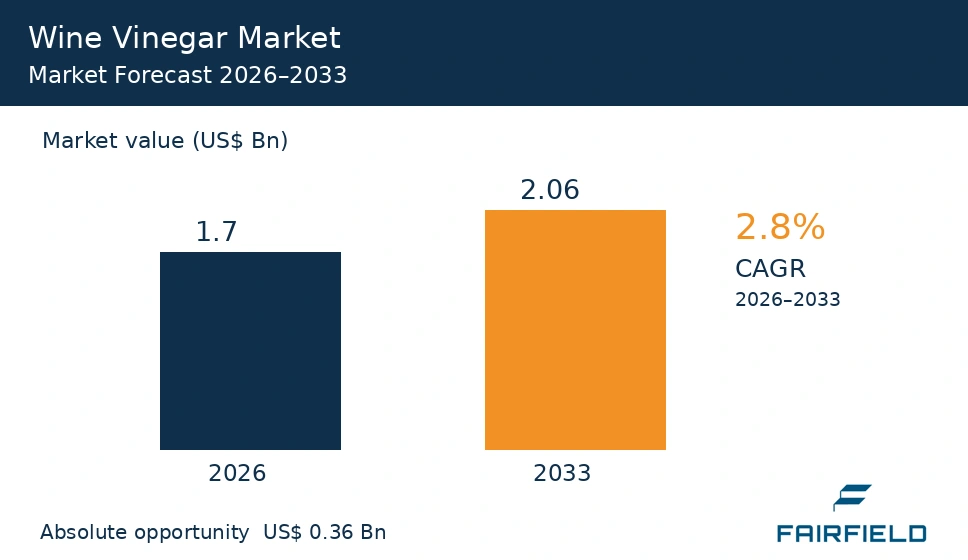
The global wine vinegar market size is expected to be valued at US$ 1.70 billion in 2026 and projected to reach US$ 2.06 billion by 2033, growing at a CAGR of 2.8% between 2026 and 2033.
Between 2020 and 2025, the market grew at a CAGR of about 2.5%, rising from roughly US$ 1.46 billion to about US$ 1.65 billion, as home cooking increased sharply during the pandemic years, Mediterranean diets gained popularity, and shoppers bought more premium, organic, and imported pantry products from Europe. The wine vinegar market covers vinegars made by fermenting red, white, sherry, champagne, and other wines. These products are used in salad dressings, marinades, sauces, pickles, mayonnaise, mustard, and cooking, and they are also sold for household cleaning, food preservation, and wellness uses at home. They are bought by households, restaurants, and food manufacturers through supermarkets, specialty food stores, food service distributors, and online shops. In March 2026, Italian vinegar maker De Nigris received B Corporation certification.
Key Report Takeaways
-
By Product Type: Red Wine Vinegar held about 46% share in 2025, while White Wine Vinegar is projected to expand at a 3.5% CAGR through 2033, driven by its mild flavor, light color, and growing use in dressings, sauces, and pickling.
-
By Nature: Conventional held about 82% share in 2025, while Organic is projected to expand at a 5.6% CAGR through 2033, driven by clean-label demand, interest in organic grapes, and premium positioning in supermarkets and specialty stores.
-
By Distribution Channel: Supermarkets and Hypermarkets held about 48% share in 2025, while Online Retail is projected to expand at a 6.2% CAGR through 2033, driven by direct-to-consumer brands, specialty food websites, and gift sets of premium vinegars.
-
By Region: Europe held about 45% share in 2025, while Asia Pacific is projected to expand at a 4.3% CAGR through 2033, driven by growing interest in western cooking, salad culture, and imported gourmet foods in China, Japan, and India.
Global Wine Vinegar Market Trends and Insights
Drivers Impact Analysis
Two drivers carry the strongest influence on wine vinegar market demand during the forecast period.
| Driver | Impact on CAGR Forecast | Geographic Relevance | Impact Timeline |
| Popularity of Mediterranean diets and home cooking | High | Europe, North America | Medium term (2-4 years) |
| Demand for premium, organic, and clean-label condiments | Medium | North America, Europe, Asia Pacific | Long term (≥4 years) |
Mediterranean Diets and Home Cooking Are Driving the Wine Vinegar Market
The popularity of Mediterranean diets and home cooking is the strongest driver of the wine vinegar market. Wine vinegar is a core pantry staple in these diets.
The mechanism is that Mediterranean eating, which includes salads, vegetables, olive oil, and vinaigrettes, is widely promoted as healthy, and wine vinegar is a key ingredient in many recipes. Cooking shows, recipe websites, and social media encourage people to make dressings and marinades at home. Households in Italy, France, Spain, and Greece use wine vinegar daily, and its use is growing in the United States, Canada, and the United Kingdom. Restaurants and food makers also use wine vinegar in sauces, dressings, and pickles, which supports steady demand. Wine vinegar is also used to make pickled vegetables, mustard, and ketchup, so demand from food factories adds a large and stable base of sales each year.
Premium and Organic Demand Is Expanding the Wine Vinegar Market
Demand for premium, organic, and clean-label condiments is expanding the wine vinegar market. Shoppers are trading up.
The cause is that consumers want simple ingredients, natural fermentation, and products from known regions, such as Spain's sherry vinegar from Jerez and France's champagne vinegar. Organic wine vinegars made from organically grown grapes are gaining shelf space in supermarkets and natural food stores. Barrel-aged and flavored wine vinegars sell at higher prices and are popular as gifts. Kosterina launched its vinegars in Walmart stores across the United States in February 2026, showing how premium Mediterranean products are reaching mass retail. These trends raise value per bottle. Gourmet food stores, olive oil shops, and online sellers also promote tasting events and recipe ideas that help shoppers try new vinegar types.
Restraints Impact Analysis
Two restraints limit how quickly the wine vinegar market grows.
| Restraint | Impact on CAGR Forecast | Geographic Relevance | Impact Timeline |
| Competition from other vinegars and dressings | High | Global | Medium term (2-4 years) |
| Wine supply changes, costs, and tariffs | Medium | Europe, North America | Medium term (2-4 years) |
Competition from Other Vinegars Slows the Wine Vinegar Market
Competition from other vinegars and ready-made dressings slows the wine vinegar market. Shoppers have many choices.
The problem is that balsamic vinegar, apple cider vinegar, rice vinegar, distilled white vinegar, and malt vinegar compete for the same uses in cooking and dressings. Apple cider vinegar has gained strong popularity for health and wellness uses, drawing attention away from wine vinegar. Many consumers buy ready-made salad dressings instead of making their own. In many parts of Asia Pacific, Latin America, and Middle East & Africa, rice, cane, and synthetic vinegars are cheaper and more familiar. These factors limit volume growth outside traditional markets. Private-label products from large supermarket chains also keep prices low, which makes it harder for branded producers to grow sales and invest in marketing.
Wine Supply and Tariffs Restrict the Wine Vinegar Market
Wine supply changes, costs, and tariffs restrict the wine vinegar market. Production depends on the wine industry.
The constraint is that wine vinegar makers need a steady supply of wine, and grape harvests vary with weather, disease, and climate change. Higher costs for glass bottles, energy, transport, and labor have raised prices. Tariffs on European food products entering the United States have increased costs for imported wine vinegars from Italy, France, and Spain. Premium wine vinegar also costs more than distilled vinegar, which limits its use in mass-market food products. These factors squeeze margins and slow growth in price-sensitive channels. Smaller producers often lack the scale to absorb rising costs, and some may sell their businesses to larger groups or focus only on niche premium products.
Market Opportunities
Organic, Aged, and Flavored Vinegars Open a Premium Revenue Pool
Organic, aged, and flavored wine vinegars open a premium revenue pool. Gourmet buyers are willing to pay more for quality and origin.
The opportunity comes from organic red and white wine vinegars, barrel-aged and reserve vinegars, protected-origin sherry and champagne vinegars, rosé and sweet wine vinegars, and flavored products infused with herbs, fruit, or honey. De Nigris has launched a sweet rosé wine vinegar made from Italian Ancellotta grapes. Gift sets, small-batch craft vinegars, and drinking vinegars also sell at high prices during holiday seasons. Companies that tell clear origin stories, use sustainable packaging, and offer premium ranges can earn higher margins. Partnerships with chefs, wineries, and gourmet retailers can raise brand awareness, while tourism visits to vinegar cellars in Italy and Spain also build loyal customers abroad.
Asia Pacific and Food Service Create a Growth Revenue Pool
Asia Pacific and food service create a growth revenue pool. Many new buyers are discovering western-style dressings and sauces.
The opportunity reflects rising interest in salads, Mediterranean restaurants, and western-style cooking in China, Japan, South Korea, India, and Australia, along with fast growth in imported gourmet foods and online grocery sales. Food service chains, hotels, and restaurants need consistent supply of wine vinegar for dressings, sauces, and marinades. Food makers use wine vinegar in mayonnaise, mustard, ketchup, and ready meals for local tastes. Companies that build distribution partnerships, offer food service packs, and educate chefs can capture this growth. Online marketplaces and cross-border e-commerce also make it easier for European brands to reach new shoppers without large investments in local stores.
Segment Analysis
By Product Type: Red Wine Vinegar Leads While White Wine Vinegar Grows Fastest
Red Wine Vinegar held about 46% share in 2025. Red wine vinegar is widely used in vinaigrettes, marinades, pickled vegetables, and Mediterranean dishes, and it is a standard product in supermarkets in Europe and North America. Its strong flavor and wide availability give this type the largest share.
White Wine Vinegar is the fastest-growing product type, expanding at a 3.5% CAGR through 2033. Its milder taste and light color make it ideal for dressings, sauces such as hollandaise and béarnaise, seafood dishes, and pickling, where it does not change food color. Sherry Vinegar, Champagne Vinegar, and Others form other segments, with sherry vinegar from Spain sold as a premium product. For the market, white wine vinegar growth supports wider use.
By Nature: Conventional Leads While Organic Grows Fastest
Conventional held about 82% share in 2025. Conventional wine vinegars are widely available, cost less, and are used by most households, restaurants, and food manufacturers. Large producers supply big volumes to supermarket private labels and food factories, which keeps this segment the largest by far.
Organic is the fastest-growing nature segment, expanding at a 5.6% CAGR through 2033. Organic wine vinegars made from certified organic grapes appeal to health-conscious and environmentally aware shoppers, and they sell at higher prices in supermarkets, natural food stores, and online shops, where buyers can read about farming methods and origin. Organic farming in Italy, Spain, and France provides a growing supply of certified grapes. For the market, organic growth raises value per bottle.
By Distribution Channel: Supermarkets and Hypermarkets Lead While Online Retail Grows Fastest
Supermarkets and Hypermarkets held about 48% share in 2025. Large grocery chains offer a wide range of wine vinegar brands and private labels at competitive prices. Shoppers often buy wine vinegar during weekly grocery trips, and in-store promotions help brands gain attention.
Online Retail is the fastest-growing channel, expanding at a 6.2% CAGR through 2033. Specialty food websites, brand stores, and grocery delivery apps make it easy to buy premium and imported vinegars, often with recipe ideas, reviews, and fast home delivery. Convenience Stores, Specialty Stores, and Food Service form other segments. Specialty stores sell aged and protected-origin vinegars, while food service distributors supply restaurants and hotels. For the market, online growth supports premium brands.
Geography Analysis
Wine Vinegar Market in North America
North America is a large wine vinegar market. The United States has strong demand for red and white wine vinegars used in salads, marinades, and food manufacturing, and many households cook Mediterranean dishes at home. Mizkan America, Pompeian, Kraft Heinz, and Napa Valley Naturals are major brands, alongside imported Italian and Spanish products. Kosterina expanded into Walmart in 2026. Key barriers include tariffs on European imports and strong competition from apple cider vinegar, which is popular for health uses. Canada adds steady demand. One opportunity is organic and craft wine vinegars from local producers in California.
Which Region Is Leading the Wine Vinegar Market?
Europe is leading the wine vinegar market with about 45% share in 2025. Italy, France, Spain, Germany, and Greece have long traditions of wine and vinegar production and use wine vinegar daily in cooking. Ponti, De Nigris, Acetum, Borges, Carl Kühne, and Monari Federzoni are major producers. Bonini merged with Olio Piro in January 2026. Protected-origin vinegars from Jerez and Modena add premium value in export markets. Key barriers include mature demand and strong private-label competition. One change shaping the region is growth in organic and sustainably made vinegars.
Which Region Is Growing Fastest in the Wine Vinegar Market?
Asia Pacific is the fastest-growing region in the wine vinegar market, expanding at a 4.3% CAGR through 2033. China, Japan, and South Korea are seeing more interest in western cooking, salads, and Mediterranean restaurants, while Australia has a strong wine industry and local vinegar production. India is adding imported gourmet foods through modern retail chains and online grocery apps. Mizkan has a strong presence in Japan. Key barriers include competition from rice vinegar, which is cheaper and more familiar in local cooking. One change shaping the region is online gourmet food sales in large cities.
Wine Vinegar Market in Latin America
Latin America is a growing wine vinegar market with rising demand from both homes and food makers. Argentina and Chile have large wine industries that also produce wine vinegar, while Brazil and Mexico have growing demand for dressings, sauces, and pickled foods. Supermarket chains are adding imported and local wine vinegar brands, and restaurants in large cities use wine vinegar for salads and sauces. Key barriers include lower incomes and competition from cheaper alcohol and fruit vinegars made locally. Growing tourism and restaurant sectors in Mexico and Brazil add demand. One opportunity is local wine vinegars made from regional grapes for supermarkets, hotels, and restaurants.
Wine Vinegar Market in Middle East & Africa
Middle East & Africa is a small but developing wine vinegar market with steady import demand. South Africa has a strong wine industry and local vinegar production, and Israel has strong demand for Mediterranean cooking ingredients and salads. The United Arab Emirates imports premium European foods for hotels, restaurants, and expatriate shoppers, and large supermarkets carry Italian and Spanish brands. Key barriers include religious and cultural limits on wine-based products in some countries, which keeps demand small and focused on tourism and international shoppers. One opportunity is premium imported vinegars for hotels, restaurants, and high-end supermarkets in large cities.
Competitive Landscape
The wine vinegar market is fragmented. Mizkan, Ponti, De Nigris, Acetum, and Borges are leading players, while Pompeian, Kraft Heinz, Carl Kühne, Monari Federzoni, Giusti, Kosterina, and Stonewall Kitchen compete strongly. Large Italian and Spanish producers supply branded and private-label wine vinegars across Europe and export markets, while Mizkan is strong in North America and Japan through its wide range of vinegars and sauces. Many small regional and craft producers sell premium vinegars through specialty stores, restaurants, and online shops, often focusing on local grapes and traditional aging methods.
Companies in this market mainly compete on flavor, acidity, grape origin, aging methods, organic and protected-origin certifications, packaging, brand story, product range, retail and food service distribution, private-label supply, and price. Strong and lasting relationships with supermarket chains and large food manufacturers are very important. Large producers also supply private-label vinegar to retailers, which helps them keep plants busy but adds price pressure during yearly contract talks.
Strategic moves show how competition is changing. Bonini and Olio Piro announced a merger in January 2026, Kosterina expanded into Walmart in February 2026, and De Nigris earned B Corporation certification in March 2026. These moves show how brands are using mergers, retail growth, and sustainability to stand out.
Three themes shape vendor strategy. First, producers are expanding organic and premium ranges. Second, they are strengthening sustainability credentials. Third, they are growing mass retail and online sales.
Wine Vinegar Market Industry Leaders
- Mizkan Holdings Co., Ltd.
- Ponti S.p.A.
- Gruppo De Nigris
- Acetum S.p.A. (Associated British Foods)
- Borges International Group
Recent Industry Developments
-
March 2026: Gruppo De Nigris, an Italian family-owned vinegar and condiment maker founded in 1889, received B Corporation certification with a score of 84.1 - strengthens sustainability credentials among premium vinegar brands.
-
February 2026: Kosterina launched its vinegars nationwide in Walmart stores in the United States, expanding beyond specialty and natural channels - brings premium Mediterranean vinegars to mass retail.
-
January 2026: Bonini, a producer of traditional balsamic vinegar of Modena, and Olio Piro, a Tuscan olive oil producer, announced a merger - combines Italian vinegar and olive oil brands.
Companies Covered in the Report
-
Mizkan Holdings Co., Ltd.
-
Ponti S.p.A.
-
Gruppo De Nigris
-
Acetum S.p.A. (Associated British Foods)
-
Borges International Group
-
Pompeian, Inc.
-
The Kraft Heinz Company
-
Carl Kühne KG
-
Monari Federzoni S.p.A.
-
Giuseppe Giusti S.r.l.
-
Kosterina
-
Stonewall Kitchen (Napa Valley Naturals)
Wine Vinegar Market Report Scope
This report covers the global wine vinegar market, including red wine, white wine, sherry, champagne, and other wine vinegars, in organic and conventional forms, sold through supermarkets and hypermarkets, convenience stores, specialty stores, online retail, and food service, across North America, Europe, Asia Pacific, Latin America, and Middle East & Africa. The base year is 2025, and the forecast runs from 2026 to 2033 in US$ Billion.
| Product Type | Red Wine Vinegar, White Wine Vinegar, Sherry Vinegar, Champagne Vinegar, Others |
| Nature | Organic, Conventional |
| Distribution Channel | Supermarkets and Hypermarkets, Convenience Stores, Specialty Stores, Online Retail, Food Service |
| Regions | North America, Europe, Asia Pacific, Latin America, Middle East & Africa |
1. Executive Summary
1.1 Wine Vinegar Market Snapshot
1.2 Future Projections
1.3 Key Market Trends
1.4 Regional Snapshot
2. Market Overview
2.1 Market Definition and Report Scope
2.2 Historical Market Trends
2.3 Market Dynamics
2.3.1 Drivers
2.3.1.1 Mediterranean Diets and Home Cooking Are Driving the Wine Vinegar Market
2.3.1.2 Premium and Organic Demand Is Expanding the Wine Vinegar Market
2.3.2 Restraints
2.3.2.1 Competition from Other Vinegars Slows the Wine Vinegar Market
2.3.2.2 Wine Supply and Tariffs Restrict the Wine Vinegar Market
2.3.3 Market Opportunities
2.3.3.1 Organic, Aged, and Flavored Vinegars Open a Premium Revenue Pool
2.3.3.2 Asia Pacific and Food Service Create a Growth Revenue Pool
3. Global Wine Vinegar Market Outlook, 2020–2033
3.1 Global Wine Vinegar Market Outlook, by Product Type, Value (US$ Billion), 2020–2033
3.1.1 Red Wine Vinegar
3.1.2 White Wine Vinegar
3.1.3 Sherry Vinegar
3.1.4 Champagne Vinegar
3.1.5 Others
3.2 Global Wine Vinegar Market Outlook, by Nature, Value (US$ Billion), 2020–2033
3.2.1 Organic
3.2.2 Conventional
3.3 Global Wine Vinegar Market Outlook, by Distribution Channel, Value (US$ Billion), 2020–2033
3.3.1 Supermarkets and Hypermarkets
3.3.2 Convenience Stores
3.3.3 Specialty Stores
3.3.4 Online Retail
3.3.5 Food Service
3.4 Global Wine Vinegar Market Outlook, by Region, Value (US$ Billion), 2020–2033
3.4.1 North America
3.4.2 Europe
3.4.3 Asia Pacific
3.4.4 Latin America
3.4.5 Middle East & Africa
4. North America Wine Vinegar Market Outlook, 2020–2033
4.1 North America Wine Vinegar Market Outlook, by Product Type, Value (US$ Billion), 2020–2033
4.1.1 Red Wine Vinegar
4.1.2 White Wine Vinegar
4.1.3 Sherry Vinegar
4.1.4 Champagne Vinegar
4.1.5 Others
4.2 North America Wine Vinegar Market Outlook, by Nature, Value (US$ Billion), 2020–2033
4.2.1 Organic
4.2.2 Conventional
4.3 North America Wine Vinegar Market Outlook, by Distribution Channel, Value (US$ Billion), 2020–2033
4.3.1 Supermarkets and Hypermarkets
4.3.2 Convenience Stores
4.3.3 Specialty Stores
4.3.4 Online Retail
4.3.5 Food Service
4.4 North America Wine Vinegar Market Outlook, by Country, Value (US$ Billion), 2020–2033
4.4.1 United States Wine Vinegar Market Outlook, by Product Type, 2020–2033
4.4.2 United States Wine Vinegar Market Outlook, by Nature, 2020–2033
4.4.3 United States Wine Vinegar Market Outlook, by Distribution Channel, 2020–2033
4.4.4 Canada Wine Vinegar Market Outlook, by Product Type, 2020–2033
4.4.5 Canada Wine Vinegar Market Outlook, by Nature, 2020–2033
4.4.6 Canada Wine Vinegar Market Outlook, by Distribution Channel, 2020–2033
5. Europe Wine Vinegar Market Outlook, 2020–2033
5.1 Europe Wine Vinegar Market Outlook, by Product Type, Value (US$ Billion), 2020–2033
5.1.1 Red Wine Vinegar
5.1.2 White Wine Vinegar
5.1.3 Sherry Vinegar
5.1.4 Champagne Vinegar
5.1.5 Others
5.2 Europe Wine Vinegar Market Outlook, by Nature, Value (US$ Billion), 2020–2033
5.2.1 Organic
5.2.2 Conventional
5.3 Europe Wine Vinegar Market Outlook, by Distribution Channel, Value (US$ Billion), 2020–2033
5.3.1 Supermarkets and Hypermarkets
5.3.2 Convenience Stores
5.3.3 Specialty Stores
5.3.4 Online Retail
5.3.5 Food Service
5.4 Europe Wine Vinegar Market Outlook, by Country, Value (US$ Billion), 2020–2033
5.4.1 Italy Wine Vinegar Market Outlook, by Product Type, 2020–2033
5.4.2 Italy Wine Vinegar Market Outlook, by Nature, 2020–2033
5.4.3 Italy Wine Vinegar Market Outlook, by Distribution Channel, 2020–2033
5.4.4 France Wine Vinegar Market Outlook, by Product Type, 2020–2033
5.4.5 France Wine Vinegar Market Outlook, by Nature, 2020–2033
5.4.6 France Wine Vinegar Market Outlook, by Distribution Channel, 2020–2033
5.4.7 Spain Wine Vinegar Market Outlook, by Product Type, 2020–2033
5.4.8 Spain Wine Vinegar Market Outlook, by Nature, 2020–2033
5.4.9 Spain Wine Vinegar Market Outlook, by Distribution Channel, 2020–2033
5.4.10 Germany Wine Vinegar Market Outlook, by Product Type, 2020–2033
5.4.11 Germany Wine Vinegar Market Outlook, by Nature, 2020–2033
5.4.12 Germany Wine Vinegar Market Outlook, by Distribution Channel, 2020–2033
6. Asia Pacific Wine Vinegar Market Outlook, 2020–2033
6.1 Asia Pacific Wine Vinegar Market Outlook, by Product Type, Value (US$ Billion), 2020–2033
6.1.1 Red Wine Vinegar
6.1.2 White Wine Vinegar
6.1.3 Sherry Vinegar
6.1.4 Champagne Vinegar
6.1.5 Others
6.2 Asia Pacific Wine Vinegar Market Outlook, by Nature, Value (US$ Billion), 2020–2033
6.2.1 Organic
6.2.2 Conventional
6.3 Asia Pacific Wine Vinegar Market Outlook, by Distribution Channel, Value (US$ Billion), 2020–2033
6.3.1 Supermarkets and Hypermarkets
6.3.2 Convenience Stores
6.3.3 Specialty Stores
6.3.4 Online Retail
6.3.5 Food Service
6.4 Asia Pacific Wine Vinegar Market Outlook, by Country, Value (US$ Billion), 2020–2033
6.4.1 China Wine Vinegar Market Outlook, by Product Type, 2020–2033
6.4.2 China Wine Vinegar Market Outlook, by Nature, 2020–2033
6.4.3 China Wine Vinegar Market Outlook, by Distribution Channel, 2020–2033
6.4.4 Japan Wine Vinegar Market Outlook, by Product Type, 2020–2033
6.4.5 Japan Wine Vinegar Market Outlook, by Nature, 2020–2033
6.4.6 Japan Wine Vinegar Market Outlook, by Distribution Channel, 2020–2033
6.4.7 South Korea Wine Vinegar Market Outlook, by Product Type, 2020–2033
6.4.8 South Korea Wine Vinegar Market Outlook, by Nature, 2020–2033
6.4.9 South Korea Wine Vinegar Market Outlook, by Distribution Channel, 2020–2033
6.4.10 Australia Wine Vinegar Market Outlook, by Product Type, 2020–2033
6.4.11 Australia Wine Vinegar Market Outlook, by Nature, 2020–2033
6.4.12 Australia Wine Vinegar Market Outlook, by Distribution Channel, 2020–2033
6.4.13 India Wine Vinegar Market Outlook, by Product Type, 2020–2033
6.4.14 India Wine Vinegar Market Outlook, by Nature, 2020–2033
6.4.15 India Wine Vinegar Market Outlook, by Distribution Channel, 2020–2033
7. Latin America Wine Vinegar Market Outlook, 2020–2033
7.1 Latin America Wine Vinegar Market Outlook, by Product Type, Value (US$ Billion), 2020–2033
7.1.1 Red Wine Vinegar
7.1.2 White Wine Vinegar
7.1.3 Sherry Vinegar
7.1.4 Champagne Vinegar
7.1.5 Others
7.2 Latin America Wine Vinegar Market Outlook, by Nature, Value (US$ Billion), 2020–2033
7.2.1 Organic
7.2.2 Conventional
7.3 Latin America Wine Vinegar Market Outlook, by Distribution Channel, Value (US$ Billion), 2020–2033
7.3.1 Supermarkets and Hypermarkets
7.3.2 Convenience Stores
7.3.3 Specialty Stores
7.3.4 Online Retail
7.3.5 Food Service
7.4 Latin America Wine Vinegar Market Outlook, by Country, Value (US$ Billion), 2020–2033
7.4.1 Argentina Wine Vinegar Market Outlook, by Product Type, 2020–2033
7.4.2 Argentina Wine Vinegar Market Outlook, by Nature, 2020–2033
7.4.3 Argentina Wine Vinegar Market Outlook, by Distribution Channel, 2020–2033
7.4.4 Chile Wine Vinegar Market Outlook, by Product Type, 2020–2033
7.4.5 Chile Wine Vinegar Market Outlook, by Nature, 2020–2033
7.4.6 Chile Wine Vinegar Market Outlook, by Distribution Channel, 2020–2033
7.4.7 Brazil Wine Vinegar Market Outlook, by Product Type, 2020–2033
7.4.8 Brazil Wine Vinegar Market Outlook, by Nature, 2020–2033
7.4.9 Brazil Wine Vinegar Market Outlook, by Distribution Channel, 2020–2033
7.4.10 Mexico Wine Vinegar Market Outlook, by Product Type, 2020–2033
7.4.11 Mexico Wine Vinegar Market Outlook, by Nature, 2020–2033
7.4.12 Mexico Wine Vinegar Market Outlook, by Distribution Channel, 2020–2033
8. Middle East & Africa Wine Vinegar Market Outlook, 2020–2033
8.1 Middle East & Africa Wine Vinegar Market Outlook, by Product Type, Value (US$ Billion), 2020–2033
8.1.1 Red Wine Vinegar
8.1.2 White Wine Vinegar
8.1.3 Sherry Vinegar
8.1.4 Champagne Vinegar
8.1.5 Others
8.2 Middle East & Africa Wine Vinegar Market Outlook, by Nature, Value (US$ Billion), 2020–2033
8.2.1 Organic
8.2.2 Conventional
8.3 Middle East & Africa Wine Vinegar Market Outlook, by Distribution Channel, Value (US$ Billion), 2020–2033
8.3.1 Supermarkets and Hypermarkets
8.3.2 Convenience Stores
8.3.3 Specialty Stores
8.3.4 Online Retail
8.3.5 Food Service
8.4 Middle East & Africa Wine Vinegar Market Outlook, by Country, Value (US$ Billion), 2020–2033
8.4.1 South Africa Wine Vinegar Market Outlook, by Product Type, 2020–2033
8.4.2 South Africa Wine Vinegar Market Outlook, by Nature, 2020–2033
8.4.3 South Africa Wine Vinegar Market Outlook, by Distribution Channel, 2020–2033
8.4.4 Israel Wine Vinegar Market Outlook, by Product Type, 2020–2033
8.4.5 Israel Wine Vinegar Market Outlook, by Nature, 2020–2033
8.4.6 Israel Wine Vinegar Market Outlook, by Distribution Channel, 2020–2033
8.4.7 United Arab Emirates Wine Vinegar Market Outlook, by Product Type, 2020–2033
8.4.8 United Arab Emirates Wine Vinegar Market Outlook, by Nature, 2020–2033
8.4.9 United Arab Emirates Wine Vinegar Market Outlook, by Distribution Channel, 2020–2033
9. Competitive Landscape
9.1 Wine Vinegar Market Industry Leaders
9.2 Recent Industry Developments
9.3 Company Profiles
9.3.1 Mizkan Holdings Co., Ltd.
9.3.2 Ponti S.p.A.
9.3.3 Gruppo De Nigris
9.3.4 Acetum S.p.A. (Associated British Foods)
9.3.5 Borges International Group
9.3.6 Pompeian, Inc.
9.3.7 The Kraft Heinz Company
9.3.8 Carl Kühne KG
9.3.9 Monari Federzoni S.p.A.
9.3.10 Giuseppe Giusti S.r.l.
9.3.11 Kosterina
9.3.12 Stonewall Kitchen (Napa Valley Naturals)
10. Appendix
10.1 Research Methodology
10.2 Report Assumptions
10.3 Acronyms and Abbreviations
| Product Type | Red Wine Vinegar, White Wine Vinegar, Sherry Vinegar, Champagne Vinegar, Others |
| Nature | Organic, Conventional |
| Distribution Channel | Supermarkets and Hypermarkets, Convenience Stores, Specialty Stores, Online Retail, Food Service |
| Regions | North America, Europe, Asia Pacific, Latin America, Middle East & Africa |
Our Research Methodology
Considering the volatility of business today, traditional approaches to strategizing a game plan can be unfruitful if not detrimental. True ambiguity is no way to determine a forecast. A myriad of predetermined factors must be accounted for such as the degree of risk involved, the magnitude of circumstances, as well as conditions or consequences that are not known or unpredictable. To circumvent binary views that cast uncertainty, the application of market research intelligence to strategically posture, move, and enable actionable outcomes is necessary.
View Methodology
Quality Assured
Rigorous Validation Process

Confidentiality Assured
End-to-end Data Security

Custom Research Services
Tailored To Your Objectives
FAQs
The global wine vinegar market is expected to be valued at US$ 1.70 billion in 2026, driven by Mediterranean diets and premium condiments.
The market is projected to grow at a 2.8% CAGR from 2026 to 2033, reaching about US$ 2.06 billion by 2033.
Europe leads with about 45% share, supported by long wine and vinegar traditions in Italy, France, and Spain.
Asia Pacific is growing fastest at a 4.3% CAGR, driven by interest in western cooking, salads, and imported gourmet foods.
Key players include Mizkan, Ponti, De Nigris, Acetum, and Borges, competing on quality, origin, organic ranges, distribution, and price.
Related Reports
Soy Based Foods Market Size, Share, Insights, Competitive Landscape, and Forecast 2026 to 2033
The soy based foods market is projected to grow from US$55.6 billion in 2026 to US$74.4 billion by 2033, registering a CAGR of 4.3% during the forecast period.
Plant Protein Ingredients Market Size, Share, Insights, Competitive Landscape, and Forecast 2026 to 2033
The plant protein ingredients market is projected to grow from US$15.2 billion in 2026 to US$24.9 billion by 2033, registering a CAGR of 7.3%.
Peanut Ingredients Market Size, Share, Insights, Competitive Landscape, and Forecast 2026 to 2033
The global peanut ingredients market is valued at US$35.5 billion in 2026, reaching US$52.2 billion by 2033, growing at a 5.7% CAGR
Bouillon Cubes Market Size, Share, Insights, Competitive Landscape, and Forecast 2026 to 2033
The bouillon cubes market is projected to grow from US$5.18 billion in 2026 to US$7.20 billion by 2033, registering a CAGR of 4.8% during the forecast period.
Alcoholic Ingredients Market Size, Share, Insights, Competitive Landscape, and Forecast 2026 to 2033
The alcoholic ingredients market is projected to grow from US$3.35 billion in 2026 to US$5.31 billion by 2033, registering a CAGR of 6.8% during the forecast period.
Sunflower Oilmeal Market Size, Share, Insights, Competitive Landscape, and Forecast 2026 to 2033
The sunflower oilmeal market is projected to grow from US$6.2 billion in 2026 to US$8.9 billion by 2033, registering a CAGR of 5.3% during the forecast period.