



Sunflower Oilmeal Market
Sunflower Oilmeal Market Size, Share, Insights, Competitive Landscape, and Forecast 2026 to 2033
Sunflower Oilmeal Market
Sunflower Oilmeal Market Size and Trend Analysis
How Fast Will the Sunflower Oilmeal Market Grow Through 2033?
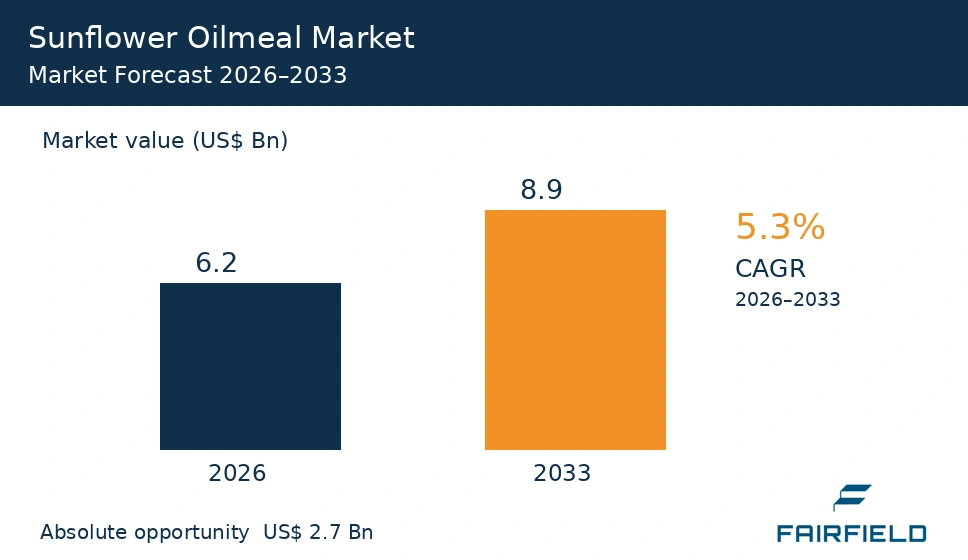
The global Sunflower Oilmeal market size is expected to be valued at US$ 6.2 billion in 2026 and projected to reach US$ 8.9 billion by 2033, growing at a CAGR of 5.3% between 2026 and 2033. Growth tracks the sunflower crushing cycle, because oilmeal volume follows sunflower oil demand rather than moving on its own. Steady protein feed consumption, firmer pellet trade flows and competitive pricing against soybean meal support the value gains. Between 2020 and 2025 the market advanced at a 4.1% CAGR, held back by freight volatility and currency swings. The absolute dollar opportunity across the forecast period reaches US$ 2.7 billion.
Key Report Takeaways
- By Protein Content Grade: Standard protein grade led with 62.0% share in 2026, while high-protein dehulled meal is projected to expand at a 6.4% CAGR through 2033, driven by added dehulling capacity at modern plants.
- By Form: Loose meal held 54.0% share in 2026, while pelletised sunflower oilmeal is projected to expand at a 6.1% CAGR through 2033, driven by lower bulk freight cost per unit of protein shipped.
- By Livestock Application: Ruminant feed accounted for 38.0% share in 2026, while aquaculture is projected to expand at a 7.2% CAGR through 2033, driven by plant protein substitution in warm-water species diets.
- By Distribution Channel: Direct bulk supply held 56.5% share in 2026, while digital commodity platforms are projected to expand at an 8.1% CAGR through 2033, driven by wider price transparency for smaller feed buyers.
- By Region: Europe led with 41.5% share in 2026, ahead of Asia Pacific, Middle East & Africa, North America and Latin America, while Asia Pacific is projected to expand at a 6.6% CAGR through 2033, driven by rising compound feed output.
Market Trends and Insights
Market Growth Drivers
Sunflower Crush Expansion Lifts Oilmeal Availability and Trade
Sunflower oilmeal supply grows mainly because crushers expand capacity to serve sunflower oil demand. Oilmeal is a co-product, so each additional tonne of seed crushed releases meal automatically. Feed buyers therefore gain volume without having to bid it away from another competing use. Crushers also treat meal revenue as a margin cushion, which keeps plants running when oil values soften. The result is a steadier protein supply line into compound feed production.
Crush investment has concentrated where seed arrives cheaply and ports allow quick dispatch. Plant operators have added preparation, dehulling and pelleting lines rather than only raising seed throughput. Fairfield Market Research observes that integrated crush and port assets shorten the path from seed to vessel. Feed manufacturers in deficit regions read that reliability as a reason to write longer supply contracts. Export trade flows have widened accordingly across several importing markets.
Price Advantage Against Soybean Meal Supports Feed Demand
Sunflower oilmeal competes for a place in feed rations mainly on delivered cost per unit of protein. When soybean meal trades at a wide premium, least-cost formulation shifts purchasing volume toward sunflower meal. That substitution effect gives the market a demand floor that does not depend on livestock herd expansion alone. Buyers located close to Black Sea supply gain the clearest advantage, since freight adds relatively little to the landed price they finally pay.
The relationship works in both directions, so sunflower meal loses ground when soybean values fall sharply. Crushers manage that exposure by selling into several livestock sectors instead of concentrating on one. Protein and fibre specifications now appear routinely in contracts, which lets buyers value individual cargoes more precisely. Fairfield Market Research notes that clearer specification pricing has made sunflower oilmeal easier to position against competing protein sources.
Restraints Impact Analysis of Market
Origin Concentration Exposes Buyers to Supply and Logistics Risk
Supply concentration in a small number of Black Sea origins limits how quickly the market can grow. Buyers who depend on one producing belt carry weather, logistics and counterparty risk in a single exposure. Feed manufacturers respond by holding alternative protein approvals, which caps the ration share sunflower meal can realistically win. Procurement teams in distant markets also discount offers to compensate for voyage and documentation uncertainty they cannot control.
Port capacity, inland rail availability and vessel scheduling matter as much as crush volume in these origins. Any interruption to handling along a single corridor moves delivered prices across several importing regions at once. Insurance and finance costs rise with that perceived concentration, which raises the working capital a trader must commit. Smaller crushers feel the effect first because they lack the balance sheet to carry extended positions.
Freight and Currency Volatility Compress Delivered-Cost Margins
Delivered cost rather than factory-gate price decides whether sunflower oilmeal reaches a distant feed mill. Ocean freight and inland haulage form a large part of that total, because meal is bulky and low in value per tonne. Rate spikes can erase the protein price advantage that attracted the buyer in the first place. Trading margins then compress quickly, and some cargoes are simply never offered into the market.
Currency movement adds a second layer, since seed is bought locally while meal is sold in dollars. Exporters facing a weakening local currency may gain temporarily, yet importers in the same position cut purchase volumes. Hedging tools exist, but smaller feed mills rarely use them consistently across a full season. Fairfield Market Research observes that this cost uncertainty keeps many buyers on short-dated contracts rather than annual commitments.
Market Opportunities
High-Protein Dehulled Grades Open Higher-Value Contracts
Dehulling creates a higher-protein grade that earns a clear premium over standard sunflower oilmeal. That premium gives crushers a way to lift revenue per tonne of seed without processing additional volume. Feed buyers accept it because higher protein density lowers the freight and storage cost carried per unit of nutrition. The grade also opens access to monogastric and aquafeed customers that standard meal has long struggled to serve.
Capturing the opportunity requires investment in hull separation, screening and consistent quality control systems. Plants that already run modern preparation lines can add the step at modest incremental cost. Hulls removed during processing are sold as fuel pellets or animal bedding, which improves overall plant economics. Fairfield Market Research sees grade differentiation becoming a central way crushers defend margin through the forecast period.
Aquaculture and Digital Trading Channels Widen the Buyer Base
Aquaculture and digital trading give sunflower oilmeal two routes into buyers it has historically reached slowly. Fish and shrimp producers are steadily replacing marine proteins, and dehulled sunflower grades suit several warm-water diets. Online commodity platforms meanwhile let smaller mills see offers that once moved only through established trader relationships. Both routes raise effective demand without requiring any new crush capacity to be built first.
Platform trading also changes how contracts settle, with digital documentation shortening payment and cargo release cycles for both sides. Sellers gain reach into fragmented buying markets across Asia and Africa where single-vessel volumes are rare. Quality assurance remains the gating factor, so suppliers that publish consistent protein and fibre test results win repeat orders. Fairfield Market Research expects channel diversification to become a visible point of competitive difference among established exporters.
Category-wise Insights
Standard Protein Grade Holds Volume While Dehulled Meal Gains Value
Standard protein sunflower oilmeal led the market with 62.0% share in 2026, reflecting the large installed base of conventional crush plants. It remains the default ration ingredient wherever fibre tolerance is acceptable and price per tonne governs the buying decision. High-protein dehulled meal is the fastest-growing grade at a 6.4% CAGR between 2026 and 2033. Growth follows investment in hull separation and screening equipment, which lets crushers lift protein content without changing seed intake. Dehulled grades travel better economically, because buyers pay freight on protein rather than on hulls. The split matters for the wider market because it separates volume leadership from margin leadership. Crushers able to supply both grades from a single site hold a stronger negotiating position with multi-species feed manufacturers.
Pelletised Meal Outpaces Loose Form on Export Economics
Loose meal held 54.0% share in 2026, because domestic buyers located near crush plants prefer it for direct mixing. Handling costs stay low over short distances, and no pelleting energy is consumed. Pelletised sunflower oilmeal is growing faster, at a 6.1% CAGR between 2026 and 2033. Pellets pack more densely, resist dust loss and flow more predictably through port conveyors and ship holds. That combination lowers delivered cost per tonne on long voyages and reduces cargo claims. Crushers serving export lanes have therefore added pelleting lines as a commercial necessity rather than an upgrade. The form split effectively mirrors the domestic and export divide in this market. It also signals that further value growth depends on trade reach rather than on crush volume alone.
Which Livestock Segment Consumes the Most Sunflower Oilmeal?
Ruminant feed consumes the most sunflower oilmeal, holding 38.0% share in 2026, because cattle and sheep digest higher fibre levels comfortably. Dairy formulations in particular use the ingredient as a steady, economical protein base. Poultry and swine follow, drawing mainly on dehulled grades where fibre tolerance is lower. Aquaculture is the fastest-growing application at a 7.2% CAGR between 2026 and 2033. Growth there reflects a long shift away from marine protein sources toward plant alternatives in warm-water species production. Aquafeed manufacturers value dehulled sunflower meal for its amino acid contribution and reliable availability. The pattern tells suppliers that volume security still rests with ruminant demand, while incremental value is increasingly created in aquafeed and monogastric channels that demand tighter specifications.
Direct Bulk Supply Dominates While Digital Platforms Scale
Direct bulk supply to feed mills and livestock integrators held 56.5% share in 2026, since large buyers contract straight with crushers. Volume certainty, specification control and settlement terms all favour that arrangement. Traders and distributors handle the remainder of conventional flow, aggregating cargoes for buyers too small to charter vessels. Digital commodity platforms are the fastest-growing channel at an 8.1% CAGR between 2026 and 2033. Adoption is strongest among mid-sized mills that previously saw only the offers their regional broker chose to show. Platforms shorten documentation cycles and make comparative pricing visible across origins. The channel shift gradually erodes information advantage held by intermediaries. For crushers it widens the addressable buyer base without requiring additional sales infrastructure in every importing country.
Geography Analysis
North America Buys Selectively Against Abundant Domestic Soybean Meal
North America accounted for 11.0% of the global market in 2026, the smallest share among the five regions. Ample domestic soybean meal supply keeps sunflower oilmeal in a specialist role rather than a core ration position. The United States and Canada crush sunflower mainly for confectionery and high-oleic oil markets, so meal volume stays modest. Dairy and beef operations across the northern plains use the meal locally, where short haul distances keep freight cost minimal. Imports arrive only when relative protein pricing turns clearly favourable. Regional demand therefore behaves opportunistically, responding quickly to soybean meal price movement rather than to underlying feed production growth, and purchasing patterns stay seasonal.
Which Region Is Leading the Sunflower Oilmeal Market?
Europe leads the sunflower oilmeal market with 41.5% share in 2026, because the region combines large crush capacity with heavy feed demand. Ukraine, Russia, Turkey, Spain and France anchor both processing and consumption within the regional taxonomy. Black Sea plants supply export cargoes, while Western European mills buy meal for dairy and swine rations. Port terminals, silo networks and short sea routes make onward redistribution efficient and predictable across the continent. Compound feed manufacturers maintain established approval processes for sunflower grades, which lowers switching friction. Regional leadership rests on close proximity between crushing assets and the large feed manufacturing industry that consumes most of their output each season.
Which Region Is Growing Fastest in the Sunflower Oilmeal Market?
Asia Pacific is growing fastest at a 6.6% CAGR between 2026 and 2033, holding 26.0% share in 2026. Expanding compound feed output across India, China, Vietnam and Indonesia drives the increase. Poultry and aquaculture capacity additions create steady protein demand that local oilseed crushing capacity cannot fully cover on its own. Port upgrades and larger bulk handling berths have made imported meal cargoes more economical to discharge. Buyers also use sunflower oilmeal to diversify away from dependence on a single imported protein source. Rising disposable income and higher animal protein consumption underpin the trend, giving the region the strongest structural growth outlook of the five regions covered.
Latin America Remains a Marginal Buyer Beside Local Protein Supply
Latin America represented 9.0% of the market in 2026, constrained by the region's own abundant oilseed processing base. Argentina crushes sunflower at meaningful scale and exports meal rather than importing it. Brazil and neighbouring markets rely largely on domestically produced soybean meal for feed protein. Sunflower oilmeal therefore serves niche formulation needs and regional balancing rather than bulk ration demand across the region. Export activity from Argentine ports nonetheless gives the region clear relevance on the supply side of global sunflower oilmeal trade. Growth prospects stay moderate, tied closely to sunflower planted area and the relative returns the crop offers against competing row crops each season.
Middle East & Africa Leans on Imports to Fill Protein Deficits
Middle East & Africa held 12.5% share in 2026, supported by structural protein deficits and limited domestic oilseed crushing. Egypt, Saudi Arabia, Morocco and South Africa import meal to supply growing poultry and dairy operations. Proximity to Black Sea loading ports keeps voyage times short and delivery schedules manageable for regional importers. Government interest in food security has encouraged silo construction and port storage investment across several countries. Feed manufacturers favour pelletised cargoes because inland transport distances from port to mill are often long. Demand growth follows population expansion and poultry capacity additions far more closely than it follows gains in livestock productivity across the region.
Competitive Landscape
The sunflower oilmeal market is moderately concentrated, with a small group of integrated crushers and trading houses moving most export volume. Bunge Global SA, Cargill, Incorporated, Archer-Daniels-Midland Company and Louis Dreyfus Company compete alongside origin-based processors such as Kernel Holding S.A. and Viterra Limited. Scale matters because meal margins are thin and depend on moving cargoes continuously. Regional crushers remain numerous, yet most sell into domestic feed demand rather than contesting export lanes directly.
Competition centres on consistency rather than product novelty. Buyers judge suppliers on protein and fibre stability, moisture control, pellet durability and cleanliness of loading. Companies that have added dehulling and pelleting lines can offer more than one grade from the same plant, which widens their customer list. Energy efficiency and solvent recovery also shape unit cost, so plant age quietly determines who can bid competitively on thin margins.
Strategic activity concentrates on asset positioning rather than headline transactions. Firms invest in port terminals, silo capacity and inland logistics because control of handling determines delivery reliability. Others extend laboratory testing and digital contract tools so buyers can verify quality before shipment. Each move matters competitively because it reduces the discount a distant buyer applies to an unfamiliar origin or an unproven counterparty.
The broader direction favours suppliers that can diversify origin, grade and channel at the same time. Fairfield Market Research sees sustainability reporting, traceability and flexible contract sizes becoming standard expectations rather than genuine differentiators. Competitive advantage increasingly rests on the ability to serve several livestock sectors without renegotiating specifications each season.
Industry Leaders
-
Bunge Global SA
-
Cargill, Incorporated
-
Archer-Daniels-Midland Company
-
Louis Dreyfus Company
-
Kernel Holding S.A.
-
Viterra Limited
Companies Covered in the Report
-
Bunge Global SA
-
Cargill, Incorporated
-
Archer-Daniels-Midland Company
-
Louis Dreyfus Company
-
Kernel Holding S.A.
-
Viterra Limited
-
Olam Agri Holdings
-
COFCO International
-
MHP SE
-
Astarta Holding N.V.
-
Avril Group
-
Sodrugestvo Group
-
ViOil Group
-
Allseeds Group
-
Risoil S.A.
Sunflower Oilmeal Market Report Scope
The Sunflower Oilmeal market is segmented by protein content grade, form, livestock application, distribution channel and region.
| By Protein Content Grade | Standard Protein Grade, High-Protein Dehulled Grade |
| By Form | Loose Meal, Pellet |
| By Livestock Application | Ruminants, Poultry, Swine, Aquaculture |
| By Distribution Channel | Direct Bulk Supply, Traders and Distributors, Digital Commodity Platforms |
| By Region | North America, Europe, Asia Pacific, Latin America, Middle East & Africa |
1. Executive Summary
1.1 Sunflower Oilmeal Market Snapshot
1.2 Future Projections
1.3 Key Market Trends
1.4 Regional Snapshot
2. Market Overview
2.1 Market Definition and Report Scope
2.2 Historical Market Trends
2.3 Market Dynamics
2.3.1 Drivers
2.3.1.1 Sunflower Crush Expansion Lifts Oilmeal Availability and Trade
2.3.1.2 Price Advantage Against Soybean Meal Supports Feed Demand
2.3.2 Restraints
2.3.2.1 Origin Concentration Exposes Buyers to Supply and Logistics Risk
2.3.2.2 Freight and Currency Volatility Compress Delivered-Cost Margins
2.3.3 Market Opportunities
2.3.3.1 High-Protein Dehulled Grades Open Higher-Value Contracts
2.3.3.2 Aquaculture and Digital Trading Channels Widen the Buyer Base
3. Global Sunflower Oilmeal Market Outlook, 2026–2033
3.1 Global Sunflower Oilmeal Market Outlook, by Protein Content Grade, Value (US$ Billion), 2026–2033
3.1.1 Standard Protein Grade
3.1.2 High-Protein Dehulled Grade
3.2 Global Sunflower Oilmeal Market Outlook, by Form, Value (US$ Billion), 2026–2033
3.2.1 Loose Meal
3.2.2 Pellet
3.3 Global Sunflower Oilmeal Market Outlook, by Livestock Application, Value (US$ Billion), 2026–2033
3.3.1 Ruminants
3.3.2 Poultry
3.3.3 Swine
3.3.4 Aquaculture
3.4 Global Sunflower Oilmeal Market Outlook, by Distribution Channel, Value (US$ Billion), 2026–2033
3.4.1 Direct Bulk Supply
3.4.2 Traders and Distributors
3.4.3 Digital Commodity Platforms
3.5 Global Sunflower Oilmeal Market Outlook, by Region, Value (US$ Billion), 2026–2033
3.5.1 North America
3.5.2 Europe
3.5.3 Asia Pacific
3.5.4 Latin America
3.5.5 Middle East & Africa
4. North America Sunflower Oilmeal Market Outlook, 2026–2033
4.1 North America Sunflower Oilmeal Market Outlook, by Protein Content Grade, Value (US$ Billion), 2026–2033
4.1.1 Standard Protein Grade
4.1.2 High-Protein Dehulled Grade
4.2 North America Sunflower Oilmeal Market Outlook, by Form, Value (US$ Billion), 2026–2033
4.2.1 Loose Meal
4.2.2 Pellet
4.3 North America Sunflower Oilmeal Market Outlook, by Livestock Application, Value (US$ Billion), 2026–2033
4.3.1 Ruminants
4.3.2 Poultry
4.3.3 Swine
4.3.4 Aquaculture
4.4 North America Sunflower Oilmeal Market Outlook, by Distribution Channel, Value (US$ Billion), 2026–2033
4.4.1 Direct Bulk Supply
4.4.2 Traders and Distributors
4.4.3 Digital Commodity Platforms
4.5 North America Sunflower Oilmeal Market Outlook, by Country, Value (US$ Billion), 2026–2033
4.5.1 United States Sunflower Oilmeal Market Outlook, by Protein Content Grade, 2026–2033
4.5.2 United States Sunflower Oilmeal Market Outlook, by Form, 2026–2033
4.5.3 United States Sunflower Oilmeal Market Outlook, by Livestock Application, 2026–2033
4.5.4 United States Sunflower Oilmeal Market Outlook, by Distribution Channel, 2026–2033
4.5.5 Canada Sunflower Oilmeal Market Outlook, by Protein Content Grade, 2026–2033
4.5.6 Canada Sunflower Oilmeal Market Outlook, by Form, 2026–2033
4.5.7 Canada Sunflower Oilmeal Market Outlook, by Livestock Application, 2026–2033
4.5.8 Canada Sunflower Oilmeal Market Outlook, by Distribution Channel, 2026–2033
5. Europe Sunflower Oilmeal Market Outlook, 2026–2033
5.1 Europe Sunflower Oilmeal Market Outlook, by Protein Content Grade, Value (US$ Billion), 2026–2033
5.1.1 Standard Protein Grade
5.1.2 High-Protein Dehulled Grade
5.2 Europe Sunflower Oilmeal Market Outlook, by Form, Value (US$ Billion), 2026–2033
5.2.1 Loose Meal
5.2.2 Pellet
5.3 Europe Sunflower Oilmeal Market Outlook, by Livestock Application, Value (US$ Billion), 2026–2033
5.3.1 Ruminants
5.3.2 Poultry
5.3.3 Swine
5.3.4 Aquaculture
5.4 Europe Sunflower Oilmeal Market Outlook, by Distribution Channel, Value (US$ Billion), 2026–2033
5.4.1 Direct Bulk Supply
5.4.2 Traders and Distributors
5.4.3 Digital Commodity Platforms
5.5 Europe Sunflower Oilmeal Market Outlook, by Country, Value (US$ Billion), 2026–2033
5.5.1 Russia Sunflower Oilmeal Market Outlook, by Protein Content Grade, 2026–2033
5.5.2 Russia Sunflower Oilmeal Market Outlook, by Form, 2026–2033
5.5.3 Russia Sunflower Oilmeal Market Outlook, by Livestock Application, 2026–2033
5.5.4 Russia Sunflower Oilmeal Market Outlook, by Distribution Channel, 2026–2033
5.5.5 Turkey Sunflower Oilmeal Market Outlook, by Protein Content Grade, 2026–2033
5.5.6 Turkey Sunflower Oilmeal Market Outlook, by Form, 2026–2033
5.5.7 Turkey Sunflower Oilmeal Market Outlook, by Livestock Application, 2026–2033
5.5.8 Turkey Sunflower Oilmeal Market Outlook, by Distribution Channel, 2026–2033
5.5.9 Spain Sunflower Oilmeal Market Outlook, by Protein Content Grade, 2026–2033
5.5.10 Spain Sunflower Oilmeal Market Outlook, by Form, 2026–2033
5.5.11 Spain Sunflower Oilmeal Market Outlook, by Livestock Application, 2026–2033
5.5.12 Spain Sunflower Oilmeal Market Outlook, by Distribution Channel, 2026–2033
5.5.13 France Sunflower Oilmeal Market Outlook, by Protein Content Grade, 2026–2033
5.5.14 France Sunflower Oilmeal Market Outlook, by Form, 2026–2033
5.5.15 France Sunflower Oilmeal Market Outlook, by Livestock Application, 2026–2033
5.5.16 France Sunflower Oilmeal Market Outlook, by Distribution Channel, 2026–2033
6. Asia Pacific Sunflower Oilmeal Market Outlook, 2026–2033
6.1 Asia Pacific Sunflower Oilmeal Market Outlook, by Protein Content Grade, Value (US$ Billion), 2026–2033
6.1.1 Standard Protein Grade
6.1.2 High-Protein Dehulled Grade
6.2 Asia Pacific Sunflower Oilmeal Market Outlook, by Form, Value (US$ Billion), 2026–2033
6.2.1 Loose Meal
6.2.2 Pellet
6.3 Asia Pacific Sunflower Oilmeal Market Outlook, by Livestock Application, Value (US$ Billion), 2026–2033
6.3.1 Ruminants
6.3.2 Poultry
6.3.3 Swine
6.3.4 Aquaculture
6.4 Asia Pacific Sunflower Oilmeal Market Outlook, by Distribution Channel, Value (US$ Billion), 2026–2033
6.4.1 Direct Bulk Supply
6.4.2 Traders and Distributors
6.4.3 Digital Commodity Platforms
6.5 Asia Pacific Sunflower Oilmeal Market Outlook, by Country, Value (US$ Billion), 2026–2033
6.5.1 India Sunflower Oilmeal Market Outlook, by Protein Content Grade, 2026–2033
6.5.2 India Sunflower Oilmeal Market Outlook, by Form, 2026–2033
6.5.3 India Sunflower Oilmeal Market Outlook, by Livestock Application, 2026–2033
6.5.4 India Sunflower Oilmeal Market Outlook, by Distribution Channel, 2026–2033
6.5.5 China Sunflower Oilmeal Market Outlook, by Protein Content Grade, 2026–2033
6.5.6 China Sunflower Oilmeal Market Outlook, by Form, 2026–2033
6.5.7 China Sunflower Oilmeal Market Outlook, by Livestock Application, 2026–2033
6.5.8 China Sunflower Oilmeal Market Outlook, by Distribution Channel, 2026–2033
6.5.9 Vietnam Sunflower Oilmeal Market Outlook, by Protein Content Grade, 2026–2033
6.5.10 Vietnam Sunflower Oilmeal Market Outlook, by Form, 2026–2033
6.5.11 Vietnam Sunflower Oilmeal Market Outlook, by Livestock Application, 2026–2033
6.5.12 Vietnam Sunflower Oilmeal Market Outlook, by Distribution Channel, 2026–2033
6.5.13 Indonesia Sunflower Oilmeal Market Outlook, by Protein Content Grade, 2026–2033
6.5.14 Indonesia Sunflower Oilmeal Market Outlook, by Form, 2026–2033
6.5.15 Indonesia Sunflower Oilmeal Market Outlook, by Livestock Application, 2026–2033
6.5.16 Indonesia Sunflower Oilmeal Market Outlook, by Distribution Channel, 2026–2033
7. Latin America Sunflower Oilmeal Market Outlook, 2026–2033
7.1 Latin America Sunflower Oilmeal Market Outlook, by Protein Content Grade, Value (US$ Billion), 2026–2033
7.1.1 Standard Protein Grade
7.1.2 High-Protein Dehulled Grade
7.2 Latin America Sunflower Oilmeal Market Outlook, by Form, Value (US$ Billion), 2026–2033
7.2.1 Loose Meal
7.2.2 Pellet
7.3 Latin America Sunflower Oilmeal Market Outlook, by Livestock Application, Value (US$ Billion), 2026–2033
7.3.1 Ruminants
7.3.2 Poultry
7.3.3 Swine
7.3.4 Aquaculture
7.4 Latin America Sunflower Oilmeal Market Outlook, by Distribution Channel, Value (US$ Billion), 2026–2033
7.4.1 Direct Bulk Supply
7.4.2 Traders and Distributors
7.4.3 Digital Commodity Platforms
7.5 Latin America Sunflower Oilmeal Market Outlook, by Country, Value (US$ Billion), 2026–2033
7.5.1 Argentina Sunflower Oilmeal Market Outlook, by Protein Content Grade, 2026–2033
7.5.2 Argentina Sunflower Oilmeal Market Outlook, by Form, 2026–2033
7.5.3 Argentina Sunflower Oilmeal Market Outlook, by Livestock Application, 2026–2033
7.5.4 Argentina Sunflower Oilmeal Market Outlook, by Distribution Channel, 2026–2033
7.5.5 Brazil Sunflower Oilmeal Market Outlook, by Protein Content Grade, 2026–2033
7.5.6 Brazil Sunflower Oilmeal Market Outlook, by Form, 2026–2033
7.5.7 Brazil Sunflower Oilmeal Market Outlook, by Livestock Application, 2026–2033
7.5.8 Brazil Sunflower Oilmeal Market Outlook, by Distribution Channel, 2026–2033
8. Middle East & Africa Sunflower Oilmeal Market Outlook, 2026–2033
8.1 Middle East & Africa Sunflower Oilmeal Market Outlook, by Protein Content Grade, Value (US$ Billion), 2026–2033
8.1.1 Standard Protein Grade
8.1.2 High-Protein Dehulled Grade
8.2 Middle East & Africa Sunflower Oilmeal Market Outlook, by Form, Value (US$ Billion), 2026–2033
8.2.1 Loose Meal
8.2.2 Pellet
8.3 Middle East & Africa Sunflower Oilmeal Market Outlook, by Livestock Application, Value (US$ Billion), 2026–2033
8.3.1 Ruminants
8.3.2 Poultry
8.3.3 Swine
8.3.4 Aquaculture
8.4 Middle East & Africa Sunflower Oilmeal Market Outlook, by Distribution Channel, Value (US$ Billion), 2026–2033
8.4.1 Direct Bulk Supply
8.4.2 Traders and Distributors
8.4.3 Digital Commodity Platforms
8.5 Middle East & Africa Sunflower Oilmeal Market Outlook, by Country, Value (US$ Billion), 2026–2033
8.5.1 Egypt Sunflower Oilmeal Market Outlook, by Protein Content Grade, 2026–2033
8.5.2 Egypt Sunflower Oilmeal Market Outlook, by Form, 2026–2033
8.5.3 Egypt Sunflower Oilmeal Market Outlook, by Livestock Application, 2026–2033
8.5.4 Egypt Sunflower Oilmeal Market Outlook, by Distribution Channel, 2026–2033
8.5.5 Saudi Arabia Sunflower Oilmeal Market Outlook, by Protein Content Grade, 2026–2033
8.5.6 Saudi Arabia Sunflower Oilmeal Market Outlook, by Form, 2026–2033
8.5.7 Saudi Arabia Sunflower Oilmeal Market Outlook, by Livestock Application, 2026–2033
8.5.8 Saudi Arabia Sunflower Oilmeal Market Outlook, by Distribution Channel, 2026–2033
8.5.9 Morocco Sunflower Oilmeal Market Outlook, by Protein Content Grade, 2026–2033
8.5.10 Morocco Sunflower Oilmeal Market Outlook, by Form, 2026–2033
8.5.11 Morocco Sunflower Oilmeal Market Outlook, by Livestock Application, 2026–2033
8.5.12 Morocco Sunflower Oilmeal Market Outlook, by Distribution Channel, 2026–2033
8.5.13 South Africa Sunflower Oilmeal Market Outlook, by Protein Content Grade, 2026–2033
8.5.14 South Africa Sunflower Oilmeal Market Outlook, by Form, 2026–2033
8.5.15 South Africa Sunflower Oilmeal Market Outlook, by Livestock Application, 2026–2033
8.5.16 South Africa Sunflower Oilmeal Market Outlook, by Distribution Channel, 2026–2033
9. Competitive Landscape
9.1 Industry Leaders
9.2 Company Profiles
9.2.1 Bunge Global SA
9.2.2 Cargill, Incorporated
9.2.3 Archer-Daniels-Midland Company
9.2.4 Louis Dreyfus Company
9.2.5 Kernel Holding S.A.
9.2.6 Viterra Limited
9.2.7 Olam Agri Holdings
9.2.8 COFCO International
9.2.9 MHP SE
9.2.10 Astarta Holding N.V.
9.2.11 Avril Group
9.2.12 Sodrugestvo Group
9.2.13 ViOil Group
9.2.14 Allseeds Group
9.2.15 Risoil S.A.
10. Appendix
10.1 Research Methodology
10.2 Report Assumptions
10.3 Acronyms and Abbreviations
| By Protein Content Grade | Standard Protein Grade, High-Protein Dehulled Grade |
| By Form | Loose Meal, Pellet |
| By Livestock Application | Ruminants, Poultry, Swine, Aquaculture |
| By Distribution Channel | Direct Bulk Supply, Traders and Distributors, Digital Commodity Platforms |
| By Region | North America, Europe, Asia Pacific, Latin America, Middle East & Africa |
Our Research Methodology
Considering the volatility of business today, traditional approaches to strategizing a game plan can be unfruitful if not detrimental. True ambiguity is no way to determine a forecast. A myriad of predetermined factors must be accounted for such as the degree of risk involved, the magnitude of circumstances, as well as conditions or consequences that are not known or unpredictable. To circumvent binary views that cast uncertainty, the application of market research intelligence to strategically posture, move, and enable actionable outcomes is necessary.
View Methodology
Quality Assured
Rigorous Validation Process

Confidentiality Assured
End-to-end Data Security

Custom Research Services
Tailored To Your Objectives
FAQs
The global market is valued at US$ 6.2 billion in 2026 and is projected to reach US$ 8.9 billion by 2033.
The market is forecast to grow at a 5.3% CAGR between 2026 and 2033, creating an absolute opportunity of US$ 2.7 billion.
Ruminant feed accounts for the largest share at 38.0% in 2026, while aquaculture grows fastest at a 7.2% CAGR through 2033.
Europe holds 41.5% share in 2026, supported by concentrated crushing capacity and large regional dairy, swine and poultry feed consumption.
Leading participants in this market include Bunge Global SA, Cargill, Incorporated, Archer-Daniels-Midland Company, Louis Dreyfus Company, Kernel Holding S.A. and Viterra Limited.
Related Reports
Wine Vinegar Market Size, Share, Insights, Competitive Landscape, and Forecast 2026 to 2033
The wine vinegar market is projected to grow from US$1.70 billion in 2026 to US$2.06 billion by 2033, registering a CAGR of 2.8% during the forecast period.
Soy Based Foods Market Size, Share, Insights, Competitive Landscape, and Forecast 2026 to 2033
The soy based foods market is projected to grow from US$55.6 billion in 2026 to US$74.4 billion by 2033, registering a CAGR of 4.3% during the forecast period.
Plant Protein Ingredients Market Size, Share, Insights, Competitive Landscape, and Forecast 2026 to 2033
The plant protein ingredients market is projected to grow from US$15.2 billion in 2026 to US$24.9 billion by 2033, registering a CAGR of 7.3%.
Peanut Ingredients Market Size, Share, Insights, Competitive Landscape, and Forecast 2026 to 2033
The global peanut ingredients market is valued at US$35.5 billion in 2026, reaching US$52.2 billion by 2033, growing at a 5.7% CAGR
Bouillon Cubes Market Size, Share, Insights, Competitive Landscape, and Forecast 2026 to 2033
The bouillon cubes market is projected to grow from US$5.18 billion in 2026 to US$7.20 billion by 2033, registering a CAGR of 4.8% during the forecast period.
Alcoholic Ingredients Market Size, Share, Insights, Competitive Landscape, and Forecast 2026 to 2033
The alcoholic ingredients market is projected to grow from US$3.35 billion in 2026 to US$5.31 billion by 2033, registering a CAGR of 6.8% during the forecast period.