



Bouillon Cubes Market
Bouillon Cubes Market Size, Share, Insights, Competitive Landscape, and Forecast 2026 to 2033
Bouillon Cubes Market
Bouillon Cubes Market Size and Trend Analysis
How Fast Is the Bouillon Cubes Market Growing?
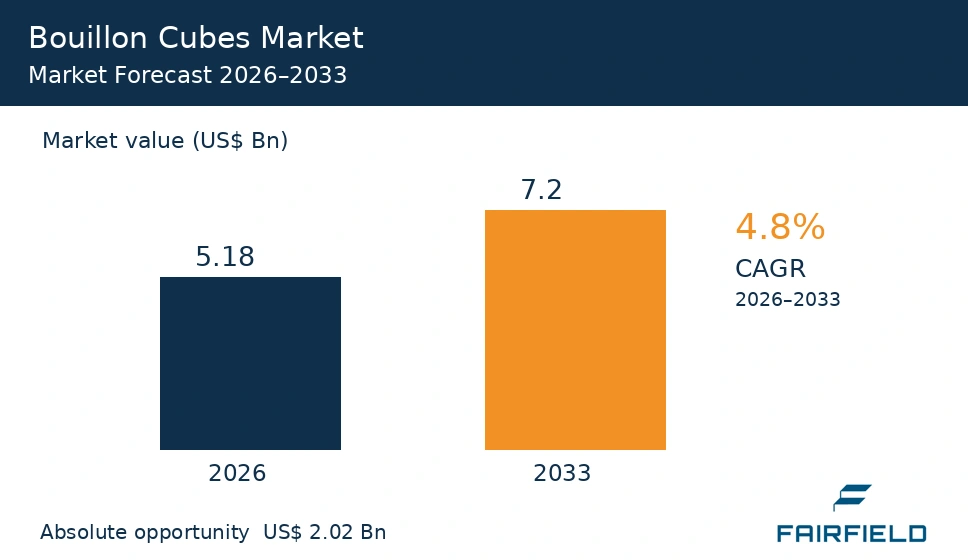
The global bouillon cubes market size is expected to be valued at US$ 5.18 billion in 2026 and projected to reach US$ 7.20 billion by 2033, growing at a CAGR of 4.8% between 2026 and 2033.
Between 2020 and 2025, the market grew at a CAGR of about 4.0%, rising from roughly US$ 4.05 billion to about US$ 4.94 billion, as home cooking increased during the pandemic, rising food prices pushed families toward low-cost flavor boosters, and demand for convenient cooking aids grew in cities. The bouillon cubes market covers dehydrated stock and seasoning cubes and tablets made from salt, fats, flavor enhancers, vegetables, herbs, spices, and meat or fish extracts. Flavors include chicken, beef, vegetable, fish, and others. They are used by households, restaurants, caterers, and food makers to flavor soups, stews, sauces, rice, and meat dishes, and they are sold through supermarkets, small shops, open markets, and online stores. In August 2026, Nestlé Cameroon launched three locally made MAGGI powdered seasonings.
Key Report Takeaways
-
By Type: Chicken held about 36% share in 2025, while Vegetable is projected to expand at a 6.0% CAGR through 2033, driven by plant-based diets, demand for meat-free cooking, and organic, low-sodium, and clean-label vegetable cubes in supermarkets.
-
By Distribution Channel: Store-Based held about 88% share in 2025, while Non-Store-Based is projected to expand at a 9.5% CAGR through 2033, driven by online grocery shopping, quick commerce, bulk packs, and direct-to-consumer brand stores.
-
By End User: Household held about 72% share in 2025, while Food Service is projected to expand at a 5.6% CAGR through 2033, driven by restaurant growth, catering, and demand for consistent and low-cost flavor in large-scale cooking.
-
By Region: North America held about 40% share in 2025, while Asia Pacific is projected to expand at a 6.1% CAGR through 2033, driven by rising packaged food use, urban cooking habits, and fast growth in India, China, and Indonesia.
Global Bouillon Cubes Market Trends and Insights
Drivers Impact Analysis
Two drivers carry the strongest influence on bouillon cubes market demand during the forecast period.
| Driver | Impact on CAGR Forecast | Geographic Relevance | Impact Timeline |
| Demand for convenient and affordable cooking aids | High | Global, with focus on Middle East & Africa and Asia Pacific | Medium term (2-4 years) |
| Growth in plant-based, organic, and low-sodium products | Medium | North America, Europe | Long term (≥4 years) |
Convenience and Affordability Are Driving the Bouillon Cubes Market
Demand for convenient and affordable cooking aids is the strongest driver of the bouillon cubes market. Cubes add flavor quickly and cheaply.
The mechanism is that bouillon cubes give rich flavor to soups, stews, rice, and sauces in minutes, without the time and cost of making stock from scratch. Small, low-cost packs make them affordable for low-income households, and they have a long shelf life without refrigeration. In Nigeria, Ghana, Cameroon, and other countries, cubes are a daily kitchen staple, and Nestlé sells about 80 million MAGGI cubes a day in Nigeria. Busy urban families in North America, Europe, and Asia Pacific also use cubes to save time. This broad use supports steady volume growth. Rising food prices also make cubes attractive, because a single low-cost cube can flavor a large family meal.
Plant-Based and Healthier Products Are Expanding the Bouillon Cubes Market
Growth in plant-based, organic, and low-sodium products is expanding the bouillon cubes market. Shoppers want healthier cooking aids.
The cause is that more consumers follow vegetarian, vegan, or flexitarian diets and need vegetable-based stocks for cooking. Health-conscious buyers look for cubes with less salt, no added monosodium glutamate, no palm oil, organic ingredients, and clean labels. Organic bouillon is growing at about 6% a year. Brands are also adding gluten-free, keto, and bone broth versions. Fortification with iodine, iron, and zinc in cubes helps address nutrient gaps in many countries. These products sell at higher prices, raising value per pack. Supermarkets in Europe and North America now give more shelf space to organic and vegan bouillon, and specialty brands are winning new shoppers through health food stores and online channels.
Restraints Impact Analysis
Two restraints limit how quickly the bouillon cubes market grows.
| Restraint | Impact on CAGR Forecast | Geographic Relevance | Impact Timeline |
| Health concerns over salt and additives | High | North America, Europe, Middle East & Africa | Long term (≥4 years) |
| Competition from liquid stocks, pastes, and powders | Medium | North America, Europe | Medium term (2-4 years) |
Salt and Additive Concerns Slow the Bouillon Cubes Market
Health concerns over salt and additives slow the bouillon cubes market. Many cubes contain high sodium levels.
The problem is that standard bouillon cubes can contain a large share of the daily recommended salt intake, and high salt diets are linked to high blood pressure and heart disease. Health authorities in many countries are encouraging food makers to cut salt, and some consumers avoid flavor enhancers and palm oil. In Nigeria, public misconceptions about chemicals in cubes led Nestlé to hold a factory media tour in June 2026 to explain local sourcing and processing. Reformulating products to cut salt while keeping taste adds cost. These concerns limit growth in some groups. Some governments are also setting salt targets for processed foods, which could force wider recipe changes across the industry.
Competition from Other Formats Restricts the Bouillon Cubes Market
Competition from liquid stocks, pastes, and powders restricts the bouillon cubes market. Shoppers have more choices.
The constraint is that ready-to-use liquid broths, concentrated stock pots, pastes, jellied stocks, and granules offer more fresh-tasting or flexible options, especially in North America and Europe. Brands such as Better Than Bouillon, Swanson, and Knorr Stock Pots compete with cubes. Powdered seasonings let users adjust the amount used, which some prefer to fixed cubes. Private-label cubes also put pressure on branded prices. These factors limit volume growth for traditional cubes in mature markets and push makers to add new formats. Many leading brands now sell cubes alongside powders, stock pots, and liquid concentrates to keep customers within their own product families and protect their shelf space in supermarkets.
Market Opportunities
Clean-Label, Organic, and Fortified Cubes Open a Premium Revenue Pool
Clean-label, organic, and fortified cubes open a premium revenue pool. Health-focused shoppers will pay more.
The opportunity comes from low-sodium, organic, vegan, palm oil-free, and additive-free cubes, as well as bone broth, herbal, and ethnic flavor cubes such as tom yum, jollof, and curry. Fortified cubes with iron, iodine, zinc, and vitamin A help fight hidden hunger in Middle East & Africa and Asia Pacific. Nestlé has fortified MAGGI cubes with zinc and iodine. Premium brands such as Massel and Kallo focus on clean and plant-based recipes. Companies that combine taste, health claims, and sustainable sourcing can earn higher margins. Partnerships with public health programs and non-profit groups can also help fortified cubes reach more families, while clear labels and recipe ideas build trust with younger shoppers.
Asia Pacific and Local Production Create a Growth Revenue Pool
Asia Pacific and local production create a growth revenue pool. New buyers and new factories are expanding the market.
The opportunity reflects rising use of packaged seasonings in India, China, Indonesia, Vietnam, and the Philippines, where urban families are adopting quick cooking aids. In Middle East & Africa, large manufacturers are building and expanding local plants to cut costs and offer low-price packs, as Nestlé did in Cameroon in August 2026. Local sourcing of soybeans, cassava, and spices supports farmers and cuts costs. Companies that offer affordable small packs, local flavors, and strong rural distribution can capture this growth. Digital marketing, cooking shows, and social media campaigns with local chefs can also raise brand awareness and help new products win space in busy kitchens.
Segment Analysis
By Type: Chicken Leads While Vegetable Grows Fastest
Chicken held about 36% share in 2025. Chicken bouillon cubes are the most widely used flavor worldwide because they suit soups, rice dishes, stews, and sauces in many cuisines. MAGGI, Knorr, Jumbo, and OXO offer popular chicken cubes, giving this type the largest share.
Vegetable is the fastest-growing type, expanding at a 6.0% CAGR through 2033. Vegetable cubes made from onion, carrot, celery, herbs, and spices appeal to vegetarians, vegans, and health-focused cooks, and many are offered in organic, low-salt, and yeast-free versions. Beef, Fish, and Others form other segments, with fish and shrimp cubes popular in Asia Pacific and Middle East & Africa. For the market, vegetable growth supports premium sales and wider appeal among younger buyers.
By Distribution Channel: Store-Based Leads While Non-Store-Based Grows Fastest
Store-Based held about 88% share in 2025. Supermarkets, hypermarkets, convenience stores, small grocery shops, and open-air markets sell most bouillon cubes, often as low-cost single cubes or small packs. Traditional retail outlets are especially important in Middle East & Africa and Asia Pacific, where cubes are sold in local shops.
Non-Store-Based is the fastest-growing channel, expanding at a 9.5% CAGR through 2033. Online grocery stores, quick commerce apps, and brand websites make it easy to buy bulk packs, organic cubes, and specialty flavors. Online sales of bouillon cubes rose by about 10% in the past year. For the market, online growth supports premium and specialty products and reaches shoppers in areas with few large stores.
By End User: Household Leads While Food Service Grows Fastest
Household held about 72% share in 2025. Home cooks use bouillon cubes daily for soups, stews, rice, and sauces, and they buy most cubes sold through retail. In many countries, families buy single cubes daily from small shops, while shoppers in North America and Europe buy larger packs during weekly grocery trips. Familiar brands and low prices keep household demand strong.
Food Service is the fastest-growing end user, expanding at a 5.6% CAGR through 2033. Restaurants, hotels, catering firms, school and hospital kitchens, and street food vendors use cubes and bulk bouillon to deliver consistent flavor at low cost. Food service buyers often prefer bulk tubs, large packs, and granules that are easy to measure. Quick-service restaurants and caterers also value cubes for their long shelf life. For the market, food service growth adds bulk volume.
Geography Analysis
Which Region Is Leading the Bouillon Cubes Market?
North America is leading the bouillon cubes market with about 40% share in 2025. The United States and Canada have strong demand for chicken, beef, and vegetable cubes, as well as rising sales of low-sodium, organic, and vegan options. Knorr, Maggi, Herb-Ox, Goya, and many private labels are sold in supermarkets. McCormick agreed to combine with Unilever's foods business, including Knorr, in March 2026. Key barriers include strong competition from liquid broths and stock concentrates. Online grocery sales are rising fast. One change shaping the region is clean-label growth.
Bouillon Cubes Market in Europe
Europe is a large and mature bouillon cubes market. The United Kingdom, Germany, France, Spain, and Italy use bouillon cubes widely for soups, gravies, stews, and sauces in home kitchens. OXO from Premier Foods, Knorr, Maggi, Gallina Blanca from The GB Foods, and Kallo are strong brands. Organic and vegetable cubes are growing, supported by plant-based diets and health trends. Salt reduction programs push brands to reformulate recipes and cut sodium. Key barriers include competition from stock pots and pastes. One change shaping the region is low-salt and organic product growth.
Which Region Is Growing Fastest in the Bouillon Cubes Market?
Asia Pacific is the fastest-growing region in the bouillon cubes market, expanding at a 6.1% CAGR through 2033. India, China, Indonesia, Vietnam, and the Philippines are seeing rising use of seasoning cubes and powders in home cooking as urban lifestyles change. Ajinomoto, Maggi, and Knorr are major brands, along with local players. Australia has strong demand for premium brands such as Massel. Key barriers include competition from local spice blends and fresh home cooking. Fish and shrimp flavors are popular in coastal countries. One change shaping the region is growth in modern retail.
Bouillon Cubes Market in Latin America
Latin America is a growing bouillon cubes market. Mexico, Brazil, Colombia, Peru, and Argentina use chicken and beef cubes widely in soups, rice, beans, and stews. Knorr, Maggi, Goya, and local brands compete through supermarkets and small neighborhood shops. Low-cost single cubes are popular among price-sensitive families, and many brands offer local flavors such as tomato-chicken and herbs. Food service demand is also growing in large cities. Key barriers include economic swings and high inflation in some countries. One opportunity is affordable fortified cubes and local flavor varieties for families.
Bouillon Cubes Market in Middle East & Africa
Middle East & Africa is a very important bouillon cubes market by volume. Nigeria, Ghana, Cameroon, Senegal, and Côte d'Ivoire use cubes in almost every meal, and MAGGI, Knorr, Jumbo, and Royco are household names. Nestlé runs large factories in Nigeria and Cameroon, while The GB Foods sells Jumbo widely across the region. Saudi Arabia and Egypt also have strong demand from homes and restaurants. Rising populations and urban growth keep demand high. Key barriers include currency weakness and high import costs for raw materials. One opportunity is fortified, low-price cubes made locally.
Competitive Landscape
The bouillon cubes market is consolidated. Nestlé through MAGGI and Unilever through Knorr are the largest players, followed by The GB Foods, Premier Foods, and Ajinomoto, while McCormick, Campbell's, Goya, Edward & Sons, Hormel, Massel, and Kallo compete strongly. MAGGI holds about 35% of the seasoning category in Nigeria, where its name is used as a general word for seasoning cubes. Many local and private-label brands compete on price in supermarkets and small shops, especially in Asia Pacific, Latin America, and Middle East & Africa.
Companies compete on taste, price per cube, pack sizes, brand trust, local flavors, health claims such as low salt and fortification, clean-label recipes, distribution reach into rural shops and open markets, marketing, and local manufacturing. Strong relationships with wholesalers and small retailers are vital in emerging markets. Leading brands also spend heavily on advertising, cooking events, and sponsorships to keep their names top of mind, and they use local factories to keep prices low and protect margins.
Strategic moves show how competition is changing. McCormick agreed to combine with Unilever's foods business in March 2026, while Nestlé promoted local sourcing in Nigeria in June 2026 and launched powdered MAGGI seasonings in Cameroon in August 2026. These moves show how leaders are protecting share in key markets.
Three themes shape vendor strategy. First, companies are consolidating through deals. Second, they are adding powders and new formats. Third, they are expanding local production.
Bouillon Cubes Market Industry Leaders
- Nestlé S.A. (Maggi)
- Unilever PLC (Knorr)
- The GB Foods (Jumbo and Gallina Blanca)
- Premier Foods plc (OXO)
- Ajinomoto Co., Inc.
Recent Industry Developments
-
August 2026: Nestlé Cameroon launched three locally made MAGGI powdered seasonings in 8-gram sachets at its Douala factory, priced at CFAF 100 for a pack of three - offers a flexible, low-cost alternative to cubes.
-
June 2026: Nestlé Nigeria hosted a media tour of its Agbara factory, which employs about 3,000 people, to explain that MAGGI cubes are made from locally sourced fermented soybeans and fortified with zinc and iodine - addresses consumer concerns about cube ingredients.
-
March 2026: McCormick and Unilever agreed to combine Unilever's foods business, led by Knorr and Hellmann's, with McCormick in a deal valued at about US$ 44.8 billion, expected to close by mid-2027 - will reshape ownership of a leading bouillon brand.
Companies Covered in the Report
-
Nestlé S.A. (Maggi)
-
Unilever PLC (Knorr)
-
The GB Foods (Jumbo and Gallina Blanca)
-
Premier Foods plc (OXO)
-
Ajinomoto Co., Inc.
-
McCormick & Company, Inc.
-
The Campbell's Company
-
Goya Foods, Inc.
-
Edward & Sons Trading Co.
-
Hormel Foods Corporation (Herb-Ox)
-
Massel
-
Kallo Foods
Bouillon Cubes Market Report Scope
This report covers the global bouillon cubes market, including vegetable, beef, chicken, fish, and other bouillon cubes, sold through store-based and non-store-based channels to household and food service end users, across North America, Europe, Asia Pacific, Latin America, and Middle East & Africa. The base year is 2025, and the forecast period runs from 2026 to 2033. All values are expressed in US$ Billion.
| Type | Vegetable, Beef, Chicken, Fish, Others |
| Distribution Channel | Store-Based, Non-Store-Based |
| End User | Household, Food Service |
| Regions | North America, Europe, Asia Pacific, Latin America, Middle East & Africa |
1. Executive Summary
1.1 Bouillon Cubes Market Snapshot
1.2 Future Projections
1.3 Key Market Trends
1.4 Regional Snapshot
2. Market Overview
2.1 Market Definition and Report Scope
2.2 Historical Market Trends
2.3 Market Dynamics
2.3.1 Drivers
2.3.1.1 Convenience and Affordability Are Driving the Bouillon Cubes Market
2.3.1.2 Plant-Based and Healthier Products Are Expanding the Bouillon Cubes Market
2.3.2 Restraints
2.3.2.1 Salt and Additive Concerns Slow the Bouillon Cubes Market
2.3.2.2 Competition from Other Formats Restricts the Bouillon Cubes Market
2.3.3 Market Opportunities
2.3.3.1 Clean-Label, Organic, and Fortified Cubes Open a Premium Revenue Pool
2.3.3.2 Asia Pacific and Local Production Create a Growth Revenue Pool
3. Global Bouillon Cubes Market Outlook, 2020–2033
3.1 Global Bouillon Cubes Market Outlook, by Type, Value (US$ Billion), 2020–2033
3.1.1 Vegetable
3.1.2 Beef
3.1.3 Chicken
3.1.4 Fish
3.1.5 Others
3.2 Global Bouillon Cubes Market Outlook, by Distribution Channel, Value (US$ Billion), 2020–2033
3.2.1 Store-Based
3.2.2 Non-Store-Based
3.3 Global Bouillon Cubes Market Outlook, by End User, Value (US$ Billion), 2020–2033
3.3.1 Household
3.3.2 Food Service
3.4 Global Bouillon Cubes Market Outlook, by Region, Value (US$ Billion), 2020–2033
3.4.1 North America
3.4.2 Europe
3.4.3 Asia Pacific
3.4.4 Latin America
3.4.5 Middle East & Africa
4. North America Bouillon Cubes Market Outlook, 2020–2033
4.1 North America Bouillon Cubes Market Outlook, by Type, Value (US$ Billion), 2020–2033
4.1.1 Vegetable
4.1.2 Beef
4.1.3 Chicken
4.1.4 Fish
4.1.5 Others
4.2 North America Bouillon Cubes Market Outlook, by Distribution Channel, Value (US$ Billion), 2020–2033
4.2.1 Store-Based
4.2.2 Non-Store-Based
4.3 North America Bouillon Cubes Market Outlook, by End User, Value (US$ Billion), 2020–2033
4.3.1 Household
4.3.2 Food Service
4.4 North America Bouillon Cubes Market Outlook, by Country, Value (US$ Billion), 2020–2033
4.4.1 United States Bouillon Cubes Market Outlook, by Type, 2020–2033
4.4.2 United States Bouillon Cubes Market Outlook, by Distribution Channel, 2020–2033
4.4.3 United States Bouillon Cubes Market Outlook, by End User, 2020–2033
4.4.4 Canada Bouillon Cubes Market Outlook, by Type, 2020–2033
4.4.5 Canada Bouillon Cubes Market Outlook, by Distribution Channel, 2020–2033
4.4.6 Canada Bouillon Cubes Market Outlook, by End User, 2020–2033
5. Europe Bouillon Cubes Market Outlook, 2020–2033
5.1 Europe Bouillon Cubes Market Outlook, by Type, Value (US$ Billion), 2020–2033
5.1.1 Vegetable
5.1.2 Beef
5.1.3 Chicken
5.1.4 Fish
5.1.5 Others
5.2 Europe Bouillon Cubes Market Outlook, by Distribution Channel, Value (US$ Billion), 2020–2033
5.2.1 Store-Based
5.2.2 Non-Store-Based
5.3 Europe Bouillon Cubes Market Outlook, by End User, Value (US$ Billion), 2020–2033
5.3.1 Household
5.3.2 Food Service
5.4 Europe Bouillon Cubes Market Outlook, by Country, Value (US$ Billion), 2020–2033
5.4.1 United Kingdom Bouillon Cubes Market Outlook, by Type, 2020–2033
5.4.2 United Kingdom Bouillon Cubes Market Outlook, by Distribution Channel, 2020–2033
5.4.3 United Kingdom Bouillon Cubes Market Outlook, by End User, 2020–2033
5.4.4 Germany Bouillon Cubes Market Outlook, by Type, 2020–2033
5.4.5 Germany Bouillon Cubes Market Outlook, by Distribution Channel, 2020–2033
5.4.6 Germany Bouillon Cubes Market Outlook, by End User, 2020–2033
5.4.7 France Bouillon Cubes Market Outlook, by Type, 2020–2033
5.4.8 France Bouillon Cubes Market Outlook, by Distribution Channel, 2020–2033
5.4.9 France Bouillon Cubes Market Outlook, by End User, 2020–2033
5.4.10 Spain Bouillon Cubes Market Outlook, by Type, 2020–2033
5.4.11 Spain Bouillon Cubes Market Outlook, by Distribution Channel, 2020–2033
5.4.12 Spain Bouillon Cubes Market Outlook, by End User, 2020–2033
5.4.13 Italy Bouillon Cubes Market Outlook, by Type, 2020–2033
5.4.14 Italy Bouillon Cubes Market Outlook, by Distribution Channel, 2020–2033
5.4.15 Italy Bouillon Cubes Market Outlook, by End User, 2020–2033
6. Asia Pacific Bouillon Cubes Market Outlook, 2020–2033
6.1 Asia Pacific Bouillon Cubes Market Outlook, by Type, Value (US$ Billion), 2020–2033
6.1.1 Vegetable
6.1.2 Beef
6.1.3 Chicken
6.1.4 Fish
6.1.5 Others
6.2 Asia Pacific Bouillon Cubes Market Outlook, by Distribution Channel, Value (US$ Billion), 2020–2033
6.2.1 Store-Based
6.2.2 Non-Store-Based
6.3 Asia Pacific Bouillon Cubes Market Outlook, by End User, Value (US$ Billion), 2020–2033
6.3.1 Household
6.3.2 Food Service
6.4 Asia Pacific Bouillon Cubes Market Outlook, by Country, Value (US$ Billion), 2020–2033
6.4.1 India Bouillon Cubes Market Outlook, by Type, 2020–2033
6.4.2 India Bouillon Cubes Market Outlook, by Distribution Channel, 2020–2033
6.4.3 India Bouillon Cubes Market Outlook, by End User, 2020–2033
6.4.4 China Bouillon Cubes Market Outlook, by Type, 2020–2033
6.4.5 China Bouillon Cubes Market Outlook, by Distribution Channel, 2020–2033
6.4.6 China Bouillon Cubes Market Outlook, by End User, 2020–2033
6.4.7 Indonesia Bouillon Cubes Market Outlook, by Type, 2020–2033
6.4.8 Indonesia Bouillon Cubes Market Outlook, by Distribution Channel, 2020–2033
6.4.9 Indonesia Bouillon Cubes Market Outlook, by End User, 2020–2033
6.4.10 Vietnam Bouillon Cubes Market Outlook, by Type, 2020–2033
6.4.11 Vietnam Bouillon Cubes Market Outlook, by Distribution Channel, 2020–2033
6.4.12 Vietnam Bouillon Cubes Market Outlook, by End User, 2020–2033
6.4.13 Philippines Bouillon Cubes Market Outlook, by Type, 2020–2033
6.4.14 Philippines Bouillon Cubes Market Outlook, by Distribution Channel, 2020–2033
6.4.15 Philippines Bouillon Cubes Market Outlook, by End User, 2020–2033
6.4.16 Australia Bouillon Cubes Market Outlook, by Type, 2020–2033
6.4.17 Australia Bouillon Cubes Market Outlook, by Distribution Channel, 2020–2033
6.4.18 Australia Bouillon Cubes Market Outlook, by End User, 2020–2033
7. Latin America Bouillon Cubes Market Outlook, 2020–2033
7.1 Latin America Bouillon Cubes Market Outlook, by Type, Value (US$ Billion), 2020–2033
7.1.1 Vegetable
7.1.2 Beef
7.1.3 Chicken
7.1.4 Fish
7.1.5 Others
7.2 Latin America Bouillon Cubes Market Outlook, by Distribution Channel, Value (US$ Billion), 2020–2033
7.2.1 Store-Based
7.2.2 Non-Store-Based
7.3 Latin America Bouillon Cubes Market Outlook, by End User, Value (US$ Billion), 2020–2033
7.3.1 Household
7.3.2 Food Service
7.4 Latin America Bouillon Cubes Market Outlook, by Country, Value (US$ Billion), 2020–2033
7.4.1 Mexico Bouillon Cubes Market Outlook, by Type, 2020–2033
7.4.2 Mexico Bouillon Cubes Market Outlook, by Distribution Channel, 2020–2033
7.4.3 Mexico Bouillon Cubes Market Outlook, by End User, 2020–2033
7.4.4 Brazil Bouillon Cubes Market Outlook, by Type, 2020–2033
7.4.5 Brazil Bouillon Cubes Market Outlook, by Distribution Channel, 2020–2033
7.4.6 Brazil Bouillon Cubes Market Outlook, by End User, 2020–2033
7.4.7 Colombia Bouillon Cubes Market Outlook, by Type, 2020–2033
7.4.8 Colombia Bouillon Cubes Market Outlook, by Distribution Channel, 2020–2033
7.4.9 Colombia Bouillon Cubes Market Outlook, by End User, 2020–2033
7.4.10 Peru Bouillon Cubes Market Outlook, by Type, 2020–2033
7.4.11 Peru Bouillon Cubes Market Outlook, by Distribution Channel, 2020–2033
7.4.12 Peru Bouillon Cubes Market Outlook, by End User, 2020–2033
7.4.13 Argentina Bouillon Cubes Market Outlook, by Type, 2020–2033
7.4.14 Argentina Bouillon Cubes Market Outlook, by Distribution Channel, 2020–2033
7.4.15 Argentina Bouillon Cubes Market Outlook, by End User, 2020–2033
8. Middle East & Africa Bouillon Cubes Market Outlook, 2020–2033
8.1 Middle East & Africa Bouillon Cubes Market Outlook, by Type, Value (US$ Billion), 2020–2033
8.1.1 Vegetable
8.1.2 Beef
8.1.3 Chicken
8.1.4 Fish
8.1.5 Others
8.2 Middle East & Africa Bouillon Cubes Market Outlook, by Distribution Channel, Value (US$ Billion), 2020–2033
8.2.1 Store-Based
8.2.2 Non-Store-Based
8.3 Middle East & Africa Bouillon Cubes Market Outlook, by End User, Value (US$ Billion), 2020–2033
8.3.1 Household
8.3.2 Food Service
8.4 Middle East & Africa Bouillon Cubes Market Outlook, by Country, Value (US$ Billion), 2020–2033
8.4.1 Nigeria Bouillon Cubes Market Outlook, by Type, 2020–2033
8.4.2 Nigeria Bouillon Cubes Market Outlook, by Distribution Channel, 2020–2033
8.4.3 Nigeria Bouillon Cubes Market Outlook, by End User, 2020–2033
8.4.4 Ghana Bouillon Cubes Market Outlook, by Type, 2020–2033
8.4.5 Ghana Bouillon Cubes Market Outlook, by Distribution Channel, 2020–2033
8.4.6 Ghana Bouillon Cubes Market Outlook, by End User, 2020–2033
8.4.7 Saudi Arabia Bouillon Cubes Market Outlook, by Type, 2020–2033
8.4.8 Saudi Arabia Bouillon Cubes Market Outlook, by Distribution Channel, 2020–2033
8.4.9 Saudi Arabia Bouillon Cubes Market Outlook, by End User, 2020–2033
8.4.10 Egypt Bouillon Cubes Market Outlook, by Type, 2020–2033
8.4.11 Egypt Bouillon Cubes Market Outlook, by Distribution Channel, 2020–2033
8.4.12 Egypt Bouillon Cubes Market Outlook, by End User, 2020–2033
9. Competitive Landscape
9.1 Bouillon Cubes Market Industry Leaders
9.2 Recent Industry Developments
9.3 Company Profiles
9.3.1 Nestlé S.A. (Maggi)
9.3.2 Unilever PLC (Knorr)
9.3.3 The GB Foods (Jumbo and Gallina Blanca)
9.3.4 Premier Foods plc (OXO)
9.3.5 Ajinomoto Co., Inc.
9.3.6 McCormick & Company, Inc.
9.3.7 The Campbell's Company
9.3.8 Goya Foods, Inc.
9.3.9 Edward & Sons Trading Co.
9.3.10 Hormel Foods Corporation (Herb-Ox)
9.3.11 Massel
9.3.12 Kallo Foods
10. Appendix
10.1 Research Methodology
10.2 Report Assumptions
10.3 Acronyms and Abbreviations
| Type | Vegetable, Beef, Chicken, Fish, Others |
| Distribution Channel | Store-Based, Non-Store-Based |
| End User | Household, Food Service |
| Regions | North America, Europe, Asia Pacific, Latin America, Middle East & Africa |
Our Research Methodology
Considering the volatility of business today, traditional approaches to strategizing a game plan can be unfruitful if not detrimental. True ambiguity is no way to determine a forecast. A myriad of predetermined factors must be accounted for such as the degree of risk involved, the magnitude of circumstances, as well as conditions or consequences that are not known or unpredictable. To circumvent binary views that cast uncertainty, the application of market research intelligence to strategically posture, move, and enable actionable outcomes is necessary.
View Methodology
Quality Assured
Rigorous Validation Process

Confidentiality Assured
End-to-end Data Security

Custom Research Services
Tailored To Your Objectives
FAQs
The global bouillon cubes market is expected to be valued at US$ 5.18 billion in 2026, driven by convenience and affordable cooking demand.
The market is projected to grow at a 4.8% CAGR from 2026 to 2033, reaching about US$ 7.20 billion by 2033.
North America leads with about 40% share, supported by strong supermarket sales and rising demand for low-sodium and organic cubes.
Asia Pacific is growing fastest at a 6.1% CAGR, driven by urban cooking habits and packaged seasoning growth in India and China.
Key players include Nestlé, Unilever, The GB Foods, Premier Foods, and Ajinomoto, competing on taste, price, health claims, and distribution.
Related Reports
Wine Vinegar Market Size, Share, Insights, Competitive Landscape, and Forecast 2026 to 2033
The wine vinegar market is projected to grow from US$1.70 billion in 2026 to US$2.06 billion by 2033, registering a CAGR of 2.8% during the forecast period.
Soy Based Foods Market Size, Share, Insights, Competitive Landscape, and Forecast 2026 to 2033
The soy based foods market is projected to grow from US$55.6 billion in 2026 to US$74.4 billion by 2033, registering a CAGR of 4.3% during the forecast period.
Plant Protein Ingredients Market Size, Share, Insights, Competitive Landscape, and Forecast 2026 to 2033
The plant protein ingredients market is projected to grow from US$15.2 billion in 2026 to US$24.9 billion by 2033, registering a CAGR of 7.3%.
Peanut Ingredients Market Size, Share, Insights, Competitive Landscape, and Forecast 2026 to 2033
The global peanut ingredients market is valued at US$35.5 billion in 2026, reaching US$52.2 billion by 2033, growing at a 5.7% CAGR
Alcoholic Ingredients Market Size, Share, Insights, Competitive Landscape, and Forecast 2026 to 2033
The alcoholic ingredients market is projected to grow from US$3.35 billion in 2026 to US$5.31 billion by 2033, registering a CAGR of 6.8% during the forecast period.
Sunflower Oilmeal Market Size, Share, Insights, Competitive Landscape, and Forecast 2026 to 2033
The sunflower oilmeal market is projected to grow from US$6.2 billion in 2026 to US$8.9 billion by 2033, registering a CAGR of 5.3% during the forecast period.