



Plant Protein Ingredients Market
Plant Protein Ingredients Market Size, Share, Insights, Competitive Landscape, and Forecast 2026 to 2033
Plant Protein Ingredients Market
Plant Protein Ingredients Market Size and Trend Analysis
How Fast Is the Plant Protein Ingredients Market Growing?
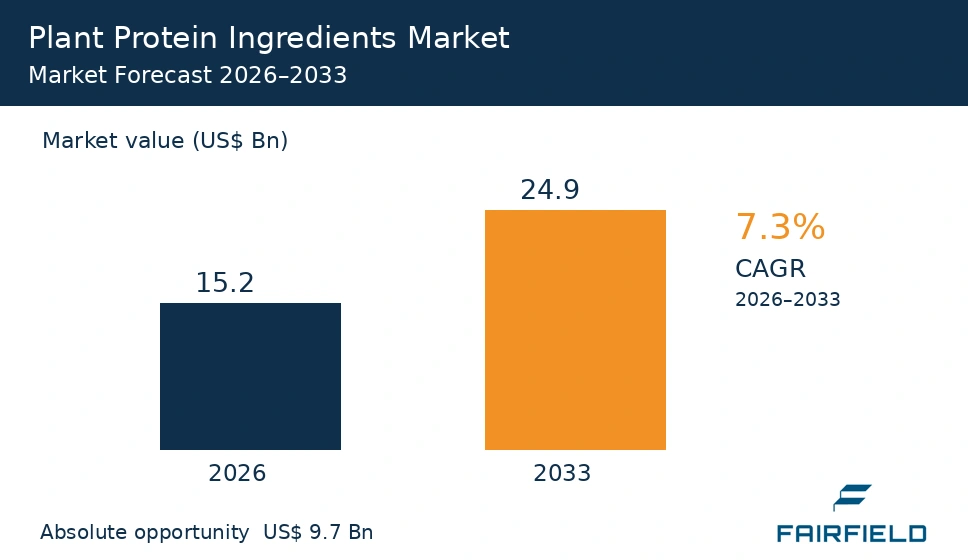
The global plant protein ingredients market size is expected to be valued at US$ 15.2 billion in 2026 and projected to reach US$ 24.9 billion by 2033, growing at a CAGR of 7.3% between 2026 and 2033.
Between 2020 and 2025, the market grew at a CAGR of about 7.5%, rising from roughly US$ 9.9 billion to about US$ 14.2 billion, as consumers looked for healthier and more sustainable foods, plant-based dairy and meat alternatives spread in stores, and food makers added protein to snacks, drinks, and bakery products. The plant protein ingredients market covers proteins extracted from soy, wheat, peas, and other sources such as rice, fava beans, potatoes, chickpeas, oats, and canola. They are sold as isolates, concentrates, textured proteins, and hydrolysates. These ingredients are used in meat and dairy alternatives, protein drinks, sports and clinical nutrition, bakery, snacks, infant formula, and animal feed. In July 2026, Louis Dreyfus Company officially opened its new pea protein isolate plant in Saskatchewan, Canada.
Key Report Takeaways
-
By Product Type: Soy Protein held about 55% share in 2025, while Pea Protein is projected to expand at a 10.8% CAGR through 2033, driven by its allergen-friendly and non-GMO profile, neutral taste, and wide use in dairy alternatives and protein drinks.
-
By Form: Concentrate held about 52% share in 2025, while Isolate is projected to expand at an 8.2% CAGR through 2033, driven by demand for high-purity, low-flavor proteins in beverages, sports nutrition, and clean-label dairy alternatives that need smooth texture.
-
By Application: Food and Beverages held about 64% share in 2025, while Sports and Clinical Nutrition is projected to expand at an 8.6% CAGR through 2033, driven by fitness trends, healthy aging, and high-protein diets among consumers using weight-loss medicines.
-
By Region: North America held about 36% share in 2025, while Asia Pacific is projected to expand at an 8.9% CAGR through 2033, driven by rising incomes, large soy traditions in China and Japan, and new plant-based brands in India.
Global Plant Protein Ingredients Market Trends and Insights
Drivers Impact Analysis
Two drivers carry the strongest influence on plant protein ingredients market demand during the forecast period.
| Driver | Impact on CAGR Forecast | Geographic Relevance | Impact Timeline |
| Rising demand for high-protein and healthy foods | High | Global, with focus on North America and Europe | Medium term (2-4 years) |
| Sustainability goals and flexitarian diets | Medium | Europe, North America, Asia Pacific | Long term (≥4 years) |
High-Protein Food Demand Is Driving the Plant Protein Ingredients Market
Rising demand for high-protein and healthy foods is the strongest driver of the plant protein ingredients market. Protein is one of the fastest-growing claims on food labels.
The mechanism is that consumers want more protein for muscle health, weight control, energy, and healthy aging, and food makers are adding plant proteins to bars, drinks, cereals, pasta, bread, and snacks. Many people using weight-loss medicines need more protein to protect muscle mass. Plant proteins are also lactose-free and often allergen-friendly, making them suitable for people who avoid dairy. ADM launched eight new soy and pea protein ingredients in North America and Europe in May 2026, reflecting strong demand. As protein products spread, ingredient volumes grow. Meat processors also use plant proteins to cut costs and improve texture.
Sustainability and Flexitarian Diets Are Expanding the Plant Protein Ingredients Market
Sustainability goals and flexitarian diets are expanding the plant protein ingredients market. More people are eating less meat.
The cause is that plant proteins need less land, water, and energy than animal proteins and produce fewer greenhouse gas emissions. Food companies and retailers have set climate targets that include more plant-based products. Flexitarian consumers who eat meat less often buy plant-based burgers, sausages, milks, yogurts, and cheeses, as well as hybrid products that mix meat and plant protein. Governments in Europe and Canada fund plant protein research and processing. These trends support long-term demand across both retail and food service. School meals, hospital menus, and company canteens are also adding plant-based dishes, which creates steady large-volume orders for ingredient makers and helps new products reach consumers who might not try them in stores.
Restraints Impact Analysis
Two restraints limit how quickly the plant protein ingredients market grows.
| Restraint | Impact on CAGR Forecast | Geographic Relevance | Impact Timeline |
| Slowing meat alternative sales and taste challenges | High | North America, Europe | Medium term (2-4 years) |
| Crop price swings and processing costs | Medium | Global | Medium term (2-4 years) |
Slowing Meat Alternative Sales Slow the Plant Protein Ingredients Market
Slowing meat alternative sales and taste challenges slow the plant protein ingredients market. Some consumers have stopped buying plant-based meat.
The problem is that retail sales of plant-based meat alternatives have fallen in the United States and parts of Europe after rapid early growth, as some shoppers found products too expensive, too processed, or not tasty enough. Some brands have cut products, closed plants, or gone out of business. Plant proteins can have beany or bitter flavors, chalky texture, or poor solubility, which makes formulation harder. Concerns about ultra-processed foods also affect demand. These factors slow volume growth in one of the largest application areas. Ingredient suppliers that built capacity for fast meat alternative growth now face lower plant use and must find new customers in bakery, nutrition, and hybrid products.
Crop Prices and Processing Costs Restrict the Plant Protein Ingredients Market
Crop price swings and processing costs restrict the plant protein ingredients market. Raw materials and energy are expensive.
The constraint is that prices for soybeans, yellow peas, wheat, and other crops change with weather, harvest size, and trade policies, which affects ingredient costs. Extracting isolates needs large amounts of water and energy, and plants must sell starch and fiber co-products to stay profitable. Building a new protein plant costs hundreds of millions of dollars, and some projects have been delayed or run below capacity. Tariffs on pulses and soy between major trading countries add further uncertainty for buyers and sellers. These factors raise prices and limit new investment. Smaller producers without co-product markets or long-term crop contracts face the highest risks when crop prices rise or demand slows.
Market Opportunities
Pea, Fava, and Novel Protein Isolates Open a Premium Revenue Pool
Pea, fava, and novel protein isolates open a premium revenue pool. Food makers want better-tasting, clean-label proteins.
The opportunity comes from high-purity pea, fava bean, chickpea, potato, rice, oat, and canola proteins with neutral taste, better solubility, and strong gelling or emulsifying functions. These ingredients help make smoother dairy alternatives, clear protein drinks, and better meat analogues. Roquette's pea protein plant in Manitoba could process up to 125,000 metric tons of yellow peas a year at full capacity, and Louis Dreyfus Company opened a pea isolate plant in Saskatchewan in July 2026. Companies with taste and texture know-how can earn premium prices. Fermentation and enzyme treatments that remove off-flavors and improve digestibility also add value, and blends of several plant proteins can match the nutrition of dairy and meat more closely.
Asia Pacific and Nutrition Products Create a Growth Revenue Pool
Asia Pacific and nutrition products create a growth revenue pool. New markets for plant proteins are opening.
The opportunity reflects strong demand for soy foods in China, Japan, and South Korea, rising interest in protein drinks and fitness products in India, Indonesia, and Australia, and new local plant-based brands. Sports nutrition, medical nutrition, and healthy aging products need high-quality proteins in powders, drinks, and bars. Large and young populations with rising incomes support strong growth. Companies that build local production, partner with regional food brands, and develop products for local tastes can capture this growth. Traditional foods such as tofu, soy milk, and lentil dishes give consumers a familiar base, which helps new protein products gain acceptance faster than in some western markets.
Segment Analysis
By Product Type: Soy Protein Leads While Pea Protein Grows Fastest
Soy Protein held about 55% share in 2025. Soy protein isolates, concentrates, and textured proteins are low-cost, widely available, and have a complete amino acid profile, so they are used in meat products, meat alternatives, soy milk, tofu, bakery, and animal feed. Large processing capacity from ADM, Cargill, Wilmar, and Fuji Oil gives this product the largest share.
Pea Protein is the fastest-growing product type, expanding at a 10.8% CAGR through 2033. Pea protein is non-GMO, free from major allergens, and has a neutral taste, making it popular in plant-based milks, yogurts, burgers, and protein shakes. New plants in Canada and Europe are adding supply. Wheat Protein and Others form other segments. For the market, pea growth raises value per tonne.
By Form: Concentrate Leads While Isolate Grows Fastest
Concentrate held about 52% share in 2025. Protein concentrates contain about 50% to 80% protein and cost less to produce, so they are widely used in meat products, bakery, snacks, cereals, and animal feed, where very high purity is not needed. They also help keep product costs low for mass-market foods.
Isolate is the fastest-growing form, expanding at an 8.2% CAGR through 2033. Isolates contain about 90% protein or more, with less flavor and better solubility, making them ideal for protein drinks, powders, dairy alternatives, and infant and clinical nutrition. Textured and hydrolyzed proteins form other segments. Hydrolyzed proteins are used in flavors, soups, and clinical foods. For the market, isolate growth supports premium sales and higher margins.
By Application: Food and Beverages Lead While Sports and Clinical Nutrition Grow Fastest
Food and Beverages held about 64% share in 2025. Plant proteins are used in meat and dairy alternatives, bakery, snacks, cereals, pasta, soups, and ready meals, as well as hybrid meat products. Food makers use plant proteins for nutrition, texture, binding, and foaming, and they often combine several proteins to improve taste. Large food companies are adding protein to everyday products such as bread, pasta, and breakfast cereals.
Sports and Clinical Nutrition is the fastest-growing application, expanding at an 8.6% CAGR through 2033. Protein powders, ready-to-drink shakes, bars, medical foods, and products for older adults need high-quality, easy-to-digest proteins. Animal Feed, Personal Care, and Others form other segments. Plant proteins are also used in pet food, fish feed, and cosmetics. For the market, nutrition growth raises demand for isolates and value-added blends.
Geography Analysis
Which Region Is Leading the Plant Protein Ingredients Market?
North America is leading the plant protein ingredients market with about 36% share in 2025. The United States has large soy processing, many plant-based food brands, and strong demand for protein drinks, bars, and sports nutrition. Canada is a major producer of yellow peas, and Roquette and Louis Dreyfus Company run large pea protein plants there. ADM, Cargill, and Ingredion are major suppliers. Key barriers include falling meat alternative sales and low-cost imports. Many consumers also buy protein-enriched snacks and cereals. One change shaping the region is growth in high-protein foods and hybrid meat products.
Plant Protein Ingredients Market in Europe
Europe is a large plant protein ingredients market. Germany, the United Kingdom, the Netherlands, and France have many flexitarian consumers and leading plant-based brands in shops and restaurants. Roquette, Cosucra, Royal Avebe, and Kerry are strong suppliers, and Lantmännen is building a pea protein plant in Sweden in partnership with Ingredion. The European Union supports local protein crops to reduce soy imports. Key barriers include high energy costs and strict novel food approval rules. Strong retail private-label ranges support plant-based sales. One change shaping the region is growth in fava and potato proteins.
Which Region Is Growing Fastest in the Plant Protein Ingredients Market?
Asia Pacific is the fastest-growing region in the plant protein ingredients market, expanding at an 8.9% CAGR through 2033. China has a long tradition of soy foods and large soy and pea protein production, and Japan and South Korea have strong demand for soy-based foods and drinks. India is seeing growth in protein supplements and plant-based brands, while Australia and Singapore host many food-tech startups. Key barriers include price sensitivity and limited cold chains. Local soy processors supply large volumes at low cost. One change shaping the region is growth in protein drinks and fortified foods.
Plant Protein Ingredients Market in Latin America
Latin America is a growing plant protein ingredients market. Brazil and Argentina are among the world's largest soybean producers, supplying raw materials for soy protein. Brazil, Mexico, and Chile are seeing growth in plant-based meat and dairy brands and protein snacks in large cities. Local food companies are adding plant protein to bakery and meat products to lower costs and improve nutrition. Large export-focused soy crushing plants also give the region a strong supply base. Key barriers include economic swings and lower incomes. One opportunity is affordable soy and pea proteins for meat extension and bakery products.
Plant Protein Ingredients Market in Middle East & Africa
Middle East & Africa is a developing plant protein ingredients market. Saudi Arabia, the United Arab Emirates, and Israel are investing in food security and alternative proteins, and Israel has many food-tech startups working on new proteins, fermentation, and plant-based foods. South Africa, Egypt, and Nigeria use soy protein in processed foods, meat products, and animal feed for poultry farms. Growing populations and urban diets also lift demand for affordable protein foods. Key barriers include reliance on imports and limited local processing. One opportunity is plant proteins for local food processing and nutrition products.
Competitive Landscape
The plant protein ingredients market is moderately consolidated. ADM, Cargill, Roquette, Ingredion, and Kerry are leading players, while IFF, Glanbia, Louis Dreyfus Company, Cosucra, Royal Avebe, Burcon, and Fuji Oil compete strongly. Large global agribusiness firms control much of the world's soy and wheat protein supply through integrated crushing and milling plants, while specialists lead in pea, fava, and potato proteins. Many smaller firms in China and Europe produce pea and rice proteins for price-sensitive buyers, and imports of low-cost Chinese pea protein have added strong price pressure in North America.
Companies mainly compete on taste, color, solubility, texture, gelling and emulsifying functions, protein purity, clean-label and non-GMO claims, sustainable sourcing, supply security, application support, and price. Close and long-term partnerships with major food and beverage brands to develop new products are important. Leading suppliers run application centers, pilot plants, and taste panels to help customers launch products faster and solve flavor and texture problems.
Strategic moves show how competition is changing. ADM launched eight new soy and pea protein ingredients in May 2026 for meat, hybrid, and alternative products, while Louis Dreyfus Company began commissioning its Yorkton pea protein plant in March 2026 and opened it officially in July 2026, adding a new competitor in pea isolates.
Three themes shape vendor strategy. First, suppliers are adding pea and pulse capacity. Second, they are improving taste and texture. Third, they are targeting nutrition products.
Plant Protein Ingredients Market Industry Leaders
- Archer Daniels Midland Company
- Cargill, Incorporated
- Roquette Frères
- Ingredion Incorporated
- Kerry Group plc
Recent Industry Developments
-
July 2026: Louis Dreyfus Company officially opened its new pea protein isolate plant in Yorkton, Saskatchewan, which can process up to 75,000 metric tonnes of yellow peas a year into protein isolate, fiber, and starch - adds new pea protein supply in North America.
-
May 2026: ADM launched eight new plant-based protein ingredients across its ProFam and Arcon portfolios in North America and Europe, including soy isolates, concentrates, and pea ingredients - expands choice for meat, hybrid, and alternative products.
-
March 2026: Louis Dreyfus Company started commissioning its pea protein isolate facility in Yorkton, marking its entry into value-added pea ingredients - diversifies supply beyond major incumbents.
Companies Covered in the Report
-
Archer Daniels Midland Company
-
Cargill, Incorporated
-
Roquette Frères
-
Ingredion Incorporated
-
Kerry Group plc
-
International Flavors & Fragrances Inc.
-
Glanbia plc
-
Louis Dreyfus Company
-
Cosucra Groupe Warcoing
-
Royal Avebe
-
Burcon NutraScience Corporation
-
Fuji Oil Holdings Inc.
Plant Protein Ingredients Market Report Scope
This report covers the global plant protein ingredients market, including soy, wheat, pea, and other proteins, in isolate, concentrate, and other forms, for food and beverages, sports and clinical nutrition, animal feed, personal care, and other applications, across North America, Europe, Asia Pacific, Latin America, and Middle East & Africa. The base year is 2025, and the forecast period runs from 2026 to 2033. All values are expressed in US$ Billion.
| Product Type | Soy Protein, Wheat Protein, Pea Protein, Others |
| Form | Isolate, Concentrate, Others |
| Application | Food and Beverages, Sports and Clinical Nutrition, Animal Feed, Personal Care, Others |
| Regions | North America, Europe, Asia Pacific, Latin America, Middle East & Africa |
1. Executive Summary
1.1 Plant Protein Ingredients Market Snapshot
1.2 Future Projections
1.3 Key Market Trends
1.4 Regional Snapshot
2. Market Overview
2.1 Market Definition and Report Scope
2.2 Historical Market Trends
2.3 Market Dynamics
2.3.1 Drivers
2.3.1.1 High-Protein Food Demand Is Driving the Plant Protein Ingredients Market
2.3.1.2 Sustainability and Flexitarian Diets Are Expanding the Plant Protein Ingredients Market
2.3.2 Restraints
2.3.2.1 Slowing Meat Alternative Sales Slow the Plant Protein Ingredients Market
2.3.2.2 Crop Prices and Processing Costs Restrict the Plant Protein Ingredients Market
2.3.3 Market Opportunities
2.3.3.1 Pea, Fava, and Novel Protein Isolates Open a Premium Revenue Pool
2.3.3.2 Asia Pacific and Nutrition Products Create a Growth Revenue Pool
3. Global Plant Protein Ingredients Market Outlook, 2020–2033
3.1 Global Plant Protein Ingredients Market Outlook, by Product Type, Value (US$ Billion), 2020–2033
3.1.1 Soy Protein
3.1.2 Wheat Protein
3.1.3 Pea Protein
3.1.4 Others
3.2 Global Plant Protein Ingredients Market Outlook, by Form, Value (US$ Billion), 2020–2033
3.2.1 Isolate
3.2.2 Concentrate
3.2.3 Others
3.3 Global Plant Protein Ingredients Market Outlook, by Application, Value (US$ Billion), 2020–2033
3.3.1 Food and Beverages
3.3.2 Sports and Clinical Nutrition
3.3.3 Animal Feed
3.3.4 Personal Care
3.3.5 Others
3.4 Global Plant Protein Ingredients Market Outlook, by Region, Value (US$ Billion), 2020–2033
3.4.1 North America
3.4.2 Europe
3.4.3 Asia Pacific
3.4.4 Latin America
3.4.5 Middle East & Africa
4. North America Plant Protein Ingredients Market Outlook, 2020–2033
4.1 North America Plant Protein Ingredients Market Outlook, by Product Type, Value (US$ Billion), 2020–2033
4.1.1 Soy Protein
4.1.2 Wheat Protein
4.1.3 Pea Protein
4.1.4 Others
4.2 North America Plant Protein Ingredients Market Outlook, by Form, Value (US$ Billion), 2020–2033
4.2.1 Isolate
4.2.2 Concentrate
4.2.3 Others
4.3 North America Plant Protein Ingredients Market Outlook, by Application, Value (US$ Billion), 2020–2033
4.3.1 Food and Beverages
4.3.2 Sports and Clinical Nutrition
4.3.3 Animal Feed
4.3.4 Personal Care
4.3.5 Others
4.4 North America Plant Protein Ingredients Market Outlook, by Country, Value (US$ Billion), 2020–2033
4.4.1 United States Plant Protein Ingredients Market Outlook, by Product Type, 2020–2033
4.4.2 United States Plant Protein Ingredients Market Outlook, by Form, 2020–2033
4.4.3 United States Plant Protein Ingredients Market Outlook, by Application, 2020–2033
4.4.4 Canada Plant Protein Ingredients Market Outlook, by Product Type, 2020–2033
4.4.5 Canada Plant Protein Ingredients Market Outlook, by Form, 2020–2033
4.4.6 Canada Plant Protein Ingredients Market Outlook, by Application, 2020–2033
5. Europe Plant Protein Ingredients Market Outlook, 2020–2033
5.1 Europe Plant Protein Ingredients Market Outlook, by Product Type, Value (US$ Billion), 2020–2033
5.1.1 Soy Protein
5.1.2 Wheat Protein
5.1.3 Pea Protein
5.1.4 Others
5.2 Europe Plant Protein Ingredients Market Outlook, by Form, Value (US$ Billion), 2020–2033
5.2.1 Isolate
5.2.2 Concentrate
5.2.3 Others
5.3 Europe Plant Protein Ingredients Market Outlook, by Application, Value (US$ Billion), 2020–2033
5.3.1 Food and Beverages
5.3.2 Sports and Clinical Nutrition
5.3.3 Animal Feed
5.3.4 Personal Care
5.3.5 Others
5.4 Europe Plant Protein Ingredients Market Outlook, by Country, Value (US$ Billion), 2020–2033
5.4.1 Germany Plant Protein Ingredients Market Outlook, by Product Type, 2020–2033
5.4.2 Germany Plant Protein Ingredients Market Outlook, by Form, 2020–2033
5.4.3 Germany Plant Protein Ingredients Market Outlook, by Application, 2020–2033
5.4.4 United Kingdom Plant Protein Ingredients Market Outlook, by Product Type, 2020–2033
5.4.5 United Kingdom Plant Protein Ingredients Market Outlook, by Form, 2020–2033
5.4.6 United Kingdom Plant Protein Ingredients Market Outlook, by Application, 2020–2033
5.4.7 Netherlands Plant Protein Ingredients Market Outlook, by Product Type, 2020–2033
5.4.8 Netherlands Plant Protein Ingredients Market Outlook, by Form, 2020–2033
5.4.9 Netherlands Plant Protein Ingredients Market Outlook, by Application, 2020–2033
5.4.10 France Plant Protein Ingredients Market Outlook, by Product Type, 2020–2033
5.4.11 France Plant Protein Ingredients Market Outlook, by Form, 2020–2033
5.4.12 France Plant Protein Ingredients Market Outlook, by Application, 2020–2033
5.4.13 Sweden Plant Protein Ingredients Market Outlook, by Product Type, 2020–2033
5.4.14 Sweden Plant Protein Ingredients Market Outlook, by Form, 2020–2033
5.4.15 Sweden Plant Protein Ingredients Market Outlook, by Application, 2020–2033
6. Asia Pacific Plant Protein Ingredients Market Outlook, 2020–2033
6.1 Asia Pacific Plant Protein Ingredients Market Outlook, by Product Type, Value (US$ Billion), 2020–2033
6.1.1 Soy Protein
6.1.2 Wheat Protein
6.1.3 Pea Protein
6.1.4 Others
6.2 Asia Pacific Plant Protein Ingredients Market Outlook, by Form, Value (US$ Billion), 2020–2033
6.2.1 Isolate
6.2.2 Concentrate
6.2.3 Others
6.3 Asia Pacific Plant Protein Ingredients Market Outlook, by Application, Value (US$ Billion), 2020–2033
6.3.1 Food and Beverages
6.3.2 Sports and Clinical Nutrition
6.3.3 Animal Feed
6.3.4 Personal Care
6.3.5 Others
6.4 Asia Pacific Plant Protein Ingredients Market Outlook, by Country, Value (US$ Billion), 2020–2033
6.4.1 China Plant Protein Ingredients Market Outlook, by Product Type, 2020–2033
6.4.2 China Plant Protein Ingredients Market Outlook, by Form, 2020–2033
6.4.3 China Plant Protein Ingredients Market Outlook, by Application, 2020–2033
6.4.4 Japan Plant Protein Ingredients Market Outlook, by Product Type, 2020–2033
6.4.5 Japan Plant Protein Ingredients Market Outlook, by Form, 2020–2033
6.4.6 Japan Plant Protein Ingredients Market Outlook, by Application, 2020–2033
6.4.7 South Korea Plant Protein Ingredients Market Outlook, by Product Type, 2020–2033
6.4.8 South Korea Plant Protein Ingredients Market Outlook, by Form, 2020–2033
6.4.9 South Korea Plant Protein Ingredients Market Outlook, by Application, 2020–2033
6.4.10 India Plant Protein Ingredients Market Outlook, by Product Type, 2020–2033
6.4.11 India Plant Protein Ingredients Market Outlook, by Form, 2020–2033
6.4.12 India Plant Protein Ingredients Market Outlook, by Application, 2020–2033
6.4.13 Australia Plant Protein Ingredients Market Outlook, by Product Type, 2020–2033
6.4.14 Australia Plant Protein Ingredients Market Outlook, by Form, 2020–2033
6.4.15 Australia Plant Protein Ingredients Market Outlook, by Application, 2020–2033
6.4.16 Singapore Plant Protein Ingredients Market Outlook, by Product Type, 2020–2033
6.4.17 Singapore Plant Protein Ingredients Market Outlook, by Form, 2020–2033
6.4.18 Singapore Plant Protein Ingredients Market Outlook, by Application, 2020–2033
7. Latin America Plant Protein Ingredients Market Outlook, 2020–2033
7.1 Latin America Plant Protein Ingredients Market Outlook, by Product Type, Value (US$ Billion), 2020–2033
7.1.1 Soy Protein
7.1.2 Wheat Protein
7.1.3 Pea Protein
7.1.4 Others
7.2 Latin America Plant Protein Ingredients Market Outlook, by Form, Value (US$ Billion), 2020–2033
7.2.1 Isolate
7.2.2 Concentrate
7.2.3 Others
7.3 Latin America Plant Protein Ingredients Market Outlook, by Application, Value (US$ Billion), 2020–2033
7.3.1 Food and Beverages
7.3.2 Sports and Clinical Nutrition
7.3.3 Animal Feed
7.3.4 Personal Care
7.3.5 Others
7.4 Latin America Plant Protein Ingredients Market Outlook, by Country, Value (US$ Billion), 2020–2033
7.4.1 Brazil Plant Protein Ingredients Market Outlook, by Product Type, 2020–2033
7.4.2 Brazil Plant Protein Ingredients Market Outlook, by Form, 2020–2033
7.4.3 Brazil Plant Protein Ingredients Market Outlook, by Application, 2020–2033
7.4.4 Argentina Plant Protein Ingredients Market Outlook, by Product Type, 2020–2033
7.4.5 Argentina Plant Protein Ingredients Market Outlook, by Form, 2020–2033
7.4.6 Argentina Plant Protein Ingredients Market Outlook, by Application, 2020–2033
7.4.7 Mexico Plant Protein Ingredients Market Outlook, by Product Type, 2020–2033
7.4.8 Mexico Plant Protein Ingredients Market Outlook, by Form, 2020–2033
7.4.9 Mexico Plant Protein Ingredients Market Outlook, by Application, 2020–2033
7.4.10 Chile Plant Protein Ingredients Market Outlook, by Product Type, 2020–2033
7.4.11 Chile Plant Protein Ingredients Market Outlook, by Form, 2020–2033
7.4.12 Chile Plant Protein Ingredients Market Outlook, by Application, 2020–2033
8. Middle East & Africa Plant Protein Ingredients Market Outlook, 2020–2033
8.1 Middle East & Africa Plant Protein Ingredients Market Outlook, by Product Type, Value (US$ Billion), 2020–2033
8.1.1 Soy Protein
8.1.2 Wheat Protein
8.1.3 Pea Protein
8.1.4 Others
8.2 Middle East & Africa Plant Protein Ingredients Market Outlook, by Form, Value (US$ Billion), 2020–2033
8.2.1 Isolate
8.2.2 Concentrate
8.2.3 Others
8.3 Middle East & Africa Plant Protein Ingredients Market Outlook, by Application, Value (US$ Billion), 2020–2033
8.3.1 Food and Beverages
8.3.2 Sports and Clinical Nutrition
8.3.3 Animal Feed
8.3.4 Personal Care
8.3.5 Others
8.4 Middle East & Africa Plant Protein Ingredients Market Outlook, by Country, Value (US$ Billion), 2020–2033
8.4.1 Saudi Arabia Plant Protein Ingredients Market Outlook, by Product Type, 2020–2033
8.4.2 Saudi Arabia Plant Protein Ingredients Market Outlook, by Form, 2020–2033
8.4.3 Saudi Arabia Plant Protein Ingredients Market Outlook, by Application, 2020–2033
8.4.4 United Arab Emirates Plant Protein Ingredients Market Outlook, by Product Type, 2020–2033
8.4.5 United Arab Emirates Plant Protein Ingredients Market Outlook, by Form, 2020–2033
8.4.6 United Arab Emirates Plant Protein Ingredients Market Outlook, by Application, 2020–2033
8.4.7 Israel Plant Protein Ingredients Market Outlook, by Product Type, 2020–2033
8.4.8 Israel Plant Protein Ingredients Market Outlook, by Form, 2020–2033
8.4.9 Israel Plant Protein Ingredients Market Outlook, by Application, 2020–2033
8.4.10 South Africa Plant Protein Ingredients Market Outlook, by Product Type, 2020–2033
8.4.11 South Africa Plant Protein Ingredients Market Outlook, by Form, 2020–2033
8.4.12 South Africa Plant Protein Ingredients Market Outlook, by Application, 2020–2033
8.4.13 Egypt Plant Protein Ingredients Market Outlook, by Product Type, 2020–2033
8.4.14 Egypt Plant Protein Ingredients Market Outlook, by Form, 2020–2033
8.4.15 Egypt Plant Protein Ingredients Market Outlook, by Application, 2020–2033
8.4.16 Nigeria Plant Protein Ingredients Market Outlook, by Product Type, 2020–2033
8.4.17 Nigeria Plant Protein Ingredients Market Outlook, by Form, 2020–2033
8.4.18 Nigeria Plant Protein Ingredients Market Outlook, by Application, 2020–2033
9. Competitive Landscape
9.1 Plant Protein Ingredients Market Industry Leaders
9.2 Recent Industry Developments
9.3 Company Profiles
9.3.1 Archer Daniels Midland Company
9.3.2 Cargill, Incorporated
9.3.3 Roquette Frères
9.3.4 Ingredion Incorporated
9.3.5 Kerry Group plc
9.3.6 International Flavors & Fragrances Inc.
9.3.7 Glanbia plc
9.3.8 Louis Dreyfus Company
9.3.9 Cosucra Groupe Warcoing
9.3.10 Royal Avebe
9.3.11 Burcon NutraScience Corporation
9.3.12 Fuji Oil Holdings Inc.
10. Appendix
10.1 Research Methodology
10.2 Report Assumptions
10.3 Acronyms and Abbreviations
| Product Type | Soy Protein, Wheat Protein, Pea Protein, Others |
| Form | Isolate, Concentrate, Others |
| Application | Food and Beverages, Sports and Clinical Nutrition, Animal Feed, Personal Care, Others |
| Regions | North America, Europe, Asia Pacific, Latin America, Middle East & Africa |
Our Research Methodology
Considering the volatility of business today, traditional approaches to strategizing a game plan can be unfruitful if not detrimental. True ambiguity is no way to determine a forecast. A myriad of predetermined factors must be accounted for such as the degree of risk involved, the magnitude of circumstances, as well as conditions or consequences that are not known or unpredictable. To circumvent binary views that cast uncertainty, the application of market research intelligence to strategically posture, move, and enable actionable outcomes is necessary.
View Methodology
Quality Assured
Rigorous Validation Process

Confidentiality Assured
End-to-end Data Security

Custom Research Services
Tailored To Your Objectives
FAQs
The global plant protein ingredients market is expected to be valued at US$ 15.2 billion in 2026, driven by high-protein food demand.
The market is projected to grow at a 7.3% CAGR from 2026 to 2033, reaching about US$ 24.9 billion by 2033.
North America leads with about 36% share, supported by large soy processing, pea production in Canada, and strong protein product demand.
Asia Pacific is growing fastest at an 8.9% CAGR, driven by soy food traditions, rising incomes, and protein drink demand.
Key players include ADM, Cargill, Roquette, Ingredion, and Kerry, competing on taste, functionality, supply security, sustainability, and price.
Related Reports
Wine Vinegar Market Size, Share, Insights, Competitive Landscape, and Forecast 2026 to 2033
The wine vinegar market is projected to grow from US$1.70 billion in 2026 to US$2.06 billion by 2033, registering a CAGR of 2.8% during the forecast period.
Soy Based Foods Market Size, Share, Insights, Competitive Landscape, and Forecast 2026 to 2033
The soy based foods market is projected to grow from US$55.6 billion in 2026 to US$74.4 billion by 2033, registering a CAGR of 4.3% during the forecast period.
Peanut Ingredients Market Size, Share, Insights, Competitive Landscape, and Forecast 2026 to 2033
The global peanut ingredients market is valued at US$35.5 billion in 2026, reaching US$52.2 billion by 2033, growing at a 5.7% CAGR
Bouillon Cubes Market Size, Share, Insights, Competitive Landscape, and Forecast 2026 to 2033
The bouillon cubes market is projected to grow from US$5.18 billion in 2026 to US$7.20 billion by 2033, registering a CAGR of 4.8% during the forecast period.
Alcoholic Ingredients Market Size, Share, Insights, Competitive Landscape, and Forecast 2026 to 2033
The alcoholic ingredients market is projected to grow from US$3.35 billion in 2026 to US$5.31 billion by 2033, registering a CAGR of 6.8% during the forecast period.
Sunflower Oilmeal Market Size, Share, Insights, Competitive Landscape, and Forecast 2026 to 2033
The sunflower oilmeal market is projected to grow from US$6.2 billion in 2026 to US$8.9 billion by 2033, registering a CAGR of 5.3% during the forecast period.