



Soy Based Foods Market
Soy Based Foods Market Size, Share, Insights, Competitive Landscape, and Forecast 2026 to 2033
Soy Based Foods Market
Soy Based Foods Market Size and Trend Analysis
How Fast Is the Soy Based Foods Market Growing?
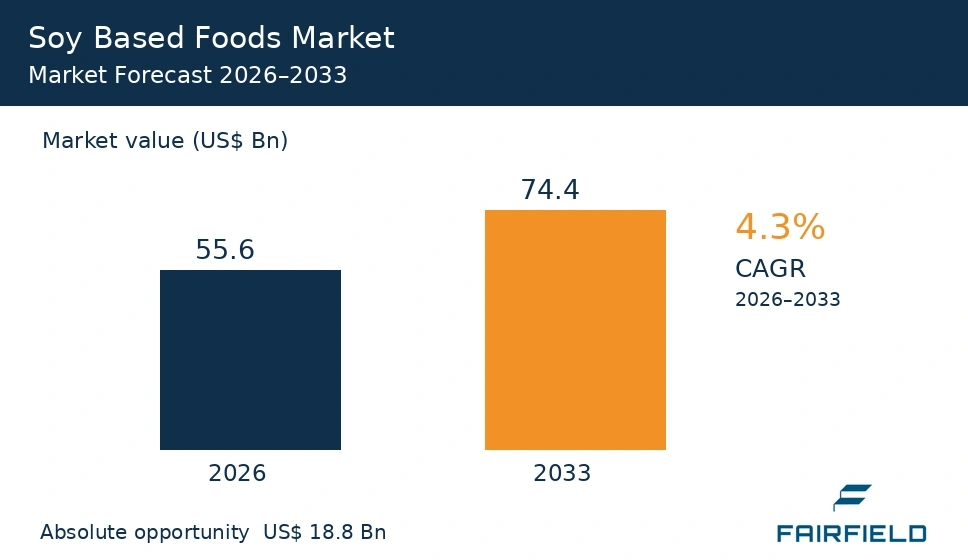
The global soy based foods market size is expected to be valued at US$ 55.6 billion in 2026 and projected to reach US$ 74.4 billion by 2033, growing at a CAGR of 4.3% between 2026 and 2033.
Between 2020 and 2025, the market grew at a CAGR of about 3.7%, rising from roughly US$ 44.6 billion to about US$ 53.5 billion, as plant-based diets spread, more people chose dairy-free drinks, and tofu and other soy proteins gained popularity in North America and Europe. The soy based foods market covers foods and drinks made from soybeans, including soy milk and beverages, tofu, tempeh, edamame, soy yogurt and desserts, soy sauce, miso, natto, and other fermented products, and soy-based meat alternatives. They are bought by households, restaurants, and food makers through supermarkets, convenience stores, specialty shops, and online stores. In October 2026, The Tofoo Co. broke ground on a new factory in Malton, England, to double its tofu output.
Key Report Takeaways
-
By Product Type: Soy Milk and Beverages held about 33% share in 2025, while Tofu is projected to expand at a 5.4% CAGR through 2033, driven by its high protein, low cost, minimal processing, and new ready-to-cook and flavored formats in western supermarkets.
-
By Category: Conventional held about 85% share in 2025, while Organic is projected to expand at a 6.2% CAGR through 2033, driven by demand for non-GMO and organic soybeans, clean-label foods, and premium plant-based products.
-
By Distribution Channel: Supermarkets and Hypermarkets held about 46% share in 2025, while Online Retail is projected to expand at an 8.0% CAGR through 2033, driven by grocery delivery apps, quick commerce in Asia Pacific, and direct-to-consumer plant-based brands.
-
By Region: Asia Pacific held about 58% share in 2025, while India is projected to expand at a 6.8% CAGR through 2033, driven by a large vegetarian population, rising protein awareness, and growing sales of soy milk, soy chunks, and tofu.
Global Soy Based Foods Market Trends and Insights
Drivers Impact Analysis
Two drivers carry the strongest influence on soy based foods market demand during the forecast period.
| Driver | Impact on CAGR Forecast | Geographic Relevance | Impact Timeline |
| Plant-based diets and protein demand | High | Global, with focus on North America and Europe | Medium term (2-4 years) |
| Lactose intolerance and dairy alternatives | Medium | Asia Pacific, North America, Europe | Long term (≥4 years) |
Plant-Based Diets and Protein Demand Are Driving the Soy Based Foods Market
Plant-based diets and protein demand are the strongest drivers of the soy based foods market. Soy is one of the most complete plant proteins.
The mechanism is that soybeans provide all essential amino acids, fiber, and healthy fats at a low cost, making soy foods a natural choice for vegetarians, vegans, and flexitarians who want to eat less meat. Tofu is gaining popularity as a minimally processed protein, while some heavily processed meat alternatives have lost favor. Pulmuone Foods USA reported that its tofu revenues in the United States rose 16.8% year on year through May 2026. New flavors, cubed and marinated tofu, and ready-to-eat formats are attracting new buyers. These trends keep soy food sales growing. Restaurants and meal kit companies are also adding tofu dishes, which introduces soy foods to new customers.
Lactose Intolerance and Dairy Alternatives Are Expanding the Soy Based Foods Market
Lactose intolerance and the shift to dairy alternatives are expanding the soy based foods market. Many people cannot easily digest milk.
The cause is that a large share of adults in Asia Pacific, Middle East & Africa, and Latin America are lactose intolerant, and many consumers in North America and Europe are choosing plant-based milks for health, ethical, or environmental reasons. Soy milk offers protein levels close to cow's milk and is often fortified with calcium and vitamins. Soy yogurts, desserts, and creamers are expanding the category. In China, Japan, and South Korea, soy milk and tofu are traditional foods with steady daily demand. This supports a large and stable base of sales. Coffee shops in Asia Pacific also offer soy milk as a standard dairy-free option for drinks.
Restraints Impact Analysis
Two restraints limit how quickly the soy based foods market grows.
| Restraint | Impact on CAGR Forecast | Geographic Relevance | Impact Timeline |
| Competition from oat, almond, and pea products | High | North America, Europe | Medium term (2-4 years) |
| Allergy, GMO, and health concerns | Medium | North America, Europe | Long term (≥4 years) |
Competition from Other Plant Proteins Slows the Soy Based Foods Market
Competition from oat, almond, and pea products slows the soy based foods market. Soy has lost share in some categories.
The problem is that oat milk and almond milk have become the most popular plant-based milks in many western markets, taking share from soy milk in cafés and supermarkets. Pea, chickpea, fava, and mycoprotein products also compete with soy in meat alternatives and yogurts. Some brands promote "soy-free" products to appeal to shoppers with allergies or concerns. Retail sales of plant-based meat alternatives have slowed in the United States and parts of Europe. These factors limit growth for some soy product lines outside Asia Pacific. Soy brands must therefore invest more in taste, texture, and marketing to keep shelf space and win back shoppers who have switched to newer plant-based options in recent years.
Allergy and Health Concerns Restrict the Soy Based Foods Market
Allergy, GMO, and health concerns restrict the soy based foods market. Some consumers avoid soy.
The constraint is that soy is one of the major food allergens, so products must carry allergen labels, and some people avoid soy entirely. Concerns about genetically modified soybeans, pesticide use, and links to deforestation in Latin America affect brand image. Myths and debates about soy's effects on hormones also cause some consumers to limit intake, even though major health bodies consider soy foods safe. Rising soybean prices and trade tensions add cost pressure. These factors slow adoption among some buyer groups. Brands are responding by using certified non-GMO and deforestation-free soybeans, sharing clear health information, and highlighting the long history of soy foods in traditional diets. Clear labeling and education campaigns can help rebuild trust over time.
Market Opportunities
Tofu Innovation and Organic Products Open a Premium Revenue Pool
Tofu innovation and organic products open a premium revenue pool. Shoppers are paying more for convenient, high-quality soy foods.
The opportunity comes from marinated, smoked, cubed, crispy, and pre-cooked tofu, high-protein tofu snacks, organic and non-GMO soy milk, fermented foods such as tempeh and natto, and soy yogurts with live cultures. Nasoya completed a US$ 55 million expansion in March 2026 that created the world's largest tofu production line, and Hilcona opened a new tofu plant in Switzerland in June 2026. Companies that offer tasty, convenient, and clean-label soy foods can earn premium prices. Soy-based protein snacks, high-protein soy drinks for fitness, and ready meals with tofu also open new uses, while food service partnerships with restaurant chains help build regular demand and brand awareness.
India and Emerging Markets Create a Growth Revenue Pool
India and emerging markets create a growth revenue pool. Protein needs are rising across many countries.
The opportunity reflects a large vegetarian population in India, rising awareness of protein shortages in diets, and growing sales of soy milk, soy chunks, tofu, and soy-based snacks through modern retail and online platforms. Indonesia has a long tradition of tempeh and tofu, and Vietnam, Thailand, and the Philippines are seeing growth in packaged soy drinks. Brazil and Nigeria also have rising demand. Companies that offer affordable, locally made soy foods and work with nutrition programs can capture this growth. School meal programs, government protein campaigns, and partnerships with local retailers can help soy foods reach families in smaller towns, while affordable packs keep prices within reach of lower-income households.
Segment Analysis
By Product Type: Soy Milk and Beverages Lead While Tofu Grows Fastest
Soy Milk and Beverages held about 33% share in 2025. Soy milk is a traditional drink across Asia Pacific and one of the most widely sold plant-based milks worldwide, available in plain, sweetened, flavored, and fortified forms. Vitasoy, Danone's Silk and Alpro, and many local brands lead this segment.
Tofu is the fastest-growing product type, expanding at a 5.4% CAGR through 2033. Tofu is affordable, high in protein, and minimally processed, and new flavored, cubed, and ready-to-cook formats are making it easier to use in western kitchens. Pulmuone, House Foods, Morinaga, and The Tofoo Co. are expanding capacity. Soy Sauce and Fermented Products, Soy-Based Meat Alternatives, and Others form other segments. For the market, tofu growth supports steady volume gains.
By Category: Conventional Leads While Organic Grows Fastest
Conventional held about 85% share in 2025. Conventional soy foods are widely available and lower in price, and they make up most soy milk, tofu, soy sauce, and processed soy products sold in Asia Pacific. Local makers use conventional soybeans to keep prices low for daily foods, and food service and food manufacturers mainly buy conventional products. Price and freshness are the main buying factors.
Organic is the fastest-growing category, expanding at a 6.2% CAGR through 2033. Organic and non-GMO soy foods appeal to shoppers in North America and Europe who want clean-label and sustainably grown products. Organic soy milk and tofu often sell at higher prices in natural food stores and online shops. Organic soybean supply is still limited, which keeps prices high. For the market, organic growth raises value per unit.
By Distribution Channel: Supermarkets and Hypermarkets Lead While Online Retail Grows Fastest
Supermarkets and Hypermarkets held about 46% share in 2025. Large grocery chains offer wide ranges of soy milk, tofu, and soy-based products in chilled and ambient aisles. Promotions, private-label ranges, and plant-based sections in stores help shoppers find soy products easily, and supermarkets remain the main channel for weekly grocery shopping.
Online Retail is the fastest-growing channel, expanding at an 8.0% CAGR through 2033. Grocery delivery apps, quick commerce, and online stores make it easy to buy chilled tofu and plant-based drinks at home. Convenience Stores, Specialty Stores, and Others form other segments. Asian grocery stores and specialty shops sell many traditional soy products. For the market, online growth widens reach to new shoppers.
Geography Analysis
Why Is North America Important to the Soy Based Foods Market?
North America is important to the soy based foods market because of its large plant-based food sector, strong tofu growth, and major soybean production. The United States is one of the world's largest soybean producers, and Pulmuone's Nasoya, House Foods, Morinaga, and Danone's Silk are leading brands. Nasoya expanded its Massachusetts plant in 2026. Asian grocery stores, restaurants, and meal kits support strong demand. Key barriers include strong competition from oat and almond milk in cafés. Canada adds steady demand. One change shaping the region is fast tofu growth in mainstream supermarkets and club stores.
Soy Based Foods Market in Europe
Europe is a growing soy based foods market. The United Kingdom, Germany, the Netherlands, and France have many flexitarian consumers and strong plant-based retail ranges. Alpro, owned by Danone, is a leading soy drink and yogurt brand, while The Tofoo Co. and Hilcona are expanding tofu production. Many European brands use locally grown, non-GMO soybeans from France and Austria. Key barriers include competition from oat products and pea-based foods. Retailers are expanding plant-based private labels. One change shaping the region is new tofu capacity and growing interest in high-protein, minimally processed foods.
Which Region Is Leading the Soy Based Foods Market?
Asia Pacific is leading the soy based foods market with about 58% share in 2025. China, Japan, South Korea, Indonesia, and Taiwan have long traditions of tofu, soy milk, soy sauce, miso, natto, and tempeh. India is the fastest-growing country, expanding at a 6.8% CAGR through 2033, driven by vegetarian diets and rising protein awareness. Kikkoman, Vitasoy, House Foods, Marusan-Ai, and Pulmuone are major players. Key barriers include price competition from many small local makers. Rising incomes support premium soy products. One change shaping the region is online grocery growth.
Soy Based Foods Market in Latin America
Latin America is a growing soy based foods market. Brazil and Argentina are among the world's largest soybean producers, and Brazil has a growing market for soy drinks, tofu, and soy-based meat alternatives. Mexico and Chile are seeing rising demand for plant-based foods in large cities, especially among younger and health-focused shoppers. Most soybeans are still exported for animal feed and oil, leaving plenty of room for more local food processing and new soy food brands. Key barriers include lower incomes and strong taste preferences for meat and dairy. One opportunity is affordable soy drinks and protein foods.
Soy Based Foods Market in Middle East & Africa
Middle East & Africa is a small but developing soy based foods market. Nigeria and South Africa use soybeans in local foods, and Nigeria has a growing market for soy milk and soy-based snacks sold by small local producers and street vendors. The United Arab Emirates and Saudi Arabia import soy milk, tofu, and soy sauce for Asian restaurants, hotels, and expatriate shoppers in large cities. Some countries also use soy flour to enrich bread and porridge. Key barriers include limited local processing and low awareness of soy foods. One opportunity is affordable soy foods for nutrition programs and schools.
Competitive Landscape
The soy based foods market is fragmented. Pulmuone, Vitasoy, Danone, House Foods, and Kikkoman are leading players, while Morinaga, Marusan-Ai, Hain Celestial, The Tofoo Co., Hilcona, Eden Foods, and SunOpta compete strongly. Many thousands of local tofu, soy milk, and soy sauce makers serve markets across Asia Pacific, often with fresh products sold in local shops and markets. In North America and Europe, a small number of large brands lead tofu and soy drinks, alongside private labels from major supermarket chains that compete strongly on price.
Companies mainly compete on taste, texture, freshness, protein content, organic and non-GMO sourcing, product range, convenience formats, chilled distribution, brand recognition, retail partnerships, and price. Strong and lasting relationships with large supermarket chains and food service customers are important. Chilled tofu and fresh soy milk both need cold supply chains and fast delivery, so the companies with strong logistics and nearby factories have an advantage in keeping products fresh and reducing waste.
Strategic moves show how competition is changing. Nasoya completed a major plant expansion in March 2026, Hilcona opened a new tofu facility in June 2026, and The Tofoo Co. broke ground on a new factory in October 2026. These moves show strong and growing confidence in future tofu demand.
Three themes shape vendor strategy. First, makers are adding tofu capacity. Second, they are launching convenient formats. Third, they are expanding organic and non-GMO ranges.
Soy Based Foods Market Industry Leaders
- Pulmuone Co., Ltd. (Nasoya)
- Vitasoy International Holdings Ltd.
- Danone S.A. (Alpro and Silk)
- House Foods Group Inc.
- Kikkoman Corporation
Recent Industry Developments
-
October 2026: The Tofoo Co. broke ground on a new factory in Malton, England, that will double its tofu output and support about £73 million in yearly sales, with completion expected by autumn 2027 - strengthens tofu supply in Europe.
-
June 2026: Hilcona began operations at a new tofu production facility at its Landquart site in Switzerland, responding to strong demand that had pushed existing capacity to its limits - adds tofu capacity in Europe.
-
June 2026: Pulmuone Foods USA reported that its tofu revenues in the United States rose 16.8% year on year through May, led by its Water Pack tofu line - shows strong tofu demand.
-
March 2026: Nasoya completed a US$ 55 million expansion of its Ayer, Massachusetts, plant, creating the world's largest tofu production line with capacity of 400,000 pounds a day - expands tofu supply in North America.
Companies Covered in the Report
-
Pulmuone Co., Ltd. (Nasoya)
-
Vitasoy International Holdings Ltd.
-
Danone S.A. (Alpro and Silk)
-
House Foods Group Inc.
-
Kikkoman Corporation
-
Morinaga Milk Industry Co., Ltd.
-
Marusan-Ai Co., Ltd.
-
The Hain Celestial Group, Inc.
-
The Tofoo Co.
-
Hilcona AG
-
Eden Foods, Inc.
-
SunOpta Inc.
Soy Based Foods Market Report Scope
This report covers the global soy based foods market, including soy milk and beverages, tofu, soy sauce and fermented products, soy-based meat alternatives, and other products, in conventional and organic categories, sold through supermarkets and hypermarkets, convenience stores, specialty stores, online retail, and others, across North America, Europe, Asia Pacific, Latin America, and Middle East & Africa, from 2026 to 2033.
| Product Type | Soy Milk and Beverages, Tofu, Soy Sauce and Fermented Products, Soy-Based Meat Alternatives, Others |
| Category | Conventional, Organic |
| Distribution Channel | Supermarkets and Hypermarkets, Convenience Stores, Specialty Stores, Online Retail, Others |
| Regions | North America, Europe, Asia Pacific, Latin America, Middle East & Africa |
1. Executive Summary
1.1 Soy Based Foods Market Snapshot
1.2 Future Projections
1.3 Key Market Trends
1.4 Regional Snapshot
2. Market Overview
2.1 Market Definition and Report Scope
2.2 Historical Market Trends
2.3 Market Dynamics
2.3.1 Drivers
2.3.1.1 Plant-Based Diets and Protein Demand Are Driving the Soy Based Foods Market
2.3.1.2 Lactose Intolerance and Dairy Alternatives Are Expanding the Soy Based Foods Market
2.3.2 Restraints
2.3.2.1 Competition from Other Plant Proteins Slows the Soy Based Foods Market
2.3.2.2 Allergy and Health Concerns Restrict the Soy Based Foods Market
2.3.3 Market Opportunities
2.3.3.1 Tofu Innovation and Organic Products Open a Premium Revenue Pool
2.3.3.2 India and Emerging Markets Create a Growth Revenue Pool
3. Global Soy Based Foods Market Outlook, 2020–2033
3.1 Global Soy Based Foods Market Outlook, by Product Type, Value (US$ Billion), 2020–2033
3.1.1 Soy Milk and Beverages
3.1.2 Tofu
3.1.3 Soy Sauce and Fermented Products
3.1.4 Soy-Based Meat Alternatives
3.1.5 Others
3.2 Global Soy Based Foods Market Outlook, by Category, Value (US$ Billion), 2020–2033
3.2.1 Conventional
3.2.2 Organic
3.3 Global Soy Based Foods Market Outlook, by Distribution Channel, Value (US$ Billion), 2020–2033
3.3.1 Supermarkets and Hypermarkets
3.3.2 Convenience Stores
3.3.3 Specialty Stores
3.3.4 Online Retail
3.3.5 Others
3.4 Global Soy Based Foods Market Outlook, by Region, Value (US$ Billion), 2020–2033
3.4.1 North America
3.4.2 Europe
3.4.3 Asia Pacific
3.4.4 Latin America
3.4.5 Middle East & Africa
4. North America Soy Based Foods Market Outlook, 2020–2033
4.1 North America Soy Based Foods Market Outlook, by Product Type, Value (US$ Billion), 2020–2033
4.1.1 Soy Milk and Beverages
4.1.2 Tofu
4.1.3 Soy Sauce and Fermented Products
4.1.4 Soy-Based Meat Alternatives
4.1.5 Others
4.2 North America Soy Based Foods Market Outlook, by Category, Value (US$ Billion), 2020–2033
4.2.1 Conventional
4.2.2 Organic
4.3 North America Soy Based Foods Market Outlook, by Distribution Channel, Value (US$ Billion), 2020–2033
4.3.1 Supermarkets and Hypermarkets
4.3.2 Convenience Stores
4.3.3 Specialty Stores
4.3.4 Online Retail
4.3.5 Others
4.4 North America Soy Based Foods Market Outlook, by Country, Value (US$ Billion), 2020–2033
4.4.1 United States Soy Based Foods Market Outlook, by Product Type, 2020–2033
4.4.2 United States Soy Based Foods Market Outlook, by Category, 2020–2033
4.4.3 United States Soy Based Foods Market Outlook, by Distribution Channel, 2020–2033
4.4.4 Canada Soy Based Foods Market Outlook, by Product Type, 2020–2033
4.4.5 Canada Soy Based Foods Market Outlook, by Category, 2020–2033
4.4.6 Canada Soy Based Foods Market Outlook, by Distribution Channel, 2020–2033
5. Europe Soy Based Foods Market Outlook, 2020–2033
5.1 Europe Soy Based Foods Market Outlook, by Product Type, Value (US$ Billion), 2020–2033
5.1.1 Soy Milk and Beverages
5.1.2 Tofu
5.1.3 Soy Sauce and Fermented Products
5.1.4 Soy-Based Meat Alternatives
5.1.5 Others
5.2 Europe Soy Based Foods Market Outlook, by Category, Value (US$ Billion), 2020–2033
5.2.1 Conventional
5.2.2 Organic
5.3 Europe Soy Based Foods Market Outlook, by Distribution Channel, Value (US$ Billion), 2020–2033
5.3.1 Supermarkets and Hypermarkets
5.3.2 Convenience Stores
5.3.3 Specialty Stores
5.3.4 Online Retail
5.3.5 Others
5.4 Europe Soy Based Foods Market Outlook, by Country, Value (US$ Billion), 2020–2033
5.4.1 United Kingdom Soy Based Foods Market Outlook, by Product Type, 2020–2033
5.4.2 United Kingdom Soy Based Foods Market Outlook, by Category, 2020–2033
5.4.3 United Kingdom Soy Based Foods Market Outlook, by Distribution Channel, 2020–2033
5.4.4 Germany Soy Based Foods Market Outlook, by Product Type, 2020–2033
5.4.5 Germany Soy Based Foods Market Outlook, by Category, 2020–2033
5.4.6 Germany Soy Based Foods Market Outlook, by Distribution Channel, 2020–2033
5.4.7 Netherlands Soy Based Foods Market Outlook, by Product Type, 2020–2033
5.4.8 Netherlands Soy Based Foods Market Outlook, by Category, 2020–2033
5.4.9 Netherlands Soy Based Foods Market Outlook, by Distribution Channel, 2020–2033
5.4.10 France Soy Based Foods Market Outlook, by Product Type, 2020–2033
5.4.11 France Soy Based Foods Market Outlook, by Category, 2020–2033
5.4.12 France Soy Based Foods Market Outlook, by Distribution Channel, 2020–2033
5.4.13 Austria Soy Based Foods Market Outlook, by Product Type, 2020–2033
5.4.14 Austria Soy Based Foods Market Outlook, by Category, 2020–2033
5.4.15 Austria Soy Based Foods Market Outlook, by Distribution Channel, 2020–2033
6. Asia Pacific Soy Based Foods Market Outlook, 2020–2033
6.1 Asia Pacific Soy Based Foods Market Outlook, by Product Type, Value (US$ Billion), 2020–2033
6.1.1 Soy Milk and Beverages
6.1.2 Tofu
6.1.3 Soy Sauce and Fermented Products
6.1.4 Soy-Based Meat Alternatives
6.1.5 Others
6.2 Asia Pacific Soy Based Foods Market Outlook, by Category, Value (US$ Billion), 2020–2033
6.2.1 Conventional
6.2.2 Organic
6.3 Asia Pacific Soy Based Foods Market Outlook, by Distribution Channel, Value (US$ Billion), 2020–2033
6.3.1 Supermarkets and Hypermarkets
6.3.2 Convenience Stores
6.3.3 Specialty Stores
6.3.4 Online Retail
6.3.5 Others
6.4 Asia Pacific Soy Based Foods Market Outlook, by Country, Value (US$ Billion), 2020–2033
6.4.1 China Soy Based Foods Market Outlook, by Product Type, 2020–2033
6.4.2 China Soy Based Foods Market Outlook, by Category, 2020–2033
6.4.3 China Soy Based Foods Market Outlook, by Distribution Channel, 2020–2033
6.4.4 Japan Soy Based Foods Market Outlook, by Product Type, 2020–2033
6.4.5 Japan Soy Based Foods Market Outlook, by Category, 2020–2033
6.4.6 Japan Soy Based Foods Market Outlook, by Distribution Channel, 2020–2033
6.4.7 South Korea Soy Based Foods Market Outlook, by Product Type, 2020–2033
6.4.8 South Korea Soy Based Foods Market Outlook, by Category, 2020–2033
6.4.9 South Korea Soy Based Foods Market Outlook, by Distribution Channel, 2020–2033
6.4.10 Indonesia Soy Based Foods Market Outlook, by Product Type, 2020–2033
6.4.11 Indonesia Soy Based Foods Market Outlook, by Category, 2020–2033
6.4.12 Indonesia Soy Based Foods Market Outlook, by Distribution Channel, 2020–2033
6.4.13 Taiwan Soy Based Foods Market Outlook, by Product Type, 2020–2033
6.4.14 Taiwan Soy Based Foods Market Outlook, by Category, 2020–2033
6.4.15 Taiwan Soy Based Foods Market Outlook, by Distribution Channel, 2020–2033
6.4.16 India Soy Based Foods Market Outlook, by Product Type, 2020–2033
6.4.17 India Soy Based Foods Market Outlook, by Category, 2020–2033
6.4.18 India Soy Based Foods Market Outlook, by Distribution Channel, 2020–2033
7. Latin America Soy Based Foods Market Outlook, 2020–2033
7.1 Latin America Soy Based Foods Market Outlook, by Product Type, Value (US$ Billion), 2020–2033
7.1.1 Soy Milk and Beverages
7.1.2 Tofu
7.1.3 Soy Sauce and Fermented Products
7.1.4 Soy-Based Meat Alternatives
7.1.5 Others
7.2 Latin America Soy Based Foods Market Outlook, by Category, Value (US$ Billion), 2020–2033
7.2.1 Conventional
7.2.2 Organic
7.3 Latin America Soy Based Foods Market Outlook, by Distribution Channel, Value (US$ Billion), 2020–2033
7.3.1 Supermarkets and Hypermarkets
7.3.2 Convenience Stores
7.3.3 Specialty Stores
7.3.4 Online Retail
7.3.5 Others
7.4 Latin America Soy Based Foods Market Outlook, by Country, Value (US$ Billion), 2020–2033
7.4.1 Brazil Soy Based Foods Market Outlook, by Product Type, 2020–2033
7.4.2 Brazil Soy Based Foods Market Outlook, by Category, 2020–2033
7.4.3 Brazil Soy Based Foods Market Outlook, by Distribution Channel, 2020–2033
7.4.4 Argentina Soy Based Foods Market Outlook, by Product Type, 2020–2033
7.4.5 Argentina Soy Based Foods Market Outlook, by Category, 2020–2033
7.4.6 Argentina Soy Based Foods Market Outlook, by Distribution Channel, 2020–2033
7.4.7 Mexico Soy Based Foods Market Outlook, by Product Type, 2020–2033
7.4.8 Mexico Soy Based Foods Market Outlook, by Category, 2020–2033
7.4.9 Mexico Soy Based Foods Market Outlook, by Distribution Channel, 2020–2033
7.4.10 Chile Soy Based Foods Market Outlook, by Product Type, 2020–2033
7.4.11 Chile Soy Based Foods Market Outlook, by Category, 2020–2033
7.4.12 Chile Soy Based Foods Market Outlook, by Distribution Channel, 2020–2033
8. Middle East & Africa Soy Based Foods Market Outlook, 2020–2033
8.1 Middle East & Africa Soy Based Foods Market Outlook, by Product Type, Value (US$ Billion), 2020–2033
8.1.1 Soy Milk and Beverages
8.1.2 Tofu
8.1.3 Soy Sauce and Fermented Products
8.1.4 Soy-Based Meat Alternatives
8.1.5 Others
8.2 Middle East & Africa Soy Based Foods Market Outlook, by Category, Value (US$ Billion), 2020–2033
8.2.1 Conventional
8.2.2 Organic
8.3 Middle East & Africa Soy Based Foods Market Outlook, by Distribution Channel, Value (US$ Billion), 2020–2033
8.3.1 Supermarkets and Hypermarkets
8.3.2 Convenience Stores
8.3.3 Specialty Stores
8.3.4 Online Retail
8.3.5 Others
8.4 Middle East & Africa Soy Based Foods Market Outlook, by Country, Value (US$ Billion), 2020–2033
8.4.1 Nigeria Soy Based Foods Market Outlook, by Product Type, 2020–2033
8.4.2 Nigeria Soy Based Foods Market Outlook, by Category, 2020–2033
8.4.3 Nigeria Soy Based Foods Market Outlook, by Distribution Channel, 2020–2033
8.4.4 South Africa Soy Based Foods Market Outlook, by Product Type, 2020–2033
8.4.5 South Africa Soy Based Foods Market Outlook, by Category, 2020–2033
8.4.6 South Africa Soy Based Foods Market Outlook, by Distribution Channel, 2020–2033
8.4.7 United Arab Emirates Soy Based Foods Market Outlook, by Product Type, 2020–2033
8.4.8 United Arab Emirates Soy Based Foods Market Outlook, by Category, 2020–2033
8.4.9 United Arab Emirates Soy Based Foods Market Outlook, by Distribution Channel, 2020–2033
8.4.10 Saudi Arabia Soy Based Foods Market Outlook, by Product Type, 2020–2033
8.4.11 Saudi Arabia Soy Based Foods Market Outlook, by Category, 2020–2033
8.4.12 Saudi Arabia Soy Based Foods Market Outlook, by Distribution Channel, 2020–2033
9. Competitive Landscape
9.1 Soy Based Foods Market Industry Leaders
9.2 Recent Industry Developments
9.3 Company Profiles
9.3.1 Pulmuone Co., Ltd. (Nasoya)
9.3.2 Vitasoy International Holdings Ltd.
9.3.3 Danone S.A. (Alpro and Silk)
9.3.4 House Foods Group Inc.
9.3.5 Kikkoman Corporation
9.3.6 Morinaga Milk Industry Co., Ltd.
9.3.7 Marusan-Ai Co., Ltd.
9.3.8 The Hain Celestial Group, Inc.
9.3.9 The Tofoo Co.
9.3.10 Hilcona AG
9.3.11 Eden Foods, Inc.
9.3.12 SunOpta Inc.
10. Appendix
10.1 Research Methodology
10.2 Report Assumptions
10.3 Acronyms and Abbreviations
| Product Type | Soy Milk and Beverages, Tofu, Soy Sauce and Fermented Products, Soy-Based Meat Alternatives, Others |
| Category | Conventional, Organic |
| Distribution Channel | Supermarkets and Hypermarkets, Convenience Stores, Specialty Stores, Online Retail, Others |
| Regions | North America, Europe, Asia Pacific, Latin America, Middle East & Africa |
Our Research Methodology
Considering the volatility of business today, traditional approaches to strategizing a game plan can be unfruitful if not detrimental. True ambiguity is no way to determine a forecast. A myriad of predetermined factors must be accounted for such as the degree of risk involved, the magnitude of circumstances, as well as conditions or consequences that are not known or unpredictable. To circumvent binary views that cast uncertainty, the application of market research intelligence to strategically posture, move, and enable actionable outcomes is necessary.
View Methodology
Quality Assured
Rigorous Validation Process

Confidentiality Assured
End-to-end Data Security

Custom Research Services
Tailored To Your Objectives
FAQs
The global soy based foods market is expected to be valued at US$ 55.6 billion in 2026, driven by plant-based diets.
The market is projected to grow at a 4.3% CAGR from 2026 to 2033, reaching about US$ 74.4 billion by 2033.
Asia Pacific leads with about 58% share, supported by long soy food traditions in China, Japan, South Korea, and Indonesia.
India is growing fastest at a 6.8% CAGR, driven by vegetarian diets, rising protein awareness, and growing soy milk sales.
Key players include Pulmuone, Vitasoy, Danone, House Foods, and Kikkoman, competing on taste, quality, product range, distribution, and price.
Related Reports
Wine Vinegar Market Size, Share, Insights, Competitive Landscape, and Forecast 2026 to 2033
The wine vinegar market is projected to grow from US$1.70 billion in 2026 to US$2.06 billion by 2033, registering a CAGR of 2.8% during the forecast period.
Plant Protein Ingredients Market Size, Share, Insights, Competitive Landscape, and Forecast 2026 to 2033
The plant protein ingredients market is projected to grow from US$15.2 billion in 2026 to US$24.9 billion by 2033, registering a CAGR of 7.3%.
Peanut Ingredients Market Size, Share, Insights, Competitive Landscape, and Forecast 2026 to 2033
The global peanut ingredients market is valued at US$35.5 billion in 2026, reaching US$52.2 billion by 2033, growing at a 5.7% CAGR
Bouillon Cubes Market Size, Share, Insights, Competitive Landscape, and Forecast 2026 to 2033
The bouillon cubes market is projected to grow from US$5.18 billion in 2026 to US$7.20 billion by 2033, registering a CAGR of 4.8% during the forecast period.
Alcoholic Ingredients Market Size, Share, Insights, Competitive Landscape, and Forecast 2026 to 2033
The alcoholic ingredients market is projected to grow from US$3.35 billion in 2026 to US$5.31 billion by 2033, registering a CAGR of 6.8% during the forecast period.
Sunflower Oilmeal Market Size, Share, Insights, Competitive Landscape, and Forecast 2026 to 2033
The sunflower oilmeal market is projected to grow from US$6.2 billion in 2026 to US$8.9 billion by 2033, registering a CAGR of 5.3% during the forecast period.