



Peanut Ingredients Market
Peanut Ingredients Market Size, Share, Insights, Competitive Landscape, and Forecast 2026 to 2033
Peanut Ingredients Market Size and Trend Analysis
How Fast Is the Peanut Ingredients Market Growing?
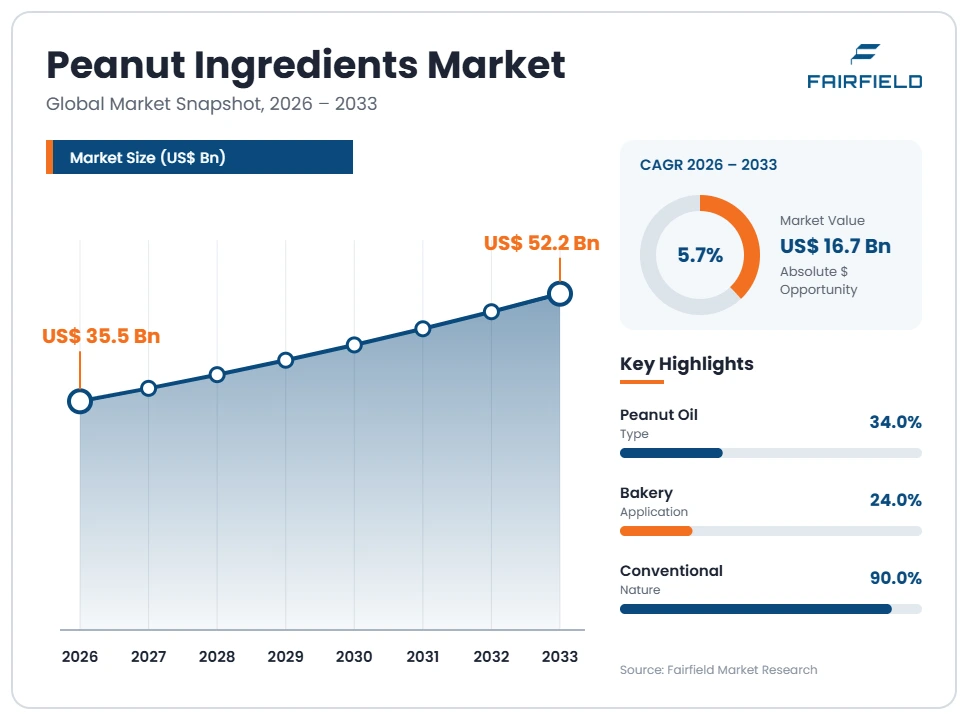
The global peanut ingredients market size is expected to be valued at US$ 35.5 billion in 2026 and projected to reach US$ 52.2 billion by 2033, growing at a CAGR of 5.7% between 2026 and 2033.
Between 2020 and 2025, the market grew at a CAGR of about 4.5%, rising from roughly US$ 26.9 billion to about US$ 33.6 billion, as home snacking increased during the pandemic, demand for plant-based protein grew, and food makers used more peanut butter, paste, flour, and oil in bakery, confectionery, and snacks. The peanut ingredients market covers peanut oil, peanut butter and paste, peanut flour, peanut powder, peanut protein, granules, and other processed peanut products. These ingredients are used in bakery goods, savory snacks, confectionery, dairy and frozen desserts, sauces, nutrition products, and animal feed. They are supplied by shellers, crushers, and processors to food manufacturers, food service, and retail brands. In April 2026, Ferrero opened a US$ 75 million Nutella Peanut production line in Illinois.
Key Report Takeaways
- By Type: Peanut Oil held about 34% share in 2025, while Peanut Flour is projected to expand at a 7.0% CAGR through 2033, driven by its high protein and fiber content, gluten-free use in bakery, and clean-label appeal in snacks and nutrition products.
- By Application: Bakery held about 24% share in 2025, while Savory Snacks is projected to expand at a 6.6% CAGR through 2033, driven by demand for protein-rich snacks, coated peanuts, and peanut-flavored chips and crackers across retail and convenience channels.
- By Nature: Conventional held about 90% share in 2025, while Organic is projected to expand at an 8.1% CAGR through 2033, driven by clean-label demand, natural peanut butter, and premium organic snacks sold through supermarkets and online stores.
- By Region: Asia Pacific held about 33% share in 2025, while India is projected to expand at a 7.4% CAGR through 2033, driven by large peanut production, rising packaged food demand, strong peanut oil use, and export growth.
Global Peanut Ingredients Market Trends and Insights
Drivers Impact Analysis
Two drivers carry the strongest influence on peanut ingredients market demand during the forecast period.
| Driver | Impact on CAGR Forecast | Geographic Relevance | Impact Timeline |
| Rising demand for plant-based protein and healthy snacks | High | Global, with focus on North America and Asia Pacific | Medium term (2-4 years) |
| Growth in bakery, confectionery, and spreads | High | North America, Europe, Asia Pacific | Long term (≥4 years) |
Plant Protein and Snacking Are Driving the Peanut Ingredients Market
Rising demand for plant-based protein and healthy snacks is the strongest driver of the peanut ingredients market. Peanuts are an affordable protein source.
The mechanism is that peanuts provide protein, healthy fats, fiber, vitamins, and minerals at a lower cost than many tree nuts, and consumers use them as a convenient snack and plant-based protein. Peanut flour can deliver about 35% to 55% protein, making it useful for gluten-free foods, protein bars, and fortified drinks. Peanut protein powders are being used in ready-to-mix beverages and meal replacements. Strong demand for high-protein diets, fitness nutrition, and on-the-go snacks in North America, Asia Pacific, and Europe keeps ingredient volumes rising. Peanuts also fit vegan, vegetarian, and flexitarian diets, which widens their appeal among younger shoppers.
Bakery, Confectionery, and Spreads Are Expanding the Peanut Ingredients Market
Growth in bakery, confectionery, and spreads is expanding the peanut ingredients market. Peanut flavors are popular worldwide.
The cause is that peanut butter, paste, granules, and roasted peanuts are key ingredients in chocolates, candy bars, cookies, cakes, breakfast cereals, ice cream, and sauces. Large brands keep launching peanut products, and Ferrero opened a US$ 75 million Nutella Peanut line in Illinois in April 2026, its first Nutella product made in the United States. Peanut butter remains a staple in many households, and no-added-sugar and natural versions are gaining share. Private-label foods also use large volumes of peanut ingredients. New flavors such as peanut-chocolate spreads, peanut sauces for Asian dishes, and peanut-based ice creams keep brands launching products, which raises steady demand for paste, butter, and granules from processors.
Restraints Impact Analysis
Two restraints limit how quickly the peanut ingredients market grows.
| Restraint | Impact on CAGR Forecast | Geographic Relevance | Impact Timeline |
| Peanut allergies and food safety rules | High | North America, Europe | Long term (≥4 years) |
| Crop price swings and aflatoxin risks | Medium | Global | Medium term (2-4 years) |
Peanut Allergies Slow the Peanut Ingredients Market
Peanut allergies and strict food safety rules slow the peanut ingredients market. Allergies limit where peanuts can be used.
The problem is that peanut allergy is one of the most common and serious food allergies, especially among children in the United States, Canada, the United Kingdom, and Australia. Many schools, airlines, and food service outlets restrict peanut products, and food makers must manage cross-contact, labeling, and separate production lines. Some brands avoid peanuts entirely to make allergen-free products. Strict allergen labeling rules add costs. These factors limit peanut use in some product categories and markets, even as research into early introduction and allergy treatment continues. Guidance that encourages parents to introduce peanuts early to babies may slowly reduce allergy rates over time, and new allergy treatments could help more people eat peanuts safely.
Crop Prices and Aflatoxin Risks Restrict the Peanut Ingredients Market
Crop price swings and aflatoxin risks restrict the peanut ingredients market. Supply depends on weather and quality control.
The constraint is that peanut harvests in China, India, Nigeria, the United States, Argentina, and Brazil vary with rainfall, drought, and disease, which causes price swings. Peanuts can be contaminated with aflatoxins, which are harmful molds, so buyers in Europe and other markets set strict limits and test shipments carefully. Rejected shipments create losses for exporters. Rising farm costs, low prices for growers, and trade tariffs also affect supply. These factors make costs harder to predict for ingredient makers. Climate change is also shifting rainfall patterns in key growing regions, and buyers increasingly ask for traceable supply chains, sustainable farming, and proof of good labor practices from their suppliers.
Market Opportunities
Peanut Protein and Clean-Label Products Open a Premium Revenue Pool
Peanut protein and clean-label products open a premium revenue pool. Health-focused buyers will pay more.
The opportunity comes from high-protein defatted peanut flour, instantized peanut protein powders, powdered peanut butter, organic and non-GMO peanut butters, no-added-sugar spreads, and allergen-controlled ingredients for export. These products serve sports nutrition, weight management, gluten-free bakery, and plant-based foods for many age groups. Puratos acquired nut butter and filling maker Vör Foods in January 2026 to meet fast-growing demand for nut-based bakery ingredients. Companies that offer high-protein, clean-label, and traceable peanut ingredients can earn premium prices. Peanut-based dairy alternatives such as peanut milk and yogurt are also emerging, and they open new uses for paste and protein in chilled foods and drinks.
India and Asia Pacific Processing Create a Growth Revenue Pool
India and Asia Pacific processing create a growth revenue pool. Large peanut-growing countries are adding more value at home.
The opportunity reflects huge peanut production in China and India, rising demand for packaged snacks, sweets, and spreads, and strong use of peanut oil for daily home cooking. Processors in India, China, and Vietnam are expanding automated shelling, grading, blanching, and roasting capacity for exports. Nigeria and Senegal are also large producers with plans to add local processing. Companies that build modern processing plants, aflatoxin testing, and export certifications can capture this growth. Partnerships with farmer groups to improve seeds, drying, and storage can also raise quality and yields, while rising incomes increase local demand for branded peanut butter and snacks in large cities across the region.
Segment Analysis
- By Type: Peanut Oil Leads While Peanut Flour Grows Fastest
Peanut Oil held about 34% share in 2025. Peanut oil is widely used for cooking and frying because of its high smoke point, mild flavor, and stability, and it is a staple cooking oil in China and India. Food service, snack makers, and households use large volumes, giving this type the largest share.
Peanut Flour is the fastest-growing type, expanding at a 7.0% CAGR through 2033. Defatted peanut flour is high in protein and fiber and works well in gluten-free bakery, protein bars, snacks, sauces, and fortified foods. Peanut Butter and Peanut Powder form other segments, with peanut butter holding about 29% share and peanut powder about 16%. For the market, flour growth supports higher-value ingredients.
- By Application: Bakery Leads While Savory Snacks Grow Fastest
Bakery held about 24% share in 2025. Peanut butter, paste, granules, and flour are used in cookies, cakes, breads, pastries, and bars, and they are popular in both branded and private-label bakery products. Peanut butter cookies, filled pastries, and peanut-topped breads are common in North America, and bakery chains in Asia Pacific are adding peanut flavors. Bakers value peanut ingredients for flavor, texture, and protein.
Savory Snacks is the fastest-growing application, expanding at a 6.6% CAGR through 2033. Roasted, salted, coated, and flavored peanuts, peanut crackers, and peanut-based chips are popular as affordable, protein-rich snacks. Confectionery, Dairy and Frozen Desserts, and Animal Feed form other segments. Confectionery makers use peanuts in chocolate bars and candies, while animal feed uses peanut meal from oil crushing. For the market, snack growth raises volume demand.
- By Nature: Conventional Leads While Organic Grows Fastest
Conventional held about 90% share in 2025. Conventional peanuts are widely grown, cost less, and supply most food manufacturers, oil crushers, and snack makers. Large-scale farming in China, India, the United States, and Argentina keeps conventional supply high, and most private-label and food service products use conventional peanuts. Price is the main buying factor.
Organic is the fastest-growing nature segment, expanding at an 8.1% CAGR through 2033. Organic peanut butter, organic peanuts, and organic snacks appeal to health-conscious shoppers and sell at premium prices. Organic supply is still limited because farmers need several years to convert land and must manage pests without synthetic chemicals. Online stores and natural food chains are key sales channels. For the market, organic growth raises value per kilogram.
Geography Analysis
- Why Is North America Important to the Peanut Ingredients Market?
North America is important to the peanut ingredients market because of its large peanut production, strong peanut butter demand, and advanced processing industry. North America holds about 31% share. The United States is the fourth-largest peanut producer in the world, with Georgia, Alabama, Florida, and Texas leading output. Kraft Heinz, J.M. Smucker, Hormel, ADM, ofi, and Birdsong are major players. Peanut butter exports remain strong. Key barriers include peanut allergies. Canada and Mexico are major buyers of United States peanut butter. One change shaping the region is new peanut product launches.
- Peanut Ingredients Market in Europe
Europe is a large peanut ingredients market with about 24% share. Germany, the United Kingdom, the Netherlands, France, and Spain import peanuts and peanut ingredients for snacks, confectionery, spreads, and bakery products. The Netherlands is a major hub for peanut trade and processing. Natra acquired Dutch peanut butter and ingredients supplier Bredabest in September 2025. Strict aflatoxin rules shape supply and favor tested, high-quality origins such as Argentina and the United States. Key barriers include allergy concerns. Rising snack demand supports imports. One change shaping the region is growth in natural and organic peanut butter.
- Which Region Is Leading the Peanut Ingredients Market?
Asia Pacific is leading the peanut ingredients market with about 33% share in 2025. China is the world's largest peanut producer and consumer, using large volumes for peanut oil, snacks, and sauces, and accounts for about 14% of the regional market. India is the fastest-growing country, expanding at a 7.4% CAGR through 2033, driven by large peanut production, peanut oil demand, and packaged snack growth. Japan, Indonesia, and Vietnam add demand from snacks and sauces. Key barriers include aflatoxin control and weather-related harvest swings. One change shaping the region is export processing growth and rising snack demand.
- Peanut Ingredients Market in Latin America
Latin America is a growing peanut ingredients market. Argentina is one of the world's largest peanut exporters, supplying high-quality peanuts to Europe and other markets, and Brazil is also a major producer. Mexico has strong demand for peanut snacks, candies, and traditional sweets sold in shops and markets. Local processors are adding blanching, roasting, and peanut butter capacity to sell higher-value products. Peanut snacks and candies are popular across the region. Key barriers include weather risks, currency swings, and changing export demand. One opportunity is value-added peanut ingredients such as paste, butter, and blanched kernels for export markets.
- Peanut Ingredients Market in Middle East & Africa
Middle East & Africa is a developing peanut ingredients market. Nigeria, Senegal, Sudan, and South Africa are important peanut producers, and Saudi Arabia and the United Arab Emirates import peanut butter and snacks. Peanut oil and paste are common in local cooking in many countries, and peanut stews and sauces are traditional dishes. Imports still supply most packaged products in the region today. Key barriers include aflatoxin contamination, limited processing, and weak storage. Growing urban populations are raising demand for packaged foods. One opportunity is modern processing plants that add value to local peanut crops and create jobs.
Competitive Landscape
The peanut ingredients market is fragmented. Kraft Heinz, with about 9% share, and ofi, with about 8%, are the largest players, followed by ADM through Golden Peanut and Tree Nuts, J.M. Smucker, and Hormel, while Cargill, Hampton Farms, Birdsong, American Peanut Growers Group, Natra, Ruparel Foods, and Whitley's compete strongly. Large shellers and processors supply raw peanuts, paste, oil, and flour to food brands, while consumer brands lead in peanut butter and snacks. Many regional crushers and processors in China and India serve local markets, especially for peanut oil and snacks, and they compete mainly on price.
Companies mainly compete on peanut quality, flavor, aflatoxin control, allergen management, food safety certifications, product range, supply security, farm sourcing networks, processing capacity, private-label supply, and price. Long-term and reliable supply contracts with confectionery, bakery, and snack makers are important. Shellers also work very closely with farmers to secure crop volumes, and processors that control farming, shelling, and processing can manage quality and costs better.
Strategic moves show how competition is changing. Natra acquired Bredabest in September 2025, Puratos bought Vör Foods in January 2026, and Ferrero opened its Nutella Peanut line in Illinois in April 2026. These moves show strong interest in peanut spreads and nut-based bakery ingredients.
Three themes shape vendor strategy. First, companies are acquiring nut butter makers. Second, they are expanding processing capacity. Third, they are launching protein and clean-label products.
Peanut Ingredients Market Industry Leaders
- The Kraft Heinz Company
- ofi (Olam Food Ingredients)
- Archer Daniels Midland Company (Golden Peanut and Tree Nuts)
- The J.M. Smucker Company
- Hormel Foods Corporation
Recent Industry Developments
- April 2026: Ferrero North America opened a US$ 75 million Nutella Peanut production line in Franklin Park, Illinois, creating 50 new jobs and producing the first Nutella product made in the United States - shows strong demand for peanut spreads.
- January 2026: Puratos acquired Vör Foods, a producer of clean-label nut butters and nut-based fillings, and plans to invest in its equipment and capacity - expands nut-based bakery ingredients.
- September 2025: Natra acquired Bredabest, a Dutch producer of peanut butter and value-added peanut ingredients, creating a larger supplier of sweet spreads and confectionery - strengthens peanut supply in Europe.
Companies Covered in the Report
- The Kraft Heinz Company
- ofi (Olam Food Ingredients)
- Archer Daniels Midland Company (Golden Peanut and Tree Nuts)
- The J.M. Smucker Company
- Hormel Foods Corporation
- Cargill, Incorporated
- Hampton Farms
- Birdsong Peanuts
- American Peanut Growers Group
- Natra (Bredabest)
- Ruparel Foods
- Whitley's Peanut Factory
Peanut Ingredients Market Report Scope
| Metric | Value |
| Study Period | 2020-2033 |
| Market Size 2026 | US$ 35.5 Billion |
| Market Size 2033 | US$ 52.2 Billion |
| CAGR 2026-2033 | 5.7% |
| Absolute Dollar Opportunity | US$ 16.7 Billion |
| Largest Market | Asia Pacific |
| Fastest-Growing Market | India |
| Market Concentration | Fragmented |
| Major Players | The Kraft Heinz Company, ofi (Olam Food Ingredients), Archer Daniels Midland Company (Golden Peanut and Tree Nuts), The J.M. Smucker Company, Hormel Foods Corporation |
Peanut Ingredients Market Segmentation
Type
- Peanut Oil
- Peanut Butter
- Peanut Flour
- Peanut Powder
Application
- Bakery
- Savory Snacks
- Confectionery
- Dairy and Frozen Desserts
- Animal Feed
Nature
- Conventional
- Organic
Regions
- North America
- Europe
- Asia Pacific
- Latin America
- Middle East & Africa
- Executive Summary
- Peanut Ingredients Market Snapshot
- Future Projections
- Key Market Trends
- Regional Snapshot
- Market Overview
- Market Definition and Report Scope
- Historical Market Trends
- Market Dynamics
- Drivers
- Plant Protein and Snacking Are Driving the Peanut Ingredients Market
- Bakery, Confectionery, and Spreads Are Expanding the Peanut Ingredients Market
- Restraints
- Peanut Allergies Slow the Peanut Ingredients Market
- Crop Prices and Aflatoxin Risks Restrict the Peanut Ingredients Market
- Market Opportunities
- Peanut Protein and Clean-Label Products Open a Premium Revenue Pool
- India and Asia Pacific Processing Create a Growth Revenue Pool
- Drivers
- Global Peanut Ingredients Market Outlook, 2020–2033
- Global Peanut Ingredients Market Outlook, by Type, Value (US$ Billion), 2020–2033
- Peanut Oil
- Peanut Butter
- Peanut Flour
- Peanut Powder
- Global Peanut Ingredients Market Outlook, by Application, Value (US$ Billion), 2020–2033
- Bakery
- Savory Snacks
- Confectionery
- Dairy and Frozen Desserts
- Animal Feed
- Global Peanut Ingredients Market Outlook, by Nature, Value (US$ Billion), 2020–2033
- Conventional
- Organic
- Global Peanut Ingredients Market Outlook, by Region, Value (US$ Billion), 2020–2033
- North America
- Europe
- Asia Pacific
- Latin America
- Middle East & Africa
- Global Peanut Ingredients Market Outlook, by Type, Value (US$ Billion), 2020–2033
- North America Peanut Ingredients Market Outlook, 2020–2033
- North America Peanut Ingredients Market Outlook, by Type, Value (US$ Billion), 2020–2033
- Peanut Oil
- Peanut Butter
- Peanut Flour
- Peanut Powder
- North America Peanut Ingredients Market Outlook, by Application, Value (US$ Billion), 2020–2033
- Bakery
- Savory Snacks
- Confectionery
- Dairy and Frozen Desserts
- Animal Feed
- North America Peanut Ingredients Market Outlook, by Nature, Value (US$ Billion), 2020–2033
- Conventional
- Organic
- North America Peanut Ingredients Market Outlook, by Country, Value (US$ Billion), 2020–2033
- United States Peanut Ingredients Market Outlook, by Type, 2020–2033
- United States Peanut Ingredients Market Outlook, by Application, 2020–2033
- United States Peanut Ingredients Market Outlook, by Nature, 2020–2033
- Canada Peanut Ingredients Market Outlook, by Type, 2020–2033
- Canada Peanut Ingredients Market Outlook, by Application, 2020–2033
- Canada Peanut Ingredients Market Outlook, by Nature, 2020–2033
- Mexico Peanut Ingredients Market Outlook, by Type, 2020–2033
- Mexico Peanut Ingredients Market Outlook, by Application, 2020–2033
- Mexico Peanut Ingredients Market Outlook, by Nature, 2020–2033
- North America Peanut Ingredients Market Outlook, by Type, Value (US$ Billion), 2020–2033
- Europe Peanut Ingredients Market Outlook, 2020–2033
- Europe Peanut Ingredients Market Outlook, by Type, Value (US$ Billion), 2020–2033
- Peanut Oil
- Peanut Butter
- Peanut Flour
- Peanut Powder
- Europe Peanut Ingredients Market Outlook, by Application, Value (US$ Billion), 2020–2033
- Bakery
- Savory Snacks
- Confectionery
- Dairy and Frozen Desserts
- Animal Feed
- Europe Peanut Ingredients Market Outlook, by Nature, Value (US$ Billion), 2020–2033
- Conventional
- Organic
- Europe Peanut Ingredients Market Outlook, by Country, Value (US$ Billion), 2020–2033
- Germany Peanut Ingredients Market Outlook, by Type, 2020–2033
- Germany Peanut Ingredients Market Outlook, by Application, 2020–2033
- Germany Peanut Ingredients Market Outlook, by Nature, 2020–2033
- United Kingdom Peanut Ingredients Market Outlook, by Type, 2020–2033
- United Kingdom Peanut Ingredients Market Outlook, by Application, 2020–2033
- United Kingdom Peanut Ingredients Market Outlook, by Nature, 2020–2033
- Netherlands Peanut Ingredients Market Outlook, by Type, 2020–2033
- Netherlands Peanut Ingredients Market Outlook, by Application, 2020–2033
- Netherlands Peanut Ingredients Market Outlook, by Nature, 2020–2033
- France Peanut Ingredients Market Outlook, by Type, 2020–2033
- France Peanut Ingredients Market Outlook, by Application, 2020–2033
- France Peanut Ingredients Market Outlook, by Nature, 2020–2033
- Spain Peanut Ingredients Market Outlook, by Type, 2020–2033
- Spain Peanut Ingredients Market Outlook, by Application, 2020–2033
- Spain Peanut Ingredients Market Outlook, by Nature, 2020–2033
- Argentina Peanut Ingredients Market Outlook, by Type, 2020–2033
- Argentina Peanut Ingredients Market Outlook, by Application, 2020–2033
- Argentina Peanut Ingredients Market Outlook, by Nature, 2020–2033
- United States Peanut Ingredients Market Outlook, by Type, 2020–2033
- United States Peanut Ingredients Market Outlook, by Application, 2020–2033
- United States Peanut Ingredients Market Outlook, by Nature, 2020–2033
- Europe Peanut Ingredients Market Outlook, by Type, Value (US$ Billion), 2020–2033
- Asia Pacific Peanut Ingredients Market Outlook, 2020–2033
- Asia Pacific Peanut Ingredients Market Outlook, by Type, Value (US$ Billion), 2020–2033
- Peanut Oil
- Peanut Butter
- Peanut Flour
- Peanut Powder
- Asia Pacific Peanut Ingredients Market Outlook, by Application, Value (US$ Billion), 2020–2033
- Bakery
- Savory Snacks
- Confectionery
- Dairy and Frozen Desserts
- Animal Feed
- Asia Pacific Peanut Ingredients Market Outlook, by Nature, Value (US$ Billion), 2020–2033
- Conventional
- Organic
- Asia Pacific Peanut Ingredients Market Outlook, by Country, Value (US$ Billion), 2020–2033
- China Peanut Ingredients Market Outlook, by Type, 2020–2033
- China Peanut Ingredients Market Outlook, by Application, 2020–2033
- China Peanut Ingredients Market Outlook, by Nature, 2020–2033
- India Peanut Ingredients Market Outlook, by Type, 2020–2033
- India Peanut Ingredients Market Outlook, by Application, 2020–2033
- India Peanut Ingredients Market Outlook, by Nature, 2020–2033
- Japan Peanut Ingredients Market Outlook, by Type, 2020–2033
- Japan Peanut Ingredients Market Outlook, by Application, 2020–2033
- Japan Peanut Ingredients Market Outlook, by Nature, 2020–2033
- Indonesia Peanut Ingredients Market Outlook, by Type, 2020–2033
- Indonesia Peanut Ingredients Market Outlook, by Application, 2020–2033
- Indonesia Peanut Ingredients Market Outlook, by Nature, 2020–2033
- Vietnam Peanut Ingredients Market Outlook, by Type, 2020–2033
- Vietnam Peanut Ingredients Market Outlook, by Application, 2020–2033
- Vietnam Peanut Ingredients Market Outlook, by Nature, 2020–2033
- Asia Pacific Peanut Ingredients Market Outlook, by Type, Value (US$ Billion), 2020–2033
- Latin America Peanut Ingredients Market Outlook, 2020–2033
- Latin America Peanut Ingredients Market Outlook, by Type, Value (US$ Billion), 2020–2033
- Peanut Oil
- Peanut Butter
- Peanut Flour
- Peanut Powder
- Latin America Peanut Ingredients Market Outlook, by Application, Value (US$ Billion), 2020–2033
- Bakery
- Savory Snacks
- Confectionery
- Dairy and Frozen Desserts
- Animal Feed
- Latin America Peanut Ingredients Market Outlook, by Nature, Value (US$ Billion), 2020–2033
- Conventional
- Organic
- Latin America Peanut Ingredients Market Outlook, by Country, Value (US$ Billion), 2020–2033
- Argentina Peanut Ingredients Market Outlook, by Type, 2020–2033
- Argentina Peanut Ingredients Market Outlook, by Application, 2020–2033
- Argentina Peanut Ingredients Market Outlook, by Nature, 2020–2033
- Brazil Peanut Ingredients Market Outlook, by Type, 2020–2033
- Brazil Peanut Ingredients Market Outlook, by Application, 2020–2033
- Brazil Peanut Ingredients Market Outlook, by Nature, 2020–2033
- Mexico Peanut Ingredients Market Outlook, by Type, 2020–2033
- Mexico Peanut Ingredients Market Outlook, by Application, 2020–2033
- Mexico Peanut Ingredients Market Outlook, by Nature, 2020–2033
- Latin America Peanut Ingredients Market Outlook, by Type, Value (US$ Billion), 2020–2033
- Middle East & Africa Peanut Ingredients Market Outlook, 2020–2033
- Middle East & Africa Peanut Ingredients Market Outlook, by Type, Value (US$ Billion), 2020–2033
- Peanut Oil
- Peanut Butter
- Peanut Flour
- Peanut Powder
- Middle East & Africa Peanut Ingredients Market Outlook, by Application, Value (US$ Billion), 2020–2033
- Bakery
- Savory Snacks
- Confectionery
- Dairy and Frozen Desserts
- Animal Feed
- Middle East & Africa Peanut Ingredients Market Outlook, by Nature, Value (US$ Billion), 2020–2033
- Conventional
- Organic
- Middle East & Africa Peanut Ingredients Market Outlook, by Country, Value (US$ Billion), 2020–2033
- Nigeria Peanut Ingredients Market Outlook, by Type, 2020–2033
- Nigeria Peanut Ingredients Market Outlook, by Application, 2020–2033
- Nigeria Peanut Ingredients Market Outlook, by Nature, 2020–2033
- South Africa Peanut Ingredients Market Outlook, by Type, 2020–2033
- South Africa Peanut Ingredients Market Outlook, by Application, 2020–2033
- South Africa Peanut Ingredients Market Outlook, by Nature, 2020–2033
- Saudi Arabia Peanut Ingredients Market Outlook, by Type, 2020–2033
- Saudi Arabia Peanut Ingredients Market Outlook, by Application, 2020–2033
- Saudi Arabia Peanut Ingredients Market Outlook, by Nature, 2020–2033
- United Arab Emirates Peanut Ingredients Market Outlook, by Type, 2020–2033
- United Arab Emirates Peanut Ingredients Market Outlook, by Application, 2020–2033
- United Arab Emirates Peanut Ingredients Market Outlook, by Nature, 2020–2033
- Middle East & Africa Peanut Ingredients Market Outlook, by Type, Value (US$ Billion), 2020–2033
- Competitive Landscape
- Peanut Ingredients Market Industry Leaders
- Recent Industry Developments
- Company Profiles
- The Kraft Heinz Company
- ofi (Olam Food Ingredients)
- Archer Daniels Midland Company (Golden Peanut and Tree Nuts)
- The J.M. Smucker Company
- Hormel Foods Corporation
- Cargill, Incorporated
- Hampton Farms
- Birdsong Peanuts
- American Peanut Growers Group
- Natra (Bredabest)
- Ruparel Foods
- Whitley's Peanut Factory
- Appendix
- Research Methodology
- Report Assumptions
- Acronyms and Abbreviations
Type
- Peanut Oil
- Peanut Butter
- Peanut Flour
- Peanut Powder
Application
- Bakery
- Savory Snacks
- Confectionery
- Dairy and Frozen Desserts
- Animal Feed
Nature
- Conventional
- Organic
Regions
- North America
- Europe
- Asia Pacific
- Latin America
- Middle East & Africa
Our Research Methodology
Considering the volatility of business today, traditional approaches to strategizing a game plan can be unfruitful if not detrimental. True ambiguity is no way to determine a forecast. A myriad of predetermined factors must be accounted for such as the degree of risk involved, the magnitude of circumstances, as well as conditions or consequences that are not known or unpredictable. To circumvent binary views that cast uncertainty, the application of market research intelligence to strategically posture, move, and enable actionable outcomes is necessary.
View Methodology
Quality Assured
Rigorous Validation Process

Confidentiality Assured
End-to-end Data Security

Custom Research Services
Tailored To Your Objectives
FAQs
The global peanut ingredients market is expected to be valued at US$ 35.5 billion in 2026, driven by plant protein demand and snacking.
The market is projected to grow at a 5.7% CAGR from 2026 to 2033, reaching about US$ 52.2 billion by 2033.
Asia Pacific leads with about 33% share, supported by very large peanut production and consumption in China and India.
India is growing fastest at a 7.4% CAGR, driven by large peanut production, peanut oil demand, and packaged snack growth.
Key players include Kraft Heinz, ofi, ADM, J.M. Smucker, and Hormel, competing on quality, safety, supply security, and price.
Related Reports
Wine Vinegar Market Size, Share, Insights, Competitive Landscape, and Forecast 2026 to 2033
The wine vinegar market is projected to grow from US$1.70 billion in 2026 to US$2.06 billion by 2033, registering a CAGR of 2.8% during the forecast period.
Soy Based Foods Market Size, Share, Insights, Competitive Landscape, and Forecast 2026 to 2033
The soy based foods market is projected to grow from US$55.6 billion in 2026 to US$74.4 billion by 2033, registering a CAGR of 4.3% during the forecast period.
Plant Protein Ingredients Market Size, Share, Insights, Competitive Landscape, and Forecast 2026 to 2033
The plant protein ingredients market is projected to grow from US$15.2 billion in 2026 to US$24.9 billion by 2033, registering a CAGR of 7.3%.
Bouillon Cubes Market Size, Share, Insights, Competitive Landscape, and Forecast 2026 to 2033
The bouillon cubes market is projected to grow from US$5.18 billion in 2026 to US$7.20 billion by 2033, registering a CAGR of 4.8% during the forecast period.
Alcoholic Ingredients Market Size, Share, Insights, Competitive Landscape, and Forecast 2026 to 2033
The alcoholic ingredients market is projected to grow from US$3.35 billion in 2026 to US$5.31 billion by 2033, registering a CAGR of 6.8% during the forecast period.
Sunflower Oilmeal Market Size, Share, Insights, Competitive Landscape, and Forecast 2026 to 2033
The sunflower oilmeal market is projected to grow from US$6.2 billion in 2026 to US$8.9 billion by 2033, registering a CAGR of 5.3% during the forecast period.