



Automatic Lubrication Systems Market
Automatic Lubrication Systems Market Insights, Competitive Landscape, and Market Forecast - 2033
Global Automatic Lubrication Systems Market Forecast
The Automatic Lubrication Systems Market is expected to grow from USD 1093.3 Million in 2026 to USD 1507.8 Million by 2033, reflecting strong industry expansion and registering a CAGR of 4.7% during the forecast period from 2026 to 2033.
Automatic Lubrication Systems Market Insights
A Look Back and a Look Forward - Comparative Analysis
The automatic lubrication systems market experienced steady growth during the period from 2019 to 2023, driven by increased industrial automation and the need for efficient machinery maintenance. Sectors such as mining, manufacturing, and construction adopted automatic lubrication to minimize manual intervention, reduce downtime, and enhance equipment lifespan.
Rising labour costs and safety concerns also contributed to the adoption of automated lubrication solutions, as they offered a reliable and safe alternative to manual lubrication, especially in hazardous environments. North America and Europe were leading markets due to their advanced industrial infrastructure, while adoption in emerging markets was slower due to cost constraints and limited awareness.
The market is expected to accelerate, driven by advancements in IoT-enabled lubrication systems and predictive maintenance technologies over the forecast period. IoT integration allows real-time monitoring of lubrication needs, improving efficiency and minimizing wear on critical components. Consequently, it is increasingly attractive to industries prioritizing asset longevity.
Emerging economies in Asia Pacific, Latin America, and Africa are anticipated to see a significant uptake due to rising industrial activities and infrastructure developments. The demand for eco-friendly and energy-efficient systems is also expected to boost the market as companies aim to align with sustainability goals. Such advancements position the automatic lubrication systems market for robust and sustained growth globally.
Key Growth Determinants
- Benefits of Automatic Lubrication System Blended with Industry 4.0 Trends
One of the key driving elements for the automatic lubrication systems market is the growing knowledge of the advantages of using automatic lubrication systems with industrial automation. Everything in this era of Industry 4.0 is designed and produced to streamline the process.
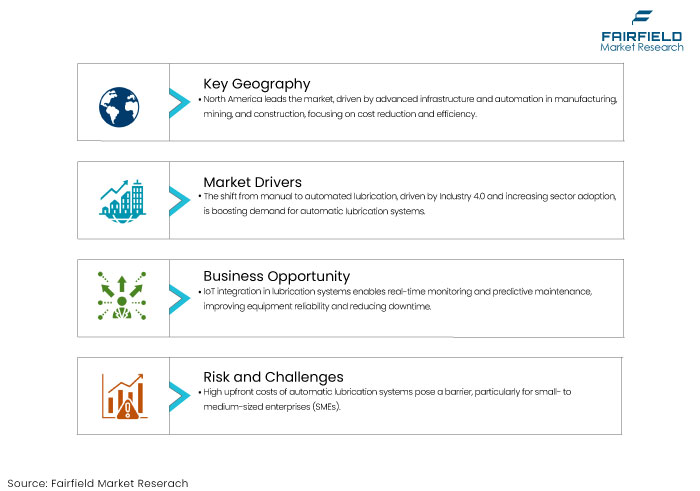
In keeping with the general trend, the manufacturing sector is progressively moving from manual lubrication methods toward automated lubrication. Growing uses in many end-use sectors and the shift from manual to automatic lubrication are driving demand for automatic lubrication systems.
From steel, mining, paper, agriculture, food and beverages, packaging, and mobile off-road and on-road vehicles, automatic lubrication systems find employment in various industrial settings. Various benefits of automated lubrication are fueling demand for these systems.
A few advantages that automatic lubrication systems provide are low noise levels, less wear & tear, less power consumption, improved dependability, higher productivity, better machine life, suitable oil usage, elimination of human mistakes, and generally higher profitability.
- Rising Automation Trend to Support Market Players in Bode Well
The global automatic lubrication systems market has also been driven by the increasing adoption of multiline lubrication systems and automation in certain industrial sectors. Rising industrial automation has improved the acceptance of sophisticated equipment and machinery.
Advanced technology and machinery are increasing the output of several sectors. Since they lower the danger of accidents by up to 90%, automatic lubrication systems are shown to be the ideal option for maintaining this equipment. Likewise, a reasonably affordable and user-friendly solution for the centralized automatic lubrication systems of several places in equipment or machines is multiline lubricators, sometimes known as radial lubricators.
Combining numerous pumps into one unit, sharing a common reservoir and motor, is what multiline lubrication systems do. Stone crushers, forging hammers, cement plants, sugar mills, rolling mills, hydro-turbines, calendaring machines, and batch mixers are the most often used multiline lubrication systems.
Key Growth Barriers
- High Initial Investment and Maintenance Costs
One of the primary restraints for the automatic lubrication systems market is the high upfront cost associated with installing these systems. For many small- to medium-sized enterprises (SMEs), the initial expense of acquiring and installing automatic lubrication equipment can be prohibitive.
Systems often require regular maintenance and occasional software upgrades, which add to operational costs. While automatic lubrication systems are cost-effective in the long term, providing reduced downtime and extended equipment lifespan, the initial investment can be a significant barrier to adoption. For companies in emerging economies or industries with limited budgets, these high costs hinder widespread adoption, limiting market growth potential.
- Lack of Awareness and Technical Knowledge
Some restraints affecting automatic lubrication systems market growth are the lack of awareness and technical knowledge regarding the benefits and operation of automatic lubrication systems. In many regions, particularly in emerging markets, industrial managers and operators may not be fully aware of the advantages of automated lubrication over manual methods.
Implementing and managing these automated systems often requires a certain level of technical expertise to ensure optimal functionality and integration with existing machinery. The absence of skilled personnel and sufficient training can lead to operational inefficiencies, system misuse, or even system failure, deterring companies from investing in automatic lubrication systems.
Automatic Lubrication Systems Market Trends and Opportunities
- Integration with IoT and Predictive Maintenance
The integration of Internet of Things (IoT) technology presents a significant opportunity for the automatic lubrication systems market. By embedding IoT sensors in lubrication systems, companies can enable real-time monitoring and data collection, allowing for predictive maintenance.
The integration helps identify issues like clogged lubricant lines or inadequate lubrication levels before they lead to equipment failure. IoT-enabled lubrication systems provide actionable insights, enhancing equipment reliability and reducing unplanned downtime.
Industries such as mining, manufacturing, and transportation, where machinery uptime is critical, stand to benefit significantly from predictive maintenance. It also aligns with the broader shift toward Industry 4.0, where smart technology is transforming industrial processes.
- Increased Demand for Eco-Friendly Lubrication Solutions
There is an increasing demand for eco-friendly lubrication solutions with growing environmental regulations and a push for sustainable practices. Automatic lubrication systems can be configured to use precisely the amount of lubricant required, reducing waste and minimizing environmental impact.
Advancements in biodegradable and low-toxicity lubricants enhance sustainability while meeting performance needs. Companies are investing in lubrication solutions, which is expected to create growth opportunities as eco-friendly automatic lubrication systems become a preferred choice for environmentally conscious businesses.
How Does Regulatory Scenario Shape the Industry?
The regulatory scenario is increasingly shaping the automatic lubrication systems market, particularly with regard to environmental and safety standards. Governments and regulatory bodies worldwide are emphasizing sustainability and the reduction of environmental impact in industrial operations.
Regulations targeting emissions, waste reduction, and energy efficiency have prompted companies to adopt automatic lubrication systems, as these systems help ensure precise lubrication, minimize waste, and reduce the risk of oil leaks and spills.
Safety regulations play a significant role. Workplace safety agencies, like OSHA in the United States and EU-OSHA in Europe have strict guidelines to minimize worker injuries, especially in hazardous industrial environments. Automatic lubrication systems reduce the need for manual lubrication in risky areas, thereby lowering the risk of workplace accidents.
As regulatory frameworks become stricter, companies are more inclined to adopt automatic lubrication systems to meet these requirements, driving market growth. Compliance with these evolving regulations provides a competitive advantage, making regulatory alignment a key factor shaping market dynamics.
Segments Covered in the Report
- Series Progressive Lubrication Systems Top System Type Segmentation
Series progressive lubrication systems are predicted to dominate the system type segmentation accounting for a market share of around 28%. Continuous lubrication is made possible by series progressive systems for as long as the pump remains in the process condition.
Once the pump stops functioning, the pistons of the progressive metering system will remain in the places they were in before the pump stopped working. Once the pump resumes its supply of oil, the pistons continue their work from the point where they had previously stopped.
Utilizing the technology offers several additional advantages, including continuous lubrication, dependable monitoring and control, and efficiency in difficult situations. As a result of all of these variables, series progressive lubrication systems are the most readily available on the market.
- Oil-Based Lubrication System Takes the Lead
Oil-based lubrication is anticipated to accumulate around 64% of the global automatic lubrication systems market over the forecast period. Oil-based lubrication is favoured over grease-based lubrication in the majority of mechanical applications.
Oil-based lubrication has numerous advantages, including superior cooling qualities, since it effectively dissipates excess heat and is free from thickeners, eliminating the risk of incompatible thickener interactions.
Oil is cleaner than grease because it effectively removes contaminants and allows for easy regulation of lubricant quantity. The oil in lubrication systems can be readily replaced without disassembling the machinery. Owing to these advantageous aspects, oil-based lubrication has the notable growth potential in the forecast years.
Regional Analysis
- Advanced Industrial Infrastructure Fueling Demand in North America
North America holds a significant share of the market, driven by advanced industrial infrastructure and a strong focus on automation. The United States and Canada are leading adopters, particularly in the manufacturing, mining, and construction sectors.
The emphasis on reducing maintenance costs and enhancing equipment efficiency propels region's demand for automatic lubrication systems. North America is at the forefront of industrial automation, with sectors like manufacturing, automotive, construction, and mining mainly relying on automated systems to streamline operations.
Automatic lubrication systems align with this trend by providing maintenance solutions that minimize downtime and reduce the need for manual intervention. North America's focus on Industry 4.0 further supports the integration of smart lubrication systems that can monitor and adjust lubrication needs in real time.
North America is expected to remain a leading region for automatic lubrication systems, with growth anticipated due to increased investment in IoT-enabled lubrication systems and predictive maintenance. As more companies adopt smart solutions that integrate with broad industrial automation frameworks, the demand for advanced lubrication technologies will likely expand.
- Europe Provides the most Favorable Growth Environment
Europe automatic lubrication systems market is driven by a well-established industrial base, and high technological adoption rates, especially in sectors such as automotive, manufacturing, and heavy machinery.
Leading market growth contributors in Europe include Germany, France, the United Kingdom, and Italy, each with strong industrial infrastructure and regulatory frameworks supporting advanced automation technologies.
Europe’s strong focus on environmental protection and sustainability significantly influences the automatic lubrication systems market. The European Union enforces strict regulations to reduce industrial emissions, waste, and environmental impact, compelling companies to adopt eco-friendly lubrication systems.
Automatic lubrication helps meet these standards by reducing lubricant consumption and minimizing spill risks. Additionally, the EU’s Green Deal and carbon-neutral goals are prompting companies to integrate efficient, sustainable solutions, including automated lubrication, to align with environmental targets.
Fairfield’s Competitive Landscape Analysis
The competitive landscape of the automatic lubrication systems market features a mix of global giants and specialized providers focusing on advanced lubrication solutions. Key players like SKF, Timken, Graco, and Bijur Delimon lead the market with extensive product portfolios and strong global distribution networks.
Companies emphasize technological innovations, such as IoT-enabled lubrication systems to enhance operational efficiency and predictive maintenance capabilities. Specialized firms like DropsA and Lincoln Industrial also hold significant shares, especially in niche markets and specific industrial applications.
Strategic mergers, acquisitions, and collaborations are common as companies aim to expand market reach and integrate advanced technologies. Growing demand across manufacturing, automotive, and mining sectors intensifies competition, driving continuous innovation and market expansion.
Key Market Companies
- Lubrication Engineers
- Graco Inc.
- DropsA USA, Inc.
- Price Engineering
- Cenlub Systems
- Lubecore International Inc.
- H-T-L perma
- Digilube Systems, Inc.
- Sloan Lubrication Systems
- Acumen Technologies Inc.
Global Automatic Lubrication Systems Market is Segmented as-
By System Type
- Oil and Air Lubrication Systems
- Circulating Oil Lubrication Systems
- Series Progressive Lubrication Systems
- Single-line Lubrication Systems
- Dual-line Lubrication Systems
- Multi-line Lubrication Systems
By Lubrication Type
- Oil-based Lubrication
- Grease-based Lubrication
By End Use
- Steel
- Manufacturing
- Transportation
- Mining
- Power
- Cement
- Construction
- Paper & Printing
- Agriculture
By Region
- North America
- Europe
- Asia Pacific
- Latin America
- The Middle East & Africa
- Executive Summary
- Global Automatic Lubrication Systems Market Snapshot
- Future Projections
- Key Market Trends
- Regional Snapshot, by Value, 2026
- Analyst Recommendations
- Market Overview
- Market Definitions and Segmentations
- Market Dynamics
- Drivers
- Restraints
- Market Opportunities
- Value Chain Analysis
- COVID-19 Impact Analysis
- Porter's Five Forces Analysis
- Impact of Russia-Ukraine Conflict
- PESTLE Analysis
- Regulatory Analysis
- Price Trend Analysis
- Current Prices and Future Projections, 2025-2033
- Price Impact Factors
- Global Automatic Lubrication Systems Market Outlook, 2020 - 2033
- Global Automatic Lubrication Systems Market Outlook, by System Type, Value (US$ Mn), 2020-2033
- Oil and Air Lubrication Systems
- Circulating Oil Lubrication Systems
- Series Progressive Lubrication Systems
- Single-line Lubrication Systems
- Dual-line Lubrication Systems
- Multi-line Lubrication Systems
- Global Automatic Lubrication Systems Market Outlook, by Lubrication Type , Value (US$ Mn), 2020-2033
- Oil-based Lubrication
- Grease-based Lubrication
- Global Automatic Lubrication Systems Market Outlook, by End Use, Value (US$ Mn), 2020-2033
- Steel
- Manufacturing
- Transportation
- Mining
- Power
- Cement
- Construction
- Paper & Printing
- Agriculture
- Global Automatic Lubrication Systems Market Outlook, by Region, Value (US$ Mn), 2020-2033
- North America
- Europe
- Asia Pacific
- Latin America
- Middle East & Africa
- Global Automatic Lubrication Systems Market Outlook, by System Type, Value (US$ Mn), 2020-2033
- North America Automatic Lubrication Systems Market Outlook, 2020 - 2033
- North America Automatic Lubrication Systems Market Outlook, by System Type, Value (US$ Mn), 2020-2033
- Oil and Air Lubrication Systems
- Circulating Oil Lubrication Systems
- Series Progressive Lubrication Systems
- Single-line Lubrication Systems
- Dual-line Lubrication Systems
- Multi-line Lubrication Systems
- North America Automatic Lubrication Systems Market Outlook, by Lubrication Type , Value (US$ Mn), 2020-2033
- Oil-based Lubrication
- Grease-based Lubrication
- North America Automatic Lubrication Systems Market Outlook, by End Use, Value (US$ Mn), 2020-2033
- Steel
- Manufacturing
- Transportation
- Mining
- Power
- Cement
- Construction
- Paper & Printing
- Agriculture
- North America Automatic Lubrication Systems Market Outlook, by Country, Value (US$ Mn), 2020-2033
- U.S. Automatic Lubrication Systems Market Outlook, by System Type, 2020-2033
- U.S. Automatic Lubrication Systems Market Outlook, by Lubrication Type , 2020-2033
- U.S. Automatic Lubrication Systems Market Outlook, by End Use, 2020-2033
- Canada Automatic Lubrication Systems Market Outlook, by System Type, 2020-2033
- Canada Automatic Lubrication Systems Market Outlook, by Lubrication Type , 2020-2033
- Canada Automatic Lubrication Systems Market Outlook, by End Use, 2020-2033
- BPS Analysis/Market Attractiveness Analysis
- North America Automatic Lubrication Systems Market Outlook, by System Type, Value (US$ Mn), 2020-2033
- Europe Automatic Lubrication Systems Market Outlook, 2020 - 2033
- Europe Automatic Lubrication Systems Market Outlook, by System Type, Value (US$ Mn), 2020-2033
- Oil and Air Lubrication Systems
- Circulating Oil Lubrication Systems
- Series Progressive Lubrication Systems
- Single-line Lubrication Systems
- Dual-line Lubrication Systems
- Multi-line Lubrication Systems
- Europe Automatic Lubrication Systems Market Outlook, by Lubrication Type , Value (US$ Mn), 2020-2033
- Oil-based Lubrication
- Grease-based Lubrication
- Europe Automatic Lubrication Systems Market Outlook, by End Use, Value (US$ Mn), 2020-2033
- Steel
- Manufacturing
- Transportation
- Mining
- Power
- Cement
- Construction
- Paper & Printing
- Agriculture
- Europe Automatic Lubrication Systems Market Outlook, by Country, Value (US$ Mn), 2020-2033
- Germany Automatic Lubrication Systems Market Outlook, by System Type, 2020-2033
- Germany Automatic Lubrication Systems Market Outlook, by Lubrication Type , 2020-2033
- Germany Automatic Lubrication Systems Market Outlook, by End Use, 2020-2033
- Italy Automatic Lubrication Systems Market Outlook, by System Type, 2020-2033
- Italy Automatic Lubrication Systems Market Outlook, by Lubrication Type , 2020-2033
- Italy Automatic Lubrication Systems Market Outlook, by End Use, 2020-2033
- France Automatic Lubrication Systems Market Outlook, by System Type, 2020-2033
- France Automatic Lubrication Systems Market Outlook, by Lubrication Type , 2020-2033
- France Automatic Lubrication Systems Market Outlook, by End Use, 2020-2033
- U.K. Automatic Lubrication Systems Market Outlook, by System Type, 2020-2033
- U.K. Automatic Lubrication Systems Market Outlook, by Lubrication Type , 2020-2033
- U.K. Automatic Lubrication Systems Market Outlook, by End Use, 2020-2033
- Spain Automatic Lubrication Systems Market Outlook, by System Type, 2020-2033
- Spain Automatic Lubrication Systems Market Outlook, by Lubrication Type , 2020-2033
- Spain Automatic Lubrication Systems Market Outlook, by End Use, 2020-2033
- Russia Automatic Lubrication Systems Market Outlook, by System Type, 2020-2033
- Russia Automatic Lubrication Systems Market Outlook, by Lubrication Type , 2020-2033
- Russia Automatic Lubrication Systems Market Outlook, by End Use, 2020-2033
- Rest of Europe Automatic Lubrication Systems Market Outlook, by System Type, 2020-2033
- Rest of Europe Automatic Lubrication Systems Market Outlook, by Lubrication Type , 2020-2033
- Rest of Europe Automatic Lubrication Systems Market Outlook, by End Use, 2020-2033
- BPS Analysis/Market Attractiveness Analysis
- Europe Automatic Lubrication Systems Market Outlook, by System Type, Value (US$ Mn), 2020-2033
- Asia Pacific Automatic Lubrication Systems Market Outlook, 2020 - 2033
- Asia Pacific Automatic Lubrication Systems Market Outlook, by System Type, Value (US$ Mn), 2020-2033
- Oil and Air Lubrication Systems
- Circulating Oil Lubrication Systems
- Series Progressive Lubrication Systems
- Single-line Lubrication Systems
- Dual-line Lubrication Systems
- Multi-line Lubrication Systems
- Asia Pacific Automatic Lubrication Systems Market Outlook, by Lubrication Type , Value (US$ Mn), 2020-2033
- Oil-based Lubrication
- Grease-based Lubrication
- Asia Pacific Automatic Lubrication Systems Market Outlook, by End Use, Value (US$ Mn), 2020-2033
- Steel
- Manufacturing
- Transportation
- Mining
- Power
- Cement
- Construction
- Paper & Printing
- Agriculture
- Asia Pacific Automatic Lubrication Systems Market Outlook, by Country, Value (US$ Mn), 2020-2033
- China Automatic Lubrication Systems Market Outlook, by System Type, 2020-2033
- China Automatic Lubrication Systems Market Outlook, by Lubrication Type , 2020-2033
- China Automatic Lubrication Systems Market Outlook, by End Use, 2020-2033
- Japan Automatic Lubrication Systems Market Outlook, by System Type, 2020-2033
- Japan Automatic Lubrication Systems Market Outlook, by Lubrication Type , 2020-2033
- Japan Automatic Lubrication Systems Market Outlook, by End Use, 2020-2033
- South Korea Automatic Lubrication Systems Market Outlook, by System Type, 2020-2033
- South Korea Automatic Lubrication Systems Market Outlook, by Lubrication Type , 2020-2033
- South Korea Automatic Lubrication Systems Market Outlook, by End Use, 2020-2033
- India Automatic Lubrication Systems Market Outlook, by System Type, 2020-2033
- India Automatic Lubrication Systems Market Outlook, by Lubrication Type , 2020-2033
- India Automatic Lubrication Systems Market Outlook, by End Use, 2020-2033
- Southeast Asia Automatic Lubrication Systems Market Outlook, by System Type, 2020-2033
- Southeast Asia Automatic Lubrication Systems Market Outlook, by Lubrication Type , 2020-2033
- Southeast Asia Automatic Lubrication Systems Market Outlook, by End Use, 2020-2033
- Rest of SAO Automatic Lubrication Systems Market Outlook, by System Type, 2020-2033
- Rest of SAO Automatic Lubrication Systems Market Outlook, by Lubrication Type , 2020-2033
- Rest of SAO Automatic Lubrication Systems Market Outlook, by End Use, 2020-2033
- BPS Analysis/Market Attractiveness Analysis
- Asia Pacific Automatic Lubrication Systems Market Outlook, by System Type, Value (US$ Mn), 2020-2033
- Latin America Automatic Lubrication Systems Market Outlook, 2020 - 2033
- Latin America Automatic Lubrication Systems Market Outlook, by System Type, Value (US$ Mn), 2020-2033
- Oil and Air Lubrication Systems
- Circulating Oil Lubrication Systems
- Series Progressive Lubrication Systems
- Single-line Lubrication Systems
- Dual-line Lubrication Systems
- Multi-line Lubrication Systems
- Latin America Automatic Lubrication Systems Market Outlook, by Lubrication Type , Value (US$ Mn), 2020-2033
- Oil-based Lubrication
- Grease-based Lubrication
- Latin America Automatic Lubrication Systems Market Outlook, by End Use, Value (US$ Mn), 2020-2033
- Steel
- Manufacturing
- Transportation
- Mining
- Power
- Cement
- Construction
- Paper & Printing
- Agriculture
- Latin America Automatic Lubrication Systems Market Outlook, by Country, Value (US$ Mn), 2020-2033
- Brazil Automatic Lubrication Systems Market Outlook, by System Type, 2020-2033
- Brazil Automatic Lubrication Systems Market Outlook, by Lubrication Type , 2020-2033
- Brazil Automatic Lubrication Systems Market Outlook, by End Use, 2020-2033
- Mexico Automatic Lubrication Systems Market Outlook, by System Type, 2020-2033
- Mexico Automatic Lubrication Systems Market Outlook, by Lubrication Type , 2020-2033
- Mexico Automatic Lubrication Systems Market Outlook, by End Use, 2020-2033
- Argentina Automatic Lubrication Systems Market Outlook, by System Type, 2020-2033
- Argentina Automatic Lubrication Systems Market Outlook, by Lubrication Type , 2020-2033
- Argentina Automatic Lubrication Systems Market Outlook, by End Use, 2020-2033
- Rest of LATAM Automatic Lubrication Systems Market Outlook, by System Type, 2020-2033
- Rest of LATAM Automatic Lubrication Systems Market Outlook, by Lubrication Type , 2020-2033
- Rest of LATAM Automatic Lubrication Systems Market Outlook, by End Use, 2020-2033
- BPS Analysis/Market Attractiveness Analysis
- Latin America Automatic Lubrication Systems Market Outlook, by System Type, Value (US$ Mn), 2020-2033
- Middle East & Africa Automatic Lubrication Systems Market Outlook, 2020 - 2033
- Middle East & Africa Automatic Lubrication Systems Market Outlook, by System Type, Value (US$ Mn), 2020-2033
- Oil and Air Lubrication Systems
- Circulating Oil Lubrication Systems
- Series Progressive Lubrication Systems
- Single-line Lubrication Systems
- Dual-line Lubrication Systems
- Multi-line Lubrication Systems
- Middle East & Africa Automatic Lubrication Systems Market Outlook, by Lubrication Type , Value (US$ Mn), 2020-2033
- Oil-based Lubrication
- Grease-based Lubrication
- Middle East & Africa Automatic Lubrication Systems Market Outlook, by End Use, Value (US$ Mn), 2020-2033
- Steel
- Manufacturing
- Transportation
- Mining
- Power
- Cement
- Construction
- Paper & Printing
- Agriculture
- Middle East & Africa Automatic Lubrication Systems Market Outlook, by Country, Value (US$ Mn), 2020-2033
- GCC Automatic Lubrication Systems Market Outlook, by System Type, 2020-2033
- GCC Automatic Lubrication Systems Market Outlook, by Lubrication Type , 2020-2033
- GCC Automatic Lubrication Systems Market Outlook, by End Use, 2020-2033
- South Africa Automatic Lubrication Systems Market Outlook, by System Type, 2020-2033
- South Africa Automatic Lubrication Systems Market Outlook, by Lubrication Type , 2020-2033
- South Africa Automatic Lubrication Systems Market Outlook, by End Use, 2020-2033
- Egypt Automatic Lubrication Systems Market Outlook, by System Type, 2020-2033
- Egypt Automatic Lubrication Systems Market Outlook, by Lubrication Type , 2020-2033
- Egypt Automatic Lubrication Systems Market Outlook, by End Use, 2020-2033
- Nigeria Automatic Lubrication Systems Market Outlook, by System Type, 2020-2033
- Nigeria Automatic Lubrication Systems Market Outlook, by Lubrication Type , 2020-2033
- Nigeria Automatic Lubrication Systems Market Outlook, by End Use, 2020-2033
- Rest of Middle East Automatic Lubrication Systems Market Outlook, by System Type, 2020-2033
- Rest of Middle East Automatic Lubrication Systems Market Outlook, by Lubrication Type , 2020-2033
- Rest of Middle East Automatic Lubrication Systems Market Outlook, by End Use, 2020-2033
- BPS Analysis/Market Attractiveness Analysis
- Middle East & Africa Automatic Lubrication Systems Market Outlook, by System Type, Value (US$ Mn), 2020-2033
- Competitive Landscape
- Company Vs Segment Heatmap
- Company Market Share Analysis, 2025
- Competitive Dashboard
- Company Profiles
- Lubrication Engineers
- Company Overview
- Product Portfolio
- Financial Overview
- Business Strategies and Developments
- Graco Inc.
- DropsA USA, Inc.
- Price Engineering
- Cenlub Systems
- Lubecore International Inc.
- H-T-L perma
- Digilube Systems, Inc.
- Sloan Lubrication Systems
- Acumen Technologies Inc.
- Lubrication Engineers
- Appendix
- Research Methodology
- Report Assumptions
- Acronyms and Abbreviations
|
BASE YEAR |
HISTORICAL DATA |
FORECAST PERIOD |
UNITS |
|||
 |
2025 |
 |
2020 - 2025 |
 |
2026 - 2033 |
Value: US$ Billion |
|
REPORT FEATURES |
DETAILS |
|
System Type Coverage |
|
|
Lubrication Type Coverage |
|
|
End Use Coverage |
|
|
Geographical Coverage |
|
|
Leading Companies |
|
|
Report Highlights |
Key Market Indicators, Macro-micro economic impact analysis, Technological Roadmap, Key Trends, Driver, Restraints, and Future Opportunities & Revenue Pockets, Porter’s 5 Forces Analysis, Historical Trend (2019-2021), Market Estimates and Forecast, Market Dynamics, Industry Trends, Competition Landscape, Category, Region, Country-wise Trends & Analysis, COVID-19 Impact Analysis (Demand and Supply Chain) |
Our Research Methodology
Considering the volatility of business today, traditional approaches to strategizing a game plan can be unfruitful if not detrimental. True ambiguity is no way to determine a forecast. A myriad of predetermined factors must be accounted for such as the degree of risk involved, the magnitude of circumstances, as well as conditions or consequences that are not known or unpredictable. To circumvent binary views that cast uncertainty, the application of market research intelligence to strategically posture, move, and enable actionable outcomes is necessary.
View Methodology
Quality Assured
Rigorous Validation Process

Confidentiality Assured
End-to-end Data Security

Custom Research Services
Tailored To Your Objectives
FAQs
The Automatic Lubrication Systems Market size is valued at USD 1,093.3 million in 2026.
The Automatic Lubrication Systems Market is projected to grow at a CAGR of 4.7% from 2026 to 2033, reaching USD 1,507.8 million by 2033.
What is Propelling the Automatic Lubrication Systems Market Growth?
Asia Pacific is the dominant region in the Automatic Lubrication Systems Market.
Lubrication Engineers, Graco Inc., DropsA USA, Inc., Cenlub Systems, and Lubecore International Inc. are some of the leading industry players in the Automatic Lubrication Systems Market.
Related Reports
Built To Rent Residential Market Insights, Competitive Landscape, and Market Forecast 2033
Built to Rent Residential Market to reach USD 76.26 Bn by 2033, growing at 8.9% CAGR, driven by rental demand, housing affordability, and institutional investment.
Building Inspection Services Market Insights, Competitive Landscape, and Market Forecast 2033
Building Inspection Services Market to reach USD 23.93 Bn by 2033, growing at 6.7% CAGR, driven by aging buildings, safety regulations, and real estate demand.
Transformer Protection Equipment Market Forecast - 2033
The global transformer protection equipment market is set to reach US$ 8.66 billion by 2033, growing at a 6.4% CAGR from 2026-2033
Industrial Demand Response Management Systems Market Forecast - 2033
The global industrial demand response management systems market is set to reach US$ 6.81 billion by 2033, growing at an 11.4% CAGR from 2026-2033
Embroidery Machine Market Insights, Competitive Landscape, and Market Forecast 2033
The embroidery machines market will grow from USD 1.85 billion in 2026 to USD 2.64 billion by 2033, driven by customized and branded apparel demand.
Electric Vehicle CNC Turning Centers Market Insights, Competitive Landscape, and Market Forecast 2033
The electric vehicle CNC turning centers market is projected to rise from USD 1.35 billion in 2026 to USD 2.60 billion by 2033, driven by rising EV production.