



Cold Monitoring Market
Cold Monitoring Market Size, Share, Insights, Competitive Landscape, and Forecast 2026 to 2033
Report Overview
Cold Monitoring Market Size and Trend Analysis
How Fast Is the Cold Monitoring Market Growing?
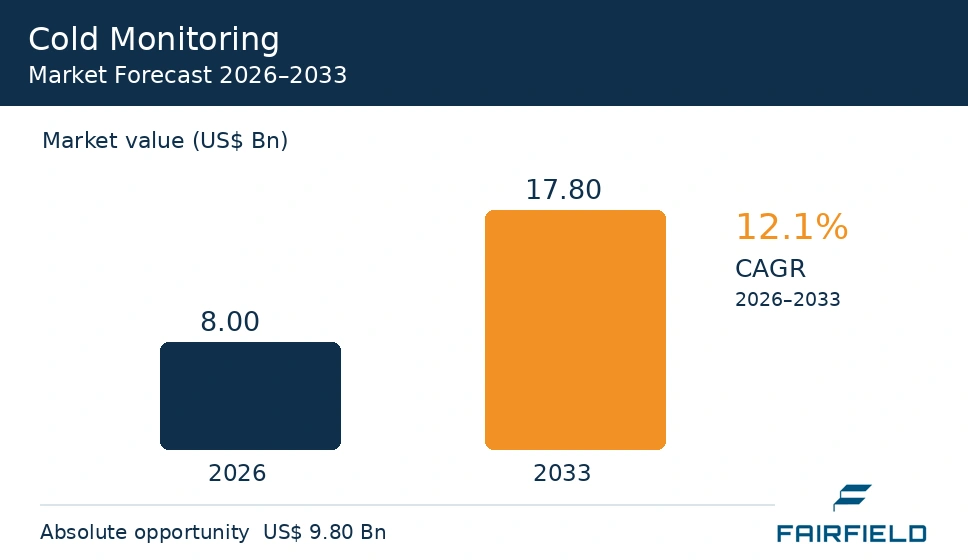
The global cold monitoring market size is expected to be valued at US$ 8.00 billion in 2026 and projected to reach US$ 17.80 billion by 2033, growing at a CAGR of 12.1% between 2026 and 2033.
Between 2020 and 2025, the market grew at a CAGR of about 13.0%, rising from roughly US$ 3.9 billion to US$ 7.2 billion, as global COVID-19 vaccine distribution required strict temperature control, online grocery and meal delivery expanded, and regulators tightened rules on food safety and medicine transport. The cold monitoring market, also called the cold chain monitoring market, covers hardware, software, and services that track the temperature, humidity, location, shock, and light exposure of temperature-sensitive products during storage and transport. Products include data loggers, wireless sensors, RFID tags, telematics units on refrigerated trucks and containers, gateways, and cloud software with alerts and compliance reports. Main users are pharmaceutical companies, food and beverage producers, logistics providers, retailers, and hospitals. Monitoring helps prevent spoilage, protect patient safety, and meet regulatory requirements. In September 2026, Copeland completed its acquisition of Dickson.
Key Report Takeaways
- By Component: Hardware held about 60% share in 2025, while Software is projected to expand at a 14.5% CAGR through 2033, driven by cloud platforms, real-time alerts, artificial intelligence analytics, and digital compliance records that customers buy as recurring subscriptions across many sites and shipment lanes.
- By Application: Food and Beverages held about 42% share in 2025, while Pharmaceuticals and Healthcare are projected to expand at a 13.5% CAGR through 2033, driven by biologics, vaccines, cell and gene therapies, and strict good distribution practice rules.
- By Temperature Range: Chilled held about 60% share in 2025, while Deep-Frozen and Ultra-Low is projected to expand at a 15.0% CAGR through 2033, driven by mRNA products, cell and gene therapies, and frozen specialty foods.
- By Region: North America held about 35% share in 2025, while Asia Pacific is projected to expand at a 14.0% CAGR through 2033, driven by rapid cold chain build-out, online grocery growth, and pharmaceutical exports from China and India.
Global Cold Monitoring Market Trends and Insights
Drivers Impact Analysis
Two drivers carry the strongest influence on cold monitoring market demand during the forecast period.
| Driver | Impact on CAGR Forecast | Geographic Relevance | Impact Timeline |
| Growth of temperature-sensitive medicines | High | North America, Europe, Asia Pacific | Long term (≥4 years) |
| Food safety rules and online grocery growth | High | Global | Medium term (2-4 years) |
Temperature-Sensitive Medicines Are Driving the Cold Monitoring Market
Growth of temperature-sensitive medicines is the strongest driver of the cold monitoring market. Many new drugs must stay cold from factory to patient.
The mechanism is that biologics, vaccines, insulin, monoclonal antibodies, GLP-1 weight loss drugs, and cell and gene therapies lose effectiveness if they get too warm or too cold. A large and rising share of new medicines need cold storage, and some, such as cell therapies, must be kept at very low temperatures. Regulators in the United States, Europe, and other regions require companies to prove proper temperature control through good distribution practice rules and serialization laws such as the Drug Supply Chain Security Act. Clinical trials also ship temperature-sensitive samples and drugs worldwide. A single failed shipment can cost hundreds of thousands of dollars. These trends push pharmaceutical companies to monitor every shipment in real time.
Food Safety Rules Are Expanding the Cold Monitoring Market
Food safety rules and online grocery growth are expanding the cold monitoring market. Retailers and regulators want proof that food stays safe.
The cause is tighter regulation and changing shopping habits. The United States Food and Drug Administration food traceability rule and the Food Safety Modernization Act require better record-keeping for high-risk foods, while the European Union and many Asian countries are also strengthening cold chain rules. Online grocery, meal kits, and quick-commerce delivery have grown rapidly, adding many more shipments and handovers where temperatures can rise. Fresh produce, meat, seafood, dairy, and frozen food exporters ship goods across long ocean and air routes. Retail chains use wireless sensors in fridges and freezers to reduce waste and energy use. Food waste costs billions of dollars each year. These trends raise demand for monitoring across farms, warehouses, trucks, and stores.
Restraints Impact Analysis
Two restraints limit how quickly the cold monitoring market grows.
| Restraint | Impact on CAGR Forecast | Geographic Relevance | Impact Timeline |
| High costs for small and medium businesses | High | Asia Pacific, Latin America, Middle East & Africa | Medium term (2-4 years) |
| Connectivity gaps and data integration problems | Medium | Global | Medium term (2-4 years) |
High Costs Slow the Cold Monitoring Market
High costs for small and medium businesses slow the cold monitoring market. Real-time monitoring is not cheap.
The problem is that real-time cellular trackers, gateways, software subscriptions, and data plans add cost to each shipment and storage site. Large pharmaceutical companies and global retailers can afford these systems, but small farmers, food processors, local distributors, and pharmacies in many countries often rely on simple thermometers or single-use indicators. Margins in food logistics are thin, making it hard to justify extra spending. Returning or recycling reusable trackers also adds logistics work. In developing countries, limited cold storage and refrigerated transport mean monitoring alone cannot solve spoilage problems. Training staff to use and respond to monitoring data takes time. These factors slow adoption among smaller users and in lower-income regions.
Connectivity Gaps Restrict the Cold Monitoring Market
Connectivity gaps and data integration problems restrict the cold monitoring market. Monitoring is only useful if data reaches the right people.
The constraint is that shipments often pass through areas with weak cellular coverage, such as rural roads, oceans, and airport holding areas, and some airlines restrict active wireless devices on aircraft. This can create gaps in real-time data. Customers also use many different devices and software platforms from different vendors, so combining data into one view is difficult. Linking monitoring data with warehouse, transport, and enterprise resource planning systems requires custom work. Too many alerts can overwhelm staff, while false alarms reduce trust. Data security and ownership concerns add further complexity. Battery limits on small devices also reduce how often data is sent. These issues slow large-scale rollout and push customers to look for integrated, vendor-neutral platforms.
Market Opportunities
Real-Time Visibility Platforms Open a Fast-Growth Revenue Pool
Real-time visibility platforms open a fast-growth revenue pool. Customers want to fix problems before products are lost.
The opportunity comes from shifting from passive data loggers, which are read after delivery, to connected trackers that send live temperature and location data to cloud platforms. These systems alert teams when a shipment starts to warm, letting them reroute, re-ice, or replace goods before spoilage. Artificial intelligence can predict risky routes and lanes and recommend better packaging or carriers. Companies such as Sensitech, Controlant, Tive, and Roambee are expanding real-time platforms, and Copeland bought Dickson to add cloud monitoring. Subscription pricing creates recurring revenue. Vendors that offer reliable devices, global connectivity, and easy-to-use software can win long-term contracts with pharmaceutical companies, food shippers, and logistics providers.
Emerging Markets and Sustainable Devices Create a Growth Revenue Pool
Emerging markets and sustainable devices create a growth revenue pool. Cold chains are expanding quickly in many developing countries.
The opportunity reflects heavy investment in cold storage, refrigerated trucks, and pharmaceutical distribution in India, China, Indonesia, Vietnam, Brazil, Mexico, Saudi Arabia, and Kenya. Governments are funding cold chains to reduce food loss, support farm exports, and deliver vaccines to rural areas. Low-cost sensors, Bluetooth tags, and solar-powered loggers make monitoring affordable for smaller users. At the same time, customers want reusable and recyclable devices to reduce electronic waste, and device takeback programs are growing. Development banks and aid groups are funding many of these projects. Vendors that offer affordable, sustainable, and locally supported solutions can capture strong growth in these fast-developing markets.
Segment Analysis
By Component: Hardware Leads While Software Grows Fastest
Hardware held about 60% share in 2025. It includes data loggers, wireless sensors, RFID tags, telematics units, gateways, and temperature indicators used in warehouses, trucks, containers, aircraft shipments, and retail fridges. Every monitored shipment or storage area needs at least one device, and many single-use loggers are bought in very large volumes each year by pharmaceutical and food shippers.
Software is the fastest-growing component, expanding at a 14.5% CAGR through 2033. Cloud platforms collect device data, send alerts, create compliance reports, and analyze performance across lanes and suppliers. Artificial intelligence tools predict risks and recommend actions. Services, including installation, calibration, and data analysis, form another segment. For the market, software growth adds recurring subscription revenue and raises customer value.
By Application: Food and Beverages Lead While Pharmaceuticals and Healthcare Grow Fastest
Food and Beverages held about 42% share in 2025. Fresh produce, meat, seafood, dairy, frozen foods, and beverages need careful temperature control to prevent spoilage and illness, and very large volumes move through farms, processing plants, warehouses, trucks, and stores every day.
Pharmaceuticals and Healthcare are the fastest-growing application, expanding at a 13.5% CAGR through 2033. Vaccines, biologics, insulin, cell and gene therapies, and clinical trial materials require strict temperature control and full documentation. High product values justify real-time monitoring. Chemicals and Others form other applications, including flowers, electronics, and laboratory samples. Specialty chemicals and adhesives also need temperature control during long shipments. Specialty pharmacies shipping drugs to homes also monitor many small parcels. For the market, pharmaceutical growth supports premium devices and software.
By Temperature Range: Chilled Leads While Deep-Frozen and Ultra-Low Grows Fastest
Chilled held about 60% share in 2025. Most temperature-sensitive medicines, fresh foods, and dairy products are stored between about 2°C and 8°C, making this the largest range for monitoring in warehouses, trucks, and stores. Chilled products often have short shelf lives, so even small temperature changes can cause large losses for retailers and producers.
Deep-Frozen and Ultra-Low is the fastest-growing range, expanding at a 15.0% CAGR through 2033. Cell and gene therapies, some vaccines, biological samples, and specialty frozen foods need temperatures far below freezing, often using dry ice or liquid nitrogen. Frozen forms another range. Monitoring devices for these ranges need special sensors and batteries that work in extreme cold. Each shipment is often worth a very large amount. For the market, ultra-low growth adds specialized, high-value monitoring needs.
Geography Analysis
Which Region Is Leading the Cold Monitoring Market?
North America is leading the cold monitoring market with about 35% share in 2025. The United States has a large pharmaceutical industry, advanced cold chain logistics, and strict FDA rules for drug distribution and food traceability. Leading companies such as Sensitech, Copeland, ORBCOMM, Tive, and SpotSee are based in the region. Online grocery, meal kits, and specialty pharmacy shipping add strong demand. Canada and Mexico have large food export and pharmaceutical flows. Key barriers include cost pressure in food logistics. Retailers also use wireless sensors in thousands of stores. One change shaping the region is fast adoption of real-time trackers.
Europe Shapes the Cold Monitoring Market Through Strict Distribution Rules
Europe is a major cold monitoring market. Germany, France, the United Kingdom, the Netherlands, Switzerland, and Belgium have strong pharmaceutical industries and major logistics hubs, and European Union good distribution practice rules require temperature control for medicines. Companies such as Testo, ELPRO-BUCHS, and Controlant are based in the region. Sustainability rules encourage reusable devices and less food waste. Key barriers include high costs and complex rules across countries. Air cargo hubs in Frankfurt, Amsterdam, and Brussels handle large volumes of pharmaceutical shipments. Food retailers across the region monitor stores to cut waste. One opportunity is reusable, recyclable monitoring devices.
Which Region Is Growing Fastest in the Cold Monitoring Market?
Asia Pacific is the fastest-growing cold monitoring market, expanding at a 14.0% CAGR through 2033. China is building large cold storage and refrigerated transport networks to support online grocery and fresh food demand. India is a major vaccine and generic drug exporter and is expanding cold chains for farm produce. Japan, South Korea, and Australia have advanced cold chains, while Indonesia, Vietnam, and Thailand are investing heavily. Key barriers include fragmented logistics and cost sensitivity. Governments in India are funding cold chains to cut farm losses. Local device makers offer lower-cost loggers. One change shaping the region is rapid growth of online grocery delivery.
Latin America Grows the Cold Monitoring Market Through Food Exports
Latin America is a growing cold monitoring market. Brazil is a leading exporter of meat, poultry, and fruit, while Mexico, Chile, Peru, and Colombia ship large volumes of fresh produce, seafood, avocados, berries, and flowers to North America, Europe, and Asia Pacific. Pharmaceutical distribution is also growing. Exporters use monitoring devices to meet buyer requirements and reduce claims. Key barriers include limited cold storage, long transport distances, and cost sensitivity. Ports in Brazil and Chile handle large volumes of refrigerated containers. Vaccine programs also need monitored storage in remote areas. Supermarket chains are adding store monitoring. One opportunity is real-time monitoring for fresh produce exports.
Middle East & Africa Builds the Cold Monitoring Market Through Logistics Investment
Middle East & Africa is an emerging cold monitoring market. Saudi Arabia and the United Arab Emirates are building modern cold storage and logistics hubs to support food imports, pharmaceutical distribution, and re-exports, where hot climates make temperature control critical. South Africa exports fruit and wine, while Kenya ships flowers and vegetables. Nigeria and Egypt are expanding vaccine and food cold chains. Key barriers include limited infrastructure and power reliability. Vaccine programs supported by international health groups use monitoring devices in remote clinics. Airports in Dubai and Doha are major hubs for chilled cargo. Food imports are rising in many countries. One opportunity is solar-powered cold storage with monitoring.
Competitive Landscape
The cold monitoring market is moderately fragmented. Sensitech, Copeland, ORBCOMM, Controlant, and Testo are leading players, while Tive, Roambee, SpotSee, ELPRO-BUCHS, Dickson, Monnit, and Samsara compete strongly. Large companies offer broad portfolios covering data loggers, real-time trackers, telematics for refrigerated trucks and containers, and software, while many startups focus on real-time cellular trackers, wireless store sensors, or analytics. Telematics and fleet software providers also offer temperature monitoring as part of wider platforms.
Companies compete on device accuracy, battery life, connectivity coverage, regulatory compliance, software usability, integration with customer systems, global service, and price per shipment. Pharmaceutical customers require validated devices, calibration certificates, and secure audit trails, which favors experienced suppliers. Food and retail customers are more price-sensitive and value low-cost, easy-to-install sensors and clear alerts. Partnerships with logistics providers, packaging makers, and refrigeration equipment companies help vendors reach customers.
Strategic moves show how competition is changing. In March 2026, SpotSee and Controlant formed a partnership for life sciences shipments. In September 2026, Sensitech launched a global real-time monitor for food shipments, and Copeland completed its acquisition of Dickson. These moves show consolidation and a shift from simple loggers toward connected, real-time visibility platforms.
Three themes shape vendor strategy. First, companies are building real-time, cloud-based platforms with artificial intelligence analytics. Second, they are offering reusable devices and takeback programs to meet sustainability goals. Third, they are expanding in Asia Pacific, Latin America, and Middle East & Africa, where cold chains are growing fastest.
Cold Monitoring Market Industry Leaders
Sensitech Copeland ORBCOMM Controlant Testo
Recent Industry Developments
- September 2026: Copeland completed its acquisition of Dickson, adding cloud-native monitoring and compliance tools for healthcare and life sciences - extends coverage from drug manufacturing to patient care in the cold monitoring market.
- September 2026: Sensitech launched TempTale GEO APX Global, a real-time location and condition monitor for food shipments across ocean, road, and rail - expands real-time visibility for multimodal food logistics.
- March 2026: SpotSee and Controlant announced a strategic collaboration, including a co-branded Controlant Go device for high-value shipments - strengthens life sciences shipment visibility and last-mile proof.
Companies Covered in the Report
- Sensitech
- Copeland
- ORBCOMM
- Controlant
- Testo
- Tive
- Roambee
- SpotSee
- ELPRO-BUCHS
- Dickson
- Monnit
- Samsara
Cold Monitoring Market Report Scope
This report covers the cold monitoring market, including hardware, software, and services, used to monitor chilled, frozen, and deep-frozen and ultra-low temperature products across storage and transportation in food and beverages, pharmaceuticals and healthcare, chemicals, and other applications. The base year is 2025, and the forecast period runs from 2026 to 2033. All values are expressed in US$ Billion.
| Component | Hardware, Software, Services |
| Application | Food and Beverages, Pharmaceuticals and Healthcare, Chemicals, Others |
| Temperature Range | Chilled, Frozen, Deep-Frozen and Ultra-Low |
| Regions | North America, Europe, Asia Pacific, Latin America, Middle East & Africa |
1. Executive Summary
1.1 Cold Monitoring Market Snapshot
1.2 Future Projections
1.3 Key Market Trends
1.4 Regional Snapshot
2. Market Overview
2.1 Market Definition and Report Scope
2.2 Historical Market Trends
2.3 Market Dynamics
2.3.1 Drivers
2.3.1.1 Temperature-Sensitive Medicines Are Driving the Cold Monitoring Market
2.3.1.2 Food Safety Rules Are Expanding the Cold Monitoring Market
2.3.2 Restraints
2.3.2.1 High Costs Slow the Cold Monitoring Market
2.3.2.2 Connectivity Gaps Restrict the Cold Monitoring Market
2.3.3 Market Opportunities
2.3.3.1 Real-Time Visibility Platforms Open a Fast-Growth Revenue Pool
2.3.3.2 Emerging Markets and Sustainable Devices Create a Growth Revenue Pool
3. Global Cold Monitoring Market Outlook, 2020–2033
3.1 Global Cold Monitoring Market Outlook, by Component, Value (US$ Billion), 2020–2033
3.1.1 Hardware
3.1.2 Software
3.1.3 Services
3.2 Global Cold Monitoring Market Outlook, by Application, Value (US$ Billion), 2020–2033
3.2.1 Food and Beverages
3.2.2 Pharmaceuticals and Healthcare
3.2.3 Chemicals
3.2.4 Others
3.3 Global Cold Monitoring Market Outlook, by Temperature Range, Value (US$ Billion), 2020–2033
3.3.1 Chilled
3.3.2 Frozen
3.3.3 Deep-Frozen and Ultra-Low
3.4 Global Cold Monitoring Market Outlook, by Region, Value (US$ Billion), 2020–2033
3.4.1 North America
3.4.2 Europe
3.4.3 Asia Pacific
3.4.4 Latin America
3.4.5 Middle East & Africa
4. North America Cold Monitoring Market Outlook, 2020–2033
4.1 North America Cold Monitoring Market Outlook, by Component, Value (US$ Billion), 2020–2033
4.1.1 Hardware
4.1.2 Software
4.1.3 Services
4.2 North America Cold Monitoring Market Outlook, by Application, Value (US$ Billion), 2020–2033
4.2.1 Food and Beverages
4.2.2 Pharmaceuticals and Healthcare
4.2.3 Chemicals
4.2.4 Others
4.3 North America Cold Monitoring Market Outlook, by Temperature Range, Value (US$ Billion), 2020–2033
4.3.1 Chilled
4.3.2 Frozen
4.3.3 Deep-Frozen and Ultra-Low
4.4 North America Cold Monitoring Market Outlook, by Country, Value (US$ Billion), 2020–2033
4.4.1 United States Cold Monitoring Market Outlook, by Component, 2020–2033
4.4.2 United States Cold Monitoring Market Outlook, by Application, 2020–2033
4.4.3 United States Cold Monitoring Market Outlook, by Temperature Range, 2020–2033
4.4.4 Canada Cold Monitoring Market Outlook, by Component, 2020–2033
4.4.5 Canada Cold Monitoring Market Outlook, by Application, 2020–2033
4.4.6 Canada Cold Monitoring Market Outlook, by Temperature Range, 2020–2033
4.4.7 Mexico Cold Monitoring Market Outlook, by Component, 2020–2033
4.4.8 Mexico Cold Monitoring Market Outlook, by Application, 2020–2033
4.4.9 Mexico Cold Monitoring Market Outlook, by Temperature Range, 2020–2033
5. Europe Cold Monitoring Market Outlook, 2020–2033
5.1 Europe Cold Monitoring Market Outlook, by Component, Value (US$ Billion), 2020–2033
5.1.1 Hardware
5.1.2 Software
5.1.3 Services
5.2 Europe Cold Monitoring Market Outlook, by Application, Value (US$ Billion), 2020–2033
5.2.1 Food and Beverages
5.2.2 Pharmaceuticals and Healthcare
5.2.3 Chemicals
5.2.4 Others
5.3 Europe Cold Monitoring Market Outlook, by Temperature Range, Value (US$ Billion), 2020–2033
5.3.1 Chilled
5.3.2 Frozen
5.3.3 Deep-Frozen and Ultra-Low
5.4 Europe Cold Monitoring Market Outlook, by Country, Value (US$ Billion), 2020–2033
5.4.1 Germany Cold Monitoring Market Outlook, by Component, 2020–2033
5.4.2 Germany Cold Monitoring Market Outlook, by Application, 2020–2033
5.4.3 Germany Cold Monitoring Market Outlook, by Temperature Range, 2020–2033
5.4.4 France Cold Monitoring Market Outlook, by Component, 2020–2033
5.4.5 France Cold Monitoring Market Outlook, by Application, 2020–2033
5.4.6 France Cold Monitoring Market Outlook, by Temperature Range, 2020–2033
5.4.7 United Kingdom Cold Monitoring Market Outlook, by Component, 2020–2033
5.4.8 United Kingdom Cold Monitoring Market Outlook, by Application, 2020–2033
5.4.9 United Kingdom Cold Monitoring Market Outlook, by Temperature Range, 2020–2033
5.4.10 Netherlands Cold Monitoring Market Outlook, by Component, 2020–2033
5.4.11 Netherlands Cold Monitoring Market Outlook, by Application, 2020–2033
5.4.12 Netherlands Cold Monitoring Market Outlook, by Temperature Range, 2020–2033
5.4.13 Switzerland Cold Monitoring Market Outlook, by Component, 2020–2033
5.4.14 Switzerland Cold Monitoring Market Outlook, by Application, 2020–2033
5.4.15 Switzerland Cold Monitoring Market Outlook, by Temperature Range, 2020–2033
5.4.16 Belgium Cold Monitoring Market Outlook, by Component, 2020–2033
5.4.17 Belgium Cold Monitoring Market Outlook, by Application, 2020–2033
5.4.18 Belgium Cold Monitoring Market Outlook, by Temperature Range, 2020–2033
6. Asia Pacific Cold Monitoring Market Outlook, 2020–2033
6.1 Asia Pacific Cold Monitoring Market Outlook, by Component, Value (US$ Billion), 2020–2033
6.1.1 Hardware
6.1.2 Software
6.1.3 Services
6.2 Asia Pacific Cold Monitoring Market Outlook, by Application, Value (US$ Billion), 2020–2033
6.2.1 Food and Beverages
6.2.2 Pharmaceuticals and Healthcare
6.2.3 Chemicals
6.2.4 Others
6.3 Asia Pacific Cold Monitoring Market Outlook, by Temperature Range, Value (US$ Billion), 2020–2033
6.3.1 Chilled
6.3.2 Frozen
6.3.3 Deep-Frozen and Ultra-Low
6.4 Asia Pacific Cold Monitoring Market Outlook, by Country, Value (US$ Billion), 2020–2033
6.4.1 China Cold Monitoring Market Outlook, by Component, 2020–2033
6.4.2 China Cold Monitoring Market Outlook, by Application, 2020–2033
6.4.3 China Cold Monitoring Market Outlook, by Temperature Range, 2020–2033
6.4.4 India Cold Monitoring Market Outlook, by Component, 2020–2033
6.4.5 India Cold Monitoring Market Outlook, by Application, 2020–2033
6.4.6 India Cold Monitoring Market Outlook, by Temperature Range, 2020–2033
6.4.7 Japan Cold Monitoring Market Outlook, by Component, 2020–2033
6.4.8 Japan Cold Monitoring Market Outlook, by Application, 2020–2033
6.4.9 Japan Cold Monitoring Market Outlook, by Temperature Range, 2020–2033
6.4.10 South Korea Cold Monitoring Market Outlook, by Component, 2020–2033
6.4.11 South Korea Cold Monitoring Market Outlook, by Application, 2020–2033
6.4.12 South Korea Cold Monitoring Market Outlook, by Temperature Range, 2020–2033
6.4.13 Australia Cold Monitoring Market Outlook, by Component, 2020–2033
6.4.14 Australia Cold Monitoring Market Outlook, by Application, 2020–2033
6.4.15 Australia Cold Monitoring Market Outlook, by Temperature Range, 2020–2033
6.4.16 Indonesia Cold Monitoring Market Outlook, by Component, 2020–2033
6.4.17 Indonesia Cold Monitoring Market Outlook, by Application, 2020–2033
6.4.18 Indonesia Cold Monitoring Market Outlook, by Temperature Range, 2020–2033
6.4.19 Vietnam Cold Monitoring Market Outlook, by Component, 2020–2033
6.4.20 Vietnam Cold Monitoring Market Outlook, by Application, 2020–2033
6.4.21 Vietnam Cold Monitoring Market Outlook, by Temperature Range, 2020–2033
6.4.22 Thailand Cold Monitoring Market Outlook, by Component, 2020–2033
6.4.23 Thailand Cold Monitoring Market Outlook, by Application, 2020–2033
6.4.24 Thailand Cold Monitoring Market Outlook, by Temperature Range, 2020–2033
7. Latin America Cold Monitoring Market Outlook, 2020–2033
7.1 Latin America Cold Monitoring Market Outlook, by Component, Value (US$ Billion), 2020–2033
7.1.1 Hardware
7.1.2 Software
7.1.3 Services
7.2 Latin America Cold Monitoring Market Outlook, by Application, Value (US$ Billion), 2020–2033
7.2.1 Food and Beverages
7.2.2 Pharmaceuticals and Healthcare
7.2.3 Chemicals
7.2.4 Others
7.3 Latin America Cold Monitoring Market Outlook, by Temperature Range, Value (US$ Billion), 2020–2033
7.3.1 Chilled
7.3.2 Frozen
7.3.3 Deep-Frozen and Ultra-Low
7.4 Latin America Cold Monitoring Market Outlook, by Country, Value (US$ Billion), 2020–2033
7.4.1 Brazil Cold Monitoring Market Outlook, by Component, 2020–2033
7.4.2 Brazil Cold Monitoring Market Outlook, by Application, 2020–2033
7.4.3 Brazil Cold Monitoring Market Outlook, by Temperature Range, 2020–2033
7.4.4 Mexico Cold Monitoring Market Outlook, by Component, 2020–2033
7.4.5 Mexico Cold Monitoring Market Outlook, by Application, 2020–2033
7.4.6 Mexico Cold Monitoring Market Outlook, by Temperature Range, 2020–2033
7.4.7 Chile Cold Monitoring Market Outlook, by Component, 2020–2033
7.4.8 Chile Cold Monitoring Market Outlook, by Application, 2020–2033
7.4.9 Chile Cold Monitoring Market Outlook, by Temperature Range, 2020–2033
7.4.10 Peru Cold Monitoring Market Outlook, by Component, 2020–2033
7.4.11 Peru Cold Monitoring Market Outlook, by Application, 2020–2033
7.4.12 Peru Cold Monitoring Market Outlook, by Temperature Range, 2020–2033
7.4.13 Colombia Cold Monitoring Market Outlook, by Component, 2020–2033
7.4.14 Colombia Cold Monitoring Market Outlook, by Application, 2020–2033
7.4.15 Colombia Cold Monitoring Market Outlook, by Temperature Range, 2020–2033
8. Middle East & Africa Cold Monitoring Market Outlook, 2020–2033
8.1 Middle East & Africa Cold Monitoring Market Outlook, by Component, Value (US$ Billion), 2020–2033
8.1.1 Hardware
8.1.2 Software
8.1.3 Services
8.2 Middle East & Africa Cold Monitoring Market Outlook, by Application, Value (US$ Billion), 2020–2033
8.2.1 Food and Beverages
8.2.2 Pharmaceuticals and Healthcare
8.2.3 Chemicals
8.2.4 Others
8.3 Middle East & Africa Cold Monitoring Market Outlook, by Temperature Range, Value (US$ Billion), 2020–2033
8.3.1 Chilled
8.3.2 Frozen
8.3.3 Deep-Frozen and Ultra-Low
8.4 Middle East & Africa Cold Monitoring Market Outlook, by Country, Value (US$ Billion), 2020–2033
8.4.1 Saudi Arabia Cold Monitoring Market Outlook, by Component, 2020–2033
8.4.2 Saudi Arabia Cold Monitoring Market Outlook, by Application, 2020–2033
8.4.3 Saudi Arabia Cold Monitoring Market Outlook, by Temperature Range, 2020–2033
8.4.4 United Arab Emirates Cold Monitoring Market Outlook, by Component, 2020–2033
8.4.5 United Arab Emirates Cold Monitoring Market Outlook, by Application, 2020–2033
8.4.6 United Arab Emirates Cold Monitoring Market Outlook, by Temperature Range, 2020–2033
8.4.7 South Africa Cold Monitoring Market Outlook, by Component, 2020–2033
8.4.8 South Africa Cold Monitoring Market Outlook, by Application, 2020–2033
8.4.9 South Africa Cold Monitoring Market Outlook, by Temperature Range, 2020–2033
8.4.10 Kenya Cold Monitoring Market Outlook, by Component, 2020–2033
8.4.11 Kenya Cold Monitoring Market Outlook, by Application, 2020–2033
8.4.12 Kenya Cold Monitoring Market Outlook, by Temperature Range, 2020–2033
8.4.13 Nigeria Cold Monitoring Market Outlook, by Component, 2020–2033
8.4.14 Nigeria Cold Monitoring Market Outlook, by Application, 2020–2033
8.4.15 Nigeria Cold Monitoring Market Outlook, by Temperature Range, 2020–2033
8.4.16 Egypt Cold Monitoring Market Outlook, by Component, 2020–2033
8.4.17 Egypt Cold Monitoring Market Outlook, by Application, 2020–2033
8.4.18 Egypt Cold Monitoring Market Outlook, by Temperature Range, 2020–2033
9. Competitive Landscape
9.1 Cold Monitoring Market Industry Leaders
9.2 Recent Industry Developments
9.3 Company Profiles
9.3.1 Sensitech
9.3.2 Copeland
9.3.3 ORBCOMM
9.3.4 Controlant
9.3.5 Testo
9.3.6 Tive
9.3.7 Roambee
9.3.8 SpotSee
9.3.9 ELPRO-BUCHS
9.3.10 Dickson
9.3.11 Monnit
9.3.12 Samsara
10. Appendix
10.1 Research Methodology
10.2 Report Assumptions
10.3 Acronyms and Abbreviations
| Component | Hardware, Software, Services |
| Application | Food and Beverages, Pharmaceuticals and Healthcare, Chemicals, Others |
| Temperature Range | Chilled, Frozen, Deep-Frozen and Ultra-Low |
| Regions | North America, Europe, Asia Pacific, Latin America, Middle East & Africa |
Our Research Methodology
Considering the volatility of business today, traditional approaches to strategizing a game plan can be unfruitful if not detrimental. True ambiguity is no way to determine a forecast. A myriad of predetermined factors must be accounted for such as the degree of risk involved, the magnitude of circumstances, as well as conditions or consequences that are not known or unpredictable. To circumvent binary views that cast uncertainty, the application of market research intelligence to strategically posture, move, and enable actionable outcomes is necessary.
View Methodology
Quality Assured
Rigorous Validation Process

Confidentiality Assured
End-to-end Data Security

Custom Research Services
Tailored To Your Objectives
FAQs
The cold monitoring market is valued at US$ 8.00 billion in 2026, led by hardware, food and beverages, and North America.
The market is projected to reach US$ 17.80 billion by 2033, growing at a 12.1% CAGR and adding US$ 9.80 billion.
Software is growing fastest at a 14.5% CAGR through 2033, driven by cloud platforms, real-time alerts, and digital compliance records.
Asia Pacific is growing fastest at a 14.0% CAGR through 2033, driven by cold chain build-out, online grocery, and pharmaceutical exports.
North America holds the largest share at about 35% in 2025, supported by pharmaceutical demand, strict rules, and leading vendors.
Related Reports
Data Center Rack Market Size, Share, Insights, Competitive Landscape, and Forecast 2026 to 2033
Explore the Data Center Rack market, forecast to reach US$11.5 billion by 2033 at 10.8% CAGR, with insights on rack types, end users, and regions.
SiC GaN Power Semiconductor Market Size, Share, Insights, Competitive Landscape, and Forecast 2026 to 2033
Explore the SiC GaN power semiconductor market outlook for 2026–2033, covering products, power ranges, applications, regions, and key companies.
Serverless Architecture Market Size, Share, Insights, Competitive Landscape, and Forecast 2026 to 2033
Explore the serverless architecture market outlook for 2026–2033, covering services, deployment models, industries, regional trends, and key companies.
Network Sandboxing Market Size, Share, Insights, Competitive Landscape, and Forecast 2026 to 2033
The global network sandboxing market is valued at US$5.8 billion in 2026, reaching US$14.7 billion by 2033, growing at a 14.2% CAGR
Location of Things Market Size, Share, Insights, Competitive Landscape, and Forecast 2026 to 2033
The global location of things market is valued at US$52.31 billion in 2026, reaching US$297.93 billion by 2033, growing at a 28.2% CAGR
Chemical Mechanical Planarization Market Size, Share, Insights, Competitive Landscape, and Forecast 2026 to 2033
The global chemical mechanical planarization market is valued at US$7.2 billion in 2026, reaching US$11.95 billion by 2033, growing at a 7.5% CAGR