



Location of Things Market
Location of Things Market Size, Share, Insights, Competitive Landscape, and Forecast 2026 to 2033
Location of Things Market Size and Trend Analysis
How Fast Is the Location of Things Market Growing?
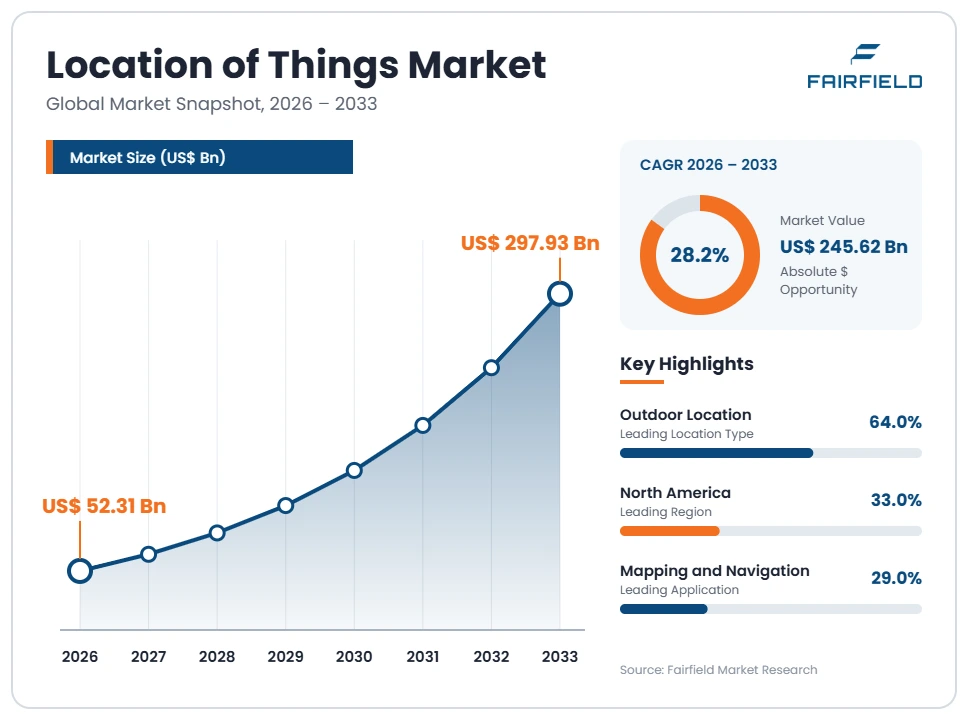
The global location of things market size is expected to be valued at US$ 52.31 billion in 2026 and projected to reach US$ 297.93 billion by 2033, growing at a CAGR of 28.2% between 2026 and 2033.
Between 2020 and 2025, the market grew at a CAGR of about 25.6%, reaching about US$ 40.8 billion in 2025, as the pandemic accelerated contact tracing, delivery tracking, and warehouse automation, and connected devices, satellite launches, and 5G networks expanded rapidly afterwards. The location of things market covers technologies that let connected devices know, share, and act on their location. It includes GPS and satellite positioning, cellular and Wi-Fi location, Bluetooth beacons, ultra-wideband, RFID, and real-time location systems for indoor tracking, along with mapping data, location analytics platforms, software, and services. These tools support location intelligence for navigation, asset tracking, fleet management, smart cities, retail, healthcare, and autonomous vehicles. Growth comes from the Internet of Things, e-commerce logistics, and AI systems that need spatial data. In July 2026, HERE Technologies and Esri signed a three-year partnership on AI-ready location analytics.
Key Report Takeaways
- By Location Type: Outdoor Location held about 64% share in 2025, while Indoor Location is projected to expand at a 31.5% CAGR through 2033, driven by smart buildings, warehouse automation, hospital asset tracking, and indoor navigation in malls and airports.
- By Application: Mapping and Navigation held about 29% share in 2025, while Location Intelligence and Analytics is projected to expand at a 30.8% CAGR through 2033, driven by AI agents, retail site planning, and demand for real-time spatial decisions.
- By Industry Vertical: Transportation and Logistics held about 27% share in 2025, while Healthcare is projected to expand at a 31.2% CAGR through 2033, driven by tracking of equipment, staff, and patients, and by connected care in hospitals.
- By Region: North America held about 33% share in 2025, while Asia Pacific is projected to expand at a 31.0% CAGR through 2033, driven by smart city programs, e-commerce logistics, connected vehicles, and 5G rollouts in China, India, and Japan.
Global Location of Things Market Trends and Insights
Drivers Impact Analysis
Two drivers carry the strongest influence on location of things market demand during the forecast period.
| Driver | Impact on CAGR Forecast | Geographic Relevance | Impact Timeline |
| Growth of connected devices and logistics tracking | High | Global | Long term (≥4 years) |
| AI, autonomous systems, and smart city demand for spatial data | Medium | North America, Asia Pacific, Europe | Medium term (2-4 years) |
Connected Devices Are Driving the Location of Things Market
Growth of connected devices and logistics tracking is the strongest driver of the location of things market. More things need to know where they are.
The mechanism is the rapid spread of the Internet of Things. Billions of connected devices, from smartphones and vehicles to shipping containers, pallets, and medical equipment, now carry GPS, cellular, Bluetooth, or RFID chips that report location. E-commerce has raised customer expectations for real-time delivery tracking, and logistics companies use location data to plan routes, cut fuel costs, and reduce lost goods. Shipping lines have fitted millions of containers with trackers, and retailers track inventory across stores and warehouses. Low-power networks and satellite IoT services now cover remote areas, oceans, and farms. Falling sensor costs make tracking affordable for low-value items. These trends support strong long-term demand across nearly every industry.
AI and Smart Cities Are Expanding the Location of Things Market
AI, autonomous systems, and smart city demand for spatial data are expanding the location of things market. Machines need accurate maps.
The cause is the rise of systems that act on location. Autonomous vehicles, robotaxis, delivery drones, and warehouse robots depend on precise maps and positioning to move safely. AI agents increasingly answer questions involving routes, travel times, and nearby services, but large language models alone struggle with spatial reasoning, so they need location platforms. In May 2026, HERE Technologies launched Location Reasoning to give AI systems a dedicated layer for spatial computation. Cities are installing smart streetlights, parking sensors, and traffic systems that report their location and status, and connected cars share road conditions with map providers. Drone delivery services need precise routes and landing points. These trends expand sales.
Restraints Impact Analysis
Two restraints limit how quickly the location of things market grows.
| Restraint | Impact on CAGR Forecast | Geographic Relevance | Impact Timeline |
| Privacy, security, and data protection concerns | High | Europe, North America | Long term (≥4 years) |
| Accuracy limits, interoperability, and integration costs | Medium | Global | Medium term (2-4 years) |
Privacy Concerns Slow the Location of Things Market
Privacy, security, and data protection concerns slow the location of things market. Location data is highly sensitive.
The specific causes are risks of tracking people without consent. Location histories can reveal where people live, work, worship, and seek medical care, and regulators have fined companies for selling or mishandling location data. Laws such as the GDPR in Europe and state privacy laws in the United States require consent, limit data retention, and restrict sharing. Mobile operating systems now ask users for permission before apps can access precise location, reducing the data available to some services. Connected trackers can be misused to follow people, leading to new safety features. Cyberattacks on location platforms could expose fleets or critical infrastructure. These factors slow adoption, raise compliance costs, and make some companies cautious about collecting location data.
Integration Challenges Restrict the Location of Things Market
Accuracy limits, interoperability, and integration costs restrict the location of things market. Systems do not always work together.
The underlying causes are technical gaps and fragmented standards. GPS signals do not work well indoors, in tunnels, or between tall buildings, so indoor tracking needs separate systems such as beacons or ultra-wideband. Many vendors use different protocols and platforms, making it hard to combine data. Installing and maintaining tracking systems in large buildings can be costly, and battery replacement for thousands of tags adds ongoing work. Maps must be updated constantly as roads, buildings, and businesses change, which requires large investment. Satellite signals can be jammed or spoofed, raising safety concerns for aviation, shipping, and autonomous vehicles. Smaller companies often lack the skills to combine location data with their business systems. These factors restrict growth.
Market Opportunities
AI-Ready Location Data Opens a Fast-Growth Revenue Pool
AI-ready location data opens a fast-growth revenue pool in the location of things market. AI systems need trusted spatial information.
Providers can capture this opportunity. Businesses are building AI agents and analytics tools that answer location questions, plan logistics, select store sites, and manage infrastructure, and these tools need accurate maps, traffic data, addresses, and points of interest. In July 2026, HERE Technologies and Esri signed a three-year agreement to develop AI-ready location analytics inside ArcGIS, and HERE expanded its partnership with Precisely in June 2026 to provide trusted address and location data. Location data companies can license data and services to AI developers, cloud platforms, and enterprises. Companies that combine high-quality data with easy-to-use analytics can earn recurring revenue as more organizations build spatial AI.
Indoor Positioning and Healthcare Tracking Create a Growth Revenue Pool
Indoor positioning and healthcare tracking create a growth revenue pool in the location of things market. Buildings are becoming smarter.
Providers can capture this opportunity. Hospitals lose time and money searching for equipment such as infusion pumps and wheelchairs, and real-time location systems help staff find assets, monitor hand hygiene, protect patients, and manage beds. Warehouses, factories, and airports use indoor tracking for workers, robots, and goods. Ultra-wideband chips in smartphones and Bluetooth beacons are lowering costs. Retailers use indoor location to study shopper movement and send offers inside stores, and factories track tools and work in progress to improve efficiency. Regulations in some countries require hospitals to track high-value equipment and protect at-risk patients. Companies offering accurate, low-maintenance indoor positioning with simple software can grow quickly.
Segment Analysis
- By Location Type: Outdoor Location Leads While Indoor Location Grows Fastest
Outdoor Location held about 64% share in 2025. Satellite navigation, cellular positioning, and mapping services support vehicles, smartphones, fleets, shipping, agriculture, and outdoor infrastructure, and they are used by billions of people every day. Satellite constellations from the United States, Europe, China, and Russia provide global coverage, and new satellite IoT services extend tracking to oceans and remote areas.
Indoor Location is the fastest-growing location type, expanding at a 31.5% CAGR through 2033. Bluetooth beacons, Wi-Fi positioning, ultra-wideband, and RFID allow tracking inside hospitals, factories, warehouses, airports, and shopping malls, where satellite signals do not reach. Smart building programs, warehouse robots, and retail analytics are driving adoption. For the market, indoor growth opens new uses in enterprises.
- By Application: Mapping and Navigation Leads While Location Intelligence and Analytics Grows Fastest
Mapping and Navigation held about 29% share in 2025. Navigation apps, in-car systems, fleet routing, and mapping platforms from HERE Technologies, Google, TomTom, and Esri are core uses, and connected cars rely on updated maps and traffic data. HD maps for driver assistance and autonomous driving add value.
Location Intelligence and Analytics is the fastest-growing application, expanding at a 30.8% CAGR through 2033. Businesses use location intelligence to choose store sites, plan deliveries, analyze customer traffic, manage risk, and power AI agents. Asset tracking, geofencing, location-based marketing, and emergency response form other applications, with asset tracking widely used in logistics and emergency services needing precise caller location. For the market, analytics growth adds high-value software revenue.
- By Industry Vertical: Transportation and Logistics Leads While Healthcare Grows Fastest
Transportation and Logistics held about 27% share in 2025. Fleet operators, shipping lines, airlines, railways, and delivery companies use location data to track vehicles, containers, and parcels, plan routes, and reduce costs, and e-commerce growth adds demand. Ride-hailing and robotaxi services depend on precise positioning and live traffic data.
Healthcare is the fastest-growing vertical, expanding at a 31.2% CAGR through 2033. Hospitals use real-time location systems for equipment, staff, and patient tracking, and remote monitoring devices for older people include location features. Retail, manufacturing, government and public safety, energy and utilities, and other verticals form further segments, with utilities tracking field crews and assets across large networks. For the market, healthcare growth adds new enterprise customers.
Geography Analysis
- Which Region Is Leading the Location of Things Market?
North America is leading the location of things market with about 33% share in 2025. The United States has high adoption of connected vehicles, fleet telematics, smartphones, and enterprise IoT, along with major technology companies such as Microsoft, Google, Qualcomm, Esri, Zebra Technologies, and Apple. Robotaxi services, drone deliveries, and large logistics networks rely on precise location, and hospitals are major users of real-time location systems. Canada adds mining, logistics, and smart city demand. Key barriers include state privacy laws and concerns about location data sales. One change shaping the region is the use of location data in AI agents.
- Europe Shapes the Location of Things Market Through Smart Cities and Privacy Rules
Europe is a major location of things market. Germany, the United Kingdom, France, the Netherlands, and Spain have advanced automotive, logistics, and smart city projects, and Europe hosts a large share of the world’s smart streetlights. HERE Technologies is based in the Netherlands, and TomTom and many indoor positioning firms operate in the region. The Galileo satellite system provides high-accuracy positioning, and the European Union’s eCall rule requires new cars to send their location in a crash. Logistics hubs in Rotterdam and Hamburg use container tracking widely. Key barriers include strict privacy rules under the GDPR. One opportunity is connected and automated vehicles.
- Which Region Is Growing Fastest in the Location of Things Market?
Asia Pacific is growing fastest in the location of things market, expanding at a 31.0% CAGR through 2033. China has huge logistics networks, robotaxi services from Baidu, the BeiDou satellite system, and large smart city programs. India is expanding e-commerce delivery, fleet tracking, and digital public infrastructure, while Japan and South Korea lead in connected vehicles, robotics, and 5G. Singapore and Australia invest in smart city platforms. Logistics platforms in Indonesia and Vietnam are growing quickly. Key barriers include data localization rules and fragmented standards. One change shaping the region is rapid growth of delivery and ride-hailing platforms.
- Latin America Grows the Location of Things Market Through Logistics and Security
Latin America is a growing location of things market. Brazil, Mexico, Chile, Colombia, and Argentina use vehicle tracking widely to fight cargo theft and manage fleets, and e-commerce companies such as Mercado Libre are building delivery networks that depend on location data. Agriculture uses satellite positioning for precision farming in Brazil and Argentina. Smart city projects are growing in major capitals, and ride-hailing and delivery apps rely on accurate maps. Key barriers include economic swings, limited budgets, and uneven network coverage in rural and mountain areas. One opportunity is fleet and cargo security tracking.
- Middle East & Africa Builds the Location of Things Market Through Smart City Projects
Middle East & Africa is an emerging location of things market. Saudi Arabia, the United Arab Emirates, and Qatar are building smart cities, ports, and transport systems that use location technology, including large projects in Riyadh and Dubai. South Africa, Kenya, and Nigeria use vehicle tracking, mobile location services, and logistics platforms, and vehicle tracking is common in South Africa to fight car theft. Oil and gas companies track assets in remote fields. Key barriers include limited infrastructure in rural areas, cost, and data rules. One opportunity is smart city and port tracking systems in growing trade hubs.
Competitive Landscape
The location of things market is moderately fragmented. HERE Technologies, Esri, Qualcomm, Microsoft, and Zebra Technologies are leading players, while Google, IBM, TomTom, Cloud Software Group, Ubisense, Navigine, and Verizon compete strongly. The market brings together map and location data providers, geospatial software firms, chipmakers, cloud platforms, telecom operators, and specialists in indoor positioning and asset tracking, with many startups focused on niche uses such as drones and robotics.
Companies compete on map accuracy and freshness, positioning precision, coverage, data privacy, ease of integration, analytics tools, and price. Large customers want platforms that combine outdoor and indoor location, connect with existing software, and scale across many sites. Partnerships between data providers, software firms, and cloud platforms are common because no single company controls the full stack.
Strategic moves show how competition is changing. In May 2026, HERE Technologies launched Location Reasoning for AI systems. In June 2026, HERE expanded its partnership with Precisely on trusted address and location data. In July 2026, HERE and Esri signed a three-year agreement to build AI-ready location analytics within ArcGIS. These moves show competition shifting toward trusted location data and analytics for AI systems and enterprise customers.
Three themes shape vendor strategy. First, companies are packaging location data and tools for AI agents and analytics. Second, they are combining outdoor and indoor positioning in single platforms. Third, they are expanding in Asia Pacific and in healthcare and logistics, where demand is growing fastest.
Location of Things Market Industry Leaders
- HERE Technologies
- Esri
- Qualcomm
- Microsoft
- Zebra Technologies
Recent Industry Developments
- July 2026: HERE Technologies and Esri signed a three-year agreement to develop AI-ready location analytics and visualization within ArcGIS for transportation, public sector, automotive, and high-tech customers - strengthens location intelligence in the location of things market.
- June 2026: HERE Technologies and Precisely expanded their partnership to provide trusted location and address data - supports accurate location data for enterprise and AI applications.
- May 2026: HERE Technologies launched Location Reasoning, a spatial computation layer for AI models and agents used in transport, logistics, and field services - helps AI systems answer location questions reliably.
Companies Covered in the Report
- HERE Technologies
- Esri
- Qualcomm
- Microsoft
- Zebra Technologies
- IBM
- TomTom
- Cloud Software Group
- Ubisense
- Navigine
- Verizon
Location of Things Market Report Scope
| Metric | Value |
| Study Period | 2020-2033 |
| Market Size 2026 | US$ 52.31 Billion |
| Market Size 2033 | US$ 297.93 Billion |
| CAGR 2026-2033 | 28.2% |
| Absolute Dollar Opportunity | US$ 245.62 Billion |
| Largest Market | North America |
| Fastest-Growing Market | Asia Pacific |
| Market Concentration | Moderately Fragmented |
| Major Players | HERE Technologies, Esri, Qualcomm, Microsoft, Zebra Technologies |
Location of Things Market Segmentation
- Executive Summary
- Location of Things Market Snapshot
- Future Projections
- Key Market Trends
- Regional Snapshot
- Market Overview
- Market Definition and Report Scope
- Historical Market Trends
- Market Dynamics
- Drivers
- Connected Devices Are Driving the Location of Things Market
- AI and Smart Cities Are Expanding the Location of Things Market
- Restraints
- Privacy Concerns Slow the Location of Things Market
- Integration Challenges Restrict the Location of Things Market
- Market Opportunities
- AI-Ready Location Data Opens a Fast-Growth Revenue Pool
- Indoor Positioning and Healthcare Tracking Create a Growth Revenue Pool
- Drivers
- Global Location of Things Market Outlook, 2020–2033
- Global Location of Things Market Outlook, by Location Type, Value (US$ Billion), 2020–2033
- Outdoor Location
- Indoor Location
- Global Location of Things Market Outlook, by Application, Value (US$ Billion), 2020–2033
- Mapping and Navigation
- Location Intelligence and Analytics
- Asset Tracking
- Location-Based Marketing
- Others
- Global Location of Things Market Outlook, by Industry Vertical, Value (US$ Billion), 2020–2033
- Transportation and Logistics
- Healthcare
- Retail
- Manufacturing
- Government and Public Safety
- Others
- Global Location of Things Market Outlook, by Region, Value (US$ Billion), 2020–2033
- North America
- Europe
- Asia Pacific
- Latin America
- Middle East & Africa
- Global Location of Things Market Outlook, by Location Type, Value (US$ Billion), 2020–2033
- North America Location of Things Market Outlook, 2020–2033
- North America Location of Things Market Outlook, by Location Type, Value (US$ Billion), 2020–2033
- Outdoor Location
- Indoor Location
- North America Location of Things Market Outlook, by Application, Value (US$ Billion), 2020–2033
- Mapping and Navigation
- Location Intelligence and Analytics
- Asset Tracking
- Location-Based Marketing
- Others
- North America Location of Things Market Outlook, by Industry Vertical, Value (US$ Billion), 2020–2033
- Transportation and Logistics
- Healthcare
- Retail
- Manufacturing
- Government and Public Safety
- Others
- North America Location of Things Market Outlook, by Country, Value (US$ Billion), 2020–2033
- United States Location of Things Market Outlook, by Location Type, 2020–2033
- United States Location of Things Market Outlook, by Application, 2020–2033
- United States Location of Things Market Outlook, by Industry Vertical, 2020–2033
- Canada Location of Things Market Outlook, by Location Type, 2020–2033
- Canada Location of Things Market Outlook, by Application, 2020–2033
- Canada Location of Things Market Outlook, by Industry Vertical, 2020–2033
- North America Location of Things Market Outlook, by Location Type, Value (US$ Billion), 2020–2033
- Europe Location of Things Market Outlook, 2020–2033
- Europe Location of Things Market Outlook, by Location Type, Value (US$ Billion), 2020–2033
- Outdoor Location
- Indoor Location
- Europe Location of Things Market Outlook, by Application, Value (US$ Billion), 2020–2033
- Mapping and Navigation
- Location Intelligence and Analytics
- Asset Tracking
- Location-Based Marketing
- Others
- Europe Location of Things Market Outlook, by Industry Vertical, Value (US$ Billion), 2020–2033
- Transportation and Logistics
- Healthcare
- Retail
- Manufacturing
- Government and Public Safety
- Others
- Europe Location of Things Market Outlook, by Country, Value (US$ Billion), 2020–2033
- Germany Location of Things Market Outlook, by Location Type, 2020–2033
- Germany Location of Things Market Outlook, by Application, 2020–2033
- Germany Location of Things Market Outlook, by Industry Vertical, 2020–2033
- United Kingdom Location of Things Market Outlook, by Location Type, 2020–2033
- United Kingdom Location of Things Market Outlook, by Application, 2020–2033
- United Kingdom Location of Things Market Outlook, by Industry Vertical, 2020–2033
- France Location of Things Market Outlook, by Location Type, 2020–2033
- France Location of Things Market Outlook, by Application, 2020–2033
- France Location of Things Market Outlook, by Industry Vertical, 2020–2033
- Netherlands Location of Things Market Outlook, by Location Type, 2020–2033
- Netherlands Location of Things Market Outlook, by Application, 2020–2033
- Netherlands Location of Things Market Outlook, by Industry Vertical, 2020–2033
- Spain Location of Things Market Outlook, by Location Type, 2020–2033
- Spain Location of Things Market Outlook, by Application, 2020–2033
- Spain Location of Things Market Outlook, by Industry Vertical, 2020–2033
- Europe Location of Things Market Outlook, by Location Type, Value (US$ Billion), 2020–2033
- Asia Pacific Location of Things Market Outlook, 2020–2033
- Asia Pacific Location of Things Market Outlook, by Location Type, Value (US$ Billion), 2020–2033
- Outdoor Location
- Indoor Location
- Asia Pacific Location of Things Market Outlook, by Application, Value (US$ Billion), 2020–2033
- Mapping and Navigation
- Location Intelligence and Analytics
- Asset Tracking
- Location-Based Marketing
- Others
- Asia Pacific Location of Things Market Outlook, by Industry Vertical, Value (US$ Billion), 2020–2033
- Transportation and Logistics
- Healthcare
- Retail
- Manufacturing
- Government and Public Safety
- Others
- Asia Pacific Location of Things Market Outlook, by Country, Value (US$ Billion), 2020–2033
- China Location of Things Market Outlook, by Location Type, 2020–2033
- China Location of Things Market Outlook, by Application, 2020–2033
- China Location of Things Market Outlook, by Industry Vertical, 2020–2033
- India Location of Things Market Outlook, by Location Type, 2020–2033
- India Location of Things Market Outlook, by Application, 2020–2033
- India Location of Things Market Outlook, by Industry Vertical, 2020–2033
- Japan Location of Things Market Outlook, by Location Type, 2020–2033
- Japan Location of Things Market Outlook, by Application, 2020–2033
- Japan Location of Things Market Outlook, by Industry Vertical, 2020–2033
- South Korea Location of Things Market Outlook, by Location Type, 2020–2033
- South Korea Location of Things Market Outlook, by Application, 2020–2033
- South Korea Location of Things Market Outlook, by Industry Vertical, 2020–2033
- Singapore Location of Things Market Outlook, by Location Type, 2020–2033
- Singapore Location of Things Market Outlook, by Application, 2020–2033
- Singapore Location of Things Market Outlook, by Industry Vertical, 2020–2033
- Australia Location of Things Market Outlook, by Location Type, 2020–2033
- Australia Location of Things Market Outlook, by Application, 2020–2033
- Australia Location of Things Market Outlook, by Industry Vertical, 2020–2033
- Indonesia Location of Things Market Outlook, by Location Type, 2020–2033
- Indonesia Location of Things Market Outlook, by Application, 2020–2033
- Indonesia Location of Things Market Outlook, by Industry Vertical, 2020–2033
- Vietnam Location of Things Market Outlook, by Location Type, 2020–2033
- Vietnam Location of Things Market Outlook, by Application, 2020–2033
- Vietnam Location of Things Market Outlook, by Industry Vertical, 2020–2033
- Asia Pacific Location of Things Market Outlook, by Location Type, Value (US$ Billion), 2020–2033
- Latin America Location of Things Market Outlook, 2020–2033
- Latin America Location of Things Market Outlook, by Location Type, Value (US$ Billion), 2020–2033
- Outdoor Location
- Indoor Location
- Latin America Location of Things Market Outlook, by Application, Value (US$ Billion), 2020–2033
- Mapping and Navigation
- Location Intelligence and Analytics
- Asset Tracking
- Location-Based Marketing
- Others
- Latin America Location of Things Market Outlook, by Industry Vertical, Value (US$ Billion), 2020–2033
- Transportation and Logistics
- Healthcare
- Retail
- Manufacturing
- Government and Public Safety
- Others
- Latin America Location of Things Market Outlook, by Country, Value (US$ Billion), 2020–2033
- Brazil Location of Things Market Outlook, by Location Type, 2020–2033
- Brazil Location of Things Market Outlook, by Application, 2020–2033
- Brazil Location of Things Market Outlook, by Industry Vertical, 2020–2033
- Mexico Location of Things Market Outlook, by Location Type, 2020–2033
- Mexico Location of Things Market Outlook, by Application, 2020–2033
- Mexico Location of Things Market Outlook, by Industry Vertical, 2020–2033
- Chile Location of Things Market Outlook, by Location Type, 2020–2033
- Chile Location of Things Market Outlook, by Application, 2020–2033
- Chile Location of Things Market Outlook, by Industry Vertical, 2020–2033
- Colombia Location of Things Market Outlook, by Location Type, 2020–2033
- Colombia Location of Things Market Outlook, by Application, 2020–2033
- Colombia Location of Things Market Outlook, by Industry Vertical, 2020–2033
- Argentina Location of Things Market Outlook, by Location Type, 2020–2033
- Argentina Location of Things Market Outlook, by Application, 2020–2033
- Argentina Location of Things Market Outlook, by Industry Vertical, 2020–2033
- Latin America Location of Things Market Outlook, by Location Type, Value (US$ Billion), 2020–2033
- Middle East & Africa Location of Things Market Outlook, 2020–2033
- Middle East & Africa Location of Things Market Outlook, by Location Type, Value (US$ Billion), 2020–2033
- Outdoor Location
- Indoor Location
- Middle East & Africa Location of Things Market Outlook, by Application, Value (US$ Billion), 2020–2033
- Mapping and Navigation
- Location Intelligence and Analytics
- Asset Tracking
- Location-Based Marketing
- Others
- Middle East & Africa Location of Things Market Outlook, by Industry Vertical, Value (US$ Billion), 2020–2033
- Transportation and Logistics
- Healthcare
- Retail
- Manufacturing
- Government and Public Safety
- Others
- Middle East & Africa Location of Things Market Outlook, by Country, Value (US$ Billion), 2020–2033
- Saudi Arabia Location of Things Market Outlook, by Location Type, 2020–2033
- Saudi Arabia Location of Things Market Outlook, by Application, 2020–2033
- Saudi Arabia Location of Things Market Outlook, by Industry Vertical, 2020–2033
- United Arab Emirates Location of Things Market Outlook, by Location Type, 2020–2033
- United Arab Emirates Location of Things Market Outlook, by Application, 2020–2033
- United Arab Emirates Location of Things Market Outlook, by Industry Vertical, 2020–2033
- Qatar Location of Things Market Outlook, by Location Type, 2020–2033
- Qatar Location of Things Market Outlook, by Application, 2020–2033
- Qatar Location of Things Market Outlook, by Industry Vertical, 2020–2033
- South Africa Location of Things Market Outlook, by Location Type, 2020–2033
- South Africa Location of Things Market Outlook, by Application, 2020–2033
- South Africa Location of Things Market Outlook, by Industry Vertical, 2020–2033
- Kenya Location of Things Market Outlook, by Location Type, 2020–2033
- Kenya Location of Things Market Outlook, by Application, 2020–2033
- Kenya Location of Things Market Outlook, by Industry Vertical, 2020–2033
- Nigeria Location of Things Market Outlook, by Location Type, 2020–2033
- Nigeria Location of Things Market Outlook, by Application, 2020–2033
- Nigeria Location of Things Market Outlook, by Industry Vertical, 2020–2033
- Middle East & Africa Location of Things Market Outlook, by Location Type, Value (US$ Billion), 2020–2033
- Competitive Landscape
- Location of Things Market Industry Leaders
- Recent Industry Developments
- Company Profiles
- HERE Technologies
- Esri
- Qualcomm
- Microsoft
- Zebra Technologies
- IBM
- TomTom
- Cloud Software Group
- Ubisense
- Navigine
- Verizon
- Appendix
- Research Methodology
- Report Assumptions
- Acronyms and Abbreviations
Location Type
- Outdoor Location
- Indoor Location
Application
- Mapping and Navigation
- Location Intelligence and Analytics
- Asset Tracking
- Location-Based Marketing
- Others
Industry Vertical
- Transportation and Logistics
- Healthcare
- Retail
- Manufacturing
- Government and Public Safety
- Others
Regions
- North America
- Europe
- Asia Pacific
- Latin America
- Middle East & Africa
Our Research Methodology
Considering the volatility of business today, traditional approaches to strategizing a game plan can be unfruitful if not detrimental. True ambiguity is no way to determine a forecast. A myriad of predetermined factors must be accounted for such as the degree of risk involved, the magnitude of circumstances, as well as conditions or consequences that are not known or unpredictable. To circumvent binary views that cast uncertainty, the application of market research intelligence to strategically posture, move, and enable actionable outcomes is necessary.
View Methodology
Quality Assured
Rigorous Validation Process

Confidentiality Assured
End-to-end Data Security

Custom Research Services
Tailored To Your Objectives
FAQs
The location of things market is valued at US$ 52.31 billion in 2026, led by outdoor location, navigation, and North America.
The market is projected to reach US$ 297.93 billion by 2033, growing at a 28.2% CAGR and adding US$ 245.62 billion.
Indoor location is growing fastest at a 31.5% CAGR through 2033, driven by smart buildings, warehouses, and hospital asset tracking.
Asia Pacific is growing fastest at a 31.0% CAGR through 2033, driven by smart cities, logistics, and connected vehicles in China and India.
North America holds the largest share at about 33% in 2025, supported by connected vehicles, enterprise IoT, and leading technology companies.
Related Reports
SiC GaN Power Semiconductor Market Size, Share, Insights, Competitive Landscape, and Forecast 2026 to 2033
Explore the SiC GaN power semiconductor market outlook for 2026–2033, covering products, power ranges, applications, regions, and key companies.
Serverless Architecture Market Size, Share, Insights, Competitive Landscape, and Forecast 2026 to 2033
Explore the serverless architecture market outlook for 2026–2033, covering services, deployment models, industries, regional trends, and key companies.
Network Sandboxing Market Size, Share, Insights, Competitive Landscape, and Forecast 2026 to 2033
The global network sandboxing market is valued at US$5.8 billion in 2026, reaching US$14.7 billion by 2033, growing at a 14.2% CAGR
Chemical Mechanical Planarization Market Size, Share, Insights, Competitive Landscape, and Forecast 2026 to 2033
The global chemical mechanical planarization market is valued at US$7.2 billion in 2026, reaching US$11.95 billion by 2033, growing at a 7.5% CAGR
Contact Center as a Service Market Size, Share, Insights, Competitive Landscape, and Forecast 2026 to 2033
Explore the contact center as a service market outlook for 2026–2033, including cloud deployment, AI tooling, regional trends, and competitive insights.
Affiliate Software Market Size, Share, Insights, Competitive Landscape, and Forecast 2026 to 2033
Explore the affiliate software market outlook for 2026–2033, including tracking tools, payout trends, regional insights, and competitive analysis.