



SiC GaN Power Semiconductor Market
SiC GaN Power Semiconductor Market Size, Share, Insights, Competitive Landscape, and Forecast 2026 to 2033
Report Overview
SiC GaN Power Semiconductor Market Size and Trend Analysis
How Fast Is the SiC GaN Power Semiconductor Market Growing?
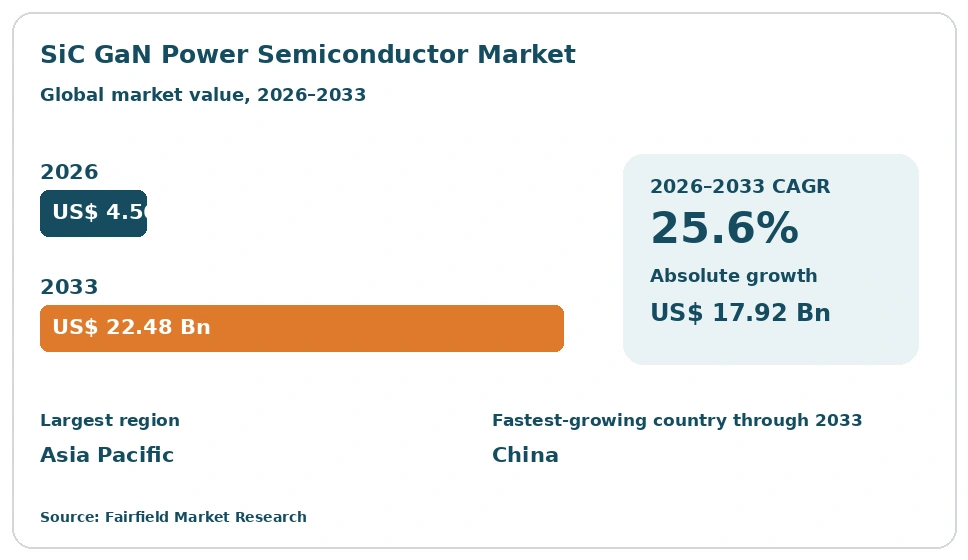
The global SiC GaN power semiconductor market size is expected to be valued at US$ 4.56 billion in 2026 and projected to reach US$ 22.48 billion by 2033, growing at a CAGR of 25.6% between 2026 and 2033.
Between 2020 and 2025, the market grew at a CAGR of about 23.4%, rising to about US$ 3.63 billion in 2025, as electric vehicle makers adopted silicon carbide MOSFETs in traction inverters and fast chargers used GaN, though an EV slowdown and price competition from China hit some suppliers in 2024 and 2025. The SiC GaN power semiconductor market covers power chips made from silicon carbide (SiC) and gallium nitride (GaN), known as wide bandgap semiconductors, which handle higher voltages, temperatures, and switching speeds with lower energy loss than silicon. Products include SiC and GaN discrete devices and modules. They are used in electric vehicles, chargers, solar and wind inverters, energy storage, data center power supplies, industrial motor drives, rail traction, and consumer fast chargers. Growth comes from vehicle electrification, renewable energy, and AI data centers. In October 2026, Infineon announced a €1.1 billion 300mm GaN fab in Austria.
Key Report Takeaways
- By Product: Discrete SiC held about 38% share in 2025, while GaN Power Module is projected to expand at a 31.2% CAGR through 2033, driven by AI data center power supplies, onboard chargers, and high-efficiency industrial systems.
- By Power Range: High-Power held about 44% share in 2025, while Medium-Power is projected to expand at a 28.0% CAGR through 2033, driven by solar inverters, energy storage, EV charging, and server power supplies in the 1 to 10 kilowatt range.
- By Vertical: Hybrid and Electric Vehicles held about 41% share in 2025, while PV Inverters and Energy Storage is projected to expand at a 28.6% CAGR through 2033, driven by solar growth, grid batteries, and efficiency gains.
- By Region: Asia Pacific held about 46% share in 2025, while China is projected to expand at a 27.4% CAGR through 2033, driven by the world’s largest EV and solar industries, local SiC wafer production, and government chip programs.
Global SiC GaN Power Semiconductor Market Trends and Insights
Drivers Impact Analysis
Two drivers carry the strongest influence on SiC GaN power semiconductor market demand during the forecast period.
| Driver | Impact on CAGR Forecast | Geographic Relevance | Impact Timeline |
| Vehicle electrification and fast charging | High | Asia Pacific, Europe, North America | Long term (≥4 years) |
| Renewable energy and AI data center power demand | Medium | Global | Medium term (2-4 years) |
Vehicle Electrification Is Driving the SiC GaN Power Semiconductor Market
Vehicle electrification and fast charging are the strongest driver of the SiC GaN power semiconductor market. Electric vehicles need efficient power chips.
The mechanism is the efficiency advantage of wide bandgap chips in vehicles. Silicon carbide MOSFETs in traction inverters convert battery power to drive the motor with lower losses than silicon IGBTs, extending driving range or allowing smaller batteries, and they are essential for 800-volt platforms that enable faster charging. Automakers such as Tesla, BYD, Hyundai, General Motors, and Mercedes-Benz use SiC in many models. Onboard chargers and DC-DC converters increasingly use SiC and GaN to save weight and space. Public fast chargers rated at 150 to 350 kilowatts and above need high-voltage power modules. Global EV sales continue to rise, led by China and Europe. These trends support strong long-term demand.
Renewables and Data Centers Are Expanding the SiC GaN Power Semiconductor Market
Renewable energy and AI data center power demand are expanding the SiC GaN power semiconductor market. Every watt saved matters.
The cause is the need for efficient power conversion. Solar inverters, wind converters, and battery storage systems use SiC devices to raise efficiency, reduce cooling, and shrink equipment size. AI data centers consume huge amounts of electricity, and GaN and SiC power supplies cut losses in servers and new 800-volt DC power architectures. Consumer fast chargers for phones and laptops have adopted GaN widely. Industrial motor drives, heat pumps, air conditioners, and rail traction also benefit from lower losses and smaller cooling systems. Governments are tightening energy efficiency rules for power supplies and motors, which favors wide bandgap designs. Utility-scale solar plants are moving to 1,500-volt systems that suit SiC devices. These trends expand sales.
Restraints Impact Analysis
Two restraints limit how quickly the SiC GaN power semiconductor market grows.
| Restraint | Impact on CAGR Forecast | Geographic Relevance | Impact Timeline |
| High costs and price competition | High | Global | Medium term (2-4 years) |
| Manufacturing complexity and supply chain risks | Medium | North America, Europe | Long term (≥4 years) |
Costs and Price Competition Slow the SiC GaN Power Semiconductor Market
High costs and price competition slow the SiC GaN power semiconductor market. Wide bandgap chips still cost more than silicon.
The specific causes are expensive materials and fast-falling prices. SiC wafers are hard to grow and cut, with defects that lower yields, so SiC devices cost several times more than silicon equivalents. At the same time, Chinese producers have added large SiC wafer and device capacity, pushing down prices quickly and hurting margins for Western and Japanese suppliers. Slower EV sales growth in Europe and the United States in 2024 and 2025 left suppliers with excess capacity. Wolfspeed entered Chapter 11 restructuring in 2025 before emerging in September 2025. Customers also delay design changes while prices fall, waiting for cheaper parts. These pressures slow investment and value growth, even as unit volumes keep rising.
Manufacturing Complexity Restricts the SiC GaN Power Semiconductor Market
Manufacturing complexity and supply chain risks restrict the SiC GaN power semiconductor market. Making these chips is difficult.
The underlying causes are hard processes and concentrated supply. Growing SiC crystals takes days and needs temperatures above 2,000 degrees Celsius, and GaN-on-silicon wafers face stress, cracking, and defect challenges that reduce output. Specialized equipment for crystal growth and epitaxy is costly and in limited supply. Yields for large SiC wafers are still lower than for silicon, and qualifying new devices for automotive use takes years of testing. Gallium supply is dominated by China, which has placed export controls on it, raising concerns for GaN makers elsewhere. Trade tensions and tariffs between the United States and China affect equipment and chip flows. Skilled engineers in wide bandgap processes are in short supply. These factors restrict growth.
Market Opportunities
300mm Manufacturing Opens a Fast-Growth Revenue Pool
Larger 300mm wafer manufacturing opens a fast-growth revenue pool in the SiC GaN power semiconductor market. Bigger wafers lower costs.
Manufacturers can capture this opportunity. Moving from 150mm and 200mm to 300mm wafers yields about 2.3 times more chips per wafer and allows use of existing silicon fab equipment, cutting costs sharply. In October 2026, Infineon announced about €1.1 billion for the world’s first high-volume 300mm GaN fab in Villach, Austria, with production expected by the end of 2027, and in November 2026 it processed 300mm SiC wafers into working power devices. Lower costs could open GaN and SiC to mass-market vehicles, appliances, and consumer electronics. Companies that scale large-wafer production first can win share and defend margins against low-cost rivals.
AI Data Center Power Creates a Growth Revenue Pool
AI data center power creates a growth revenue pool in the SiC GaN power semiconductor market. Power demand from AI is soaring.
Suppliers can capture this opportunity. AI servers draw far more power than traditional servers, and operators are moving to higher-voltage DC power systems to cut losses. GaN and SiC devices enable smaller, more efficient power supply units and converters. Chipmakers are partnering with server and power supply makers to develop new designs. New power architectures being developed by Nvidia and its partners use 800-volt DC distribution, which needs high-voltage SiC and GaN converters. Telecom base stations and edge data centers add further demand. Operators value every percentage point of efficiency because it cuts electricity and cooling costs at huge scale. Companies with proven, reliable data center products and strong partnerships can grow quickly.
Segment Analysis
By Product: Discrete SiC Leads While GaN Power Module Grows Fastest
Discrete SiC held about 38% share in 2025. Discrete SiC MOSFETs and Schottky diodes are used in EV onboard chargers, DC fast chargers, solar inverters, industrial power supplies, and motor drives, and they are produced by Infineon, STMicroelectronics, onsemi, Wolfspeed, and ROHM. SiC power modules, which combine several chips in one package, are the main choice for EV traction inverters and high-power industrial systems.
GaN Power Module is the fastest-growing product, expanding at a 31.2% CAGR through 2033. GaN devices switch very fast with low losses, making them ideal for compact power supplies in AI data centers, telecom equipment, onboard chargers, and consumer fast chargers. Discrete GaN transistors and GaN power ICs form another segment. For the market, GaN growth adds new applications.
By Power Range: High-Power Leads While Medium-Power Grows Fastest
High-Power held about 44% share in 2025. High-power devices are used in EV traction inverters, fast chargers, rail traction, wind converters, and grid equipment, where SiC modules handle high voltages and currents efficiently. Automotive demand drives most of this segment.
Medium-Power is the fastest-growing power range, expanding at a 28.0% CAGR through 2033. Medium-power devices serve residential and commercial solar inverters, battery storage, EV onboard chargers, server power supplies, and industrial drives, where both SiC and GaN compete. Low-power devices, mainly GaN, are used in consumer chargers and adapters, where they shrink charger size. Prices for low-power GaN chips have fallen quickly, widening use in laptops and phones. For the market, medium-power growth widens adoption.
By Vertical: Hybrid and Electric Vehicles Lead While PV Inverters and Energy Storage Grow Fastest
Hybrid and Electric Vehicles held about 41% share in 2025. Traction inverters, onboard chargers, and DC-DC converters in EVs use SiC and increasingly GaN, and 800-volt platforms are spreading. China is the largest EV market, and automakers are qualifying more suppliers to secure supply. Electric trucks and buses add high-power demand.
PV Inverters and Energy Storage is the fastest-growing vertical, expanding at a 28.6% CAGR through 2033. Solar installations and grid batteries are growing rapidly, and SiC devices raise inverter efficiency and power density. Power supplies, industrial motor drives, traction, and other verticals form further segments, with data center power supplies growing quickly and rail operators adopting SiC traction converters to save energy. For the market, renewable growth diversifies demand.
Geography Analysis
Why Is North America Important to the SiC GaN Power Semiconductor Market?
North America is important to the SiC GaN power semiconductor market because it is home to key SiC material and device makers and leading technology customers. Wolfspeed, onsemi, and Microchip Technology produce SiC wafers and devices in the United States, and GaN firms such as Navitas and Transphorm, now part of Renesas, are based there. Tesla was an early SiC adopter, and AI data center builders are major GaN and SiC buyers. CHIPS Act funding supports domestic production. Canada adds GaN design strength. Key barriers include high costs and supplier restructuring. One change shaping the region is data center demand.
Europe Shapes the SiC GaN Power Semiconductor Market Through Automotive and Fab Investment
Europe is a major SiC GaN power semiconductor market. Germany, France, Italy, Austria, and Sweden host automakers, industrial firms, and chipmakers such as Infineon and STMicroelectronics. STMicroelectronics is building SiC capacity in Italy, and Infineon is investing in 300mm GaN and SiC in Austria with support from the European Chips Act. Rail and industrial firms such as Siemens and ABB use SiC in traction and drives. Automakers such as Volkswagen, BMW, and Renault are major customers. Key barriers include slower EV growth and high energy costs. One opportunity is 300mm production that lowers costs for European automakers and industrial customers.
Which Region Is Leading the SiC GaN Power Semiconductor Market?
Asia Pacific is leading the SiC GaN power semiconductor market with about 46% share in 2025, and China is the fastest-growing country, expanding at a 27.4% CAGR through 2033. China has the world’s largest EV, solar, and battery industries and has built large local SiC wafer and device capacity through companies such as SICC and San’an Optoelectronics. Japan’s ROHM, Mitsubishi Electric, and Fuji Electric, along with Taiwan and South Korea, are major producers. Key barriers include price wars and trade restrictions. One change shaping the region is local supply growth in China.
Latin America Grows the SiC GaN Power Semiconductor Market Through Renewables and EVs
Latin America is an emerging SiC GaN power semiconductor market. Brazil, Mexico, and Chile are rapidly expanding solar and wind power, which use inverters with efficient SiC devices, and Mexico hosts automotive and electronics plants serving North America, including power electronics assembly. Electric buses are growing in Chile and Colombia, and Brazil is adding EV charging networks in major cities. Key barriers include limited local production, reliance on imported systems, and slow EV adoption. Charging network growth is uneven across countries. One opportunity is solar inverters, battery storage, and EV chargers for growing cities and highways.
Middle East & Africa Builds the SiC GaN Power Semiconductor Market Through Solar Projects
Middle East & Africa is an emerging SiC GaN power semiconductor market. Saudi Arabia, the United Arab Emirates, and Morocco are building giant solar and energy storage projects, and Saudi Arabia and the United Arab Emirates are investing heavily in AI data centers and electric vehicle programs. South Africa is adding renewable power and battery storage to ease electricity shortages, and Egypt is building large solar parks such as Benban. Key barriers include reliance on imports, limited local industry, and harsh heat that tests device reliability. One opportunity is power electronics for solar plants and new data centers.
Competitive Landscape
The SiC GaN power semiconductor market is highly consolidated. Infineon Technologies, STMicroelectronics, onsemi, Wolfspeed, and ROHM are leading players, while Mitsubishi Electric, Fuji Electric, Renesas Electronics, Navitas Semiconductor, Microchip Technology, San’an Optoelectronics, and Littelfuse compete strongly. A small group of companies supplies most SiC devices to automakers, while GaN has more specialist players, and Chinese producers are rapidly gaining share in wafers and devices.
Companies compete on device performance, reliability, wafer supply, manufacturing cost, automotive qualification, and long-term supply agreements with automakers and power supply makers. Control of SiC wafer production is a key advantage, since wafers make up a large part of device cost. Moving to larger wafers, improving yields, and packaging innovations help suppliers cut costs as prices fall, and vertical integration from crystal growth to modules gives leaders more control.
Strategic moves show how competition is changing. In September 2025, Wolfspeed emerged from Chapter 11 restructuring after pressure from falling prices and slower EV demand. In October 2026, Infineon announced about €1.1 billion for a 300mm GaN fab in Austria. In November 2026, Infineon processed 300mm SiC wafers into working devices. These moves show competition shifting toward scale, larger wafers, and aggressive cost reduction.
Three themes shape vendor strategy. First, companies are moving to 200mm and 300mm wafers to cut costs. Second, they are targeting AI data centers and renewable energy alongside EVs. Third, they are securing local supply chains in North America, Europe, and Asia Pacific.
SiC GaN Power Semiconductor Market Industry Leaders
- Infineon Technologies
- STMicroelectronics
- onsemi
- Wolfspeed
- ROHM
Recent Industry Developments
- November 2026: Infineon processed 300mm silicon carbide wafers into working power devices at its Villach fab, using existing silicon equipment - a step toward lower-cost silicon carbide MOSFETs in the SiC GaN power semiconductor market.
- October 2026: Infineon announced about €1.1 billion for the first high-volume 300mm GaN power chip fab in Villach, Austria, with production expected by the end of 2027 - scales wide bandgap semiconductors in Europe.
- September 2025: Wolfspeed emerged from Chapter 11 restructuring with a stronger balance sheet - stabilizes a major U.S. supplier of SiC wafers and devices.
Companies Covered in the Report
- Infineon Technologies
- STMicroelectronics
- onsemi
- Wolfspeed
- ROHM
- Mitsubishi Electric
- Fuji Electric
- Renesas Electronics
- Navitas Semiconductor
- Microchip Technology
- San’an Optoelectronics
- Littelfuse
SiC GaN Power Semiconductor Market Report Scope
This report covers the SiC GaN power semiconductor market, including SiC power modules, GaN power modules, discrete SiC, and discrete GaN devices across low, medium, and high power ranges, used in hybrid and electric vehicles, PV inverters and energy storage, power supplies, industrial motor drives, traction, and other verticals. The base year is 2025, and the forecast period runs from 2026 to 2033. All values are expressed in US$ Billion.
| Product | SiC Power Module, GaN Power Module, Discrete SiC, Discrete GaN |
| Power Range | Low-Power, Medium-Power, High-Power |
| Vertical | Hybrid and Electric Vehicles, PV Inverters and Energy Storage, Power Supplies, Industrial Motor Drives, Traction, Others |
| Regions | North America, Europe, Asia Pacific, Latin America, Middle East & Africa |
1. Executive Summary
1.1 SiC GaN Power Semiconductor Market Snapshot
1.2 Future Projections
1.3 Key Market Trends
1.4 Regional Snapshot
2. Market Overview
2.1 Market Definition and Report Scope
2.2 Historical Market Trends
2.3 Market Dynamics
2.3.1 Drivers
2.3.1.1 Vehicle Electrification Is Driving the SiC GaN Power Semiconductor Market
2.3.1.2 Renewables and Data Centers Are Expanding the SiC GaN Power Semiconductor Market
2.3.2 Restraints
2.3.2.1 Costs and Price Competition Slow the SiC GaN Power Semiconductor Market
2.3.2.2 Manufacturing Complexity Restricts the SiC GaN Power Semiconductor Market
2.3.3 Market Opportunities
2.3.3.1 300mm Manufacturing Opens a Fast-Growth Revenue Pool
2.3.3.2 AI Data Center Power Creates a Growth Revenue Pool
3. Global SiC GaN Power Semiconductor Market Outlook, 2020–2033
3.1 Global SiC GaN Power Semiconductor Market Outlook, by Product, Value (US$ Billion), 2020–2033
3.1.1 SiC Power Module
3.1.2 GaN Power Module
3.1.3 Discrete SiC
3.1.4 Discrete GaN
3.2 Global SiC GaN Power Semiconductor Market Outlook, by Power Range, Value (US$ Billion), 2020–2033
3.2.1 Low-Power
3.2.2 Medium-Power
3.2.3 High-Power
3.3 Global SiC GaN Power Semiconductor Market Outlook, by Vertical, Value (US$ Billion), 2020–2033
3.3.1 Hybrid and Electric Vehicles
3.3.2 PV Inverters and Energy Storage
3.3.3 Power Supplies
3.3.4 Industrial Motor Drives
3.3.5 Traction
3.3.6 Others
3.4 Global SiC GaN Power Semiconductor Market Outlook, by Region, Value (US$ Billion), 2020–2033
3.4.1 North America
3.4.2 Europe
3.4.3 Asia Pacific
3.4.4 Latin America
3.4.5 Middle East & Africa
4. North America SiC GaN Power Semiconductor Market Outlook, 2020–2033
4.1 North America SiC GaN Power Semiconductor Market Outlook, by Product, Value (US$ Billion), 2020–2033
4.1.1 SiC Power Module
4.1.2 GaN Power Module
4.1.3 Discrete SiC
4.1.4 Discrete GaN
4.2 North America SiC GaN Power Semiconductor Market Outlook, by Power Range, Value (US$ Billion), 2020–2033
4.2.1 Low-Power
4.2.2 Medium-Power
4.2.3 High-Power
4.3 North America SiC GaN Power Semiconductor Market Outlook, by Vertical, Value (US$ Billion), 2020–2033
4.3.1 Hybrid and Electric Vehicles
4.3.2 PV Inverters and Energy Storage
4.3.3 Power Supplies
4.3.4 Industrial Motor Drives
4.3.5 Traction
4.3.6 Others
4.4 North America SiC GaN Power Semiconductor Market Outlook, by Country, Value (US$ Billion), 2020–2033
4.4.1 United States SiC GaN Power Semiconductor Market Outlook, by Product, 2020–2033
4.4.2 United States SiC GaN Power Semiconductor Market Outlook, by Power Range, 2020–2033
4.4.3 United States SiC GaN Power Semiconductor Market Outlook, by Vertical, 2020–2033
4.4.4 Canada SiC GaN Power Semiconductor Market Outlook, by Product, 2020–2033
4.4.5 Canada SiC GaN Power Semiconductor Market Outlook, by Power Range, 2020–2033
4.4.6 Canada SiC GaN Power Semiconductor Market Outlook, by Vertical, 2020–2033
5. Europe SiC GaN Power Semiconductor Market Outlook, 2020–2033
5.1 Europe SiC GaN Power Semiconductor Market Outlook, by Product, Value (US$ Billion), 2020–2033
5.1.1 SiC Power Module
5.1.2 GaN Power Module
5.1.3 Discrete SiC
5.1.4 Discrete GaN
5.2 Europe SiC GaN Power Semiconductor Market Outlook, by Power Range, Value (US$ Billion), 2020–2033
5.2.1 Low-Power
5.2.2 Medium-Power
5.2.3 High-Power
5.3 Europe SiC GaN Power Semiconductor Market Outlook, by Vertical, Value (US$ Billion), 2020–2033
5.3.1 Hybrid and Electric Vehicles
5.3.2 PV Inverters and Energy Storage
5.3.3 Power Supplies
5.3.4 Industrial Motor Drives
5.3.5 Traction
5.3.6 Others
5.4 Europe SiC GaN Power Semiconductor Market Outlook, by Country, Value (US$ Billion), 2020–2033
5.4.1 Germany SiC GaN Power Semiconductor Market Outlook, by Product, 2020–2033
5.4.2 Germany SiC GaN Power Semiconductor Market Outlook, by Power Range, 2020–2033
5.4.3 Germany SiC GaN Power Semiconductor Market Outlook, by Vertical, 2020–2033
5.4.4 France SiC GaN Power Semiconductor Market Outlook, by Product, 2020–2033
5.4.5 France SiC GaN Power Semiconductor Market Outlook, by Power Range, 2020–2033
5.4.6 France SiC GaN Power Semiconductor Market Outlook, by Vertical, 2020–2033
5.4.7 Italy SiC GaN Power Semiconductor Market Outlook, by Product, 2020–2033
5.4.8 Italy SiC GaN Power Semiconductor Market Outlook, by Power Range, 2020–2033
5.4.9 Italy SiC GaN Power Semiconductor Market Outlook, by Vertical, 2020–2033
5.4.10 Austria SiC GaN Power Semiconductor Market Outlook, by Product, 2020–2033
5.4.11 Austria SiC GaN Power Semiconductor Market Outlook, by Power Range, 2020–2033
5.4.12 Austria SiC GaN Power Semiconductor Market Outlook, by Vertical, 2020–2033
5.4.13 Sweden SiC GaN Power Semiconductor Market Outlook, by Product, 2020–2033
5.4.14 Sweden SiC GaN Power Semiconductor Market Outlook, by Power Range, 2020–2033
5.4.15 Sweden SiC GaN Power Semiconductor Market Outlook, by Vertical, 2020–2033
6. Asia Pacific SiC GaN Power Semiconductor Market Outlook, 2020–2033
6.1 Asia Pacific SiC GaN Power Semiconductor Market Outlook, by Product, Value (US$ Billion), 2020–2033
6.1.1 SiC Power Module
6.1.2 GaN Power Module
6.1.3 Discrete SiC
6.1.4 Discrete GaN
6.2 Asia Pacific SiC GaN Power Semiconductor Market Outlook, by Power Range, Value (US$ Billion), 2020–2033
6.2.1 Low-Power
6.2.2 Medium-Power
6.2.3 High-Power
6.3 Asia Pacific SiC GaN Power Semiconductor Market Outlook, by Vertical, Value (US$ Billion), 2020–2033
6.3.1 Hybrid and Electric Vehicles
6.3.2 PV Inverters and Energy Storage
6.3.3 Power Supplies
6.3.4 Industrial Motor Drives
6.3.5 Traction
6.3.6 Others
6.4 Asia Pacific SiC GaN Power Semiconductor Market Outlook, by Country, Value (US$ Billion), 2020–2033
6.4.1 China SiC GaN Power Semiconductor Market Outlook, by Product, 2020–2033
6.4.2 China SiC GaN Power Semiconductor Market Outlook, by Power Range, 2020–2033
6.4.3 China SiC GaN Power Semiconductor Market Outlook, by Vertical, 2020–2033
6.4.4 Japan SiC GaN Power Semiconductor Market Outlook, by Product, 2020–2033
6.4.5 Japan SiC GaN Power Semiconductor Market Outlook, by Power Range, 2020–2033
6.4.6 Japan SiC GaN Power Semiconductor Market Outlook, by Vertical, 2020–2033
6.4.7 Taiwan SiC GaN Power Semiconductor Market Outlook, by Product, 2020–2033
6.4.8 Taiwan SiC GaN Power Semiconductor Market Outlook, by Power Range, 2020–2033
6.4.9 Taiwan SiC GaN Power Semiconductor Market Outlook, by Vertical, 2020–2033
6.4.10 South Korea SiC GaN Power Semiconductor Market Outlook, by Product, 2020–2033
6.4.11 South Korea SiC GaN Power Semiconductor Market Outlook, by Power Range, 2020–2033
6.4.12 South Korea SiC GaN Power Semiconductor Market Outlook, by Vertical, 2020–2033
7. Latin America SiC GaN Power Semiconductor Market Outlook, 2020–2033
7.1 Latin America SiC GaN Power Semiconductor Market Outlook, by Product, Value (US$ Billion), 2020–2033
7.1.1 SiC Power Module
7.1.2 GaN Power Module
7.1.3 Discrete SiC
7.1.4 Discrete GaN
7.2 Latin America SiC GaN Power Semiconductor Market Outlook, by Power Range, Value (US$ Billion), 2020–2033
7.2.1 Low-Power
7.2.2 Medium-Power
7.2.3 High-Power
7.3 Latin America SiC GaN Power Semiconductor Market Outlook, by Vertical, Value (US$ Billion), 2020–2033
7.3.1 Hybrid and Electric Vehicles
7.3.2 PV Inverters and Energy Storage
7.3.3 Power Supplies
7.3.4 Industrial Motor Drives
7.3.5 Traction
7.3.6 Others
7.4 Latin America SiC GaN Power Semiconductor Market Outlook, by Country, Value (US$ Billion), 2020–2033
7.4.1 Brazil SiC GaN Power Semiconductor Market Outlook, by Product, 2020–2033
7.4.2 Brazil SiC GaN Power Semiconductor Market Outlook, by Power Range, 2020–2033
7.4.3 Brazil SiC GaN Power Semiconductor Market Outlook, by Vertical, 2020–2033
7.4.4 Mexico SiC GaN Power Semiconductor Market Outlook, by Product, 2020–2033
7.4.5 Mexico SiC GaN Power Semiconductor Market Outlook, by Power Range, 2020–2033
7.4.6 Mexico SiC GaN Power Semiconductor Market Outlook, by Vertical, 2020–2033
7.4.7 Chile SiC GaN Power Semiconductor Market Outlook, by Product, 2020–2033
7.4.8 Chile SiC GaN Power Semiconductor Market Outlook, by Power Range, 2020–2033
7.4.9 Chile SiC GaN Power Semiconductor Market Outlook, by Vertical, 2020–2033
7.4.10 Colombia SiC GaN Power Semiconductor Market Outlook, by Product, 2020–2033
7.4.11 Colombia SiC GaN Power Semiconductor Market Outlook, by Power Range, 2020–2033
7.4.12 Colombia SiC GaN Power Semiconductor Market Outlook, by Vertical, 2020–2033
8. Middle East & Africa SiC GaN Power Semiconductor Market Outlook, 2020–2033
8.1 Middle East & Africa SiC GaN Power Semiconductor Market Outlook, by Product, Value (US$ Billion), 2020–2033
8.1.1 SiC Power Module
8.1.2 GaN Power Module
8.1.3 Discrete SiC
8.1.4 Discrete GaN
8.2 Middle East & Africa SiC GaN Power Semiconductor Market Outlook, by Power Range, Value (US$ Billion), 2020–2033
8.2.1 Low-Power
8.2.2 Medium-Power
8.2.3 High-Power
8.3 Middle East & Africa SiC GaN Power Semiconductor Market Outlook, by Vertical, Value (US$ Billion), 2020–2033
8.3.1 Hybrid and Electric Vehicles
8.3.2 PV Inverters and Energy Storage
8.3.3 Power Supplies
8.3.4 Industrial Motor Drives
8.3.5 Traction
8.3.6 Others
8.4 Middle East & Africa SiC GaN Power Semiconductor Market Outlook, by Country, Value (US$ Billion), 2020–2033
8.4.1 Saudi Arabia SiC GaN Power Semiconductor Market Outlook, by Product, 2020–2033
8.4.2 Saudi Arabia SiC GaN Power Semiconductor Market Outlook, by Power Range, 2020–2033
8.4.3 Saudi Arabia SiC GaN Power Semiconductor Market Outlook, by Vertical, 2020–2033
8.4.4 United Arab Emirates SiC GaN Power Semiconductor Market Outlook, by Product, 2020–2033
8.4.5 United Arab Emirates SiC GaN Power Semiconductor Market Outlook, by Power Range, 2020–2033
8.4.6 United Arab Emirates SiC GaN Power Semiconductor Market Outlook, by Vertical, 2020–2033
8.4.7 Morocco SiC GaN Power Semiconductor Market Outlook, by Product, 2020–2033
8.4.8 Morocco SiC GaN Power Semiconductor Market Outlook, by Power Range, 2020–2033
8.4.9 Morocco SiC GaN Power Semiconductor Market Outlook, by Vertical, 2020–2033
8.4.10 South Africa SiC GaN Power Semiconductor Market Outlook, by Product, 2020–2033
8.4.11 South Africa SiC GaN Power Semiconductor Market Outlook, by Power Range, 2020–2033
8.4.12 South Africa SiC GaN Power Semiconductor Market Outlook, by Vertical, 2020–2033
8.4.13 Egypt SiC GaN Power Semiconductor Market Outlook, by Product, 2020–2033
8.4.14 Egypt SiC GaN Power Semiconductor Market Outlook, by Power Range, 2020–2033
8.4.15 Egypt SiC GaN Power Semiconductor Market Outlook, by Vertical, 2020–2033
9. Competitive Landscape
9.1 SiC GaN Power Semiconductor Market Industry Leaders
9.2 Recent Industry Developments
9.3 Company Profiles
9.3.1 Infineon Technologies
9.3.2 STMicroelectronics
9.3.3 onsemi
9.3.4 Wolfspeed
9.3.5 ROHM
9.3.6 Mitsubishi Electric
9.3.7 Fuji Electric
9.3.8 Renesas Electronics
9.3.9 Navitas Semiconductor
9.3.10 Microchip Technology
9.3.11 San'an Optoelectronics
9.3.12 Littelfuse
10. Appendix
10.1 Research Methodology
10.2 Report Assumptions
10.3 Acronyms and Abbreviations
| Product | SiC Power Module, GaN Power Module, Discrete SiC, Discrete GaN |
| Power Range | Low-Power, Medium-Power, High-Power |
| Vertical | Hybrid and Electric Vehicles, PV Inverters and Energy Storage, Power Supplies, Industrial Motor Drives, Traction, Others |
| Regions | North America, Europe, Asia Pacific, Latin America, Middle East & Africa |
Our Research Methodology
Considering the volatility of business today, traditional approaches to strategizing a game plan can be unfruitful if not detrimental. True ambiguity is no way to determine a forecast. A myriad of predetermined factors must be accounted for such as the degree of risk involved, the magnitude of circumstances, as well as conditions or consequences that are not known or unpredictable. To circumvent binary views that cast uncertainty, the application of market research intelligence to strategically posture, move, and enable actionable outcomes is necessary.
View Methodology
Quality Assured
Rigorous Validation Process

Confidentiality Assured
End-to-end Data Security

Custom Research Services
Tailored To Your Objectives
FAQs
The SiC GaN power semiconductor market is valued at US$ 4.56 billion in 2026, led by discrete SiC and Asia Pacific.
The market is projected to reach US$ 22.48 billion by 2033, growing at a 25.6% CAGR and adding US$ 17.92 billion.
GaN power modules are growing fastest at a 31.2% CAGR through 2033, driven by AI data center power supplies and onboard chargers.
China is growing fastest at a 27.4% CAGR through 2033, driven by its huge EV and solar industries and local SiC production.
Asia Pacific holds the largest share at about 46% in 2025, supported by EV, solar, and chip production in China and Japan.
Related Reports
Serverless Architecture Market Size, Share, Insights, Competitive Landscape, and Forecast 2026 to 2033
Explore the serverless architecture market outlook for 2026–2033, covering services, deployment models, industries, regional trends, and key companies.
Network Sandboxing Market Size, Share, Insights, Competitive Landscape, and Forecast 2026 to 2033
The global network sandboxing market is valued at US$5.8 billion in 2026, reaching US$14.7 billion by 2033, growing at a 14.2% CAGR
Location of Things Market Size, Share, Insights, Competitive Landscape, and Forecast 2026 to 2033
The global location of things market is valued at US$52.31 billion in 2026, reaching US$297.93 billion by 2033, growing at a 28.2% CAGR
Chemical Mechanical Planarization Market Size, Share, Insights, Competitive Landscape, and Forecast 2026 to 2033
The global chemical mechanical planarization market is valued at US$7.2 billion in 2026, reaching US$11.95 billion by 2033, growing at a 7.5% CAGR
Contact Center as a Service Market Size, Share, Insights, Competitive Landscape, and Forecast 2026 to 2033
Explore the contact center as a service market outlook for 2026–2033, including cloud deployment, AI tooling, regional trends, and competitive insights.
Affiliate Software Market Size, Share, Insights, Competitive Landscape, and Forecast 2026 to 2033
Explore the affiliate software market outlook for 2026–2033, including tracking tools, payout trends, regional insights, and competitive analysis.