



Construction Bolts Market
Construction Bolts Market Size, Share, Insights, Competitive Landscape, and Forecast 2026 to 2033
Report Overview
Construction Bolts Market Size and Trend Analysis
What Is Driving Growth in Construction Bolts Demand?
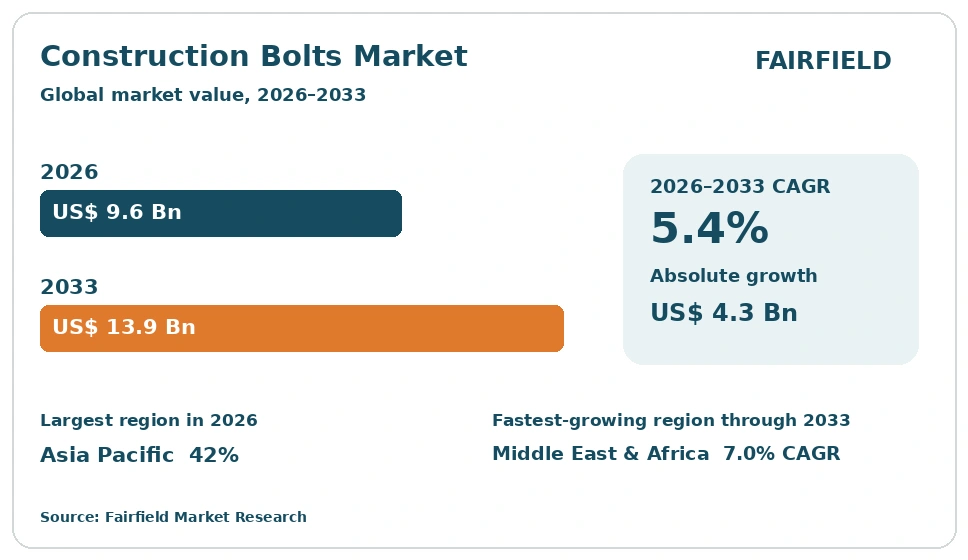
The global construction bolts market size is expected to be valued at US$ 9.6 billion in 2026 and projected to reach US$ 13.9 billion by 2033, growing at a CAGR of 5.4% between 2026 and 2033. Growth follows a steady shift from welded joints to bolted steel connections across commercial, industrial and transport projects. Public infrastructure renewal, warehouse construction and modular building systems add volume, while stricter site inspection pushes buyers toward certified high-strength bolts. Demand expanded at a 4.1% CAGR between 2020 and 2025, so the outlook assumes measured acceleration rather than a sharp break. The absolute dollar opportunity across the period is US$ 4.3 billion.
Key Report Takeaways
- By Product Type: Structural bolts led with 38% share in 2026, while anchor bolts are projected to expand at a 6.4% CAGR through 2033, driven by retrofit anchoring work on existing concrete frames and seismic upgrades.
- By Material Grade: Carbon steel led with 56% share in 2026, while stainless steel is projected to expand at a 6.8% CAGR through 2033, driven by coastal and marine structures where chloride exposure rules out plain steel.
- By Coating and Finish: Hot-dip galvanized bolts led with 41% share in 2026, while zinc-flake and other advanced coatings are projected to expand at a 7.3% CAGR through 2033, driven by thinner films that keep thread fit predictable.
- By End Use: Commercial buildings led with 31% share in 2026, while infrastructure is projected to expand at a 6.5% CAGR through 2033, driven by bridge replacement programmes and long-span transport structures.
- By Region: Asia Pacific led with 42% share in 2026, ahead of North America, Europe, Latin America and Middle East & Africa, while Middle East & Africa is projected to expand at a 7.0% CAGR through 2033, driven by Gulf rail and industrial city programmes.
Market Trends and Insights
Market Growth Drivers
Infrastructure Renewal Programmes Lift High-Strength Bolt Consumption
Ageing bridges, viaducts and transit structures are moving from inspection to replacement, and that shift raises bolt volumes per project. Replacement decks and strengthening schemes use bolted splices because they can be installed under traffic without hot work. A single highway bridge girder line can absorb several thousand high-strength assemblies, supplied as matched sets. Rehabilitation also creates repeat demand for anchor and foundation bolts at pier caps and bearing seats.
Public works budgets in most large economies now separate maintenance funding from new build funding, which gives fastener suppliers a steadier order book. Bolted connections also suit modern inspection practice, since tension can be checked and documented long after installation. Owners increasingly require traceable material certificates for every lot, so demand concentrates among producers that can supply test records with each consignment.
Steel-Framed and Modular Construction Expand Bolted Connection Volumes
Steel framing is gaining share in warehouses, data centres, hospitals and mid-rise residential buildings, and every steel frame is a bolted frame. Fabricators prefer shop welding with site bolting because it moves labour into controlled conditions and shortens programme time. Modular and volumetric construction pushes that logic further, since finished modules are joined on site almost entirely by bolted brackets, splice plates and levelling anchors. The result is a higher count of fasteners for each tonne of structural steel erected.
Skilled welder shortages reinforce the trend, because bolting needs less specialist labour and less inspection time per joint. Design practice supports it, with pre-engineered connection libraries and detailing software that specify standard bolt assemblies by default. Fabricators are responding by holding deeper stocks of common diameters and lengths to protect erection schedules.
Restraints Impact Analysis of Market
Steel Price Volatility Compresses Fastener Margins and Order Visibility
Wire rod and bar stock account for much of a bolt’s cost, so swings in steel pricing move fastener economics quickly. Manufacturers quote construction projects months ahead of delivery, which leaves them exposed when input costs rise between tender and shipment. Distributors respond by shortening price validity, and contractors respond by delaying commitments, so order books become harder to plan. Smaller forgers with limited hedging capacity feel the squeeze first and sometimes decline marginal work.
Energy costs add a second layer, because hot forging, heat treatment and galvanizing are all energy intensive. Freight rates and import duties on fasteners introduce further uncertainty for buyers sourcing across regions. Projects under fixed-price contracts absorb these shifts poorly, and some specifiers substitute lower grades or thinner coatings, which trims value even when unit volumes hold steady.
Non-Conforming Supply Raises Qualification and Testing Burdens
Structural bolting is safety critical, and the presence of mis-marked or non-conforming product in distribution channels slows procurement. Buyers facing that risk add vendor audits, incoming inspection and third-party testing, which lengthens approval cycles and raises the cost of switching suppliers. New entrants find qualification difficult even when their product is sound, so demand concentrates among established names and competition narrows. Projects sometimes stall when a consignment fails verification close to erection.
Standards families such as ISO, ASTM International and the European EN system set the conformity framework, and certification against them requires metallurgical control, documented heat treatment and lot traceability. Building that capability needs capital in testing equipment and quality staff. For producers serving mainly commodity hardware, the investment is hard to justify, which limits supply of certified structural grades.
Market Opportunities
Advanced Coatings Create Higher-Value Product Lines
Corrosion protection is becoming the main point of differentiation in a product that is otherwise standardised, and that opens premium positions. Zinc-flake systems, mechanical galvanizing and fluoropolymer topcoats offer controlled film thickness, so threads assemble predictably and tension results stay repeatable. Owners of coastal bridges and chemical plants will pay for longer service life because replacing a bolt in service costs far more than the fastener itself. Coating choice is now written into the specification rather than left to the supplier.
The commercial case rests on maintenance economics and long-life durability requirements. Coating lines also give manufacturers a way to capture value without adding forging capacity, and they support shorter lead times when applied in house. Suppliers combining certified base material with a qualified coating process can serve demanding projects that commodity producers cannot reach.
Digital Bolting and Tension Verification Open Service Revenue
Documented bolt tension is becoming a deliverable in its own right, and that turns a hardware sale into a service relationship. Electronic torque tools, tension-indicating washers and load-sensing fasteners record what each joint received, replacing handwritten logs with exportable data. Owners want that record for warranty and inspection, and contractors want it to close quality gates faster. Suppliers who provide tools, training and reporting alongside the bolts capture spend that once went to separate tool vendors.
Structural health monitoring extends the same idea into operation, with instrumented connections on bridges and towers flagging tension loss before it becomes a defect. Digital fabrication helps, since connection data already exists in the building model. The attached software and calibration services create recurring revenue that is less exposed to steel pricing, which is why fastener suppliers increasingly treat verification as a product line rather than a sales aid.
Category-wise Insights
Which Bolt Types Carry the Largest Share of Construction Fastening?
Structural bolts hold the leading position, with 38% share in 2026, because every bolted steel frame depends on them. They are supplied as matched assemblies with controlled tension, which makes them the default for beam-to-column splices, bracing and truss connections in commercial and industrial buildings. Volume follows structural steel output closely.
Anchor bolts are the fastest-growing type at a 6.4% CAGR through 2033, led by work on existing structures. Seismic strengthening, equipment rebasing and facade retrofits require post-installed anchoring into concrete never detailed for it. Cast-in foundation bolts, at 14% share, remain tied to new build starts, while hex and carriage bolts at 13% and 7% serve secondary steelwork and timber framing. The split matters because anchoring demand is less cyclical and carries higher value per piece.
Carbon Steel Dominates Volume While Stainless Captures Durability Spend
Carbon steel accounts for 56% share in 2026, the natural outcome of cost per joint in a market where most bolts work in protected interior conditions. Heat-treated carbon grades deliver the strength structural connections need at a price that suits high piece counts. Alloy steel follows at 26% share, used where higher preload or low-temperature toughness is specified.
Stainless steel is the fastest-growing grade at a 6.8% CAGR through 2033, despite holding only 14% share. Coastal infrastructure, water treatment plants and facade fixings face chloride exposure that shortens coated carbon steel life, so specifiers move to austenitic and duplex grades. Lifecycle costing supports the change, since inaccessible connections are expensive to replace. For manufacturers, the shift favours those holding stainless forging capability, since the processing route differs from carbon steel.
Hot-Dip Galvanizing Leads Protection as Thin-Film Systems Gain Ground
Hot-dip galvanizing holds 41% share in 2026 and remains the reference finish for exposed structural steel. The zinc layer is thick, self-healing at cut edges and well understood, which keeps it on bridges, transmission structures and external framing. Zinc electroplating follows at 27% share, serving interior work, while plain uncoated bolts hold 15% in protected environments.
Zinc-flake and other advanced systems are the fastest-growing category at a 7.3% CAGR through 2033 from a 5% base. Their appeal is dimensional control: a thinner film means threads fit without re-tapping and torque-tension behaviour stays predictable. The processes also run at low temperature, avoiding embrittlement concerns in high-strength work. Mechanical galvanizing, at 12% share, occupies similar ground. Coating capability is becoming a competitive asset rather than an outsourced step.
Commercial Buildings Anchor Demand While Infrastructure Sets the Growth Pace
Commercial construction contributes the largest end-use share at 31% in 2026, reflecting the volume of offices, retail, warehousing and data centre work built on steel frames. These projects favour bolted connections for speed, and fastener content per square metre is high against concrete-framed alternatives. Industrial facilities follow at 24% share, covering process plants and power generation, where equipment anchoring adds demand.
Infrastructure is the fastest-growing end use at a 6.5% CAGR through 2033, holding 29% share. Bridge replacement, rail electrification, ports and long-span structures use high-strength assemblies intensively, and public funding cycles are more visible than private pipelines. Residential construction, at 16% share, is the smallest contributor, concentrated in light-gauge steel and timber connections. Public works exposure offers suppliers a steadier revenue base than commercial cycles alone.
Geography Analysis
North America Sustains Volume Through Bridge and Industrial Investment
North America holds 23% share in 2026 and is set to grow at a 4.5% CAGR through 2033. The United States dominates regional consumption, supported by federal and state bridge rehabilitation programmes, data centre construction and reshored manufacturing plants. Canada adds demand from mining, energy and transit work, while Mexico benefits from industrial park development near the northern border. Procurement rules on publicly funded projects favour locally melted and manufactured fasteners, which supports domestic capacity. Buyers here are demanding on documentation, with mill certificates, lot traceability and tension verification routinely required. That preference raises the mix toward certified structural assemblies and galvanized finishes rather than commodity hardware.
Europe Links Bolt Demand to Renovation and Energy Transition Work
Europe accounts for 21% share in 2026, expanding at a 4.0% CAGR through 2033, the slowest regional pace. Germany, France, the United Kingdom, Italy and the Nordic countries form the core demand base. New build volumes are modest, so growth comes from renovation, bridge strengthening and the structures that support wind, grid and rail investment. Wind towers in particular consume large-diameter high-strength bolts with demanding corrosion protection. Harmonised conformity requirements under the European EN framework and CE marking keep certification standards high and sustain a tier of specialist structural bolt makers. Embodied carbon reporting also favours bolted connections that let structural steel be dismantled and reused.
Which Region Is Leading the Construction Bolts Market?
Asia Pacific leads the construction bolts market with 42% share in 2026, and it also grows quickly at a 6.3% CAGR through 2033. China supplies and consumes the largest volume, combining extensive fastener manufacturing capacity with continued infrastructure and industrial building. India is the strongest demand story, with national highway, metro, airport and freight corridor programmes converting into sustained structural steel use. Japan and South Korea contribute high-specification demand tied to seismic design and heavy industry, while Southeast Asia adds factory and logistics construction. Low-cost forging capacity and integrated steel supply keep the region central to global bolt trade. Rising domestic standards are now lifting the certified share of that output.
Latin America Builds Demand Around Mining, Energy and Urban Transit
Latin America represents 6% share in 2026, growing at a 5.2% CAGR through 2033. Brazil, Mexico, Chile, Peru and Colombia account for most consumption. Mining and mineral processing investment drives demand for heavy anchor and foundation bolts, since crushers, conveyors and mill structures need heavy anchoring. Energy projects, including hydroelectric and solar installations, add further volume, and urban transit schemes in major cities support structural bolt use. Regional manufacturing capacity is limited outside Brazil and Mexico, so many certified structural grades are imported, which exposes buyers to freight costs and currency movement. Infrastructure funding stays tied to commodity cycles, which keeps growth above the global average without matching the fastest regions.
Which Region Is Growing Fastest in the Construction Bolts Market?
Middle East & Africa is the fastest-growing region at a 7.0% CAGR through 2033, from 8% share in 2026. Saudi Arabia and the United Arab Emirates drive the increase through large tourism, residential, rail and industrial city developments that rely on structural steel. Qatar and Egypt add transport and industrial work, while South Africa and Nigeria contribute mining and power-related demand. Gulf conditions make corrosion protection central, with humidity, salt air and heat pushing buyers toward galvanized and stainless options. Local fastener production is limited, so imports supply most certified structural bolts, though several states encourage domestic fabrication. Programme scale rather than market maturity explains the growth rate.
Competitive Landscape
The construction bolts market is fragmented, with a small group of international suppliers competing alongside many regional forgers and specialist structural bolt makers. Scale players such as Hilti Group, Würth Group and Illinois Tool Works Inc. combine broad product ranges with distribution reach, while focused producers hold strong positions in high-strength assemblies for bridges and towers. Regional manufacturers remain competitive because freight weight, lead times and local certification favour nearby supply. Consolidation is gradual and targets capability gaps such as coating lines and stainless capacity rather than volume.
Competition centres on certification, consistency and availability more than on headline price. Suppliers differentiate through documented metallurgical control, lot traceability, coating performance and the ability to deliver matched bolt, nut and washer assemblies that behave predictably during tensioning. Engineering support is a second axis, with anchor design software, pull-out testing and on-site training shaping specification well before purchase. Entrants from adjacent fastening segments bring coating technology and tool integration that commodity producers lack.
Strategic activity concentrates on capacity close to demand, qualification against ISO, ASTM International and EN requirements, and investment in corrosion protection processes. Manufacturers are adding automated inspection and marking systems because traceability is now a purchasing condition on public projects. Partnerships between fastener makers and tool suppliers matter because documented tension is a shared deliverable rather than a hardware feature.
Vendor strategy is converging on three themes: verified quality, longer service life and connected installation data. Suppliers pairing certified product with coating capability and installation support are shifting from component maker to connection partner.
Industry Leaders
- Hilti Group
- Simpson Manufacturing Co., Inc.
- Würth Group
- fischer Group
- Illinois Tool Works Inc.
- SFS Group AG
- Nucor Corporation
- Stanley Black & Decker, Inc.
Companies Covered in the Report
- Hilti Group
- Simpson Manufacturing Co., Inc.
- Würth Group
- fischer Group
- Illinois Tool Works Inc.
- SFS Group AG
- Nucor Corporation
- Stanley Black & Decker, Inc.
- EJOT SE & Co. KG
- Bufab AB
- TR Fastenings Limited
- Sundram Fasteners Limited
- Cooper & Turner Limited
- Peiner Umformtechnik GmbH
- Portland Bolt & Manufacturing Company
Construction Bolts Market Report Scope
The construction bolts market is segmented by product type, material grade, coating and finish, end use and region.
| By Product Type | Structural bolts, Anchor bolts, Foundation bolts, Hex bolts, Carriage bolts, Others |
| By Material Grade | Carbon steel, Alloy steel, Stainless steel, Others |
| By Coating and Finish | Hot-dip galvanized, Zinc electroplated, Mechanically galvanized, Plain or uncoated, Zinc-flake and other advanced coatings |
| By End Use | Commercial buildings, Infrastructure, Industrial facilities, Residential construction |
| By Region | North America, Europe, Asia Pacific, Latin America, Middle East & Africa |
1. Executive Summary
1.1 Global Construction Bolts Market Snapshot
1.2 Future Projections, 2026–2033
1.3 Key Industry Highlights
1.4 Regional Snapshot
2. Market Overview
2.1 Market Definition and Report Scope
2.2 Historical Market Trends
2.3 Market Dynamics
2.3.1 Drivers
2.3.2 Restraints
2.3.3 Market Opportunities
3. Global Construction Bolts Market Outlook, 2026–2033
3.1 Global Construction Bolts Market Outlook, by Product Type, Value (US$ Billion), 2026–2033
3.1.1 Structural bolts
3.1.2 Anchor bolts
3.1.3 Foundation bolts
3.1.4 Hex bolts
3.1.5 Carriage bolts
3.1.6 Others
3.2 Global Construction Bolts Market Outlook, by Material Grade, Value (US$ Billion), 2026–2033
3.2.1 Carbon steel
3.2.2 Alloy steel
3.2.3 Stainless steel
3.2.4 Others
3.3 Global Construction Bolts Market Outlook, by Coating and Finish, Value (US$ Billion), 2026–2033
3.3.1 Hot-dip galvanized
3.3.2 Zinc electroplated
3.3.3 Mechanically galvanized
3.3.4 Plain or uncoated
3.3.5 Zinc-flake and other advanced coatings
3.4 Global Construction Bolts Market Outlook, by End Use, Value (US$ Billion), 2026–2033
3.4.1 Commercial buildings
3.4.2 Infrastructure
3.4.3 Industrial facilities
3.4.4 Residential construction
3.5 Global Construction Bolts Market Outlook, by Region, Value (US$ Billion), 2026–2033
3.5.1 North America
3.5.2 Europe
3.5.3 Asia Pacific
3.5.4 Latin America
3.5.5 Middle East & Africa
4. North America Construction Bolts Market Outlook, 2026–2033
4.1 North America Construction Bolts Market Outlook, by Product Type, Value (US$ Billion), 2026–2033
4.1.1 Structural bolts
4.1.2 Anchor bolts
4.1.3 Foundation bolts
4.1.4 Hex bolts
4.1.5 Carriage bolts
4.1.6 Others
4.2 North America Construction Bolts Market Outlook, by Material Grade, Value (US$ Billion), 2026–2033
4.2.1 Carbon steel
4.2.2 Alloy steel
4.2.3 Stainless steel
4.2.4 Others
4.3 North America Construction Bolts Market Outlook, by Coating and Finish, Value (US$ Billion), 2026–2033
4.3.1 Hot-dip galvanized
4.3.2 Zinc electroplated
4.3.3 Mechanically galvanized
4.3.4 Plain or uncoated
4.3.5 Zinc-flake and other advanced coatings
4.4 North America Construction Bolts Market Outlook, by End Use, Value (US$ Billion), 2026–2033
4.4.1 Commercial buildings
4.4.2 Infrastructure
4.4.3 Industrial facilities
4.4.4 Residential construction
4.5 North America Construction Bolts Market Outlook, by Country, Value (US$ Billion), 2026–2033
4.5.1 United States Construction Bolts Market Outlook, by Product Type, 2026–2033
4.5.2 United States Construction Bolts Market Outlook, by Material Grade, 2026–2033
4.5.3 United States Construction Bolts Market Outlook, by Coating and Finish, 2026–2033
4.5.4 United States Construction Bolts Market Outlook, by End Use, 2026–2033
4.5.5 Canada Construction Bolts Market Outlook, by Product Type, 2026–2033
4.5.6 Canada Construction Bolts Market Outlook, by Material Grade, 2026–2033
4.5.7 Canada Construction Bolts Market Outlook, by Coating and Finish, 2026–2033
4.5.8 Canada Construction Bolts Market Outlook, by End Use, 2026–2033
4.5.9 Mexico Construction Bolts Market Outlook, by Product Type, 2026–2033
4.5.10 Mexico Construction Bolts Market Outlook, by Material Grade, 2026–2033
4.5.11 Mexico Construction Bolts Market Outlook, by Coating and Finish, 2026–2033
4.5.12 Mexico Construction Bolts Market Outlook, by End Use, 2026–2033
5. Europe Construction Bolts Market Outlook, 2026–2033
5.1 Europe Construction Bolts Market Outlook, by Product Type, Value (US$ Billion), 2026–2033
5.1.1 Structural bolts
5.1.2 Anchor bolts
5.1.3 Foundation bolts
5.1.4 Hex bolts
5.1.5 Carriage bolts
5.1.6 Others
5.2 Europe Construction Bolts Market Outlook, by Material Grade, Value (US$ Billion), 2026–2033
5.2.1 Carbon steel
5.2.2 Alloy steel
5.2.3 Stainless steel
5.2.4 Others
5.3 Europe Construction Bolts Market Outlook, by Coating and Finish, Value (US$ Billion), 2026–2033
5.3.1 Hot-dip galvanized
5.3.2 Zinc electroplated
5.3.3 Mechanically galvanized
5.3.4 Plain or uncoated
5.3.5 Zinc-flake and other advanced coatings
5.4 Europe Construction Bolts Market Outlook, by End Use, Value (US$ Billion), 2026–2033
5.4.1 Commercial buildings
5.4.2 Infrastructure
5.4.3 Industrial facilities
5.4.4 Residential construction
5.5 Europe Construction Bolts Market Outlook, by Country and Subregion, Value (US$ Billion), 2026–2033
5.5.1 Germany Construction Bolts Market Outlook, by Product Type, 2026–2033
5.5.2 Germany Construction Bolts Market Outlook, by Material Grade, 2026–2033
5.5.3 Germany Construction Bolts Market Outlook, by Coating and Finish, 2026–2033
5.5.4 Germany Construction Bolts Market Outlook, by End Use, 2026–2033
5.5.5 France Construction Bolts Market Outlook, by Product Type, 2026–2033
5.5.6 France Construction Bolts Market Outlook, by Material Grade, 2026–2033
5.5.7 France Construction Bolts Market Outlook, by Coating and Finish, 2026–2033
5.5.8 France Construction Bolts Market Outlook, by End Use, 2026–2033
5.5.9 United Kingdom Construction Bolts Market Outlook, by Product Type, 2026–2033
5.5.10 United Kingdom Construction Bolts Market Outlook, by Material Grade, 2026–2033
5.5.11 United Kingdom Construction Bolts Market Outlook, by Coating and Finish, 2026–2033
5.5.12 United Kingdom Construction Bolts Market Outlook, by End Use, 2026–2033
5.5.13 Italy Construction Bolts Market Outlook, by Product Type, 2026–2033
5.5.14 Italy Construction Bolts Market Outlook, by Material Grade, 2026–2033
5.5.15 Italy Construction Bolts Market Outlook, by Coating and Finish, 2026–2033
5.5.16 Italy Construction Bolts Market Outlook, by End Use, 2026–2033
5.5.17 Nordic countries Construction Bolts Market Outlook, by Product Type, 2026–2033
5.5.18 Nordic countries Construction Bolts Market Outlook, by Material Grade, 2026–2033
5.5.19 Nordic countries Construction Bolts Market Outlook, by Coating and Finish, 2026–2033
5.5.20 Nordic countries Construction Bolts Market Outlook, by End Use, 2026–2033
6. Asia Pacific Construction Bolts Market Outlook, 2026–2033
6.1 Asia Pacific Construction Bolts Market Outlook, by Product Type, Value (US$ Billion), 2026–2033
6.1.1 Structural bolts
6.1.2 Anchor bolts
6.1.3 Foundation bolts
6.1.4 Hex bolts
6.1.5 Carriage bolts
6.1.6 Others
6.2 Asia Pacific Construction Bolts Market Outlook, by Material Grade, Value (US$ Billion), 2026–2033
6.2.1 Carbon steel
6.2.2 Alloy steel
6.2.3 Stainless steel
6.2.4 Others
6.3 Asia Pacific Construction Bolts Market Outlook, by Coating and Finish, Value (US$ Billion), 2026–2033
6.3.1 Hot-dip galvanized
6.3.2 Zinc electroplated
6.3.3 Mechanically galvanized
6.3.4 Plain or uncoated
6.3.5 Zinc-flake and other advanced coatings
6.4 Asia Pacific Construction Bolts Market Outlook, by End Use, Value (US$ Billion), 2026–2033
6.4.1 Commercial buildings
6.4.2 Infrastructure
6.4.3 Industrial facilities
6.4.4 Residential construction
6.5 Asia Pacific Construction Bolts Market Outlook, by Country, Value (US$ Billion), 2026–2033
6.5.1 China Construction Bolts Market Outlook, by Product Type, 2026–2033
6.5.2 China Construction Bolts Market Outlook, by Material Grade, 2026–2033
6.5.3 China Construction Bolts Market Outlook, by Coating and Finish, 2026–2033
6.5.4 China Construction Bolts Market Outlook, by End Use, 2026–2033
6.5.5 India Construction Bolts Market Outlook, by Product Type, 2026–2033
6.5.6 India Construction Bolts Market Outlook, by Material Grade, 2026–2033
6.5.7 India Construction Bolts Market Outlook, by Coating and Finish, 2026–2033
6.5.8 India Construction Bolts Market Outlook, by End Use, 2026–2033
6.5.9 Japan Construction Bolts Market Outlook, by Product Type, 2026–2033
6.5.10 Japan Construction Bolts Market Outlook, by Material Grade, 2026–2033
6.5.11 Japan Construction Bolts Market Outlook, by Coating and Finish, 2026–2033
6.5.12 Japan Construction Bolts Market Outlook, by End Use, 2026–2033
6.5.13 South Korea Construction Bolts Market Outlook, by Product Type, 2026–2033
6.5.14 South Korea Construction Bolts Market Outlook, by Material Grade, 2026–2033
6.5.15 South Korea Construction Bolts Market Outlook, by Coating and Finish, 2026–2033
6.5.16 South Korea Construction Bolts Market Outlook, by End Use, 2026–2033
7. Latin America Construction Bolts Market Outlook, 2026–2033
7.1 Latin America Construction Bolts Market Outlook, by Product Type, Value (US$ Billion), 2026–2033
7.1.1 Structural bolts
7.1.2 Anchor bolts
7.1.3 Foundation bolts
7.1.4 Hex bolts
7.1.5 Carriage bolts
7.1.6 Others
7.2 Latin America Construction Bolts Market Outlook, by Material Grade, Value (US$ Billion), 2026–2033
7.2.1 Carbon steel
7.2.2 Alloy steel
7.2.3 Stainless steel
7.2.4 Others
7.3 Latin America Construction Bolts Market Outlook, by Coating and Finish, Value (US$ Billion), 2026–2033
7.3.1 Hot-dip galvanized
7.3.2 Zinc electroplated
7.3.3 Mechanically galvanized
7.3.4 Plain or uncoated
7.3.5 Zinc-flake and other advanced coatings
7.4 Latin America Construction Bolts Market Outlook, by End Use, Value (US$ Billion), 2026–2033
7.4.1 Commercial buildings
7.4.2 Infrastructure
7.4.3 Industrial facilities
7.4.4 Residential construction
7.5 Latin America Construction Bolts Market Outlook, by Country, Value (US$ Billion), 2026–2033
7.5.1 Brazil Construction Bolts Market Outlook, by Product Type, 2026–2033
7.5.2 Brazil Construction Bolts Market Outlook, by Material Grade, 2026–2033
7.5.3 Brazil Construction Bolts Market Outlook, by Coating and Finish, 2026–2033
7.5.4 Brazil Construction Bolts Market Outlook, by End Use, 2026–2033
7.5.5 Mexico Construction Bolts Market Outlook, by Product Type, 2026–2033
7.5.6 Mexico Construction Bolts Market Outlook, by Material Grade, 2026–2033
7.5.7 Mexico Construction Bolts Market Outlook, by Coating and Finish, 2026–2033
7.5.8 Mexico Construction Bolts Market Outlook, by End Use, 2026–2033
7.5.9 Chile Construction Bolts Market Outlook, by Product Type, 2026–2033
7.5.10 Chile Construction Bolts Market Outlook, by Material Grade, 2026–2033
7.5.11 Chile Construction Bolts Market Outlook, by Coating and Finish, 2026–2033
7.5.12 Chile Construction Bolts Market Outlook, by End Use, 2026–2033
7.5.13 Peru Construction Bolts Market Outlook, by Product Type, 2026–2033
7.5.14 Peru Construction Bolts Market Outlook, by Material Grade, 2026–2033
7.5.15 Peru Construction Bolts Market Outlook, by Coating and Finish, 2026–2033
7.5.16 Peru Construction Bolts Market Outlook, by End Use, 2026–2033
7.5.17 Colombia Construction Bolts Market Outlook, by Product Type, 2026–2033
7.5.18 Colombia Construction Bolts Market Outlook, by Material Grade, 2026–2033
7.5.19 Colombia Construction Bolts Market Outlook, by Coating and Finish, 2026–2033
7.5.20 Colombia Construction Bolts Market Outlook, by End Use, 2026–2033
8. Middle East & Africa Construction Bolts Market Outlook, 2026–2033
8.1 Middle East & Africa Construction Bolts Market Outlook, by Product Type, Value (US$ Billion), 2026–2033
8.1.1 Structural bolts
8.1.2 Anchor bolts
8.1.3 Foundation bolts
8.1.4 Hex bolts
8.1.5 Carriage bolts
8.1.6 Others
8.2 Middle East & Africa Construction Bolts Market Outlook, by Material Grade, Value (US$ Billion), 2026–2033
8.2.1 Carbon steel
8.2.2 Alloy steel
8.2.3 Stainless steel
8.2.4 Others
8.3 Middle East & Africa Construction Bolts Market Outlook, by Coating and Finish, Value (US$ Billion), 2026–2033
8.3.1 Hot-dip galvanized
8.3.2 Zinc electroplated
8.3.3 Mechanically galvanized
8.3.4 Plain or uncoated
8.3.5 Zinc-flake and other advanced coatings
8.4 Middle East & Africa Construction Bolts Market Outlook, by End Use, Value (US$ Billion), 2026–2033
8.4.1 Commercial buildings
8.4.2 Infrastructure
8.4.3 Industrial facilities
8.4.4 Residential construction
8.5 Middle East & Africa Construction Bolts Market Outlook, by Country and Subregion, Value (US$ Billion), 2026–2033
8.5.1 Saudi Arabia Construction Bolts Market Outlook, by Product Type, 2026–2033
8.5.2 Saudi Arabia Construction Bolts Market Outlook, by Material Grade, 2026–2033
8.5.3 Saudi Arabia Construction Bolts Market Outlook, by Coating and Finish, 2026–2033
8.5.4 Saudi Arabia Construction Bolts Market Outlook, by End Use, 2026–2033
8.5.5 United Arab Emirates Construction Bolts Market Outlook, by Product Type, 2026–2033
8.5.6 United Arab Emirates Construction Bolts Market Outlook, by Material Grade, 2026–2033
8.5.7 United Arab Emirates Construction Bolts Market Outlook, by Coating and Finish, 2026–2033
8.5.8 United Arab Emirates Construction Bolts Market Outlook, by End Use, 2026–2033
8.5.9 Qatar Construction Bolts Market Outlook, by Product Type, 2026–2033
8.5.10 Qatar Construction Bolts Market Outlook, by Material Grade, 2026–2033
8.5.11 Qatar Construction Bolts Market Outlook, by Coating and Finish, 2026–2033
8.5.12 Qatar Construction Bolts Market Outlook, by End Use, 2026–2033
8.5.13 Egypt Construction Bolts Market Outlook, by Product Type, 2026–2033
8.5.14 Egypt Construction Bolts Market Outlook, by Material Grade, 2026–2033
8.5.15 Egypt Construction Bolts Market Outlook, by Coating and Finish, 2026–2033
8.5.16 Egypt Construction Bolts Market Outlook, by End Use, 2026–2033
8.5.17 South Africa Construction Bolts Market Outlook, by Product Type, 2026–2033
8.5.18 South Africa Construction Bolts Market Outlook, by Material Grade, 2026–2033
8.5.19 South Africa Construction Bolts Market Outlook, by Coating and Finish, 2026–2033
8.5.20 South Africa Construction Bolts Market Outlook, by End Use, 2026–2033
8.5.21 Nigeria Construction Bolts Market Outlook, by Product Type, 2026–2033
8.5.22 Nigeria Construction Bolts Market Outlook, by Material Grade, 2026–2033
8.5.23 Nigeria Construction Bolts Market Outlook, by Coating and Finish, 2026–2033
8.5.24 Nigeria Construction Bolts Market Outlook, by End Use, 2026–2033
8.5.25 Gulf Construction Bolts Market Outlook, by Product Type, 2026–2033
8.5.26 Gulf Construction Bolts Market Outlook, by Material Grade, 2026–2033
8.5.27 Gulf Construction Bolts Market Outlook, by Coating and Finish, 2026–2033
8.5.28 Gulf Construction Bolts Market Outlook, by End Use, 2026–2033
9. Competitive Landscape
9.1 Industry Leaders
9.2 Company Profiles
9.2.1 Hilti Group
9.2.2 Simpson Manufacturing Co., Inc.
9.2.3 Würth Group
9.2.4 fischer Group
9.2.5 Illinois Tool Works Inc.
9.2.6 SFS Group AG
9.2.7 Nucor Corporation
9.2.8 Stanley Black & Decker, Inc.
9.2.9 EJOT SE & Co. KG
9.2.10 Bufab AB
9.2.11 TR Fastenings Limited
9.2.12 Sundram Fasteners Limited
9.2.13 Cooper & Turner Limited
9.2.14 Peiner Umformtechnik GmbH
9.2.15 Portland Bolt & Manufacturing Company
10. Appendix
10.1 Research Methodology
10.2 Report Assumptions
10.3 Acronyms and Abbreviations
| By Product Type | Structural bolts, Anchor bolts, Foundation bolts, Hex bolts, Carriage bolts, Others |
| By Material Grade | Carbon steel, Alloy steel, Stainless steel, Others |
| By Coating and Finish | Hot-dip galvanized, Zinc electroplated, Mechanically galvanized, Plain or uncoated, Zinc-flake and other advanced coatings |
| By End Use | Commercial buildings, Infrastructure, Industrial facilities, Residential construction |
| By Region | North America, Europe, Asia Pacific, Latin America, Middle East & Africa |
Our Research Methodology
Considering the volatility of business today, traditional approaches to strategizing a game plan can be unfruitful if not detrimental. True ambiguity is no way to determine a forecast. A myriad of predetermined factors must be accounted for such as the degree of risk involved, the magnitude of circumstances, as well as conditions or consequences that are not known or unpredictable. To circumvent binary views that cast uncertainty, the application of market research intelligence to strategically posture, move, and enable actionable outcomes is necessary.
View Methodology
Quality Assured
Rigorous Validation Process

Confidentiality Assured
End-to-end Data Security

Custom Research Services
Tailored To Your Objectives
FAQs
The construction bolts market is valued at US$ 9.6 billion in 2026, supported by steel-framed commercial building, infrastructure renewal and industrial construction.
The market is projected to reach US$ 13.9 billion by 2033, growing at a 5.4% CAGR as bolted structural connections replace welded joints.
Structural bolts hold the largest share at 38% in 2026, because bolted steel frames need matched, tension-controlled assemblies at every splice and brace.
Asia Pacific leads with 42% share in 2026, while Middle East & Africa grows fastest at a 7.0% CAGR through 2033 on major project pipelines.
Related Reports
Machine Automation Controller Market Size, Share, Insights, Competitive Landscape, and Forecast 2026 to 2033
The global machine automation controller market is valued at US$2.4 billion in 2026, reaching US$4.5 billion by 2033, growing at a 9.4% CAGR
Lined Valve Market Size, Share, Insights, Competitive Landscape, and Forecast 2026 to 2033
The global lined valve market is valued at US$2.8 billion in 2026, reaching US$4.1 billion by 2033, growing at a 5.6% CAGR
Hydraulic Intensifiers Market Size, Share, Insights, Competitive Landscape, and Forecast 2026 to 2033
The global hydraulic intensifiers market is valued at US$1.28 billion in 2026, reaching US$1.92 billion by 2033, growing at a 6.0% CAGR
Dual Chamber Syringe Filling Machine Market Size, Share, Insights, Competitive Landscape, and Forecast 2026 to 2033
The dual chamber syringe filling machine market is projected to grow from US$430 million in 2026 to US$771 million by 2033 at an 8.7% CAGR.
CVD and CVI Vacuum Furnaces Market Size, Share, Insights, Competitive Landscape, and Forecast 2026 to 2033
The CVD and CVI vacuum furnaces market is projected to grow from US$1.24 billion in 2026 to US$2.04 billion by 2033 at a 7.4% CAGR.
Capping Machine Market Size, Share, Insights, Competitive Landscape, and Forecast 2026 to 2033
The capping machine market is projected to grow from US$3.4 billion in 2026 to US$4.9 billion by 2033 at a 5.4% CAGR.