



Dual Chamber Syringe Filling Machine Market
Dual Chamber Syringe Filling Machine Market Size, Share, Insights, Competitive Landscape, and Forecast 2026 to 2033
Report Overview
Dual Chamber Syringe Filling Machine Market Size and Trend Analysis
What Is Pushing Dual Chamber Syringe Filling Machine Growth?
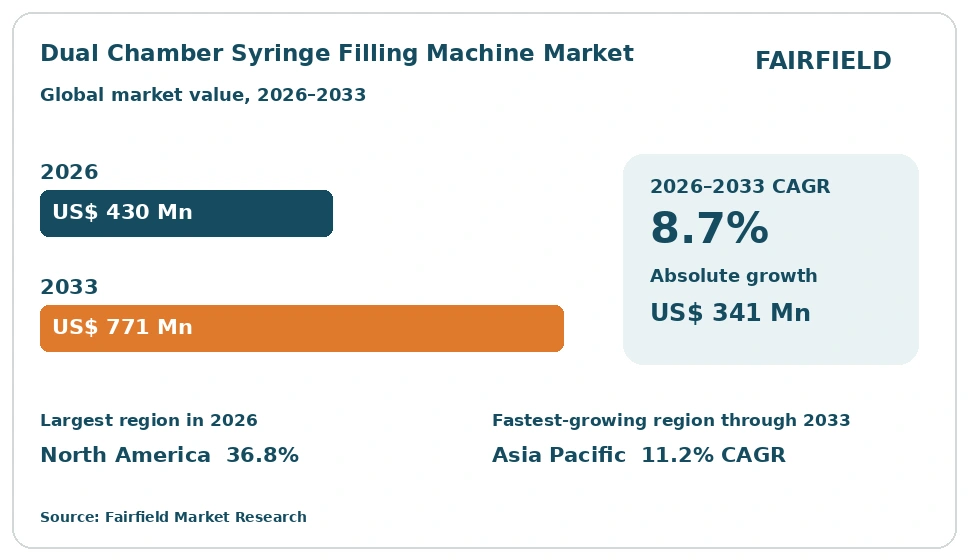
The global Dual Chamber Syringe Filling Machine market size is expected to be valued at US$ 430 Mn in 2026 and projected to reach US$ 771 Mn by 2033, growing at a CAGR of 8.7% between 2026 and 2033. Growth is anchored in the shift toward lyophilised biologics that must stay separate from their diluent until the moment of use. Dual-chamber syringes and cartridges solve that problem, and pharmaceutical manufacturers need aseptic machines that fill powder and liquid on one line. Demand is further lifted by self-administration, which pushes drug makers toward ready-to-reconstitute presentations. Between 2020 and 2025 the market grew at a 6.4% CAGR, and the absolute dollar opportunity stands at US$ 341 Mn.
Key Report Takeaways
- By Machine Type: Fully automatic systems led with 58.4% share in 2026, while semi-automatic platforms are projected to expand at a 9.9% CAGR through 2033, driven by contract manufacturers running small clinical batches across frequent product changeovers.
- By Container Format: Dual-chamber syringes held 61.7% share in 2026, while dual-chamber cartridges are set to grow at a 10.4% CAGR through 2033, driven by pen injectors and autoinjectors built around reconstituted biologic doses.
- By Filling Technology: Rotary piston dosing led with 38.6% share in 2026, while peristaltic systems are projected to advance at a 10.6% CAGR through 2033, driven by single-use fluid paths that remove cleaning validation between batches.
- By End User: Pharmaceutical and biopharmaceutical companies accounted for 56.2% share in 2026, while CDMOs are forecast to expand at a 10.8% CAGR through 2033, driven by sponsors outsourcing sterile fill-finish for complex combination products.
- By Region: North America led with 36.8% share in 2026, while Asia Pacific is projected to grow at an 11.2% CAGR through 2033; Europe, Latin America, and Middle East & Africa add demand from steady sterile capacity upgrades.
Market Trends and Insights
Market Growth Drivers
Expanding Lyophilised Biologic Pipelines Lift Dual-Chamber Filling Demand
Dual-chamber filling demand rises with the number of drugs that cannot sit in solution. Many monoclonal antibodies, peptides, and vaccines degrade in water, so they are freeze-dried and reconstituted at the point of care. A dual-chamber syringe holds that powder in one compartment and sterile diluent in the other, which removes vial transfer steps for the patient. Each new lyophilised candidate entering late-stage development therefore creates demand for a combined powder-and-liquid aseptic line.
The underlying trend is a biologics pipeline that keeps widening beyond oncology into immunology and metabolic disease. Drug developers increasingly fix the final presentation early, because the container shapes stability studies and regulatory filings. Equipment builders have responded with platforms that integrate lyophilisation handling, powder dosing, bypass plunger placement, and liquid filling under one barrier system. Pharmaceutical manufacturers and CDMOs are consequently specifying dual-chamber capability in new sterile suites rather than retrofitting it later.
Self-Administration and Home Care Favour Ready-to-Reconstitute Formats
Self-administration lifts equipment demand because it changes what a finished drug must look like. When patients dose themselves at home, a separate vial, syringe, and mixing step becomes a safety risk. Dual-chamber presentations compress reconstitution into a single device action, so drug makers choose them for chronic therapies. That choice moves the filling burden back to the manufacturer, which must buy machines able to handle powder and diluent aseptically on the same line.
Health systems in developed markets continue to shift injectable care out of hospitals to control cost and free capacity. Payers and providers favour presentations that reduce nursing time and dosing error, and regulators such as the FDA and the EMA expect human factors evidence for any device a patient operates. Dual-chamber syringes and cartridges answer both pressures at once. Manufacturers are adding dedicated dual-chamber lines rather than adapting standard liquid fillers.
Restraints Impact Analysis of Market
High Capital Cost and Long Validation Timelines Slow Adoption
High capital cost limits how quickly dual-chamber filling capacity can be added. A dual-chamber line combines powder dosing, liquid filling, bypass plunger insertion, and often a restricted access barrier or isolator. That bundle costs far more than a conventional single-chamber syringe filler, and the equipment is only part of the spend. Facility changes, utilities, and qualification work follow, so smaller manufacturers delay purchases or outsource the step instead of investing.
Validation timelines extend the problem. Aseptic lines must pass installation, operational, and performance qualification, then media fill runs that prove sterility under routine conditions. Good manufacturing practice frameworks applied by the FDA and the EMA require that evidence before commercial supply begins. For a dual-chamber format the burden is heavier, because two separate fill paths and the bypass mechanism each need proof. Projects therefore run long, and capital committees weigh that delay against faster single-chamber alternatives.
Powder Dosing Accuracy and Bypass Assembly Add Technical Risk
Technical complexity caps output and restrains revenue growth per machine. Powder dosing behaves differently from liquid filling, because lyophilised cake and bulk powder vary in density and flow. Achieving tight fill weight on small doses while holding sterility slows the machine down. Bypass plunger placement adds a further mechanical step that must be precise, since a misplaced plunger ruins the device. Lines therefore run slower than comparable single-chamber fillers, which weakens the cost case.
The wider industry issue is a shortage of operators and engineers who understand both aseptic processing and precision assembly. Dual-chamber containers are supplied by a narrow group of glass and polymer makers, so tolerance variation between lots reaches the filling line directly. Machine builders answer with in-process weight checks, camera inspection, and servo-driven assembly, yet each addition raises cost and maintenance load. Qualified staffing and component consistency remain practical limits on faster adoption.
Market Opportunities
Robotic Gloveless Isolator Platforms Open a New Replacement Cycle
Robotic, gloveless isolator platforms create a new revenue line for equipment builders. Removing glove ports removes the largest single source of contamination risk in aseptic filling. Robot arms handle nests of pre-sterilised dual-chamber syringes, perform the fill, place the bypass plunger, and stopper the container without human intervention. Manufacturers replacing older barrier lines are therefore buying capability rather than capacity, which supports premium pricing and recurring service contracts.
Revised aseptic processing expectations from the FDA and the EMA place contamination control strategy at the centre of sterile manufacturing. That emphasis favours closed, automated systems over open manual operations. Ready-to-use nested containers have matured in parallel, so a single compact machine can now fill several formats with only a change part. Small-batch biologics, cell therapies, and clinical supply all benefit, opening dual-chamber filling to sites that previously lacked the scale to justify it.
Contract Manufacturing Expansion Creates Fresh Equipment Demand
Contract manufacturing expansion opens the largest near-term equipment opportunity. Sponsors increasingly hand sterile fill-finish to CDMOs, and those providers compete on the formats they can offer. Dual-chamber capability is still scarce, so adding it wins work that rivals cannot take. CDMOs also buy flexible machines that run several container formats, which raises the value of each order. Equipment suppliers that package validation support, change parts, and training alongside the machine capture more of that spend.
Sterile capacity is being built fastest in Asia Pacific, where governments back domestic biologics manufacturing and local firms move into complex injectables. Greenfield sites install current-generation isolator lines rather than inheriting older equipment, so they adopt dual-chamber capability from the start. European and North American CDMOs are meanwhile upgrading to defend high-value programmes. Both patterns point to sustained orders through the forecast period rather than a single replacement wave.
Category-wise Insights
Which Machine Type Holds the Largest Market Share?
Fully automatic systems hold the largest share, at 58.4% in 2026, because commercial sterile production needs continuous, closed operation. These lines integrate nest handling, powder dosing, liquid filling, bypass plunger placement, and capping under a barrier system, which keeps human intervention to a minimum. Semi-automatic platforms are the fastest-growing type, advancing at a 9.9% CAGR through 2033. Their appeal sits with contract manufacturers and clinical supply units that run small, frequent batches and cannot justify a dedicated commercial line. Manual and benchtop units remain confined to development laboratories. The split matters because it shows the market widening rather than simply scaling. Large manufacturers keep buying high-output automated lines, while a second tier of smaller buyers enters through flexible, lower-cost equipment. Suppliers able to serve both tiers from one technology platform gain the broadest addressable base.
Dual-Chamber Syringes Lead Volume as Cartridges Scale with Pen Injectors
Dual-chamber syringes account for 61.7% of revenue in 2026, reflecting their established use in reconstituted biologics and emergency injectables. The format is familiar to clinicians, supported by mature glass and polymer supply, and straightforward to fill on nested lines. Dual-chamber cartridges grow fastest, at a 10.4% CAGR through 2033, because pen injectors and autoinjectors need a cartridge rather than a staked-needle syringe. Growth hormone, fertility, and newer peptide therapies drive that shift, since patients dose repeatedly and value a device that mixes automatically. Dual-chamber vials hold a smaller position in hospital settings. For equipment buyers the implication is clear. A line restricted to syringes risks early obsolescence, so format flexibility and quick change parts have become central purchasing criteria rather than optional extras.
Rotary Piston Dosing Leads While Single-Use Peristaltic Systems Gain Ground
Rotary piston dosing leads with 38.6% share in 2026, because it delivers the repeatable accuracy that small injectable volumes demand. Pumps are robust, well understood by validation teams, and effective across a wide viscosity range. Peristaltic systems grow fastest, at a 10.6% CAGR through 2033, driven by disposable fluid paths that arrive pre-sterilised. Single-use tubing removes cleaning and cleaning validation between products, which suits multi-product sites and shortens changeover. Powder dosing modules, using auger or vacuum drum principles, remain essential for the lyophilised chamber, while time-pressure filling serves higher-volume diluent duties. The direction of travel favours low-shear, contact-free handling, because biologics are sensitive to mechanical stress. Vendors combining single-use liquid paths with precise powder dosing in one frame are best placed as pipelines shift toward sensitive molecules.
Which End User Is Growing Fastest in Dual-Chamber Filling?
Contract development and manufacturing organisations grow fastest, at a 10.8% CAGR through 2033, as sponsors outsource sterile fill-finish for complex combination products. CDMOs invest to differentiate, and dual-chamber capability is still uncommon enough to win programmes outright. Pharmaceutical and biopharmaceutical companies nevertheless remain the largest end user, holding 56.2% share in 2026, because flagship biologics are usually filled in-house to protect supply security and intellectual property. Research institutes and clinical supply units account for the remainder, buying smaller semi-automatic equipment. The pattern signals a two-speed market. Innovator companies anchor demand for high-output commercial lines, while CDMOs create a steady stream of orders for flexible systems. Equipment suppliers offering modular platforms, strong validation documentation, and responsive field service capture demand from both groups at once.
Geography Analysis
Which Region Is Leading the Dual Chamber Syringe Filling Machine Market?
North America leads the market with 36.8% share in 2026. The United States concentrates biologics innovation, and most lyophilised products reaching approval are developed or commercialised there, so dual-chamber capacity follows the pipeline. Large sterile fill-finish investments across the country have added isolator-based suites intended for combination products rather than plain vials. Canada contributes through specialist contract sites. Regulatory expectation is a second factor. The FDA applies strict contamination control standards, which pushes operators toward closed, automated equipment and shortens replacement cycles for older barrier lines. Reimbursement for home-administered injectables further supports device-based presentations, giving manufacturers a commercial reason to adopt dual-chamber formats early.
Europe Sustains Demand Through Established Sterile Manufacturing Clusters
Europe holds 31.4% share in 2026, supported by deep sterile manufacturing clusters in Germany, Switzerland, Italy, and Ireland. The region hosts many of the world’s leading aseptic filling machine builders, so technology development and equipment supply sit close together. Demand comes from both innovator sites and large contract manufacturers serving global sponsors. European expectations for contamination control strategy have prompted systematic upgrades from open restricted access barriers to full isolators, and the EMA reinforces that direction. Growth is steady rather than rapid, because the installed base is already comparatively modern. Replacement projects and format-flexibility upgrades, not greenfield capacity, drive most European orders.
Which Region Is Growing Fastest in the Dual Chamber Syringe Filling Machine Market?
Asia Pacific grows fastest, at an 11.2% CAGR through 2033, from a 23.1% share in 2026. China, India, South Korea, and Japan are all expanding sterile injectable capacity, and governments actively support domestic biologics manufacturing. New sites specify current-generation isolator equipment from the start, so they adopt dual-chamber capability without a retrofit penalty. Indian and Chinese contract manufacturers are moving beyond generic vials into devices and combination products, which requires exactly this machinery. Rising chronic disease prevalence and wider insurance coverage lift domestic injectable demand at the same time. Export ambition adds pressure to meet FDA and EMA standards, which favours fully automated lines.
Latin America Builds Local Sterile Capacity From a Small Base
Latin America accounts for 5.2% share in 2026, with activity concentrated in Brazil, Mexico, and Argentina. Public health programmes and local production policies encourage domestic filling of injectables, including biosimilars reaching the region. Investment is selective, because capital is scarce and most sites begin with conventional liquid filling before adding dual-chamber capability. Semi-automatic equipment is common, since batch sizes are modest. Regulatory modernisation by national health agencies raises the standard expected for aseptic processing, which gradually pushes operators toward barrier systems. Growth is steady, and the base is small enough that a single large contract manufacturing investment can shift regional demand noticeably.
Middle East & Africa Demand Follows Pharmaceutical Localisation Programmes
Middle East & Africa holds 3.5% share in 2026, the smallest regional position. Demand is driven by localisation policy, particularly in Saudi Arabia, the United Arab Emirates, and Egypt, where governments fund domestic pharmaceutical manufacturing to reduce import dependence. South Africa provides additional sterile capacity for the sub-Saharan market. New facilities are often built to international standards, so they install isolator-based lines directly. Adoption of dual-chamber formats remains early, because most local output is generic liquid injectables. Skilled aseptic staffing and validation expertise are the main constraints, and partnerships with established equipment builders are the usual route to closing that gap.
Competitive Landscape
The dual chamber syringe filling machine market is moderately concentrated. A small group of European engineering firms supplies most high-output aseptic lines, supported by specialist builders serving small-batch and clinical work. Barriers to entry are high, because buyers demand proven sterility performance, complete validation documentation, and service support measured in decades rather than years. Asian manufacturers have grown by serving domestic capacity expansion and now compete on export projects, which is slowly broadening the supplier base without displacing established positions.
Competition centres on contamination control, dosing accuracy, and flexibility. Vendors differentiate through isolator integration, gloveless robotic handling, single-use fluid paths, and in-process weight verification on every unit. Format flexibility matters as much as speed, since buyers want one frame to run syringes, cartridges, and vials using change parts. Digital capability has become a further axis of competition, with recipe management, electronic batch records, and remote diagnostics increasingly treated as standard rather than optional. New entrants tend to arrive through robotics and single-use technology rather than traditional machine building.
Strategic activity follows those themes. Equipment builders expand through acquisitions that add barrier, inspection, or device assembly expertise, and through partnerships with container and nest suppliers that make ready-to-use formats easier to adopt. Several have invested in local service and technology centres to shorten qualification support in growth markets. Product development concentrates on compact, modular platforms aimed at small-batch biologics and clinical supply. The common direction is clear. Suppliers are selling validated, connected processes rather than standalone machines, and the firms that most reduce a customer’s time to commercial supply hold the strongest competitive footing.
Industry Leaders
- Syntegon Technology GmbH
- OPTIMA packaging group GmbH
- IMA S.p.A.
- Groninger & Co. GmbH
- Bausch+Ströbel Maschinenfabrik Ilshofen GmbH + Co. KG
- Steriline S.r.l.
Companies Covered in the Report
- Syntegon Technology GmbH
- OPTIMA packaging group GmbH
- IMA S.p.A.
- Groninger & Co. GmbH
- Bausch+Ströbel Maschinenfabrik Ilshofen GmbH + Co. KG
- Steriline S.r.l.
- Marchesini Group S.p.A.
- Romaco Group
- Cytiva
- Dara Pharmaceutical Packaging S.L.
- Truking Technology Limited
- Tofflon Science and Technology Group Co., Ltd.
Dual Chamber Syringe Filling Machine Market Report Scope
Fairfield Market Research segments the dual chamber syringe filling machine market across four categories and five regions.
| By Machine Type | Fully Automatic, Semi-Automatic, Manual and Benchtop |
| By Container Format | Dual-Chamber Syringes, Dual-Chamber Cartridges, Dual-Chamber Vials |
| By Filling Technology | Rotary Piston Dosing, Peristaltic Filling, Powder Dosing, Time-Pressure Filling |
| By End User | Pharmaceutical and Biopharmaceutical Companies, Contract Development and Manufacturing Organisations, Research Institutes and Clinical Supply Units |
| By Region | North America, Europe, Asia Pacific, Latin America, Middle East & Africa |
1. Executive Summary
1.1 Global Dual Chamber Syringe Filling Machine Market Snapshot
1.2 Future Projections, 2026–2033
1.3 Key Industry Highlights
1.4 Regional Snapshot
2. Market Overview
2.1 Market Definition and Report Scope
2.2 Historical Market Trends
2.3 Market Dynamics
2.3.1 Drivers
2.3.1.1 Expanding Lyophilised Biologic Pipelines Lift Dual-Chamber Filling Demand
2.3.1.2 Self-Administration and Home Care Favour Ready-to-Reconstitute Formats
2.3.2 Restraints
2.3.2.1 High Capital Cost and Long Validation Timelines Slow Adoption
2.3.2.2 Powder Dosing Accuracy and Bypass Assembly Add Technical Risk
2.3.3 Market Opportunities
2.3.3.1 Robotic Gloveless Isolator Platforms Open a New Replacement Cycle
2.3.3.2 Contract Manufacturing Expansion Creates Fresh Equipment Demand
3. Global Dual Chamber Syringe Filling Machine Market Outlook, 2026–2033
3.1 Global Dual Chamber Syringe Filling Machine Market Outlook, by Machine Type, Value (US$ Mn), 2026–2033
3.1.1 Fully Automatic
3.1.2 Semi-Automatic
3.1.3 Manual and Benchtop
3.2 Global Dual Chamber Syringe Filling Machine Market Outlook, by Container Format, Value (US$ Mn), 2026–2033
3.2.1 Dual-Chamber Syringes
3.2.2 Dual-Chamber Cartridges
3.2.3 Dual-Chamber Vials
3.3 Global Dual Chamber Syringe Filling Machine Market Outlook, by Filling Technology, Value (US$ Mn), 2026–2033
3.3.1 Rotary Piston Dosing
3.3.2 Peristaltic Filling
3.3.3 Powder Dosing
3.3.4 Time-Pressure Filling
3.4 Global Dual Chamber Syringe Filling Machine Market Outlook, by End User, Value (US$ Mn), 2026–2033
3.4.1 Pharmaceutical and Biopharmaceutical Companies
3.4.2 Contract Development and Manufacturing Organisations
3.4.3 Research Institutes and Clinical Supply Units
3.5 Global Dual Chamber Syringe Filling Machine Market Outlook, by Region, Value (US$ Mn), 2026–2033
3.5.1 North America
3.5.2 Europe
3.5.3 Asia Pacific
3.5.4 Latin America
3.5.5 Middle East & Africa
4. North America Dual Chamber Syringe Filling Machine Market Outlook, 2026–2033
4.1 North America Dual Chamber Syringe Filling Machine Market Outlook, by Machine Type, Value (US$ Mn), 2026–2033
4.1.1 Fully Automatic
4.1.2 Semi-Automatic
4.1.3 Manual and Benchtop
4.2 North America Dual Chamber Syringe Filling Machine Market Outlook, by Container Format, Value (US$ Mn), 2026–2033
4.2.1 Dual-Chamber Syringes
4.2.2 Dual-Chamber Cartridges
4.2.3 Dual-Chamber Vials
4.3 North America Dual Chamber Syringe Filling Machine Market Outlook, by Filling Technology, Value (US$ Mn), 2026–2033
4.3.1 Rotary Piston Dosing
4.3.2 Peristaltic Filling
4.3.3 Powder Dosing
4.3.4 Time-Pressure Filling
4.4 North America Dual Chamber Syringe Filling Machine Market Outlook, by End User, Value (US$ Mn), 2026–2033
4.4.1 Pharmaceutical and Biopharmaceutical Companies
4.4.2 Contract Development and Manufacturing Organisations
4.4.3 Research Institutes and Clinical Supply Units
4.5 North America Dual Chamber Syringe Filling Machine Market Outlook, by Country, Value (US$ Mn), 2026–2033
4.5.1 United States Dual Chamber Syringe Filling Machine Market Outlook, by Machine Type, 2026–2033
4.5.2 United States Dual Chamber Syringe Filling Machine Market Outlook, by Container Format, 2026–2033
4.5.3 United States Dual Chamber Syringe Filling Machine Market Outlook, by Filling Technology, 2026–2033
4.5.4 United States Dual Chamber Syringe Filling Machine Market Outlook, by End User, 2026–2033
4.5.5 Canada Dual Chamber Syringe Filling Machine Market Outlook, by Machine Type, 2026–2033
4.5.6 Canada Dual Chamber Syringe Filling Machine Market Outlook, by Container Format, 2026–2033
4.5.7 Canada Dual Chamber Syringe Filling Machine Market Outlook, by Filling Technology, 2026–2033
4.5.8 Canada Dual Chamber Syringe Filling Machine Market Outlook, by End User, 2026–2033
5. Europe Dual Chamber Syringe Filling Machine Market Outlook, 2026–2033
5.1 Europe Dual Chamber Syringe Filling Machine Market Outlook, by Machine Type, Value (US$ Mn), 2026–2033
5.1.1 Fully Automatic
5.1.2 Semi-Automatic
5.1.3 Manual and Benchtop
5.2 Europe Dual Chamber Syringe Filling Machine Market Outlook, by Container Format, Value (US$ Mn), 2026–2033
5.2.1 Dual-Chamber Syringes
5.2.2 Dual-Chamber Cartridges
5.2.3 Dual-Chamber Vials
5.3 Europe Dual Chamber Syringe Filling Machine Market Outlook, by Filling Technology, Value (US$ Mn), 2026–2033
5.3.1 Rotary Piston Dosing
5.3.2 Peristaltic Filling
5.3.3 Powder Dosing
5.3.4 Time-Pressure Filling
5.4 Europe Dual Chamber Syringe Filling Machine Market Outlook, by End User, Value (US$ Mn), 2026–2033
5.4.1 Pharmaceutical and Biopharmaceutical Companies
5.4.2 Contract Development and Manufacturing Organisations
5.4.3 Research Institutes and Clinical Supply Units
5.5 Europe Dual Chamber Syringe Filling Machine Market Outlook, by Country, Value (US$ Mn), 2026–2033
5.5.1 Germany Dual Chamber Syringe Filling Machine Market Outlook, by Machine Type, 2026–2033
5.5.2 Germany Dual Chamber Syringe Filling Machine Market Outlook, by Container Format, 2026–2033
5.5.3 Germany Dual Chamber Syringe Filling Machine Market Outlook, by Filling Technology, 2026–2033
5.5.4 Germany Dual Chamber Syringe Filling Machine Market Outlook, by End User, 2026–2033
5.5.5 Switzerland Dual Chamber Syringe Filling Machine Market Outlook, by Machine Type, 2026–2033
5.5.6 Switzerland Dual Chamber Syringe Filling Machine Market Outlook, by Container Format, 2026–2033
5.5.7 Switzerland Dual Chamber Syringe Filling Machine Market Outlook, by Filling Technology, 2026–2033
5.5.8 Switzerland Dual Chamber Syringe Filling Machine Market Outlook, by End User, 2026–2033
5.5.9 Italy Dual Chamber Syringe Filling Machine Market Outlook, by Machine Type, 2026–2033
5.5.10 Italy Dual Chamber Syringe Filling Machine Market Outlook, by Container Format, 2026–2033
5.5.11 Italy Dual Chamber Syringe Filling Machine Market Outlook, by Filling Technology, 2026–2033
5.5.12 Italy Dual Chamber Syringe Filling Machine Market Outlook, by End User, 2026–2033
5.5.13 Ireland Dual Chamber Syringe Filling Machine Market Outlook, by Machine Type, 2026–2033
5.5.14 Ireland Dual Chamber Syringe Filling Machine Market Outlook, by Container Format, 2026–2033
5.5.15 Ireland Dual Chamber Syringe Filling Machine Market Outlook, by Filling Technology, 2026–2033
5.5.16 Ireland Dual Chamber Syringe Filling Machine Market Outlook, by End User, 2026–2033
6. Asia Pacific Dual Chamber Syringe Filling Machine Market Outlook, 2026–2033
6.1 Asia Pacific Dual Chamber Syringe Filling Machine Market Outlook, by Machine Type, Value (US$ Mn), 2026–2033
6.1.1 Fully Automatic
6.1.2 Semi-Automatic
6.1.3 Manual and Benchtop
6.2 Asia Pacific Dual Chamber Syringe Filling Machine Market Outlook, by Container Format, Value (US$ Mn), 2026–2033
6.2.1 Dual-Chamber Syringes
6.2.2 Dual-Chamber Cartridges
6.2.3 Dual-Chamber Vials
6.3 Asia Pacific Dual Chamber Syringe Filling Machine Market Outlook, by Filling Technology, Value (US$ Mn), 2026–2033
6.3.1 Rotary Piston Dosing
6.3.2 Peristaltic Filling
6.3.3 Powder Dosing
6.3.4 Time-Pressure Filling
6.4 Asia Pacific Dual Chamber Syringe Filling Machine Market Outlook, by End User, Value (US$ Mn), 2026–2033
6.4.1 Pharmaceutical and Biopharmaceutical Companies
6.4.2 Contract Development and Manufacturing Organisations
6.4.3 Research Institutes and Clinical Supply Units
6.5 Asia Pacific Dual Chamber Syringe Filling Machine Market Outlook, by Country, Value (US$ Mn), 2026–2033
6.5.1 China Dual Chamber Syringe Filling Machine Market Outlook, by Machine Type, 2026–2033
6.5.2 China Dual Chamber Syringe Filling Machine Market Outlook, by Container Format, 2026–2033
6.5.3 China Dual Chamber Syringe Filling Machine Market Outlook, by Filling Technology, 2026–2033
6.5.4 China Dual Chamber Syringe Filling Machine Market Outlook, by End User, 2026–2033
6.5.5 India Dual Chamber Syringe Filling Machine Market Outlook, by Machine Type, 2026–2033
6.5.6 India Dual Chamber Syringe Filling Machine Market Outlook, by Container Format, 2026–2033
6.5.7 India Dual Chamber Syringe Filling Machine Market Outlook, by Filling Technology, 2026–2033
6.5.8 India Dual Chamber Syringe Filling Machine Market Outlook, by End User, 2026–2033
6.5.9 South Korea Dual Chamber Syringe Filling Machine Market Outlook, by Machine Type, 2026–2033
6.5.10 South Korea Dual Chamber Syringe Filling Machine Market Outlook, by Container Format, 2026–2033
6.5.11 South Korea Dual Chamber Syringe Filling Machine Market Outlook, by Filling Technology, 2026–2033
6.5.12 South Korea Dual Chamber Syringe Filling Machine Market Outlook, by End User, 2026–2033
6.5.13 Japan Dual Chamber Syringe Filling Machine Market Outlook, by Machine Type, 2026–2033
6.5.14 Japan Dual Chamber Syringe Filling Machine Market Outlook, by Container Format, 2026–2033
6.5.15 Japan Dual Chamber Syringe Filling Machine Market Outlook, by Filling Technology, 2026–2033
6.5.16 Japan Dual Chamber Syringe Filling Machine Market Outlook, by End User, 2026–2033
7. Latin America Dual Chamber Syringe Filling Machine Market Outlook, 2026–2033
7.1 Latin America Dual Chamber Syringe Filling Machine Market Outlook, by Machine Type, Value (US$ Mn), 2026–2033
7.1.1 Fully Automatic
7.1.2 Semi-Automatic
7.1.3 Manual and Benchtop
7.2 Latin America Dual Chamber Syringe Filling Machine Market Outlook, by Container Format, Value (US$ Mn), 2026–2033
7.2.1 Dual-Chamber Syringes
7.2.2 Dual-Chamber Cartridges
7.2.3 Dual-Chamber Vials
7.3 Latin America Dual Chamber Syringe Filling Machine Market Outlook, by Filling Technology, Value (US$ Mn), 2026–2033
7.3.1 Rotary Piston Dosing
7.3.2 Peristaltic Filling
7.3.3 Powder Dosing
7.3.4 Time-Pressure Filling
7.4 Latin America Dual Chamber Syringe Filling Machine Market Outlook, by End User, Value (US$ Mn), 2026–2033
7.4.1 Pharmaceutical and Biopharmaceutical Companies
7.4.2 Contract Development and Manufacturing Organisations
7.4.3 Research Institutes and Clinical Supply Units
7.5 Latin America Dual Chamber Syringe Filling Machine Market Outlook, by Country, Value (US$ Mn), 2026–2033
7.5.1 Brazil Dual Chamber Syringe Filling Machine Market Outlook, by Machine Type, 2026–2033
7.5.2 Brazil Dual Chamber Syringe Filling Machine Market Outlook, by Container Format, 2026–2033
7.5.3 Brazil Dual Chamber Syringe Filling Machine Market Outlook, by Filling Technology, 2026–2033
7.5.4 Brazil Dual Chamber Syringe Filling Machine Market Outlook, by End User, 2026–2033
7.5.5 Mexico Dual Chamber Syringe Filling Machine Market Outlook, by Machine Type, 2026–2033
7.5.6 Mexico Dual Chamber Syringe Filling Machine Market Outlook, by Container Format, 2026–2033
7.5.7 Mexico Dual Chamber Syringe Filling Machine Market Outlook, by Filling Technology, 2026–2033
7.5.8 Mexico Dual Chamber Syringe Filling Machine Market Outlook, by End User, 2026–2033
7.5.9 Argentina Dual Chamber Syringe Filling Machine Market Outlook, by Machine Type, 2026–2033
7.5.10 Argentina Dual Chamber Syringe Filling Machine Market Outlook, by Container Format, 2026–2033
7.5.11 Argentina Dual Chamber Syringe Filling Machine Market Outlook, by Filling Technology, 2026–2033
7.5.12 Argentina Dual Chamber Syringe Filling Machine Market Outlook, by End User, 2026–2033
8. Middle East & Africa Dual Chamber Syringe Filling Machine Market Outlook, 2026–2033
8.1 Middle East & Africa Dual Chamber Syringe Filling Machine Market Outlook, by Machine Type, Value (US$ Mn), 2026–2033
8.1.1 Fully Automatic
8.1.2 Semi-Automatic
8.1.3 Manual and Benchtop
8.2 Middle East & Africa Dual Chamber Syringe Filling Machine Market Outlook, by Container Format, Value (US$ Mn), 2026–2033
8.2.1 Dual-Chamber Syringes
8.2.2 Dual-Chamber Cartridges
8.2.3 Dual-Chamber Vials
8.3 Middle East & Africa Dual Chamber Syringe Filling Machine Market Outlook, by Filling Technology, Value (US$ Mn), 2026–2033
8.3.1 Rotary Piston Dosing
8.3.2 Peristaltic Filling
8.3.3 Powder Dosing
8.3.4 Time-Pressure Filling
8.4 Middle East & Africa Dual Chamber Syringe Filling Machine Market Outlook, by End User, Value (US$ Mn), 2026–2033
8.4.1 Pharmaceutical and Biopharmaceutical Companies
8.4.2 Contract Development and Manufacturing Organisations
8.4.3 Research Institutes and Clinical Supply Units
8.5 Middle East & Africa Dual Chamber Syringe Filling Machine Market Outlook, by Country, Value (US$ Mn), 2026–2033
8.5.1 Saudi Arabia Dual Chamber Syringe Filling Machine Market Outlook, by Machine Type, 2026–2033
8.5.2 Saudi Arabia Dual Chamber Syringe Filling Machine Market Outlook, by Container Format, 2026–2033
8.5.3 Saudi Arabia Dual Chamber Syringe Filling Machine Market Outlook, by Filling Technology, 2026–2033
8.5.4 Saudi Arabia Dual Chamber Syringe Filling Machine Market Outlook, by End User, 2026–2033
8.5.5 United Arab Emirates Dual Chamber Syringe Filling Machine Market Outlook, by Machine Type, 2026–2033
8.5.6 United Arab Emirates Dual Chamber Syringe Filling Machine Market Outlook, by Container Format, 2026–2033
8.5.7 United Arab Emirates Dual Chamber Syringe Filling Machine Market Outlook, by Filling Technology, 2026–2033
8.5.8 United Arab Emirates Dual Chamber Syringe Filling Machine Market Outlook, by End User, 2026–2033
8.5.9 Egypt Dual Chamber Syringe Filling Machine Market Outlook, by Machine Type, 2026–2033
8.5.10 Egypt Dual Chamber Syringe Filling Machine Market Outlook, by Container Format, 2026–2033
8.5.11 Egypt Dual Chamber Syringe Filling Machine Market Outlook, by Filling Technology, 2026–2033
8.5.12 Egypt Dual Chamber Syringe Filling Machine Market Outlook, by End User, 2026–2033
8.5.13 South Africa Dual Chamber Syringe Filling Machine Market Outlook, by Machine Type, 2026–2033
8.5.14 South Africa Dual Chamber Syringe Filling Machine Market Outlook, by Container Format, 2026–2033
8.5.15 South Africa Dual Chamber Syringe Filling Machine Market Outlook, by Filling Technology, 2026–2033
8.5.16 South Africa Dual Chamber Syringe Filling Machine Market Outlook, by End User, 2026–2033
9. Competitive Landscape
9.1 Industry Leaders
9.2 Company Profiles
9.2.1 Syntegon Technology GmbH
9.2.2 OPTIMA packaging group GmbH
9.2.3 IMA S.p.A.
9.2.4 Groninger & Co. GmbH
9.2.5 Bausch+Ströbel Maschinenfabrik Ilshofen GmbH + Co. KG
9.2.6 Steriline S.r.l.
9.2.7 Marchesini Group S.p.A.
9.2.8 Romaco Group
9.2.9 Cytiva
9.2.10 Dara Pharmaceutical Packaging S.L.
9.2.11 Truking Technology Limited
9.2.12 Tofflon Science and Technology Group Co., Ltd.
10. Appendix
10.1 Research Methodology
10.2 Report Assumptions
10.3 Acronyms and Abbreviations
| By Machine Type | Fully Automatic, Semi-Automatic, Manual and Benchtop |
| By Container Format | Dual-Chamber Syringes, Dual-Chamber Cartridges, Dual-Chamber Vials |
| By Filling Technology | Rotary Piston Dosing, Peristaltic Filling, Powder Dosing, Time-Pressure Filling |
| By End User | Pharmaceutical and Biopharmaceutical Companies, Contract Development and Manufacturing Organisations, Research Institutes and Clinical Supply Units |
| By Region | North America, Europe, Asia Pacific, Latin America, Middle East & Africa |
Our Research Methodology
Considering the volatility of business today, traditional approaches to strategizing a game plan can be unfruitful if not detrimental. True ambiguity is no way to determine a forecast. A myriad of predetermined factors must be accounted for such as the degree of risk involved, the magnitude of circumstances, as well as conditions or consequences that are not known or unpredictable. To circumvent binary views that cast uncertainty, the application of market research intelligence to strategically posture, move, and enable actionable outcomes is necessary.
View Methodology
Quality Assured
Rigorous Validation Process

Confidentiality Assured
End-to-end Data Security

Custom Research Services
Tailored To Your Objectives
FAQs
The market is valued at US$ 430 Mn in 2026 and is projected to reach US$ 771 Mn by 2033, reflecting steady aseptic equipment demand.
The market is expected to grow at an 8.7% CAGR between 2026 and 2033, adding an absolute dollar opportunity of US$ 341 Mn.
Fully automatic machines lead with 58.4% share in 2026, while semi-automatic systems grow fastest at a 9.9% CAGR through 2033 across clinical batch production.
North America leads with 36.8% share in 2026, while Asia Pacific grows fastest at an 11.2% CAGR through 2033 on new sterile capacity.
Key suppliers include Syntegon Technology GmbH, OPTIMA packaging group GmbH, IMA S.p.A., Groninger & Co. GmbH, Bausch+Ströbel, and Steriline S.r.l., among others.
Related Reports
Machine Automation Controller Market Size, Share, Insights, Competitive Landscape, and Forecast 2026 to 2033
The global machine automation controller market is valued at US$2.4 billion in 2026, reaching US$4.5 billion by 2033, growing at a 9.4% CAGR
Lined Valve Market Size, Share, Insights, Competitive Landscape, and Forecast 2026 to 2033
The global lined valve market is valued at US$2.8 billion in 2026, reaching US$4.1 billion by 2033, growing at a 5.6% CAGR
Hydraulic Intensifiers Market Size, Share, Insights, Competitive Landscape, and Forecast 2026 to 2033
The global hydraulic intensifiers market is valued at US$1.28 billion in 2026, reaching US$1.92 billion by 2033, growing at a 6.0% CAGR
CVD and CVI Vacuum Furnaces Market Size, Share, Insights, Competitive Landscape, and Forecast 2026 to 2033
The CVD and CVI vacuum furnaces market is projected to grow from US$1.24 billion in 2026 to US$2.04 billion by 2033 at a 7.4% CAGR.
Construction Bolts Market Size, Share, Insights, Competitive Landscape, and Forecast 2026 to 2033
The construction bolts market is projected to grow from US$9.6 billion in 2026 to US$13.9 billion by 2033 at a 5.4% CAGR.
Capping Machine Market Size, Share, Insights, Competitive Landscape, and Forecast 2026 to 2033
The capping machine market is projected to grow from US$3.4 billion in 2026 to US$4.9 billion by 2033 at a 5.4% CAGR.