



Machine Automation Controller Market
Machine Automation Controller Market Insights, Competitive Landscape, and Market Forecast 2033
Global Machine Automation Controller Market Forecast
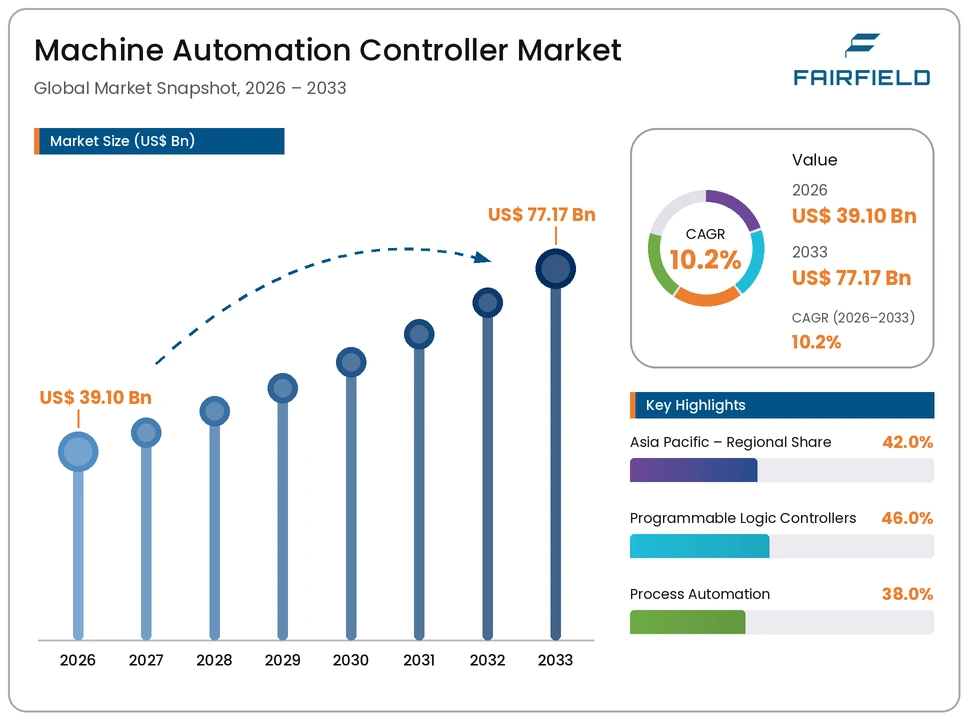
The global machine automation controller market is expected to be valued at US$ 39.10 Billion in 2026 and is projected to reach US$ 77.17 Billion by 2033, growing at a CAGR of 10.2% between 2026 and 2033. This trajectory follows a historical growth rate of 9.3% between 2020 and 2025, confirming an accelerating demand curve rather than a cyclical uptick. The International Federation of Robotics (IFR) reported in its 2024 World Robotics report that global robot installations reached a record 4.28 million operational units, each requiring sophisticated motion control and programmable logic infrastructure, directly expanding the addressable base for machine automation controllers. For OEM strategists and institutional investors, the compound effect of electrification, smart manufacturing mandates, and edge computing convergence makes this one of the most consequential industrial hardware markets through the decade.
Key Highlights
- Asia Pacific's 42% regional share and 12% CAGR make it the defining growth engine of the machine automation controller market through 2033.
- Programmable Logic Controllers command 46% of controller type revenue, underpinned by decades of installed-base loyalty across automotive and process industries; however, vendors that fail to embed OPC-UA and TSN compatibility into their next PLC generation risk accelerated displacement by open-architecture IPC platforms before 2030.
- Robotics control is the fastest-growing application within the machine automation controller landscape, with collaborative robot deployments triggering fresh motion controller procurement cycles in light manufacturing and logistics.
- The U.S. CHIPS and Science Act is functioning as a direct demand catalyst for high-precision process automation controllers in semiconductor fabrication, with TSMC, Intel, and Samsung Electronics all commissioning new U.S. fabs requiring controller infrastructure specified to SEMI S2 and S8 safety standards.
- The convergence of edge AI inference with programmable automation controller hardware presents a US$ 38 billion incremental opportunity between 2026 and 2033, vendors that successfully bundle predictive maintenance analytics with controller hardware will command structurally higher margins and extend replacement cycle durations, reinforcing switching costs.
Key Growth Determinants
- Industrial Digitalisation Mandates and Smart Factory Rollouts
Governments and industry consortia are actively accelerating the transition to Industry 4.0 infrastructure, creating durable procurement cycles for programmable logic controllers, distributed control systems, and related automation hardware. The European Commission's Digital Compass policy targets 75% of EU enterprises adopting cloud, AI, or big data solutions by 2030, with connected manufacturing assets central to that ambition. This regulatory posture has prompted discrete equipment spending commitments from manufacturers including Volkswagen AG, which announced a €180 billion technology and decarbonisation investment plan through 2028, with automated production lines and controller-intensive body shop upgrades among the primary capital allocation categories. The resulting demand is not speculative; it is locked into capital expenditure pipelines that procurement teams are already executing.
Key Growth Barriers
- High Integration Complexity and Legacy System Compatibility
Deploying modern machine automation controllers into brownfield facilities requires engineering integration work that frequently exceeds the hardware cost itself. Older distributed control systems operating on proprietary fieldbus protocols, PROFIBUS, Modbus RTU, and DeviceNet, are not natively compatible with contemporary OPC-UA or TSN (Time-Sensitive Networking) communication standards. The NAMUR user association for process industries has documented that retrofitting legacy process plants with current-generation controllers can consume 30–50% of total automation project budgets in protocol conversion and commissioning alone. For mid-market manufacturers operating on thin margins, this cost structure creates material procurement hesitation, particularly when existing infrastructure remains operationally functional.
Market Opportunities
- Edge AI Integration and Intelligent Controller Architectures
The convergence of edge computing with industrial control hardware is creating a new product category that commands substantial price premiums over conventional PLCs. Controllers embedded with on-device inference engines can perform predictive maintenance, anomaly detection, and adaptive process optimisation without round-tripping data to centralised cloud infrastructure. NVIDIA Corporation launched its Jetson Orin industrial compute modules in 2023 specifically targeting machine builders requiring AI-capable edge control, and multiple automation OEMs have since integrated these modules into next-generation industrial PC and PAC platforms. For vendors positioned to deliver this capability, the addressable market expands beyond replacement cycles into net-new functionality that existing infrastructure cannot replicate.
Category-wise Insights
- Controller Type Analysis
Programmable Logic Controllers (PLC) account for 46.0% of the global machine automation controller market in 2026, equivalent to US$ 17.99 Billion. PLCs dominate because they represent the default automation hardware choice across decades of discrete manufacturing buildout, their deterministic scan-cycle execution, rugged form factor, and extensive trained installer base make them irreplaceable in applications from automotive body welding to bottling line sequencing. A automotive stamping plant deploying Siemens AG SIMATIC S7-1500 PLCs for press line synchronisation, or a beverage manufacturer using Allen-Bradley PLCs from Rockwell Automation for filler and capper control, typifies the installed-base loyalty that sustains PLC dominance.
Industrial PCs (IPC) are the fastest-growing controller type, propelled by demand for Windows- and Linux-based control environments capable of running complex vision algorithms, digital twin synchronisation, and multi-protocol communication simultaneously. Beckhoff Automation expanded its TwinCAT 3 IPC platform in 2023 to support real-time Ethernet and EtherCAT motion control within a standard PC architecture, accelerating IPC adoption among machine builders targeting semiconductor inspection and collaborative robotics applications.
- End-use Industry Analysis
The Automotive end-use segment accounts for 24.0% of the global machine automation controller market in 2026, equivalent to US$ 9.38 Billion. Automotive manufacturers operate among the most controller-intensive production environments in industry, a single final assembly line integrates hundreds of PLCs, motion controllers, and safety-rated PACs governing welding robots, conveyor sequencing, torque tool management, and end-of-line quality testing. The structural shift toward EV platforms, which require entirely new powertrain assembly cells, is sustaining abnormally high capex commitments from OEMs and tier-one suppliers alike, directly supporting continued automotive segment leadership.
Electronics & Semiconductor is the fastest-growing end-use segment, driven by the global semiconductor capacity expansion triggered by the U.S. CHIPS and Science Act (2022), which allocated US$ 52.7 billion to domestic semiconductor manufacturing. Wafer fabrication equipment, steppers, etch chambers, and CMP tools, requires extremely precise motion control and process automation controller integration. Taiwan Semiconductor Manufacturing Company (TSMC) and Intel Corporation are both commissioning new fabs in Arizona with controller infrastructure requirements that extend across the full automation stack.
- Application Analysis
Process Automation accounts for 38.0% of the global machine automation controller market in 2026, equivalent to US$ 14.86 Billion. Process industries, refining, petrochemicals, specialty chemicals, and pharmaceutical manufacturing, deploy distributed control systems and PACs as their command-and-control backbone, governing continuous flow processes where any unplanned interruption carries significant safety and economic consequences. An ExxonMobil refinery operating a Honeywell Experion PKS DCS to manage crude distillation column pressure and temperature loops, or a BASF SE chemical plant using controller-based advanced process control to optimise reactor yield, illustrates the mission-critical, long-lifecycle procurement pattern sustaining process automation leadership.
Robotics Control is the fastest-growing application segment as collaborative robot deployments surge across light manufacturing, logistics, and healthcare. Universal Robots, a subsidiary of Teradyne, Inc., reported cumulative cobot deployments exceeding 75,000 units globally by 2024, each requiring dedicated motion controller hardware. The ISO/TS 15066 standard governing collaborative robot safety has clarified force and speed limits, enabling broader deployment in human-shared workspaces and accelerating procurement across previously hesitant buyer segments.
Regional Insights
- North America Machine Automation Controller Market Trends and Insights
North America accounts for 27.0% of the global machine automation controller market in 2026, representing US$ 10.56 Billion. The region's automation investment cycle is being actively sustained by onshoring incentives, the U.S. Inflation Reduction Act (IRA) and CHIPS and Science Act together channelling hundreds of billions into domestic industrial capacity, much of which requires controller-dense automation infrastructure. North America's well-established systems integrator ecosystem and concentration of tier-one automotive OEMs reinforce its position as a structurally stable, high-value regional market.
United States Machine Automation Controller Market Size
The United States machine automation controller market represents 82.0% of the North America regional market in 2026, equivalent to US$ 8.66 Billion. Reshoring-driven greenfield factory construction, particularly in EV battery manufacturing and semiconductor fabrication, is the primary demand driver, creating fresh automation controller specifications unconstrained by legacy infrastructure. As these facilities ramp production through 2027–2028, aftermarket controller upgrades and capacity expansion projects will sustain procurement momentum beyond initial commissioning.
Canada Machine Automation Controller Market Size
The Canada machine automation controller market represents 18.0% of the North America regional market in 2026, equivalent to US$ 1.90 Billion. Demand is anchored in oil sands process automation and automotive assembly in Ontario, where Stellantis NV and Honda Motor Co. operate EV-retooled facilities requiring updated controller infrastructure. Ongoing investment in critical minerals processing, a Government of Canada strategic priority, is expected to incrementally expand the addressable market for process automation controllers through the forecast period.
- Asia Pacific Machine Automation Controller Market Trends and Insights
Asia Pacific accounts for 42.0% of the global machine automation controller market in 2026, representing US$ 16.42 Billion, and is the fastest-growing region at an estimated CAGR of 12%. China's Made in China 2025 initiative and South Korea's K-Semiconductor Strategy are driving state-backed investment into high-precision manufacturing, creating sustained procurement demand for advanced PLCs, IPCs, and PACs. The region's concentration of electronics contract manufacturers, automotive assembly, and process industry capacity positions it as the defining growth engine for the machine automation controller industry through 2033
China Machine Automation Controller Market Size
The China machine automation controller market represents 41.0% of the Asia Pacific regional market in 2026, equivalent to US$ 6.73 Billion. Domestic champions including INOVANCE Technology and Hollysys Automation Technologies are capturing an increasing share of PLC and DCS procurement as import substitution policies accelerate. State-directed investment in smart manufacturing parks, with over 2,500 certified national-level industrial internet platforms identified by China's Ministry of Industry and Information Technology (MIIT), will sustain controller demand well into the next decade.
India Machine Automation Controller Market Size
The India machine automation controller market represents 18.0% of the Asia Pacific regional market in 2026, equivalent to US$ 2.96 Billion. The Production Linked Incentive (PLI) scheme across electronics, pharmaceutical, and automotive sectors is incentivising greenfield manufacturing investment that defaults to contemporary automation controller architectures. As domestic contract electronics manufacturing scales, supported by Apple supplier relocations and semiconductor assembly investments, demand for motion control and factory automation controllers will expand well beyond current levels.
Japan Machine Automation Controller Market Size
The Japan machine automation controller market represents 22.0% of the Asia Pacific regional market in 2026, equivalent to US$ 3.61 Billion. Japan's machine automation controller landscape is shaped by deep domestic supplier integration, Mitsubishi Electric Corporation, Omron Corporation, and Keyence Corporation each maintain strong installed-base positions in domestic automotive and electronics manufacturing. Japan's Society of Automotive Engineers (JSAE) standardisation activity around connected manufacturing and its government's Green Innovation Fund targeting carbon-neutral production will sustain controller refresh cycles through the forecast period.
Competitive Landscape
The machine automation controller industry operates as a concentrated oligopoly at the premium tier, with Siemens AG, Rockwell Automation, ABB Ltd., and Schneider Electric SE collectively commanding an estimated majority of global revenue in high-complexity DCS and PAC categories. Competition below that tier is significantly more fragmented, with regional specialists, particularly Japanese vendors Mitsubishi Electric, Omron, and Yokogawa Electric Corporation, holding entrenched positions in their domestic markets and across Southeast Asian supply chains. The primary basis of competition is not price but ecosystem lock-in: proprietary engineering software platforms (Siemens TIA Portal, Rockwell Studio 5000), certified training networks, and multi-decade service agreements create switching costs that make displacing an incumbent controller architecture commercially prohibitive for most end-users. New entrants are competing primarily at the IPC and edge-AI controller tier, where open-architecture platforms reduce the software moat advantage of legacy vendors.
Companies Covered in Machine Automation Controller Market
- Siemens AG
- Schneider Electric SE
- ABB Ltd.
- Rockwell Automation
- Mitsubishi Electric Corporation
- Omron Corporation
- Emerson Electric Co.
- Honeywell International Inc.
- Yokogawa Electric Corporation
- Bosch Rexroth AG
- Beckhoff Automation GmbH & Co. KG
- Keyence Corporation
- INOVANCE Technology Co., Ltd.
- Hollysys Automation Technologies Ltd.
- B&R Industrial Automation GmbH (an ABB company)
- Fanuc Corporation
- Yaskawa Electric Corporation
Market Segmentation
By Controller Type
- Programmable Logic Controllers (PLC)
- Distributed Control Systems (DCS)
- Industrial PC (IPC)
- Programmable Automation Controllers (PAC)
By End-use Industry
- Automotive
- Food & Beverage
- Oil & Gas
- Electronics & Semiconductor
- Others
By Application
- Process Automation
- Factory Automation
- Motion Control
- Robotics Control
By Regions
- North America
- Europe
- East Asia
- South Asia & Oceania
- Latin America
- Middle East & Africa
- Executive Summary
- Global Machine Automation Controller Market Snapshot
- Future Projections
- Key Market Trends
- Regional Snapshot, by Value, 2026
- Analyst Recommendations
- Market Overview
- Market Definitions and Segmentations
- Market Dynamics
- Drivers
- Restraints
- Market Opportunities
- Value Chain Analysis
- COVID-19 Impact Analysis
- Porter's Five Forces Analysis
- Impact of Russia-Ukraine Conflict
- PESTLE Analysis
- Regulatory Analysis
- Price Trend Analysis
- Current Prices and Future Projections, 2025-2033
- Price Impact Factors
- Global Machine Automation Controller Market Outlook, 2020 - 2033
- Global Machine Automation Controller Market Outlook, by Controller Type, Value (US$ Bn), 2020-2033
- Programmable Logic Controllers (PLC)
- Distributed Control Systems (DCS)
- Industrial PC (IPC)
- Programmable Automation Controllers (PAC)
- Global Machine Automation Controller Market Outlook, by End-use Industry, Value (US$ Bn), 2020-2033
- Automotive
- Food & Beverage
- Oil & Gas
- Electronics & Semiconductor
- Others
- Global Machine Automation Controller Market Outlook, by Application, Value (US$ Bn), 2020-2033
- Process Automation
- Factory Automation
- Motion Control
- Robotics Control
- Global Machine Automation Controller Market Outlook, by Region, Value (US$ Bn), 2020-2033
- North America
- Europe
- Asia Pacific
- Latin America
- Middle East & Africa
- Global Machine Automation Controller Market Outlook, by Controller Type, Value (US$ Bn), 2020-2033
- North America Machine Automation Controller Market Outlook, 2020 - 2033
- North America Machine Automation Controller Market Outlook, by Controller Type, Value (US$ Bn), 2020-2033
- Programmable Logic Controllers (PLC)
- Distributed Control Systems (DCS)
- Industrial PC (IPC)
- Programmable Automation Controllers (PAC)
- North America Machine Automation Controller Market Outlook, by End-use Industry, Value (US$ Bn), 2020-2033
- Automotive
- Food & Beverage
- Oil & Gas
- Electronics & Semiconductor
- Others
- North America Machine Automation Controller Market Outlook, by Application, Value (US$ Bn), 2020-2033
- Process Automation
- Factory Automation
- Motion Control
- Robotics Control
- North America Machine Automation Controller Market Outlook, by Country, Value (US$ Bn), 2020-2033
- U.S. Machine Automation Controller Market Outlook, by Controller Type, 2020-2033
- U.S. Machine Automation Controller Market Outlook, by End-use Industry, 2020-2033
- U.S. Machine Automation Controller Market Outlook, by Application, 2020-2033
- Canada Machine Automation Controller Market Outlook, by Controller Type, 2020-2033
- Canada Machine Automation Controller Market Outlook, by End-use Industry, 2020-2033
- Canada Machine Automation Controller Market Outlook, by Application, 2020-2033
- BPS Analysis/Market Attractiveness Analysis
- North America Machine Automation Controller Market Outlook, by Controller Type, Value (US$ Bn), 2020-2033
- Europe Machine Automation Controller Market Outlook, 2020 - 2033
- Europe Machine Automation Controller Market Outlook, by Controller Type, Value (US$ Bn), 2020-2033
- Programmable Logic Controllers (PLC)
- Distributed Control Systems (DCS)
- Industrial PC (IPC)
- Programmable Automation Controllers (PAC)
- Europe Machine Automation Controller Market Outlook, by End-use Industry, Value (US$ Bn), 2020-2033
- Automotive
- Food & Beverage
- Oil & Gas
- Electronics & Semiconductor
- Others
- Europe Machine Automation Controller Market Outlook, by Application, Value (US$ Bn), 2020-2033
- Process Automation
- Factory Automation
- Motion Control
- Robotics Control
- Europe Machine Automation Controller Market Outlook, by Country, Value (US$ Bn), 2020-2033
- Germany Machine Automation Controller Market Outlook, by Controller Type, 2020-2033
- Germany Machine Automation Controller Market Outlook, by End-use Industry, 2020-2033
- Germany Machine Automation Controller Market Outlook, by Application, 2020-2033
- Italy Machine Automation Controller Market Outlook, by Controller Type, 2020-2033
- Italy Machine Automation Controller Market Outlook, by End-use Industry, 2020-2033
- Italy Machine Automation Controller Market Outlook, by Application, 2020-2033
- France Machine Automation Controller Market Outlook, by Controller Type, 2020-2033
- France Machine Automation Controller Market Outlook, by End-use Industry, 2020-2033
- France Machine Automation Controller Market Outlook, by Application, 2020-2033
- U.K. Machine Automation Controller Market Outlook, by Controller Type, 2020-2033
- U.K. Machine Automation Controller Market Outlook, by End-use Industry, 2020-2033
- U.K. Machine Automation Controller Market Outlook, by Application, 2020-2033
- Spain Machine Automation Controller Market Outlook, by Controller Type, 2020-2033
- Spain Machine Automation Controller Market Outlook, by End-use Industry, 2020-2033
- Spain Machine Automation Controller Market Outlook, by Application, 2020-2033
- Russia Machine Automation Controller Market Outlook, by Controller Type, 2020-2033
- Russia Machine Automation Controller Market Outlook, by End-use Industry, 2020-2033
- Russia Machine Automation Controller Market Outlook, by Application, 2020-2033
- Rest of Europe Machine Automation Controller Market Outlook, by Controller Type, 2020-2033
- Rest of Europe Machine Automation Controller Market Outlook, by End-use Industry, 2020-2033
- Rest of Europe Machine Automation Controller Market Outlook, by Application, 2020-2033
- BPS Analysis/Market Attractiveness Analysis
- Europe Machine Automation Controller Market Outlook, by Controller Type, Value (US$ Bn), 2020-2033
- Asia Pacific Machine Automation Controller Market Outlook, 2020 - 2033
- Asia Pacific Machine Automation Controller Market Outlook, by Controller Type, Value (US$ Bn), 2020-2033
- Programmable Logic Controllers (PLC)
- Distributed Control Systems (DCS)
- Industrial PC (IPC)
- Programmable Automation Controllers (PAC)
- Asia Pacific Machine Automation Controller Market Outlook, by End-use Industry, Value (US$ Bn), 2020-2033
- Automotive
- Food & Beverage
- Oil & Gas
- Electronics & Semiconductor
- Others
- Asia Pacific Machine Automation Controller Market Outlook, by Application, Value (US$ Bn), 2020-2033
- Process Automation
- Factory Automation
- Motion Control
- Robotics Control
- Asia Pacific Machine Automation Controller Market Outlook, by Country, Value (US$ Bn), 2020-2033
- China Machine Automation Controller Market Outlook, by Controller Type, 2020-2033
- China Machine Automation Controller Market Outlook, by End-use Industry, 2020-2033
- China Machine Automation Controller Market Outlook, by Application, 2020-2033
- Japan Machine Automation Controller Market Outlook, by Controller Type, 2020-2033
- Japan Machine Automation Controller Market Outlook, by End-use Industry, 2020-2033
- Japan Machine Automation Controller Market Outlook, by Application, 2020-2033
- South Korea Machine Automation Controller Market Outlook, by Controller Type, 2020-2033
- South Korea Machine Automation Controller Market Outlook, by End-use Industry, 2020-2033
- South Korea Machine Automation Controller Market Outlook, by Application, 2020-2033
- India Machine Automation Controller Market Outlook, by Controller Type, 2020-2033
- India Machine Automation Controller Market Outlook, by End-use Industry, 2020-2033
- India Machine Automation Controller Market Outlook, by Application, 2020-2033
- Southeast Asia Machine Automation Controller Market Outlook, by Controller Type, 2020-2033
- Southeast Asia Machine Automation Controller Market Outlook, by End-use Industry, 2020-2033
- Southeast Asia Machine Automation Controller Market Outlook, by Application, 2020-2033
- Rest of SAO Machine Automation Controller Market Outlook, by Controller Type, 2020-2033
- Rest of SAO Machine Automation Controller Market Outlook, by End-use Industry, 2020-2033
- Rest of SAO Machine Automation Controller Market Outlook, by Application, 2020-2033
- BPS Analysis/Market Attractiveness Analysis
- Asia Pacific Machine Automation Controller Market Outlook, by Controller Type, Value (US$ Bn), 2020-2033
- Latin America Machine Automation Controller Market Outlook, 2020 - 2033
- Latin America Machine Automation Controller Market Outlook, by Controller Type, Value (US$ Bn), 2020-2033
- Programmable Logic Controllers (PLC)
- Distributed Control Systems (DCS)
- Industrial PC (IPC)
- Programmable Automation Controllers (PAC)
- Latin America Machine Automation Controller Market Outlook, by End-use Industry, Value (US$ Bn), 2020-2033
- Automotive
- Food & Beverage
- Oil & Gas
- Electronics & Semiconductor
- Others
- Latin America Machine Automation Controller Market Outlook, by Application, Value (US$ Bn), 2020-2033
- Process Automation
- Factory Automation
- Motion Control
- Robotics Control
- Latin America Machine Automation Controller Market Outlook, by Country, Value (US$ Bn), 2020-2033
- Brazil Machine Automation Controller Market Outlook, by Controller Type, 2020-2033
- Brazil Machine Automation Controller Market Outlook, by End-use Industry, 2020-2033
- Brazil Machine Automation Controller Market Outlook, by Application, 2020-2033
- Mexico Machine Automation Controller Market Outlook, by Controller Type, 2020-2033
- Mexico Machine Automation Controller Market Outlook, by End-use Industry, 2020-2033
- Mexico Machine Automation Controller Market Outlook, by Application, 2020-2033
- Argentina Machine Automation Controller Market Outlook, by Controller Type, 2020-2033
- Argentina Machine Automation Controller Market Outlook, by End-use Industry, 2020-2033
- Argentina Machine Automation Controller Market Outlook, by Application, 2020-2033
- Rest of LATAM Machine Automation Controller Market Outlook, by Controller Type, 2020-2033
- Rest of LATAM Machine Automation Controller Market Outlook, by End-use Industry, 2020-2033
- Rest of LATAM Machine Automation Controller Market Outlook, by Application, 2020-2033
- BPS Analysis/Market Attractiveness Analysis
- Latin America Machine Automation Controller Market Outlook, by Controller Type, Value (US$ Bn), 2020-2033
- Middle East & Africa Machine Automation Controller Market Outlook, 2020 - 2033
- Middle East & Africa Machine Automation Controller Market Outlook, by Controller Type, Value (US$ Bn), 2020-2033
- Programmable Logic Controllers (PLC)
- Distributed Control Systems (DCS)
- Industrial PC (IPC)
- Programmable Automation Controllers (PAC)
- Middle East & Africa Machine Automation Controller Market Outlook, by End-use Industry, Value (US$ Bn), 2020-2033
- Automotive
- Food & Beverage
- Oil & Gas
- Electronics & Semiconductor
- Others
- Middle East & Africa Machine Automation Controller Market Outlook, by Application, Value (US$ Bn), 2020-2033
- Process Automation
- Factory Automation
- Motion Control
- Robotics Control
- Middle East & Africa Machine Automation Controller Market Outlook, by Country, Value (US$ Bn), 2020-2033
- GCC Machine Automation Controller Market Outlook, by Controller Type, 2020-2033
- GCC Machine Automation Controller Market Outlook, by End-use Industry, 2020-2033
- GCC Machine Automation Controller Market Outlook, by Application, 2020-2033
- South Africa Machine Automation Controller Market Outlook, by Controller Type, 2020-2033
- South Africa Machine Automation Controller Market Outlook, by End-use Industry, 2020-2033
- South Africa Machine Automation Controller Market Outlook, by Application, 2020-2033
- Egypt Machine Automation Controller Market Outlook, by Controller Type, 2020-2033
- Egypt Machine Automation Controller Market Outlook, by End-use Industry, 2020-2033
- Egypt Machine Automation Controller Market Outlook, by Application, 2020-2033
- Nigeria Machine Automation Controller Market Outlook, by Controller Type, 2020-2033
- Nigeria Machine Automation Controller Market Outlook, by End-use Industry, 2020-2033
- Nigeria Machine Automation Controller Market Outlook, by Application, 2020-2033
- Rest of Middle East Machine Automation Controller Market Outlook, by Controller Type, 2020-2033
- Rest of Middle East Machine Automation Controller Market Outlook, by End-use Industry, 2020-2033
- Rest of Middle East Machine Automation Controller Market Outlook, by Application, 2020-2033
- BPS Analysis/Market Attractiveness Analysis
- Middle East & Africa Machine Automation Controller Market Outlook, by Controller Type, Value (US$ Bn), 2020-2033
- Competitive Landscape
- Company Vs Segment Heatmap
- Company Market Share Analysis, 2025
- Competitive Dashboard
- Company Profiles
- Siemens AG
- Company Overview
- Product Portfolio
- Financial Overview
- Business Strategies and Developments
- Schneider Electric SE
- ABB Ltd.
- Rockwell Automation
- Mitsubishi Electric Corporation
- Omron Corporation
- Emerson Electric Co.
- Honeywell International Inc.
- Yokogawa Electric Corporation
- Bosch Rexroth AG
- Siemens AG
- Appendix
- Research Methodology
- Report Assumptions
- Acronyms and Abbreviations
By Controller Type
- Programmable Logic Controllers (PLC)
- Distributed Control Systems (DCS)
- Industrial PC (IPC)
- Programmable Automation Controllers (PAC)
By End-use Industry
- Automotive
- Food & Beverage
- Oil & Gas
- Electronics & Semiconductor
- Others
By Application
- Process Automation
- Factory Automation
- Motion Control
- Robotics Control
By Regions
- North America
- Europe
- East Asia
- South Asia & Oceania
- Latin America
- Middle East & Africa
Our Research Methodology
Considering the volatility of business today, traditional approaches to strategizing a game plan can be unfruitful if not detrimental. True ambiguity is no way to determine a forecast. A myriad of predetermined factors must be accounted for such as the degree of risk involved, the magnitude of circumstances, as well as conditions or consequences that are not known or unpredictable. To circumvent binary views that cast uncertainty, the application of market research intelligence to strategically posture, move, and enable actionable outcomes is necessary.
View Methodology
Quality Assured
Rigorous Validation Process

Confidentiality Assured
End-to-end Data Security

Custom Research Services
Tailored To Your Objectives
FAQs
The machine automation controller market is valued at US$ 39.10 Billion in 2026 and is forecast to reach US$ 77.17 Billion by 2033, expanding at a CAGR of 10.2%.
Two structural forces dominate: the proliferation of collaborative and industrial robot deployments, tracked by the International Federation of Robotics as exceeding 4 million operational units globally, and mandatory digitalisation compliance frameworks such as the European Commission's Digital Compass, which require connected automation assets across manufacturing enterprises. Together, these forces are converting automation investment from discretionary to obligatory for competitive manufacturers.
Programmable Logic Controllers (PLCs) hold 46.0% of market revenue, sustained by their deterministic performance characteristics, multi-decade installed base across discrete manufacturing, and the depth of certified systems integrators trained on major platforms.
Asia Pacific leads with 42% of global revenue, driven by China's state-directed smart manufacturing investments and South Korea's semiconductor expansion programmes.
The integration of AI inference capabilities directly into controller hardware represents the most commercially significant opportunity, vendors delivering on-device predictive analytics within PAC and IPC platforms can command premium pricing and extend service contract revenues. Pharmaceutical continuous manufacturing, actively encouraged by the FDA's emerging technology programme, provides a high-margin, validated automation opportunity for vendors with 21 CFR Part 11-compliant controller architectures.
Related Reports
Elevator Maintenance Market Size, Share, Insights, Competitive Landscape, and Forecast 2026 to 2033
The global elevator maintenance market is valued at US$64.8 billion in 2026, reaching US$92.6 billion by 2033, growing at a 5.2% CAGR
Gas Insulated Power Equipment Market Size, Share, Insights, Competitive Landscape, and Forecast 2026 to 2033
The gas insulated power equipment market is valued at US$ 24.0 Bn in 2026 and is projected to reach US$ 40.5 Bn by 2033, growing at a CAGR of 7.8%
Chain Conveyors Market Size, Share, Insights, Competitive Landscape, and Forecast 2026 to 2033
The global chain conveyors market will grow from US$9.78 billion in 2026 to US$15.45 billion by 2033, at a CAGR of 6.75%, driven by industrial automation.
Reciprocating Plunger Pumps Market Size, Share, Insights, Competitive Landscape, and Forecast 2026 to 2033
The reciprocating plunger pumps market will grow from US$4.89 billion in 2026 to US$7.45 billion by 2033, at a CAGR of 6.2%.
Plastic Injection Molding Machine for MedTech Market Size, Share, Insights, Competitive Landscape, and Forecast 2026 to 2033
The plastic injection molding machine for MedTech market will grow from US$2.1 billion in 2026 to US$3.46 billion by 2033, at a CAGR of 7.4%.
Plastic Processing Machinery Market Size, Share, Insights, Competitive Landscape, and Forecast 2026 to 2033
The plastic processing machinery market will grow from US$38.5 billion in 2026 to US$55.3 billion by 2033, at a 5.3% CAGR, driven by industrial demand.